


Diving into the world of Rolex is a huge moment, but let's be honest—it can feel like a lot. This guide is here to cut through the noise and focus on what really matters from the get-go: figuring out your why, setting a real-world budget, and understanding the massive difference between buying a new vs. a pre-owned watch.
Getting these fundamentals right is the first step to making a smart, confident purchase you'll be happy with for years.
Starting Your Rolex Buying Journey
Think of buying your first Rolex less like shopping and more like mapping out a strategy. That initial thrill can turn into analysis paralysis fast if you don't have a plan. You're laying the groundwork for a serious investment, and the choices you make now will shape everything from how much you enjoy the watch to its long-term value.
So, the first question isn't "which model do I want?" It's "why do I want a Rolex?" Your personal motivation is the single most important factor. It's what will take a thousand different options and narrow them down to the few that actually make sense for your life.
Define Your Purpose
Before you even glance at a Submariner or a Datejust, get crystal clear on your main goal. Are you looking for a tough, reliable watch to wear every single day? Is this a trophy piece to mark a major life achievement? Or are you viewing this as a hard asset for your investment portfolio?
- The Daily Companion: If you need one watch that can do it all, you should be looking at durability. Think robust materials like Oystersteel, comfortable bracelets, and timeless designs. Models like the Datejust or Explorer are perfect because they look just as good in a boardroom as they do on a weekend getaway.
- The Milestone Celebration: To commemorate something special, you’ll probably want a watch with a bit more presence or symbolic weight. This is where precious metals come in, like the iconic Day-Date (the "President") or a sharp two-tone Submariner.
- The Long-Term Investment: If your primary goal is value retention and, hopefully, appreciation, then your search changes completely. You'll be diving into the world of high-demand stainless steel sports models like the Daytona and GMT-Master II, where market dynamics are everything.
A Rolex is never just a watch; it's a statement of purpose. Whether that purpose is celebrating a graduation, closing a huge deal, or finally owning a piece of watchmaking history, your 'why' is the key that unlocks this entire guide.
Set a Realistic Budget
Once your purpose is clear, it's time to talk numbers. Rolex prices cover a massive range, from around $6,000 for an entry-level Oyster Perpetual at a boutique to well over $100,000 for complicated or gem-set models.
Then there's the pre-owned market, which is a whole different ballgame. Here, the most sought-after watches often trade for double their original retail price due to scarcity.
Setting a firm budget isn't just about what you can afford; it's about focus. It stops you from getting distracted and forces you to compare your options logically. Most importantly, it helps you answer the biggest question on your journey: do you try your luck with an Authorized Dealer (AD) for a retail price and a long wait, or do you turn to the pre-owned market for immediate access at current market prices? That single decision is one of the most significant forks in the road.
To make that choice easier, let's break down the key considerations.
Key Rolex Buying Decisions at a Glance
For any prospective Rolex buyer, the journey typically starts with a fundamental choice between pursuing a brand-new watch from an Authorized Dealer or exploring the vast and dynamic pre-owned market. Each path offers a distinct set of advantages and challenges that will shape your entire ownership experience. This table summarizes the core trade-offs at a glance.
| Consideration | New (Authorized Dealer) | Pre-Owned (Trusted Reseller) |
|---|---|---|
| Availability | Extremely limited; long waitlists for popular models. | Immediate availability for most models, including discontinued and vintage pieces. |
| Pricing | Manufacturer's Suggested Retail Price (MSRP). | Market-driven prices; can be significantly higher or lower than MSRP depending on demand. |
| Model Selection | Limited to current production models only. | Virtually unlimited; access to every Rolex ever made. |
| Condition | Brand new, unworn, factory-fresh. | Varies from "like-new" to vintage with visible wear. Condition is a key price factor. |
| Wait Time | Months or even years. | None. Purchase and receive your watch within days. |
| Purchase Experience | Boutique experience, but relationship-building is often required. | Transactional and straightforward; focus is on the watch itself. |
| Investment Potential | High potential for instant equity if you can buy a popular model at retail. | Market price already reflects current value, but appreciation is still possible over time. |
Ultimately, there is no single "best" way to buy a Rolex. The right path depends entirely on your priorities. If you value the boutique experience and are willing to wait patiently for a chance to buy at retail, the AD route is for you. But if you prioritize choice, speed, and access to specific references, the pre-owned market offers a world of possibilities.
Finding the Right Rolex Model for Your Lifestyle
Choosing a Rolex isn't just about picking a watch; it's about finding a companion that truly fits your life. Forget the iconic crown for a second. Each model has its own unique personality and was built for a specific purpose, a specific environment. This isn't just a list of features—it's about matching a watch to your story.
Think of it like buying a car. You wouldn't take a Ferrari off-roading, and you probably wouldn't show up to a black-tie gala in a rugged pickup truck. It's the same idea here. The adventurous, go-anywhere spirit of an Explorer is worlds apart from the sophisticated, jet-setting elegance of a GMT-Master II. Getting that difference is the key to finding the one that feels like it was made for you.
Matching a Model to Your Daily Routine
First things first, let's get practical and look at your real life. Are you running between board meetings, hopping across time zones for work, or spending your weekends outdoors? Your answer will immediately point you toward a specific family of Rolex watches.
To start narrowing it down, think about which of these sounds most like you:
- The Professional Powerhouse: If your days are spent in boardrooms and at client dinners, you need a watch that telegraphs quiet confidence. The Datejust and Day-Date are the undisputed champions here. Their classic designs look just right with a suit and never feel out of place.
- The Global Traveler: Constantly in an airport? The GMT-Master II is your new best friend. Its ability to track a second time zone with that iconic two-tone bezel isn't just a cool feature—it's a genuinely useful tool for staying grounded when you're halfway across the world.
- The Adventurous Spirit: For anyone who feels more at home outside than in, durability is everything. The Explorer was literally born on expeditions to the world's highest mountains, and the Submariner wrote the rulebook for dive watches. Both are tough as nails and easy to read, no matter what you throw at them.
This decision tree gives you a great visual for the two main paths you can take to get a Rolex on your wrist.
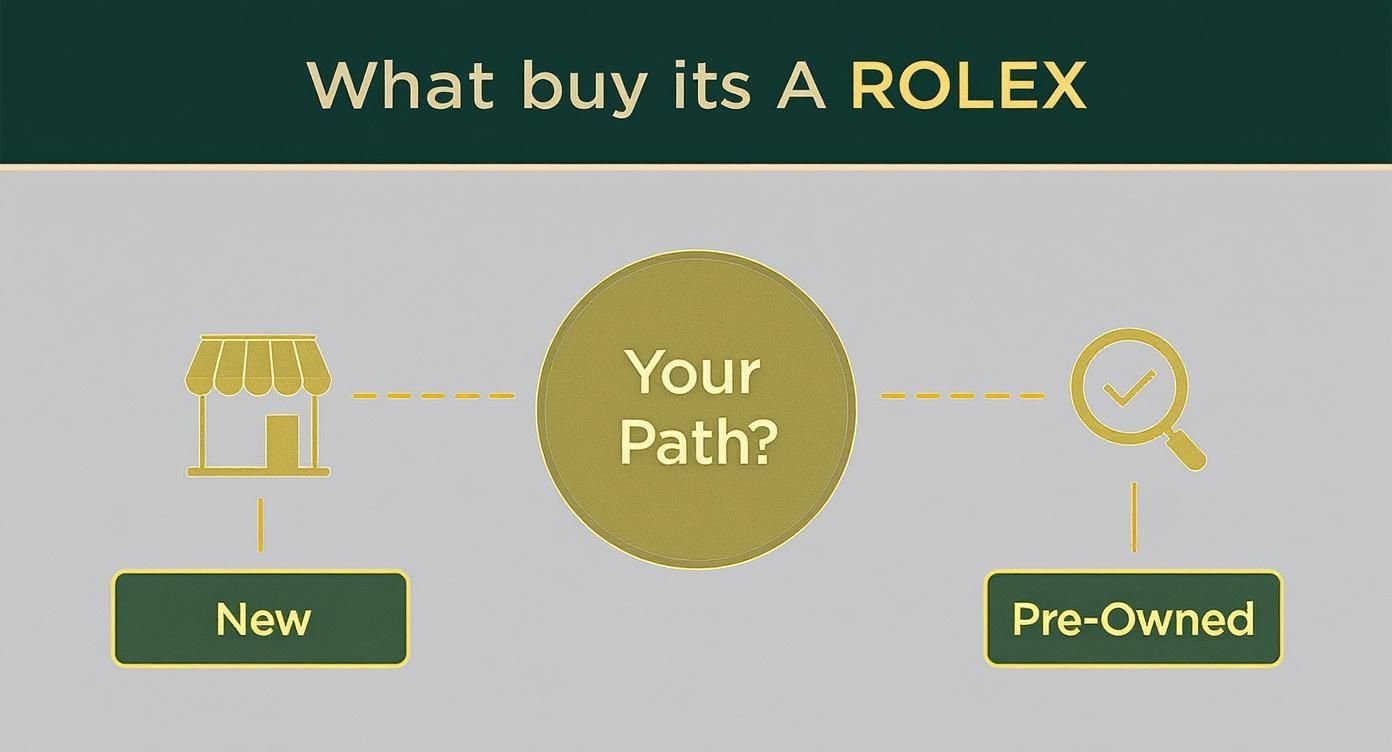
As you can see, your journey really boils down to whether you want that fresh-from-the-boutique experience or the immediate availability and broader selection that comes with going pre-owned.
Considering Materials and Comfort
Beyond the specific model, the physical feel of the watch is a huge deal. The metal, case size, and bracelet all change how it sits on your wrist day in and day out. A heavy, solid gold Day-Date on a President bracelet makes its presence known, while a sleek Oystersteel model on an Oyster bracelet can feel like it's barely there.
The best Rolex for you is one that you forget you're wearing until you need it. Comfort is just as important as aesthetics and function, especially for a watch intended for daily use.
For example, Rolex's own Oystersteel is famous for being incredibly tough and resistant to corrosion, making it perfect for an everyday piece. On the other hand, Everose gold—Rolex’s special pink gold alloy—has a warm, luxurious feel that’s perfect for making a statement. Even the bracelets matter: the five-link Jubilee is known for being incredibly comfortable and flexible, while the three-link Oyster has a sportier, more solid feel. You can dive deeper into the personalities of the most popular timepieces in our detailed guide covering different Rolex models.
The Importance of Case Size
Finally, let's talk size. Rolex cases typically run from a petite 28mm on the Lady-Datejust all the way up to a beefy 44mm for the Deepsea. Your wrist size is a starting point, but personal taste is what really matters. A 36mm case, once the standard for men, is now seen as a perfect unisex size with classic, balanced proportions.
These days, 40mm and 41mm cases have become the modern sweet spot for most sport models, giving you a strong presence without being clunky. Honestly, the only way to know for sure is to try them on. You'd be surprised how two watches with the same diameter can wear completely differently based on how the lugs are shaped. This is the last piece of the puzzle to make sure your new Rolex doesn't just fit your life, but fits your wrist perfectly.
Navigating the New Versus Pre-Owned Rolex Market
One of the first big decisions you'll make is how you'll get your Rolex. Will you chase a brand-new watch from an Authorized Dealer (AD), or dive into the exciting world of the pre-owned market? This single choice shapes everything that follows—from the price you pay to the specific models you can actually get your hands on.
Buying new has that undeniable magic. You get a perfect, factory-fresh timepiece with the full five-year international warranty. It's the purest way to own a Rolex, but it comes with a massive catch: scarcity. For the really popular steel sports models like a Submariner or GMT-Master II, the waitlists can drag on for years, and there’s no guarantee you’ll ever get the call. It's a game of patience, and it often helps to have a long-standing relationship with your dealer.
On the flip side, the pre-owned market is all about instant access. Here, you can find just about any Rolex imaginable—current models, discontinued favorites, and true vintage classics—all ready to buy today. That accessibility is its biggest advantage. It lets you sidestep the whole AD system and get the exact watch you want, right now.
The Appeal of Buying a New Rolex
The main reason people chase a new Rolex from an AD is the price. You pay the Manufacturer’s Suggested Retail Price (MSRP), plain and simple. Since many of these watches trade for way more on the open market, getting one at retail feels like hitting the jackpot. You also get the full boutique experience, official papers, and zero doubt about its authenticity.
But for most buyers, this path is a dead end. ADs save their tiny inventory for their best, long-time clients. A new customer walking in off the street has almost no chance of scoring a hot model. If you love that "unboxing" thrill and you're ready for a very, very long wait, the AD route is still worth a shot.
Why the Pre-Owned Market Dominates
Let's be honest: the pre-owned market is where the real action is. It runs on pure supply and demand, so you get a transparent view of what a watch is truly worth at any given moment. This is where you’ll find discontinued legends like the "Hulk" Submariner or vintage pieces with incredible stories behind them.
The secondary market for Rolex isn't just a place to buy watches; it's a living, breathing ecosystem that proves just how desirable this brand is. It provides access, price discovery, and liquidity that the retail network simply can't.
This is also where you’ll run into market premiums. A pre-owned stainless steel Daytona might sell for double its retail price. Why? Because far more people want one than Rolex will ever produce. While that might sound intimidating, it also shows you the incredible investment potential these watches hold. For a closer look, our guide on the value of certified pre-owned watches explains the security and benefits of this market.
The secondary market really highlights Rolex's strength as an asset. In-demand sports models like the Daytona are known to sell incredibly fast, often moving within 15-30 days. Dressier models might take a bit longer, maybe 45-90 days. Watches like the Daytona have also shown incredible resilience, bouncing back strong after market dips, as detailed in market trends on Bob's Watches.
Making the Right Choice for You
So, new or pre-owned? It all boils down to what matters most to you. Here’s how to decide:
- Immediacy: If you want your watch on your wrist this month, not in a few years, the pre-owned market is your only real choice for popular models.
- Budget: Are you willing to pay the market price to get what you want now? Or is sticking to MSRP the absolute goal, even if it means an indefinite wait?
- Model Choice: If you’re dreaming of a discontinued or vintage reference, the pre-owned market is your only option.
- Investment: The pre-owned market gives you a much clearer picture of a watch's current value and track record, which is crucial if you're looking at it as an investment.
How to Authenticate a Rolex with Confidence
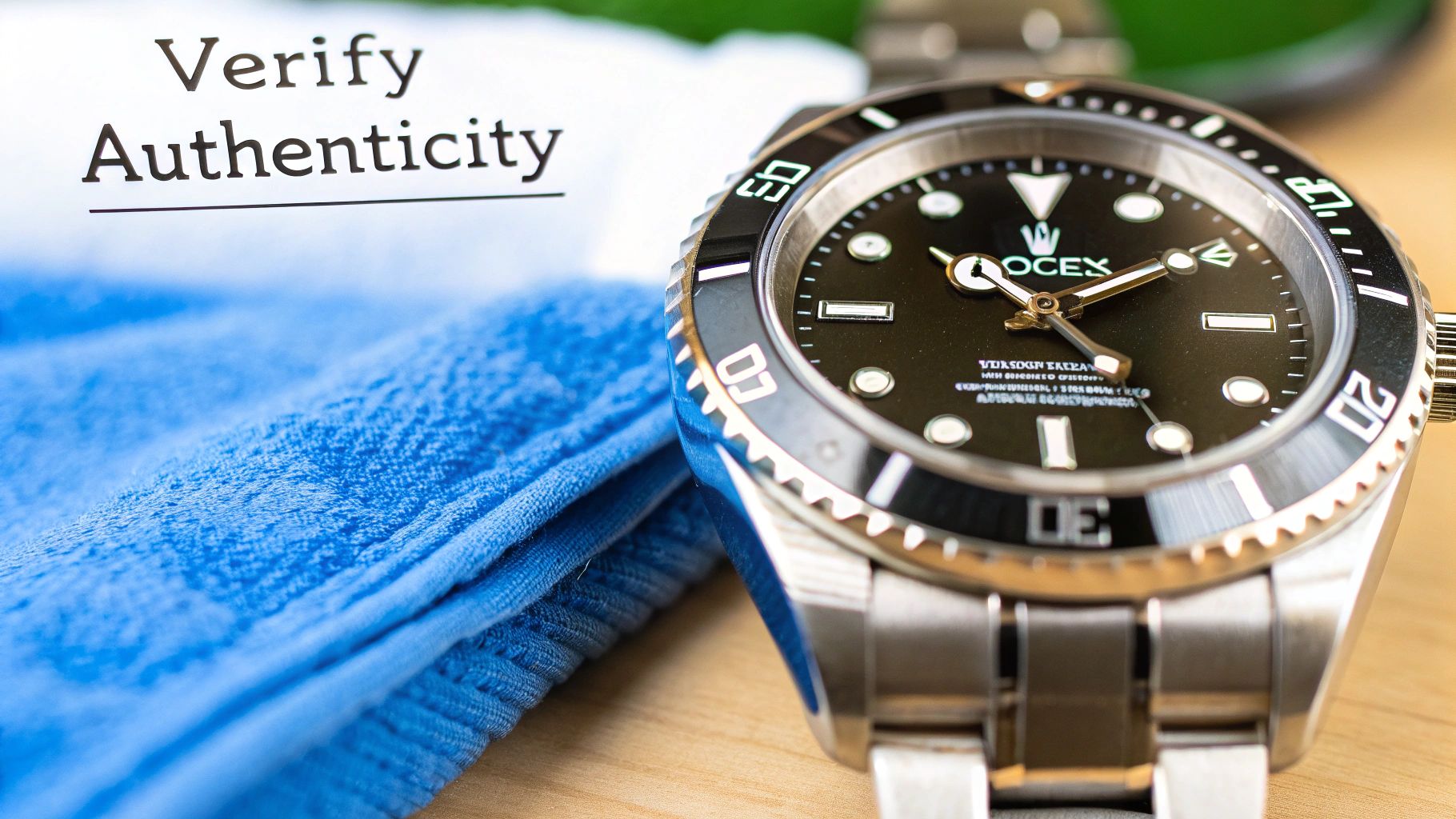
In the world of luxury watches, authenticity is non-negotiable. A real Rolex is a marvel of engineering and artistry, built to last a lifetime. A fake is just a cheap imitation, and knowing the difference is your best defense. This is your field guide to spotting a counterfeit, going beyond a quick glance to see the details that truly matter.
The truth is, counterfeiters have gotten good—scarily good. Gone are the days of obviously fake watches you could spot from across the room. Today's "superfakes" can be convincing at first, but they always fall short where it counts: perfection. Rolex's obsession with flawless execution is the very thing that makes a real one stand out, and it's where the fakes always give themselves away.
Examining the Watch's Exterior Details
Your first checkpoint is a simple visual and tactile inspection. Pick it up. A genuine Rolex feels solid and substantial in your hand. This is because Rolex uses premium materials like its proprietary 904L stainless steel or solid precious metals. Fakes often use lower-grade materials and feel noticeably lighter or flimsy in comparison.
Next, get your eyes on the dial. Every single letter, marker, and logo on a real Rolex dial is applied with razor-sharp precision. The text should be crisp and clean, with no smudging, bleeding, or fuzzy edges, even under a jeweler's loupe.
Pay close attention to the Cyclops lens over the date window. This is a classic Rolex feature, and fakes almost never get it right. A genuine lens provides a very distinct 2.5x magnification, making the date jump out and fill the entire window. Fakes usually manage a weak 1.5x magnification at best, resulting in a date that looks small, flat, or distorted. It's a huge red flag.
Verifying Serial Numbers and Engravings
Every Rolex has a unique serial number, like a fingerprint. On modern models, you'll find this number engraved on the inner bezel ring (what collectors call the "rehaut") right at the 6 o'clock position. The engraving should be deep, perfectly aligned, and immaculately finished.
Since 2002, Rolex has also included a tiny, laser-etched crown logo on the sapphire crystal, also at the 6 o’clock position. It’s almost impossible to see with the naked eye, but it’s a powerful authenticity marker that forgers struggle to replicate accurately.
If you're looking at a pre-owned watch, having the original box and papers—what the industry calls a "full set"—is a big deal. It adds significant value and another layer of confidence. The serial number on the watch must match the number on the warranty card perfectly. Any mismatch is an immediate deal-breaker. For a complete breakdown, check out our in-depth guide on how to authenticate a Rolex watch.
The Ultimate Test: A Movement Inspection
While checking the outside is a great start, the only way to be 100% certain is to look under the hood. Inspecting the movement is where all doubt is removed. An authentic Rolex caliber is an intricate work of art, beautifully finished and assembled in-house. It’s the heart of the watch.
An expert watchmaker can spot a cheap, mass-produced replica movement in a second. It's the definitive test.
So, let's recap the key verification steps, from simple to complex:
- Weight and Feel: Does the watch feel solid and dense? Cheap materials are an easy tell.
- Dial and Cyclops: Is the dial printing flawless? Does the Cyclops lens magnify the date properly at 2.5x?
- Serial and Model Numbers: Are the engravings crisp and clean? Do they match the paperwork?
- Movement Check: Has a trusted professional popped the caseback to verify the in-house Rolex caliber?
Ultimately, the best way to buy with total confidence is to work with a reputable source you trust. At ECI Jewelers, every single watch we sell comes with an ironclad guarantee of authenticity, backed by our team of professional in-house experts. That peace of mind is priceless, removing the guesswork and ensuring your investment is genuine.
Understanding Rolex Pricing and Market Value
Ever wondered why you can find a pre-owned Rolex selling for thousands more than a brand-new one at a boutique? It’s not a glitch in the market; it’s the very core of Rolex economics. The brand has masterfully built a pricing world where scarcity, desirability, and brand prestige all play a part.
Getting a handle on these dynamics is key. It’s the difference between overpaying and finding fair value, between following a fleeting trend and making a sound financial decision. Let's pull back the curtain on what truly drives the price of a Rolex.
Supply and Demand, The Rolex Way
At its heart, the value of any Rolex boils down to simple supply and demand. But here’s the thing: nobody plays this game better than Rolex. By deliberately keeping production of its hottest models—especially the stainless steel sport watches—well below what the market wants, the brand creates a level of demand that skyrockets prices.
This managed scarcity turns buying a new watch at retail into a major event. An Authorized Dealer (AD) might only get a few Submariners to sell all year, but they’ll have hundreds of people on a waiting list. Naturally, that watch’s value on the open market climbs far beyond its sticker price.
Rolex has perfected this strategy for decades. Despite making around 1.24 million watches a year, the company’s revenue keeps climbing, not because they’re making more watches, but because the average price of each watch is going up. This reinforces the brand’s exclusivity, a strategy detailed in an analysis of Rolex’s market dominance.
Factors That Influence a Rolex Watch Price
Beyond the big picture of supply and demand, a few specific factors determine a Rolex's market value on any given day.
- Model and Reference Number: Some models are just rockstars. The Daytona, GMT-Master II, and Submariner consistently fetch the biggest premiums because of their legendary status and history.
- Materials: While precious metals like gold and platinum have obvious value, it’s the Oystersteel models that often carry the largest percentage premium over their retail price. Why? Immense popularity and a more accessible starting point.
- Condition and Set: A watch in pristine condition that comes with its original box, warranty card, and booklets—known as a "full set"—will always be worth more. These pieces prove its history and are a huge draw for collectors.
- Pop Culture and Hype: All it takes is a celebrity being spotted with a certain model or the community giving a watch a cool nickname (think "Hulk" or "Batman") for demand to explode almost overnight.
Understanding the market isn’t about trying to predict the future. It’s about recognizing the stable, long-term factors that give a Rolex its value. Rarity, condition, and desirability are the three pillars that hold up its price.
Recognizing Value in the Market
So, how do you put this all together when you’re looking to buy? Don’t just stare at the price tag; ask why it's priced that way. Is a watch expensive because it's a rare reference in mint condition with a full set? Or is the seller just riding a temporary wave of market hype?
A savvy buyer learns to separate genuine, lasting value from short-term trends. By focusing on models with a proven track record and making sure you get the best example with complete documentation, you’re not just buying a watch. You're making a purchase you can enjoy today and feel good about for years to come.
Your Rolex Buying Questions Answered
Alright, you're near the finish line. As you get ready to pull the trigger on a Rolex, a few last-minute questions always seem to pop up. Getting straight answers is the key to buying with confidence, so let's tackle the most common ones we hear every day.
Think of this as your final pre-purchase checklist. Nailing down these details helps set the right expectations and ensures you’re making a smart, well-informed move—not just buying a watch, but securing an asset.
How Long Is the Waitlist for a New Rolex?
This is probably the number one question we get. The hard truth? The "waitlist" at an Authorized Dealer (AD) isn't really a list at all. It's more of an allocation system, and wait times can stretch from a few months to several years, with zero guarantees for hot models like a Daytona or a steel GMT-Master II.
ADs tend to prioritize clients with a long-standing relationship and significant purchase history. That uncertainty is exactly why so many buyers skip the frustration and turn to the pre-owned market, where the watch you want is available right now.
Does a Rolex Watch Come with an International Warranty?
Yes, and this is a huge deal. Every new Rolex comes with a five-year international guarantee that travels with the watch, not the owner. This is a game-changer for the pre-owned market. If you buy a pre-owned Rolex that's less than five years old and includes its original warranty card, that factory guarantee is still 100% valid and will be honored by Rolex anywhere in the world.
What about watches older than five years? That’s where a reputable dealer makes all the difference. A trusted seller will provide their own warranty, giving you peace of mind that your investment is protected against mechanical issues long after the original Rolex guarantee has ended.
It’s an extra layer of security that makes buying a quality pre-owned piece a completely safe bet.
Is It Better to Buy a Rolex with the Original Box and Papers?
While the watch itself is the ultimate proof of authenticity, having the original box and papers—what collectors call a "full set"—is critical for its value. The warranty card is like the watch's birth certificate; it documents its origin and sale date.
A full set dramatically boosts a Rolex's desirability and resale value. A watch with its complete paperwork can easily command a 10-20% higher price than the exact same model sold as "watch only." From an investment standpoint, buying a full set is almost always the smarter financial move for the long run.
At ECI Jewelers, we believe in clear answers and fully authenticated timepieces. Our goal is to make your buying journey transparent and seamless. Explore our curated collection of Rolex watches, where every piece is verified by our in-house experts and backed by our commitment to trust. Find your perfect Rolex today at https://www.ecijewelers.com.


