


At its core, the difference between the Rolex Daytona and the Submariner is all about purpose. The Daytona is a precision racing chronograph built to time speed down to the fraction of a second, while the Submariner is a robust professional dive watch engineered for the crushing pressures of the deep. It’s a choice between horological complexity and motorsport heritage versus rugged versatility and an aquatic legacy.
Decoding Two Rolex Legends
Picking between a Rolex Daytona and a Rolex Submariner is one of the great debates for any watch enthusiast. Each one represents the absolute peak of Rolex engineering, but they were born for completely different worlds—one on the high-octane asphalt of the racetrack, the other in the silent depths of the ocean.
Before getting into the nitty-gritty, it's crucial to understand what they were built to do. The Daytona is a highly specialized tool for measuring elapsed time with incredible accuracy, a direct nod to its motorsport roots. The Submariner, in contrast, is all about legibility and sheer durability, designed to track dive times with its signature rotating bezel and withstand immense pressure.
This graphic really boils it down to the first question you should ask yourself.
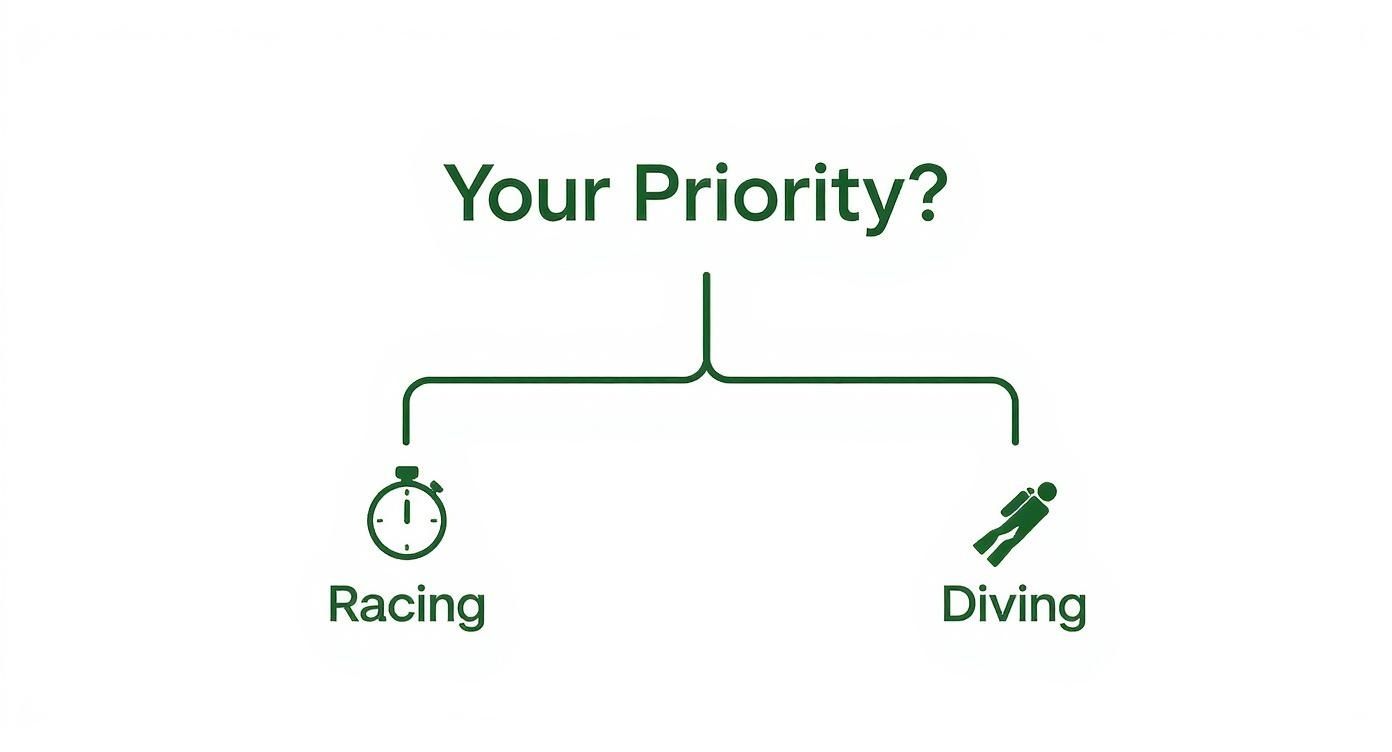
It frames the choice perfectly, putting the intended environment front and center.
Rolex Daytona vs Submariner At a Glance
To really see how these two icons stack up, a side-by-side comparison is the best way to start. This table breaks down the essential specs that give each watch its unique character and function. It’s a quick-reference guide to what truly sets them apart.
| Feature | Rolex Daytona | Rolex Submariner |
|---|---|---|
| Primary Function | Chronograph (Stopwatch) | Dive Watch |
| Bezel Type | Fixed Tachymeter Scale | Unidirectional Rotating 60-Min |
| Movement | Calibre 4131 (Chronograph) | Calibre 3230/3235 (Time/Date) |
| Typical Case Size | 40mm | 41mm |
| Water Resistance | 100 meters (330 feet) | 300 meters (1,000 feet) |
| Aesthetic | Sporty, technical, elegant | Robust, utilitarian, timeless |
| Availability | Extremely limited, high demand | More accessible than Daytona |
And for anyone interested in exploring beyond these two, our guide on different Rolex models provides a much broader look at the brand's offerings. Ultimately, the Daytona vs. Submariner question isn't about which watch is "better," but which one is better for you.
The Daytona is for the person who loves mechanical complexity and a direct link to racing history. On the other hand, the Submariner is the quintessential do-anything, go-anywhere luxury sports watch, famous for its unmatched toughness and versatility.
The Heritage of Speed and Sea
To really get into a Rolex Daytona vs Submariner comparison, you have to look past the steel and sapphire. These watches weren't just designed in a boardroom; they were forged by purpose. Each one tells a story—one born from the roar of engines on a racetrack, the other from the silent, crushing pressure of the deep ocean. Grasping this heritage is the key to understanding why they look and function so differently.
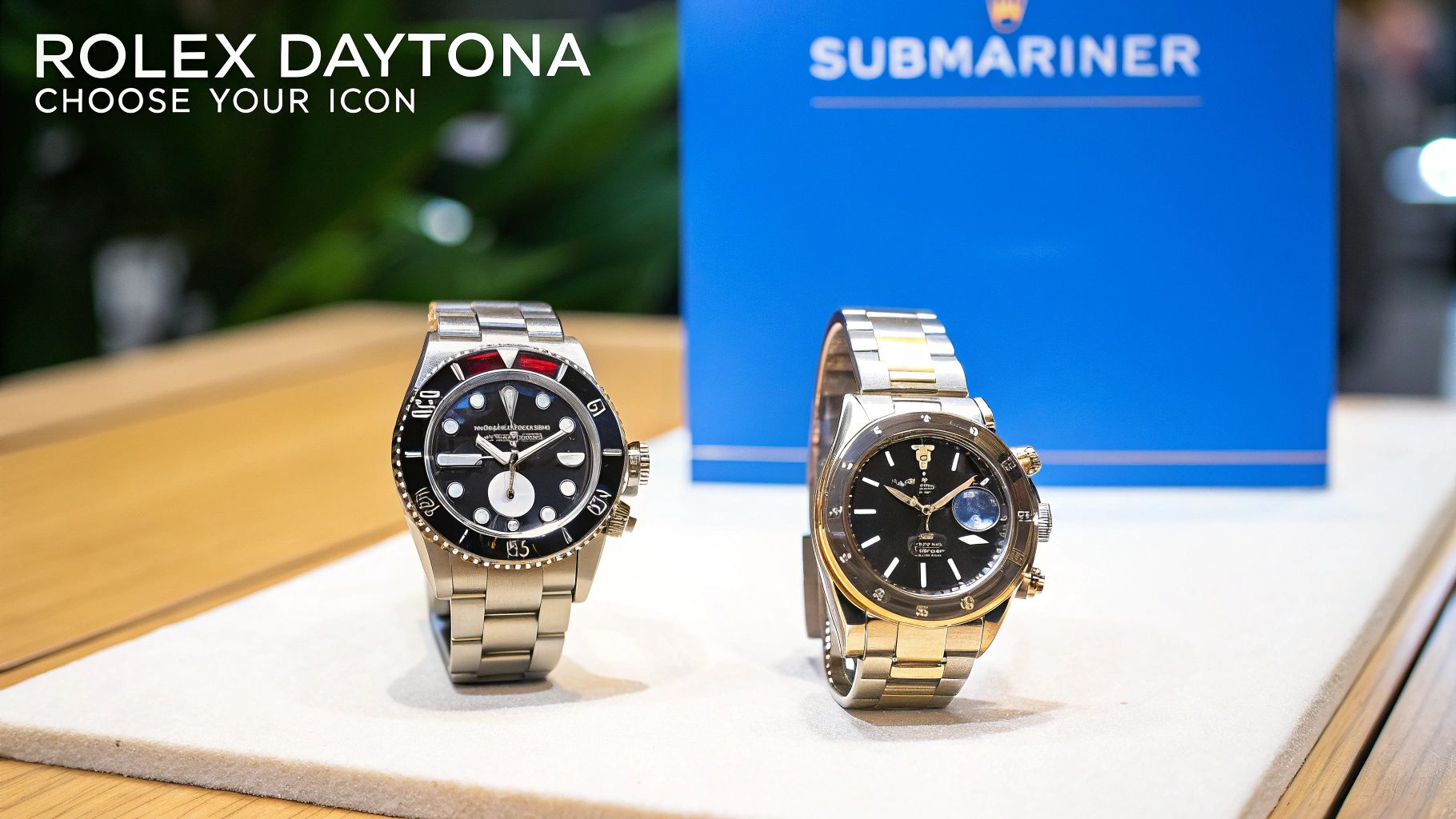
Their histories aren't just clever marketing. They directly shaped the engineering, the aesthetics, and the legacies that define them today. The Daytona is a product of speed; the Submariner is an icon of exploration.
The Daytona: A Legacy Forged in Motorsport
The story of the Cosmograph Daytona kicks off in the early 1960s, a time when auto racing was capturing the world's imagination. Rolex was already sponsoring the 24 Hours of Daytona race, and they saw a clear need for a watch built specifically for the drivers pushing cars to their absolute limits.
Launched in 1963, the Cosmograph was designed for one critical task: timing laps with pinpoint precision. Its most recognizable feature, the tachymeter scale engraved right onto the bezel, was a true functional innovation. It gave drivers a way to instantly measure their average speed over a set distance—essential data for any competitive racer. That single design choice cemented the watch's identity as a professional tool for the track.
Interestingly, the watch was a slow seller at first. Its destiny changed forever when it landed on the wrist of one of Hollywood's most legendary leading men.
Paul Newman, a serious racing driver in his own right, famously wore a reference 6239 Daytona. His connection to the watch elevated it from a niche tool to a cultural phenomenon, creating a level of demand that still drives the market today.
The "Paul Newman" Daytona, with its distinctive exotic dial, is now one of the most sought-after vintage watches on the planet. This blend of motorsport credibility and Hollywood glamour gave the Daytona a unique mystique no other Rolex chronograph has. It became a symbol not just of speed, but of effortless cool.
The Submariner: A Pioneer of the Deep
While the Daytona was making a name for itself on the racetrack, the Submariner was busy conquering a completely different frontier: the ocean. Introduced a full decade earlier in 1953, the Submariner was one of the very first wristwatches purpose-built for underwater diving. Back then, scuba was a new and dangerous field, and having reliable gear was literally a matter of life and death.
Rolex engineered the Submariner to be an indispensable tool for these pioneers. Its core design was driven entirely by necessity:
- Unmatched Water Resistance: It was initially rated to 100 meters, a massive achievement for the time that set the benchmark for all dive watches.
- Crystal-Clear Legibility: Large, luminous hour markers and hands were non-negotiable for visibility in murky, dark water.
- Critical Timing Function: The rotating bezel let divers accurately track their time underwater, a crucial function for managing their oxygen supply.
Its tough, no-nonsense build quickly earned the trust of professional divers and even military forces, including the British Royal Navy. This kind of real-world validation proved the Submariner was more than a luxury item—it was a piece of life-saving equipment.
Over the decades, as its reputation grew, the Submariner transitioned from a pure tool watch to a universal symbol of adventure and rock-solid reliability. It became the go-to watch for explorers and professionals, eventually becoming the blueprint for nearly every dive watch that followed. It’s arguably the most recognizable and influential sports watch ever made.
Comparing Movements, Bezels, and Materials
Beyond their storied histories is the brilliant engineering that truly sets the Daytona and Submariner apart. If the movement is the soul of a luxury watch—and it is—then these two follow completely different philosophies. One is a master of intricate timing, the other a champion of unwavering simplicity.
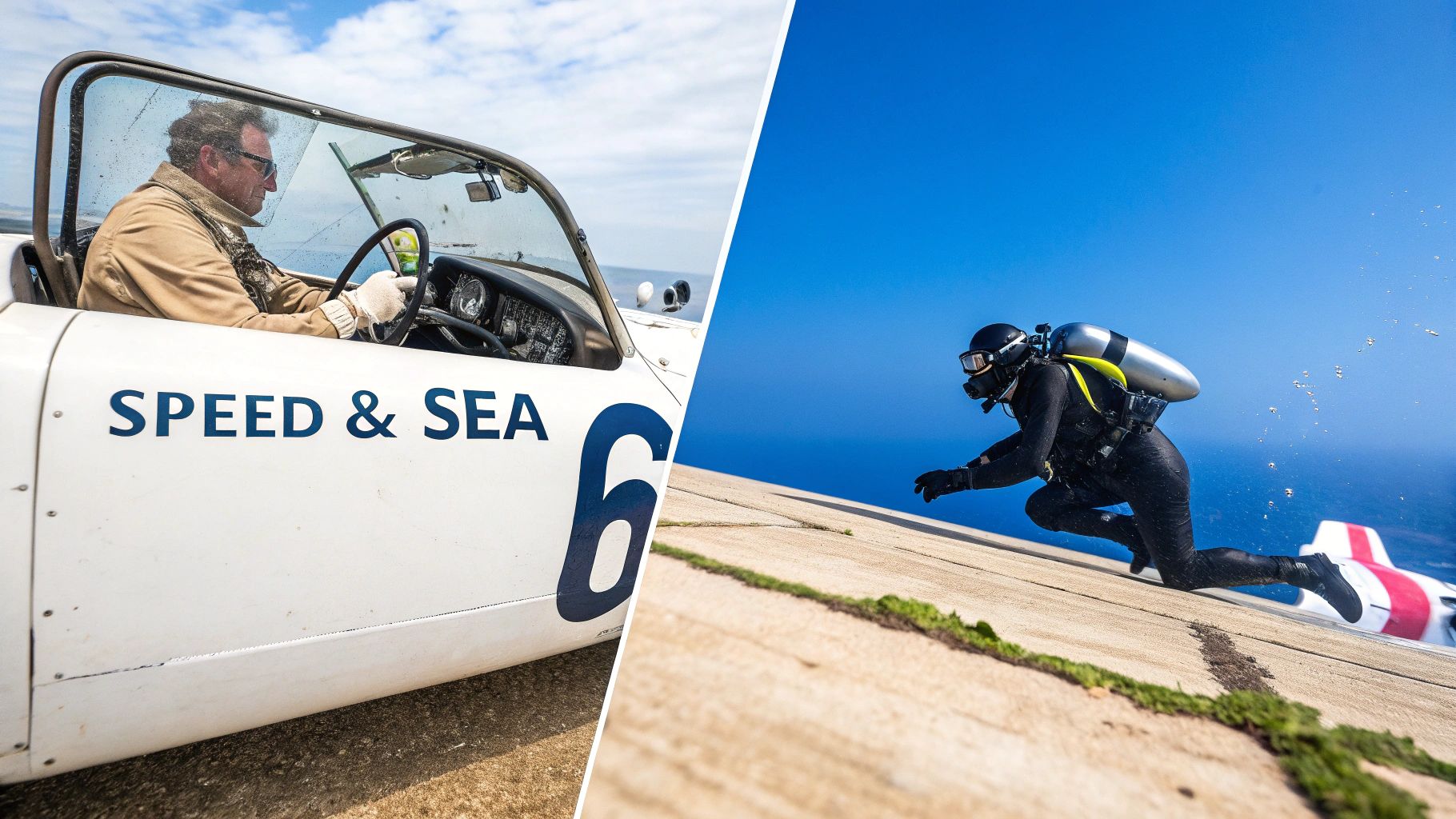
This split personality extends to their bezels and material choices, too. Each element was designed from the ground up to serve a specific, real-world purpose. Getting to know these differences is the best way to figure out which watch's engineering really speaks to you.
Horological Heart: The Calibre Comparison
Inside the Daytona beats the Calibre 4130 (and its updated successor, the 4131), a sophisticated in-house chronograph movement. This is a complex machine, built with a column wheel and vertical clutch for an incredibly smooth and precise stopwatch function. Rolex famously engineered it with fewer components than most chronographs, making it exceptionally reliable and giving it an impressive 72-hour power reserve.
The Submariner, on the other hand, runs on the Calibre 3230 (no-date) or 3235 (date). Think of these as the ultimate workhorses. They are celebrated for their sheer durability and incorporate Rolex’s Chronergy escapement for better efficiency, delivering a rock-solid 70-hour power reserve.
The practical difference is clear: The Daytona’s movement is built for interaction and precision timing, offering the intricate function of a stopwatch. The Submariner’s movement is engineered for set-it-and-forget-it reliability, prioritizing accuracy and resilience above all else.
For anyone who loves the technical side of things, exploring the nuances between different Rolex movements offers an even deeper look into the brand's incredible engineering. The Daytona and Submariner are perfect examples of how Rolex can create both highly specialized and universally dependable calibres.
Bezel Functionality: Speed vs. Safety
The bezel is probably the most obvious visual and functional split in the Daytona vs. Submariner debate. Each one is a purpose-built tool designed for a totally different world.
- Daytona's Tachymetric Scale: The Daytona has a fixed bezel engraved with a tachymeter scale. It’s not for timing laps; it’s for measuring average speed. Start the chronograph over a known distance—say, one mile on a racetrack—and you can read your average speed right off the bezel. It’s a direct nod to its motorsport roots.
- Submariner's Dive Bezel: The Submariner features a unidirectional rotating bezel with a 60-minute scale. This is a life-saving tool for divers, letting them track their time underwater with total confidence. The reason it only turns counter-clockwise is simple: an accidental bump can only shorten the perceived dive time, never extend it. That prevents a diver from misjudging their remaining oxygen.
Simply put, the Daytona's bezel measures performance, while the Submariner's ensures safety.
Case Design and Material Choices
While both watches use the iconic Oyster case, their materials and finishing cater to different tastes and price points. The Submariner is mostly found in highly corrosion-resistant Oystersteel, with options in two-tone (Rolesor) and solid yellow or white gold. Its design is classic, functional, and built to last.
The Daytona, however, comes in a much wider and more luxurious array of materials. Beyond Oystersteel, you can get it in yellow gold, white gold, Everose gold, and even the top-of-the-line 950 platinum. This broad selection positions the Daytona more firmly as a luxury-sport icon, offering something for everyone, from a pure tool watch to a high-end statement piece.
These technical differences—from the engine inside to the metals on the outside—aren’t just for show. They are the direct result of each watch's unique heritage, creating two masterpieces of engineering that are the absolute best at what they were designed to do.
Functionality for Your Real World
A luxury watch's real worth isn't just on paper; it’s about how it performs in your day-to-day life. Both the Daytona and the Submariner are masterpieces of Rolex engineering, but their core functions were born from entirely different worlds. This is where the debate shifts from specs to practical, real-world usefulness.
One watch was built to measure tiny, precise slivers of time with a complex mechanism. The other was engineered to track chunks of time with rugged, foolproof simplicity. Figuring out which of these functions actually fits your lifestyle is the key to choosing the right one. It’s not about which is "better," but which is more useful for you.
The Daytona Chronograph: More Than Just a Racetrack Tool
At its heart, the Daytona is a chronograph. Its entire purpose is to be a sophisticated stopwatch, controlled by the two pushers that flank the winding crown. And while its racing DNA is undeniable, its usefulness goes way beyond timing laps at the track.
In everyday life, that chronograph becomes a surprisingly handy tool for managing small, precise tasks. Think of it as a personal efficiency meter you wear on your wrist.
- Cooking and Grilling: Need to time a steak for that perfect medium-rare? Or get your pasta perfectly al dente? The Daytona handles it with split-second accuracy.
- Work and Productivity: It’s great for timing how long you spend on projects, managing breaks with the Pomodoro Technique, or keeping a presentation on track.
- Fitness and Training: Use it for timing rest periods between sets at the gym or clocking your run times with precision.
The Daytona’s function is interactive and hands-on. It encourages you to measure moments, turning even routine activities into an exercise in precision. It’s for the person who loves having a high-performance timing instrument ready at a moment's notice.
The Daytona measures a moment; the Submariner safeguards it. This fundamental difference in philosophy dictates their entire design, from the bezel to the water resistance rating.
For many watch lovers, the chronograph complication adds a layer of mechanical fascination that's hard to resist. It's a constant, tangible reminder of the incredible engineering ticking away right under the dial.
The Submariner Bezel: Your Everyday Companion
The Submariner’s functionality is all about its iconic unidirectional rotating bezel. It was originally created as a life-saving device for divers to track their oxygen supply, but its simple genius has made it incredibly useful for all sorts of everyday situations.
This 60-minute counter is a simple, tactile, and incredibly effective way to track elapsed time. You just spin the bezel's zero marker to line up with the minute hand, and you can instantly see how much time has passed. It's a pure analog timer—no buttons to push, just the satisfying click of the bezel.
Here are just a few real-world examples:
- Parking Meters: Set the bezel and you'll know exactly how much time you have left, helping you dodge a costly ticket.
- Meetings and Appointments: Easily track how long a meeting has been going or time your commute to the minute.
- Everyday Reminders: Use it as a quick reminder for when to pull something out of the oven or when it's time to make your next call.
The brilliance is in its simplicity. Because the bezel only turns counter-clockwise, you can never accidentally add more time—only shorten it. It's a fail-safe that translates perfectly from deep-sea diving to daily life.
Water Resistance: The Practical Differences
Beyond the timing functions, the most significant practical difference is water resistance. This is where the Submariner's tool-watch heritage really comes through.
With a depth rating of 300 meters (1,000 feet) and its Triplock screw-down crown, the Submariner is built for serious underwater action. You can take it swimming, snorkeling, and even recreational diving without a second thought. It offers a level of security that defines the modern dive watch.
The Daytona, on the other hand, has a water resistance of 100 meters (330 feet). This is perfectly fine for daily wear, protecting it from rain, washing your hands, and even a casual dip in the pool. But it isn't a dive watch, and you should never, ever operate the chronograph pushers while it's underwater.
For most people, 100 meters is more than enough protection. But if you spend a lot of time in or around the water, the Submariner’s superior rating gives you unmatched peace of mind. It’s built to handle pretty much any environment you can throw at it, making it the more robust, worry-free choice for an all-around companion.
Analyzing Investment Potential and Value
When you start talking about the Rolex Daytona versus the Submariner, the conversation always lands on how they perform as assets. Both of these watches are famous for holding their value incredibly well, but they really represent two completely different investment ideas. One is a high-growth, high-demand phenomenon; the other is a rock-solid pillar of stability.
Choosing between them from an investment angle comes down to your own financial goals and how much risk you're comfortable with. Are you looking for the explosive growth that comes with a rare, cult-status object? Or do you prefer the steady, reliable appreciation of a "blue-chip" classic? Making that distinction is key to aligning your purchase with where you want to go financially.
The Daytona: High-Growth Potential
The Rolex Daytona is, without a doubt, a giant on the secondary watch market. Its investment profile is all about scarcity and massive desirability, a combination that creates a perfect storm for rapid value appreciation. Production numbers are notoriously low, while demand—fueled by its racing history and iconic status—is just astronomical.
This imbalance makes the Daytona act more like a high-growth asset than a simple watch. We’ve seen certain references surge to market values that are multiples of their original retail price. This performance is driven by collectors and investors who see the Daytona not just as a watch, but as a trophy piece with serious upside.
Take the explosive growth of specific models as a prime example. Market analysis shows the steel and ceramic "Panda" Daytona (reference 116500LN) and the yellow gold model (reference 116508) went through incredible surges. At one point, the Panda hit an astonishing $110,000—a jump of nearly 633% from its 2016 levels. For comparison, the vintage Submariner 5512 also showed strong performance, appreciating 249% from 2014 to 2025. After a market correction, it recovered to hold 92% of its peak value, showing what experts call "blue-chip behavior."
Growth like this isn't guaranteed across every Daytona model, but it proves the watch's capacity for incredible returns. This makes it a compelling choice for anyone with a higher risk tolerance who's hunting for aggressive growth. When looking at the long-term value of any luxury watch, it helps to apply broader investment principles, like understanding intrinsic value.
The Submariner: Blue-Chip Stability
The Rolex Submariner, on the other hand, offers a different—but just as compelling—investment story. It’s the quintessential "blue-chip" asset of the watch world, known for its consistent, stable, and predictable growth over decades. It might not hit the same explosive peaks as the Daytona, but its market value is incredibly resilient, often weathering economic downturns with remarkable steadiness.
The Submariner's strength is its universal appeal and higher production numbers (relative to the Daytona, of course). It's the foundation of countless watch collections and is often the first major luxury watch purchase for new enthusiasts. This broad, constant demand creates a liquid market and a solid floor for its value.
The Submariner is less about timing the market and more about trusting it. Its value is built on a legacy of unwavering reliability, both in function and as a financial asset, making it the safer, more conservative investment choice.
This dependable performance makes the Submariner an excellent store of value. It's an asset you can buy, wear, and enjoy, all while having confidence that its worth is steadily growing in the background. For a deeper dive into what makes certain models so valuable, check out our guide on the resale value of Rolex watches.
Investment Profile Side-by-Side
To make the distinction crystal clear, here’s a direct comparison of their investment profiles. This should help you decide which path fits your financial outlook.
| Investment Factor | Rolex Daytona | Rolex Submariner |
|---|---|---|
| Growth Profile | High-growth, potential for rapid appreciation | Stable, consistent, and predictable growth |
| Risk Profile | Higher risk, more susceptible to market peaks | Lower risk, highly resilient during downturns |
| Driving Factor | Extreme scarcity and intense collector demand | Universal appeal and broad, steady demand |
| Market Behavior | Acts like a high-growth stock or rare collectible | Behaves like a blue-chip stock or stable asset |
| Ideal Investor | Seeks aggressive returns, higher risk tolerance | Prefers long-term stability and capital preservation |
At the end of the day, both watches are superb investments. Your choice in the Rolex Daytona vs Submariner debate really depends on your personal financial philosophy—the thrill of high-stakes appreciation or the security of steady, reliable growth.
So, Which Iconic Rolex Is Right for You?
When it comes down to the Rolex Daytona vs. Submariner, the choice boils down to a pretty simple question: what are you really using this watch for? There’s no winner or loser here—only the right watch for a specific person. Your decision really has to line up with your personal style, what you do every day, and how you think about watches as an investment.
One is a marvel of mechanical engineering, built for timing things to a fraction of a second. The other is a legendary piece of gear, designed for ultimate reliability and toughness. Picking the right one means matching the watch's soul to your own.
Who Is the Daytona Owner?
The Daytona is the obvious pick for someone who gets a kick out of horological complexity and loves the story behind motorsport. It's more than just a watch; it's a statement piece that says you appreciate the deep, mechanical art of watchmaking.
You’re probably a Daytona person if you are:
- The Collector: You’re captivated by rare complications and the thrill of owning something highly sought-after, especially a reference with a reputation for explosive investment growth.
- The Connoisseur: The smooth, crisp click of a chronograph pusher and the history behind a tachymeter scale are things that genuinely get you excited.
- The Style-Conscious Professional: You need a watch that looks just as good in a boardroom as it does at a rooftop bar, projecting an aura of sophisticated, sporty elegance.
Honestly, the Daytona is a conversation starter. Its owner is usually someone who geeks out on the tiny mechanical details and actually enjoys the hands-on nature of a chronograph.
The Daytona is for the individual who sees a watch as a high-performance machine. It’s an active choice, rewarding those who understand its technical genius and legendary past.
Who Is the Submariner Owner?
When it comes to pure versatility and bulletproof durability, the Submariner is the undisputed king. It’s the perfect partner for the person who wants one incredible watch that can handle absolutely anything life throws its way.
This is your watch if you are:
- The Pragmatist: You just need a watch that’s dead-reliable, easy to read, and tough as nails. It needs to perform perfectly whether you’re closing a deal or jumping off a boat.
- The Adventurer: Your life involves travel, water, and a genuine need for gear that will never, ever let you down. That 300-meter water resistance isn’t just a spec; it’s total peace of mind.
- The Understated Achiever: You lean towards a timeless, iconic look that’s recognized and respected everywhere without being loud about it. The Sub’s value is in its quiet confidence.
The Submariner is the definition of a go-anywhere, do-anything luxury watch. Its magic lies in its simple, direct functionality and its legacy as a pro-grade tool that accidentally became a global style icon. Its "blue-chip" investment profile offers a sense of security to go along with its looks, making it a cornerstone for any serious watch collection.
Your final call in the Rolex Daytona vs Submariner matchup should reflect not just what you want to wear on your wrist, but who you are.
Frequently Asked Questions
When you're weighing two icons like the Rolex Daytona and Submariner, a few common questions always pop up. Getting clear on these final details is often the last step before making a confident choice.
Which Is a Better Investment: The Daytona or Submariner?
This really comes down to your personal investment style. Think of the Daytona as a high-growth asset; its incredible rarity and white-hot demand give it massive growth potential, but with more volatility.
The Submariner, on the other hand, is the quintessential "blue-chip" stock of the watch world. It offers steadier, more predictable appreciation over time. Your decision here should mirror your own risk tolerance.
Can You Wear a Rolex Submariner with a Suit?
Absolutely. It’s one of the Submariner's best tricks. While it was born as a tough-as-nails tool watch for divers, its clean, timeless design has made it a chameleon.
It looks just as natural paired with a business suit or formal wear as it does with a t-shirt and jeans, cementing its reputation as a true go-anywhere, do-anything classic.
Why Is the Rolex Daytona So Hard to Buy?
The mystique around the Daytona comes from a perfect storm of scarcity and desire. Its legendary status, deeply tied to motorsports, creates a level of demand that is simply off the charts.
Rolex intentionally keeps production numbers low, creating a massive imbalance. The result? Insanely long waitlists, a booming secondary market, and a premium price tag that reflects its rarity.


