

The Rolex Oyster Perpetual Date 1500 is a 34 mm steel automatic with a date window, made from about 1960 to 1976 with calibers 1560/1565 and later 1570/1575. It's one of the most affordable ways into a vintage Rolex: ECI currently has two 1500s from 1970 and 1971 at $4,200 each (October 2026). Its reference number alone doesn't establish its age or originality, so we recommend judging the case, movement, dial, and bracelet together before deciding whether an example is right for you.
A convincing vintage watch needs more than an attractive dial. We'll explain what to measure, what a watchmaker should inspect, and how to distinguish original components from later replacements without treating every mismatch as a counterfeit.
In this article
- What are the Rolex 1500's specifications?
- Where does the 1500 fit in Rolex history?
- Which movement does your 1500 use?
- How do you check whether a 1500 is original?
- What condition points should you inspect?
- How much is a Rolex 1500 in 2026?
- Vintage 1500 or modern 34 mm Oyster Perpetual?
- How can you pay for it?
- Frequently asked questions
Reference 1500 Specifications at a Glance
The reference 1500 combines an Oyster case, automatic winding, and a calendar date in a compact format. The specifications below establish its basic identity, but they aren't a substitute for examining the individual watch.
The measurement baseline comes from a Chrono24 reference 1500 listing, which describes a 34 mm case measured without the crown and a documented 1978 example measuring approximately 38 mm including the crown and 42 mm lug to lug.
| Feature | Reference 1500 detail | Why it matters for buyers |
|---|---|---|
| Case diameter | 34 mm, measured without the crown | Sets wrist fit; 2 mm smaller than the 36 mm Datejust |
| Overall size | About 38 mm with crown; 42 mm lug to lug in the documented 1978 example | Lug-to-lug length helps determine whether the case extends beyond your wrist |
| Crystal | Acrylic, also called Plexiglas | Scratches more easily than sapphire but can generally be polished |
| Bezel and case | Smooth steel bezel and Oyster case on steel examples | Confirm the bezel and case material match the description |
| Crown and caseback | Screw-down | Water protection requires sound seals, threads, and crown components |
| Date display | Date window, often with a Cyclops magnifier | Check visibility, alignment, and replacement disclosures |
| Movement | Automatic, with different calibers across production | The installed caliber helps establish period consistency |
| Production run | Approximately 1960 through 1976 | A useful period window, not an exact build date for an individual watch |
| Metals | Stainless steel and precious-metal configurations | Have a specialist reconcile material markings with the listing |
Lug to lug means the distance between the outer tips of the case's upper and lower lugs, where the bracelet attaches. Compare that dimension with a watch you already wear comfortably, rather than judging fit from diameter alone.
Ask whether the seller measured with calipers, included the crown, or rounded the result. Small differences in measurement don't automatically mean the watch has the wrong case.
Where the Reference 1500 Fits in Rolex History
The Oyster Perpetual Date family came first; the reference followed later. Phillips places the family's catalog introduction in 1955, the replacement of reference 6534 by reference 1500 in 1960, and production at approximately 1960 through 1976, or about 16 years.
That distinction matters when reading model histories. A family introduction date isn't necessarily the launch date of every reference within it.

Why the production period matters
Rolex offered different metals, dials, and components during the reference's lifespan. Think of it as a family of related watches, not one fixed specification sheet.
Say you're comparing an early example with a later one. Different movement details or bracelet construction may be appropriate for each, rather than evidence that one is wrong.
Practical rule: Compare a vintage watch with documented examples from its own period, not simply with another watch carrying the same reference.
Published production dates are useful boundaries, but component transitions don't always follow a clean calendar cutoff. Our overview of vintage Rolex watches offers broader context for evaluating age, condition, and ownership priorities.
Which Movement Your 1500 Uses and What It Means
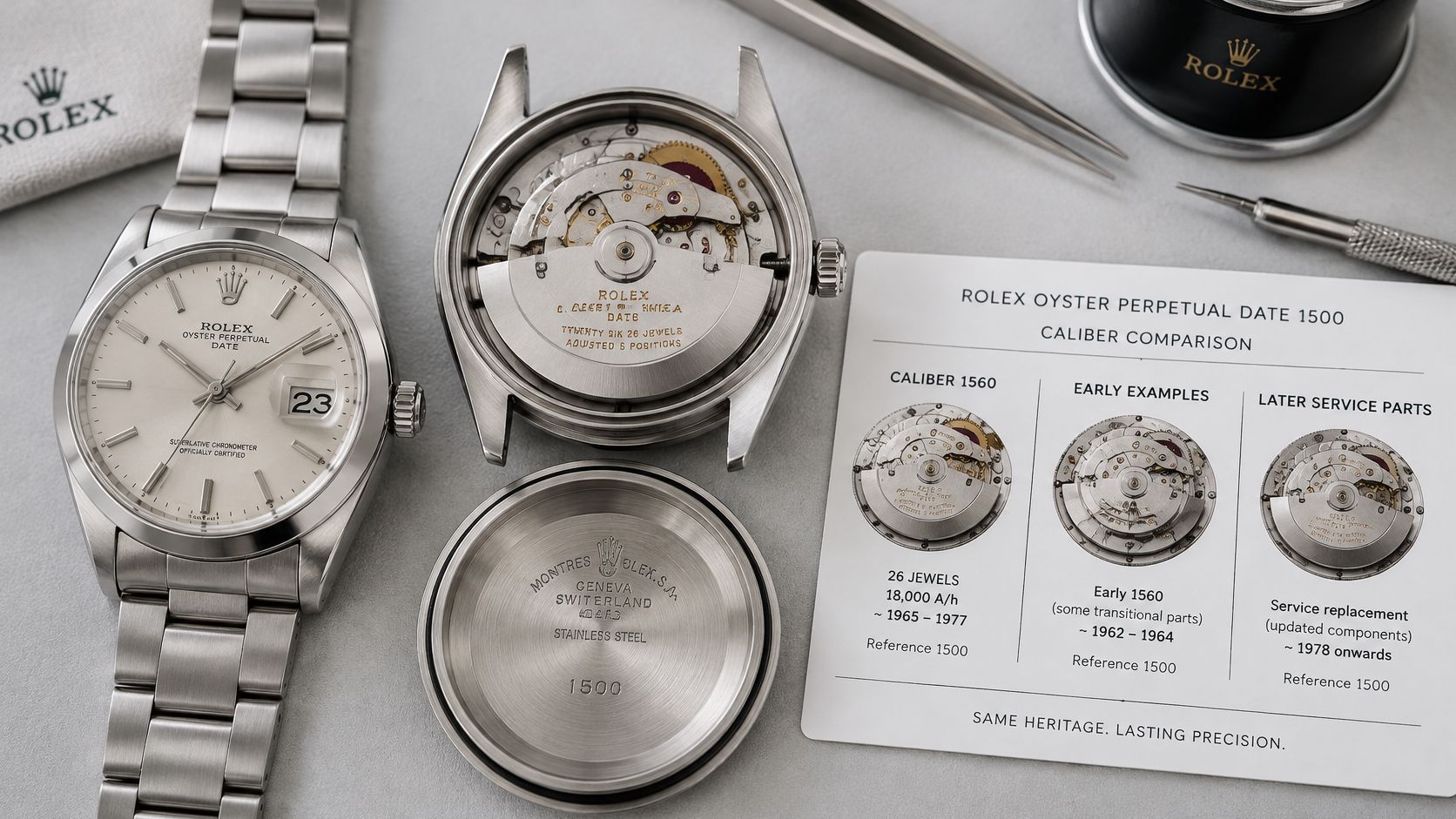
Two reference 1500s can sit side by side, look identical on the wrist, and run different movements inside. The caliber, meaning the movement's identifying model designation, is what separates them. Have a qualified watchmaker open the watch and record its markings, since the dial alone cannot tell you which mechanism sits underneath.
Collector Square's reference overview associates earlier watches with calibers 1560 or 1565 and later watches with 1570-based or 1575 date movements. The same overview gives the 1565 approximately 18,000 vibrations per hour and 42 hours of reserve, versus 19,800 vibrations per hour and about 48 hours for the 1575.
| Caliber | Typical era | Beat rate | Power reserve | Identifying notes |
|---|---|---|---|---|
| 1560 | Early examples | About 18,000 vph | About 42 hours, the figure cited for the earlier family | Cited for early watches |
| 1565 | Earlier examples | About 18,000 vph | Date-equipped caliber cited for earlier watches | |
| 1570 | Later examples; specialist transition estimate around 1965 | 19,800 vph | About 48 hours, the figure cited for the later family | Chronometer-rated; non-quickset date documented on some examples |
| 1575 | Later examples | 19,800 vph | 28.2 mm automatic movement, 25 jewels, instantaneous midnight date change |
A disassembled example shows why external photographs settle nothing about the installed movement.
What the specifications mean
Beat rate works like the graduations on a ruler: 19,800 vibrations per hour divides each second into smaller slices than 18,000, which can produce smoother seconds-hand motion. A worn or poorly regulated movement can still keep poor time at the higher rate.
Published descriptions do not agree on every detail. Chronocheck places the family transition around 1965 and describes 26 jewels, while the date-caliber figures above specify 25 jewels. Treat those as different documented configurations, and compare each watch against the configuration claimed for it.
Jewels are wear-resistant bearings inside the movement. A count matters only when it matches the mechanism the watch should contain, so record what is fitted rather than assuming a higher number means a better watch.
Our guide to different Rolex movements explains how movement families differ from the complications built on them.
What to ask a watchmaker to test
- Identify the mechanism. Request clear photographs of the caliber engravings, including any date-movement designation.
- Observe the calendar. Advance the hands through midnight and confirm the date completes its change cleanly. The 1575 family is documented with an instantaneous midnight change.
- Measure performance. Ask for timegrapher readings in several positions. Rate measures how fast or slow the watch runs; amplitude describes the balance wheel's swing.
A watchmaker should weigh those readings alongside lubrication, magnetization, and service condition. A correct caliber confirms the movement fits the claimed period, while the dial, hands, case, and bracelet remain separate questions of originality.
The accompanying video provides additional visual context for the mechanism.
How to Check Whether a 1500 Is Original or Replaced
A vintage watch can contain components of different ages. We separate three questions: Is the component genuine, is it appropriate to the period, and is there evidence it left the factory with this particular watch?
Those aren't interchangeable judgments. A genuine service replacement may be suitable for daily wear without satisfying a collector seeking an untouched example.
Build a dated verification record
- Start with the case identity. Record the serial number and any inside-caseback date code. Have a specialist compare them with the proposed production period, recognizing that a caseback code isn't necessarily the final assembly date.
- Confirm the installed movement against the claimed era. Ask for photographs rather than accepting a caliber name copied from a generic model description.
- Examine the dial and hands together. Compare typography, minute-track printing, luminous material, and hand style with documented period examples. Matching discoloration alone doesn't establish originality.
- Reconcile the case reference and material markings with the description. Unclear stamps need investigation, not an optimistic interpretation.
- Date the bracelet separately. Record its reference, clasp markings, and end-link identification. End links are the shaped pieces joining the bracelet to the case.
- Treat certificates and service records as supporting evidence. Check that their identifying details correspond to the watch.
Work through those clues together, not one at a time. Our Rolex serial number lookup helps you check the serial against the claimed production period.

What mismatched dates can mean
The Hodinkee reference documentation includes a 1965 watch with an Oyster bracelet dated 1983, alongside a 1974 example measuring 35 mm with caliber 1570, case stamp 1500, bracelet 7835/19, and end link 357.
These examples show why a bracelet date or slightly different case measurement can't settle the whole identification. A later genuine bracelet isn't automatically counterfeit, but it should be disclosed rather than described as original without evidence.
Ask for a component-by-component explanation, not just a single production-year estimate.
Our guide to checking whether a Rolex is real provides additional context. For a vintage purchase, the most useful conclusion identifies what's original, what's period-correct, and what's a later replacement.
Condition Points to Inspect on a Vintage 1500
Condition affects both collectibility and the practicality of wearing the watch. We recommend inspecting under diffuse light first, then using a loupe to examine edges, printing, corrosion, and wear.
The Chrono24 reference description identifies acrylic crystal construction and cautions that water protection depends on seals, crown condition, and service history. Acrylic can generally be polished, but polishing doesn't repair cracks or restore an incorrectly fitted crystal.
| Area | What to check | Warning sign |
|---|---|---|
| Crystal | Surface marks, edge shape, clarity, and replacement history | Heavy polishing marks, distortion, cracks, or unexplained replacement |
| Case and bezel | Lug edges, bezel edges, and symmetry | Dented lugs or case lines softened by buffing |
| Crown and caseback | Screw-down engagement and thread condition | Crown won't seat or threads show cross-threading |
| Date mechanism | Calendar operation and correction method | Incomplete change, persistent mistiming, or inability to correct |
| Water resistance | Seals, service records, and a current pressure test | Protection claimed without test evidence |
| Bracelet | Link articulation, pin wear, clasp security, and end-link fit | Excessive looseness or worn attachment points |
| Dial and lume | Spotting, printing, luminous material, and consistency with the era | Refinishing clues or unexplained inconsistencies |
Calendar operation and daily care
Don't force the crown in search of a quickset position. EveryWatch's documented example has a non-quickset calendar, requiring the hands to pass through a full 24-hour cycle to advance the date.
Have the watchmaker demonstrate the correct procedure for the installed movement. Stop if you feel grinding, binding, or unusual resistance.
For a watch fitted to leather, keep cleaning moisture away from the case and strap attachments. Evo Dyne Products' guide to safe methods for cleaning leather straps is a useful care resource; suede and finished leather need different treatment.
Before wearing it in water: A screw-down crown isn't proof that an older watch is watertight. Request a pressure test and follow the watchmaker's recommendations.
How Much Is a Rolex 1500 in 2026?
Condition, originality and papers drive the price more than the year. At ECI, our two steel 1500s from 1970 and 1971, both with silver index dials and Oyster bracelets, are $4,200 each (October 2026). That makes the 1500 one of the lowest-cost ways into a vintage Rolex with a date. Browse more options in our watches under $5,000 and Rolex Oyster Perpetual collections.
34 mm · Stainless Steel · 1971
Rolex 1500 Oyster Perpetual Date, Silver Index Dial
Smooth bezel, Oyster bracelet.
$4,200
View the watch →
34 mm · Stainless Steel · 1970
Rolex 1500 Oyster Perpetual Date, Silver Index Dial
Smooth bezel, Oyster bracelet.
$4,200
View the watch →
Budget for a service if the watch has no recent records. A $4,200 watch that needs a full overhaul can cost more in total than a slightly pricier one that has just been serviced, so ask about service history before comparing prices.
Choosing a Vintage 1500 or a Modern 34 mm Oyster Perpetual
The decision starts with the date display. The vintage Date carries a calendar; the modern Oyster Perpetual is time-only, so these are not older and newer versions of an identical watch.
Weigh fit, ownership expectations, and how much period correctness matters to you. A collector and an everyday wearer may reasonably choose different examples.
Which watch suits your wrist and routine?
Try the watch on with the bracelet adjusted, if possible. A loose bracelet lets the case slide and can make an otherwise suitable watch feel awkward.
- Choose vintage character if you enjoy acrylic crystal profiles, older dial treatments, and the process of establishing a watch's history.
- Choose simpler ownership if you prefer a more recent watch with fewer decades of potential component changes.
- Prioritize serviceability if you intend to wear it regularly. A disclosed replacement crystal may be more practical than a damaged original.
- Prioritize documentation if period correctness matters most. Detailed photographs and a component record tell you more than broad claims about rarity.
Don't reject every serviced watch, and don't assume every untouched watch is ready to wear. Ask what work was performed, which parts were changed, and whether supporting records are available.
How should you think about value?
Well-preserved examples can attract buyers because of Rolex demand and the limited supply of convincingly documented vintage watches. That does not mean every example will hold its purchase price.
Condition, originality, service needs, and the price you pay all matter. Budget for an assessment and possibly a service before regular wear, especially when the maintenance history is incomplete.
A modern alternative at ECI Jewelers
We offer the Rolex Oyster Perpetual as a time-only watch with an Oyster case, Oyster bracelet, and simple dial layout. A modern 124200 costs about twice as much as a vintage 1500 but comes with a sapphire crystal, current movement and box and papers. Our in-stock examples are the 124200 Oyster Perpetual 34 mm with a pink index dial from 2022 at $8,900 and the 124200 with a pistachio dial from 2025 at $9,500 (October 2026).

34 mm · Oystersteel · 2022
Rolex 124200 Oyster Perpetual 34, Pink Dial
Smooth bezel, Oyster bracelet, box and papers.
$8,900
View the watch →
See each product page for current photographs, price, and availability, and ask us to confirm the details of any watch before you buy.
Whether you choose a reference 1500 or a modern 34 mm, the watch in front of you should match its description, its photographs, and its paperwork.
How can you pay for it?
Customers can explore financing through Affirm, Synchrony, Acima, and Snap Finance, with approval and terms set by each provider. Our flexible financing and leasing options explain the available routes.
Read the provider's payment schedule, interest or leasing charges, and total repayment terms before applying. Those terms come from the provider, not from a general description of financing.
Our explanation of whether you can finance a Rolex watch can help you prepare questions. Keep a separate allowance for any vintage-watch assessment or service rather than committing your entire budget to the purchase.
Customers can also trade in a luxury watch. That page explains the steps; trade-ins apply to watches only, and an offer amount shouldn't be assumed before evaluation.
Frequently asked questions
How much is a Rolex 1500 worth?
At ECI in October 2026, steel 1500s from 1970 and 1971 with silver index dials are $4,200 each. Prices vary with dial originality, condition, service history and whether box and papers are included.
Is the reference 1500 still in production?
No. It's a discontinued vintage reference, so you're shopping for a pre-owned watch rather than a newly manufactured example.
What caliber does a 1500 use?
The installed caliber reflects its production period and potentially its service history. Have a watchmaker identify it directly, then assess whether it makes sense alongside the case and other components.
How do I know which size fits my wrist?
Compare the case's lug-to-lug span with the flat portion of your wrist and with a watch you already enjoy wearing. Bracelet adjustment and case thickness also affect comfort, so diameter alone doesn't settle the choice.
Is a mismatched bracelet a sign of a fake?
Not automatically. A genuine replacement bracelet can be a reasonable service change, but the seller should distinguish it from one claimed to be original to the watch.
Can a vintage Date work as part of a matching pair?
Yes, provided both wearers like the proportions and understand the ownership requirements. Our guide to his and hers Rolex watches explains how to coordinate watches without requiring identical references.
Find Your Vintage Rolex Date
Compare vintage and modern Oyster Perpetual watches by reference, condition and service history, online or at our NYC showroom.
Shop Oyster Perpetual →Or see watches under $5,000.
Prices shown are as of October 2026. At ECI Jewelers, we offer pre-owned luxury watches and personal guidance online and in our New York City showroom. Visit ECI Jewelers to discuss a vintage Rolex Date or compare Oyster Perpetual options, with attention to fit, condition, and the details that matter to you. Each pre-owned watch is one of a kind.


