


So, you're wondering what it'll cost to get your Rolex serviced. It's one of the most common questions we get, and the honest answer is: it depends.
Think of it like taking a high-performance car to the shop. An oil change is one thing, but a full engine rebuild is a completely different conversation. A standard Rolex repair cost for a routine service usually lands somewhere between $800 and $1,200. But that's just the starting line. The final bill can easily climb depending on your watch's model, its age, and what the watchmaker finds once they get under the hood.
Your Rolex Repair Cost at a Glance
Knowing the potential investment to keep your timepiece running perfectly is just part of being a responsible owner. The price spectrum for a Rolex service is wide, covering everything from a basic overhaul to a full-blown restoration that might involve tracking down rare parts or working with precious metals.
This quick overview will give you a clear financial snapshot. Once you have the baseline numbers in mind, you can better understand all the little things that can affect the final quote, which we’ll get into next. It’s all about setting realistic expectations so you can make the best decision for your watch.
To give you a clearer picture, here’s a quick breakdown of what you can generally expect to pay for different levels of service.
Estimated Rolex Service Costs at a Glance
| Service Level | Typical Cost Range (USD) | Common Services Included |
|---|---|---|
| Basic Overhaul | $800 – $1,200 | Movement disassembly, cleaning, lubrication, reassembly, gasket replacement, water-resistance test. |
| Vintage Service | $1,500+ | Basic overhaul plus sourcing of rare or period-correct parts (e.g., dial, hands, bezel). |
| Complex Chronograph | $1,300 – $2,500+ | Overhaul of intricate movements (like a Daytona), plus replacement of worn chronograph components. |
Keep in mind, these are estimates. The true cost becomes clear only after a detailed inspection by a qualified watchmaker.
Establishing a Baseline Cost
The most common procedure your watch will undergo is a full overhaul, which is a deep, meticulous process designed to bring it back to factory specs. Most independent experts and official centers agree that a standard service typically runs between $800 and $1,200.
If you go directly to an official Rolex Service Center (RSC) in a major city like New York or Dallas, their base prices often start at $700 for a simple time-only watch and $750 for models with a date function. You can discover more insights about Rolex service pricing and what it covers.
This baseline price almost always includes the complete disassembly, ultrasonic cleaning, precise lubrication, and careful reassembly of the movement. It also covers replacing gaskets and pressure testing to ensure it's still water-resistant.
Here’s the key takeaway: The initial quote for a standard service is just the foundation. The real cost is only revealed after a watchmaker opens it up and sees if any parts need to be replaced. Those parts are always billed separately.
Common Cost Scenarios
To see how this plays out in the real world, let's walk through a few common examples:
-
A Modern Submariner (5-10 years old): If you've worn it regularly but taken good care of it, it probably just needs a standard movement overhaul. Your cost will likely stick close to that $800–$1,100 base price.
-
A Vintage Datejust (30+ years old): This is where things can get interesting. A watch this old might need more than an overhaul; it could require sourcing rare, period-correct parts. The bill could easily climb to $1,500 or more.
-
A Complex Daytona Chronograph: Because of its incredibly intricate movement, the starting price for a Daytona service is always higher, usually beginning around $1,300. If any of the chronograph components are worn out and need replacing, the final total could push $2,500.
As you can see, the specific model and its age have a huge impact on the final Rolex repair cost, quickly turning a straightforward service into a much more significant investment.
Key Factors That Drive Your Service Pricing
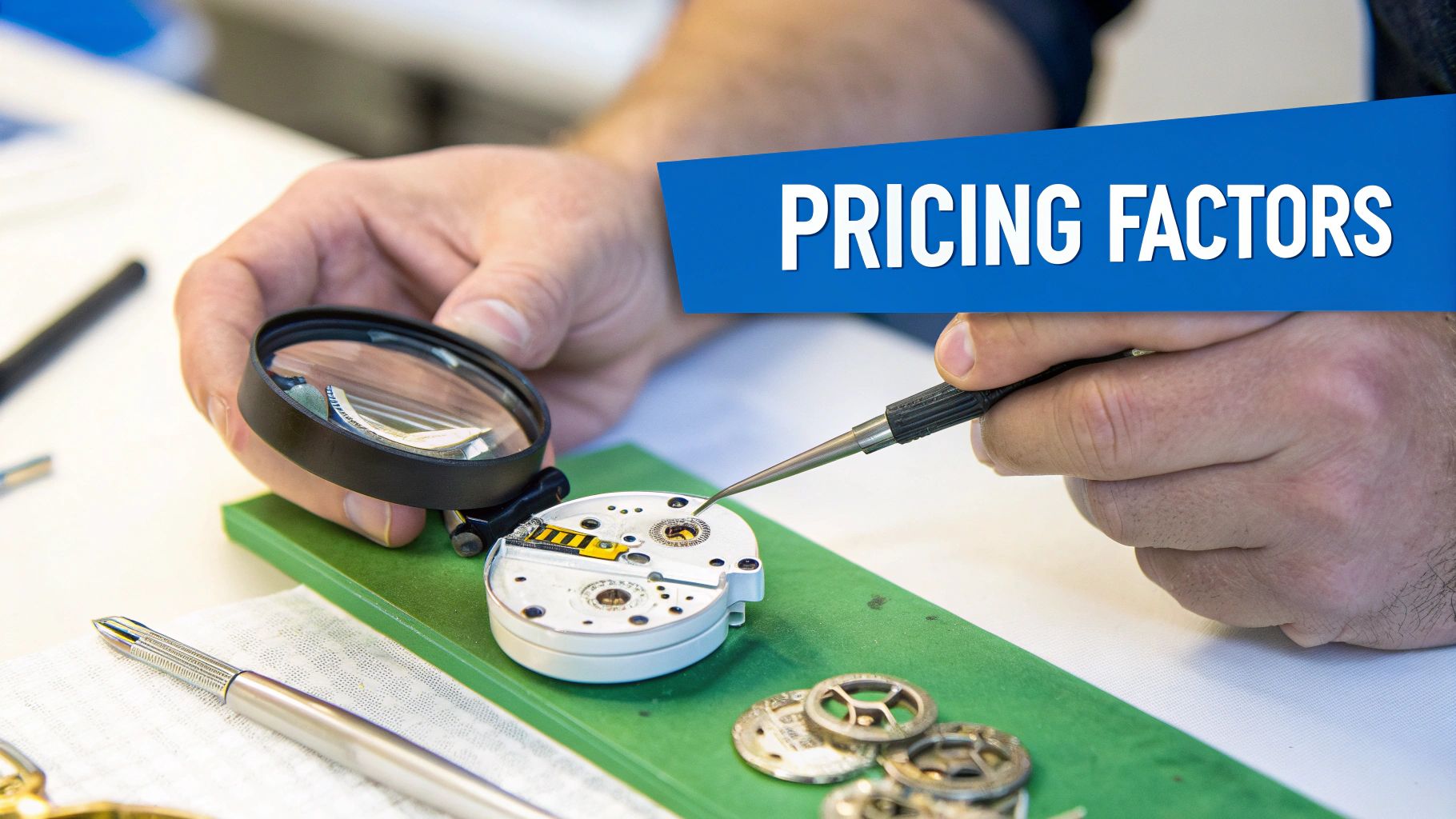
So you've seen the baseline estimates, but why does one Rolex overhaul cost so much more than another? The final bill tells the story of your specific watch—its model, its history, and its current condition. Understanding these variables is the key to making sense of any service quote.
Think of it like this: servicing a Toyota Camry is predictable. Servicing a vintage Ferrari, on the other hand, requires a specialist, rare parts, and a lot more labor. The same idea applies to Rolex. A straightforward, time-only Oyster Perpetual is a completely different beast than a Daytona with its complex chronograph, and the service price will absolutely reflect that.
Model and Mechanical Complexity
The single biggest driver of your service cost is the watch's model, which determines how complicated its movement is. A movement with more features, or "complications," simply takes more time, skill, and specialized tools to take apart, clean, and perfectly calibrate.
A standard Datejust, for example, has a relatively direct movement. But a GMT-Master II adds a 24-hour hand and a mechanism to track a second time zone. That adds layers of complexity, which means more work for the watchmaker.
Here’s a quick breakdown:
- Simple Models: Watches like the Oyster Perpetual and Datejust have the most straightforward movements, making their service the most affordable starting point.
- Professional Models: A Submariner or Explorer II has more robust parts and needs rigorous water-resistance testing, pushing the base service cost up a bit.
- Highly Complex Models: The Daytona, with its chronograph, and the Sky-Dweller, with its annual calendar, are at the top of the pricing pyramid. These movements are packed with hundreds of tiny, interacting parts that demand an expert's touch.
Age and Rarity of the Timepiece
Just like with a classic car, the age of your Rolex heavily influences the service cost, especially for vintage models (think pre-1990s). Servicing a vintage watch isn't just a technical job; it's an act of preservation.
Older watches often need parts that Rolex stopped making years ago. Hunting down these period-correct components can be a global scavenger hunt, adding to the final price. In some cases, if an original part is nowhere to be found, it might need to be custom-fabricated—a highly skilled and costly task.
A critical point for vintage owners: preserving originality is everything. An official service center might insist on replacing an old, patinated dial with a modern one, which can crush a collector's value. A skilled independent watchmaker, however, will work to save those original components.
Necessary Component Replacements
Beyond the movement overhaul, the condition of your watch’s other parts will affect your final Rolex repair cost. The initial quote covers the labor for the service, but any worn-out parts are an extra expense.
These replacements are only ever recommended after a watchmaker has done a full diagnosis. Common parts that often need replacing include:
- The Crystal: A scratched or chipped sapphire crystal isn't just ugly; it compromises the watch's water resistance.
- The Crown and Tube: The winding crown and the tube it screws onto are your first line of defense against water. Their seals wear down over time and are a very common replacement item.
- The Bracelet: Links can stretch and the clasp can wear out after years of being on your wrist every day.
- The Dial and Hands: On older watches, the lume can degrade, or the dial might show signs of moisture damage from a past failure.
Each of these adds to the total, turning a standard service into a more involved restoration. A trustworthy quote will always itemize these parts for your approval before any work begins. This gives you full control over the final cost, with no surprises.
Unpacking the Hidden Costs of Component Replacements
A standard movement overhaul is the foundation of any Rolex service, but it’s the unexpected need for replacement parts that can dramatically spike your final Rolex repair cost. It’s kind of like renovating a house: you budget for fresh paint and new floors, but finding out the entire electrical system needs replacing is a whole different financial ballgame. The same thing can happen with your watch.
The labor for a full overhaul is fairly predictable. The real variable is the cost of individual components, which can turn a routine service into a major restoration. We're not talking about generic parts here; these are high-precision components, engineered by Rolex to microscopic tolerances, and their prices reflect that level of craftsmanship.
This is exactly where an initial estimate can shift. After a detailed diagnostic, a watchmaker might find a micro-fracture in the sapphire crystal or discover the bracelet clasp is worn beyond safe repair. Each of these necessary replacements gets itemized on your final quote, and understanding what they might cost upfront helps you manage expectations.
Common Replacement Parts and Their Costs
Let's break down the prices on some of the most frequently replaced components. These are often non-negotiable replacements needed to restore your watch's look, function, and especially its water resistance.
- Sapphire Crystal: This is your watch's shield against the world. A new crystal, often needed due to scratches or chips, will typically add $300 to $600 to the bill.
- Crown and Tube: The winding crown and its tube are vital for keeping moisture out. Their seals naturally degrade over time with every wind and time adjustment. Replacing them usually runs between $150 and $350.
- Dial and Hands: If a watch has suffered moisture damage in the past or is a vintage piece showing its age, the dial and hands may need replacing. This is a bigger job, with costs from $500 to over $1,500 depending on the model's rarity.
- Bezel Assembly: A dinged-up or heavily scratched bezel, especially on a professional model like a Submariner or GMT-Master, can be a pricey fix. A replacement can cost anywhere from $400 to over $2,000 for the newer ceramic versions.
These numbers really show why being proactive with maintenance is so important. Catching a failing gasket early can save you from having to replace a much more expensive dial later on.
The High Cost of Precious Metals and Movements
The material your watch is made from plays a massive role in replacement part costs. A component in stainless steel is one price; the exact same part in gold or platinum is in another league entirely.
For example, a single link for a steel Oyster bracelet might be around $100. That same link in 18k yellow gold could easily be $500 or more. A full replacement bracelet in a precious metal can run into the thousands, sometimes becoming a huge fraction of the watch's original price.
But the biggest potential hidden cost lies deep inside the watch—the movement. A standard service handles normal wear and tear, but severe damage from a major drop or years of neglect can require an extensive rebuild of the movement itself.
When key internal components like gears or springs have to be replaced, the cost can jump dramatically, often landing between $1,200 and $3,000. This makes it one of the most expensive parts of any Rolex restoration. The incredible complexity of these tiny engines is why their repair demands such a high level of skill. You can learn more about the different Rolex movements in our detailed guide.
Choosing Your Service Provider
Deciding where to get your Rolex serviced is one of the biggest calls you'll make as an owner. This isn't just about fixing a watch; it's about trusting someone with a valuable, often sentimental, piece of engineering. Your two main paths are an official Rolex Service Center (RSC) or a highly skilled independent watchmaker.
Think of it like choosing a mechanic for a prized classic car. The dealership offers a factory guarantee but often comes with a premium price tag and rigid, by-the-book procedures. On the other hand, a trusted local specialist might give you more personalized service, a quicker turnaround, and potentially save you a good chunk of change. Neither is automatically better—it all boils down to your priorities.
The Official Rolex Service Center Experience
Going straight to an RSC is the manufacturer's approved route, and its biggest draw is the promise of 100% authenticity. Every single part used is a genuine Rolex component, and the work is backed by a two-year international service warranty. For many owners, that peace of mind is priceless.
RSCs follow Rolex's famously strict procedures to the letter, ensuring your watch is brought back to its original factory specifications. But this rigidity can be a double-edged sword, especially for vintage collectors. An RSC might insist on replacing a beautifully faded, patinated dial with a modern service dial—a move that can strip a collector's piece of its unique character and hurt its value.
The Independent Watchmaker Advantage
A top-tier independent specialist offers a compelling alternative built on flexibility, expertise, and value. These are often master watchmakers with decades of hands-on experience who can walk you through your options and explain the "why" behind every recommendation.
The most significant advantage is often the Rolex repair cost. Official Rolex Service Centers are known for their premium rates. In contrast, an independent certified watchmaker can provide the same level of meticulous service, sometimes at a fraction of the cost. For example, some independents offer fixed rates around $395 for a full overhaul (plus parts), which can easily represent a savings of 50% or more compared to official channels.
Independents are also far more likely to share a collector's mindset. They understand the value of originality and will go the extra mile to save and restore original components rather than simply replacing them. Of course, reputation is everything. It's vital to ensure any independent you choose is vetted and trustworthy. Our guide on how to authenticate a Rolex watch can help you spot the details that matter.
This decision tree gives you a visual on how costs can change when major components like the crystal or movement are involved.

As the flowchart shows, what starts as a standard service can quickly climb in price once high-value parts come into play, which is why a clear, itemized quote is non-negotiable.
Rolex Service Center vs. Independent Specialist: A Comparison
To make the choice clearer, here’s a side-by-side look at what you can expect from each service provider.
| Factor | Official Rolex Service Center (RSC) | Independent Specialist (like ECI Jewelers) |
|---|---|---|
| Cost | Premium pricing, often significantly higher. | Generally more affordable, with potential savings of 50% or more. |
| Parts Used | Exclusively new, genuine Rolex parts. | Can source genuine Rolex parts, high-quality aftermarket options, or restore original parts. |
| Turnaround Time | Can be lengthy, often several weeks to months. | Typically much faster, sometimes a matter of weeks. |
| Vintage Watches | May insist on replacing original parts (like dials/hands), potentially lowering collector value. | More willing to preserve original components to maintain the watch's character and value. |
| Warranty | Standard two-year international service warranty. | Varies by watchmaker, but reputable ones offer their own service warranty. |
| Communication | Often formal and less direct; you may not speak with the actual watchmaker. | Direct, personal communication with the expert working on your watch is common. |
Ultimately, the best path depends entirely on your watch and your personal priorities as an owner.
Making an Informed Decision
At the end of the day, the right choice aligns with your watch and what you value most.
- Go with an RSC if: You have a modern Rolex still under its original warranty, and the official two-year service guarantee is your top priority.
- Go with an Independent Specialist if: You're looking for significant cost savings, need a faster turnaround, or own a vintage piece where preserving its originality is crucial.
The most important factor here is trust. A quality independent service center will be completely transparent about their process, the parts they use, and will always provide a detailed, no-obligation estimate before a single screw is turned. This ensures you stay in full control of the final Rolex repair cost.
The ECI Jewelers Concierge Service Experience
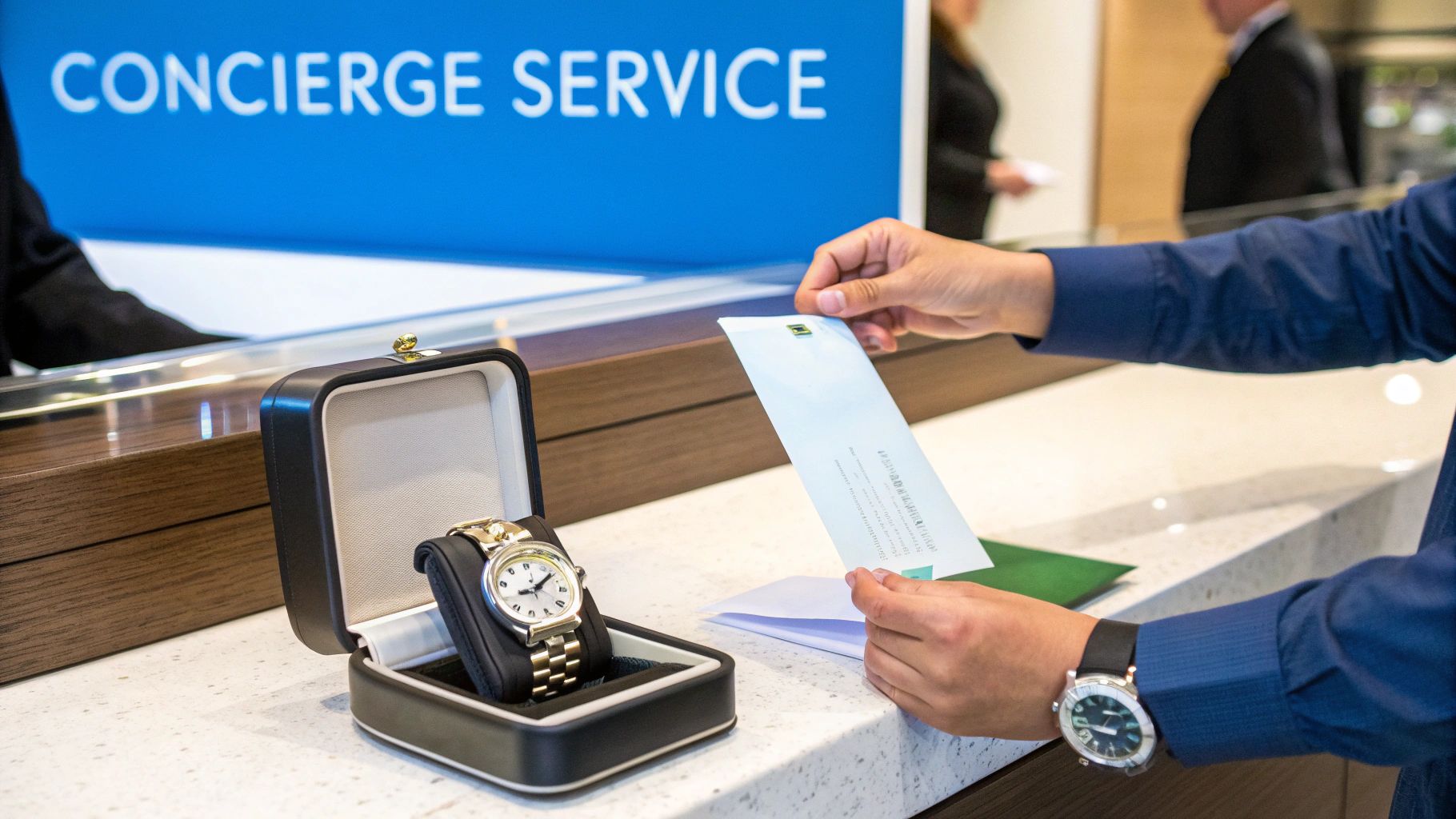
Knowing the numbers behind a Rolex repair cost is one thing, but finding a partner you can actually trust with your timepiece? That’s everything. At ECI Jewelers, we believe the service experience should be just as precise and dependable as the watch itself.
That's why we’ve built our entire process around a true concierge service. We’re not just a repair shop; think of us as your personal guide through the journey of luxury watch ownership, focused on transparency, communication, and master craftsmanship.
From the very first call, our goal is to take the guesswork and anxiety out of servicing a high-value watch.
Our Meticulous Evaluation Process
Your journey with us kicks off with a comprehensive, no-obligation diagnostic. Our seasoned watchmakers don’t just give your Rolex a quick once-over. They perform a deep dive, meticulously examining everything from the movement’s performance and amplitude to the integrity of the case, bracelet, and crystal.
This detailed inspection gives us a complete picture of your watch's health. Only then do we create an exhaustive estimate that breaks down every single recommended service and required part.
With our estimates, there are no surprises or vague line items. We list every cost, from the base overhaul to individual components like a new crown or gasket, so you have complete control over the final invoice. No work ever begins without your explicit approval.
This commitment to clarity is how we build trust. You’ll know precisely what’s being done and exactly why it’s necessary for your watch’s long-term performance.
Craftsmanship and Communication
Once you give us the green light, our expert watchmakers get to work. We blend decades of hands-on experience with a deep respect for horological tradition, using genuine parts to ensure every repair meets the most exacting standards. Our workshop is fully equipped to handle anything from a standard overhaul to a complex vintage restoration.
And we keep you in the loop the entire time. We know being without your Rolex is tough, so we provide regular progress updates and are always here to answer your questions. That personal touch is the heart of our concierge philosophy.
Our job isn’t done when the repair is finished. Before your watch is returned, it must pass a series of rigorous quality control checks:
- Timing Calibration: We regulate the movement to make sure it meets or exceeds chronometer standards for accuracy.
- Water-Resistance Testing: Your watch goes through multiple pressure tests to guarantee its seals are secure and its water resistance is fully restored.
- Power Reserve Analysis: We verify that your watch holds its charge for its full, intended duration.
These final checks are our promise of perfection. When you get your watch back, you can be confident it has been restored to its absolute best, backed by our dedicated service warranty.
To start your personalized service journey, explore the ECI Jewelers Watch Concierge program and see how we’re redefining luxury timepiece care.
Your Guide to Repair Timelines and Warranties
When you hand over your Rolex for service, two big questions pop into your head: "How long will this take?" and "Is the work guaranteed?" The answers tell you everything you need to know about the quality of the service you're getting.
A proper Rolex service is a painstaking process. It's not a quick tune-up; it's a full-blown restoration of a tiny, intricate engine. From complete disassembly and ultrasonic cleaning to reassembly, lubrication, and days of testing, it all takes time. Rushing it is simply not an option.
What's a Realistic Service Timeline?
Patience is key here. Any watchmaker promising an overnight fix is a major red flag that screams "we cut corners."
- Independent Specialists: A good independent watchmaker will usually need your watch for four to six weeks. This gives them enough time to diagnose the issue, order genuine parts if needed, perform the service, and then test the watch's accuracy over several days.
- Official Rolex Service Centers (RSCs): Because they handle a much higher volume and have a very structured process, the wait time at an RSC can be longer. Expect anywhere from six weeks to several months, especially if your watch has to be sent to a central workshop.
If a shop quotes you a one-week turnaround, walk away. They are almost certainly skipping crucial steps like post-service accuracy and water-resistance testing, which puts your entire investment at risk.
Understanding Your Service Warranty
After paying a significant Rolex repair cost, you need a guarantee. A service warranty is the watchmaker’s promise that they stand behind their work, and it's absolutely non-negotiable.
Any top-tier independent shop or official RSC should offer a minimum two-year warranty. This warranty should cover the movement and all the specific work they performed.
This is your safety net. If something related to the service goes wrong within that two-year window, they'll fix it for free. Always get the warranty terms in writing so you know exactly what’s covered. Remember, it protects against faulty workmanship, not new damage from an accidental drop.
Red Flags to Watch Out For
Knowing what to look for is your best defense against a bad repair experience. Be on high alert for these warning signs when choosing where to get your watch serviced:
- Prices That Seem Too Good to Be True: If a quote is dramatically lower than the typical $800+ starting point, it’s a bad sign. It almost always means they're using cheap aftermarket parts or have an inexperienced technician on the job.
- Vague, Unitemized Quotes: A professional will give you a detailed breakdown of the costs—labor, each replacement part, etc. If all you get is a single, unexplained number, it’s time to find someone else.
- A Total Lack of Transparency: Does the provider get cagey when you ask about their process, where they source their parts, or the specifics of their warranty? If they can't or won't give you straight answers, take your business elsewhere. Trustworthy service is built on clear communication.
Your Top Rolex Repair Questions Answered
Even after breaking down the costs, you probably still have a few specific questions swirling around. That’s completely normal. To give you total peace of mind, here are direct answers to the most common things we hear from Rolex owners every day.
How Often Should I Really Service My Rolex?
Rolex officially stretched its recommended service interval to about 10 years, which is a testament to their modern engineering. But think of that as a maximum, not a target. The best answer depends entirely on how you wear your watch. It’s like a car—the one you drive daily needs more attention than the classic that only comes out on weekends.
For a watch you wear every day, most seasoned experts will tell you to aim for a service every five to seven years. Taking this proactive step handles the natural aging of lubricants and gaskets before they can cause bigger, pricier headaches.
Will Polishing My Rolex Tank Its Value?
This is a huge—and very valid—concern, especially if you own a vintage piece. A light, professional polish done by a skilled hand can bring back that factory shine without hurting its value. The danger lies in an aggressive or sloppy polish, which can round off the sharp, crisp lines of the case and lugs that collectors cherish.
For a collectible vintage Rolex, that loss of original case geometry can crush its value. A true expert will always discuss refinishing with you beforehand. In many cases, leaving a vintage watch unpolished is the smartest move to protect its history and market worth.
What Exactly Is a Standard Rolex Overhaul?
A standard overhaul is the watch equivalent of a frame-off restoration. It’s an incredibly detailed process designed to bring your watch back to its original factory performance.
It’s not just a quick tune-up. The process involves:
- Complete Disassembly: Your watch's movement is taken apart, down to the last tiny screw and gear.
- Ultrasonic Cleaning: Every single component is deep-cleaned to strip away old oils, dust, and microscopic grime.
- Meticulous Inspection: Each part is put under a loupe to check for wear. Anything that doesn't meet Rolex's strict tolerances is replaced with a genuine factory part.
- Reassembly & Lubrication: The movement is painstakingly rebuilt and lubricated with up to a dozen different specialized oils and greases.
- Rigorous Testing: Finally, the watch is put through its paces to test for timekeeping accuracy, water resistance, and power reserve, ensuring it runs like new.
Do I Have to Approve Repairs Before the Work Starts?
Yes, 100%. Any service center worth its salt—whether it’s an official RSC or a reputable independent shop—will give you a detailed, itemized estimate after they’ve inspected your watch.
This quote will clearly list all the recommended work and any parts that need replacing, along with the exact cost for each. No work should ever begin without your direct, explicit approval. This keeps you in the driver's seat and ensures there are zero surprises when you get the final bill.
At ECI Jewelers, we know trust is built on transparency. Our concierge service guarantees you get a detailed, no-pressure estimate and are kept in the loop every step of the way. Visit us to get a fair and transparent quote for your Rolex repair today.


