

Finding the right watch isn't just about telling time—it's about discovering a piece that perfectly blends style, craftsmanship, and personal meaning. When you hear names like Rolex, Cartier, and Omega, you're not just hearing about brands. You're hearing about icons celebrated for their timeless designs and incredible engineering. These watches aren't just accessories; they are statements of taste and, often, future heirlooms.
Why a Watch Is More Than Just a Timepiece
A luxury watch is a rare mix of art and engineering that you can wear every day. It tells a story, and not just the time. It speaks to the heritage of its maker, the incredible skill that went into its creation, and the personality of the person who wears it. Far from being simple time-tellers, the best women's watches have become powerful symbols of achievement, personal style, and life's biggest milestones.
Think of it as wearable art. Just like a painting expresses an artist's vision, a beautifully made watch from a house like Patek Philippe or Cartier is the culmination of decades—sometimes centuries—of design innovation. Choosing a classic Cartier Tank versus a sporty Rolex Lady-Datejust says something distinct about your aesthetic and what you value.
An Expression of Individuality
In a world of fast fashion and disposable trends, a well-made timepiece offers something lasting. It’s an intentional choice that sets you apart. The world of women's watches has moved far beyond the old "pink it and shrink it" approach. Today, the options are as diverse as the women who wear them.
- Bold, sporty models that make a statement and offer serious functionality.
- Elegant, jewelry-like pieces that shimmer with diamonds and precious metals.
- Understated classics with clean lines and sophisticated mechanical movements that true enthusiasts appreciate.
Think of this guide as your personal consultation. We're here to help you navigate this exciting world, demystify the technical jargon, highlight iconic designs, and give you the confidence to pick a watch that feels like it was made just for you.
Choosing a watch is a personal journey. It’s about finding a companion that not only keeps pace with your life but also reflects your unique identity and celebrates your accomplishments.
A Legacy on Your Wrist
Ultimately, a great watch becomes a part of your story—something that can be passed down through generations. The value isn't just about the price tag; it's emotional. Every little scratch and mark it picks up over the years tells a story, creating a tangible connection to the past for the people you'll one day pass it on to. We'll give you the insights you need to find a piece you'll treasure for a lifetime.
Understanding What Makes a Watch Great
Before you even start looking at specific brands, it’s worth understanding what separates a nice watch from a truly exceptional one. Think of it like buying a car—you wouldn’t just pick one based on the color. You'd want to know what's under the hood, the quality of the materials, and how it’s built to last. Learning these fundamentals empowers you to see past the initial sparkle and recognize true, lasting craftsmanship.
And it’s a big deal. The global women's watch market is a powerhouse, projected to hit $28.52 billion in 2025. This isn't just about telling time; women are seeking out timepieces that are sophisticated symbols of personal and professional achievement, with icons like Rolex and Cartier leading the way.
The Heartbeat of the Watch: The Movement
The movement is the engine that makes your watch tick, and it's where much of the magic happens. It's the difference between a high-performance electric vehicle and a classic, hand-built combustion engine. Both get you where you’re going, but their soul and the experience they offer are worlds apart.
You’ll generally run into two main types:
- Quartz Movement: This is your precise, low-maintenance workhorse. Powered by a small battery, a quartz movement sends an electrical current through a tiny quartz crystal, causing it to vibrate at a near-perfect frequency. It’s the ultimate "set it and forget it" option, delivering incredible accuracy with minimal fuss.
- Automatic Movement: This is the intricate, self-winding heart of traditional watchmaking. An automatic watch is powered by you. As you move your arm, a weighted rotor inside spins, winding the mainspring and storing energy. It’s a stunning feat of micro-engineering that you can often admire through a see-through case back.
An automatic movement doesn't just tell time; it celebrates the art of horology. Every tiny gear and spring works in perfect harmony—a testament to centuries of innovation ticking right there on your wrist.
If you're fascinated by how these tiny machines work, you can dive deeper into the mechanics in our detailed guide on how a mechanical watch works. Understanding this complexity is a huge part of what makes collecting so rewarding and helps one appreciate brands that embody this legacy, like exploring Cartier's art of distinction.
Crafting the Exterior: Case Materials and Crystals
A watch's case is its protective shell, and the material it's made from dictates its entire look, feel, and durability. Stainless steel is the industry standard for a reason—it’s tough, resists corrosion, and is versatile enough for both a rugged sports watch and an elegant dress piece.
Precious metals like gold (in yellow, white, or rose tones) and platinum offer a level of luxury and warmth that steel just can't replicate. They’re softer and carry more weight, giving the watch a substantial, elegant feel on the wrist.
Guarding the dial is the crystal, which is essentially the watch's windshield. There are two you'll see most often:
| Crystal Type | Key Characteristics | Best For |
|---|---|---|
| Mineral | A type of heat-treated glass that offers better scratch resistance than standard glass. | Everyday watches in more accessible price ranges. |
| Sapphire | A synthetic crystal that's second only to diamond in hardness, making it virtually scratch-proof. | Luxury timepieces where pristine clarity and durability are non-negotiable. |
Understanding Water Resistance
Water resistance is one of the most misunderstood features. The rating doesn't tell you the depth a watch can actually be used at; it refers to the static pressure it can withstand in a lab.
Here's what those numbers mean in the real world:
- 30 meters (3 ATM): Splash-proof. It's fine with rain or washing your hands, but that's it. Don't submerge it.
- 50 meters (5 ATM): Can handle a brief dip in the water, but it's not designed for swimming.
- 100 meters (10 ATM): Good to go for swimming and snorkeling.
- 200+ meters (20+ ATM): Built for scuba diving and serious water sports.
Getting a handle on these core components—the movement, materials, crystal, and water resistance—gives you the language to confidently assess any watch. It's the first and most important step toward finding a timepiece that you not only love to look at but also truly appreciate for its artistry.
Exploring the Top 10 Women's Watches
Diving into the world of luxury watches can feel a bit overwhelming, like walking into a museum filled with masterpieces. To make it easier, we've put together a list of iconic women's watches, but instead of a simple countdown, we’ve grouped them by style. This way, you can see exactly how a legendary timepiece might fit into your life—whether you need a go-to classic, an elegant dress watch, or something that makes a real statement.
Every watch here is more than just a pretty accessory; it's a piece of history with its own story. We'll get into what makes each one an icon, from its design roots to the features that set it apart. Think of it as finding the perfect watch that matches your own personal story.
The Everyday Classic: Timeless Companions
Your everyday watch is the ultimate workhorse. It has to be versatile enough for the office, tough enough for a packed weekend, and stylish enough for an impromptu dinner. These watches are all about timeless design, solid construction, and an easy, understated confidence.
-
Rolex Lady-Datejust: If there's one women's luxury watch the world recognizes, it's the Lady-Datejust. An icon since 1957, it brilliantly captures the spirit of its bigger brother in a much more refined package.
- Defining Feature: That instantly recognizable Cyclops lens over the date. It’s a Rolex signature that magnifies the date, making it a breeze to read.
- Why It's a Legend: The Lady-Datejust is the perfect marriage of form and function. Its rugged Oyster case keeps it water-resistant, while the sheer number of options—from dial colors to bezel styles (fluted, smooth, or diamond-set) and bracelets (Oyster or Jubilee)—means you can find one that feels truly yours.
-
Omega Seamaster Aqua Terra: For the woman who loves a sporty edge but isn't willing to compromise on elegance, the Aqua Terra is a knockout. The design was inspired by the teak decks of luxury sailboats, which you can see in the beautiful horizontal pattern on the dial.
- Defining Feature: It's incredibly versatile. With 150 meters of water resistance and a Master Chronometer movement that shrugs off magnetism, this watch is as technically brilliant as it is beautiful.
- Why It's a Legend: Omega is a master at blending rugged capability with pure class. The symmetrical case and integrated bracelet make it so comfortable you'll forget you're wearing it, proving a tough watch can still be exceptionally chic.
The Elegant Dress Watch: Understated Sophistication
A dress watch is elegance personified. They’re known for their slim cases, clean dials, and are often paired with leather straps or delicate metal bracelets. The whole point is to slip discreetly under a cuff—they don't scream for attention, they earn it with quiet grace.
-
Cartier Tank: The Cartier Tank isn't just a watch; it's a design masterpiece. Created in 1917 and inspired by the shape of a military tank seen from above, its clean rectangular case and Roman numerals have been worn by style icons from Jackie Kennedy to Princess Diana.
- Defining Feature: The "brancards"—those vertical bars that form the case and flow seamlessly into the strap lugs. It creates a fluid, unmistakable look.
- Why It's a Legend: The Tank simply doesn't go out of style. Its Art Deco geometry is timeless, projecting an intellectual, artistic kind of elegance. It’s the quintessential dress watch, proving true style lasts forever.
-
Longines Mini DolceVita: This watch truly captures the "sweet life" its name promises. The DolceVita collection channels 1920s glamour, and the Mini version—with its petite rectangular case and options for colorful leather straps or intricate bracelets—is a modern take on classic charm.
- Defining Feature: Its compact, elongated shape and stylized Art Deco numerals. It has that vintage Cartier vibe but with its own unique, accessible personality.
- Why It's a Legend: Longines has a long history of making beautiful women's watches, and the DolceVita is a prime example. It gives you a taste of high-end Swiss design without the eye-watering price tag, making it a favorite for collectors at every level. If you're interested in other brands that deliver amazing style and value, our guide to the top 10 watch brands for women is full of great options.
A great dress watch is an exercise in restraint. Its beauty lies not in complexity, but in the perfection of its simple lines, the clarity of its dial, and the quiet confidence it projects.
The Bold Statement Piece: Horological Power
Statement watches are for the woman who owns the room. These pieces are often larger, feature groundbreaking designs, and flex some serious mechanical muscle. They're conversation starters—powerful expressions of who you are.
-
Audemars Piguet Royal Oak: When the Royal Oak landed in 1972, it broke all the rules. A luxury watch made of steel? With an octagonal bezel and a bold, industrial look? It single-handedly created the "luxury sports watch" category. The smaller 34mm or 37mm models are perfectly scaled for a woman’s wrist without losing an ounce of the original's power.
- Defining Feature: The iconic octagonal bezel with its eight exposed hexagonal screws, and that stunning integrated bracelet that seems to flow right out of the case.
- Why It's a Legend: The Royal Oak is a symbol of rebellion. It proved that steel could be just as precious as gold and that a sports watch could be high art.
-
Patek Philippe Nautilus: Designed by the same genius who created the Royal Oak, the Nautilus (1976) was inspired by a ship's porthole. Its rounded octagonal case and horizontally embossed dial create a look that's sporty, elegant, and completely unique.
- Defining Feature: The "ears" on the case at 3 and 9 o'clock. They mimic the hinges of a porthole and give the Nautilus its unmistakable shape.
- Why It's a Legend: The Nautilus is the absolute peak of casual elegance. It blends Patek Philippe’s legendary quality with a design that’s both relaxed and incredibly sophisticated, making it one of the most desirable watches on the planet.
Whether you prefer a watch powered by a battery or by the motion of your wrist is one of the first big decisions you'll make. This little decision tree can help you figure out which "movement" type is right for you.
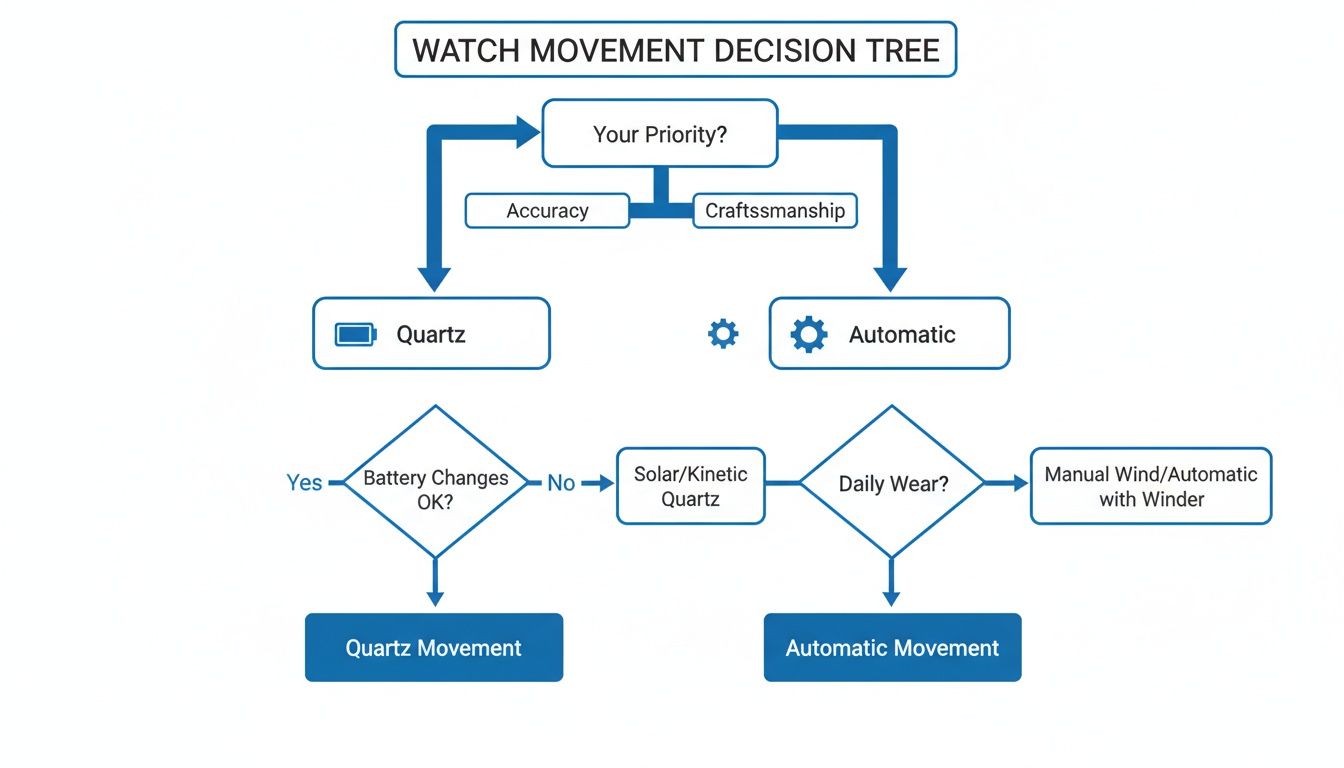
As you can see, the path is pretty clear. If you value pinpoint accuracy and grab-and-go convenience, a Quartz movement is your best bet. But if you're fascinated by intricate mechanics and the art of traditional watchmaking, an Automatic movement is calling your name.
To help you see how these pieces compare at a glance, we've put together a quick summary of some of the most celebrated models in women's watchmaking.
A Quick Look at Iconic Women's Watches
This table gives you a snapshot of what makes each of these watches special, from their core features to their potential as a long-term investment.
| Watch Model | Brand | Style Category | Key Features | Investment Potential |
|---|---|---|---|---|
| Lady-Datejust | Rolex | Everyday Classic | Cyclops date lens, Oyster case, vast customization | Excellent |
| Aqua Terra | Omega | Everyday Classic | Teak-pattern dial, 150m water resistance, co-axial movement | Strong |
| Tank | Cartier | Elegant Dress | Rectangular case, Roman numerals, "brancards" design | Excellent |
| Royal Oak | Audemars Piguet | Bold Statement | Octagonal bezel, integrated bracelet, "Tapisserie" dial | Exceptional |
| Nautilus | Patek Philippe | Bold Statement | Porthole-inspired case, embossed dial, integrated bracelet | Exceptional |
Ultimately, whether you're drawn to the everyday reliability of a Rolex, the artistic elegance of a Cartier, or the bold design of an Audemars Piguet, each of these watches represents the very best in its class.
How Watches Can Become Valuable Assets
A beautiful luxury watch is one thing, but for a savvy buyer, it can be something more: a sound financial asset. It might sound surprising, but certain timepieces don’t just hold their value—they appreciate, sometimes spectacularly. This shift from a simple accessory to a tangible asset is driven by a powerful mix of brand heritage, model rarity, and unwavering market demand.
Think of it like investing in fine art or a classic car. You buy it because you love it, but the right choice can also grow in worth over time. Iconic models from legendary brands like Patek Philippe or Rolex have a proven history of not just retaining but significantly increasing in value. It's a purchase that's both emotionally rewarding and financially intelligent.
Drivers of Value Appreciation
So, what makes one watch a better investment than another? It really comes down to a few key factors that create scarcity and desire. A watch's ability to appreciate is directly tied to the story it tells and just how few of them are out there.
- Brand Heritage: Brands with a long, uninterrupted history of innovation and quality—like the "Holy Trinity" of Patek Philippe, Audemars Piguet, and Vacheron Constantin—command immense respect and, consequently, higher resale values.
- Model Rarity: Limited production runs, discontinued models, or unique configurations are the magic ingredients for scarcity. When demand outstrips supply, prices on the secondary market naturally climb.
- Market Demand: Some watches simply become cultural icons. Think of the Rolex Daytona or the Patek Philippe Nautilus. Their overwhelming popularity creates massive waitlists at authorized dealers, pushing buyers to the pre-owned market where these pieces often sell for far more than their original retail price.
A watch’s long-term worth is ultimately decided on the secondary market. This is where true demand is measured, revealing which timepieces aren't just popular for a season but are coveted by collectors for generations.
Take, for example, Patek Philippe's ladies' Nautilus 7118 family. It's a standout for impressive value appreciation. Key models have gained over 15% in the past year alone—a figure that blows past the overall watch market's modest 1.8% uptick. This growth is a direct result of limited production and timeless design creating intense scarcity, which sends secondary market prices soaring.
New vs. Pre-Owned Markets
Understanding the dynamic between the new (primary) and pre-owned (secondary) markets is critical to spotting a watch's investment potential. The primary market is simple: authorized dealers selling brand-new watches at a fixed retail price. The secondary market is where things get interesting—it's where individuals and independent dealers buy and sell watches that have been previously owned.
When a watch trades on the secondary market for more than its retail price, that's the tell-tale sign that demand is crushing supply. This is the hallmark of a true investment piece. For a deeper dive, check out our complete guide on investing in luxury watches.
This principle of choosing items with lasting value goes beyond just watches. If you apply this mindset to your entire wardrobe, learning about investing in quality women's clothing brands can sharpen your eye for durable, timeless fashion. In the end, whether it's a timepiece or a tailored jacket, the goal is to find pieces that bring you joy today and hold their value for all your tomorrows.
How to Purchase and Care for Your Timepiece
You've explored the icons and understand what makes a watch tick. Now for the most exciting part: bringing one home and making sure it lasts a lifetime. This is where knowledge turns into action. A truly great purchase isn't just about the watch itself—it's about knowing it's authentic and caring for it so it can be passed down for generations.
When you're looking at luxury watches, especially on the pre-owned market, you have to be diligent. The absolute first priority is authentication. A watch without a verified history is just an accessory; one with proven provenance is a true asset. That’s why working with a trusted jeweler who provides an authenticity guarantee is non-negotiable. They have the experience to spot fakes that could easily fool an untrained eye.
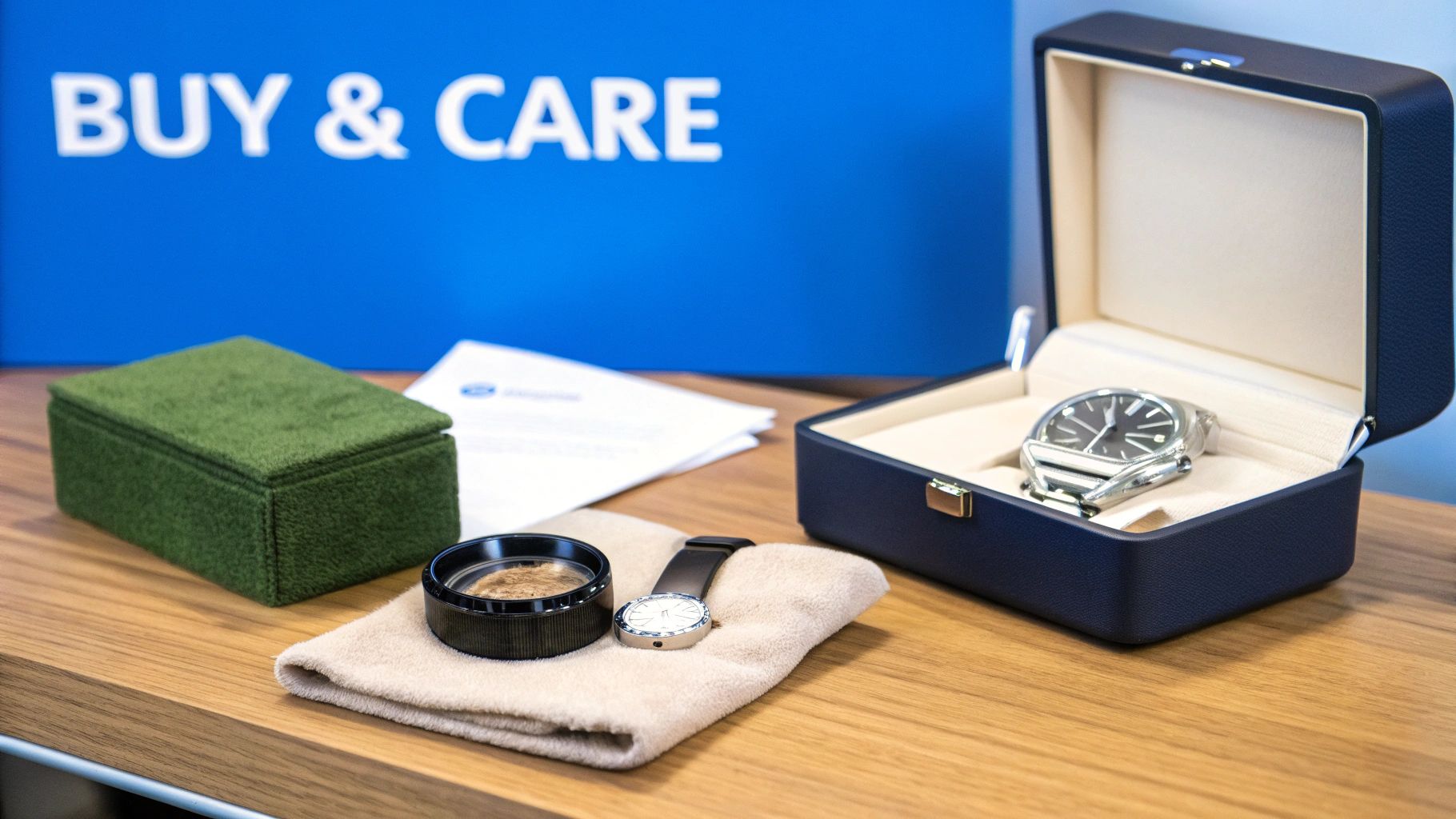
Securing an Authentic Watch
When you're evaluating a timepiece, the phrase "box and papers" is your best friend. This refers to the original presentation box, warranty card, instruction manuals, and any sales receipts. While these items can be forged, having them is a strong sign that the watch is legitimate.
But the papers are just part of the story. You have to look closely at the watch itself.
- Dial and Printing: The lettering should be perfect—crisp and clean. Any smudged logos or uneven text are major red flags.
- Weight and Finish: A genuine luxury watch has a satisfying heft to it, a direct result of its high-quality materials and complex movement. The finishing on the case and bracelet should be flawless.
- Movement: This is the heart of the watch and the hardest part to replicate. A professional inspection is the only way to be 100% certain the movement is genuine.
Purchasing from a reputable dealer like ECI Jewelers takes all the guesswork out of the equation. Our specialists meticulously inspect every single timepiece, so you get a guaranteed authentic watch and the peace of mind that comes with it.
Maintaining Your Timepiece for Longevity
Once that beautiful watch is on your wrist, proper care will ensure it remains a precise and valuable heirloom. Think of it like a luxury car—it needs regular attention to perform at its best. A few simple habits can make a huge difference.
Storage is crucial. When you aren't wearing your watch, keep it in its original box or a soft-lined watch case to protect it from dust, moisture, and accidental bumps. And always try to avoid direct contact with harsh chemicals in perfumes or lotions, as they can damage the finish and rubber gaskets over time.
Cleaning and Professional Servicing
Keeping your watch clean is simple. A quick wipe with a soft, dry microfiber cloth is usually all it takes to remove fingerprints and oils after you've worn it. For water-resistant models, you can occasionally give it a gentle clean with a soft brush, mild soap, and water—just make sure the crown is screwed down tight first!
But the most critical part of long-term care is professional servicing.
- Quartz Watches: These are pretty low-maintenance. You'll just need to bring it in for a battery change every few years.
- Automatic Watches: These complex little machines need a tune-up every 3 to 5 years. This service involves cleaning the movement, re-lubricating the tiny components, and replacing worn seals to maintain accuracy and prevent damage.
Finally, getting the bracelet sized correctly isn't just about comfort—it's about preserving your watch. A bracelet that's too loose can cause the links to stretch and wear out prematurely. A professional jeweler can ensure a perfect fit that protects your investment and feels fantastic on your wrist.
Common Questions About Buying a Woman's Watch
Even after doing your homework, a few last-minute questions always pop up when you're close to choosing the perfect watch. We hear them all the time from our clients, so we've put together a quick rundown of the most common ones.
Think of this as your final checklist. These answers cover the practical details that can make all the difference, helping you invest with total confidence.
What Is a Good First Luxury Watch for a Woman?
A great first luxury watch is one you can wear almost anywhere, from a brand with real history. Models like the Cartier Tank Must or the Omega Aqua Terra are perfect examples—they have that ideal blend of prestige and classic design that works for any occasion.
These pieces tend to hold their value well but are more approachable than ultra-rare or complicated watches. For a first-time buyer, we always suggest focusing on:
- Durable Materials: You can't go wrong with stainless steel. It’s tough, timeless, and looks fantastic.
- Versatile Sizing: A case size between 28mm and 36mm hits the sweet spot—it’s elegant and comfortable for most wrists.
- Recognizable Design: Choosing an icon means it will look just as stylish decades from now as it does today.
Should I Get a Quartz or an Automatic Watch?
This one is all about you and your lifestyle. There's no right answer, only what fits best. It’s like choosing between a high-tech electric car (Quartz) and a classic, hand-built roadster (Automatic).
A Quartz watch is battery-powered, which means it’s incredibly accurate and requires almost no maintenance. It's the ultimate "set it and forget it" option for a busy life. On the other hand, an Automatic movement is a tiny mechanical engine powered by the motion of your own wrist—a true marvel of traditional watchmaking.
If you love the idea of intricate craftsmanship and the smooth, sweeping motion of the second hand, go for an Automatic. If you value convenience and dead-on precision above all else, a Quartz movement is a brilliant, worry-free choice.
How Can I Be Sure a Pre-Owned Watch Is Real?
The only way to be 100% certain is to buy from a reputable dealer who has expert watchmakers on staff. While the original "box and papers" are nice to have, they can be faked just like the watch itself. A professional knows exactly what to look for.
Obvious tells are the quality of the dial printing, the finishing on the case and bracelet, and even the weight of the watch. But the movement inside is the hardest part to fake convincingly.
The definitive test is having an expert open the case back to inspect the mechanics. Any trusted seller will stand behind their inventory with an unconditional guarantee of authenticity, so you don't have to worry.
What Do Water Resistance Ratings Actually Mean?
This is easily one of the most misunderstood specs on a watch. The numbers don't refer to the depth you can dive to, but rather the static pressure the watch can handle in a lab. Real-world movement adds a lot more stress.
Here’s a simple breakdown of what those ratings mean in practice:
- 30m (3 ATM): Splash-proof. It’s safe for handwashing or getting caught in the rain, but that’s it.
- 50m (5 ATM): Can handle a quick dip, but not swimming laps.
- 100m (10 ATM): Good for recreational swimming and snorkeling.
- 200m+ (20+ ATM): Built for the serious stuff, including scuba diving.
A quick tip: no matter the rating, never use the crown while the watch is wet. It's also a good idea to have the seals professionally checked every couple of years to keep it water-tight.
At ECI Jewelers, we take the guesswork out of buying a luxury timepiece. Our expert team authenticates every single watch, giving you the confidence and peace of mind you deserve. Explore our curated collection of guaranteed authentic women's watches today.


