


At its heart, a chronograph is really a watch with a built-in stopwatch. It tells you the time of day, just like any other timepiece, but it also gives you the power to measure and record elapsed time whenever you need to—completely separate from its main timekeeping job.
Defining the Dual-Purpose Timepiece
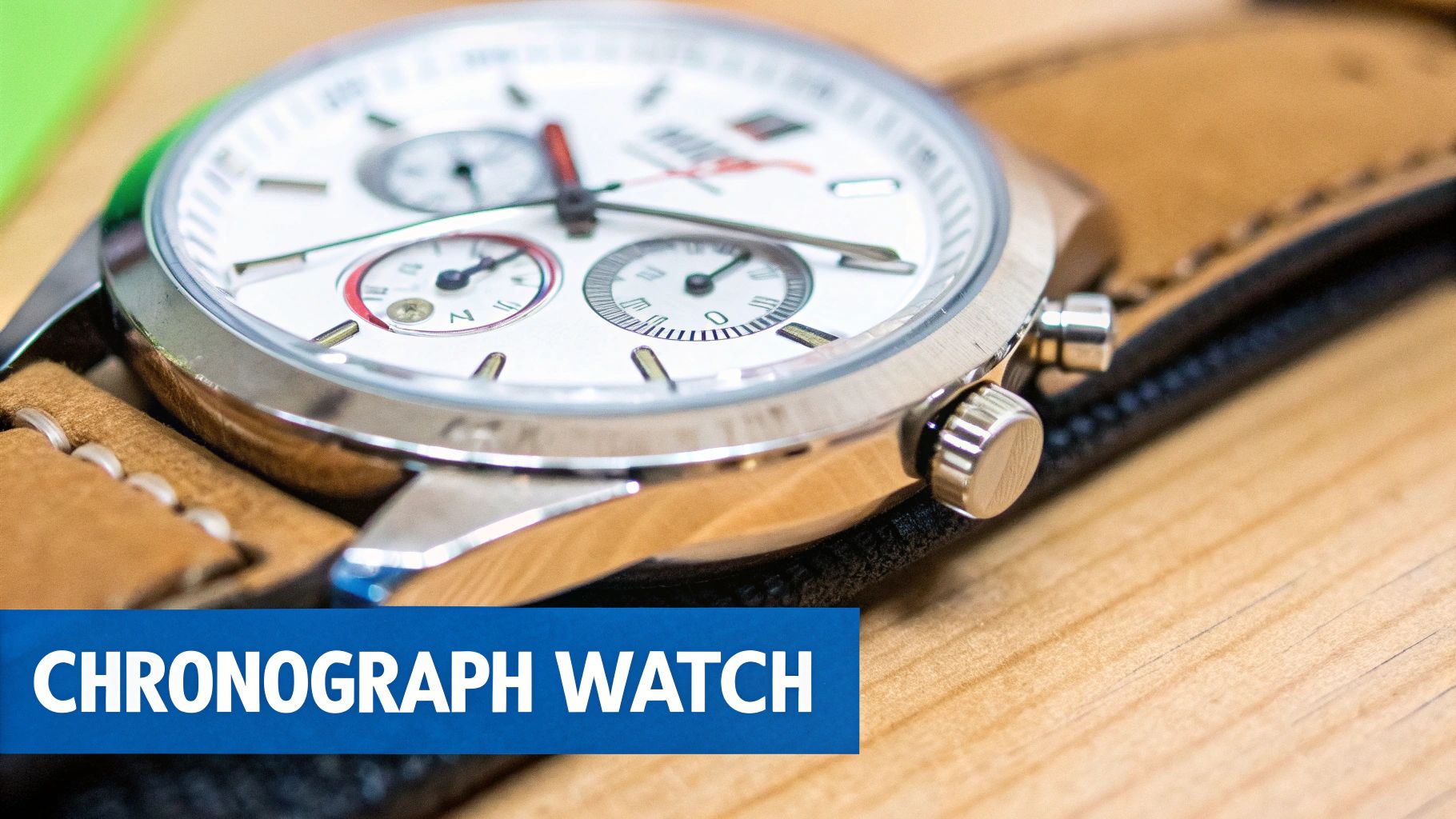
A good way to think about it is like having a professional-grade racetrack timer built right into your car’s dashboard. The car’s main job is getting you around town, but with the flip of a switch, you can time a lap with incredible precision. A chronograph watch works on that same idea of dual functionality.
The primary timekeeping—your hour, minute, and seconds hands—runs continuously, often powered by an intricate mechanical movement. If you're curious about the engines that power these pieces, you can explore the fundamentals of how an automatic watch works in our detailed guide. The stopwatch feature, however, just waits patiently until you decide to bring it to life.
To give you a clearer picture, here’s a quick breakdown of what makes a chronograph tick.
Chronograph Watch at a Glance
| Component | Primary Function |
|---|---|
| Pushers | Buttons on the side of the case used to start, stop, and reset the stopwatch function. |
| Sub-Dials | Smaller dials on the watch face that track elapsed minutes and hours for the stopwatch. |
| Central Hand | The main seconds hand for the stopwatch, which sweeps the dial when activated. |
| Tachymeter Scale | A scale (often on the bezel) used to measure speed over a known distance. |
| Timekeeping Hands | The standard hour, minute, and small seconds hands that tell the current time of day. |
These components work together to provide both standard timekeeping and specialized time measurement in one sophisticated package.
Visual Clues of a Chronograph
You can usually spot a chronograph from across the room by a few distinct features. These aren't just for show; they're the direct interface for its time-measuring capabilities.
- Pushers: Look for two buttons flanking the crown (the winding knob). The top pusher typically starts and stops the stopwatch, while the bottom one resets everything back to zero.
- Sub-Dials: The main dial will almost always have smaller dials, known as registers. These are the odometers for your stopwatch, tracking the elapsed minutes and hours while the timer is running.
- Central Chronograph Hand: Many chronographs have a long, slender central hand that rests motionless at the 12 o'clock position. When you hit the start pusher, this hand springs to life, sweeping around the dial to count the seconds.
At its core, the chronograph's appeal lies in this blend of everyday utility and specialized precision. It provides the standard time you need for daily life while offering a sophisticated tool for measuring moments that matter, all within a single, elegant design.
The Fascinating History of the Chronograph
To really get what a chronograph watch is all about, you have to look at its incredible backstory. This wasn't a feature born out of luxury; it was a serious scientific instrument, created from the need to measure fleeting moments with absolute precision—from tracking stars in the sky to timing a king's horse race.
The story starts not on a racetrack, but in an observatory. Back in 1816, a man named Louis Moinet invented the very first chronograph, a device he called the compteur de tierces, or "thirds counter." It was built for astronomical work and could measure time down to 1/60th of a second—an unbelievable achievement for the era. For a while, though, this amazing invention stayed a highly specialized tool for scientists.
From Science to Sport
It was a few years later that the chronograph really made its public debut. In 1821, a French watchmaker, Nicolas Mathieu Rieussec, was commissioned by King Louis XVIII, who was desperate for a way to accurately time his beloved horse races. Rieussec came up with a clever device that used a tiny drop of ink to mark the elapsed time on a rotating dial, literally "writing time." This was the birth of the first commercially available chronograph, and it forever tied the complication to the world of speed and competition.
The chronograph’s journey from an astronomer's tool to a king's stopwatch really gets to its core purpose: to capture and measure moments that are just too quick for the human eye. This shift laid all the groundwork for its future in countless professional fields.
Throughout the 19th and early 20th centuries, innovators kept tweaking and perfecting the design. Adolphe Nicole patented a critical reset feature in 1844, and by the 1930s, Breitling had established the two-pusher system for start, stop, and reset that we all recognize today. You can dive deeper into this journey in this detailed history of chronograph watches from their very beginning.
An Icon of Adventure and Precision
This newfound practicality quickly made the chronograph an essential tool for any professional who relied on exact timing. Aviators used them for navigation, military officers for coordinating missions, and, of course, race car drivers for clocking lap times.
The chronograph's legacy was truly cemented in the mid-20th century when it became the symbol of motorsport and exploration. Icons were born during this era. You can explore one of the most famous examples in our guide to the legendary Rolex Cosmograph Daytona, a watch that will forever be linked to the world of professional racing. It’s a perfect example of how a simple need to measure time evolved into one of watchmaking's most celebrated complications.
How a Chronograph Watch Actually Works
When you press the top pusher on a chronograph, you're doing more than just pushing a button—you're waking up a complex, miniature engine. That single press kicks off a cascade of levers and gears, instantly turning your timepiece into a precision stopwatch. It’s a beautiful marriage of everyday timekeeping and on-demand measurement.
At its core, the chronograph's stopwatch function is totally separate from the watch's main timekeeping mechanism. To get a handle on the intricate engines that power the standard time, you can check out our guide on how a mechanical watch works. The chronograph, however, just lies dormant until you give the command.
This concept map shows how the chronograph evolved from a niche scientific instrument into the mainstream feature we know today.
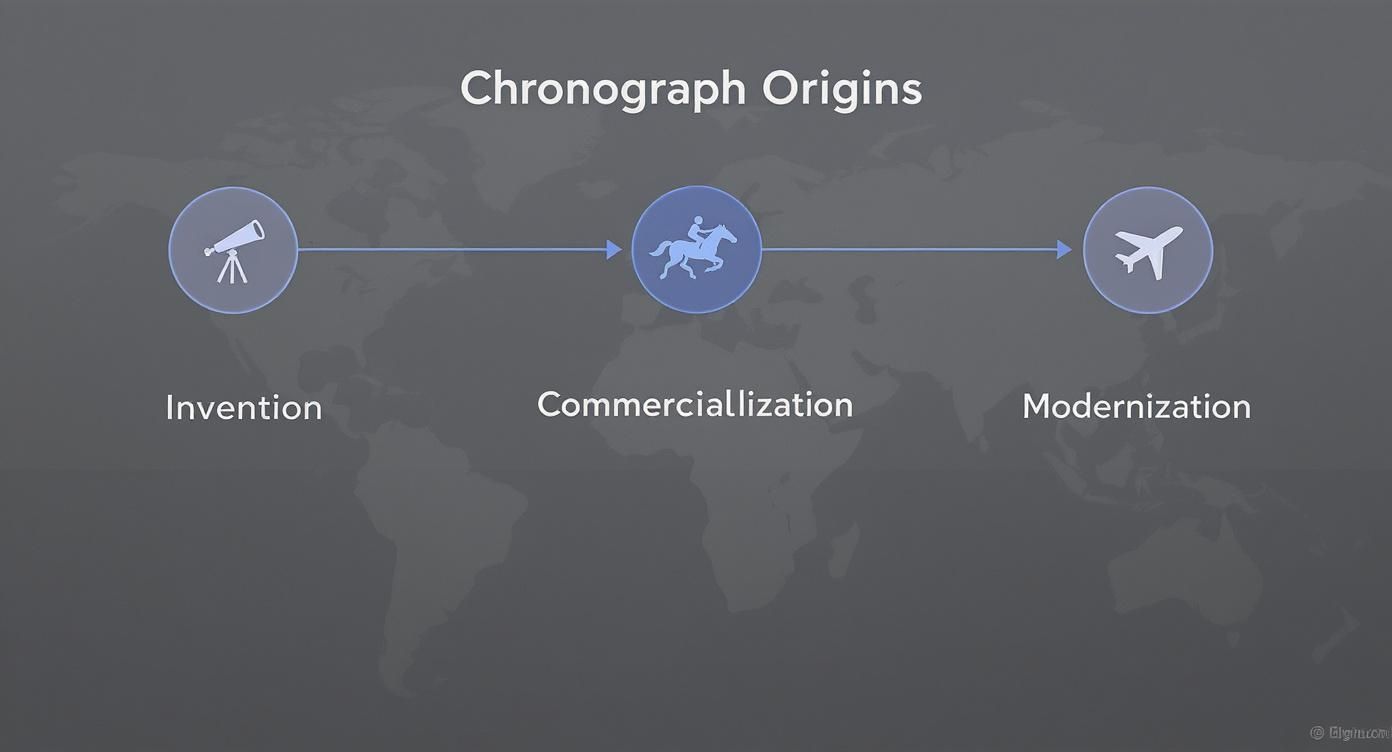
As you can see, it made its journey from an astronomical tool to a must-have for timing horse races, eventually being modernized for the high-stakes worlds of aviation and motorsport. Let's break down the components you actually control.
The Key Components and Their Roles
Your interaction with the chronograph is simple and direct, managed by just a few key parts:
- The Pushers: These are your command buttons. The top pusher (usually at 2 o'clock) starts and stops the timer. The bottom pusher (at 4 o'clock) resets the hands to zero after you've stopped timing.
- Central Chronograph Hand: This is the long, prominent hand that normally sits parked at 12 o'clock. When you start the timer, it begins its sweep around the dial, measuring elapsed seconds with incredible accuracy.
- Sub-Dials (Registers): Think of these smaller dials as the odometers. As the central hand counts seconds, one sub-dial tracks the elapsed minutes, while another often counts the hours. This is what allows you to time events far longer than just 60 seconds.
Together, these elements give you a clear and intuitive way to measure time intervals without messing with the watch's primary job of telling you the current time. But beneath the dial, the real engineering magic is happening.
Inside the Movement: The Column Wheel vs. The Cam
The mechanism that engages and disengages the chronograph is where much of a watchmaker's true artistry is revealed. There are two main systems used to control this function, and each has its own character.
Think of the column wheel as a sophisticated light dimmer. It's a small, castle-like turret with pillars. When you press a pusher, levers slot smoothly and precisely between these pillars, giving you a crisp, satisfying feel. This system is traditionally found in high-end chronographs because it's complex to make and delivers incredibly smooth operation.
The cam-lever system, on the other hand, is more like a standard light switch—it's robust, effective, and gets the job done reliably. It uses a stamped, multi-layered cam that levers push against to start, stop, and reset the chronograph.
While the cam-lever mechanism is easier and cheaper to produce, it often results in a slightly stiffer pusher feel and a noticeable "jump" of the second hand when you start it. The column wheel, however, is prized by collectors for its refined action and is widely considered a hallmark of superior chronograph construction.
Decoding Common Chronograph Scales and Features
Beyond the pushers and sub-dials, many chronographs have cryptic markings around the bezel or dial. These aren't just for show—they're specialized scales that turn your watch from a simple stopwatch into a powerful analog calculator for speed, distance, and even vital signs.
Getting to know these features unlocks what a chronograph can really do. It transforms what looks like a complex dashboard into a source of genuinely practical information.
The Tachymeter: A Need for Speed
The most common scale you'll find on a chronograph is the tachymeter, and it's the feature that cements the watch's deep roots in motorsport and aviation. Simply put, a tachymeter measures your average speed over a known distance.
Imagine you're on a highway with mile markers. Start your chronograph right as you pass the first one. When you hit the next marker exactly one mile later, stop it. If 45 seconds have passed, the central chronograph hand will be pointing to "80" on the tachymeter scale. Just like that, you know your average speed was 80 miles per hour. No math needed.
A tachymeter instantly converts elapsed time into average speed. Think of it as a quick, analog computer on your wrist, built to calculate units per hour—whether that's miles, kilometers, or even widgets coming off an assembly line.
The bezel scales on a chronograph are what make it a true "tool watch." While the tachymeter is the most famous, several other specialized scales were developed for specific professional needs, each turning the watch into a purpose-built instrument.
Here’s a breakdown of the most common scales you’ll encounter and what they were designed to do.
Understanding Chronograph Bezel Scales
| Scale Type | What It Measures | Common Application |
|---|---|---|
| Tachymeter | Average speed over a fixed distance | Motorsports, aviation, or industrial production timing. |
| Telemeter | Distance from an event you can see and hear | Gauging the distance of a storm by timing lightning and thunder. |
| Pulsometer | Heart rate (beats per minute) | Medical professionals taking a patient's pulse quickly. |
These scales are a fantastic reminder of a time before digital calculators, when a well-made watch was an essential piece of professional gear. They add a layer of history and utility that collectors truly appreciate.
Advanced Chronograph Complications
Beyond the dial, some of the most impressive watchmaking feats happen inside the movement itself. These advanced complications add even more sophisticated timing capabilities.
The Flyback Chronograph
A standard chronograph needs three clicks to time back-to-back events: stop, reset, then start again. A flyback chronograph cuts this down to a single, seamless action.
While the chronograph is running, one press of the reset pusher snaps the timing hand back to zero and instantly starts it again. This feature was a game-changer for pilots who needed to time multiple navigation legs in quick succession without losing a precious second between measurements.
The Split-Seconds Chronograph
Also known as a rattrapante, the split-seconds chronograph is one of the most mechanically complex and respected complications in all of watchmaking. It has two central chronograph hands stacked one on top of the other, plus an extra pusher, often found at 10 o’clock.
This clever setup lets you time two separate events that start together but end at different times. In a two-car race, for instance, you can stop the first hand to log the first car's lap time while the second hand keeps running. Press the pusher again, and the stopped hand instantly catches up to the running one, ready to time the next lap.
A Practical Guide to Using Your Chronograph
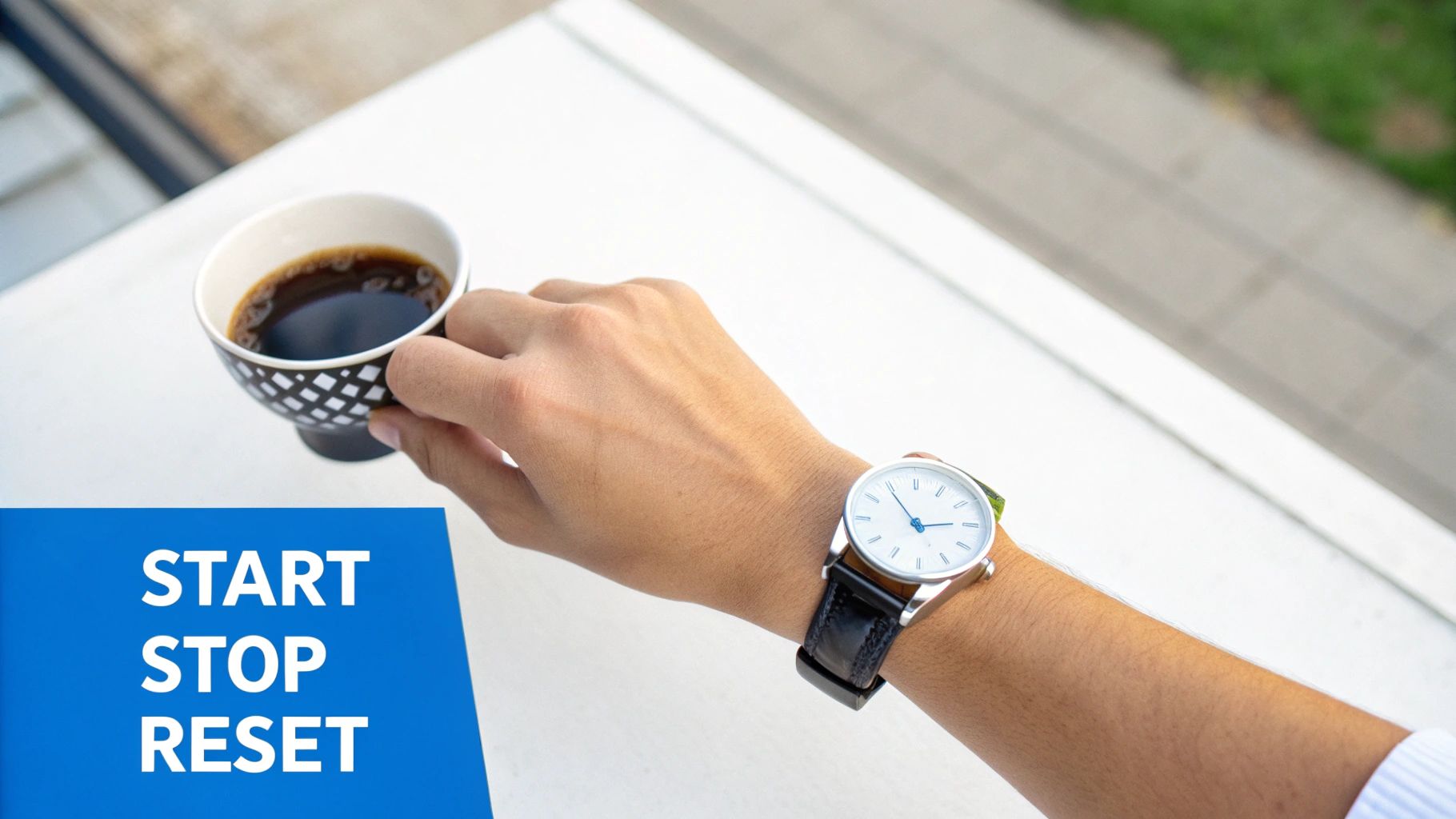
Knowing the theory is one thing, but actually using a chronograph is where the fun begins. This complication was born for action, and getting the hang of a standard two-pusher model is surprisingly simple once you know the basic commands.
Think of the pushers as your control panel. The top one, usually sitting at the 2 o’clock position, handles both start and stop. The bottom pusher, found down at 4 o’clock, has one critical job: resetting everything back to zero. That’s it. Those two buttons are all you need to time just about anything.
Your First Timing Exercise
Let's walk through it with something simple, like brewing your morning coffee. This little exercise will make the whole process feel second nature.
- Prepare for Liftoff: Before you start, glance at the dial. The long central chronograph hand and the little sub-dial hands should all be parked at their zero position (usually 12 o'clock). If not, give that bottom pusher a quick press to reset them.
- Start the Timer: The second the water hits the coffee grounds, give the top pusher a firm click. You’ll see that long central hand jump to life, beginning its clean sweep around the dial.
- Stop the Clock: Once the brew is just right, press that same top pusher again. The hand will freeze in its tracks, locking in the elapsed time. A quick look at the sub-dials will tell you how many full minutes have passed.
- Reset to Zero: After you’ve noted the time, press the bottom pusher. All the chronograph hands will snap right back home, ready for their next mission.
This simple start-stop-reset sequence is the heart and soul of what a chronograph does. It works the same whether you're timing a steak on the grill, a set at the gym, or a crucial presentation.
There's one golden rule with mechanical chronographs: Never, ever press the reset pusher while the stopwatch is still running. Doing so can cause serious, expensive damage to the delicate gears and levers inside. Always stop the timer first.
It’s a small detail, but it’s the key to keeping your watch healthy and accurate for years to come. By following these steps and remembering that one critical rule, you’ll turn a beautiful timepiece into a genuinely useful tool for everyday life.
In the world of watches, two words get thrown around and mixed up more than any others: chronograph and chronometer. They sound almost identical, but they mean completely different things. Getting this straight is a rite of passage for any new watch lover.
So, what's the deal?
A chronograph is a feature, a complication. It’s simply the stopwatch function we've been talking about—the ability to start, stop, and reset a timer. It describes something the watch does.
A chronometer, on the other hand, is a badge of honor. It’s a certification of precision given to a watch movement that has survived a series of intense accuracy tests by an official body, most famously the Contrôle Officiel Suisse des Chronomètres (COSC). It describes how well the watch performs as a timekeeper.
A Quick Automotive Analogy
Think of it this way—if your watch were a car:
- The chronograph is like having a button on the dash for nitrous boost. It’s an extra feature that gives you a specific function when you need it.
- The chronometer certification is like an official certificate proving the engine was tested and met elite standards for power, efficiency, and reliability under tough conditions.
A watch can absolutely be a chronograph without being a chronometer. And a watch can be a chronometer without having a chronograph function. But when a watch is both? That’s something special. It’s a marriage of complex functionality and certified, high-grade performance.
It all boils down to this: Chronograph = Function (Stopwatch), Chronometer = Precision (Certified Accuracy). One tells you about a watch's capabilities, and the other tells you about its quality as a timekeeping machine.
Common Questions About Chronograph Watches
To round things out, let's tackle a few of the most common questions that come up for both new and aspiring chronograph owners. Getting these answers straight will help you feel more confident about how your watch works and how to get the most out of it.
Can I Leave the Chronograph Running All the Time?
This is probably the number one question we hear. While you technically can let the stopwatch run continuously on most models, it's really not a great idea for mechanical chronographs.
Leaving that complication engaged puts constant, extra strain on the watch's mainspring and the intricate parts of the movement. Over time, this can lead to faster wear and tear and might even throw off the watch's basic timekeeping accuracy. It also chews through your power reserve much, much faster.
On a quartz chronograph, the main issue is simply a dead battery. It won't hurt the movement, but it will drain the power source much quicker.
Are Chronographs Waterproof?
Another frequent question is about water resistance. A watch's ability to keep water out is all about its case construction—the gaskets, the screw-down crown, and the caseback. It has nothing to do with the chronograph function itself. Many chronographs are highly water-resistant.
But there's one golden rule you absolutely must follow.
Never, ever operate the pushers while the watch is submerged in water. The only exception is if you own a specific diver's chronograph that is explicitly designed for that purpose. Using the pushers underwater will break the watertight seals, letting moisture flood the case and cause devastating—and very expensive—damage.
Why Are Mechanical Chronographs So Expensive?
It all comes down to one word: complexity. The movement inside a mechanical chronograph is a miniature city of hundreds of tiny, precisely engineered parts. We're talking about an ecosystem of levers, gears, springs, and wheels that all have to work together in perfect harmony.
The sheer level of craftsmanship, the hours of painstaking labor needed for assembly, and the significant R&D costs all add up. That's why they carry a higher price tag than a simple three-hand watch. It’s a true testament to the incredible skill that goes into creating such a sophisticated piece of micro-engineering.
Whether you're looking for your first chronograph or a rare collector's piece, ECI Jewelers offers a curated selection of authenticated luxury timepieces with expert guidance. Explore our collection at https://www.ecijewelers.com.


