


A dive watch is so much more than a timepiece that can get wet; it's a high-performance, life-saving instrument built for survival in some of the most unforgiving environments on Earth. Its entire reason for being is to reliably track time when things get serious, acting as a critical backup to modern dive computers.
More Than Just a Watch
So, what is a dive watch at its core? Think of it less like jewelry and more like a piece of essential safety gear, right up there with your air tank or depth gauge.
These watches were originally born out of necessity for military frogmen and professional divers. Because of that, their design is rooted in absolute reliability and instant legibility—two things you desperately need when your life is on the line. Beyond telling time, a dive watch is a vital tool for managing your dive, especially when exploring amazing places like Hawaii's top night dives.
This purpose-built design is what truly separates a dive watch from a simple "water-resistant" one. Sure, plenty of watches can handle a splash in the pool, but a true dive watch is engineered to withstand crushing pressure, shrug off corrosive saltwater, and deliver critical info in dark, murky water.
A genuine dive watch is defined by its function, not just its form. It’s a tool where every single component serves a specific, often life-preserving, purpose for underwater exploration.
Core Characteristics of a Dive Watch
It’s the combination of very specific features that defines a dive watch. Each element was designed as a direct solution to a real-world problem divers face. Over time, these core traits have become iconic, influencing watch design for decades and turning the dive watch into a beloved style icon for collectors and enthusiasts, even those who never leave dry land.
To get a quick handle on what sets these watches apart, you need to understand their foundational features and the job each one does.
At a Glance: The Core Features of a True Dive Watch
The table below breaks down the essential characteristics that separate a genuine dive watch from a simple water-resistant timepiece. Think of this as the definitive checklist.
| Feature | Primary Function |
|---|---|
| High Water Resistance | Guarantees the watch's internal mechanics are protected from the crushing pressure found at significant depths, typically 100 meters minimum. |
| Unidirectional Bezel | Acts as a simple, failsafe countdown timer to track dive time. Crucially, it only turns one way to prevent accidentally adding time. |
| Exceptional Legibility | Uses high-contrast dials and potent luminous material (lume) on hands and markers to ensure the time is instantly readable in low-light conditions. |
| Robust Construction | Employs durable materials like stainless steel or titanium and a tough crystal to resist shocks, impacts, and the corrosive effects of saltwater. |
Each of these features is a non-negotiable part of the dive watch formula, working together to create a reliable and functional underwater tool.
Deconstructing the Anatomy of a Dive Watch
A true dive watch isn't just a tough-looking timepiece; it's a symphony of purpose-built components working in perfect harmony. Every single feature is a direct, life-saving answer to a question posed by the unforgiving underwater world. To really get what a dive watch is, we need to look under the hood.
This infographic breaks down the core jobs a dive watch performs for an underwater explorer.
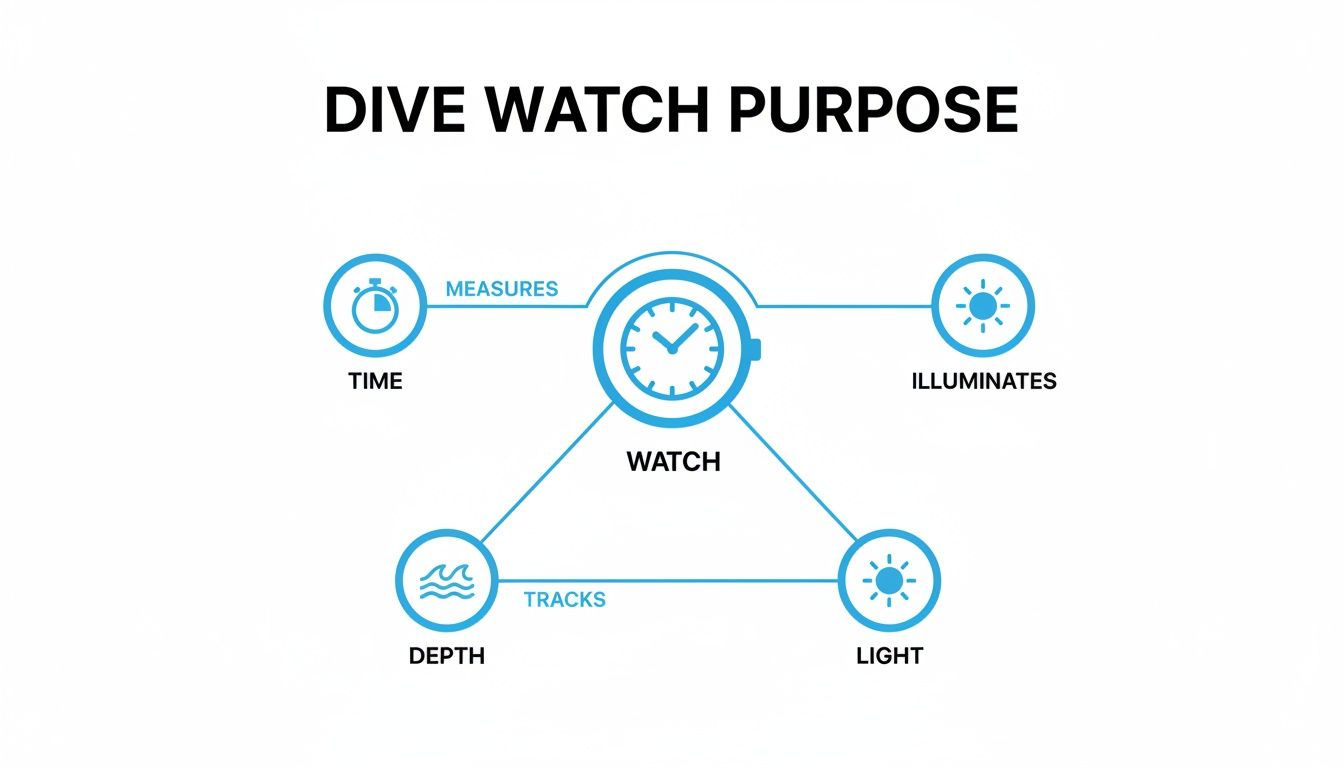
As you can see, a diver’s watch isn’t just about telling the time of day. It’s a multi-functional instrument designed to manage the critical variables of a dive.
The Unidirectional Bezel: Your Failsafe Timer
The unidirectional rotating bezel is probably the most iconic feature of any dive watch. Think of it as a simple, mechanical egg timer for your precious air supply. Before heading down, a diver simply turns the bezel to align its zero marker (usually a triangle or dot) with the minute hand.
As the dive progresses, the minute hand points to the elapsed time on the bezel, telling the diver exactly how long they've been underwater. The magic is in its one-way movement—it only turns counter-clockwise. This is a brilliant safety design. If you accidentally bump it, it can only shorten your perceived dive time, never extend it, which prevents you from staying down longer than your air tank allows.
Luminous Markers: A Beacon in the Dark
Underwater, visibility can drop to almost zero in a heartbeat. That's when luminous markers, or "lume," become absolutely essential. Any high-grade dive watch will use powerful phosphorescent materials like Super-LumiNova on the hands, hour markers, and the bezel's zero marker.
This material acts like a battery for light, absorbing it and then glowing brightly in the dark. It ensures the time is readable with just a quick glance, even in the murkiest water. It’s the watch world's equivalent of a built-in flashlight, providing vital information when light is gone.
A dive watch must be legible at a distance of 25 cm (about 10 inches) in total darkness to pass ISO 6425 certification. This proves just how critical clear, luminous visibility is for a professional-grade instrument.
The Screw-Down Crown: A Submarine Hatch
The crown—that little knob you use to set the time—is the weakest point for water entry on any watch. On a proper dive watch, this vulnerability is protected by a screw-down crown. It works exactly like the hatch on a submarine.
It has internal threads that let you screw it down tightly against the case, compressing a set of gaskets to form a hermetic seal. This simple but incredibly effective mechanism stops water from flooding the delicate movement, even under immense pressure. If you're curious about the intricate engine this feature protects, you can learn more about how a mechanical watch works in our detailed guide.
Water Resistance Ratings: Depth Demystified
Every dive watch has a depth rating, usually 200M (660 feet) or 300M (1000 feet). It's crucial to understand this isn't the literal depth the watch is safe for. These ratings are achieved in static, perfectly controlled laboratory conditions—no movement, no temperature changes.
In the real world, swimming or just moving your arm creates dynamic pressure that is far greater than the static pressure at that same depth.
- 100M: Good for surface swimming and snorkeling, but not diving.
- 200M/300M: This is the real-deal standard for recreational scuba diving. A watch with this rating is built to handle the dynamic pressures and occasional impacts that come with exploring underwater.
The Helium Escape Valve: For Saturation Divers
This next one is a bit more specialized. The Helium Escape Valve (HEV) is a small, one-way valve built for professional saturation divers. These are the divers who spend days or even weeks living in pressurized underwater habitats filled with a helium-rich breathing gas.
Over that time, tiny helium molecules can actually seep past the watch's seals and build up inside the case. During decompression, this trapped helium expands and can literally pop the crystal right off the watch. The HEV is designed to automatically open and let this helium out, equalizing the pressure and saving the watch from blowing itself apart.
From Military Tool to Luxury Icon: The History of the Dive Watch
The dive watch wasn't born in a jewelry store display case. It was forged in the deep, unforgiving worlds of military operations and underwater exploration, where a reliable timepiece was a non-negotiable piece of survival gear. Its journey from essential tool to coveted luxury icon is a story of grit, innovation, and adventure.
That rich heritage is a huge part of what pulls collectors in today. It all started long before recreational scuba diving became a hobby. In the early 20th century, just making a watch truly water-resistant was a massive engineering hurdle. Early pioneers like Rolex, Panerai, and Omega were on the front lines, creating groundbreaking timepieces for naval divers that could handle pressures once thought impossible. You can read more about some of the first waterproof watches over at Livwatches.com.
The Golden Age of Diving
The real dawn of the modern dive watch came in the post-war boom of the 1950s. This decade gave us the two titans that would write the rulebook for the entire genre: the Blancpain Fifty Fathoms and the Rolex Submariner. Both launched in 1953, and neither was designed in a vacuum. They were developed hand-in-hand with elite naval units—the French Combat Diving School for Blancpain and various military forces for Rolex.
These watches weren't just marketed to the public; they were proven in the most hostile environments on earth. Their adoption by military frogmen and underwater legends like Jacques Cousteau cemented their reputation for being tough-as-nails and absolutely dependable.
The design language established by the Submariner and Fifty Fathoms—a rotating black bezel, a high-contrast dial with luminous markers, and a robust steel case—became the undisputed standard for what a dive watch should be.
This battlefield-tested legacy is what elevates a dive watch from a simple accessory to a piece of engineering history on your wrist. To understand the icon that truly set the standard, check out our complete guide to the Rolex Submariner the dive watch that defined a legacy.
From Tool to Treasure
As scuba diving exploded in popularity as a recreational sport in the 1960s and 70s, the dive watch made a natural leap from a professional instrument to a must-have consumer item. Its rugged build and undeniable association with adventure made it a powerful status symbol, even on dry land. After all, if a watch could survive the crushing pressures of the deep sea, it could certainly handle the daily grind.
Today, that history is everything. For collectors, a vintage model’s story—its military service or connection to a famous expedition—is often just as valuable as its mechanical movement. This perfect blend of rugged function and timeless style is what keeps the dive watch an enduring icon.
Understanding the ISO 6425 Gold Standard
So, what separates a real-deal dive watch from something that just looks the part? In a word: certification. And in the world of professional dive watches, the undisputed benchmark is ISO 6425.
This isn't just some fancy marketing term. Think of it as a brutal, multi-stage boot camp for a timepiece. To earn the right to be called a true "diver's watch"—and have "DIVER'S WATCH L" printed on its dial—a watch can't just claim compliance. It has to survive a battery of independent tests designed to simulate the absolute worst conditions a diver could face.
This certification is a non-negotiable guarantee that your watch isn't just a stylish accessory; it's a piece of life-saving equipment.
The Gauntlet of ISO 6425 Tests
The standard is exhaustive, pushing a watch to its absolute limits. To pass, a watch must prove it can handle:
- Over-Engineered Water Resistance: Every single watch is individually tested to 125% of its claimed depth rating. That means a 200M watch is actually subjected to the pressure of 250 meters. There's no batch testing here.
- Shock and Thermal Torture: It has to withstand hard impacts and survive rapid, extreme temperature swings without missing a beat.
- Anti-Magnetic Properties: The watch must maintain its accuracy even after being exposed to a powerful magnetic field, which could otherwise wreck its timekeeping.
- Absolute Legibility and Function: The unidirectional bezel must be clearly marked and work flawlessly. Crucially, the dial must be perfectly legible from 25 cm away in total darkness.
- Corrosion-Proof Durability: It must endure a long, punishing saltwater spray test to ensure its case and components won't degrade over time.
Before you make a purchase, understanding the difference between a certified diver and a simple "diver-style" watch is critical. The table below breaks down exactly what that certification guarantees.
ISO 6425 Certified vs Diver-Style Watch: A Head-to-Head Comparison
This table clearly contrasts the guaranteed performance of an ISO 6425 certified watch against a watch that only shares the visual style, helping you understand the true value.
| Feature Test | ISO 6425 Certified Watch | Diver-Style Watch |
|---|---|---|
| Water Resistance Test | Individually tested to 125% of its stated depth. | Often batch-tested to its stated depth, not beyond. |
| Testing Protocol | Each watch must pass every single test in the standard. | No standardized testing required; claims are made by the manufacturer. |
| Legibility in Darkness | Must be readable from 25 cm away in total darkness. | Legibility varies; no official standard to meet. |
| Bezel Functionality | A functional, unidirectional timing bezel is mandatory. | Bezel may be bidirectional or purely decorative. |
| Shock & Magnetic Resistance | Proven to withstand specific levels of impact and magnetism. | No guaranteed resistance to shocks or magnetic fields. |
| Dial Marking | Officially allowed to be marked "DIVER'S WATCH L". | Not permitted to use the official ISO diver's marking. |
Ultimately, a watch that passes this gauntlet has earned its stripes. It’s the difference between a watch that simply looks like a tool and one that has been officially proven to be one.
A watch that is merely "water-resistant" is typically tested in batches under static pressure. An ISO 6425 certified watch is tested individually and pushed well beyond its limits, offering a proven level of robustness that a simple 'diver-style' watch just can't match.
For any collector or professional who depends on their timepiece when things get serious, the ISO 6425 stamp provides the ultimate peace of mind. It’s a mark of true engineering and reliability.
A Collector's Guide to Investing in a Dive Watch
For a collector, a luxury dive watch isn't just a purchase—it's an investment in engineering, history, and a style that never fades. Going beyond the technical specs, the real decision comes down to appreciating a watch's heritage, its physical condition, and its potential to hold or even grow in value.
Here's what you need to know to navigate the market with an expert's eye.
The market for these watches is incredibly strong. Think about this: by 2023, dive watches made up a stunning 25% of all Swiss watch exports. Pre-owned icons like the Rolex Sea-Dweller have shown annual appreciation between 15-20%. These numbers show that a classic diver offers more than just rugged water protection; it carries significant heritage and investment value.
Evaluating an Investment Piece
When you're looking at a luxury dive watch, three things should be at the top of your mind: authenticity, condition, and provenance. Each one plays a huge role in the watch's long-term value.
- Authenticity Checks: Don't just look at the brand on the dial. A trustworthy seller will show you matching serial numbers on the case and paperwork. They'll verify the movement is correct for that specific reference and confirm that every part, from the bezel insert to the clasp, is period-correct.
- Condition Assessment: You want a case that still has its original factory finish and sharp, well-defined lugs. A watch that's been over-polished can lose a massive amount of its vintage value. The patina on the dial and hands should match, and the lume should look right for the watch's age.
- Provenance and Completeness: The phrase "full set" is what every collector wants to hear. Having the original box, warranty papers, hang tags, and even the original sales receipt can boost a watch's value by 20-30% or more, especially for highly desirable models.
Provenance is the documented history of a watch. A timepiece with a clear ownership trail and all its original paperwork isn't just a watch—it's a complete historical artifact.
Iconic Models to Consider
Some models have rightfully earned their "blue-chip" investment status. The Rolex Submariner is the undisputed king of the category, but plenty of other pieces offer incredible history and value.
The Omega Seamaster collection, famous for its connections to professional diving and a certain cinematic spy, has a huge range of references to explore. Likewise, the Tudor Black Bay has become a modern icon, loved for its vintage looks and fantastic build quality at a more approachable price. Learning the details of these models is a huge part of the fun of collecting. To learn more, check out our guide on investing in luxury watches.
Of course, a great dive watch is meant to be a companion for adventure. For those who actually get in the water, investing in your own dive gear can make the experience even better. Ultimately, a great dive watch is ready for anything, whether you're exploring the ocean depths or just navigating daily life.
Caring for Your Dive Watch for a Lifetime of Use
A luxury dive watch is a tough piece of engineering, built to handle some pretty extreme conditions. But even the toughest tool needs consistent care to keep it running for a lifetime. Protecting its function and value just takes a few simple habits every owner should know.

After any swim in saltwater or a chlorinated pool—or even a heavy workout—always give your watch a good rinse with fresh, lukewarm water. This one simple step stops corrosive salt from building up and keeps moving parts, like the bezel, turning smoothly. Just as important, always double-check that the screw-down crown is fully secured before you even think about getting it wet.
Routine Maintenance and Servicing
While rinsing is great for day-to-day care, professional servicing is non-negotiable if you want to protect your investment. The internal gaskets that keep water out break down over time, even if the watch just sits in a drawer.
A dive watch’s water resistance isn't permanent. Regular servicing and pressure testing are the only ways to guarantee its protective seals are still doing their job.
Most luxury brands recommend a full service every 5 to 10 years. Here’s what a certified watchmaker will do during that process:
- Completely disassemble and clean the movement.
- Replace all worn-out gaskets and seals.
- Perform a pressure test to re-certify its depth rating.
Stick to this schedule, and your timepiece will stay a reliable, adventure-ready companion for decades to come.
Common Questions About Dive Watches
After covering the technical side of things, a few practical questions almost always come up. Here are the quick answers to what collectors and new owners ask most.
Is a 300M Dive Watch Overkill for Swimming?
Honestly, yes—and that’s the point. While 300 meters of water resistance is far more than you’ll ever need for a dip in the pool, it speaks volumes about the watch's engineering. Think of it as an indicator of overbuilt toughness. That level of durability means your watch can handle swimming, snorkeling, and daily life without you ever having to worry, giving you total peace of mind.
Can I Actually Use the Bezel for Normal Things?
Absolutely. The unidirectional bezel is one of the most useful analog timers you can have. Once you get in the habit of using it, you'll find yourself timing everything from parking meters and coffee breaks to grilling steaks and workouts. It's a simple, tactile, and incredibly practical feature that adds real utility to the watch, long after you've left the water.
Think of the bezel as a mechanical "note to self." It's a low-tech, failsafe reminder that's always ready on your wrist—no batteries required.
How Often Does a Luxury Dive Watch Need to Be Serviced?
Most high-end brands recommend a full service every 5 to 10 years, though this can vary based on how you use it. During a service, technicians will inspect the movement for wear, replace all the gaskets and seals that keep water out, and pressure-test it to confirm it’s still watertight. Sticking to a regular maintenance schedule is the key to protecting its accuracy, performance, and value for decades to come.
At ECI Jewelers, we provide expert servicing with genuine parts to ensure your timepiece performs flawlessly for a lifetime. Ready to find your next watch? Explore our curated collection of authenticated luxury dive watches or schedule your next service with our team of specialists.


