

At its simplest, a power reserve is the ‘fuel gauge’ for your mechanical watch. It’s a wonderfully practical feature that shows you exactly how much longer the watch will run before it needs to be wound again.
Think of it like the gas tank in your car. The power reserve indicator tells you how much stored energy is left in the watch's mainspring, typically measured in hours.
Your Watch's Fuel Gauge Explained
At its core, the concept of a power reserve answers a simple but critical question for any mechanical watch owner: how much longer will this thing keep ticking? Before we dive into the mechanics, it helps to explore various watches to get a feel for the different styles and features out there.
This complication is more than just a number on a spec sheet. It’s about convenience, engineering pride, and even the health of your timepiece. A longer reserve means you can set your watch down for a weekend and pick it up Monday morning, still running perfectly.
To break it down even further, here's a quick look at the core ideas.
Power Reserve At a Glance
This table simplifies the key concepts, reinforcing the 'fuel gauge' analogy for easy understanding.
| Concept | Simple Explanation | Why It Matters for You |
|---|---|---|
| Mainspring | A coiled spring that stores energy when you wind the watch. | This is your watch's "gas tank." |
| Power Reserve | The total time the watch can run on a fully wound mainspring. | Tells you how long the "tank of gas" will last. |
| Indicator | A small gauge on the dial showing the remaining energy. | The "fuel gauge" itself—no more guessing. |
Ultimately, knowing your power reserve brings a level of confidence and connection to your mechanical watch that you just don't get with quartz.
The Evolution of Endurance
Watchmaking has come a long way. Early pocket watches from the 16th century barely lasted the day, with reserves of just 8-12 hours. By the 19th century, masters like Abraham-Louis Breguet had pushed that figure to a more respectable 36 hours. Today, the industry standard for many automatic watches hovers around 40 to 50 hours.
But modern luxury brands are constantly pushing the envelope. Take Omega's Powermatic 80 movement, for example. It boasts an impressive 80-hour reserve, nearly doubling the 42 hours you'd find in a workhorse movement like the common ETA 2824. To learn more about how brands have historically advanced this technology, you can discover more insights about power reserve evolution on beaubleu-paris.com.
A strong power reserve is a direct signal of a modern, efficient movement. It shows that the watchmaker has focused on optimizing everything from the mainspring's material to the gear train's efficiency, providing tangible benefits to the owner.
In the end, a power reserve watch delivers both peace of mind and a glimpse into the technical prowess ticking away on your wrist. It’s a feature that bridges the gap between the watch’s complex inner world and your daily life, making it a truly valuable complication for collectors and first-time buyers alike.
The Mechanics Behind the Power Reserve
To really get what makes a power reserve watch tick, you have to look under the hood. It’s all about a beautifully simple and elegant mechanical ballet.
At the heart of it all is the mainspring, a tightly coiled ribbon of metal tucked inside a small drum called a barrel. The easiest way to picture it is as the watch's battery—but a purely mechanical one, just like the spring in an old-school wind-up toy.
When you turn the crown on your watch, you're literally loading potential energy into that spring. Each twist tightens the coil, packing it with the force needed to run the entire timepiece. That stored energy is then released in a perfectly controlled, gradual way.
The hero of this controlled release is the escapement. This ingenious little mechanism lets the mainspring's power "escape" one tiny tick at a time, which is what moves the gears and, ultimately, the hands on the dial. If you want to go deeper, you can learn more about how a mechanical watch works in our detailed guide.
This whole process—winding up and letting go—is a straightforward flow of power from your hand to the watch hands.
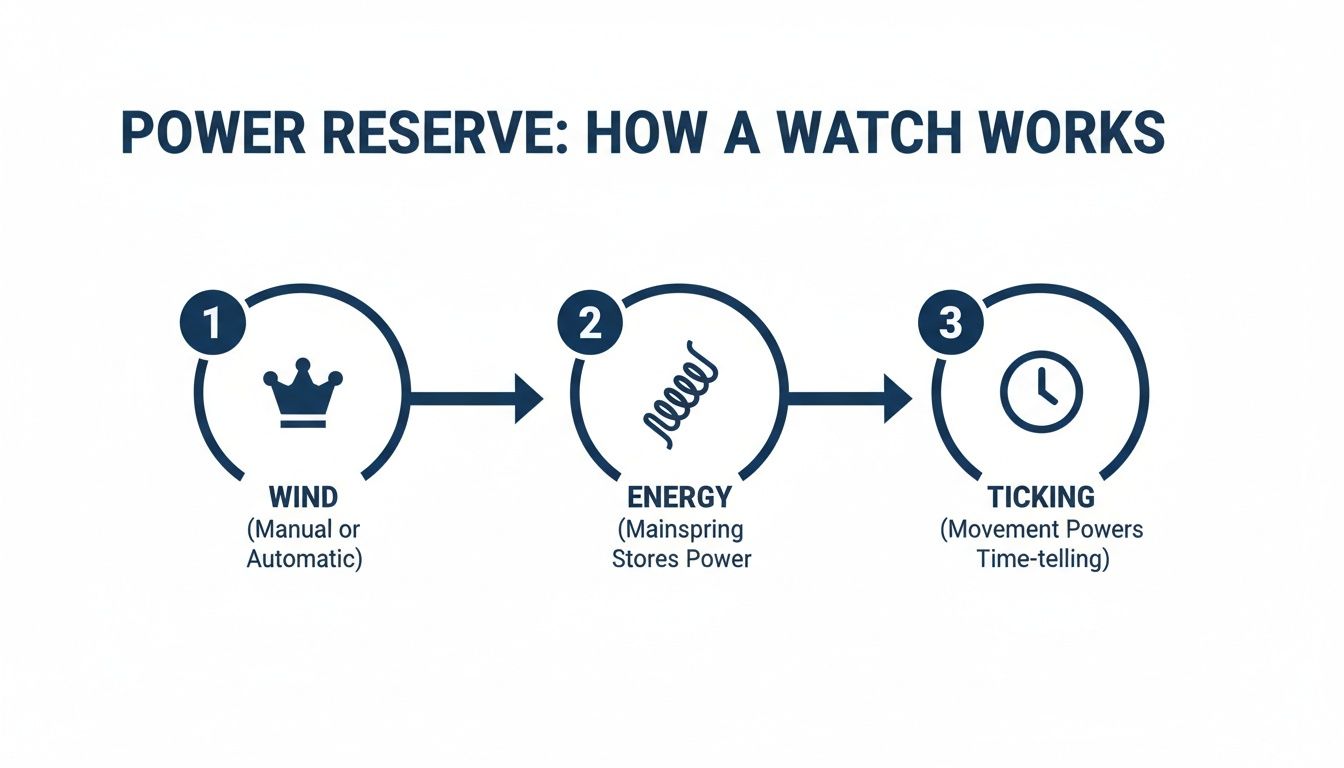
As you can see, it's a simple sequence: your action (winding) creates stored energy (the mainspring), which is then converted into precise timekeeping.
Manual vs. Automatic Winding
How you "fill the tank," so to speak, depends entirely on the watch's movement. Mechanical watches come in two main flavors, and each one handles the power reserve a bit differently.
-
Manual-Wind Movements: These are for the traditionalists. The mainspring gets its power only one way: by you turning the crown. Think of iconic watches like the Omega Speedmaster Professional—they require that direct interaction. You wind it until you feel a bit of resistance, and from that moment, the power reserve starts its countdown.
-
Automatic (Self-Winding) Movements: These add a brilliant layer of convenience. You can still wind them with the crown, but they also have a weighted, semi-circular piece inside called a rotor. As you go about your day and your wrist moves, that rotor spins and automatically winds the mainspring for you. The Rolex Submariner is a perfect example of this. As long as you wear it regularly, your own motion keeps the watch powered up.
Both manual and automatic watches are built on the same core principle: a coiled mainspring doing the work. The only real difference is how that spring gets tightened—either by your fingers or by the passive motion of your daily life.
Understanding this is key. With a manual-wind watch, the power reserve is a finite resource you have to actively top off. With an automatic, it’s more like a backup that keeps the watch running overnight or if you set it aside for a day or two. Either way, both celebrate the beautiful, battery-free engineering that defines what a power reserve watch is all about.
Understanding Different Power Reserve Durations
Not all power reserves are created equal. The runtime of a mechanical watch, from the moment it's fully wound until it stops ticking, has a huge impact on its convenience and says a lot about the sophistication of its movement.
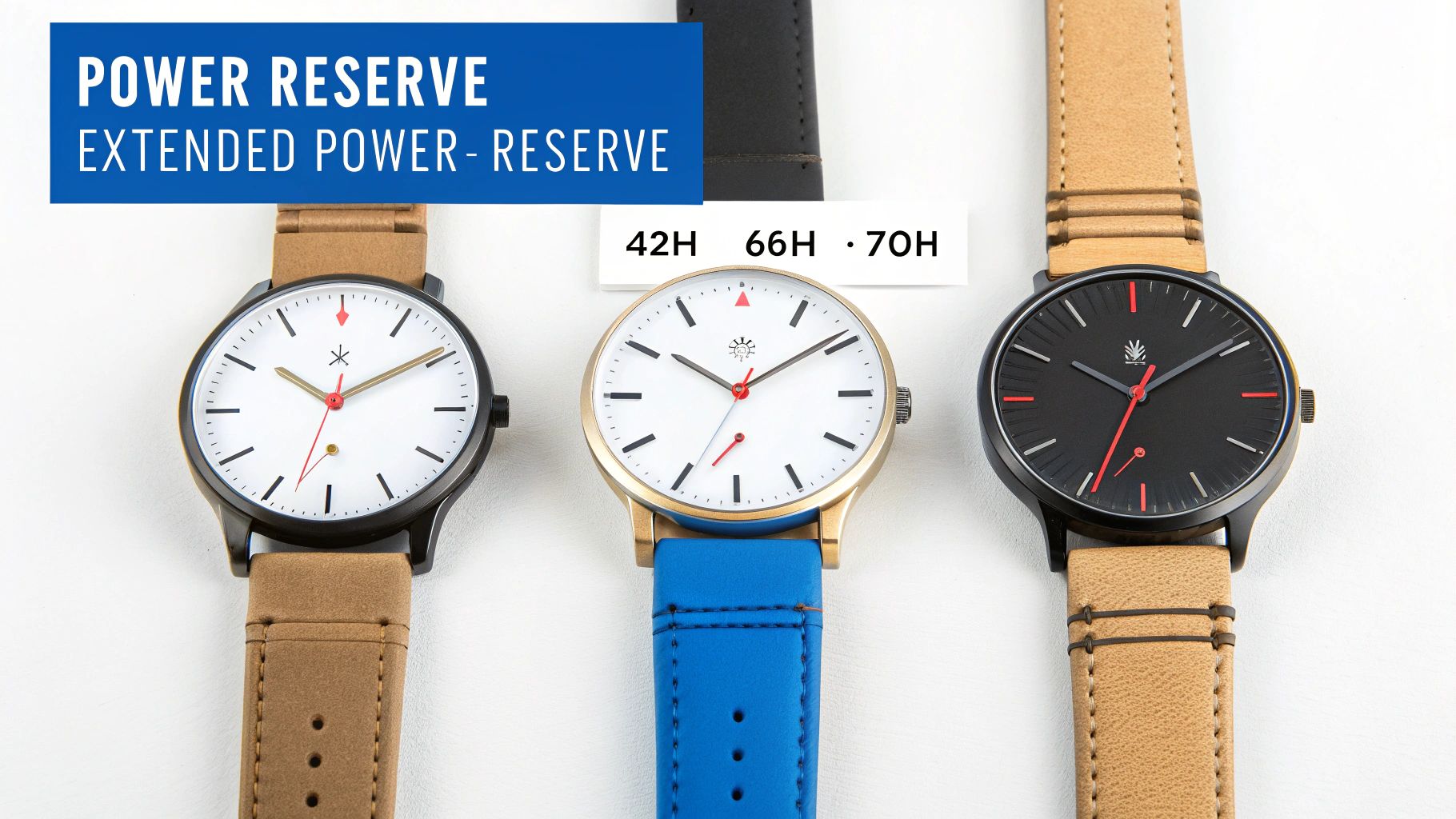
The Standard Daily Driver: 38-42 Hours
For decades, the industry standard for a solid mechanical watch has been a power reserve of around 38 to 42 hours. This is more than enough for a daily-wear timepiece.
If you wear an automatic watch with this kind of reserve every day, the natural motion of your wrist keeps the mainspring topped up. You can take it off at night, and it will still be ticking away perfectly the next morning. It’s a proven, practical balance of engineering and reliability.
But for collectors who like to rotate their watches, that standard duration can be a bit of a headache. Take your watch off Friday evening, wear something else for the weekend, and by Monday morning, it’s stopped. That means you’re stuck resetting the time and date all over again.
This is exactly why longer power reserves have become such a game-changer.
A watch’s power reserve defines its autonomy and convenience. While automatic models traditionally averaged 40-48 hours, advancements in horology have pushed these boundaries, offering collectors greater flexibility and showcasing remarkable technical skill.
The Rise of the "Weekend-Proof" Watch: 60+ Hours
The idea of a "weekend-proof" power reserve has become a major selling point in modern watchmaking. With 60 hours or more of runtime, you can put your watch down on Friday and pick it back up on Monday, still running accurately. It’s a small detail that makes a huge difference.
This leap in performance doesn't happen by accident. It’s the result of some seriously impressive engineering:
- Bigger Barrels: Some watchmakers design movements with physically larger mainspring barrels to fit a longer, more powerful spring.
- Multiple Barrels: Others use two (or more) barrels that work together, effectively doubling or tripling the runtime.
- Smarter Engineering: Many brands are now developing high-efficiency escapements and gear trains that use less energy, squeezing more hours out of the same amount of power.
Brands like Tudor have made a 70-hour power reserve their new standard across many models, offering incredible value. At the same time, specialists like Panerai have built their reputation on massive multi-day reserves, with some watches running for eight days or more on a single wind. For a closer look at how automatic movements keep themselves wound, check out our guide on what an automatic watch is.
To give you a clearer picture, here’s a quick breakdown of what you can expect from different power reserve tiers in today's market.
Typical Power Reserve Benchmarks
| Power Reserve Tier | Typical Duration | Ideal For | Example Models |
|---|---|---|---|
| Standard Daily | 38–48 Hours | The everyday watch worn consistently. | Hamilton Khaki Field, Tissot Gentleman, Seiko 5 |
| Weekend-Proof | 60–80 Hours | Collectors who rotate watches or want a buffer. | Tudor Black Bay 58, Omega Seamaster, Longines Spirit |
| Extended Reserve | 3–5 Days (72–120 Hours) | Travelers and those who value technical prowess. | IWC Big Pilot, Oris Calibre 400 models, Hublot Big Bang |
| Ultra-Long | 8+ Days (192+ Hours) | Enthusiasts seeking horological innovation. | Panerai Luminor 8 Days, Hublot MP series, A. Lange & Söhne |
This evolution from a daily necessity to a weekend-proof convenience really highlights a brand's technical mastery. It shows they're not just making watches—they're thinking about how we actually live with them.
How to Read a Power Reserve Indicator
A power reserve is a great spec on paper, but it really comes to life on the dial with a power reserve indicator. This complication is the visual bridge between you and your watch's mechanical heart, turning an abstract number into something you can actually use. Think of it like this: knowing your car has a 15-gallon tank is one thing, but having a working fuel gauge on the dashboard is what really matters.
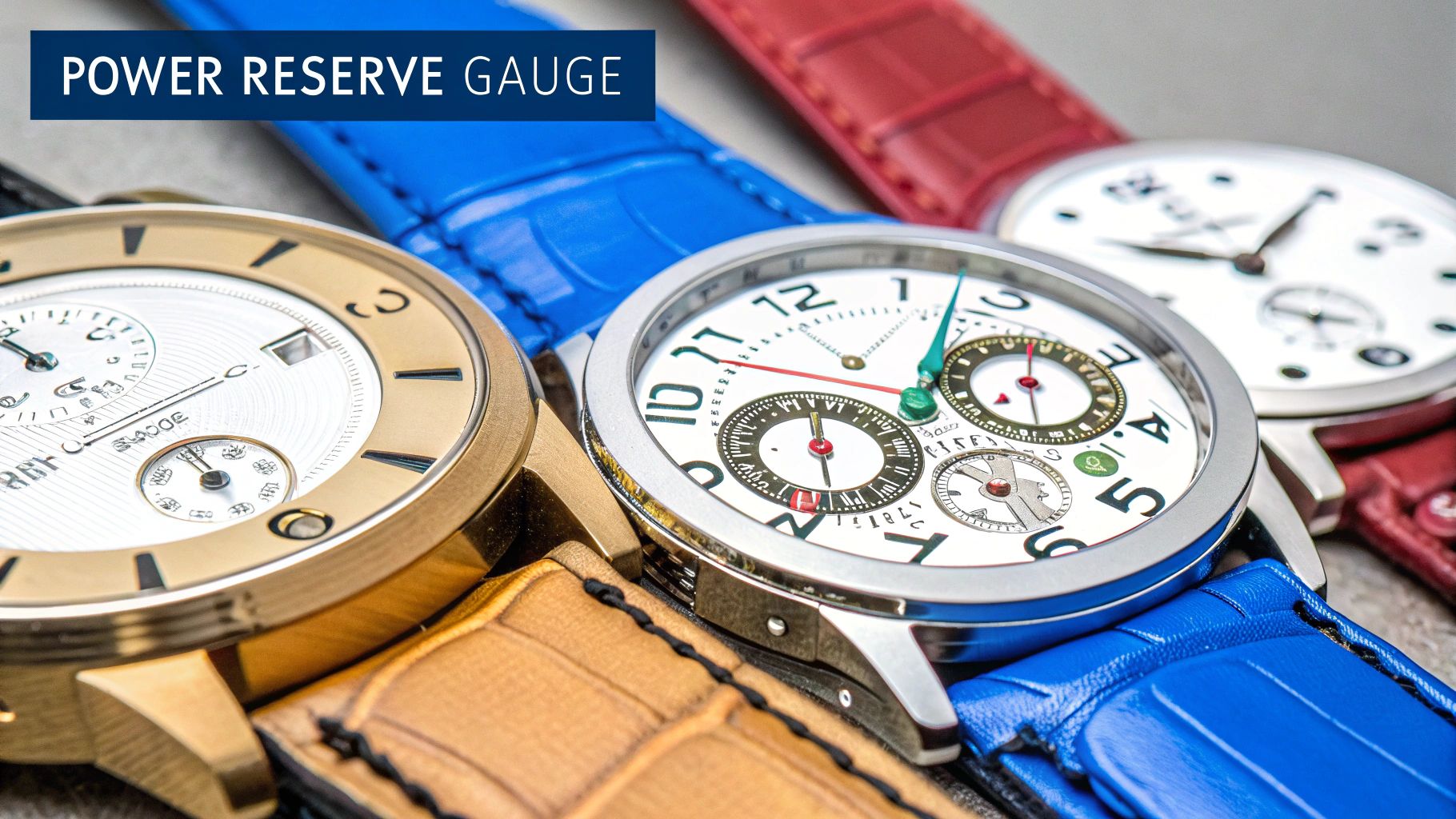
Watchmakers have come up with some pretty clever ways to display this information, each adding its own unique character to the watch. Once you know what you’re looking for, they're all incredibly easy to read.
Common Display Styles
The most classic and recognizable style is the "up/down" sub-dial. You’ll see this often—it looks a lot like a tiny fuel gauge, with a hand that sweeps across an arc marked with hours or days. When the hand is pointing to the maximum number (like "72" or "F" for full), you know the mainspring is fully wound. As the watch runs, the hand slowly moves toward "0" or "E" for empty. You'll find this iconic design on classics like the IWC Big Pilot's Watch.
Another popular approach is the linear gauge. Instead of a sweeping arc, this indicator uses a straight line with a marker that travels from one end to the other. Panerai is famous for this style, which gives a clean, modern, and super-legible look. Then you have brands like A. Lange & Söhne, which integrate these indicators with such masterful subtlety that they become a seamless part of the dial's artistry.
Of course, some brands get even more creative:
- Disc Indicators: A rotating disc, visible through a small window on the dial, might change color or reveal different numbers to show the power level.
- Sector Gauges: These are similar to the up/down sub-dial but cover a smaller, more angular section of the dial, almost like a slice of pie.
While pioneered in pocket watches, the on-dial power reserve indicator really took off as a key feature in luxury wristwatches in the 1990s. Today, it's found in about 22% of high-end mechanicals, a huge jump from just 4% before the year 2000. That really shows how much modern collectors value it.
Interpreting the Markings
Reading the indicator is totally intuitive. The markings will typically be in hours (0, 24, 48, 72) or sometimes days (0 to 8, for example). If your IWC's indicator points to "3," you’ve got three days of power left. Simple as that. If your Panerai's linear gauge is sitting halfway between 0 and 56, you have about 28 hours of runtime remaining.
This little visual cue is what keeps your watch from unexpectedly stopping. It gives you the power to know exactly when to give the crown a few winds.
Ultimately, this complication is more than just a cool technical feature; it's a genuinely practical part of the ownership experience. A quartz watch might signal a low battery by making the second hand jump every few seconds, but a mechanical watch just… stops. The indicator gives you the foresight to avoid that, deepening your connection to the amazing little machine on your wrist. To dive deeper into how this feature developed, you can learn more about power reserve indicator evolution here.
Best Practices for Winding Your Watch
There’s a certain satisfaction that comes with winding a mechanical watch. It’s a simple, hands-on ritual that connects you directly to the intricate machine on your wrist. But knowing exactly how to do it right is key to keeping your timepiece running happily for years, whether it's a manual or an automatic.
For a classic manual-wind watch, the process is beautifully direct. You simply turn the crown clockwise until you begin to feel a firm resistance. That's the mainspring letting you know it's at full capacity. Do not force it further. Automatic watches, on the other hand, are a bit more forgiving; they have a built-in slipping clutch that prevents damage from overwinding, so there's no risk of going too far.
For a deeper dive into the technique, our complete guide on how to wind a mechanical watch covers all the details.
Maintaining Your Automatic Watch's Reserve
The beauty of an automatic watch is that it's designed to be powered by you. As you go about your day, a rotor inside spins with the motion of your wrist, continuously topping off the power reserve. If you're fairly active, you may never need to wind it by hand.
But what about quieter days? Or when you swap it out for another piece in your collection? That's when the reserve can start to run low.
If your automatic watch has stopped, the best practice is to give the crown 30-40 clockwise turns to build a solid base of power. This jump-starts the movement and ensures it begins running with enough energy for accurate timekeeping before your natural movements take over.
Think of it as giving your watch a good head start for the day. This initial wind is crucial for maintaining its precision.
Managing a Watch Collection
For collectors who rotate through several watches, keeping every piece wound and ready can feel like a chore. No one wants to constantly reset the time and date, especially on complicated models. This is where a watch winder becomes an invaluable tool.
A watch winder is a device that gently rotates your watch, mimicking the motion of your wrist to keep the mainspring wound. Here’s when a winder makes the most sense:
- Convenience: A winder keeps your watches "grab-and-go" ready. This is a lifesaver for timepieces with complex calendar functions that are a hassle to reset.
- Collection Size: If you have more than two automatic watches you wear in rotation, a winder saves a surprising amount of time and effort.
- Complications: Using a chronograph or other power-hungry features will drain the reserve faster. A winder ensures even these complex watches are always ready for action.
Why Power Reserve Is Key When Buying a Watch
When you're ready to invest in a serious timepiece, the power reserve stops being a simple spec on a sheet and becomes a massive factor in how you'll actually live with your watch. It tells you a lot about its convenience, the quality of its engineering, and even its long-term desirability.
First, think about your own habits. Are you a one-watch person who straps on the same piece every single day? If so, a standard 40-hour reserve is plenty. Your daily movements will keep it wound and ready to go without any fuss.
But if you're a collector who likes to rotate through a few different watches, a longer power reserve becomes your best friend. A "weekend-proof" runtime of 70 hours or more means you can take your watch off Friday evening and pick it up Monday morning without having to reset the time and date. It’s a small detail that makes a huge difference.
How Power Reserve Reflects Quality
Beyond pure convenience, a long power reserve is a big tell about the quality of the movement inside. It’s a sign that the watchmaker has gone the extra mile, using advanced mainspring alloys, optimizing the gear train to reduce friction, or even engineering a more complex multi-barrel system.
This level of mechanical sophistication rarely exists in a vacuum. It almost always goes hand-in-hand with better finishing, tighter tolerances, and superior accuracy across the board.
For instance, a seasoned collector might gravitate toward a Panerai Luminor specifically for its incredible eight-day reserve, seeing it as a true feat of horology. In the same way, a first-time Rolex buyer gets a ton of practical, real-world value from the 70-hour reserve in a modern Datejust—a major upgrade over older versions.
A strong power reserve is more than just a number—it’s a hallmark of thoughtful design. It shows a brand’s commitment to making a watch that fits into your life, not the other way around.
Ultimately, you have to weigh the power reserve against your own lifestyle. Doing so gives you the confidence to pick a watch with specs that don't just impress on paper, but truly work for you day in and day out.
Frequently Asked Questions
Even after you get the hang of power reserves, a few questions always seem to come up. Let's tackle the most common ones to round out your understanding.
Can You Overwind a Modern Automatic Watch?
No, you absolutely cannot overwind a modern automatic watch. Engineers solved that problem ages ago with a clever little device called a slipping clutch.
Once the mainspring is fully wound, this clutch simply disengages. The rotor can keep spinning (and you can keep winding the crown) without adding any more tension or causing damage. It's a fantastic fail-safe. Just remember, this only applies to automatics—for a manual-wind watch, always stop winding as soon as you feel solid resistance.
Does a Longer Power Reserve Mean a Better Watch?
Not necessarily, but it's often a sign of a more modern and efficient movement. An extended power reserve is a huge convenience, especially if you like to rotate through several watches during the week.
That said, overall quality is a blend of accuracy, finishing, durability, and brand heritage. A beautifully crafted watch from a top-tier brand with a standard 40-hour reserve is still an exceptional timepiece. Think of a long reserve as a great feature, not the sole measure of greatness.
How Accurate Is a Power Reserve Indicator?
Power reserve indicators are very reliable for their intended job. They are mechanically linked right to the mainspring, giving you a direct visual reading of how much energy is left.
The best way to think about it is like the fuel gauge in your car. It’s not a precise digital countdown to the second, but it gives you a perfectly clear and trustworthy reading of whether your "tank" is full, half-empty, or running on fumes. And that’s exactly what you need it to do.
Why Don’t All Mechanical Watches Have an Indicator?
In watchmaking, adding any function like a power reserve indicator is called a "complication." It means adding more parts, which makes the movement more complex and more expensive to design, build, and service.
Beyond the cost, it's also about aesthetics. Many watch designers and collectors value a clean, uncluttered dial. For a classic dress watch or a minimalist piece, leaving off the indicator preserves a sense of timeless simplicity and elegance.
At ECI Jewelers, we believe understanding the details of a luxury timepiece makes ownership even more rewarding. Whether you're searching for your first automatic watch or adding a new complication to your collection, our experts are here to guide you. Explore our curated selection of authenticated luxury watches from the world's finest brands at https://www.ecijewelers.com.


