


A skeleton watch isn't just a timepiece; it's wearable kinetic art. By meticulously cutting away parts of the dial and movement, watchmakers reveal the intricate mechanics inside.
Think of it like a high-performance car with a transparent hood, where you can see every piston and gear working in perfect harmony.
A Window Into Mechanical Artistry
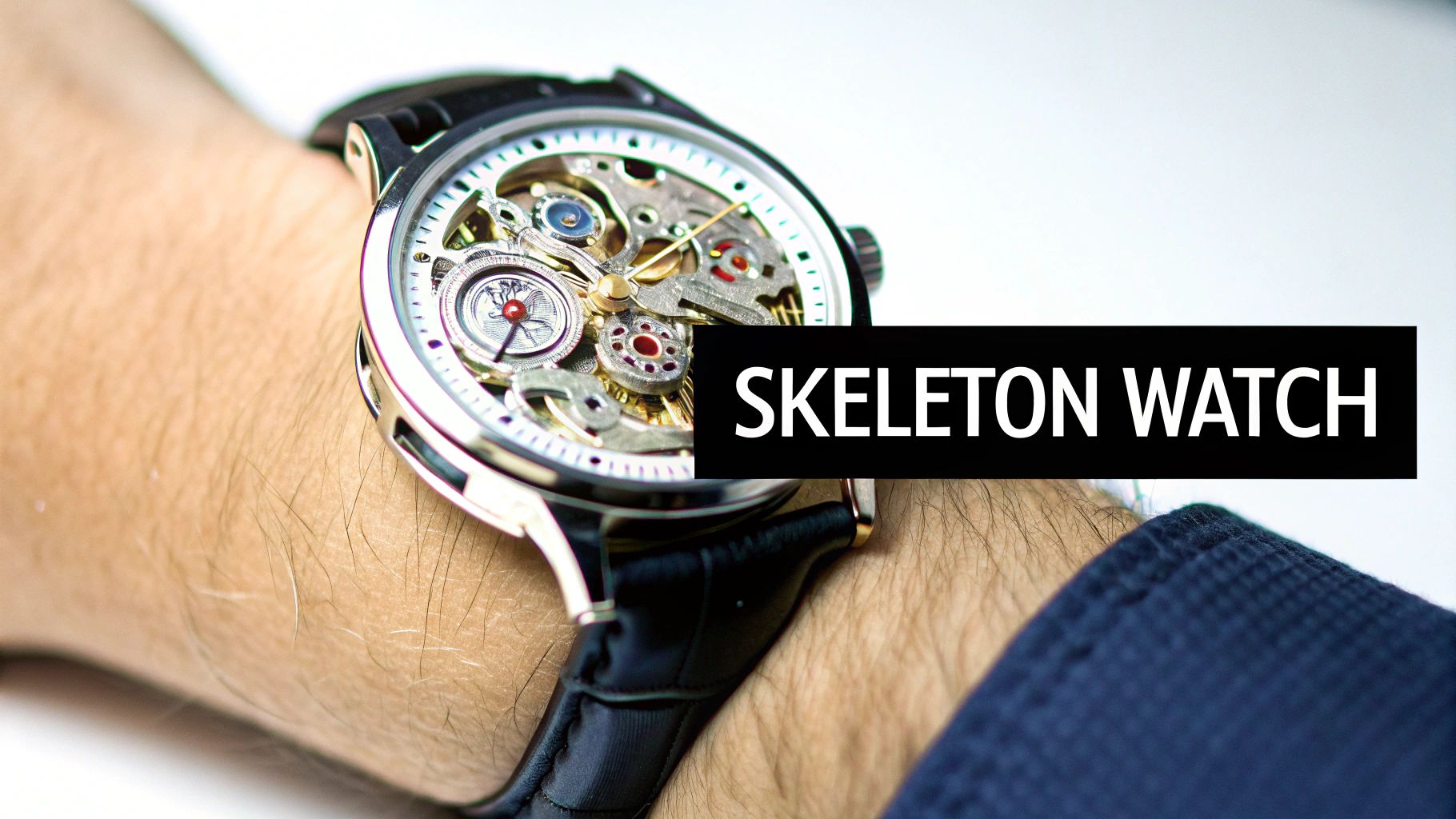
At its heart, a skeleton watch is a celebration of the complexity that makes a mechanical watch tick. Watchmakers—part engineer, part artist—carefully remove every non-essential piece of metal from the watch's internal structure, the movement. This isn't just about hollowing out parts; it's a deliberate and highly skilled process of re-engineering the entire mechanism to create a stunning visual spectacle of the watch's "heartbeat."
This intricate process, known as skeletonization, exposes the mesmerizing dance of gears, springs, jewels, and the oscillating balance wheel. The traditional dial is often removed completely or replaced with transparent sapphire crystal, offering an unobstructed view straight into the watch’s soul. This completely transforms the timepiece from a simple tool into a profound statement of mechanical mastery.
A skeleton watch doesn't just tell you the time; it shows you how time is made. It’s a mechanical ballet on your wrist, where every component has a role in a perfectly choreographed performance.
The Origins of Transparency
This idea isn’t new. In fact, it has a rich history that started back in 1760 with French watchmaker André-Charles Caron. He originally set out to create thinner, more elegant pocket watches for the elite clientele of King Louis XV. By removing unnecessary material to slim down the movement, he accidentally revealed the mechanical brilliance within, pioneering the first skeleton watch.
This context shows that skeleton watches have always been at the intersection of form and function. They invite both seasoned collectors and curious newcomers to appreciate the hundreds of hours of painstaking craftsmanship required to bring one to life.
Defining Characteristics
To help you get a clear picture of what makes these watches unique, we've broken down their core characteristics in the table below.
Core Characteristics of a Skeleton Watch
| Characteristic | Description | Impact on the Watch |
|---|---|---|
| Exposed Movement | The bridges, plates, and rotor are methodically stripped of metal to create maximum transparency. | This is the defining feature, allowing a clear view of the inner workings. |
| Artistic Embellishment | Remaining components are often ornately engraved, polished, or decorated. | Transforms functional parts into miniature sculptures, enhancing visual appeal. |
| Minimal or No Dial | The dial is either completely absent or made from a clear material like sapphire. | Ensures nothing obstructs the view of the mechanical performance inside. |
These key elements come together to create a timepiece that is as much an artistic expression as it is a functional instrument. A perfect modern example is the Hublot Spirit of Big Bang Black Magic 42 mm Skeleton Dial, which masterfully embodies this philosophy of mechanical transparency.
The Unveiling of Time: A History of Skeleton Watches
The story of the skeleton watch isn’t just about telling time; it’s about revealing it. This journey didn’t start in some high-tech lab but in the opulent courts of 18th-century France, an era obsessed with mechanical marvels and artistry.
The man behind this transparent revolution was André-Charles Caron, a French watchmaker serving King Louis XV. Around 1760, Caron wanted to craft thinner, more refined pocket watches for the aristocracy. His method was subtractive: he painstakingly stripped away every non-essential piece of metal from the movement's plates and bridges.
This didn't just slim down the watch; it unveiled the hidden ballet of gears and springs inside. The French elite were captivated. The pocket watch was no longer just a tool—it was a conversation piece. Caron’s work laid the very foundation for the skeleton watch, establishing it as a symbol of both technical genius and artistic flair.
From Aristocratic Curiosity to Victorian Artistry
As horology moved into the 19th century, the appeal of these open-worked timepieces only grew. Watchmakers started viewing the skeletonized movement as a canvas. This era saw the rise of elaborate, hand-engraved filigree and intricate scrollwork on the remaining components.
These weren’t just watches anymore; they were treasured heirlooms, each a unique piece of art reflecting the owner's status. The focus shifted from mere mechanical transparency to a full-blown showcase of decorative mastery. The goal was to make the movement as beautiful as it was functional—a tradition that still defines luxury skeleton watches today.
The Quartz Crisis and the Mechanical Renaissance
For nearly two centuries, the mechanical watch was king. Then, in the 1970s, the industry faced an existential threat: the Quartz Crisis. Cheap, hyper-accurate, battery-powered quartz watches from Asia flooded the market, making traditional timepieces seem obsolete. The impact on Swiss watchmaking was catastrophic.
The evolution of skeleton watches traces a path from 18th-century exclusivity to modern luxury icons, with André-Charles Caron inventing the style in 1760. When the quartz crisis hit hard in the 1970s-80s, it devastated Swiss watchmaking—exports plummeted from 143 million units in 1970 to just 20 million by 1985, an 86% decline. This forced brands to highlight mechanical artistry through skeleton watches to justify their value over quartz. You can explore more about this dramatic shift in the history of skeleton watches on thomas-earnshaw.com.
In this dark hour, visionary watchmakers realized they couldn't compete on price or accuracy. They had to champion what quartz lacked: soul, artistry, and human craftsmanship.
The skeleton watch became the ultimate symbol of this mechanical defiance. It was a bold declaration that the value of a fine timepiece lies not just in its function, but in the centuries of human ingenuity and artistry beating within it.
The Revival and Modern Legacy
Legendary brands like Audemars Piguet led the charge. They fought back against the quartz threat by creating the first-ever skeletonized self-winding wristwatch movement in 1978. This was a powerful statement.
By completely exposing the intricate mechanics, they showcased the irreplaceable human touch—the hand-polished angles, the delicate engravings, the rhythmic pulse of the balance wheel. It was everything a soulless battery and circuit board could never replicate.
This strategic revival worked. It recentered the conversation around craftsmanship and heritage, cementing the skeleton watch's status as a pinnacle of horological art. Today, the skeleton watch stands as a testament to resilience—a direct link to the earliest days of watchmaking, a survivor of an industrial crisis, and a celebrated icon of mechanical beauty that continues to fascinate collectors worldwide.
The Art of Skeletonization: How a Movement Is Revealed
Crafting a skeleton watch is a delicate dance between taking away and adding back. The watchmaker isn't just an engineer; they're a sculptor, completely rethinking a watch's internal architecture to turn a hidden engine into a jaw-dropping mechanical show. This artistic process, known as skeletonization, is what truly gives the watch its soul.
The journey starts by methodically carving away every last bit of non-essential metal from the movement's core components—the plates and bridges that hold everything together. Think of it like creating intricate, load-bearing latticework. The goal is to open up the view as much as possible without sacrificing the structural integrity needed for precise timekeeping.
This is an incredibly demanding task. One wrong move with the file can ruin a component, and removing too much material could cause the whole movement to bend under the force of its own mainspring. It's a high-stakes operation that can easily take hundreds of hours of focused, manual labor for a single watch.
The Decorative Arts of Horology
Once the structural carving is done, the real artistry begins. This is where functional metal parts are transformed into miniature sculptures through a series of painstaking hand-finishing techniques. These embellishments aren't just for looks; they are the hallmarks of high-end watchmaking and a clear sign of the artisan's skill.
Some of the most important decorative techniques include:
- Anglage (or Chamfering): This is the art of hand-filing and polishing a perfect 45-degree bevel along the sharp edges of the movement's parts. This technique makes light dance across the components, outlining their new shapes and giving the movement a brilliant, jewel-like finish.
- Perlage (or Circular Graining): Using a spinning abrasive peg, the watchmaker applies a pattern of tiny, overlapping circles to the flat surfaces. This creates a mesmerizing, textured finish that diffuses light and adds a beautiful sense of depth.
- Engraving and Filigree: Many skeleton watches feature elaborate, hand-engraved patterns, from delicate scrollwork to complex artistic scenes. This elevates the movement from a mere machine to a true canvas for expression.
These finishes aren't just afterthoughts; they are integral to the watch's identity. They turn what could be a cold, mechanical object into a warm, dynamic piece of art. To get a better sense of the components being worked on, you can learn more about how a mechanical watch works in our detailed guide.
Creating an Unobstructed View
The final step is to get the dial out of the way. To achieve that signature transparency, the traditional dial is either removed completely or replaced with a crystal-clear disc of sapphire. This ensures nothing stands between you and the captivating mechanical ballet underneath.
The hands are often mounted directly onto this sapphire disc or on a peripheral chapter ring, which keeps the watch readable while maximizing the view. It's the combination of a hollowed-out, decorated movement and a transparent dial that creates the stunning, three-dimensional depth that defines a skeleton watch.
The infographic below traces the historical journey of this craft, from its beginnings to its modern revival.
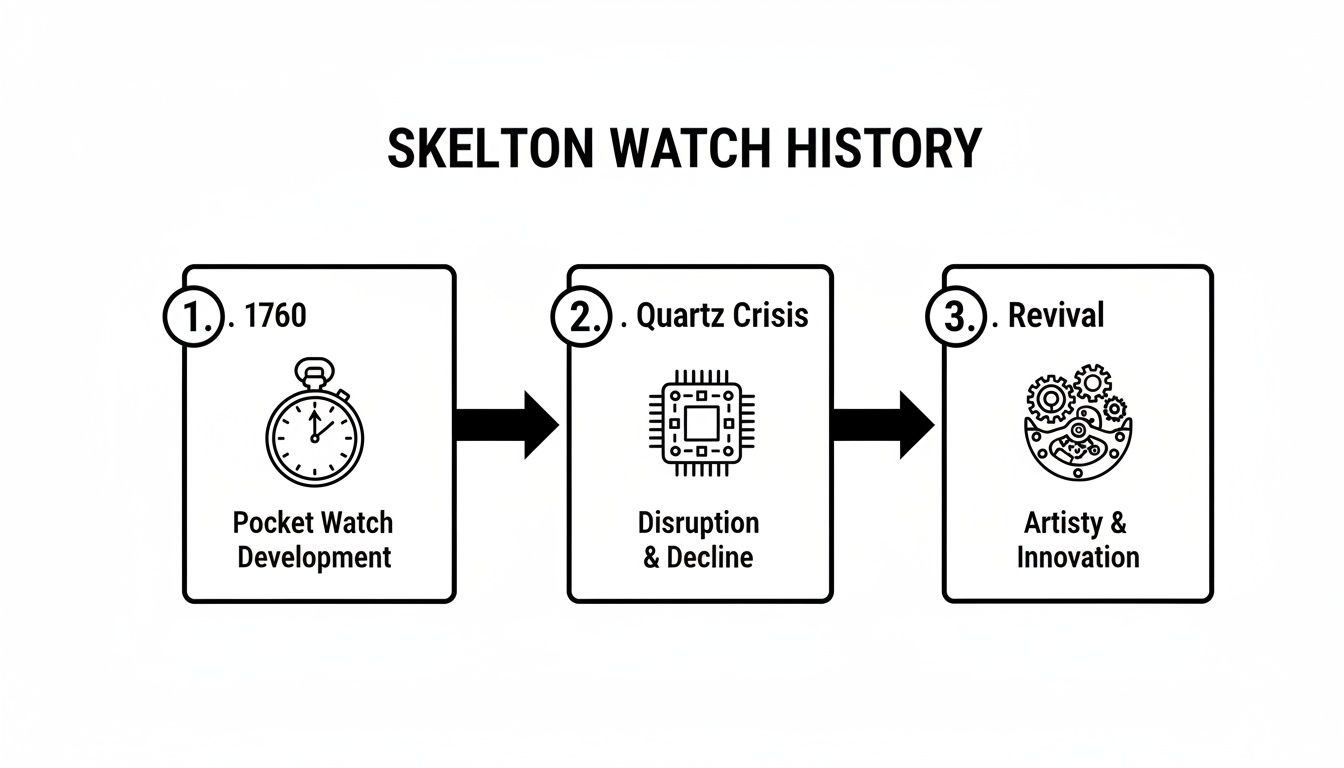
As you can see, this art form nearly vanished during the Quartz Crisis, only to re-emerge stronger than ever as a powerful symbol of mechanical artistry.
Ultimately, skeletonization is a tribute to human skill. It clarifies why these watches command a premium—every visible gear, polished angle, and delicate engraving represents countless hours of an artisan's dedication to exposing a watch's mechanical soul.
Skeleton Vs. Open-Heart: Decoding Watch Designs
As you start exploring the world of mechanical watches, you'll quickly discover designs that give you a window into their complex inner workings. But not all see-through watches are the same. For any real enthusiast, learning the difference between skeleton, open-heart, and semi-skeleton designs is a must.
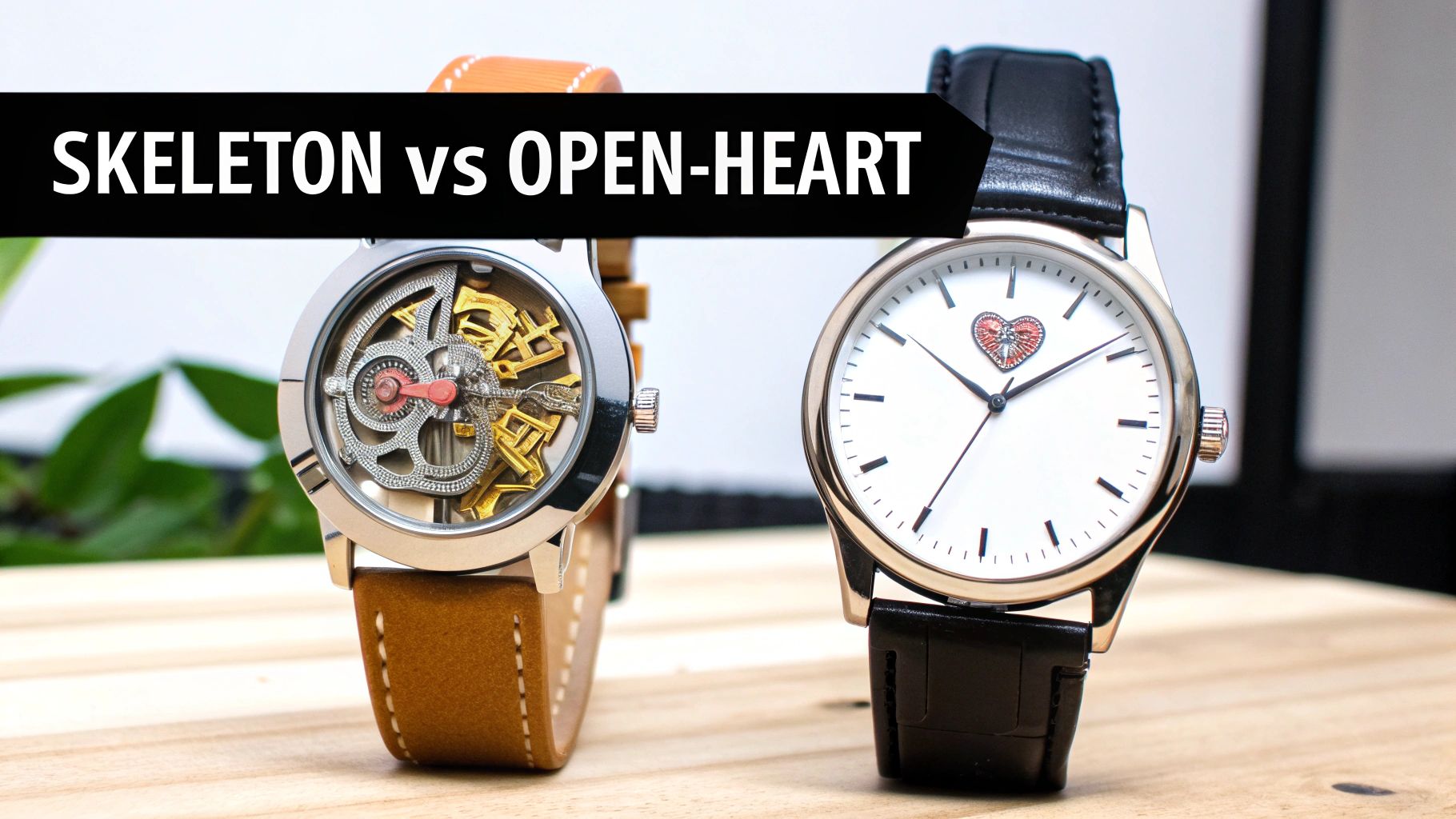
A true skeleton watch is all about total transparency. It gives you a complete, front-to-back view of the movement. Think of it as an all-access pass to the watch's mechanical soul, where the dial is either gone completely or made from clear sapphire crystal. The movement itself is painstakingly carved away, showing off the whole beautiful dance of gears and springs.
On the other hand, an open-heart watch is much more understated. It has a small, focused opening—called an aperture—on the dial that usually shows just the balance wheel. This is the "beating heart" of the watch, the part that oscillates to keep time. The rest of the movement is kept under wraps, offering just a subtle peek at the mechanics instead of a full-blown exhibition.
Finding the Middle Ground
Sitting between these two is the semi-skeleton design. This style strikes a balance, revealing more than an open-heart but not quite as much as a full skeleton watch.
Semi-skeleton watches have larger or more frequent cutouts in the dial. You might see a portion of the gear train or the mainspring barrel along with the balance wheel, giving you a wider, yet still curated, view of the machine inside.
Here's a simple way to picture it: A skeleton watch is like a house with glass walls—you see everything. An open-heart watch is a house with just a single window. A semi-skeleton is a house with several large picture windows, offering different views inside.
Comparison of Watch Transparency Styles
Knowing these differences is critical, especially for collectors. A fully skeletonized movement demands hundreds of hours of extra, highly skilled work to hollow out, finish, and decorate, and its price tag reflects that. Open-heart designs, while attractive, are far simpler to produce, making them much more accessible.
To help you tell them apart at a glance, here’s a quick comparison of the three styles.
| Feature | Skeleton Watch | Open-Heart Watch | Semi-Skeleton Watch |
|---|---|---|---|
| View | Complete movement, front & back | Small aperture, usually for the balance wheel | Partial movement through larger dial cutouts |
| Dial | Minimal or transparent sapphire dial | Mostly solid dial with a small opening | Solid dial with significant sections removed |
| Complexity | Extremely high; movement is rebuilt | Low; a simple modification to the dial | Moderate; more complex than open-heart |
| Cost | Typically the most expensive option | The most affordable of the three styles | A mid-range option between the two |
Ultimately, your choice boils down to personal taste and budget. If you're drawn to the raw, unfiltered artistry of watchmaking, nothing beats the experience of a true skeleton watch. If you prefer a more classic look with just a hint of mechanical flair, an open-heart is a fantastic choice. And if you want a bold visual statement without the full cost of complete skeletonization, the semi-skeleton offers the perfect compromise.
By understanding these distinct designs, you can confidently pick the watch that best matches your own appreciation for mechanical art.
How to Choose a Skeleton Watch: What to Look For
Buying a skeleton watch is like acquiring a piece of kinetic art for your wrist. With so many choices out there, from wild avant-garde designs to more accessible everyday models, how do you pick the right one? The key is to look past the initial "wow" factor and focus on a few critical details. This will ensure you get a timepiece that’s not just stunning, but a sound and genuine investment.
The single most important factor is the quality of the finishing. True craftsmanship lives in the details—the tiny elements you can see and feel. Get a good look at the edges of the movement’s plates and bridges. Are they sharp and industrial-looking, or do they have beautifully polished, beveled edges? This technique is called anglage, and it's a hallmark of high-end watchmaking.
A top-tier skeleton watch will be covered in hand-finishing. Think perfectly polished bevels that catch the light just so, intricate engravings, and decorative patterns like perlage (circular graining) on the flat surfaces. These touches are what separate a true work of horological art from a mass-produced piece where the parts are just stamped out by a machine.
Assess the Movement Architecture
Not all skeleton movements are created equal. Some are designed from the ground up to be seen, while others are just standard movements with bits cut out. The best luxury brands design their calibers to be beautiful from the very beginning. The architecture is planned with aesthetics in mind, making sure the final look is balanced, visually interesting, and structurally sound.
On the other hand, many lower-end models take a standard workhorse movement and simply start carving away material. This can leave you with an awkward, unbalanced appearance where the skeletonization feels like an afterthought. A well-designed skeleton movement has a natural flow that guides your eye through its mechanical world.
The best skeleton watches don't just show you a movement; they present a story. Each visible component should feel intentionally placed, creating a cohesive and captivating mechanical scene.
When you're looking at a skeleton watch, the visual presentation is everything. Understanding a few tricks on how to photograph jewelry like a pro can actually sharpen your eye for spotting quality craftsmanship and appreciating its artistry.
Evaluate Brand Heritage and Material Integrity
A brand's history and reputation really matter in watchmaking. Legacy names like Audemars Piguet or Vacheron Constantin have a long, documented history of making complex movements. That heritage brings a level of expertise and assurance that’s hard for newer brands to match.
The materials used are just as important. Here’s what to check:
- Case Material: Is it made from basic stainless steel, or does it use more advanced materials like titanium, ceramic, or precious metals like gold and platinum?
- Crystal: The "glass" covering the dial should always be sapphire crystal. It’s exceptionally scratch-resistant and offers perfect clarity. Look for anti-reflective coatings, which cut down on glare and make the view even better.
- Movement Components: High-end watches often use superior alloys for their gears and springs, which improves both long-term performance and durability.
These elements don't just affect the watch's durability; they're also crucial to its long-term value.
Prioritize Legibility and Practicality
One of the most common complaints about skeleton watches is that they can be a pain to read. With the complex machinery whirring away in the background, the hands can easily get lost in the visual noise. When you're trying one on, check its legibility in different lighting conditions.
Good designers know how to solve this. Look for smart choices that make the watch easier to read:
- Contrasting Hands: Hands made from a different color or material (like blued steel or polished gold) will stand out against the movement behind them.
- Luminescence: A healthy application of luminous material (like Super-LumiNova) on the hands and hour markers is a must-have for seeing the time in the dark.
- Chapter Ring: A clear outer ring with minute and hour markers gives your eyes a clean frame of reference without blocking the view of the mechanics.
By paying attention to these details—from the microscopic polish on a gear's edge to the overall harmony of the design— you can confidently choose a skeleton watch that will be a source of endless fascination and a fantastic addition to your collection.
Maintaining Your Mechanical Masterpiece
A skeleton watch isn't just a timepiece; it's a finely-tuned machine with its mechanical heart on full display. Like any high-performance engine, it needs the right care to perform flawlessly for generations. Think of a consistent maintenance routine as the best way to protect your investment and keep that tiny mechanical ballet running smoothly.
Because of its very design—that stunning open-worked transparency—a skeleton watch is more exposed to the elements. While they are built to be robust, all those polished surfaces and visible components are more vulnerable to dust and moisture if the case seals are ever compromised.
Regular maintenance isn't just a suggestion; it's essential for preserving the artistry and precision of a skeleton watch. Neglecting it is like owning a classic sports car and never bothering to change the oil.
The Importance of Regular Servicing
For a watch this intricate, a complete professional service is recommended every 3 to 5 years. This isn't just a quick check-up; it's a comprehensive overhaul that brings the entire mechanism back to factory-fresh condition.
Here's what happens during a full service with a certified watchmaker:
- Complete Disassembly: Every single gear, spring, and jewel is carefully removed and inspected for the slightest signs of wear.
- Thorough Cleaning: All parts are placed in specialized ultrasonic baths to strip away old lubricants, microscopic dust, and any gunk that could create friction and drag down performance.
- Replacement of Worn Parts: Any component showing wear is replaced with genuine factory parts. This always includes gaskets and seals, which are critical for maintaining water resistance.
- Meticulous Reassembly and Lubrication: The movement is painstakingly rebuilt. The watchmaker applies up to a dozen different synthetic oils and greases in microscopic amounts to very specific points. Too much or too little can throw everything off.
- Calibration and Testing: Finally, the watch is regulated for precision timing. Its power reserve and water resistance are also tested to ensure it performs exactly as it did when it first left the factory.
This incredibly detailed process is what keeps your watch a reliable and accurate timekeeper for years to come.
Daily Care and Protection
Beyond professional servicing, how you handle your watch every day makes a huge difference in its longevity. A few simple habits can prevent a lot of unnecessary wear and tear.
First, be mindful of magnetism. Strong magnetic fields from things like speakers, tablets, or even the magnetic clasps on bags can magnetize the hairspring inside the balance wheel. When that happens, the watch will start running erratically fast. While many modern watches have anti-magnetic properties, it's still best to avoid long exposure.
Also, do your best to protect your watch from severe shocks. Hard impacts, like dropping it on a tile floor or wearing it during intense sports, can damage the delicate pivots of the balance wheel. Many timepieces have shock-absorption systems, but it’s just smart to take your watch off before any high-impact activities.
For anyone new to mechanical watches, learning how to wind a mechanical watch correctly is a fantastic first step in daily care. By following these simple guidelines, you can ensure your mechanical masterpiece stays as captivating as the day you first put it on.
Common Questions About Skeleton Watches
Even seasoned collectors have questions when it comes to skeleton watches. It's understandable—these timepieces are a fascinating blend of high art and precision mechanics, and getting into the details is part of the fun. Let’s clear up a few of the most common curiosities.
First off, are skeleton watches more fragile than their solid-dial counterparts? The openworked design certainly looks delicate, but that doesn't automatically mean it’s weak.
Reputable brands engineer their movements with structural integrity front and center. Removing material is a highly calculated process to ensure the watch stays robust. That said, the intricate, exposed nature of the movement does make it more vulnerable to severe shocks, and any repairs will naturally be more complex and costly.
Pricing and Legibility
Another common question is about the price tag. Why are these watches often so expensive? It comes down to the incredible amount of skilled labor that goes into making one.
Skeletonizing a movement is an art form. It demands hundreds of hours of manual work from a master watchmaker who meticulously cuts, finishes, and decorates every single component by hand. This is a level of craftsmanship that simply can't be automated.
This intensive artistry, combined with the premium materials and engineering required to maintain reliability, is what drives the cost.
Finally, people often wonder if it's harder to tell the time on a skeleton watch. Legibility can definitely be a challenge. With all the gears and bridges creating a complex backdrop, the hands can sometimes get lost in the visual noise.
Luckily, high-end watchmakers have developed some clever solutions:
- Contrasting Materials: Using hands made of blued steel, gold, or other distinct finishes helps them pop against the movement.
- Bold Designs: Crafting the hands with strong, unambiguous shapes prevents them from blending into the background.
- Lume Application: Applying a high grade of luminescent material makes the hands easily visible in low-light conditions.
When you're considering a skeleton watch, always check its legibility with a quick glance. A truly well-designed piece will masterfully balance its stunning transparency with practical, everyday function.
Whether you're starting your collection or seeking a rare masterpiece, ECI Jewelers offers an expertly curated selection of the world's finest timepieces. Explore our collection of authenticated luxury watches at https://www.ecijewelers.com.


