

At its most basic, a tourbillon is a mind-bendingly complex addition to a watch's movement. Imagine a tiny, rotating cage that holds the watch's most critical timekeeping parts—the escapement and the balance wheel. This entire cage typically makes one full rotation every 60 seconds, creating a mesmerizing mechanical ballet right on the dial.
But it's not just for show. The whole point of this constant motion is to average out the tiny errors in timekeeping caused by gravity. Think of it like a spinning top; its constant movement keeps it perfectly stable and upright, resisting the forces that want to pull it down.
What Is a Tourbillon Watch Movement
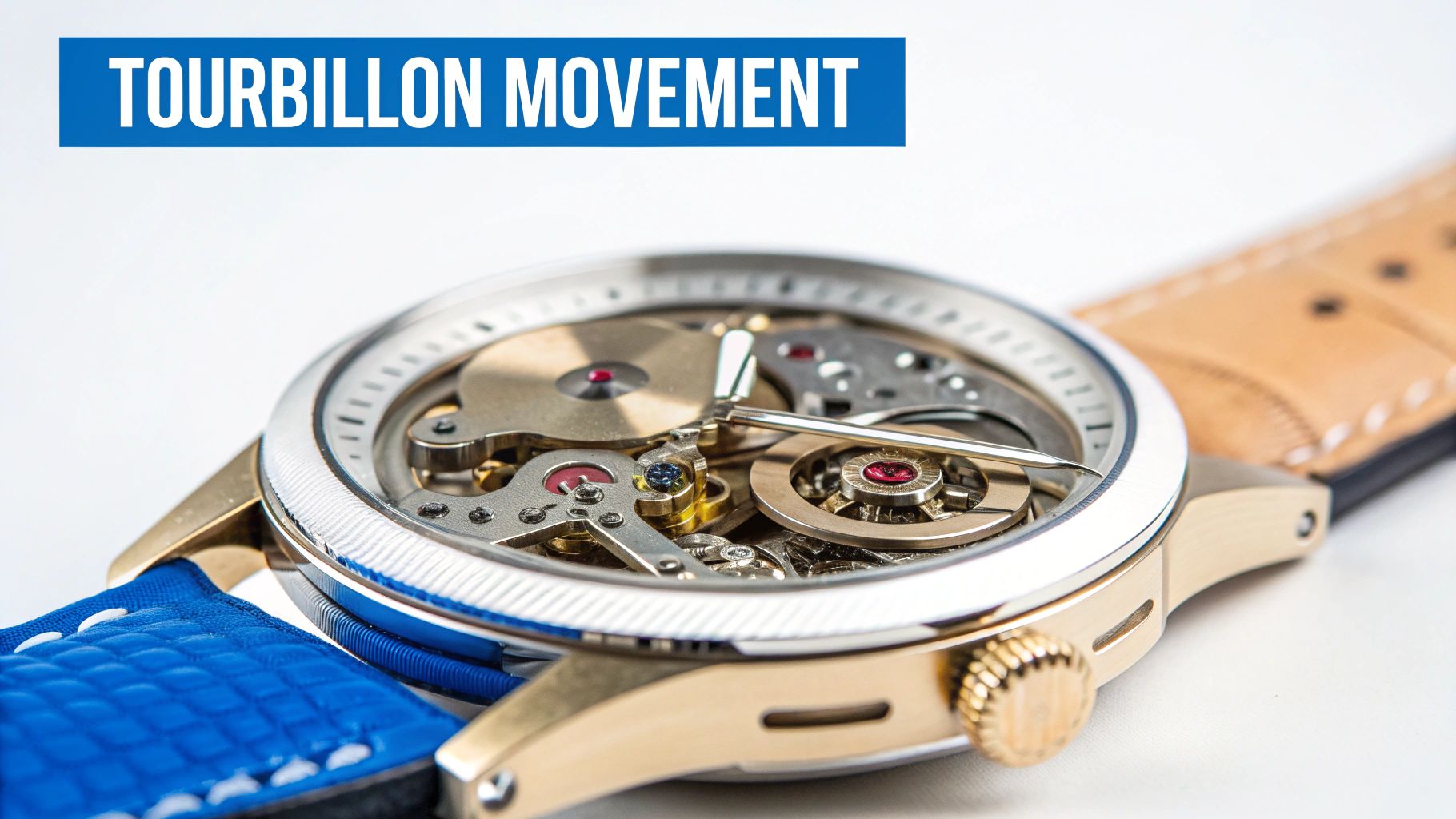
The tourbillon is a genius solution to a physics problem that haunted early watchmakers. Back when pocket watches were the standard, they spent most of their days sitting vertically in a vest pocket. In that one static position, gravity was always pulling on the delicate balance wheel from the same direction. This constant, one-sided drag introduced tiny inaccuracies that added up over time—a problem known as positional error.
Abraham-Louis Breguet, one of history's greatest horologists, tackled this problem head-on. Patented in 1801, his invention didn't try to eliminate gravity. Instead, it outsmarted it. By placing the escapement and balance wheel inside a revolving cage, he ensured these components were constantly moving through every possible vertical position. The errors from one position were simply cancelled out by the next.
The purpose of a tourbillon is to counteract the drag effect gravity has on a watch’s most sensitive components, especially when the watch remains in a fixed position for long periods.
This constant, fluid motion is what gives the tourbillon its hypnotic visual appeal. While some collectors debate its practical necessity in modern wristwatches—which are always moving on your arm anyway—its status as a hallmark of true high-end watchmaking is beyond question.
A Quick Guide to Tourbillon Components
To get a better handle on how this all comes together, it helps to break down the key parts. This little mechanism is a world unto itself within the larger watch movement.
| Component | Function | Role in Precision |
|---|---|---|
| Balance Wheel | The oscillating "heart" of the watch that beats at a set frequency. | Its consistent oscillation is what measures the passage of time. |
| Escapement | Releases the mainspring's energy in controlled, tiny impulses to the balance wheel. | Without it, the mainspring would unwind all at once. It dictates the "tick-tock." |
| Rotating Cage | Houses the balance wheel and escapement, turning them on a central axis. | This is the core of the tourbillon. Its rotation averages out gravitational errors. |
In short, the cage carries the watch's timekeeping organs through a constant rotation, giving each part an equal amount of time in every position relative to gravity. This brilliant bit of engineering is what makes the whole system work.
The Hallmark of Horological Mastery
You don't just decide to build a tourbillon. Crafting one requires an incredible level of skill, patience, and precision. We're talking about dozens of minuscule, feather-light parts that have to be finished and assembled entirely by hand to tolerances measured in microns. For a refresher on the basics of what's going on inside a watch, check out our guide on how a mechanical watch works.
This complexity is precisely why the tourbillon remains a powerful symbol of a watchmaker's talent and dedication. It’s more than just a clever mechanism; it's a piece of kinetic sculpture that represents the absolute peak of traditional horology. Seeing that spinning cage on a dial is a clear signal that you're looking at a timepiece built with a level of artistry that few other complications can even approach.
The Story Behind Breguet's Genius Invention
To really get what a tourbillon is all about, you have to travel back in time. We're not talking about a clean, modern lab, but the lively, dusty workshops of late 18th-century Paris. This is where we meet the legendary watchmaker, Abraham-Louis Breguet, a man completely fixated on a problem that bugged every timepiece of his day.
Back in the 1790s, men carried watches in their pockets, not on their wrists. These pocket watches spent almost their entire day stuck in one vertical position inside a vest. This constant orientation was the silent killer of accuracy.
You see, gravity was always at work, pulling down on the watch's most delicate parts—the balance wheel and escapement. This constant, one-sided drag created tiny errors that added up over time, a headache for watchmakers known as positional error. For a perfectionist like Breguet, this just wasn't good enough.
The Challenge of Gravity
Think of it like a car tire that's a bit heavier on one side. If that car sits in the same spot for ages, the heavy part always gets pulled down, which can warp the tire. It was the same deal with the balance wheel; any microscopic imbalance meant gravity's pull was never evened out, making the watch run inconsistently.
Breguet's brilliance wasn't in trying to beat gravity—he knew he couldn't. His genius was figuring out how to make gravity irrelevant by using constant motion.
Breguet's idea was a true breakthrough. He figured that if he could get the whole timekeeping mechanism to rotate on its own axis, the positional errors would cancel each other out with every full turn.
This idea kicked off years of painstaking work. The Swiss-French watchmaker got started around 1795 and, after nailing the design, officially patented his incredible mechanism in 1801. The patent detailed a mobile cage holding the balance wheel and escapement, which would complete a full rotation to average out gravity’s timing flaws. The complexity was staggering; it's estimated that fewer than 1,000 tourbillon watches were made worldwide between its invention and the mid-1900s. You can find more on its early days over at timeandtidewatches.com.
From Practical Fix to Mythical Status
Breguet called his invention the "tourbillon," which is French for "whirlwind." It's a perfect name for the device's mesmerizing, continuous spin. But making this whirlwind was an unbelievable challenge that demanded insane skill.
The parts had to be mind-bogglingly small, light, and perfectly balanced. Putting it all together and adjusting it was a job for only the absolute best watchmakers. As a result, tourbillons were incredibly rare and expensive right from the start.
This rarity is what cemented the tourbillon's legendary status. It was never meant for mass production; it was a showcase of the highest level of watchmaking art. Every single one was a custom-built masterpiece, often made for royalty, scientists, and explorers who needed the best possible precision for things like navigation and astronomy.
- Early Patrons Included: Monarchs like King George IV of England and Ferdinand VII of Spain.
- Scientific Application: A good number of early tourbillons were used as marine chronometers to calculate longitude at sea.
- Symbol of Mastery: Owning a Breguet tourbillon meant you understood and appreciated the peak of human ingenuity.
This history is so important. It shows the tourbillon wasn't some modern luxury gimmick but a smart, functional answer to a very real problem. Its journey from a practical tool to an icon of high watchmaking started right here, all from one man's obsessive quest for perfection.
How a Tourbillon Actually Keeps Time
To really wrap your head around the genius of a tourbillon, you first need to understand how a regular mechanical watch works—and, more importantly, where it fails. The heart of any mechanical watch is its balance wheel and hairspring. This pair is the timekeeping organ, pulsing back and forth to control how fast the watch’s mainspring unwinds.
This delicate dance is managed by the escapement, which gives the balance wheel a tiny nudge with each swing, making that classic "tick-tock" sound. In a perfect world, every single swing would take the exact same amount of time, giving you perfect accuracy. But gravity always has other ideas.
When a watch stays in one position for too long—think of a pocket watch sitting upright in a vest all day—gravity pulls on the balance wheel and hairspring from the same direction. This constant, one-sided force can subtly mess with the rhythm of the balance wheel's oscillation, making it speed up or slow down by tiny fractions of a second. These are called positional errors.
Counteracting Gravity with Constant Motion
The tourbillon doesn't get rid of gravity; it just cleverly averages out its effects. Think about roasting a chicken on a spit. If you just leave it sitting there, one side will burn while the other stays raw. The solution? Rotate it constantly so every part gets an equal amount of heat.
A tourbillon does the exact same thing for timekeeping. Abraham-Louis Breguet’s invention puts the entire timekeeping assembly—the balance wheel, hairspring, and escapement—inside a small, rotating cage. This cage usually makes one full turn every 60 seconds.
This constant rotation is what gives the mechanism its name, which is French for "whirlwind."
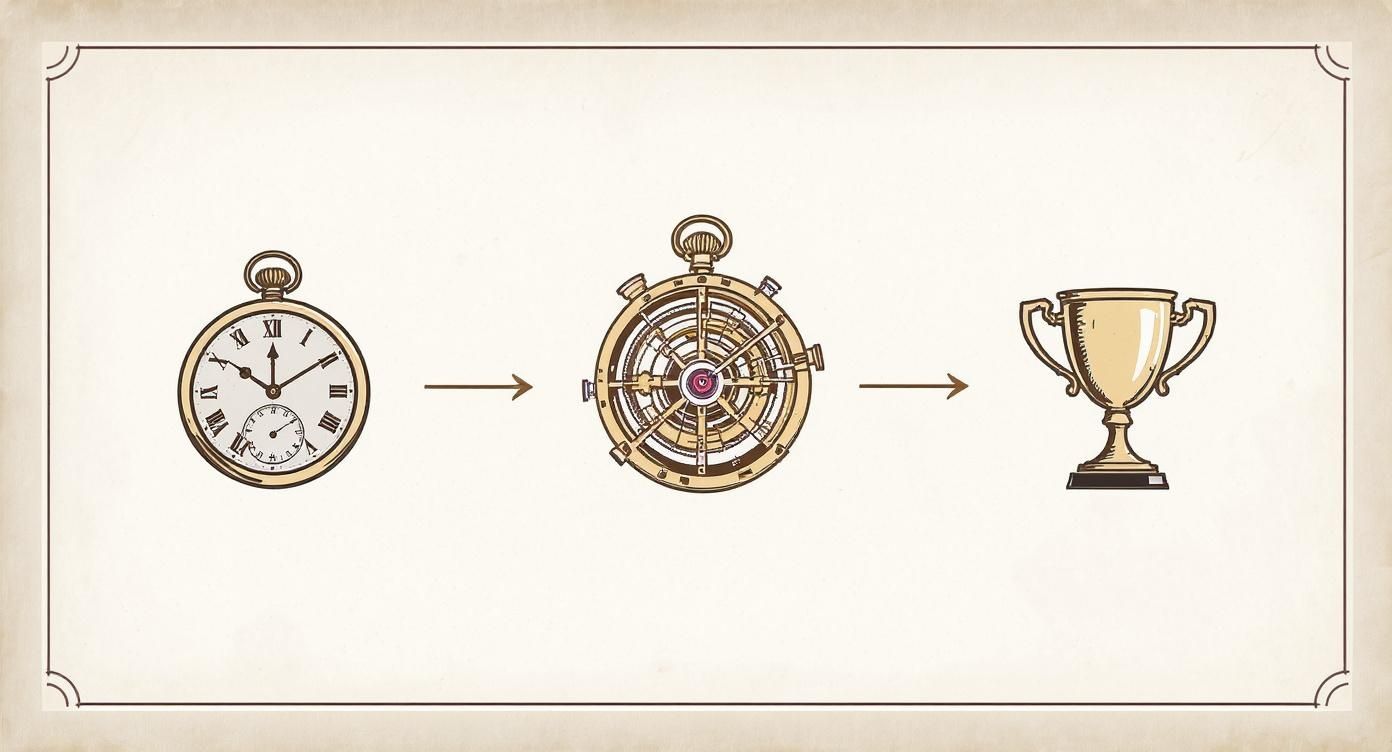
As the cage turns, it continuously moves the balance wheel through every possible vertical position. The moments where gravity might make the wheel speed up are quickly followed by moments where it would slow it down. Over the course of a minute, these tiny errors cancel each other out.
A tourbillon ensures that no single part of the timekeeping organ is continuously stressed by gravity. By averaging out positional errors, it aims to achieve a more stable and consistent rate over time.
It’s an incredibly elegant mechanical solution that uses the very force that creates the problem—gravity—to solve it.
The Key Mechanical Components at Play
Breaking it down, a tourbillon is a finely tuned system where every part has a critical job. While a standard movement has these same components, the tourbillon reconfigures them into a rotating sub-assembly, which is a massive feat of micro-engineering.
Here are the core elements working together inside the cage:
- The Cage Itself: This is the rotating frame holding everything together. It's driven by the watch's gear train and is designed to be as light as possible—often using materials like titanium to save energy. A typical tourbillon cage can have over 40 parts but weigh less than a single gram.
- The Balance Wheel: It's still the timekeeping oscillator, but now it's constantly changing its orientation to gravity.
- The Hairspring: This delicate spring provides the restoring force for the balance wheel. In a tourbillon, its "breathing" motion is averaged out across all vertical planes.
- The Escapement: Made up of the pallet fork and escape wheel, this mechanism still gives impulses to the balance wheel. The incredible part is that it does this while being carried around by the cage, a detail that is mind-bogglingly complex to assemble and regulate.
Think of it like a tiny planetarium on your wrist. The cage is like a planet rotating on its axis, while the balance wheel (its "moon") oscillates around its own center. This complex dance of movements is what makes the tourbillon not just a functional device, but a mesmerizing piece of kinetic art.
Exploring Different Types of Tourbillons

Abraham-Louis Breguet's original "whirlwind" was a brilliant solution to a very specific problem, but his invention was only the start of the story. Once the concept was out there, innovative watchmakers just couldn't resist building on it, pushing the mechanical and artistic boundaries of what was possible.
This constant evolution has given us a fascinating lineup of tourbillon types, each with its own character and technical flair. From the clean lines of the classic design to the mind-bending choreography of multi-axis creations, the world of tourbillons is incredibly diverse. Let's break down the most important variations you'll encounter.
The Classic Single-Axis Tourbillon
This is the direct descendant of Breguet's 1801 patent and by far the most common type you'll see. It works exactly as he first intended: the balance wheel and escapement are housed in a cage that rotates on a single plane, usually completing one full circle every 60 seconds.
Visually, this tourbillon is almost always supported by a bridge or cock on both the top and bottom, anchoring it firmly to the movement's mainplate. This robust construction offers excellent stability and is the foundation for nearly every other tourbillon design. Brands like Patek Philippe and Vacheron Constantin have absolutely perfected this classic execution, showcasing it as a hallmark of traditional watchmaking mastery.
The Visually Striking Flying Tourbillon
Fast forward to 1920. A Glashütte watchmaker named Alfred Helwig wanted a clearer, more dramatic view of the mesmerizing rotating cage. His solution was the flying tourbillon—a design that gets rid of the upper support bridge completely. The entire assembly is cantilevered, meaning it's only supported from underneath.
This clever piece of engineering creates the illusion that the tourbillon is "flying" or floating inside its aperture on the dial. The visual effect is pure, open, and dramatic. Of course, this design is much harder to get right, as that single mounting point has to handle all the stress and shock. Brands like IWC and Cartier are well-known for their beautifully executed flying tourbillons.
The key difference between a standard and a flying tourbillon is the absence of the top bridge. This aesthetic choice demands greater engineering precision to ensure the mechanism remains stable and secure while appearing to float freely.
The Complex Multi-Axis Tourbillon
As watchmaking technology got more advanced, horologists started asking a bold question: if rotating on one axis averages out gravity's pull in vertical positions, what if we rotate on multiple axes at once? This thinking gave birth to the multi-axis tourbillon, a category that includes some of the most complex and visually stunning mechanisms ever created.
These tourbillons put the escapement in a cage that rotates on one axis, which is then placed inside a second cage rotating on a different axis—and sometimes even a third.
- Double-Axis Tourbillon: This type has two cages spinning at different speeds on two separate axes. The goal is to compensate for gravitational effects in a much wider range of positions, not just the vertical ones.
- Triple-Axis (Tri-Axial) Tourbillon: Taking things to another level entirely, this mechanism adds a third cage, creating a gyroscopic, three-dimensional rotation. The constant tumbling motion is designed to average out positional errors from virtually any angle.
Brands like Jaeger-LeCoultre, with its famous Gyrotourbillon, and Girard-Perregaux, with its Tri-Axial Tourbillon, are true pioneers in this highly advanced field. Honestly, these creations are less about a measurable boost in accuracy and more about showing off the absolute peak of mechanical art and engineering. They are kinetic sculptures for the wrist, demanding hundreds of hours of assembly by a single master watchmaker.
The sheer number of tiny, lightweight components—often well over 100 parts for the cage system alone—and the energy needed to power them make these watches exceptionally rare and valuable. They're a powerful statement of a brand's technical skill, pushing the absolute limits of mechanical watchmaking.
This table highlights the key characteristics of different tourbillon mechanisms, helping you tell them apart at a glance.
Comparing Common Tourbillon Designs
| Tourbillon Type | Key Feature | Primary Visual Cue | Notable Brands |
|---|---|---|---|
| Single-Axis | Rotates on a single plane. | Supported by a bridge on both top and bottom. | Patek Philippe, Vacheron Constantin, Breguet |
| Flying | Cantilevered design with no upper bridge. | Appears to float, supported only from below. | IWC, Cartier, Roger Dubuis |
| Double-Axis | Two cages rotating on different axes. | A cage-within-a-cage spinning on two planes. | Jaeger-LeCoultre, Thomas Prescher |
| Triple-Axis | Three cages creating 3D rotation. | A gyroscopic, tumbling motion. | Girard-Perregaux, Jacob & Co. |
Each of these designs represents a different philosophy—from the traditional elegance of the classic tourbillon to the outright spectacle of a tri-axial masterpiece. Knowing the difference is key to appreciating the artistry behind the price tag.
Why the Tourbillon Still Matters Today
In an age of hyper-accurate quartz watches and atomic clocks, it’s a fair question: does the tourbillon even have a point anymore? Let's be honest. When Abraham-Louis Breguet invented it, he was solving a real-world problem for pocket watches, which spent most of their lives sitting upright in a vest. For a modern wristwatch that’s always moving around on your wrist, its gravity-defying trick is far less critical.
So why does this ridiculously complex and expensive mechanism not only survive but thrive? Because its job has changed. The tourbillon has evolved from a practical tool into the ultimate flex of haute horlogerie—the high art of watchmaking.
Today, a tourbillon is all about mastery. It’s a brand’s way of planting a flag and declaring its technical genius and absolute dedication to the craft. Building, finishing, and assembling the dozens of tiny, feather-light parts of a tourbillon cage is one of the toughest challenges in watchmaking. Only the most skilled hands can pull it off.
A Statement of Artistry and Prestige
For that very reason, putting a tourbillon in a watch is a statement. It signals to collectors that the watchmaker is playing in the big leagues, preserving centuries-old skills while pushing the boundaries of what's mechanically possible. That mesmerizing, spinning cage isn’t just fighting gravity anymore; it’s a piece of kinetic art, a mechanical ballet celebrating human ingenuity.
This shift really took off after the Quartz Crisis, when cheap electronic watches nearly killed the traditional Swiss industry. As mechanical watchmaking made its comeback, the tourbillon was reborn as a powerful symbol of that revival.
Audemars Piguet's 1986 launch of the Calibre 2870 was a key moment. It was the first-ever automatic tourbillon in a wristwatch, and its incredibly slim titanium cage reignited a fascination with complex mechanics. Since then, the tourbillon has become a badge of exclusivity, with its value tied more to craftsmanship and visual appeal than raw timekeeping.
The Tourbillon as a Collector's Centerpiece
For collectors, a tourbillon is often a "grail" piece. Its presence alone bumps a watch into a whole new level of collectability and value. The conversation around why tourbillon watches are still so sought-after often touches on their status as investments, which brings up interesting questions about understanding the value of high-end watches and what really drives desire on the secondary market.
In modern watchmaking, the tourbillon is less about a measurable accuracy boost and more about demonstrating a commitment to mechanical art. It is the intersection of engineering, sculpture, and tradition.
The price tag reflects this. You’re paying for the hundreds of hours of painstaking labor from a master watchmaker, combined with the mechanism's legendary status. It’s an investment in artistry, history, and the timeless appeal of a beautifully executed mechanical marvel. For a look at the brands that have perfected this complication, check out our guide on the top 10 men's luxury watch brands.
At the end of the day, the tourbillon matters not because it makes a watch run a few seconds better, but because it represents the very soul of mechanical watchmaking. It's a tangible link to horological history and a defiant celebration of human skill in a digital world. It’s not just a feature; it’s a philosophy.
Answering Your Tourbillon Questions
Even after digging into its history and mechanics, the tourbillon can still feel like a bit of a mystery. It’s a fascinating blend of art, engineering, and horological magic. To help clear the air, we’ve put together the questions we hear most often from collectors and enthusiasts, with direct, no-nonsense answers.
Are Tourbillon Watches Really More Accurate?
This is the big one. While Abraham-Louis Breguet originally invented the tourbillon to make pocket watches more accurate, its role in a modern wristwatch is a hot topic of debate. He designed it to fight gravity’s pull on a watch that spent most of its day sitting in one position in a waistcoat pocket.
But a wristwatch is a completely different animal. It’s always moving on your wrist as you go about your day. That constant motion naturally averages out the very positional errors the tourbillon was built to fix.
Today, a high-quality, chronometer-certified mechanical watch can easily be just as accurate—or even more so—than many tourbillons. The real value of a modern tourbillon isn’t about a measurable jump in precision. It’s about the sheer artistry, the stunning visual display, and the demonstration of a watchmaker's mastery.
Why Are Tourbillon Watches So Expensive?
The sky-high price of a tourbillon boils down to two things: insane complexity and the incredible skill needed to build one. The mechanism is a puzzle of dozens of minuscule, feather-light parts. Most of them have to be finished and put together by hand, under a microscope.
Just think about this: a typical tourbillon cage, which often holds over 40 components, can weigh less than a single gram. One master watchmaker will pour hundreds of hours into meticulously crafting, assembling, and fine-tuning this tiny, spinning device.
It’s this combination of rare expertise, painstaking labor, and its status as a peak achievement in watchmaking that drives the cost. You aren't just buying a time-telling device; you're investing in a miniature piece of kinetic sculpture, a testament to the absolute pinnacle of human skill in micro-mechanics.
How Do You Take Care of a Tourbillon Watch?
Looking after a tourbillon is much like caring for any other high-end mechanical watch, but you need to be extra careful. Its intricate design makes it more sensitive to shocks and its environment.
Here are the essential things to keep in mind:
- Regular Servicing is a Must: Because of its complexity, a tourbillon needs a check-up every 3 to 5 years. It’s critical that this is done by a watchmaker specifically certified to work on tourbillons. Not every watchmaker has this highly specialized training.
- Avoid Shocks and Drops: That spinning cage is incredibly delicate. A hard knock from playing sports or an accidental drop can easily damage the finely balanced parts, leading to eye-wateringly expensive repairs.
- Watch Out for Magnetic Fields: Like all mechanical watches, tourbillons hate magnets. Strong magnetic fields from things like speakers, tablets, and other electronics can mess with the hairspring and throw off its accuracy. Even though some modern tourbillons use anti-magnetic materials, it's always better to be safe than sorry.
Proper care will ensure this mechanical wonder keeps ticking beautifully for generations. Just as you would with other complex movements, it's smart to know the basics of watch maintenance. For a closer look at another common movement, check out our guide on what is an automatic watch.
Is the Tourbillon Always Visible on the Dial?
In modern watchmaking, the answer is almost always a resounding yes. A huge part of the tourbillon’s appeal today is its mesmerizing, hypnotic dance. Watchmakers know this, and they intentionally design dials with an opening, or "aperture," to show off the spinning mechanism.
While some of the very first tourbillon pocket watches from the 1800s kept the mechanism hidden away, today's brands know that seeing it in action is a massive selling point. It’s undeniable proof of the watchmaker’s skill and artistry. The visible tourbillon has become a hallmark of haute horlogerie, turning a functional part into the star of the show.
At ECI Jewelers, we understand the passion behind collecting extraordinary timepieces. Whether you're seeking your first luxury watch or a grail-worthy tourbillon, our experts are here to guide you with trust and transparency. Explore our curated collection of authenticated luxury watches from the world's most prestigious brands at https://www.ecijewelers.com.


