


When you're figuring out where to sell a luxury watch, it all boils down to your personal priorities. Are you trying to maximize the price, get a fast sale, or make sure the whole process is completely secure?
For most people, a trusted professional buyer like ECI Jewelers hits that sweet spot, offering competitive pricing, immediate payment, and total peace of mind. This guide will give you an honest, unbiased look at all your options so you can sell with confidence.
Finding the Right Buyer for Your Luxury Watch
Parting with a luxury timepiece isn't just a financial transaction. It's often an emotional process tied to a valuable, personal asset. The number of choices—from private sales to global auction houses—can feel overwhelming. Each path offers a different trade-off between speed, payout, and security, and it's critical to understand them before you start.
The world of high-end watch sales has changed a lot. Over the last decade, the market has swung heavily toward specialist secondary-market platforms and professional jewelers, completely changing how value is determined and deals are done.
Online watch sales are expected to blow past US$6 billion by 2025, making up nearly 15% of all premium watch sales. This shows a huge global demand but also more competition, which makes finding a trusted buyer in a major hub more important than ever. You can learn more about the evolving luxury watch market and its growth.
Comparing Your Selling Options
This guide is designed to cut through the noise. We'll give you a clear, straightforward comparison of your main sales channels, analyzing the real-world pros and cons of each method to help you match your goals with the right strategy.
Below is a quick overview of the avenues you're likely to consider. Each one is built for a different type of seller, whether you're chasing the absolute highest offer or just need a quick, secure payment without the fuss.
| Selling Channel | Best For Speed | Best For Payout | Best For Security |
|---|---|---|---|
| Specialty Buyers | Excellent | Very Good | Excellent |
| Online Marketplaces | Fair | Good | Fair |
| Auction Houses | Poor | Good | Very Good |
| Private Sale | Fair | Excellent | Poor |
| Consignment | Poor | Good | Good |
| Authorized Dealers | Good | Fair | Excellent |
How to Prepare Your Watch for a High-Value Sale
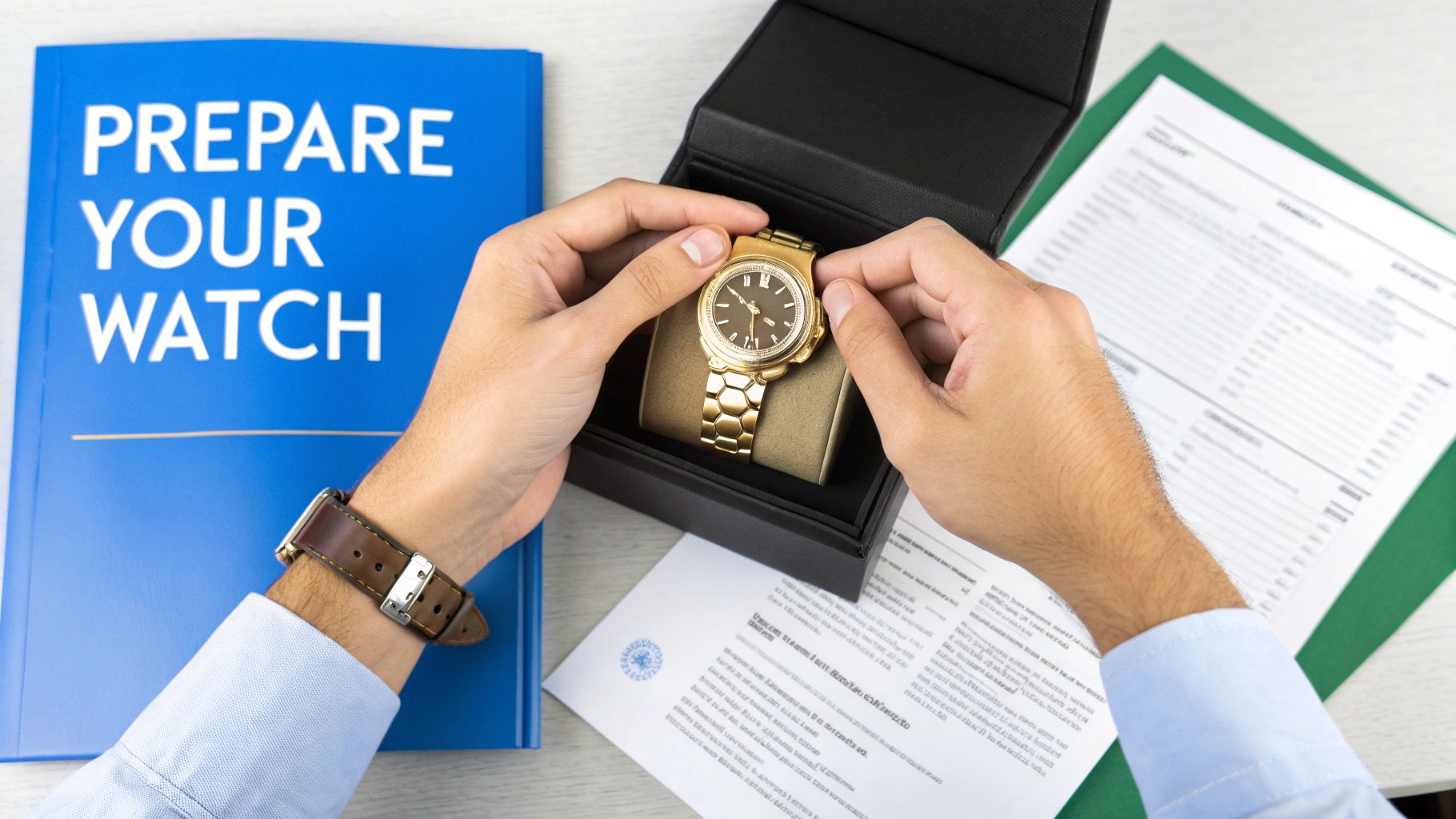
Before you even start thinking about where to sell your watch, a little prep work can make a massive difference in your final offer. The gap between a good price and a great one often comes down to the details you can provide a buyer.
When you present a watch that's well-documented and honestly assessed, it signals you're a serious seller who has taken care of the timepiece. This simple step makes any buyer's valuation process smoother—whether it's us, an auction house, or an online dealer—and sets a professional tone from the start.
Gather Your Essential Documents
If you do only one thing, do this: collect every piece of original documentation you have. This collection, known in the industry as "box and papers," is the single biggest factor in establishing your watch's provenance and boosting its market value.
Buyers will always pay a premium for a "full set." Why? Because it's the closest thing to indisputable proof of authenticity and ownership history. It turns your watch from a standalone object into a complete, verifiable collector's package.
Here’s your checklist for what makes a complete set:
- Original Presentation Box: This includes both the inner and outer boxes.
- Warranty Card or Certificate: Absolutely critical. This has the watch's serial number and original sale date.
- Instruction Manuals: Any booklets that originally came with the watch.
- Hang Tags: Especially any with serial or model numbers.
- Extra Links: Any links that were removed to size the bracelet.
- Service Records: Receipts or official papers from any services or repairs.
For many buyers, the presence of the original box and papers can increase a watch's value by 15-25% or more, especially for highly collectible models from brands like Rolex or Patek Philippe.
Having everything together just makes the authentication process faster and builds immediate trust. If you want to dive deeper into why this matters so much, you can read more about the value of a Rolex's box and papers in our guide.
Assess and Document the Condition
Next, take a hard, honest look at your watch's physical condition. Get it under a bright light and make a note of every single detail, no matter how small. Being transparent now helps you get an accurate initial quote and avoids any friction or price adjustments during a professional inspection later.
When you're documenting the condition, look for these things:
- Scratches or Dings: Check the case, bezel, crystal, and bracelet for any cosmetic marks.
- Functionality: Make sure it's keeping good time and that all complications (like the date wheel or chronograph) work as they should.
- Originality: Note if you know any parts have been replaced, like the dial, hands, or bezel insert.
Here's a pro tip: resist the urge to get the watch polished by a local jeweler before selling. While it might seem like a good way to clean it up, a bad polish can soften the sharp, factory lines of the case and literally wipe thousands of dollars off the value for a serious collector.
Professional buyers would much rather see the watch in its honest, original state. Documenting every detail with clear photos is the best way to get a fair and accurate valuation, no matter where you decide to sell your luxury watch.
Comparing Your Best Options for Selling a Timepiece
Deciding where to sell your luxury watch always comes down to a trade-off: Are you optimizing for the highest possible payout, the fastest sale, or the most security? Each channel is built for a different type of seller, and knowing the pros and cons is the key to a smooth transaction.
This isn't just about finding a buyer; it's about finding the right one for your specific watch and situation. The best way to sell a rare vintage Patek Philippe is almost never the best way to sell a modern Tudor Black Bay.
Specialty Buyers and Professional Dealers
Specialty buyers, like us here at ECI Jewelers, are businesses whose entire world revolves around the pre-owned luxury watch market. Our model is built from the ground up to accurately value, authenticate, and buy timepieces for immediate payment. For most sellers, this is the most balanced option, blending speed, security, and a strong payout.
The biggest advantage of working with a professional dealer is the complete removal of uncertainty. You get a firm, data-backed offer. If you accept, payment is sent immediately via a secure method like a wire transfer. No waiting for a buyer to show up, no haggling with strangers online, and zero risk of fraud.
This direct-to-buyer approach is incredibly efficient. The dealer takes on all the risk of finding the final owner, handling the marketing, and providing a warranty—all of which is factored into their offer. For you, it means a clean, fast, and safe exit.
Private Sales
Selling your watch privately to another collector or enthusiast on a forum offers the highest potential for a maximum payout. By cutting out any middleman, you can theoretically get the full market value without paying commissions.
But that upside comes with major risks and a lot of work. You are 100% responsible for everything: marketing the watch, vetting buyers, and figuring out the logistics of a high-value, high-risk transaction. The dangers are very real, from bounced checks and payment chargebacks to the terrifying possibility of a robbery during an in-person meetup.
A Critical Consideration for Private Sales
The private market is a minefield of sophisticated scams. A classic tactic involves a buyer using a fraudulent cashier's check that looks real to your bank for days, only to be clawed back long after you've shipped the watch. The financial upside must be carefully weighed against the very real potential for a total loss.
To succeed here, you need a deep understanding of your watch's true market value and a bulletproof plan for a secure exchange. It's a high-risk, high-reward game best left to seasoned sellers who can stomach the uncertainty.
Online Marketplaces
Platforms like Chrono24 and eBay act as global storefronts, giving you massive exposure to an international audience of watch lovers. Listing your watch on one of these sites connects you with a huge pool of potential buyers who are actively hunting for your exact model.
These platforms offer a structured environment, often with built-in escrow services for payment protection. The sheer size of the audience can help you get a competitive price, especially for popular models.
However, that convenience isn't free. Marketplaces charge hefty commission fees, typically ranging from 6.5% to over 12% of your final sale price. You're also competing directly against thousands of other sellers, including established dealers with deep feedback histories. On top of that, you still have to handle all the shipping, insurance, and any potential disputes or returns.
The resale ecosystem is heavily skewed toward a few key brands. On major platforms, Rolex can account for a third of all spending, with Audemars Piguet and Patek Philippe making up another chunk. This means over 40% of the money changing hands is for just three brands, giving expert dealers extremely reliable benchmarks for their offers. Specialists in major hubs like New York’s Diamond District use this data to make instant, market-driven offers.
Auction Houses
For truly exceptional pieces—ultra-rare, historically important, or high-value vintage watches—a major auction house like Phillips, Christie's, or Sotheby's can be a fantastic route. They have a global network of top-tier collectors and can generate incredible buzz, often leading to record-shattering prices.
The process, however, is long and highly selective. Auction houses curate their sales meticulously, and not every watch makes the cut. If your watch is accepted, expect it to be tied up for months in cataloging, marketing, and exhibitions before the auction even happens.
The fee structure is also the most complex. Sellers pay a "seller's premium," and buyers pay a "buyer's premium," which are both percentages of the final hammer price. Your net payout can get complicated, and the high buyer's premium can sometimes hold bidders back. And there's no guarantee—if the watch doesn't hit its reserve price, it goes unsold.
Consignment Shops
Selling on consignment means you leave your watch with a dealer who sells it on your behalf for a commission. You still own the watch until it sells. This approach can often net you a higher payout than selling directly to a dealer because they have no money tied up in your watch.
The big trade-off here is time. A consignment sale can take weeks, months, or even longer. There's no guarantee of a sale, and all the while, your valuable asset is locked up.
If you go this route, make sure you work with a reputable shop. Get a clear, written agreement that details the commission rate (often 15-30%), the target sale price, the length of the consignment period, and how your watch is insured. This is a good option for patient sellers who want to maximize their return without doing the legwork themselves. For an even more detailed breakdown of these methods, check out our comprehensive guide on how to sell a watch.
Authorized Dealers and Trade-Ins
An authorized dealer (AD) for your watch's brand might buy it from you, but more often, they'll offer a trade-in credit toward a new purchase. The main appeal is convenience and trust. You're in a secure, professional environment dealing with an official brand representative.
That said, the financial return is usually the lowest of any option. An AD's business is selling new watches, not buying pre-owned ones, so their offers are typically very conservative to account for their high overhead and the cost of servicing the watch for resale.
A trade-in can be a great move if your main goal is to get a new watch from that same dealer, as it wraps everything into one simple transaction. But if getting the most cash for your current watch is the top priority, other channels will almost always get you a better result.
Watch Selling Channels at a Glance
To make the decision a bit easier, this table breaks down how each channel performs based on what matters most to sellers.
| Selling Channel | Potential Payout | Sale Speed | Security Level | Best For |
|---|---|---|---|---|
| Specialty Buyers | Very Good | Immediate | Excellent | Sellers needing a fast, secure, and fair cash transaction. |
| Private Sale | Excellent | Variable | Poor | Experienced sellers with a high risk tolerance seeking top dollar. |
| Online Marketplaces | Good | Weeks/Months | Fair | Sellers comfortable with logistics who want broad market exposure. |
| Auction Houses | Excellent (for rare pieces) | 6+ Months | Excellent | Owners of ultra-rare, high-value, or historically important watches. |
| Consignment | Very Good | Months | Good | Patient sellers who want a higher payout than a direct sale. |
| Authorized Dealers | Fair | Immediate | Excellent | Buyers looking to trade up for a new watch from the same brand. |
Ultimately, the right choice depends entirely on your personal goals. Weighing these factors honestly will point you toward the path that makes the most sense for you and your watch.
Which Selling Method Is Right for You?
Choosing where to sell your luxury watch isn't about finding a single "best" place. It's about finding the best place for you. Your personal goals—whether you prioritize the highest price, the fastest sale, or the most secure transaction—will point you to the right channel.
To make things simple, we've broken down the options based on three common seller mindsets. Figure out which one sounds like you, and you'll know exactly which path to take, cutting through the stress and uncertainty that often comes with selling a high-value piece.
This decision tree visualizes the core choice every seller has to make: what do you value most right now?

As the flowchart shows, your top priority—getting top dollar, getting cash fast, or having a zero-risk experience—leads directly to a specific selling method.
The Maximizer: Patience for the Best Payout
If your main objective is to squeeze every last dollar out of your watch and you have the time and stomach for it, you're The Maximizer. You're not in a rush for cash, you know the market, and you're willing to put in the work to get the highest possible return.
For this profile, two routes stand out, but both come with serious trade-offs.
- Private Sale: This route offers the biggest theoretical payout because you cut out the middleman completely. You name the price and pocket 100% of the sale. The catch? It also carries the highest risk of scams, fraud, or even physical danger. You need deep market knowledge to price it right and a ton of effort to market the watch and vet every potential buyer.
- Auction House: If you have an exceptionally rare or historically important watch, a top-tier auction house can deliver record-breaking prices. But the trade-off is time and uncertainty. The process can drag on for over six months from consignment to payment, and there's absolutely no guarantee it will even sell.
Maximizer's Reality Check
Chasing top dollar is tempting, but the private market is a minefield. The risk of a sophisticated scam wiping out your entire investment often outweighs the extra few percentage points you might gain over selling to a trusted professional. Be honest with yourself about your ability to manage a secure, high-stakes transaction.
The Express Seller: Speed and Simplicity Above All
If you need a fast, guaranteed, and no-fuss sale, you are The Express Seller. Maybe you need cash for another investment, or you just don't want the headache of a long, drawn-out process. Your goal is simple: turn your watch into cash, quickly and cleanly.
For anyone who values speed, the choice is pretty clear.
- Specialty Buyer/Professional Dealer: This is, hands down, the most efficient method. Reputable dealers like ECI Jewelers give you an immediate, fair market offer based on real-time data. The moment you accept, payment is sent via a secure wire transfer. The whole process, from quote to cash in your account, can happen in as little as 24 hours.
- Authorized Dealer Trade-In: If you're looking to buy a new watch, trading in your old one at an AD is incredibly fast. However, the value you get is almost always the lowest of any channel. Their business is selling new watches, not buying pre-owned ones.
The Security-First Seller: Risk Mitigation Is Key
If your number one priority is a safe, transparent, and completely risk-free sale, you are The Security-First Seller. You'd rather have total peace of mind than get the absolute highest price or the fastest payout. You want to eliminate any chance of scams, shipping disasters, or payment problems.
For this mindset, the safest bets involve working exclusively with established, verified businesses that have a physical location and a long-standing reputation.
- Specialty Buyer/Professional Dealer: This channel is built for security. You're dealing with a registered business, often in a secure location like New York's Diamond District. They handle the authentication, provide fully insured shipping, and pay via verifiable bank wires, removing all the risks that come with private sales.
- Auction House: Major auction houses like Sotheby's or Christie's also offer fantastic security and authentication. Your watch is fully insured from the moment it leaves your hands. The downside is that this security is wrapped up in a very long timeline and is typically reserved for only the most sought-after timepieces.
How to Navigate Shipping, Authentication, and Payment
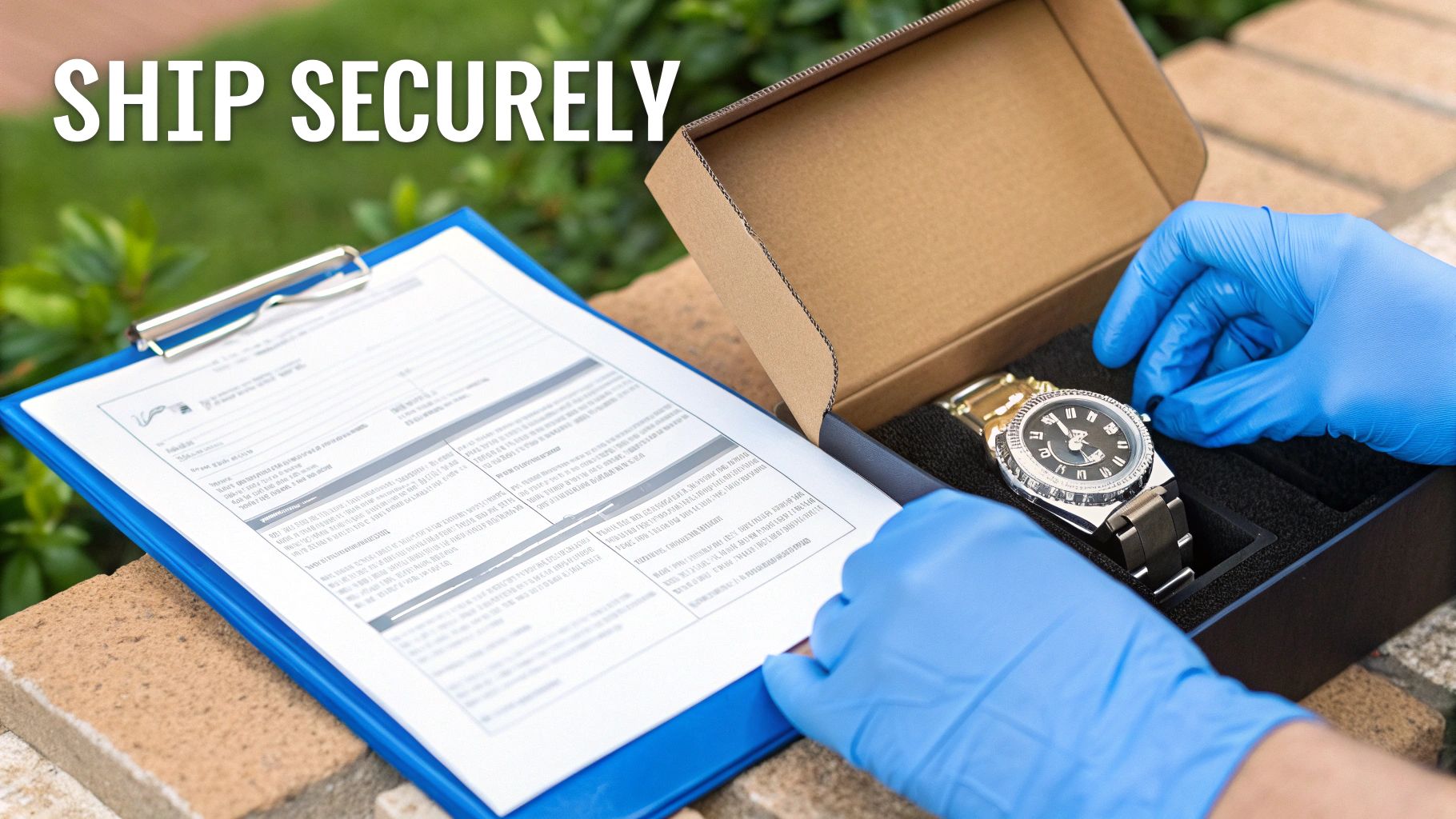
A deal isn't done until the watch is safely with its new owner and the money is securely in your bank account. This final leg of the journey—handling the logistics—is where sellers are often most vulnerable. Managing every detail here isn't just important; it's critical.
Whether you're working with a professional buyer or an individual, the entire process should hinge on security, transparency, and crystal-clear communication. Let's walk through the essential steps to ensure your transaction is completely risk-free.
The Bedrock of Trust: Authentication
Before any money ever changes hands, a professional buyer will always conduct a thorough in-house authentication. This isn't just a formality; it's a non-negotiable step that protects both you and the buyer from counterfeit watches or misrepresented parts. It’s how they confirm the watch’s mechanical health, the originality of its components, and that its serial numbers match the paperwork.
When you sell to a reputable dealer, their authentication process becomes your shield. You sidestep the frustrating disputes that often plague private sales on platforms like eBay, where a dishonest buyer might falsely claim a watch is fake just to force a return. For a closer look at what goes into this, our guide on https://www.ecijewelers.com/blogs/recent-posts/how-to-authenticate-a-rolex-watch offers some valuable insights.
For most owners, the safest way to sell is in an authenticated environment that can officially verify a watch's originality, condition, and provenance. While online luxury watch sales now top US$6 billion, many of the highest-value pieces still trade hands through vetted jewelers who provide written authenticity guarantees and handle all the insured logistics.
Businesses like ECI Jewelers bridge this gap by combining in-store inspections in New York with insured nationwide shipping. This gives you access to a global pool of buyers while you deal with a single, accountable partner.
Shipping Your High-Value Timepiece Securely
If you're selling from a distance, shipping your watch requires a lot more than just a standard box and a label. You're not sending a book; you're sending a high-value asset, and it needs to be packaged and insured as such.
Professional buyers make this simple by providing a prepaid, fully insured shipping label from a trusted carrier like FedEx or UPS, almost always specifying overnight service for maximum security.
Follow these steps for ironclad packaging:
- Wrap the Watch: Start by placing the watch securely in its box or a watch roll, making sure it can't shift around.
- Use the Double-Box Method: Put the watch box inside a slightly larger, sturdy shipping box. Use bubble wrap or packing peanuts to fill any gaps—this prevents movement and acts as a shock absorber.
- Seal It Tight: Tape all seams of the outer box securely. To add another layer of protection, consider learning about selecting the right tamper-evident bag to ensure the package hasn't been opened in transit.
Crucial Insurance Note: Never, ever declare the contents as "watch," "Rolex," or "jewelry" on the shipping label. Professional dealers will give you specific, discreet instructions to prevent targeted theft. Always get a receipt from the carrier that shows the package has been scanned into their system.
Ensuring Safe and Verified Payment
The final step—getting paid—is the ultimate test of a transaction's security. In private sales, this is the moment of highest risk. Payment apps and checks are notoriously susceptible to scams, chargebacks, and reversals.
When you work with a verified business, your options are much safer and straightforward:
- Bank Wire Transfer: This is the gold standard for high-value sales, period. It's a direct, bank-to-bank transfer that is irreversible once it’s completed. Nothing offers a higher level of security.
- In-Person Payment: If you're selling locally to a jeweler, you can receive a business check or even arrange for a wire transfer while you're on the spot.
For private sales of luxury watches, you should absolutely avoid payment methods like PayPal Goods & Services. Their policies are heavily skewed to favor the buyer in disputes, leaving sellers dangerously exposed to significant financial loss. A secure, verified payment from a professional is the only way to guarantee a safe conclusion to your sale.
Frequently Asked Questions About Selling Luxury Watches
Even with all the options laid out, a few questions probably come to mind. We get it—selling a valuable watch involves a lot of moving parts, and you want to feel confident before making a move.
We’ve handled thousands of watch sales and have heard every question in the book. Think of this as the final check-in, where we address the most common things sellers ask right before they take the next step.
How Do I Determine the Value of My Luxury Watch?
The only way to know what your watch is truly worth is to get a professional appraisal. Its value isn't just one thing; it's a blend of its brand, model, age, condition, and, critically, whether you still have the original box and papers. That full set can add a significant premium.
A specialty buyer or jeweler who deals in the pre-owned market daily will give you a valuation based on real-time sales data for your exact reference number. This is far more accurate than looking at online listings, which are just asking prices—not what watches are actually selling for.
Is It Better to Sell a Watch Online or In Person?
Each has its perks, and honestly, the best approach often mixes both. An in-person sale at a secure jeweler’s office gives you instant payment and zero shipping risk. It’s simple, transparent, and done face-to-face.
But a reputable online buyer can offer that same security and convenience. They provide fully insured, prepaid shipping labels and use secure payment methods like bank wires. The ideal setup is a dealer who offers both—a specialist with a physical showroom who also has a secure, streamlined mail-in process for clients nationwide.
The hybrid approach offers the most flexibility. You can start online to lock in a firm quote, then decide whether to complete the sale in person or use their insured shipping, depending on what makes you most comfortable.
What Is the Safest Way to Receive Payment?
For a high-value asset like a luxury watch, a bank wire transfer from a verified business is the gold standard. It’s the most secure method, hands down. Once the funds hit your account, the transaction is final and irreversible. No chargebacks, no fraud risk, just a clean financial record.
If you’re attempting a private sale, be extremely wary of other payment methods. Cashier's checks are easily forged, and payment apps almost always side with the buyer in a dispute, leaving you with no watch and no money. For your own peace of mind, stick to verified wire transfers from an established business.
Ready to discover what your watch is worth? At ECI Jewelers, we provide transparent, market-based offers with immediate and secure payment. Get a free, no-obligation quote from our experts today by visiting us at https://www.ecijewelers.com.


