


It’s a fair question: why are Patek Philippe watches so expensive? The short answer is a potent mix of unmatched craftsmanship, a legacy stretching back over 180 years, and a very deliberate, almost stubborn, scarcity. The brand’s value isn't just about telling time; it's built on a foundation of total in-house manufacturing, obsessive hand-finishing, and a history of innovation that keeps demand white-hot for an incredibly limited supply.
Answering Why Patek Philippe Watches Are So Expensive
When you ask about the price of a Patek Philippe, you're asking about more than just a watch. You're really asking about the value of a family heirloom, a piece of mechanical art, and a benchmark for horological perfection. The cost isn't just for the gold or platinum; it's for the centuries of expertise, the thousands of hours of skilled labor, and the powerful brand equity they’ve built since 1839.
A better way to think about it is like acquiring a masterpiece from a legendary artist. An original painting is valued for its provenance, the artist's skill, and its rarity—a Patek Philippe timepiece is valued for the exact same reasons. Each watch is the result of a vertically integrated process, meaning nearly every single component is designed, made, finished, and assembled under one roof in Geneva.
The Core Pillars of Value
To really get why these watches command such prices, you have to look at the pillars holding up their reputation. These aren't just marketing talking points; they are tangible, costly factors that contribute directly to the final price tag and the long-term worth of every watch that leaves their workshop.
- In-House Craftsmanship: From the tiniest screw to the most complex gear, everything is made and meticulously hand-finished to the brand's own punishing standards—the Patek Philippe Seal.
- Historical Legacy: With an unbroken history since 1839, the brand has a proven, documented track record of innovation and world-class quality.
- Deliberate Scarcity: Production is capped at around 70,000 watches annually across all their models. This isn't a limitation; it's a strategy that ensures each piece remains a rare commodity.
- Investment Performance: Patek Philippe watches consistently shatter records at auction, proving their incredible ability to hold and, more often than not, dramatically increase in value over time.
This combination creates a perfect storm of desirability and exclusivity, cementing Patek's status at the absolute pinnacle of watchmaking.
To make it even clearer, let's break down the seven core elements that justify the price of a Patek Philippe.
The Seven Pillars of Patek Philippe's Value
| Value Pillar | Brief Explanation |
|---|---|
| Heritage & Innovation | An unbroken lineage of family ownership and over 100 patents since 1839. |
| In-House Manufacturing | Complete control over the design, production, and assembly of every single watch. |
| Hand-Finishing | Countless hours of artisanal work on parts, even those completely hidden from view. |
| Deliberate Scarcity | Extremely low production numbers create immense demand and notoriously long waiting lists. |
| Precious Materials | Use of only the highest quality gold, platinum, and flawless gemstones. |
| Grand Complications | Proven mastery of the most complex and prestigious functions in all of watchmaking. |
| Auction Provenance | A stellar track record as a blue-chip, appreciating asset in the secondary market. |
Each of these pillars reinforces the others, creating a value proposition that few—if any—other brands can match. Now, let's dive into each of these factors one by one.
The Unmatched Art of In-House Craftsmanship
Beyond the precious metals and brand name, the real soul of a Patek Philippe lies in the obsessive, almost fanatical, level of human artistry that goes into making one. This is where “in-house manufacturing” stops being an industry buzzword and becomes a profound commitment to perfection.
Think of it less like a watch factory and more like a Michelin-star kitchen where the head chef not only designs the menu but grows every single ingredient from seed.
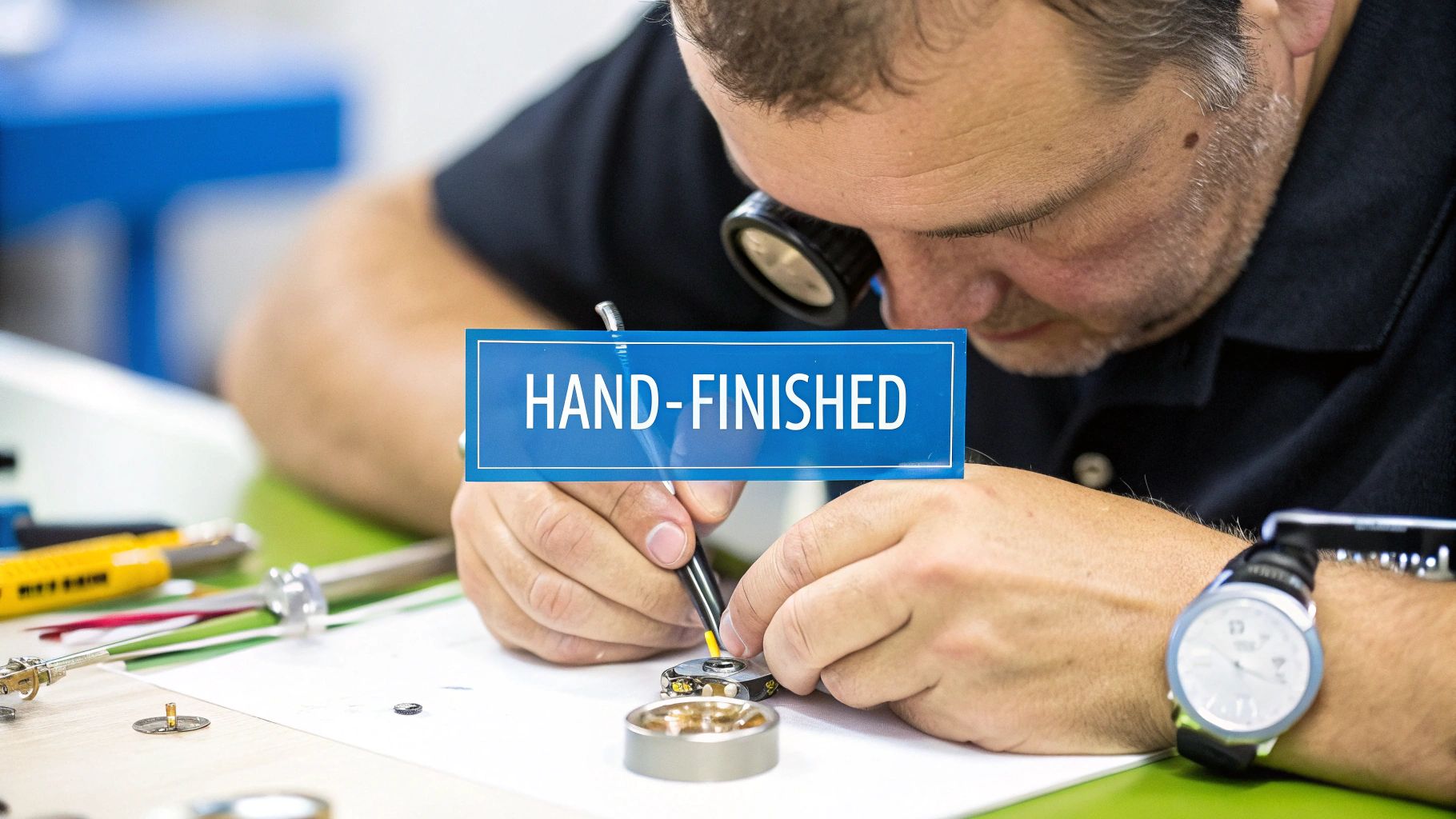
From the tiniest screw to the most intricate gear train, nearly every component is made and finished under Patek Philippe’s own roof. This total control allows the brand to enforce its own punishingly high standards—known as the Patek Philippe Seal. This benchmark goes far beyond typical industry requirements, guaranteeing not just accuracy but the flawless aesthetic quality of the entire watch.
This is a huge part of why Patek is so expensive. You're paying for an incredible investment of time and skill that's invisible to the naked eye but defines the very heart of the watch.
The Art of Finishing by Hand
The true mark of Patek Philippe's craftsmanship is only revealed under a watchmaker's loupe. Artisans spend hundreds of hours on painstaking hand-finishing techniques that serve no functional purpose for timekeeping. Instead, they transform the movement into a mechanical sculpture.
These are the details that separate a simple luxury watch from a true work of horological art.
Key techniques include:
- Anglage (Beveling): An artisan meticulously files and polishes the sharp edges of movement parts to a perfect 45-degree angle. This creates a brilliant, light-catching border that can only be achieved by an impossibly steady hand.
- Perlage (Circular Graining): This is a pattern of tiny, overlapping circles applied to the main plate and bridges. It creates a beautiful, textured finish on parts you may never even see.
- Côtes de Genève (Geneva Stripes): These are decorative, wave-like patterns applied to flat surfaces of the movement, adding a sense of depth and flow to the machinery.
These painstaking details are central to the Patek Philippe identity. They represent an absolute refusal to cut corners, even on parts hidden deep inside the case. This commitment to total perfection is a significant driver of the final cost.
The sheer amount of manual labor required is immense. A machine can stamp out a component in seconds, but a Patek Philippe artisan might spend days—or even weeks—perfecting it by hand. This human touch, this dedication to centuries-old techniques, is a primary reason a Patek Philippe commands such a premium.
If you're curious about the intricate mechanics being so carefully decorated, you can learn more about how a mechanical watch works in our detailed guide.
A Legacy of Innovation and Heritage Since 1839
When you hold a Patek Philippe, you're holding more than just a watch. You're holding a tangible piece of history. The story starts all the way back in 1839, and that uninterrupted legacy is a huge part of why Patek commands such high prices. This isn't just about being old; it's about continuous, family-owned stewardship, which is incredibly rare in the luxury world today.
The Stern family took the reins in 1932 and has now guided the brand for four generations. This consistency is everything. It means every decision is made for the long-term health of the brand, not to chase quarterly profits for shareholders. Patek Philippe answers only to itself, allowing it to maintain an obsessive, uncompromising culture of excellence.
A History Defined by Firsts
Patek Philippe's reputation was built on a foundation of genuine, game-changing innovation. Their archives are packed with over 100 patents that literally shaped modern watchmaking. Many of the complex features—what we call "complications"—that define high-horology today were either invented or perfected in Patek's workshops.
- Keyless Winding (1845): Patek Philippe was one of the very first to successfully commercialize a system for winding a watch without a separate key. It sounds simple now, but it was revolutionary.
- Perpetual Calendar (1889): The brand patented the first perpetual calendar for a pocket watch—a brilliant mechanism that automatically adjusts for the different lengths of months and even leap years.
- Split-Seconds Chronograph (1902): Patek patented the first double chronograph, a highly complex function that allows you to time multiple events that start together but end at different times.
This constant push for what's next is baked into the brand's DNA. Owning a Patek is owning a direct link to these pivotal moments in watchmaking history.
The Stern family’s continuous ownership is more than just a historical footnote; it’s a guarantee of stability and an unwavering commitment to quality. This unbroken lineage adds an immeasurable, intangible value that collectors are willing to pay a premium for.
The brand's production numbers also tell a story of deliberate, careful growth. They went from making just 100 watches in 1840 to producing over 1.6 million movements by 1985. This isn't a story about mass production; it's about methodically scaling their mastery without ever sacrificing quality. You can explore more about this impressive growth curve and its impact on the brand's valuation. This legacy isn't just marketing—it's a proven track record that justifies every dollar.
The Economics of Deliberate Scarcity
Beyond the art and history, there's a powerful economic force at play: deliberate scarcity. Patek Philippe intentionally limits how many watches they make, creating a classic case where demand massively outstrips supply. This isn’t just a clever marketing trick; it's the natural result of the incredible amount of time needed for their hand-finishing and obsessive quality control.
The numbers tell the story. While some competitors churn out over a million watches a year, recent estimates suggest Patek Philippe will only produce around 74,000 units for the entire year, spread across all their models. This bottleneck ensures that every single watch lives up to the name. You can dig deeper into how these production figures shape the market at G&G Timepieces.
This strategy of controlled output has created one of the most famous (and frustrating) phenomena in the luxury world: the waiting list.
The timeline below shows Patek Philippe's measured growth, a clear reflection of its focus on quality over sheer quantity.
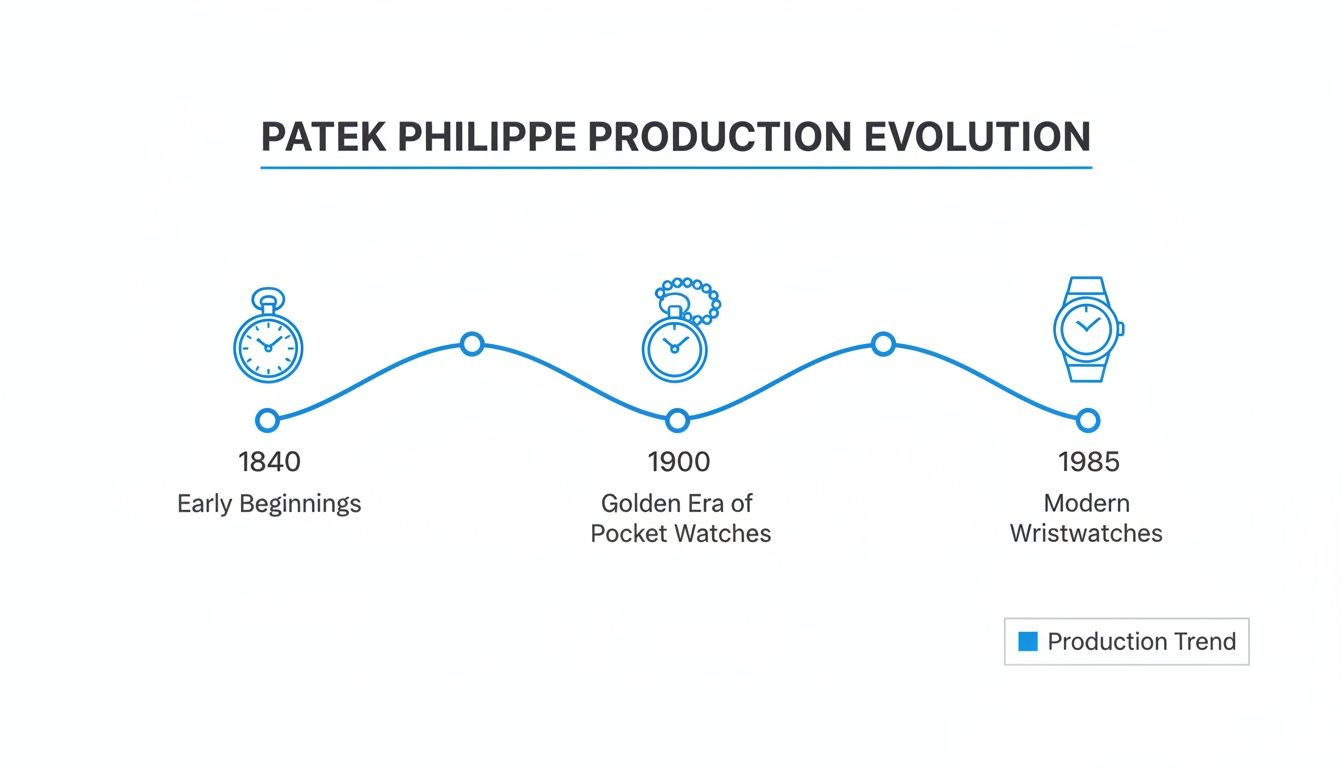
This chart illustrates a methodical evolution, proving how the brand carefully scaled its mastery without ever compromising its core values.
The Power of the Waiting List
For hot models like the Nautilus or Aquanaut, you can’t just walk into a boutique with a briefcase full of cash. Prospective buyers have to apply for the privilege of purchasing one, and then wait years for the call. It's not an artificial barrier—it’s the real-world logjam caused by global demand hitting a wall of minuscule supply.
This extreme exclusivity has a huge psychological and financial effect. It turns these watches from products into rare trophies. When something is this hard to get, its perceived value goes through the roof. The waiting list acts as a powerful amplifier for the brand's prestige, making sure the desire for a Patek only gets stronger over time.
The waiting list is more than a delay; it is a fundamental part of the Patek Philippe value proposition. It guarantees that anyone who secures a high-demand model has acquired something truly exceptional and rare, reinforcing its status as a top-tier asset.
This whole dynamic pours gasoline on the secondary market, where many of these models trade for double, triple, or even more than their original retail price. The sheer difficulty of buying a new piece from the brand means collectors will happily pay a massive premium to skip the line. It's a self-feeding cycle: scarcity drives up pre-owned prices, which in turn fuels even more insane demand at the retail level. It’s a masterclass in managing luxury desire and a huge piece of the puzzle explaining why Patek is so expensive.
How Auction Performance Proves Investment Value
A Patek Philippe is more than just a watch; it's widely considered a blue-chip asset. The brand's staggering performance at auction houses like Christie's and Sotheby's isn't just for headlines—it's hard proof of its incredible ability to hold and often skyrocket in value.
When a Patek shatters world records, it creates a powerful ripple effect. This success solidifies the brand's reputation as a secure store of value, giving collectors immense confidence. It reinforces the idea that you aren't just spending money, but acquiring a tangible asset with a proven history of appreciation.
The Power of Provenance
A huge factor driving these auction prices is provenance—the documented history of a specific watch. A timepiece with a clear, traceable past is exponentially more valuable than one without. This is where Patek Philippe has a unique and powerful advantage.
The brand has kept meticulous records since its founding in 1839. For watches older than five years, collectors can request an 'Extract from the Archives,' a service that provides a detailed history of that specific timepiece. This document verifies its production date, original sale date, and technical specifications, adding a significant premium to its value.
This archival service acts as a gold-standard verification system. For collectors, having official documentation can increase a watch’s value by 15-30% or more compared to a similar piece lacking this ironclad provenance.
This ability to trace a watch's lineage creates a transparent and robust secondary market—a major reason why Patek is so expensive. Since these watches are often viewed as significant investments, understanding how they fit into broader frameworks of strategic legacy planning for high-net-worth families can be quite valuable.
The vibrant auction scene and the brand's commitment to its archives work together perfectly. They create a feedback loop where record sales boost brand prestige, and the brand’s historical integrity gives buyers the confidence to bid high. This dynamic makes acquiring a Patek Philippe feel less like a purchase and more like a sound financial strategy.
For more on this topic, check out our guide on investing in luxury watches. It’s this proven investment potential that elevates the brand far beyond simple timekeeping.
Navigating Your Patek Philippe Purchase
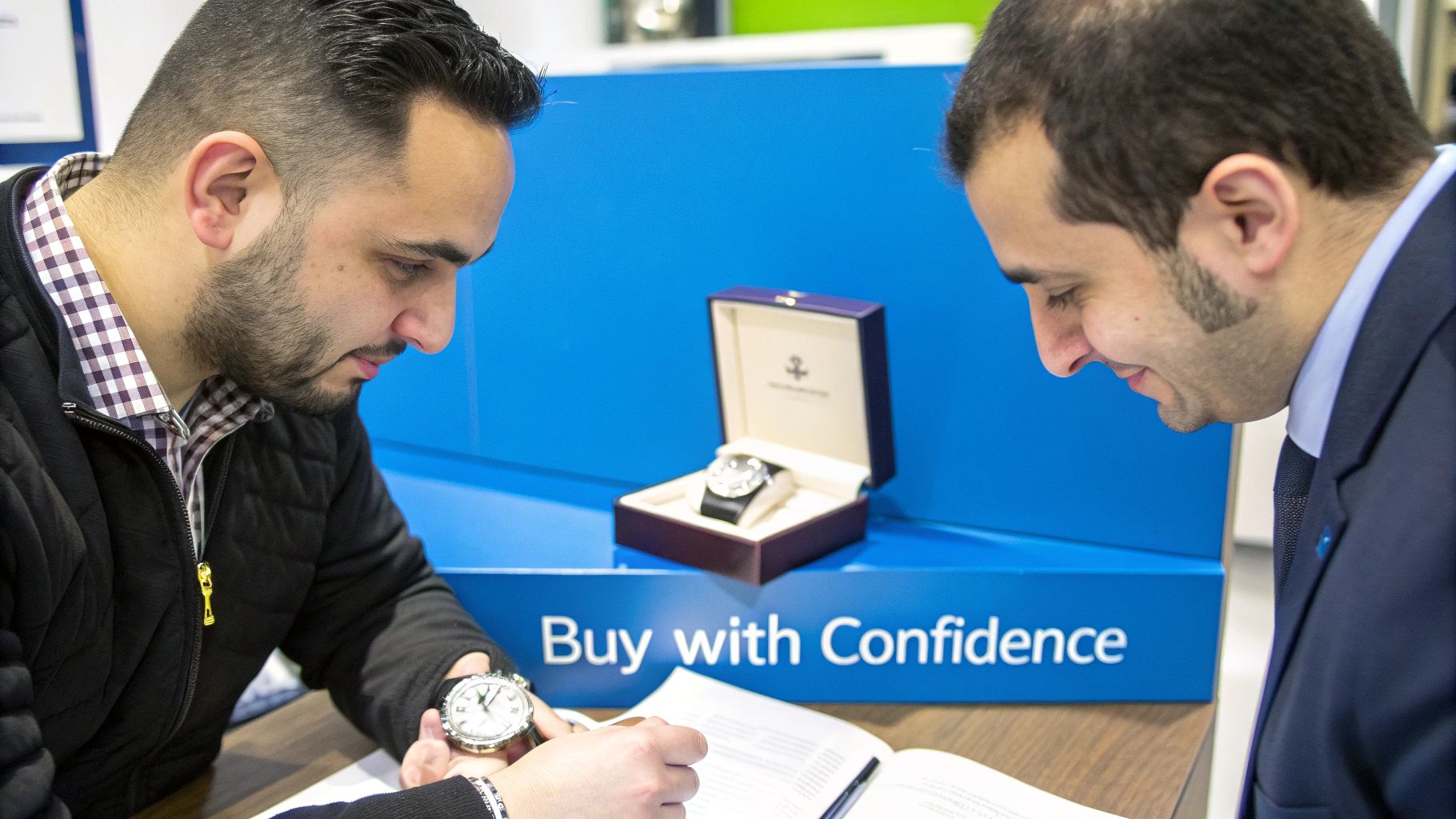
Knowing why a Patek is expensive is one thing. Actually buying one with confidence is a completely different ballgame. The pre-owned market is a fantastic way to acquire incredible timepieces, but let's be honest—it comes with risks. To navigate it successfully, you need diligence and, more than anything, a partner you can trust.
First things first: provenance. When you're looking at a pre-owned Patek, the original box and papers aren't just nice-to-haves. They're essential parts of the watch's value. Think of these documents as the watch's birth certificate and passport, confirming its entire history and authenticity. A complete set makes a world of difference.
The Role of an Expert Authenticator
This is where working with a specialist like ECI Jewelers is non-negotiable. The market for fakes has gotten scarily sophisticated. For a purchase of this magnitude, you can't rely on trust alone; you need absolute, verifiable proof.
Our expert watchmakers put every single timepiece through a rigorous, multi-point inspection. We leave no stone unturned.
- Movement Verification: We go deep inside the watch, meticulously checking that every component, every finish, and every tiny engraving is up to Patek Philippe's legendary standards.
- Serial Number Cross-Reference: The serial numbers on the case and movement must match not only each other but also the brand’s historical records and the original paperwork. We confirm it all.
- Condition Assessment: You get a completely transparent evaluation of the watch's condition, from the sharpness of its case lines to the originality of the dial. No surprises.
At ECI Jewelers, we eliminate every bit of risk from the pre-owned buying process. Our 100% authenticity guarantee ensures your purchase isn't just a transaction—it's a secure, confident investment in a piece of watchmaking history.
This painstaking approach is why collectors return to us time and again. We protect your investment and give you total peace of mind. For a closer look at what separates a trustworthy dealer from the rest, our guide on certified pre-owned watches breaks it all down.
Ultimately, partnering with an expert transforms a potentially nerve-wracking purchase into the exciting experience it's supposed to be.
Frequently Asked Questions About Patek Philippe Value
Even after you understand the history and the incredible craftsmanship, some practical questions always come up. Answering these is the key to really getting why Patek Philippe is so expensive and what that means for you as a potential owner. Here are a few of the most common questions we hear every day.
Do All Patek Philippe Watches Go Up in Value?
While Patek Philippe has an unmatched reputation for holding its worth, it's a common misconception that every single model is a rocket ship investment. The reality is a bit more complicated.
It's the steel sports models, especially the Nautilus and Aquanaut, that have seen insane growth. The demand for these watches completely dwarfs their limited supply, pushing their secondary market prices to astronomical levels.
Grand Complications and special limited editions are also blue-chip assets that almost always do exceptionally well. But your more common dress watches in precious metals? They are prestigious and hold their value incredibly well, but they offer more stability rather than the rapid, headline-grabbing appreciation of their sportier cousins.
Key Takeaway: Not all Pateks are equal as investments. The brand as a whole is rock-solid, but it’s the steel sports models and the ultra-complicated pieces that are the real drivers of Patek's legendary investment performance.
What Is the Patek Philippe Seal?
Think of the Patek Philippe Seal as the brand's personal, obsessive-compulsive promise of perfection. It's their own in-house quality standard, and it blows industry benchmarks like the Geneva Seal out of the water. Crucially, it covers the entire finished watch—not just the movement ticking away inside.
This guarantee is a commitment to excellence across the board:
- Timekeeping Accuracy: The Seal demands a rate accuracy of -3/+2 seconds per day. That’s stricter than most official chronometer certifications.
- Flawless Finishing: Every single part, even the tiny screws and springs you'll never see, must be finished to a perfect, artisanal standard. No exceptions.
- Long-Term Reliability: This isn't just about how the watch performs today. The Seal is a promise that your watch can be serviced and maintained for generations to come.
Ultimately, the Patek Philippe Seal is a tangible symbol of just how far the brand goes. It's verifiable proof of the quality you’re paying for and a huge part of what justifies the premium price.
How Do I Know a Pre-Owned Patek Is Real?
Authenticating a Patek Philippe is serious business and absolutely not a DIY job. With values this high, the market is unfortunately filled with sophisticated fakes. The only way to be 100% certain you're getting the real deal is to buy from a highly reputable and trusted dealer. Period.
Experts perform meticulous, multi-point inspections. They check the movement, case, dial, and serial numbers, cross-referencing everything against Patek's historical records. Having the original box, papers, and an Extract from the Archives adds powerful layers of verification. This is why collectors who have been in the game for decades still work with trusted partners for such a significant purchase.
At ECI Jewelers, our specialists completely eliminate the risk from buying pre-owned. We provide a 100% authenticity guarantee with every single timepiece we sell. You can explore our curated collection of authenticated Patek Philippe watches and invest with absolute confidence.


