


Owning a Rolex isn't just about telling time—it’s about stewarding a piece of mechanical art and a serious investment. The best watch winder for rolex isn't just a fancy box; it's an essential tool for keeping your timepiece in peak condition, ensuring it’s always accurate, lubricated, and ready for your wrist.
Why Your Rolex Deserves a Dedicated Watch Winder

Think of your Rolex like a high-performance engine. It was built for motion, not to sit cold in a safe. The heart of any automatic Rolex is its self-winding movement, driven by the ingenious Perpetual rotor that turns your wrist's natural movements into power. Let the watch sit still for too long, and it simply runs out of gas.
A quality watch winder mimics that gentle, kinetic motion. By rotating your watch on a set schedule, it keeps the mainspring perfectly wound. This simple action has a few powerful benefits for the health and performance of your Rolex.
To give you a quick overview, here's a look at the most important reasons to use a winder.
Key Benefits of a Watch Winder for Your Rolex
| Benefit | Why It's Critical for Your Rolex |
|---|---|
| Mechanical Health | Keeps internal oils evenly distributed, reducing friction and preventing premature wear on the intricate movement. |
| Ready-to-Wear Convenience | Eliminates the need to manually wind and reset the time, date, and other functions every time you wear it. |
| Investment Protection | Safeguards the watch's mechanical integrity, which is crucial for preserving its long-term financial value. |
| Proper Storage | Provides a secure, dust-free environment that protects the case, crystal, and bracelet from environmental damage. |
These benefits work together to ensure your Rolex not only runs perfectly today but also holds its value for generations to come.
Preserving Mechanical Integrity
Inside your Rolex is a tiny, complex world of gears, springs, and jewels, all bathed in specialized oils. When a watch stops, these lubricants can start to thicken or pull away from critical parts due to gravity.
Consistent movement keeps those oils flowing where they need to be, minimizing friction and preventing unnecessary wear and tear. It’s a basic principle of watch care we cover in our guide explaining https://www.ecijewelers.com/blogs/recent-posts/what-is-a-watch-winder. In fact, using a winder is a core component of a simple guide on how to properly store an automatic watch.
The Convenience of Grab-and-Go Readiness
Beyond the mechanical advantages, a winder offers pure, simple convenience. If you have a few watches you rotate through, it gets old having to wind and reset the time, date, or GMT hand every time you switch.
With a winder, your Rolex is always accurate and ready to go at a moment's notice.
A watch winder transforms your Rolex from a static object in a box into a dynamic, living piece of engineering, always prepared for its next journey on your wrist. It’s an investment in both preservation and practicality.
Protecting a Valuable Asset
Let’s not forget the financial side. Rolex watches have proven to be incredible assets, with many models appreciating significantly over time. Protecting that value means maintaining the watch properly.
Consider this: the average price for a pre-owned Rolex has skyrocketed by over 550% in the last 15 years. This isn't just a watch; for many, it's a key part of their portfolio.
That kind of appreciation is exactly why professional-grade care is so important. A high-quality winder protects the mechanical soul of your investment, keeping it in pristine condition for the long haul. It's a small price to pay to secure an asset that’s both a personal treasure and a significant financial holding.
Understanding Rolex Winder Settings: TPD and Direction
Getting the settings right on your watch winder is the most important step in caring for your Rolex. At first, the controls might seem a little technical, but it all comes down to two simple concepts that mimic how your wrist works: Turns Per Day (TPD) and Rotational Direction.
Think of TPD as the number of steps your watch needs to take each day to stay powered up. It’s the total count of full 360-degree rotations the winder makes in a 24-hour period. Just like you need a certain amount of activity to stay healthy, your Rolex needs a specific number of turns to keep its mainspring consistently wound.
Rotational direction is just what it sounds like—the way the winder turns. This can be clockwise, counter-clockwise, or a mix of both.
The Golden Rule for Modern Rolex Movements
Fortunately, Rolex has made this incredibly simple. The heart of every modern automatic Rolex is the Perpetual rotor, a brilliant piece of engineering that winds the mainspring using motion from any direction.
This design makes setting your winder a breeze. For nearly all modern Rolex models, from a Submariner to a GMT-Master II, the optimal setting is the same:
- Turns Per Day (TPD): 650
- Winding Direction: Bidirectional (alternating clockwise and counter-clockwise)
This 650 TPD Bidirectional setting is the gold standard. It provides just enough power to keep the watch running perfectly without putting any unnecessary stress on the internal parts. You can dive deeper into the mechanics of these incredible timepieces in our guide that explains what makes an automatic watch unique.
Why TPD and Direction Matter So Much
Imagine you're following a workout plan. If you do too few reps, you won't build any strength. But if you do too many, you risk injury. A watch winder works on the exact same principle.
Set the TPD too low, and the winder won't generate enough energy to keep the mainspring wound. Your Rolex will eventually stop, forcing you to reset the time and date—the very inconvenience a winder is meant to prevent.
On the flip side, setting the TPD too high can overwork the movement. While modern Rolexes have a built-in safety—a slipping clutch that prevents the mainspring from being overwound—constantly engaging that clutch causes needless wear and tear over the long run.
The goal of a watch winder isn't to wind a dead watch; it's to maintain the power reserve of an already running watch. The 650 TPD setting is the perfect maintenance level, not an aggressive charging session.
Using the correct bidirectional setting is equally important. Since the Perpetual rotor is designed to capture energy from movement in both directions, a bidirectional winder perfectly replicates the natural, varied motions of your wrist throughout the day. This ensures the most efficient and gentle winding process possible.
Finding the Sweet Spot for Your Rolex
While 650 TPD Bidirectional is the universal starting point for almost any modern Rolex, some owners find success with slightly higher settings, maybe up to 800 TPD. This can sometimes be useful if you have a watch with many complications or if your specific winder's rotation cycle benefits from a slightly higher count.
However, starting at 650 TPD is always the best practice. It’s the ideal balance for keeping your Rolex wound while minimizing mechanical strain. By understanding these two core settings, you can confidently set up your winder to keep your Rolex healthy, accurate, and ready for any occasion.
What Makes a Watch Winder Worthy of a Rolex?
Choosing the right watch winder is about more than just finding a box that spins. It's about selecting a precision instrument designed to protect and maintain another precision instrument. When you're looking for the best winder for your Rolex, some features are simply non-negotiable.
Think of it like choosing a garage for a classic car. You wouldn't park a vintage Ferrari in a rickety shed, exposed to the elements. In the same way, your Rolex deserves a winder built with an equal commitment to quality and engineering. This guide breaks down exactly what to look for.
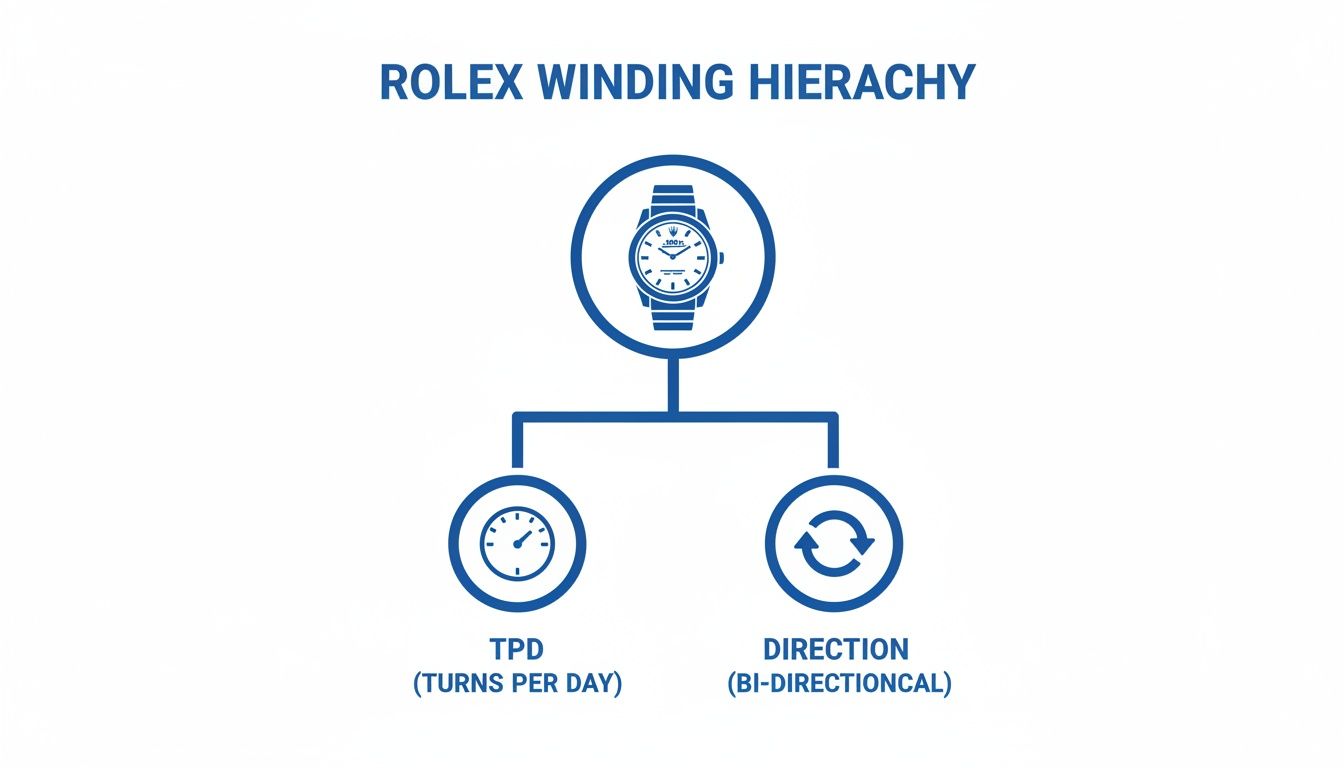
As you can see, a winder fit for a Rolex must offer precise control over both Turns Per Day (TPD) and rotational direction. Let's dig into the features that make this happen.
Motor Quality and Noise Level
The motor is the heart of any watch winder. A cheap motor isn't just loud and prone to failure; in the worst-case scenario, it can generate magnetic fields that wreak havoc on your Rolex's delicate movement.
Look for winders that use high-quality, ultra-quiet Japanese or Swiss motors. Brands like Mabuchi are famous for their reliability and nearly silent operation, often producing less than 10 decibels of noise. This is absolutely critical if the winder will live in your bedroom or office, where any sound becomes a major distraction.
A great motor ensures your winder is a silent guardian, not a noisy pest.
Programmable TPD and Direction
We've already established that Rolex movements need a specific winding schedule—typically 650 TPD set to Bidirectional. A winder with fixed, unchangeable settings is a one-size-fits-all solution that just doesn't cut it for a high-end timepiece.
Your winder must offer adjustable settings for both TPD and direction (clockwise, counter-clockwise, and bidirectional). This flexibility lets you tailor the winding cycle perfectly to your Rolex's specs, preventing needless wear on the clutch mechanism while keeping the mainspring at its optimal tension.
Build Quality and Materials
The overall construction of a winder says everything about its quality. While plastic models exist, a Rolex feels at home in a winder crafted from premium materials like solid wood, carbon fiber, or high-grade leather.
These materials do more than just look good. They provide a stable, durable housing that protects both the internal mechanics and your watch. A solid build minimizes vibrations and ensures the winder operates smoothly for years, reflecting the same lasting quality as the timepiece it holds.
The Watch Holder and Bracelet Protection
The watch holder, or cushion, is where your Rolex makes direct contact with the winder. It’s a critical detail that many buyers overlook until it's too late. A poorly designed holder can be a nightmare.
A top-tier winder will feature a soft, non-abrasive cushion that compresses to fit securely inside your watch's bracelet without stretching it. This is especially important for iconic Rolex bracelets like the Oyster or Jubilee. A secure, spring-loaded cuff prevents the watch from shifting or—even worse—falling out during rotation, protecting the clasp and lugs from scratches.
- Secure Fit: Prevents the watch from becoming loose and getting damaged.
- Soft Material: Uses materials like high-density foam or soft leather to protect the bracelet's finish.
- Adjustable Size: Accommodates different wrist sizes without putting stress on the bracelet links.
Power Options and Security
Flexibility in power is a key feature. Most quality winders offer dual power options: an AC adapter for home use and battery power for portability or storage in a safe. This ensures your Rolex stays wound even during a power outage or when it's locked away.
This level of care is more important than ever. The global luxury watch market was valued at US$ 33.12 billion in 2025 and is projected to hit US$ 48.27 billion by 2033, a clear sign of the strengthening demand for brands like Rolex. Protecting such a valuable and appreciating asset with a reliable winder is just a smart move. You can explore more data on the luxury watch market's growth and see what it means for collectors.
Common Mistakes to Avoid When Buying a Winder
Knowing what to look for in a winder is only half the battle. Just as important is knowing which common traps to sidestep. Getting this choice right protects your investment, but a poor decision can lead to frustration or, in the worst cases, actual damage to your timepiece.
One of the biggest temptations is chasing a low price tag, but this often turns into the most expensive mistake in the long run. Cheap winders are notorious for using noisy, unreliable motors that can burn out within months. Even more alarming, their motors are often poorly shielded, generating magnetic fields that can wreck your Rolex's accuracy and force a costly trip to your watchmaker for demagnetization.
Overlooking Programmability
A major pitfall is buying a winder with fixed or extremely limited settings. These "one-size-fits-all" devices often turn continuously or use a generic setting that simply isn't right for a Rolex. As we've covered, your watch's movement is engineered for a gentle 650 TPD Bidirectional cycle.
Forcing it onto a non-programmable winder puts a constant, unnecessary workload on the internal slipping clutch, which accelerates wear and tear. It’s like buying a car with the accelerator stuck down—it's inefficient and causes needless strain. Always, always prioritize a winder that gives you precise control over the TPD and direction to match your Rolex's specific needs.
Ignoring the Watch Holder Design
The watch holder, or cushion, is a surprisingly critical component that's easy to overlook until it's too late. An ill-fitting holder is a recipe for problems that directly impact the condition of your watch.
- A cushion that’s too large puts constant strain on your Rolex's bracelet, stretching the links and stressing the clasp over time.
- A cushion that’s too small or loose lets the watch shift and rattle around, leading to scuffs on the case back and bracelet. Worst-case scenario? It could even fall out during rotation.
- A holder made from abrasive materials can leave micro-scratches on the polished surfaces of your watch case and clasp, slowly dulling its pristine finish.
The ideal holder should be made of a soft, non-abrasive material like high-density foam or plush leather. It needs to compress just enough to fit snugly inside the bracelet without stretching it, keeping your Rolex secure and protected through every turn. Think of it as a custom-tailored seat for your timepiece.
Disregarding the Hidden Costs
Finally, a common mistake is focusing only on the upfront price while ignoring long-term value and support. A winder with no warranty or from a company with a reputation for poor customer service is a huge gamble. What happens if the motor dies in six months? Or if you need help dialing in the settings?
A reputable brand stands behind its product with a solid warranty and accessible support, giving you peace of mind. This is especially true now, as the pre-owned luxury watch market has become the main way collectors get their hands on premium timepieces. As insights on how luxury watches are viewed as portfolio assets show, serious collectors see quality maintenance equipment as essential. A good warranty isn’t just an extra cost—it’s insurance for your investment.
Recommended Winder Settings for Popular Rolex Models
Alright, let's get to the practical part you've been waiting for. While the "why" behind TPD and rotation is good to know, what really matters is getting your specific Rolex set up and running perfectly. This is where we cut through the theory and give you a straightforward guide.
We've already covered the golden rule for virtually all modern Rolex watches: 650 TPD set to Bidirectional. This is the sweet spot for maintaining the brand's incredibly efficient Perpetual rotor system.
Think of the 650 TPD rule as the master key that opens almost every door. The chart below, however, is like having the exact key cut just for your model. It's about that extra peace of mind.
Rolex Winding Specifications Quick Reference Guide
Below is a quick-reference table that matches some of the most sought-after Rolex references with their movements. Use this to find the optimal TPD and direction settings for your watch. Whether you have a legendary Submariner or a classic Datejust, this is your starting point.
For a deeper dive into what makes these watches so special, check out our guide to the most popular Rolex models.
Quick Tip: If you're ever in doubt or can't find your model, just fall back on 650 TPD Bidirectional. It’s always a safe and effective bet for any modern Rolex. You simply can't go wrong.
Here are the optimal settings for your specific timepiece.
| Rolex Model | Movement (Caliber) | Recommended TPD | Winding Direction |
|---|---|---|---|
| Submariner (No Date) | 3230 | 650 | Bidirectional |
| Submariner Date | 3235 | 650 | Bidirectional |
| GMT-Master II | 3285 | 650 | Bidirectional |
| Daytona | 4130 / 4131 | 650 | Bidirectional |
| Datejust 36 / 41 | 3235 | 650 | Bidirectional |
| Day-Date 36 / 40 | 3255 | 650 | Bidirectional |
| Explorer / Explorer II | 3230 / 3285 | 650 | Bidirectional |
| Yacht-Master | 3235 | 650 | Bidirectional |
| Sky-Dweller | 9001 / 9002 | 650 | Bidirectional |
| Older Models (e.g., Cal. 3135) | 3135 / 3186 | 650 | Bidirectional |
As you can see, there's a beautiful consistency here. Rolex engineered its modern Perpetual movements to be remarkably efficient and uniform, meaning you don't have to fuss with different settings for every watch in your collection. It's a testament to their commitment to robust, user-friendly design.
With this guide, you can set your winder with total confidence, knowing you're giving your Rolex the exact care it was built for. Go ahead and bookmark this page—it’s a handy reference to have ready for the next timepiece you add to your collection.
Rolex Watch Winder FAQ
To wrap things up, let's tackle some of the most common questions Rolex owners have about watch winders. Getting clear, honest answers is the key to feeling confident in how you care for your watch.
We'll cut through the noise and give you the straightforward advice you need.
Can a Watch Winder Actually Damage My Rolex?
A high-quality, properly set watch winder will not damage a Rolex. The myth of "over-winding" is a common fear, but modern Rolex movements are smarter than that. They have a built-in slipping clutch that disengages the mainspring once it's fully wound, a brilliant safety feature that prevents any harm from excess winding.
The real danger comes from cheap, non-programmable winders that just spin continuously. Over many years, this constant motion can cause unnecessary wear and tear on that clutch mechanism.
By using a winder with the correct settings—like 650 TPD Bidirectional—you're just mimicking the gentle, intermittent motion of daily wear. It’s the safest way to keep your watch running without putting any undue stress on the movement.
Do I Need a Winder If I Wear My Rolex Daily?
It's not strictly necessary if you wear it every single day without fail, but a winder still offers benefits that many owners wouldn't go without. Think of it as a secure, scratch-free, and dust-proof home for your watch overnight—much safer than a nightstand or dresser drawer.
More importantly, it keeps the mainspring at a consistent, optimal tension, which can actually improve timekeeping accuracy.
For most, though, it comes down to pure convenience. Your watch is always set to the correct time and date, ready to grab and go. This saves you from constantly unscrewing the crown to make adjustments—an action that wears down the crown's gaskets over time.
A watch winder isn't just for collectors. For a daily wearer, it's a tool for convenience and protection, ensuring your Rolex is always primed for action and safely stored when it's off your wrist.
How Often Should My Rolex Be on the Winder?
The principle is simple: your Rolex should be on the winder whenever it’s not on your wrist. How this plays out depends entirely on your wearing habits.
-
For Rotational Wearers: If you own a few watches and switch between them, just place your Rolex on the winder when you take it off. This keeps its power reserve topped up and ensures the internal lubricants are evenly distributed.
-
For Occasional Wearers: If your Rolex is saved for special occasions, a winder is essential. It keeps the movement healthy and ready to go, so you don't have to fiddle with setting a complex calendar function every time you want to wear it.
A winder is a key part of a complete care routine. It complements, but doesn't replace, the need for a professional service every 5-10 years to keep your watch running at peak performance.
At ECI Jewelers, we understand what it takes to protect and preserve a fine timepiece. From expert advice to a curated selection of the world's best watches, we're here to help you care for your investment. Explore our collection and find your next piece at https://www.ecijewelers.com.


