


A watch winder is a deceptively simple gadget that does an important job. It keeps your automatic watches running even when they’re tucked away. Without motion, most timepieces stop after 24–48 hours, leaving you to reset every function from date to moon phase.
Understanding What A Watch Winder Does
Inside, a compact motor spins your watch in gentle cycles that mirror the motion of your wrist. This subtle rotation keeps the mainspring wound, preserves lubricants, and maintains timing accuracy.
For a deep dive into market trends, see DataIntelo’s Global Watch Winder Report.
Here’s a snapshot illustrating common winder designs.

You can clearly spot the winding chamber and motor tucked inside a standard model.
Quick Summary Of Watch Winder Benefits
Let’s recap the main advantages of using a watch winder in one quick snapshot:
| Aspect | Details |
|---|---|
| Purpose | Keeps automatic watches powered |
| Ideal User | Collectors and casual wearers |
| Main Benefits | Maintains accuracy, saves reset time, displays watches securely |
This table lays out the core reasons to consider a watch winder before diving deeper into its features.
Key Point A watch winder solves downtime and keeps multiple automatics ready.
- Prevents lubricants from settling and gumming up
- Eliminates daily resets of date, time, and complications
- Enhances storage and display in a watch collection
Who Needs A Watch Winder
- Collectors juggling several automatics at once
- Owners of watches with date, moon phase, or perpetual complications
- Travelers who switch time zones and crave accurate readouts
Understanding your routine makes it easier to choose between a single-slot model or a multi-watch cabinet.
Quick Takeaways
- Keeps watches wound and accurate
- Saves time on manual resets
- Elevates your presentation and storage
These insights set the scene for exploring winding mechanisms, TPD settings, and brand-specific compatibility in the next sections.
Example Scenario
Imagine you rotate between a Rolex Submariner and a Patek Philippe Nautilus each week:
- Place each watch on its respective winder slot before bedtime.
- Select clockwise rotation at around 650 TPD for the Submariner.
- Use alternating rotation at 600 TPD for the Nautilus.
Ready to explore more?
History And Evolution
Imagine the gentle click of a winding key turning in ivory gear—this was once the daily ritual for watch lovers. Every morning, enthusiasts wound their pocket watches by hand, feeling each tooth engage as time’s heartbeat was stored.
That tradition shifted when Abraham-Louis Perrelet introduced the first self-winding mechanism in 1777. Suddenly, motion alone could energize a watch. Yet these early automatics remained rare curiosities until collectors in the 1950s began hunting for ways to keep multiple timepieces running smoothly Learn more about watch winder market findings.
After World War II, the surge in electrical gadgets inspired the first plug-in winders. No longer bound to manual cranks, aficionados could leave their watches to rotate on a gentle motor, paving the way for timer circuits and sophisticated electronic controls.
Self Winding Beginnings
Perrelet’s genius lay in a swinging weight that responded to the wearer’s movements. As the rotor oscillated, it tightened the mainspring—no key required. This simple yet elegant rotor was a milestone in mechanical design.
Early movements, however, weren’t always reliable. Many owners still hand-wound their automatics out of habit or necessity. But each setback taught watchmakers valuable lessons, leading to today’s standardized winding modules.
- 1777: Perrelet patents the self-winding concept
- 1950s: Collectors welcome the first electric winders
- 2000s: Programmable models with adjustable TPD and rotation directions
By mid-century, electric motors had largely replaced cumbersome mainsprings in winders. Consistent rotations and preset intervals became the norm, transforming user-experience and convenience.
Rise Of Programmable Winders
Advances in miniature electronics gave birth to winders you could tailor to any movement. Modern devices let you choose clockwise, counterclockwise, or alternating cycles. Many come equipped with:
- Timer circuits and memory settings
- LED status displays
- User-defined turn counts per day (TPD)
Collectors dealing with Rolex, Patek, and AP know that precise TPD and rotation settings can mean the difference between a well-oiled movement and one that lags.
This cross-section reveals how that swinging weight converts everyday motion into stored power for the mainspring.
From humble winding keys to today’s feature-rich machines, the evolution of watch winders is a story of persistence and passion. Each innovation answers a collector’s need—precision, convenience, and whisper-quiet operation.
“The evolution of winders mirrors the artisan spirit of watchmaking itself, marrying form and function through time.”
Today’s winders emphasize energy efficiency, pairing low-power motors with intelligent sleep modes. Designers even fine-tune noise levels so that whether in a bedroom or office, your watch stays perfectly wound without a single tick out of place.
Understanding How A Watch Winder Works
Think of a watch winder as a treadmill for your automatic timepiece. Instead of running shoes, you have a cushioned holder that gently rotates, mimicking the subtle movements of your wrist so the mainspring never fully unwinds. As a result, your watch stays wound, accurate, and ready to slip on at a moment’s notice.
Inside most winders, a small motor drives that cushioned platform in carefully programmed cycles. Slip clutches kick in when the torque limit is reached, preventing overwinding and protecting delicate gears and balance wheels. It’s a simple safeguard with big benefits.
Electronic controllers let you dial in turns per day and choose the rotation direction that suits your watch. Typical ranges span from 650 TPD all the way up to 1950 TPD, tailoring each cycle to the needs of different movements.
In essence, every component—from motor to clutch to controller—works together to keep lubrication even and parts moving smoothly. The upshot? Longer service intervals, reliable timekeeping, and fewer trips to the watchmaker.
Rotor Motion Explained
Imagine pacing back and forth on a path: each step flexes a pedal, storing energy bit by bit. A watch winder’s rotor follows the same principle. Every oscillation tensions the mainspring just as a walker’s footfall powers a generator.
Key Parts:
- Motor Assembly drives the rotation cycle and sets speed and torque.
- Slip Clutch disengages when the spring hits optimal tension, much like a bicycle freewheel.
- Controller Circuit schedules wind-and-rest periods and selects direction.
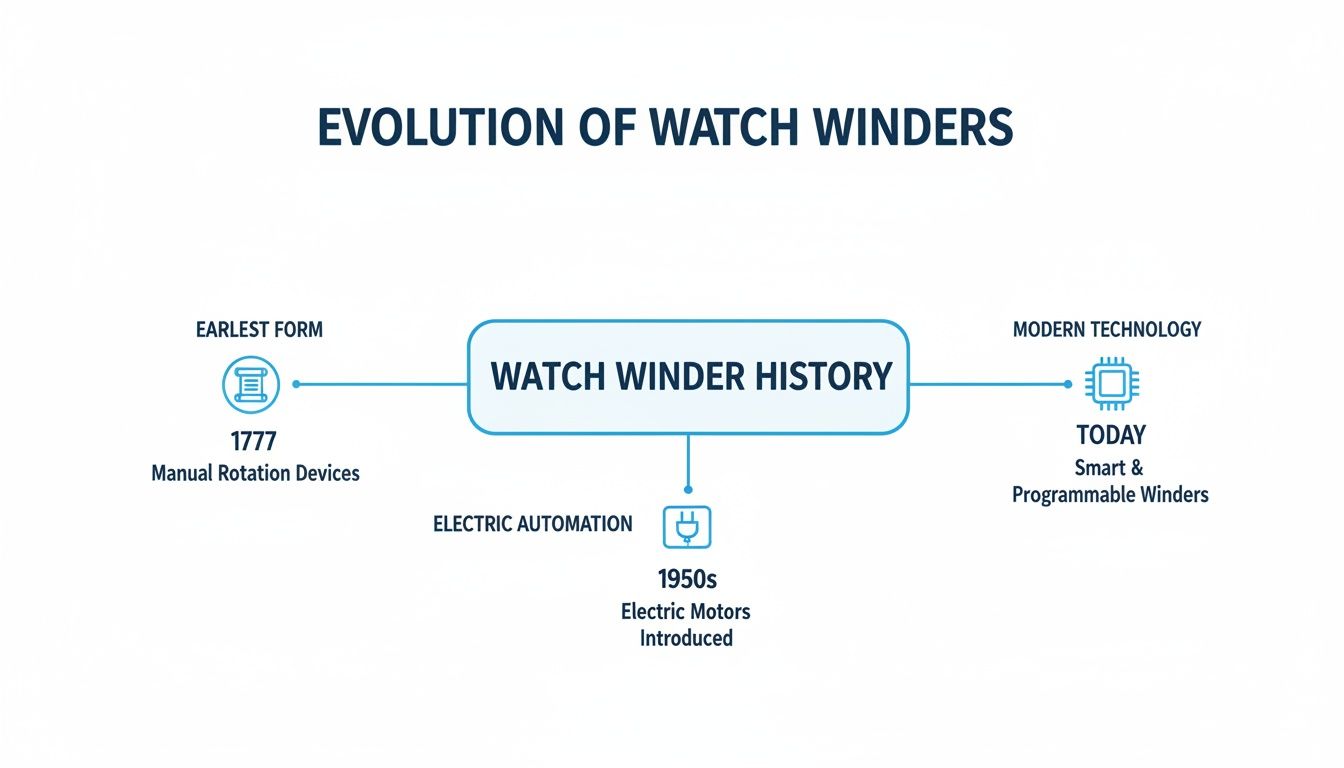
This graphic traces watch winder innovations—from Perrelet’s 1777 rotor to today’s microprocessor-controlled modules—highlighting advances in precision and convenience.
TPD Settings And Directions
Turns per day indicate how many full rotations the platform completes in 24 hours. A Rolex sports model typically needs around 650 TPD, while more complex calibers with calendars or moon phases often call for 900 TPD or higher.
Direction matters, too. Some movements wind best clockwise, others counterclockwise, and many require alternating spins. Using the wrong setting can leave your watch underwound—or put undue stress on the rotor.
| Direction | Benefit |
|---|---|
| Clockwise | Standard for many calibers |
| Counterclockwise | Matches reverse-wind designs |
| Alternating | Covers both winding directions |
Learn more about automatic watches in our guide before pairing your timepiece with the ideal winder.
Controller Electronics And Protection
Modern winders feature programmable controllers that let you customize rotation cycles and rest intervals. Some even sense when your watch is fully powered and switch to a sleep mode.
- Choose low-noise motors rated under 35 dB for quiet environments.
- Look for units that offer both AC power and battery backup to prevent downtime.
- High-end models include overvoltage protection and redundant slip clutches for extra peace of mind.
“A well-matched TPD and direction profile is the key to preserving your watch’s performance,” says a master watchmaker. With the right winder settings and a trusted dealer like ECI Jewelers at your side, your automatic watch will run smoothly and stay on time—day in, day out.
Types And Features To Consider
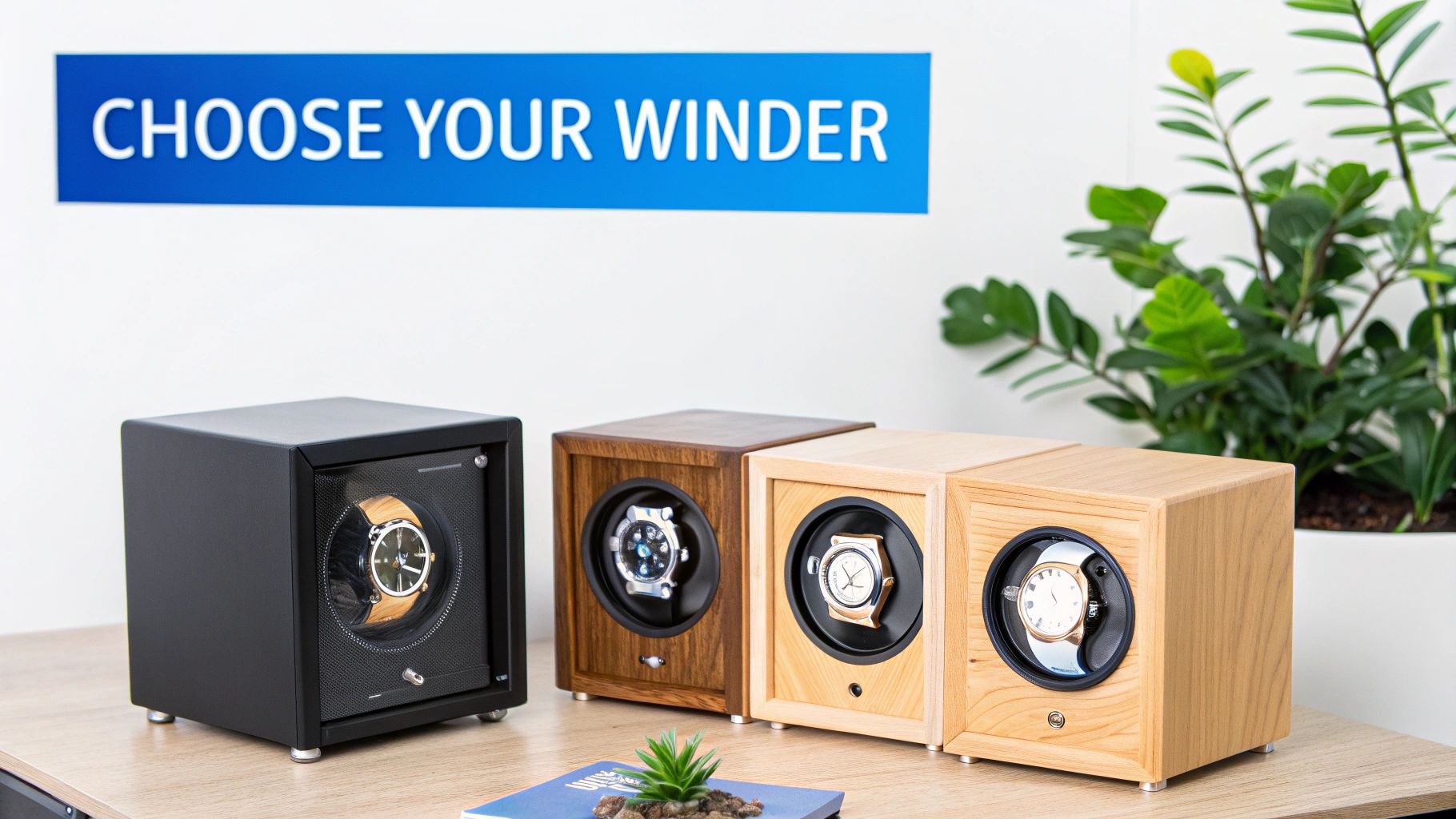
Picking the right watch winder is a bit like choosing workout gear—it has to fit your space and routine. You might go for a compact single slot if you only have one daily driver. Or you could opt for a full cabinet that doubles as a display shelf for an entire collection.
A single-watch winder is like a personal trainer for your timepiece. It focuses all its energy on one movement, keeping it ready for your next wear without taking up much shelf space.
Multi-watch winders, on the other hand, are like a small home gym. They handle anywhere from 2 to 8 watches side by side, perfect for someone who enjoys rotating through several pieces each week.
Full cabinets are the luxury fitness centers of the winder world. With spots for 30+ watches, individual settings, and display lighting, they’re built for serious collectors who want both function and flair.
Key Features To Weigh
- TPD Programming lets you dial in 650–2,500 turns per day to match different movements.
- Rotation Directions offer clockwise, counterclockwise, or alternating cycles.
- Power Options include battery, AC, and USB connections.
- Noise Levels often sit below 35 dB, so your winder stays whisper-quiet.
- Capacity ranges from 1 watch up to 30+ in larger cabinets.
- Build Materials cover plastic, leather, wood, and carbon fiber.
Key Configurations For Every Collection
If you own a single automatic, a standalone winder is both elegant and efficient. It takes up minimal room, draws low power, and usually features a clear case to show off your watch.
Collectors with two to four pieces often prefer a multi-winder tower. These units share one adapter and let you customize TPD profiles for each slot, keeping every watch wound exactly as needed.
“A multi-watch cabinet can become the centerpiece of your collection room, blending display and function seamlessly.”
This chart reveals that single winders are budget-friendly, while cabinets offer the highest capacity and quietest motors.
Regional Trends And Market Growth
Demand for watch winders used to be led by North America and Europe. Lately, though, the Asia-Pacific region has surged ahead, driven by its growing high-net-worth population.
This shift is turning winders from a niche accessory into a must-have for serious watch lovers worldwide. For a deeper dive into global sales data, check out Strategic Revenue Insights.
Comparison Of Winder Types And Key Features
Below is a quick look at how single, multi, and cabinet winders stack up.
| Feature | Single Winder | Multi Winder | Cabinet |
|---|---|---|---|
| Ideal For | Solo timepiece | Small collections | Large assortments |
| TPD Range | 650–1,950 | 650–2,100 | 650–2,500 |
| Rotation Modes | 3 | 3 per slot | Fully programmable |
| Power | AC, Battery | AC, USB | AC, Battery backup |
| Noise Level | ~30 dB | ~32–35 dB | <30 dB |
| Materials | Plastic, Wood | Leather, Metal | Wood, Carbon fiber |
With this side-by-side view, you can zero in on the winder that suits your collection size, budget, and décor.
How A Dealer Can Help
Partnering with a trusted dealer takes the guesswork out of selection and setup. ECI Jewelers offers hands-on advice, whether you’re fitting a single winder or a full cabinet.
- Expert guidance on TPD settings and rotation directions for popular calibers
- Access to extended warranties and genuine replacement parts
- Installation, setup assistance, and ongoing troubleshooting
Visit ECI Jewelers online or stop by their Diamond District showroom to see winding solutions in person and keep your automatics ready for action.
Benefits And How To Choose The Right Watch Winder
A watch winder isn’t just a gadget—it’s a way to keep your automatic timepiece humming smoothly. By mimicking the motion of your wrist, it preserves the oils that keep gears gliding. As a result, your watch stays accurate and ready the moment you strap it on.
Of course, there’s a balancing act. Winders draw power around the clock and can add to your electricity bill. And top-tier models come with a price tag that might give you pause. With those factors in mind, let’s break down who really needs a winder and how to pick the one that fits your lifestyle.
Advantages Of Using A Watch Winder
-
Maintained Accuracy
Prevents the mainspring from fully unwinding, keeping your watch within ±5 seconds per day. -
Preserved Lubrication
Stops oils from settling and helps extend service intervals from 5 to 7 years. -
Instant Wearability
Say goodbye to winding and resetting dates—your watch is always set and ticking.
“A watch winder is like a covered garage for a car—it keeps the engine warm and ready,” notes a master watchmaker.
The chart above lays out cost versus power draw for several popular winders. Notice how a higher TPD capacity often means a steeper price and greater energy use. That’s a key point when you weigh upfront cost against day-to-day convenience.
Potential Drawbacks To Consider
A great winder comes at a cost. A quality cabinet can set you back $1,200+—hard to justify if you only have one automatic watch.
Energy consumption isn’t free, either. You might see an extra $20–$40 on your energy bill each year.
Finally, even whisper-quiet motors around 30 dB can become noticeable in a silent room.
Who Benefits Most From A Winder
Not everyone needs 24/7 readiness. Check which scenario matches you:
- Avid Collector
You own 5+ automatics and resetting perpetual calendars is a chore. - Frequent Traveler
You hop time zones weekly and rely on quick, accurate timekeeping. - Weekender Wearer
Two watches rotate your weekend style—you want them both ready on Monday.
Matching Settings To Popular Movements
Get TPD (Turns Per Day) and spin direction right for top brands:
| Brand | Recommended TPD | Rotation Direction |
|---|---|---|
| Rolex Submariner | 650 | Clockwise |
| Patek Philippe Aquanaut | 600 | Alternating |
| Audemars Piguet Royal Oak | 800 | Counterclockwise |
| Omega Seamaster | 675 | Clockwise |
| Tudor Black Bay | 700 | Alternating |
A mismatched setting can underwind the mainspring or stress the rotor over time. Use this table as a starting point.
How To Choose Key Features
Match the winder’s specs to your everyday needs:
-
TPD Range
Look for 650–2,500 TPD to cover most high-end movements. -
Rotation Modes
Must support clockwise, counterclockwise and alternating cycles. -
Power Options
AC adapters for home use plus battery packs for safes or travel. -
Noise Level
Target motors under 35 dB if you plan to keep the winder in a bedroom or office. -
Capacity
Choose single-slot for one daily wearer, multi-slot or cabinet for growing collections. -
Build Materials
Wood, leather or carbon fiber influence durability and style.
Who Needs What
- Single-slot winders suit a daily-wear watch.
- Multi-watch modules handle 2–8 pieces for small collections.
- Full cabinets pay off once you cross the 10+ automatics mark.
“A properly set winder preserves your watch’s lubricant distribution, cutting service costs,” adds an ECI Jewelers technician.
Tips For Picking The Right Winder
- Try one in a showroom to gauge noise and fit.
- Compare warranty lengths and service plans.
- Read user reviews for long-term reliability.
- Verify replacement part availability.
You might be interested in our movement comparison to see whether automatic or quartz fits your habits best. Read more about automatic vs quartz movements in our article.
Best Practices After Purchase
- Place the winder on a stable, vibration-free surface away from magnets.
- Program the initial TPD according to your most demanding watch.
- Inspect bearings and electronics annually.
- Replace adapter plugs every 3–5 years to maintain steady power.
Finding the perfect winder boils down to performance, cost and your personal routine. Armed with TPD guidelines, feature checklists and brand-specific settings, you can choose confidently. And with ECI Jewelers guiding you every step of the way—from selection to setup and ongoing service—you’ll keep your automatics running like new.
Maintenance And Troubleshooting
A little routine care goes a long way in keeping your watch winder running smoothly and quietly. A quick check every few months can catch minor hiccups before they become real headaches.
- External Cleaning: Gently wipe the casing and glass with a soft, lint-free cloth to lift dust and fingerprints.
- Motor Noise Check: If you hear anything louder than 35 dB, apply a small amount of lubricant to the moving parts.
- Power Source Inspection: Verify that batteries or AC adapters are seated firmly and free of corrosion.
- Calibration Tip: Run a weekly cycle without a watch to spot any wobble or misalignment early.
- Belt and Gear Review: Inspect belts and gears every six months to catch wear before slipping occurs.
Seasonal Maintenance Checklist
Map out a simple schedule to inspect belts and gears every six months. Log room temperature and humidity to prevent moisture buildup.
- Test control buttons and digital displays for quick, accurate responses.
- Sync service reminders with your personal calendar for hassle-free upkeep.
The screenshot below shows ECI Jewelers’ service center interface for scheduling maintenance.
It lays out repair workflows, service options, and direct contact links to our technicians.
Troubleshooting Common Issues
Power failure? Start by checking for a loose connection or drained batteries. If the winder stops mid-cycle, swap in fresh cells or test the AC adapter.
- Restart Procedure: Unplug, wait 10 seconds, then reconnect to reboot the controller firmware.
- Noise Diagnosis: Run the winder with and without a watch to distinguish motor noise from watch noise.
- Calibration Reset: Let the winder spin empty through a full cycle, then adjust TPD settings if the platform isn’t perfectly centered.
- Belt Realignment: Follow the manufacturer’s guidelines to reposition belts and eliminate slipping or jamming.
If these steps don’t solve the problem, professional servicing is your best bet. ECI Jewelers offers firmware updates and on-site repairs for smart winders. Check out our guide on how to wind a mechanical watch for precise techniques.
When To Seek Professional Help
Persistent grinding noises, erratic cycles, or any sign of internal wear mean it’s time to call in the experts. An annual inspection at ECI Jewelers lets certified technicians replace worn parts, verify TPD accuracy for high-end movements, and ensure your winder stays in peak condition.
Best Practices Summary
- Keep a log of maintenance dates to track cleaning and part replacements.
- Follow manufacturer-specified torque limits to prevent motor strain and gear damage.
- Rotate watch positions regularly to distribute wear evenly across platforms.
Stick to these maintenance and troubleshooting tips, and your automatic watches will stay wound, reliable, and ready to wear—every single day.
FAQ
What Is A Watch Winder And How Do I Set Turns Per Day For Different Movements?
Think of a watch winder as a stand-in for your wrist. It gently swings your automatic watch so it never stops ticking when it’s resting.
Consult your watch manual for the recommended TPD and dial that number into your winder’s controls. Then choose the right rotation mode—clockwise, counterclockwise, or alternating—to match your movement’s needs.
Can I Risk Overwinding My Watch?
Modern winders come equipped with slip clutches. Once they reach safe torque limits, they simply let go.
As long as you invest in a quality unit, your watch stays protected.
Brands vary in their requirements. For example:
- Rolex Submariner: 650 TPD clockwise
When To Use A Watch Winder
A winder really shines when your collection keeps growing.
- Collectors with 3+ automatics
- Owners of moon phases, perpetual calendars, or other intricate complications
- Frequent travelers who hop between time zones
“Matching TPD and rotation direction is key to preserving precision,” says a seasoned watchmaker.
Do I Need A Winder For Daily Wear?
If you stick to a single watch every day, a quick wind before bedtime usually does the trick.
How Can I Verify Compatibility With High-End Brands?
First, check your winder’s maximum case size and TPD range against your watch’s specs. Next, make sure the holder grips larger models—think Rolex Daytona—without any wobble.
Ready to keep your collection always ready? Visit ECI Jewelers today.


