


So, you're looking for the perfect engagement ring. It's one of the most exciting moments of your life, and this guide is here to be your trusted map. We're going to walk you through every step, turning any confusion into pure confidence as you decode diamond quality and find a style that truly tells your love story.
Starting Your Engagement Ring Journey with Confidence
Choosing an engagement ring isn't just a purchase; it’s the first step in creating a memory that will last a lifetime. But let's be honest, with a whole new language of cuts, carats, and settings, it can feel a little overwhelming. It doesn't have to be.
Our goal is simple: to give you the knowledge you need so this journey is just as joyful as the proposal itself. With insights drawn from ECI Jewelers' 25 years of hands-on experience in NYC's Diamond District, you'll get the clarity you need to make a choice that both celebrates your love and stands as a smart investment.
First Things First: Setting a Realistic Budget
Before you even start looking at sparkling diamonds and beautiful settings, it’s crucial to land on a budget that feels right for you. That old "two or three months' salary" rule? It's completely outdated. Forget it.
Today, it's all about what feels comfortable and responsible for your financial situation, not about keeping up with some old-fashioned expectation.
While the engagement ring market is a big one—projected to be worth around $12.5 billion in the U.S. for 2025—what people actually spend is much more down-to-earth. The average ring costs somewhere around $5,800, with some studies putting it closer to $5,200. This shows a modern focus on being financially smart without sacrificing the ring's meaning.
Your budget is a personal decision. The right amount is whatever allows you to buy a beautiful symbol of your commitment without creating financial stress as you start your future together.
What to Expect From This Guide
We’ve structured this guide to build your knowledge one step at a time, making even the most complex topics easy to understand. We’ll cover everything you need to know, from the absolute basics to the final details of buying and caring for the ring.
Here’s a sneak peek at what we'll explore together:
- The Diamond 4Cs: A simple, no-nonsense breakdown of Cut, Color, Clarity, and Carat.
- Ring Styles and Metals: How to find the perfect combination that matches personal taste.
- Sizing and Certification: The practical must-dos for a perfect fit and a verified purchase.
- Buying In-Store vs. Online: Weighing the pros and cons to find the best shopping experience for you.
Once you have that perfect ring, you can start thinking about capturing the moment. You might even want to check out some romantic engagement photo ideas to celebrate this incredible time in your lives.
Making Sense of the Diamond 4Cs
When you start looking at diamonds, the term "4Cs" will come up almost immediately. This isn't just industry jargon; it's the universal standard for grading a diamond’s quality, established by the Gemological Institute of America (GIA). Getting a handle on Cut, Color, Clarity, and Carat is the single most important step you can take. It’s what turns you from a nervous browser into a confident, informed buyer.
Think of the 4Cs as a diamond's official report card. Each "C" grades a different characteristic, and together, they determine the stone's beauty, sparkle, and ultimately, its price. Let's break them down one by one so you know exactly what you’re looking at.
Cut: The Source of Sparkle
Many people think Cut is just the diamond’s shape (like round, oval, or pear). While they're related, the cut grade is actually about something much more important: how well a diamond’s facets—those tiny mirrors on its surface—play with light. It’s the only one of the 4Cs that’s all about human craftsmanship, and frankly, it's the one that matters most for a diamond's beauty.
A beautifully cut diamond works like a perfect hall of mirrors. It pulls light in, bounces it around internally, and shoots it back out through the top, creating that breathtaking fire and brilliance we all love. A poorly cut diamond, on the other hand, lets light leak out the bottom or sides. The result is a dull, glassy-looking stone, no matter how good its color or clarity is.
An excellent cut can easily make a diamond look bigger and more brilliant than a poorly cut stone of the same carat weight. If you're going to prioritize one thing, make it the cut. It’s the best way to maximize your diamond's sparkle.
Color: A Spectrum of Whiteness
Next up is Color, which in the world of white diamonds, actually refers to the absence of color. The GIA grades diamond color on a scale from D (completely colorless) down to Z (light yellow or brown). The truth is, the differences between grades are incredibly subtle and often invisible to the naked eye.
Imagine a glass of pure, distilled water—that’s a D-color diamond. As you move down the scale to a G, H, or I, it's like adding a single drop of lemonade. There might be a hint of warmth, but it still looks stunningly white, especially once it’s set in a ring.
- D-F (Colorless): The absolute top tier. These are the rarest and carry a premium price.
- G-J (Near Colorless): This is the sweet spot for value. The slight warmth is almost impossible to detect, but the savings are significant.
- K-M (Faint Color): You'll see a noticeable warmth here. Some people love this look, especially in yellow or rose gold settings that complement the tone.
For a deeper dive into how these two critical factors work together, our detailed guide on diamond clarity and color can provide even more insight.
Clarity: A Diamond's Unique Fingerprint
Clarity is a measure of a diamond’s purity. It grades the presence of inclusions (tiny internal characteristics) and blemishes (external flaws). Think of these as a diamond's natural "birthmarks," created deep inside the earth under incredible heat and pressure. Most of these are microscopic and have zero impact on the stone's beauty.
The GIA clarity scale runs from Flawless (FL) all the way down to Included (I3). A Flawless diamond is perfect even under 10x magnification. However, many diamonds in the VS (Very Slightly Included) and even SI (Slightly Included) grades are what we call "eye-clean." This means you can't see any imperfections without a jeweler's loupe.
For most buyers, a VS2 or SI1 grade hits the perfect balance of beauty and value. You get a diamond that looks flawless to the naked eye without paying the premium for a technically perfect stone you'd need a microscope to appreciate.
Carat: The Measure of Weight
Last but not least is Carat, which is probably the most misunderstood of the 4Cs. Carat is a unit of weight, not a measure of size. One carat equals 200 milligrams.
While a heavier diamond is generally a larger diamond, the stone’s cut and shape play a huge role in how big it actually looks. For instance, a well-cut 1.0-carat diamond can have a wider face-up appearance than a poorly cut 1.1-carat diamond. Likewise, elongated shapes like ovals, marquise, and pear cuts tend to look larger on the finger than a round diamond of the very same carat weight.
The key takeaway is this: don’t get fixated on the carat number alone. A beautiful diamond is a balanced diamond. Focusing on a smart combination of all 4Cs will always give you a much more stunning ring in the end.
Choosing a Style That Tells Your Story
Once you've got a handle on the 4Cs, the real fun begins. Now we get to talk about the artistic side of the ring—the style. The setting is the stage where your diamond gets to shine, and it's what gives the ring its entire personality. This is where you find a design that feels like it was made just for them.
From timeless classics that whisper elegance to modern designs that shout brilliance, each style has its own unique voice. The goal is to find the one that perfectly captures your partner's taste and tells your love story.
Finding the Perfect Setting Style
The setting does more than just hold the diamond in place; it defines the ring's whole look and feel. Take a moment to think about your partner's personal style. Are they more minimalist and classic, bold and glamorous, or do they have a soft spot for vintage romance?
Let's walk through some of the most loved options:
- Solitaire: This is the quintessential engagement ring. A single, stunning diamond on a clean band. All eyes go straight to the stone, making it a perfect choice for someone with an elegant, understated style. It’s pure, simple, and timeless.
- Halo: If you want to maximize sparkle, the halo is your answer. It frames the center stone with a circle of smaller diamonds, which not only adds a ton of fire but also creates an illusion of size. A halo can make the main diamond look up to a half-carat larger.
- Three-Stone: This style is packed with meaning. Featuring a center diamond flanked by two smaller ones, it’s a beautiful symbol of a couple's journey—representing your past, present, and future together.
- Vintage-Inspired: For the old soul, these settings are pure romance. They often feature intricate details like milgrain (tiny, beaded metalwork) or delicate filigree. Think of the bold, geometric shapes of the Art Deco era or the ornate, flowing lines of Victorian design.
A ring's style is its voice. A solitaire whispers elegance, a halo shouts brilliance, and a three-stone ring tells a story. Choose the voice that best speaks for your love.
This is where your knowledge of the 4Cs comes into play. The diamond you pick is the star of the show, no matter which setting you choose.
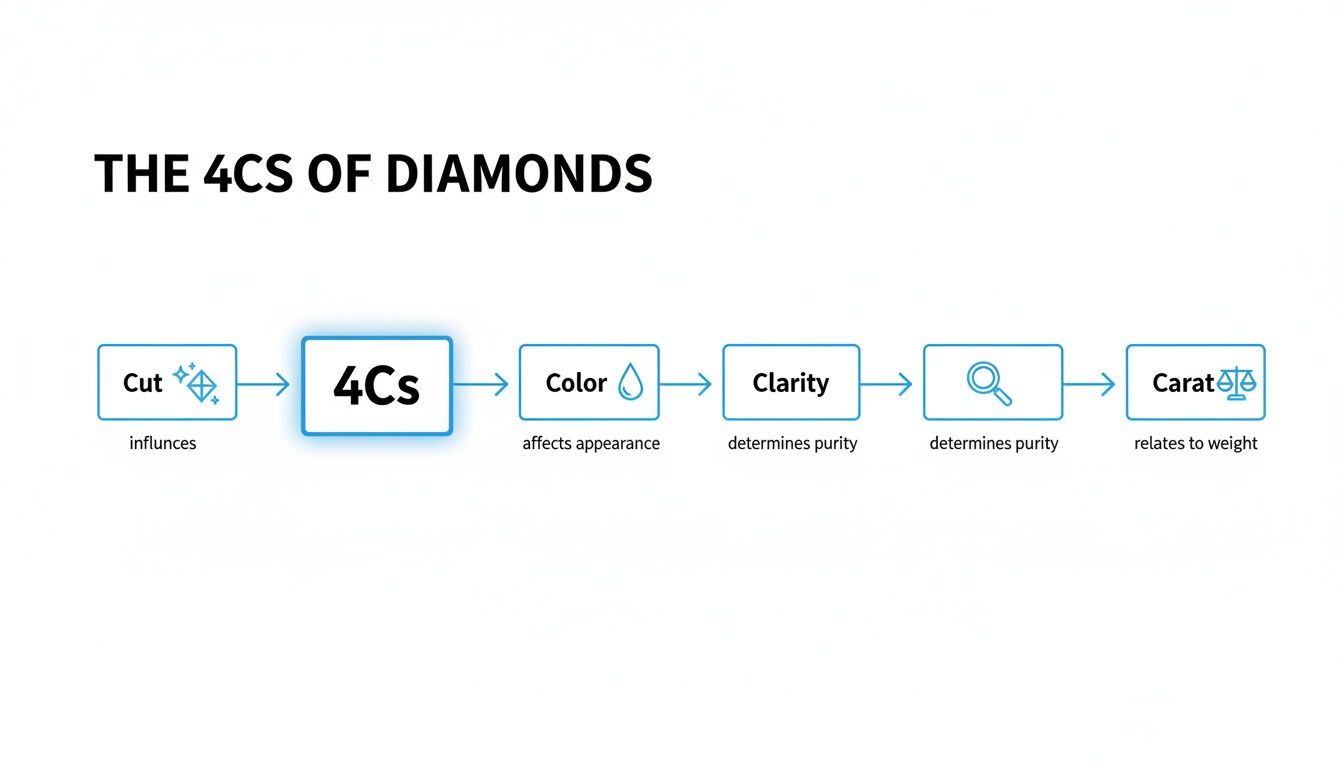
Understanding how Cut creates sparkle, Color affects warmth, Clarity measures purity, and Carat determines size will help you pick the perfect stone for any setting.
Choosing the Right Metal
The metal you choose for the band is just as important as the setting. It sets the tone for the entire ring, affecting its look, durability, and cost. Each metal also interacts with the diamond differently.
For instance, the band's color can either complement or contrast with the diamond. A warmer J-color diamond might look even more yellow against bright platinum, but it will look beautifully creamy and intentional in a yellow gold setting.
Comparing Popular Metal Choices
Let's break down the go-to options to help you decide.
Platinum
Platinum is the top-tier choice for engagement rings. It's a naturally white metal, so its cool, silvery shine will never fade or change color.
- Pros: Incredibly durable, hypoallergenic, and makes diamonds look even brighter and whiter. As the densest precious metal, it has a substantial, luxurious weight to it.
- Cons: It's the most expensive option. Over time, it develops a soft, matte finish called a patina, which some people love, but it requires a professional polish to restore its original luster.
White Gold
White gold gives you a look very similar to platinum but at a more friendly price point. It's created by mixing pure yellow gold with white metals like palladium, then plating it with rhodium for that bright white finish.
- Pros: Much more affordable than platinum while offering that same modern, sleek aesthetic.
- Cons: The rhodium plating will wear off over time, so it needs to be re-plated every few years to maintain its color. It can also contain nickel, which is a common allergen.
Yellow Gold
The classic, traditional choice. Yellow gold has a warm, rich glow that has made a huge comeback. It’s universally flattering on all skin tones.
- Pros: Its warm hue can masterfully complement diamonds with slightly lower color grades (G-J), making them appear whiter in comparison. It's also the easiest metal for jewelers to work with for resizing or repairs.
- Cons: Yellow gold is the softest of the golds, which makes it a bit more susceptible to scratches and dings from daily wear.
Rose Gold
This is a wonderfully romantic and unique option. Rose gold gets its signature pinkish hue from alloying pure gold with copper.
- Pros: The warm, vintage-inspired color is very on-trend and looks great on everyone. Thanks to its copper content, it's also surprisingly durable.
- Cons: It's not hypoallergenic because of the copper. While beautiful, its distinct color might not feel as timeless to some as yellow or white gold.
Ultimately, the right ring is a combination of style and metal that feels true to your partner's spirit. By thinking about their personality and lifestyle, you'll find a ring that isn't just a piece of jewelry, but a lasting symbol of your relationship.
5. Budget, Sizing, and Certification
Alright, you’ve sorted out the style and metal—the fun, creative part. Now it’s time to get into the practical details that turn a beautiful ring into a smart, secure investment.
This section covers three must-knows: setting a budget that actually works for you, getting the ring size right (especially for a surprise), and understanding why a diamond certificate is absolutely non-negotiable. Getting these right is the foundation for a confident, regret-free purchase.
Setting a Budget That Works for You
First things first: let's bust the biggest myth out there. The old "two or three months' salary" rule is nothing more than an outdated marketing slogan. Forget it. The right budget is a number that feels comfortable for you and aligns with your financial goals, period. Starting a new life together shouldn't begin with financial stress.
The goal here is to focus on value, not just a price tag. To help you find a number that makes sense, we put together a guide on how much you should spend on an engagement ring with practical advice for today’s world.
A thoughtful budget isn't about spending less; it's about spending smarter. It empowers you to allocate your resources toward the features that matter most, like a superior cut or a more durable metal, creating a ring of greater value, not just greater cost.
Getting the Ring Size Right
Trying to figure out your partner's ring size without them knowing can feel like a covert mission. But don't worry, a few clever tactics can help you nail it. A perfect fit is crucial for both comfort and security, so it’s worth the extra effort.
Here are a few proven methods to get their size:
- Borrow a Ring: This is the easiest trick in the book. Discreetly borrow a ring they already wear on their ring finger and bring it to a jeweler. Just make sure it’s one they won't miss right away!
- Ask for Help: Enlist a trusted friend or family member. They can casually bring up jewelry or even suggest a "just for fun" window shopping trip where they get their fingers sized.
- Trace It: If you can't sneak the ring away, place it on a piece of paper and carefully trace the inside circle with a fine-point pen. A skilled jeweler can get a very close estimate from a good tracing.
Keep in mind that fingers can swell or shrink a bit with changes in temperature or time of day. For the most accurate read, try to measure a ring when their hands are at a normal temperature—not right after a workout or when it's freezing outside.
Why Diamond Certification Is Non-Negotiable
Pay close attention here, because this is probably the most critical part of the entire buying process. A diamond certification is an official report from an independent gemological lab that grades a diamond's characteristics—its unique 4Cs. Think of it as a diamond's blueprint or official transcript.
The most trusted and rigorous lab in the world is the GIA (Gemological Institute of America). A GIA certificate is the industry's gold standard, giving you an unbiased, expert assessment of a diamond’s quality. This report is your ultimate guarantee that you're getting exactly what you paid for.
Without a certificate from a reputable lab, a diamond's quality is just someone's opinion. That's why at ECI Jewelers, we exclusively offer 100% certified diamonds. This commitment gives you total peace of mind, ensuring your investment is protected and its value is authenticated by the world's leading authority on gems.
Deciding Where to Buy Your Engagement Ring
You’ve done the research, you've set a budget, and you know the 4Cs like the back of your hand. Now for the final piece of the puzzle: where are you actually going to buy the ring?
Not too long ago, your only option was the local jeweler. Today, you can choose between huge online stores, traditional brick-and-mortar showrooms, or a modern blend of the two. Each route has its pros and cons, and the right choice really comes down to what makes you feel most confident and comfortable.
Let’s break them down.
The Online Retail Experience
Jumping online opens up a massive, seemingly endless inventory. You can browse thousands of diamonds and settings from your couch, which is incredibly convenient. Because these retailers don't have the overhead of a physical showroom, their prices are often very competitive.
But there’s a catch. You can't see the diamond in person. You can't feel the weight of the ring or appreciate how the stone truly sparkles under the light. And when it comes to diamonds, light is everything. Static photos and even videos just can't replicate that real-life magic.
Buying a diamond online without seeing it first is a bit like choosing a paint color from a computer screen—the real-life version can look surprisingly different. The subtle fire and brilliance of a diamond are things you really need to see with your own eyes.
The Traditional In-Store Journey
This is the classic approach for a reason. Walking into a jewelry store lets you have that crucial hands-on experience. You can compare diamonds side-by-side, try on different styles, and get immediate, face-to-face advice from an expert who can guide you.
That kind of personalized service is priceless, especially when you’re making such an important purchase. The downside? A physical store can only hold so much inventory. You might find your options are a bit more limited, especially if you have very specific criteria for your budget and style.
If you’re in the area, our guide to buying diamond engagement rings in NYC offers some great local tips for making the most of an in-store visit.
The Modern Hybrid Approach
So, why choose between endless online selection and in-person confidence? With a hybrid model, you don't have to. This approach, which we champion here at ECI Jewelers, gives you the best of both worlds and is quickly becoming the smartest way to buy an engagement ring.
It’s a simple, empowering process that puts you in control:
- Start Online: Begin your search from home. Explore different styles, get comfortable with the 4Cs, and browse a huge selection of certified diamonds.
- Consult an Expert: Once you have some ideas, you can connect with one of our experts for a virtual consultation. We’ll help you narrow down the options and review GIA certificates together.
- Finalize In-Person: With your top choices selected, you can schedule a visit to our NYC showroom. You'll get to see the diamonds in person, ensuring the one you choose has the fire and brilliance you've been looking for before making any commitment.
This blended strategy isn’t just our preference; it reflects where the market is headed. The engagement ring market is projected to grow at 6.5% annually between 2025 and 2033, and North America is a huge part of that, making up about 40% of all sales. More market trend data shows that while most people start their research online, they still want to see the ring in person before finalizing such a significant purchase.
For our clients outside of New York, we've perfected this high-trust experience. Through our personalized concierge service and fully insured nationwide shipping, you get the same level of confidence and expert guidance, no matter where you are.
Comparing Buying Options In-Store vs Online vs Hybrid
To make it even clearer, here’s a quick breakdown of how the three main buying paths stack up. This table should help you decide which approach is the best fit for your needs and highlights why we believe so strongly in our hybrid model.
| Feature | Online-Only | In-Store Only | ECI Jewelers (Hybrid) |
|---|---|---|---|
| Selection & Choice | Vast, almost limitless inventory of diamonds. | Limited to the physical stock on hand. | Best of Both: Access to vast online inventory with curated picks. |
| Expert Guidance | Limited to chat bots or remote agents. | Direct, face-to-face expert consultation. | Personalized: Virtual and in-person guidance from GIA experts. |
| Try-On Experience | None. You can't see or feel the ring first. | Excellent. You can see, touch, and compare. | The Final Step: See your top choices in person before you buy. |
| Price & Value | Often competitive due to lower overhead. | Can be higher; prices reflect retail costs. | Competitive: Transparent pricing plus expert validation. |
| Confidence | Risky. A diamond’s photos don’t tell all. | High. You know exactly what you’re getting. | Maximum Confidence: Research online, verify in person. |
Ultimately, the goal is to feel 100% certain about your decision. By combining the convenience of digital browsing with the essential step of an in-person viewing, the hybrid model removes the guesswork and ensures the ring you choose is truly the perfect one.
Protecting Your Investment for a Lifetime
An engagement ring is so much more than just jewelry. It’s a symbol you’ll wear every single day, a constant reminder of your commitment that's meant to last for decades. To make sure it stays as brilliant and secure as the day you proposed, a little proactive care goes a long way. This really comes down to two things: the right insurance and regular maintenance.
Think of jewelry insurance as a safety net for one of your most meaningful possessions. Your standard homeowner's or renter's policy might offer a little coverage, but it’s usually capped at a low limit (often $1,500 or less) and probably won't cover you for accidental loss or damage. For real peace of mind, you need a dedicated jewelry policy.
Securing the Right Jewelry Insurance
A specialized policy gives you comprehensive protection that goes far beyond the basics. When you’re shopping for a plan, look for one that offers "all-risk" coverage.
This type of policy is designed to protect your ring against all the unfortunate things that can happen in life, including:
- Theft or Loss: Covers you if the ring is stolen or simply vanishes.
- Accidental Damage: Protects you if a prong gets bent or the diamond gets chipped during daily wear.
- Mysterious Disappearance: This is a big one. It covers you even when you have no idea how or where the ring was lost.
Insuring your engagement ring isn’t just a practical decision; it’s an emotional one. It replaces the financial stress of a potential loss with the freedom to wear and enjoy your ring every single day without worry.
Maintaining Your Ring's Sparkle and Security
Beyond insurance, simple and consistent care is the key to keeping your ring looking brand new and preventing problems before they start. It's a small habit that delivers a lifetime of brilliance.
You can easily keep your ring sparkling at home. Just give it a gentle soak in warm water with a few drops of mild dish soap, then use a soft toothbrush to scrub away any everyday oils and lotions. Doing this every few weeks will keep your diamond shining bright.
But professional care is just as important. We always recommend bringing your ring to a trusted jeweler like ECI Jewelers at least once a year for a professional check-up. During this visit, we do two critical things:
- Professional Deep Cleaning: We use ultrasonic cleaners and high-pressure steam to blast away deep-set grime that at-home cleaning can't touch, restoring its original fire and brilliance.
- Prong and Setting Inspection: We get in there with a loupe and carefully examine every prong and the entire setting to make sure your diamond is held tight, securing anything that might have loosened up from daily wear.
Building a relationship with your jeweler doesn’t stop once you walk out the door. We're here for the long haul—for resizing, appraisals, and even future upgrades. This ongoing care is a core part of our complete engagement ring buying guide, ensuring your symbol of love truly lasts forever.
Your Engagement Ring Questions Answered
So, you’ve mastered the 4Cs and have a feel for different styles, but a few specific questions are probably popping up now that you're getting closer to buying. It happens to everyone. This is where we clear up those final details so you can make your choice with total confidence.
Let’s dive into some of the most common questions we hear.
How Far in Advance Should I Buy the Ring?
This is a big one, and bad timing can create a lot of unnecessary stress. Our advice? Start the process and purchase the ring at least two to three months before you plan to propose.
That might sound like a lot of time, but it builds in a comfortable buffer for all the little things that can come up:
- Customizations: If you're designing something from scratch or tweaking an existing ring, it takes time to get it perfect.
- Sizing: Getting the fit just right might mean a special order, especially for less common sizes.
- Shipping and Handling: You want to allow plenty of time for secure, fully insured delivery without having to sweat it.
Giving yourself this window means no last-minute panic. The ring will be ready and perfect for the big moment.
Can I Use a Family Heirloom Stone?
Absolutely! Using a diamond or gemstone from a family heirloom is a beautiful way to honor your history and add a deeply personal touch to the ring. It’s something we love to do.
A skilled jeweler can carefully set your family's stone into a new, modern design that perfectly matches your partner's style. It’s the best of both worlds—blending timeless tradition with a fresh look to create a ring that’s truly one-of-a-kind. It's also worth exploring details like the tradition behind wearing wedding rings to add even more meaning to your story.
Your engagement ring should be a symbol of your unique story. Don't hesitate to ask about custom options, as most jewelers are experienced in bringing your specific vision to life, whether it involves a new diamond or a cherished family stone.
At ECI Jewelers, our concierge team is here to answer any other questions you might have. We can guide you through our collection of certified diamonds or start the conversation about a custom design. Visit us online at https://www.ecijewelers.com to explore your options and begin creating the perfect symbol of your love.


