


Here’s the bottom line: The Cartier Santos is the sportier, more modern choice built for everyday life, while the Cartier Tank is the definition of classic, understated elegance that shines in formal or business settings. Your decision really comes down to whether you lean more towards robust versatility or timeless, artistic design.
Choosing Between Two Cartier Icons
When you're looking at luxury watches, the Cartier Santos vs. Tank debate is a classic for a reason. Both are pillars of watch design, but they speak to completely different tastes and lifestyles. To really get it right, you have to understand where they come from—and they were born a century ago under totally different stars.
One was created out of necessity for early aviation, a tool for a pilot. The other was inspired by the bold, geometric lines of military tanks. Those origins are baked right into their DNA, influencing how they look, feel, and wear today. It also helps to understand the distinction between fine jewelry and fashion jewelry, as both of these watches are masterclasses in fine watchmaking.
Cartier Santos vs Tank At a Glance
To quickly break it down, here’s a look at what truly separates these two icons. Think of it as your cheat sheet before we dive deeper.
| Attribute | Cartier Santos | Cartier Tank |
|---|---|---|
| Primary Style | Sporty & Versatile | Classic & Dressy |
| Case Shape | Square with rounded edges | Rectangular / Square |
| Design Hallmark | Exposed bezel screws | "Brancards" (vertical case bars) |
| Heritage | First pilot's wristwatch (1904) | Art Deco icon (1917) |
| Best For | Daily wear, smart-casual | Formal events, business attire |
This table gets to the heart of the matter, but a visual can often make the choice even clearer.
This simple flowchart helps frame the decision based on your personal style.
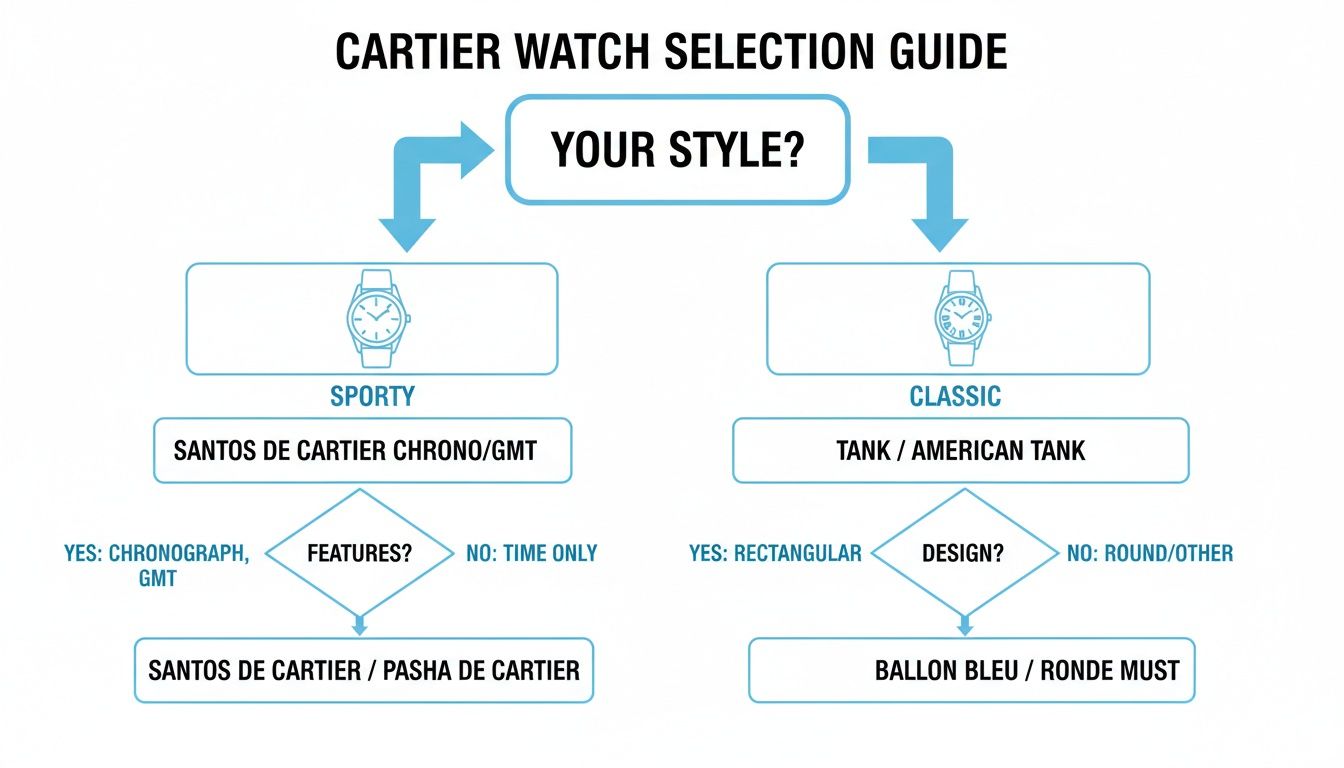
As you can see, the Santos is the go-to for a "Sporty" profile, whereas the Tank is the quintessential "Classic" choice. Getting a feel for the entire collection of Cartier timepieces can also help you see which design language speaks to you. Now that we have the basics covered, we can really get into what makes each of these watches a legend in its own right.
The Heritage Behind Each Design
To really get the Cartier Santos vs. Tank debate, you have to look past the specs and into their origin stories. These watches weren't just designed; they were born from specific moments in time that defined their character forever. One is a story of solving a practical problem, the other a tale of pure artistic expression.

This history is why the Santos has an adventurous, tool-watch feel, while the Tank gives off an air of timeless, artistic elegance. Their legacies aren't just marketing fluff—they are the soul of each watch.
The Santos: A Tool Born from the Skies
The story of the Cartier Santos kicks off in 1904. This makes it the older of the two and, more importantly, one of the very first wristwatches ever designed for a man. Its creation was a direct answer to a real-world problem faced by the famous Brazilian aviator, Alberto Santos-Dumont.
A good friend of Louis Cartier, Santos-Dumont complained that fumbling for a pocket watch while piloting his early aircraft was clumsy and downright dangerous. He needed a watch he could read instantly, without taking his hands off the controls.
Cartier’s solution was brilliant in its simplicity: a flat watch with a distinctive square bezel, attached to the wrist with a leather strap. This wasn't a piece of jewelry modified to be worn on the wrist; it was a purpose-built instrument from the ground up. The exposed bezel screws, inspired by the Eiffel Tower's engineering, weren't just for show—they were a nod to its functional, industrial roots.
The Santos was never meant to be just a pretty object. It was created as a solution, a piece of equipment for a pioneer pushing the limits of what was possible. That practical origin is key to its lasting appeal as a tough, versatile watch.
The Santos-Dumont watch quickly became a symbol of modern adventure. When Cartier finally offered it to the public in 1911, it captured the spirit of a new, fast-moving century. Its design DNA is still remarkably clear today, a direct line back to the dawn of aviation.
The Tank: An Icon Forged in Modernism
Thirteen years after the Santos took flight, the world was a very different place. The Cartier Tank arrived in 1917, a product of a world being reshaped by World War I. Its inspiration wasn't the sky but the ground—specifically, the new Renault FT-17 tanks rolling across the Western Front.
Louis Cartier saw the powerful, geometric profile of these machines from a top-down view and translated it into a watch. The case was defined by two parallel bars, known as "brancards," that blended the lugs seamlessly into the case itself, mimicking the look of the tank's treads.
This design was a radical break from the round watches of the time. With its clean lines, bold Roman numerals, and sapphire cabochon crown, the Tank was a pure expression of the emerging Art Deco movement. It was less a tool and more a piece of wearable art, a symbol of a new aesthetic era.
The Tank's initial production run confirmed its status as a high-concept piece. While the Santos had a clear job to do, the Tank was all about style and exclusivity. The first Tank Normale models went on sale in 1919, with only six handmade pieces produced—all of which sold out in months. This rarity continued for decades; fewer than 6,000 units were made in its first 50 years. You can learn more about the Cartier Tank's exclusive history online. This slow, careful production cemented its status as an icon for tastemakers, not a tool for the masses.
Ultimately, comparing the heritage of the Cartier Santos vs. Tank gets to their core identities. The Santos is a story of function creating form, a watch for pioneers. The Tank is a story of form defining a new age, a watch for artists and thinkers.
A Detailed Look at Design and Aesthetics
Place a Cartier Santos and a Tank side-by-side, and their personalities are instantly obvious. They both have Cartier's classic Roman numerals and elegant blue sword hands, but that's where the similarities end. Their core design philosophies are worlds apart, and the Cartier Santos vs Tank debate usually starts right here: industrial function versus pure artistic form.
The Santos is all about its strong, almost architectural presence. You can't miss its most iconic feature: the square bezel with eight exposed screws. This wasn't just a stylistic flourish; it was a nod to the engineering marvels of the early 20th century. Cartier turned functional hardware into the watch's defining aesthetic, celebrating its mechanical roots.
That industrial vibe carries over to the integrated bracelet, where the screws march down the links. The case is a soft square with rounded edges, a shape that grabs your attention without being too aggressive. It’s a design that feels both historic and incredibly modern all at once.
The Bold and Functional Santos
The look of the Santos is one of confident utility. The mix of brushed and polished finishes across the case and bracelet creates a fantastic play of light, underscoring its dual nature as both a sport and luxury watch. It has a substantial, well-built feel on the wrist.
Its design speaks to someone who appreciates visible craftsmanship and isn't afraid of a little avant-garde style. Every single element, from the bezel to the bracelet, feels like it belongs.
The real genius of the Santos design is how it makes industrial elements feel luxurious. Those exposed screws aren't just for show—they're a statement about the watch's purpose-built heritage, creating a look that's both rugged and refined.
This unique approach makes the Santos surprisingly versatile. It looks just as good with a t-shirt and jeans as it does with a suit, easily bridging the gap between a tool watch and a dress piece. Its design is assertive and makes a clear statement.
The Refined and Linear Tank
In complete contrast, the Cartier Tank is a masterclass in elegance and restraint. Its design is built on clean, parallel lines. The two vertical bars that frame the case, known as "brancards," are the watch's signature feature. They flow seamlessly into the lugs, creating a single, unbroken rectangular form.
This linear purity is straight out of the Art Deco playbook. You won't find any exposed screws or industrial cues here. Instead, the entire focus is on perfect proportions, symmetry, and the clean silhouette. The Tank is typically slimmer and sits flat against the wrist, making it incredibly comfortable and discreet.
The design feels more connected to classical art and architecture than it does to machinery. Every element is perfectly balanced:
- The Brancards: Create a strong, linear frame that draws your eye to the dial.
- The Dial: Often features a railway minute track, which adds to the geometric precision.
- The Crown: The iconic sapphire cabochon is the only rounded element, providing a soft counterpoint to the watch's sharp lines.
This minimalist approach makes the Tank the quintessential dress watch. It doesn’t shout for attention; it earns it with quiet confidence and flawless taste. The classic Tank is usually paired with a leather strap, which really emphasizes the clean lines of the case and completes its formal character.
Ultimately, choosing between the Cartier Santos vs Tank based on looks comes down to personal expression. Do you want a design that’s bold, functional, and makes a statement? Or do you prefer one that is subtle, classic, and whispers of refined elegance? The Santos is a piece of pioneering engineering for the wrist; the Tank is a timeless piece of art.
How Each Model Wears on the Wrist
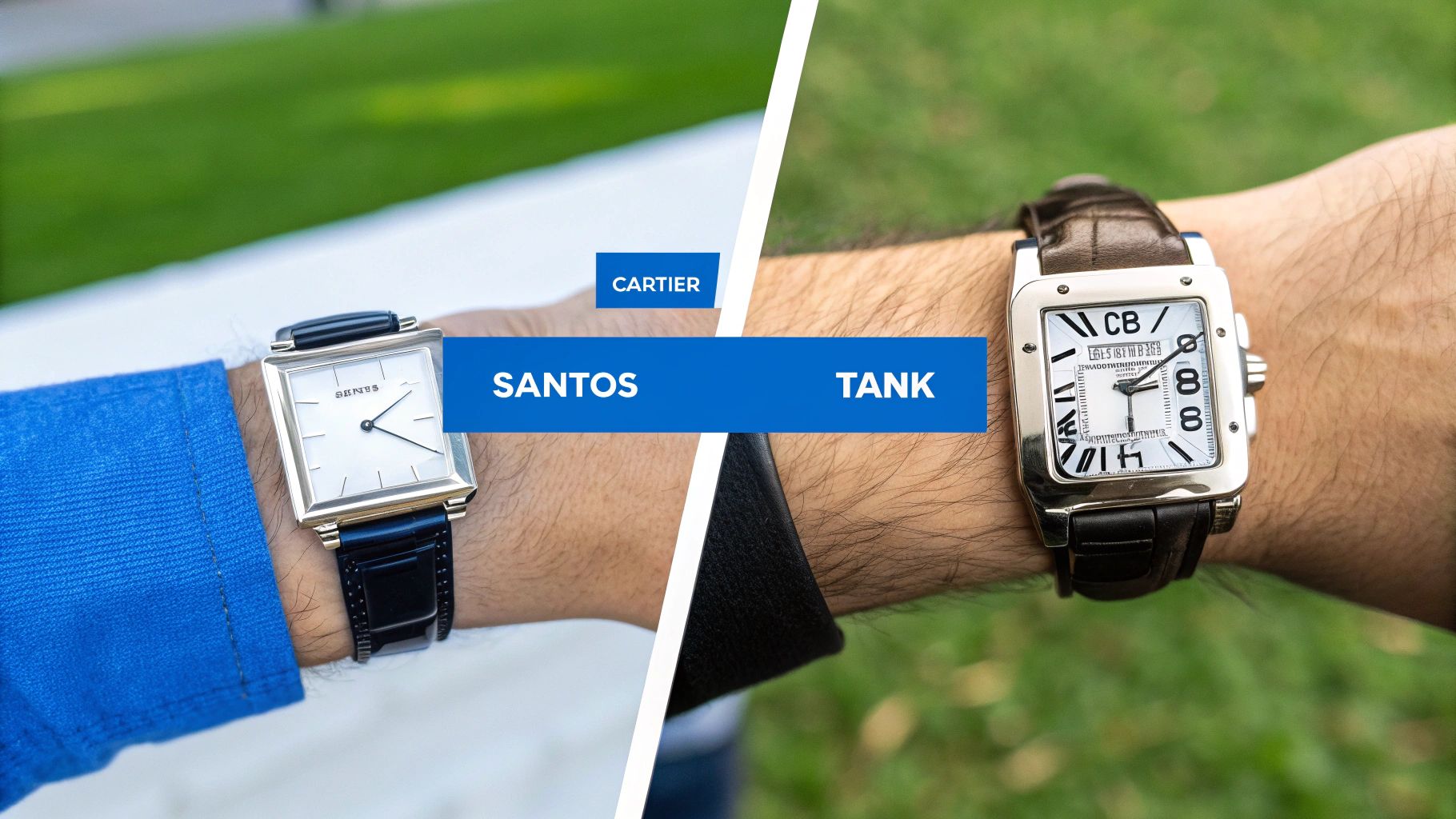
Specs and design theory are one thing, but the real test in the Cartier Santos vs Tank debate is how each watch actually feels on your wrist. Case geometry, thickness, and the way the bracelet or strap integrates with the watch head all play a massive role. A watch that looks perfect in a photo might not suit your wrist shape or personal style at all.
The biggest factor here is their fundamental shape. The Santos is a square; the Tank is a rectangle. This simple geometric difference creates two completely distinct on-wrist experiences that go far beyond millimeter dimensions.
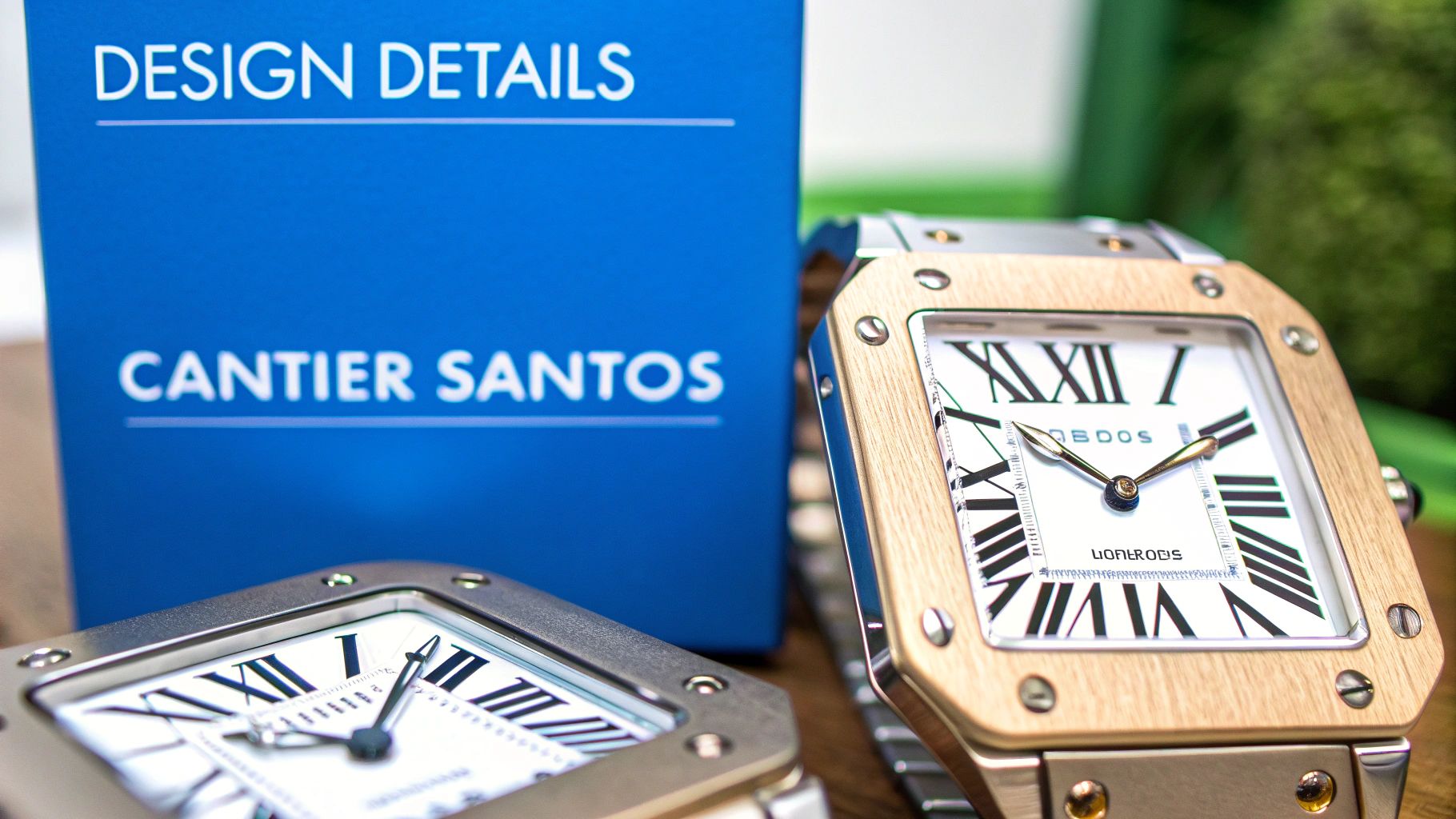
The Confident Presence of the Santos
The Cartier Santos just has a bolder, more substantial feel on the wrist. Its square case with soft corners and an integrated bracelet command attention without being loud or obnoxious. Even the "Medium" size, measuring 35.1mm across, wears much larger than its numbers suggest simply because of that square footprint.
The Santos sits proudly, and its curved lugs help it wrap comfortably around the wrist. It’s a very three-dimensional design—the bezel, case, and bracelet flow together into one cohesive, architectural piece. This makes it an incredible choice for someone who wants one watch that can go from casual to formal while always making a confident statement.
Key wearing characteristics of the Santos:
- Stronger Wrist Presence: The square shape takes up more visual real estate.
- Sporty Feel: The integrated bracelet and solid case construction give it a robust feel that’s perfect for daily wear.
- Versatile Sizing: The Medium is a great fit for smaller-to-average wrists, while the Large (39.8mm) offers a more modern, sporty presence for bigger wrists.
The Understated Elegance of the Tank
Putting on a Cartier Tank is a totally different experience. Its slim, rectangular profile is designed to sit flush against the wrist, easily sliding under a shirt cuff. The watch feels less like a piece of hardware and more like a second skin—a natural extension of your style.
Its elegance is all about proportion. A Tank Must "Large," for instance, measures just 33.7mm x 25.5mm, but that elongated shape makes it wear in a very classic, refined way. Unlike the Santos, the Tank's presence comes from its linear grace, not its width. It doesn't dominate the wrist; it complements it.
The core difference in fit is this: the Santos is a watch you wear on your wrist, while the Tank is a watch you wear with your wrist. The former makes a statement of presence; the latter, a statement of taste.
This makes the Tank an ideal choice for anyone who prefers an understated look or has a smaller wrist. The different Tank collections also offer slightly different fits:
- Tank Must: The classic choice. Sits flat, clean, and elegant.
- Tank Française: Its integrated bracelet gives it a slightly bolder, more jewelry-like feel than the Must.
- Tank Américaine: The curved case literally hugs the wrist, providing a remarkably comfortable and organic fit despite its long shape.
Ultimately, choosing between them comes down to your goal. If you want a versatile, sporty-yet-elegant watch with a noticeable presence, the Santos is the clear winner. If you're after a timeless, discreet, and exceptionally comfortable dress watch that screams classic sophistication, the Tank is the perfect fit.
A Look Inside: Movements and Material Craftsmanship
Beyond their famous shapes, the real soul of the Cartier Santos vs Tank debate is in how they're built. The engine ticking inside and the polish on the case define how they perform, age, and feel on your wrist. This is where you can really see their different personalities shine through.
Today's Cartier Santos models are mostly driven by Cartier's own Calibre 1847 MC. For watch lovers, this is a big deal—an in-house movement is a mark of a brand's technical skill. It's a tough, dependable automatic movement built to be a workhorse, and its anti-magnetic properties make it a smart pick for our modern, tech-filled lives.
The Tank, on the other hand, has a more diverse range of movements. Many of the most popular models, especially in the accessible Tank Must lineup, run on high-precision quartz. This means they are incredibly accurate and require almost no upkeep, making them a fantastic grab-and-go option. For purists, high-end models like the Tank Louis Cartier often feature manual-wind movements, offering that classic, hands-on connection to your watch.
If you're weighing your options, our guide on automatic vs. quartz watch movements can help you decide which one fits your lifestyle best.
Finishing and Material Philosophy
How Cartier chooses and finishes the metals for each watch makes their design philosophies tangible. While both lines come in stainless steel and precious metals like yellow or rose gold, the way they're executed is worlds apart.
True to its sporty roots, the Santos has a dynamic mix of finishes. Its case and bracelet are a brilliant study in combining brushed surfaces with mirror-polished details.
- Brushed Surfaces: The main flat areas of the case and bracelet links have a satin-brushed finish. This is practical, as it does a great job of hiding the minor scuffs and scratches of daily life.
- Polished Accents: The beveled edges, the bezel, and those iconic screws are all polished to a mirror shine, creating a beautiful contrast that catches the light.
This blend gives the Santos its versatile edge. It’s tough enough for everyday action but has enough gleam for a nice dinner out. It feels engineered and solid, cementing its status as a true luxury sports watch.
The Tank is the definition of classic elegance, and its finish is a direct reflection of that. Most Tank models, especially those in precious metals, are fully high-polished.
The Santos is finished like a piece of luxury industrial design, celebrating its form with contrasting textures. The Tank is finished like a piece of fine jewelry, where a flawless, uniform polish accentuates its pure, clean lines.
This all-over mirror polish on the Tank’s case and "brancards" (the vertical sidebars) highlights its graceful, straight lines. There are no brushed textures to interrupt its perfect proportions. This commitment to a flawless shine makes it an undeniable dress watch, designed to look its best under the lights of a special event or in a boardroom. While gorgeous, it does mean fingerprints and fine scratches are more noticeable, so it demands a bit more careful handling.
When you get down to it, the technical and material differences are clear. The Santos is a modern, robust tool watch with its in-house automatic movement and durable finishing. The Tank offers a spectrum of choices, from practical quartz to traditional mechanical, all wrapped in a timeless, jewelry-like finish that speaks to its enduring elegance.
Analyzing Investment and Resale Value
When you're deciding between a Cartier Santos and a Tank, it's about more than just which one looks better on your wrist. Many buyers are thinking long-term, viewing their purchase as an asset. The good news is both watches hold their value incredibly well, but they get there in completely different ways, reflecting two distinct sides of the market.
Think of the Cartier Tank as a "blue-chip" stock. Its value is built on a century of unwavering prestige—it's stable, predictable, and always in style. A Tank doesn't typically see wild, speculative price jumps. Instead, it offers steady, reliable value retention, making it a safe and elegant choice for collectors who prize long-term stability over short-term hype.
The Santos, on the other hand, has had a much more dynamic ride on the secondary market, especially over the past few years. It perfectly captured the energy of the integrated steel sports watch trend, causing demand—and prices—to surge.
The Santos’s Modern Market Surge
The modern Cartier Santos is the perfect storm of a classic design hitting a powerful modern trend. With renewed interest in versatile, everyday luxury watches, steel Santos models have taken off. Their robust build, 100m water resistance, and slick bracelet systems make them incredibly practical and desirable, a fact that's directly reflected in their strong secondary market prices.
This isn't just a fleeting moment. In terms of recent growth, the Santos has easily outpaced the Tank. Vintage Santos models from the 80s and 90s saw prices basically double, jumping from around $2,000 in mid-2021 to over $4,000 by 2022. Modern references are just as strong, retaining 80-113% of their retail value. For context, the popular Tank Must Large holds steady at 75-125% of retail, showing the Tank's solid foundation versus the Santos's explosive rally. You can dive deeper into Cartier's market performance on Chrono24.
The Tank’s Timeless Value Proposition
The Tank’s value is locked in by its iconic status. It’s a watch that has been on the wrists of cultural giants for generations, from Andy Warhol to Princess Diana, cementing its place in history. This enduring legacy creates consistent demand, insulating it from the more volatile swings of the market.
While it might not see the explosive growth of a hyped-up sports watch, certain Tank models are incredibly sought-after by serious collectors.
- Precious Metal Models: A Tank Louis Cartier in yellow gold or platinum is a perennial favorite and holds its value exceptionally well.
- Unique References: Limited editions or rare historical models like the Cintrée or Chinoise can fetch massive premiums at auction. A 1969 London Tank Cintrée, for example, sold for an incredible $304,000.
- Condition and Authenticity: With any vintage watch, provenance is everything. That’s why learning how to tell a real Cartier watch is a crucial skill for any buyer looking to invest.
The bottom line is this: The Santos offers the potential for faster appreciation driven by current trends, making it a compelling pick for someone looking for a sporty, modern asset. The Tank represents stable, long-term value, behaving more like a classic heirloom that will always be in demand.
Value Retention Snapshot: Santos vs. Tank
To give you a clearer picture, here’s a look at how popular references from both collections perform on the secondary market compared to their retail prices.
| Model Reference | Retail Price (Approx.) | Secondary Market Value (Approx.) | Value Retention % |
|---|---|---|---|
| Santos de Cartier Large (WSSA0018) | $7,750 | $6,500 - $8,000 | 84% - 103% |
| Santos de Cartier Medium (WSSA0029) | $7,050 | $6,000 - $7,500 | 85% - 106% |
| Tank Must Large (WSTA0041) | $3,850 | $3,500 - $4,800 | 91% - 125% |
| Tank Louis Cartier Large (WGTA0011) | $14,100 | $12,000 - $15,000 | 85% - 106% |
Note: Market values fluctuate. Prices are estimates based on recent market data for models in excellent condition with box and papers.
Ultimately, both are fantastic choices. The "better" investment really depends on your strategy. Are you looking for a watch that reflects current market energy and has shown impressive recent growth? The Santos is your answer. Or do you prefer a watch with a century of proven stability and a legacy that guarantees its desirability for generations? Then the Tank is the clear winner.
Frequently Asked Questions
Even after comparing these two icons, a few questions usually pop up. Let's tackle some of the most common ones to help you feel confident in your final choice between the Santos and the Tank.
Which Is More Versatile For Daily Wear The Santos Or The Tank?
While you can certainly wear either every day, the Santos is generally the more versatile of the two.
Its stainless steel case, 100 meters of water resistance, and sturdy integrated bracelet give it a tough-but-refined vibe that works just as well with a t-shirt as it does with a suit. Plus, the QuickSwitch system is a game-changer, letting you swap from bracelet to leather strap in seconds.
The Tank is absolutely a daily watch for many, but its dressier DNA and lower water resistance make it feel more at home in an office or at a nice dinner. It’s pure elegance, just maybe not the best pick for a weekend hike.
Is The Cartier Santos Or Tank A Better First Luxury Watch?
This really comes down to your personal style and what you’re looking for in that first big watch purchase.
- For the Modern Enthusiast: If you want one watch that can truly do it all and your style is more contemporary, the Santos is a fantastic first choice. Its durability and versatility make it a practical, stylish workhorse.
- For the Classic Connoisseur: If you’re drawn to timeless, understated design and your daily life is more business-oriented, the Tank is the perfect entry point. You're not just buying a watch; you're buying a piece of design history.
Ultimately, the best first luxury watch is the one that feels like you. The Santos projects modern confidence, while the Tank whispers classic, refined taste.
How Do Maintenance Costs Compare Between The Santos And The Tank?
For the standard automatic models, the service costs are very similar. You can expect a routine service for a three-hand automatic Santos or Tank to run a few hundred dollars every 3-5 years. This keeps the movement running accurately and ensures all the seals are sound.
Where you might see a difference is in specific models. The modern Santos uses Cartier's in-house Calibre 1847 MC, which has its own service protocol. On the other hand, some Tank models, especially in the Must collection, use high-precision quartz movements. For these, upkeep is just a simple battery change every few years, which costs significantly less.
As with any luxury watch, complications or precious metal cases will always increase the service price for either collection.
At ECI Jewelers, we offer a curated selection of both Cartier Santos and Tank models, each authenticated by our experts. Explore our collection and find the iconic timepiece that perfectly matches your style by visiting us at https://www.ecijewelers.com.


