


A chronometer is a precision-certified movement tested by COSC, with a required average daily rate of -4 to +6 seconds per day. A chronograph is a stopwatch complication with pushers and subdials. A watch can be one, the other, or both.
That's the answer we give when someone points to a Speedmaster and asks why it has stopwatch buttons but also says “Chronometer” on the dial. The confusion is understandable. The words sound alike, but they describe different qualities. We'll separate the certification from the mechanism, show how COSC testing works, and give you a practical way to choose a pre-owned watch.
What Is the Difference Between a Chronometer and a Chronograph
A customer often sees the pushers first. Press the upper button and a hand starts moving. Press it again and the hand stops. The lower button returns it to zero. That's a chronograph, a watch complication designed to measure elapsed time. A complication is an added function beyond basic time display.
A chronometer is different. It's a precision designation for a movement that has passed a recognized accuracy test. COSC describes a chronometer as a high-precision timekeeping instrument and states that a chronometer shouldn't be confused with a chronograph, which measures short time intervals. COSC explains the distinction in its FAQ.
The two labels aren't competing categories. One tells you what the watch can do. The other tells you how its accuracy was validated.
Practical rule: Pushers and subdials tell you to look for a chronograph. A named certification tells you to investigate chronometer status.
A watch can carry both designations. That's why a buyer can find a chronograph with a certified movement, or a simple three-hand watch with chronometer status and no stopwatch function. The important question isn't which word sounds more impressive. It's whether you need elapsed-time measurement, certified precision, or both.
For a closer look at the stopwatch function, see our guide to what a chronograph watch is.
What Makes a Watch a Certified Chronometer
COSC certification concerns the movement's accuracy. For mechanical wristwatch movements, COSC tests the movement under ISO 3159 and requires an average daily rate between -4 and +6 seconds per day. That tolerance is the key figure buyers usually mean when they refer to COSC precision. COSC lists the certified chronometer standard.
The process isn't a quick inspection. COSC states that movements are tested for 12 to 20 days, depending on the type. Testing takes place in multiple positions and temperature conditions. COSC also records 65 handlings, applies 7 elimination criteria, and performs checks every 24 hours throughout the test period. The COSC certification process sets out these stages.
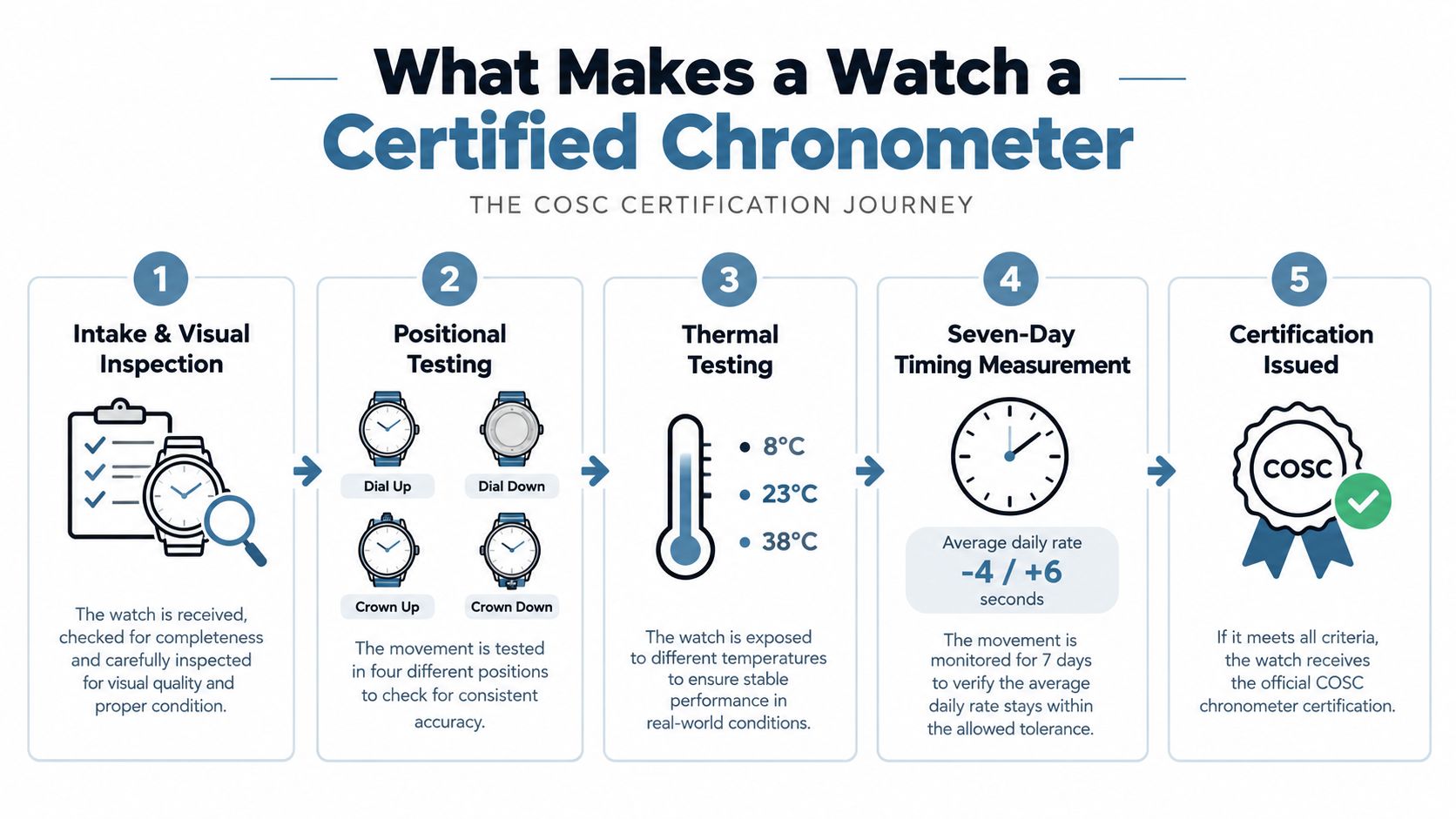
What the certificate does and doesn't tell you
A chronometer designation tells you that the movement met the stated accuracy standard during controlled testing. It doesn't mean the watch has a stopwatch, a particular case design, or a specific number of subdials.
It also doesn't make every certified watch identical. Brands may use additional testing systems or tighter internal standards. That's why we always recommend checking the exact certification named for the specific watch, rather than assuming every use of “chronometer” means the same thing.
Our separate explanation of what makes a Superlative Chronometer covers that brand-specific language in more detail.
How a Chronograph Complication Actually Works
A mechanical chronograph is a stopwatch mechanism added to a normal timekeeping movement. It lets you start, stop, and reset elapsed-time measurement without interrupting the watch's regular time display. The Fondation de la Haute Horlogerie describes this independent operation, while Seiko explains that a clutch connects and disconnects the stopwatch mechanism from the movement's gear train. The Fondation de la Haute Horlogerie explains the chronograph complication.
Most familiar layouts use two pushers. The upper pusher starts and stops the timing function. The lower pusher resets it. A central seconds hand records elapsed seconds, while smaller subdials may display elapsed minutes or hours.
The clutch matters because it controls when the timing works engage with the base movement. A column wheel routes the chronograph commands through a traditional, finely finished switching system. A cam performs the same broad job through a different architecture. Buyers don't need to choose a mechanism by reputation alone, but collectors often examine the movement because construction, finishing, service needs, and price can differ.
A flyback chronograph can reset and restart timing in one operation. A split-seconds chronograph adds a second elapsed-seconds hand for recording an intermediate time. These are specialized variations, not requirements for a watch to be a chronograph.
For the basics of the movement beneath the complication, read how a mechanical watch works.
Side by Side Comparison at a Glance
The easiest way to remember the difference is to separate function from validation. A chronograph adds an elapsed-time function. A chronometer identifies a movement that has met an accuracy standard.
| Attribute | Chronometer | Chronograph |
|---|---|---|
| Definition | A precision designation based on testing | An elapsed-time stopwatch complication |
| What it establishes | That the movement met a stated accuracy requirement | That the watch can start, stop, and reset timing |
| Required elements | A tested movement and a recognized standard | Pushers, timing hands, counters, and a switching mechanism |
| Role of COSC | COSC can certify the movement as a chronometer | COSC status isn't automatic just because a watch has a chronograph |
| Pushers and subdials | Not required | Common indicators of the complication |
| Can it stand alone? | Yes, a three-hand watch can be a chronometer | Yes, a chronograph doesn't automatically have certification |
| Effect on price | Depends on certification, brand, movement, and condition | Depends on construction, brand, movement, condition, and complexity |
The overlap is the point many basic explainers miss. A chronograph can also earn chronometer certification if its movement passes the required accuracy testing. A chronometer can be a watch without any stopwatch function. Don't buy one term expecting the other.
An Omega Speedmaster Moonwatch Professional is a useful example of why buyers should read the full specification. The watch may present the familiar chronograph layout while also carrying an accuracy designation, depending on the specific version and certification named for that watch.
Chronometer vs Chronograph in Real Watches
Look at a pre-owned case and you'll see these terms used across different watch families. Some models combine the qualities. Others deliberately offer only one.
A Rolex Daytona is the classic example buyers associate with both a racing-style chronograph and certified precision. Its pushers and subdials identify the elapsed-time function. Its chronometer language concerns accuracy, not the presence of those controls.
The Omega Speedmaster shows the same principle from another angle. It is immediately recognizable as a chronograph because of its pushers, central timing hand, and subdials. Specific Speedmaster versions may also carry a chronometer designation, so the reference number and papers deserve a careful check before you make assumptions.
A Tudor Black Bay without chronograph pushers illustrates the opposite arrangement. A watch can focus on certified precision while keeping a clean dial and conventional time display. That may suit someone who wants a precise daily watch without the added visual and mechanical complexity of a stopwatch.
A chronograph is not automatically more accurate, and a chronometer is not automatically more useful. Read the specification before you read the marketing language.
Collectors who also enjoy older or unusual timepieces may find it useful to learn how specialists sell pocket watches in Boise, especially when comparing historic timing instruments with modern wristwatches.
For more examples of timing-focused models, see our guide to the best chronograph watches.
Which One Should You Actually Buy
Start with how you'll use the watch.
Choose the chronograph complication if you regularly want to time:
- Laps and intervals: The pushers give you a physical start, stop, and reset control.
- Cooking, workouts, or travel events: You can read elapsed time directly from the dial.
- Instrument-style design: Subdials and a timing scale are part of the appeal.
Choose chronometer certification if your priority is:
- Controlled accuracy: You want a movement tested against a recognized standard.
- A clean dial: A three-hand watch avoids the extra counters and pushers.
- A certification record: You care about how the movement's rate was validated.
Some buyers should choose both. If you want the tactile pleasure of a mechanical stopwatch and a certified movement, a chronometer-certified chronograph is the natural fit. The Daytona and certain Speedmaster versions are the kind of watches buyers often investigate for that combination, but the exact reference still matters.
We also recommend separating the emotional decision from the technical one. You may never use the stopwatch, yet still love the balanced dial and mechanical action. Or you may dislike subdials and prefer a simple certified watch that disappears under a shirt cuff.
Pre-owned buyers should compare the actual watch in front of them, including its reference, movement, service record, and certification documentation. Our guide to the best entry-level luxury watches can help if you're still deciding how much complication belongs in your first purchase.
How Can You Pay for It
Financing may be available through Affirm, Synchrony, Acima, and Snap Finance, with approval and terms set by each provider. Review the payment schedule and total cost before choosing a plan through ECI Jewelers' financing and leasing options.
You can also ask about trading in a luxury watch when applying its value toward another purchase. The process and offer depend on the watch's condition, documentation, market demand, and inspection. See the luxury watch trade-in information before bringing a piece into the conversation.
Frequently Asked Questions
Is a chronograph a chronometer
Not automatically. A chronograph has an elapsed-time function, while a chronometer is a precision designation based on testing. One watch can have both, but the chronograph function alone doesn't prove certification.
Can a watch be both a chronometer and a chronograph
Yes. A chronograph movement can earn chronometer certification if it passes the required accuracy testing. A certified chronometer can also be a simple watch without pushers or subdials.
Does chronometer mean the watch has a stopwatch
No. Chronometer status concerns accuracy. It doesn't require a stopwatch complication, timing pushers, or elapsed-time counters.
What does COSC certify
COSC certifies qualifying high-precision mechanical wristwatch movements after testing them for a defined period in multiple positions and temperatures. The stated average daily rate requirement is -4 to +6 seconds per day. COSC provides the testing details.
Should I buy the certified watch or the chronograph
Buy the chronograph if you want elapsed-time timing and its added mechanical character. Buy the chronometer if tested accuracy matters more than stopwatch functions. If both matter, compare certified chronographs by exact reference and documentation.
Buying Checklist and How to Pay
A pre-owned watch deserves a calm inspection. Don't let the similar words on the dial make the decision for you.
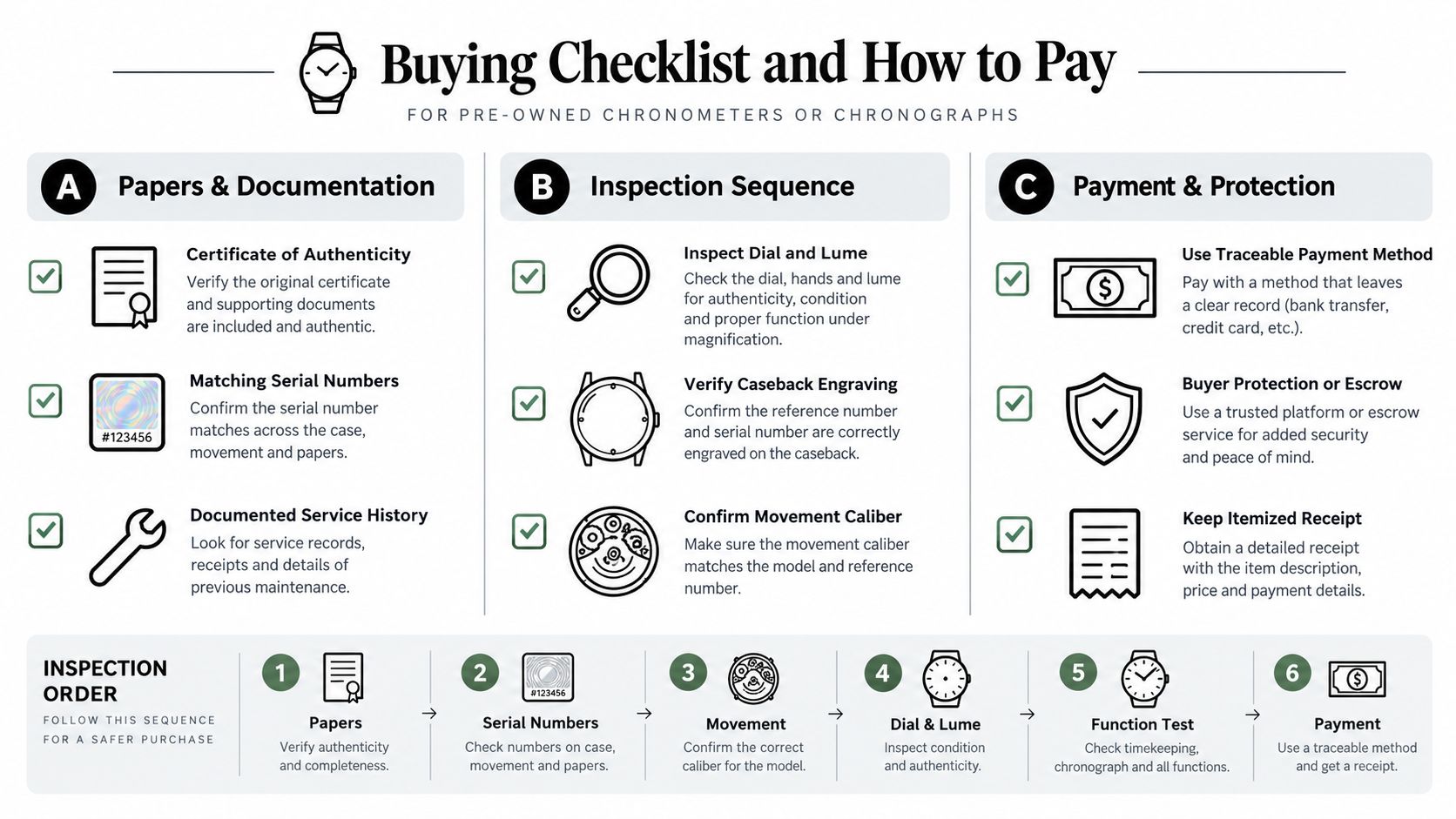
Check the paperwork first
Ask whether the watch includes its original certification documents, box, service records, and purchase documentation when available. A chronometer claim should be supported by clear information about the certification and the exact movement or watch reference.
Then compare the serial and reference markings across the watch and paperwork. They should make sense together. If the seller can't explain a discrepancy, stop and investigate before discussing price.
Inspect the watch in order
Use this sequence at the counter:
- Case and crystal: Look for deep dents, uneven polishing, chips, or scratches that affect the watch's condition.
- Dial and hands: Check alignment, printing, lume, and signs of moisture or replacement parts.
- Pushers and crown: On a chronograph, operate the start, stop, and reset functions carefully.
- Subdials: Confirm that the hands return correctly and that the counters behave as expected.
- Movement information: Verify that the stated calibre matches the model and documentation.
- Service history: Ask what work was completed and whether the timing function was tested after service.
A chronograph has more moving parts than a basic time-only watch. That doesn't make it a poor choice. It does mean the condition of the timing mechanism deserves attention, especially on a pre-owned piece.
Our buying advice: Never pay for the word “chronometer” alone. Pay for a watch whose reference, movement, condition, function, and documentation all agree.
When you're ready to compare current options, ECI Jewelers offers pre-owned luxury watches that can be reviewed online or in its New York City showroom. Ask for the exact reference and certification details, then judge the watch by the use case that matters to you.
Find the right chronometer, chronograph, or combination of both by visiting ECI Jewelers and comparing the available pre-owned watches with our team. Prices shown are as of October 2026. Each pre-owned watch is one of a kind.


