


At its heart, a chronograph is simply a watch that also features a built-in stopwatch. This function allows you to measure elapsed time whenever you need to, and it operates completely separately from the watch's main job of telling you the current time. Think of it as a standard watch that’s been given an incredibly useful upgrade—what watch collectors call a complication—that adds both function and mechanical charm.
Understanding the Chronograph Complication
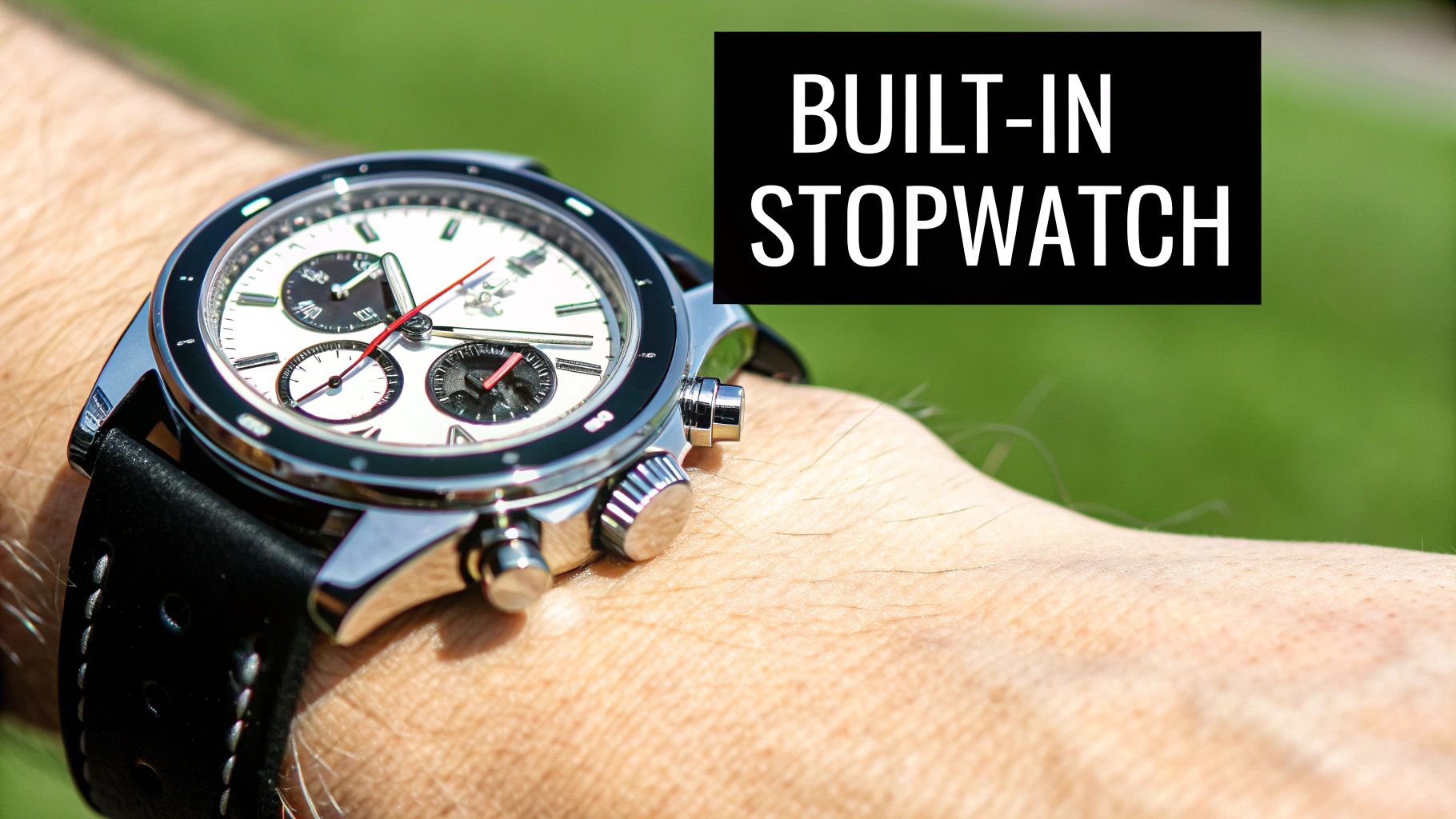
To really get a feel for how a chronograph works, an analogy helps. Picture your car's dashboard. The speedometer always shows your current speed—that’s your watch’s main time-telling function. The chronograph is like the trip meter; you can start it, stop it, and reset it to time a specific journey, all without interfering with the speedometer.
This stopwatch feature is controlled by a set of pushers on the side of the watch case, usually found at the 2 o'clock and 4 o'clock positions. The time you’re measuring is displayed on small, separate dials on the main watch face, which are known as subdials.
A Quick Tour of the Chronograph's Face
The classic look of a chronograph comes from a few key parts working together. Even if you're new to watches, you'll start to recognize this layout instantly.
For a clearer picture, this table breaks down the main components you'll see on almost any chronograph.
Chronograph Features at a Glance
| Component | Function | Common Location on the Watch |
|---|---|---|
| Pushers | The buttons used to start, stop, and reset the stopwatch. | On the side of the case, typically at 2 o'clock (start/stop) and 4 o'clock (reset). |
| Central Chronograph Hand | The long, thin hand that measures elapsed seconds for the stopwatch. | Starts at the 12 o'clock position and only moves when the stopwatch is running. |
| Subdials (Registers) | Small dials that track elapsed minutes and hours for the stopwatch. | Set into the main dial; common layouts include 30-minute and 12-hour counters. |
| Running Seconds Subdial | A small dial that shows the continuous seconds for the main time. | This subdial runs all the time, unlike the chronograph hands. |
These elements come together to create one of the most popular and practical complications in the world of fine watches.
At its core, a chronograph is more than just a watch; it's a piece of interactive engineering. Its design invites you to engage with time in a more active, precise way, transforming a passive time-teller into an active tool.
This blend of form and function is why the chronograph remains a favorite among collectors and casual enthusiasts alike. It's a watch that does something, and that’s a huge part of its enduring appeal.
From Stars to Speedways: The Journey of the Chronograph
Long before it became the go-to tool for race car drivers and pilots, the chronograph started its life with its eyes fixed on the heavens. Its story isn't one of speed, but of stars. This journey from an astronomical instrument to a racetrack icon shows how one brilliant idea can be reimagined for entirely new frontiers.
The tale begins not at a roaring speedway, but in the quiet of an observatory. Astronomers had a critical need to measure short, precise intervals of time to map the cosmos, and the first chronograph was born out of this necessity. It was designed to capture fleeting celestial events with an accuracy nobody had ever seen before.
From Celestial Maps to Finish Lines
The first true chronograph, the Compteur de Tierces (or "counter of thirds"), was invented by French watchmaker Louis Moinet way back in 1816. This pocket watch was a highly specialized instrument created for astronomical observations. It hummed along at an incredible 216,000 vibrations per hour, letting it measure time down to a sixtieth of a second—a feat that helped Moinet precisely track the movement of stars and planets.
A few years later, in 1821, Nicolas Rieussec created the first chronograph that was actually sold to the public, commissioned by King Louis XVIII to time horse races. This clever device literally "wrote the time" (the meaning of chronograph) by dropping a tiny spot of ink onto a rotating dial at the start and end of a race. It worked, but the real breakthrough was still to come.
The modern chronograph as we know it became a practical reality in 1862. That’s when Adolphe Nicole patented the crucial zero-reset function, allowing the stopwatch hand to instantly snap back to its starting position with a single button press. This innovation turned the chronograph from a niche device into a versatile, reusable tool.
This patented reset mechanism, which used a heart-shaped cam, laid the groundwork for every mechanical chronograph that followed. It made the complication reliable and easy to use, setting the stage for its adoption in fields where every fraction of a second mattered. You can dive deeper into the rich history and mechanics of these timepieces by exploring the evolution of the chronograph on Wikipedia.
Icons of Adventure and Precision
With this new practicality, the chronograph quickly found a home on the wrists of pioneers. Aviation and motorsport, two fields obsessed with speed and precision, became the complication's natural proving grounds. Brands like Breitling saw this potential early, establishing themselves as leaders in the field by the late 19th century.
This legacy was cemented by several legendary timepieces that became symbols of human ambition:
- The Breitling Navitimer: Introduced in the 1950s, its slide rule bezel was basically a flight computer on the wrist, helping pilots make crucial calculations in the cockpit.
- The Rolex Daytona: First released in 1963 and named for the famous Florida racetrack, it became the ultimate status symbol for motorsport fans and professional drivers.
- The Omega Speedmaster: Known forever as the "Moonwatch," it was flight-qualified by NASA and worn by Buzz Aldrin during the Apollo 11 moon landing in 1969, securing its place in history.
These models show how the chronograph evolved from a simple timer into a specialized, sometimes life-saving, instrument. Each watch tells a story of adventure, from breaking speed records on the ground to exploring the final frontier. At ECI Jewelers, this rich heritage is tangible in our curated collection of authenticated luxury chronographs, connecting you directly to this incredible history.
How a Chronograph Movement Actually Works
To really get what makes a chronograph tick, you have to look under the hood. The tiny, intricate dance of gears and levers inside is a marvel of micro-engineering, but the big idea is surprisingly simple.
Think of it like a car's transmission. Your watch's main timekeeping function is the engine—it's always running to keep you on schedule. The chronograph is a separate system that you can engage or disengage whenever you want, just like shifting gears, without ever stalling the engine.
When you press a pusher, you're not interfering with the watch's primary job of telling time. You're simply commanding a sophisticated mechanism to tap into the watch's power, measure an interval, and then disconnect, all with incredible precision.
The Brains and Brawn of the Operation
At the heart of this system are a few key components working in perfect harmony. While the exact designs vary, almost every mechanical chronograph relies on a similar set of principles to start, stop, and reset the stopwatch.
- Pushers: These are your controls—the physical link between you and the complex movement inside. Pressing them activates a series of levers that command the entire chronograph operation.
- Clutch: This part works just like the clutch in a car. It connects the chronograph’s wheel train to the watch's main gear train (the "engine"), letting power flow to the stopwatch hands so they can start moving.
- Coordinating Levers: An intricate system of levers, often called the "chronograph works," translates the press of a pusher into mechanical action. It tells the clutch when to engage or disengage and tells the reset hammers when to strike.
This visual timeline shows how the chronograph evolved from a tool for scientists to a symbol of pure adventure.
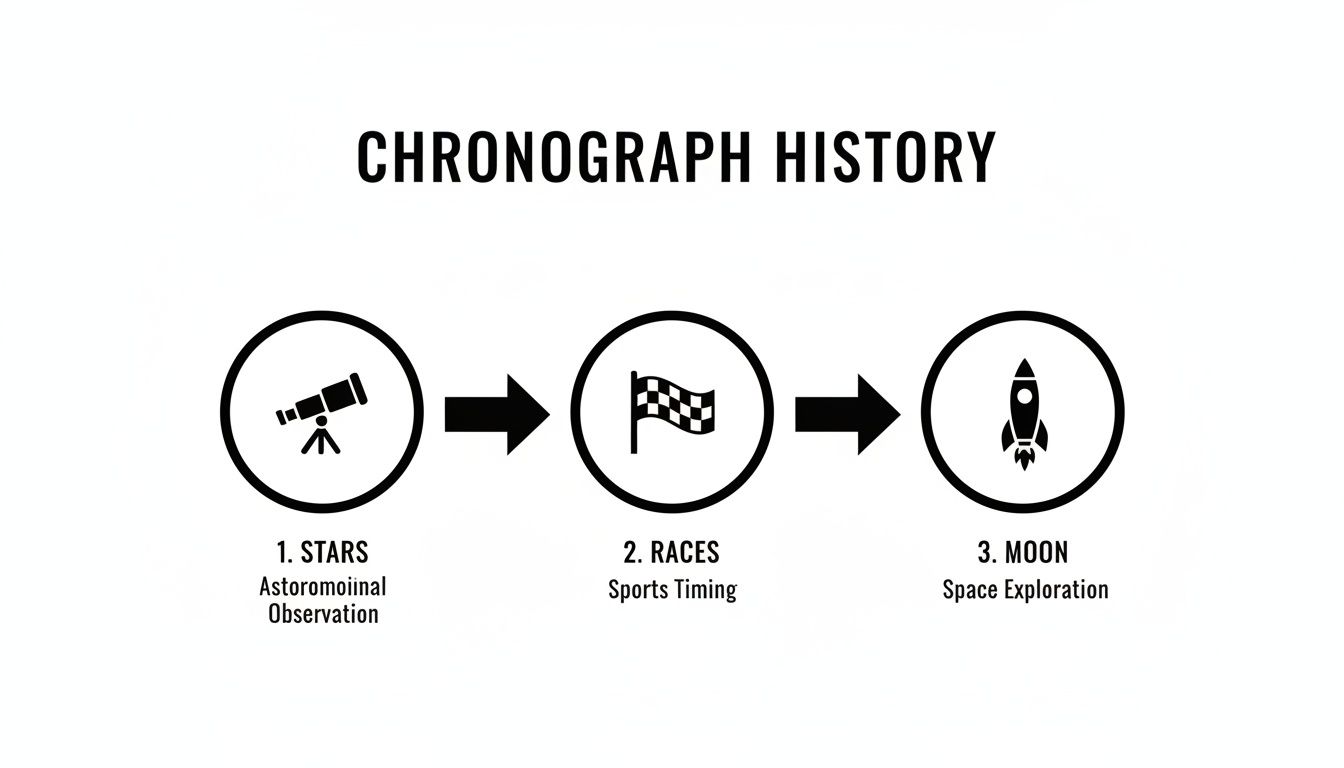
From tracking stars to timing laps and even accompanying astronauts to the moon, its core function has stayed the same, but its applications have become the stuff of legend.
The Column Wheel: The Conductor
The most celebrated component in this mechanical orchestra is often the column wheel. This small, castle-turret-shaped gear acts as the chronograph's central command unit, or its brain.
When you press a pusher, the column wheel rotates. Its pillars and gaps either engage or disengage the different levers that control the start, stop, and reset functions. A column wheel provides that crisp, satisfying feedback you feel in the pushers and is widely considered the more refined—and historically important—way to control a chronograph. Its smooth operation is a hallmark of high-end watchmaking.
If you're curious about the fundamentals of these amazing machines, you can learn more by reading our guide on how a mechanical watch works.
The more modern alternative is the cam-lever (or coulisse lever) mechanism. Developed to be easier and cheaper to manufacture, it uses a stamped metal cam instead of a milled column wheel to direct the levers. It gets the job done reliably, but the feel of the pushers is often less refined—sometimes described as "spongy" compared to the sharp click of a column wheel.
Key Takeaway: The column wheel acts like a sophisticated rotary switch, giving precise, smooth control over the stopwatch functions. The cam-lever system is a more robust, cost-effective alternative that does the same job through a different mechanical action.
Integrated vs. Modular Movements
Finally, any serious collector needs to understand the two main ways a chronograph movement is built. This distinction affects performance, servicing, and the overall value of a watch.
-
Integrated Movement: Here, the chronograph complication is built into the base movement from the ground up. Every component is designed to work together as a single, cohesive unit. This approach usually results in a thinner, more elegant movement, often featuring a column wheel, and is the top choice for watch purists. The legendary Zenith El Primero is a perfect example.
-
Modular Movement: This method involves taking a standard time-only watch movement and bolting a separate chronograph "module" right on top. It’s a practical and cost-effective way for brands to add a chronograph function to an existing, reliable base caliber. You can sometimes spot a modular chronograph because the pushers don't align perfectly with the crown. While they are highly functional, they can be trickier to service, as the entire module often has to be replaced rather than repaired.
How to Read and Use Your Chronograph
At first glance, a chronograph can look a little intimidating. All those extra hands, subdials, and pushers can seem complicated, but learning the ropes is actually quite simple. Once you get the hang of it, you’ll turn a beautiful watch into a seriously practical tool for measuring time with precision.
The trick is to think of it not as one complex machine, but as two systems working in harmony: the regular time-telling part, and the stopwatch part.
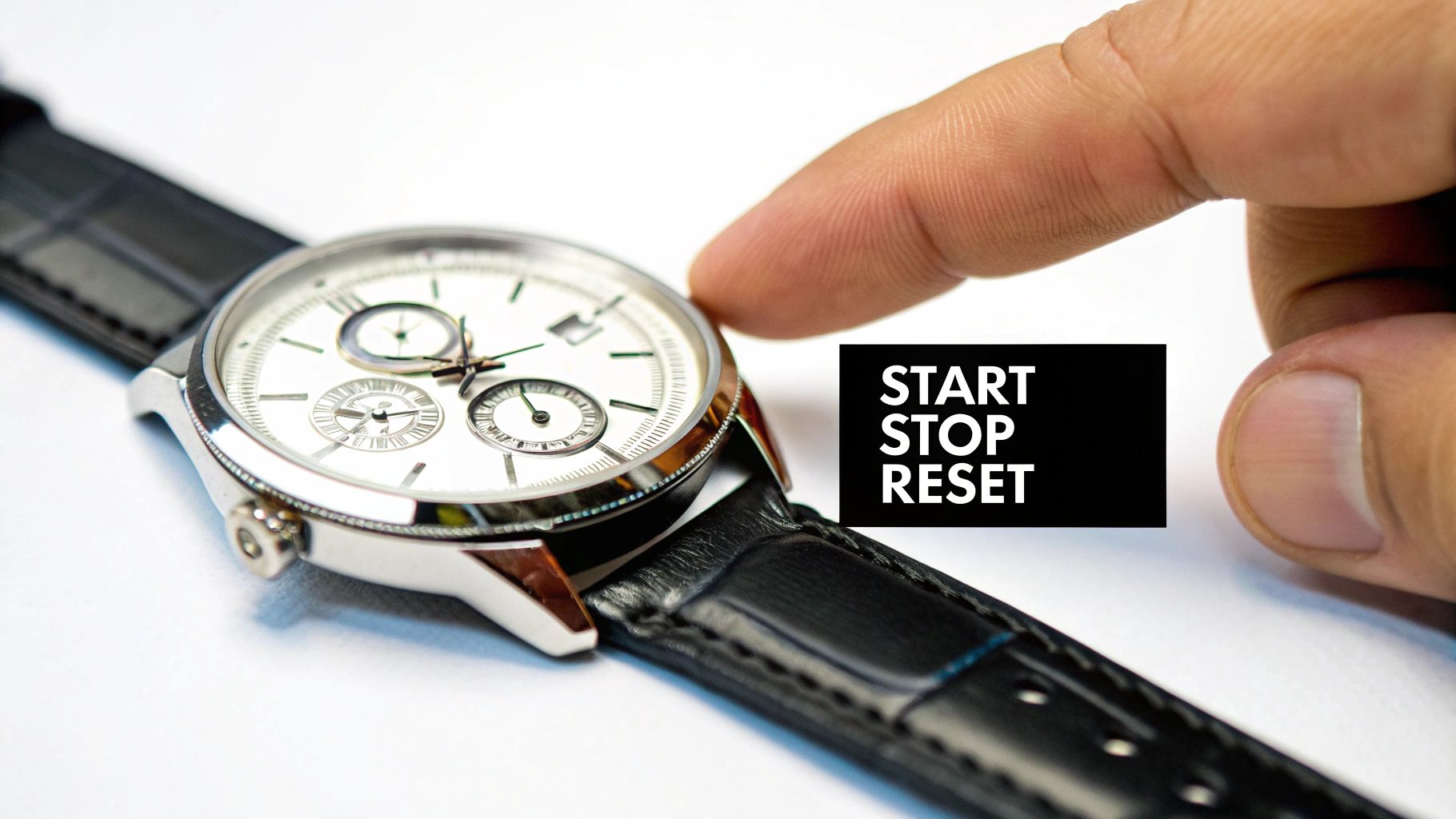
Your standard hour and minute hands do what they always do—tell you the time. The chronograph components, on the other hand, sit patiently, waiting for you to call them into action.
Identifying the Chronograph Controls
Before you can start timing anything, you need to know your way around the dial. Thankfully, nearly every modern chronograph uses a standard, intuitive layout designed for quick use.
- The Pushers: Take a look at the side of the case. You'll spot two buttons, usually at the 2 o'clock (top) and 4 o'clock (bottom) positions. These are your start/stop and reset buttons.
- Central Chronograph Seconds Hand: This is the long, thin hand that normally stays parked at 12 o'clock. It only springs to life when you activate the stopwatch to measure elapsed seconds.
- The Subdials: These small dials are the stopwatch's memory. They keep track of the total minutes and, on many watches, the hours that have passed. A typical setup might have a 30-minute counter and a 12-hour counter.
It’s a common source of confusion for new owners: why isn’t the big seconds hand moving? That’s because it belongs to the chronograph. The watch’s regular, continuously running seconds are usually ticking away on one of the small subdials.
The Three-Step Timing Process
Using your chronograph boils down to a simple three-step sequence that quickly becomes second nature. This fundamental process is the same for almost any chronograph you'll ever strap on.
- START: Press the top pusher (at 2 o'clock) one time. You’ll see the central chronograph seconds hand begin its sweep around the dial.
- STOP: When your event is over, press that same top pusher again. The central seconds hand and any subdials in motion will freeze, locking in the elapsed time for you to read.
- RESET: To send the chronograph hands back to their starting positions, press the bottom pusher (at 4 o'clock). They’ll instantly snap back to zero, ready for the next event.
Important Tip: Always stop the chronograph before you reset it. Trying to reset the stopwatch while it's still running can cause serious damage to the delicate gears inside.
For a deeper dive with more visuals, our full guide on how to read a chronograph watch offers extra examples and tips to help you operate your timepiece with confidence.
Unlocking the Tachymeter Scale
Many chronographs, especially icons with a racing pedigree like the Rolex Daytona, have a tachymeter scale engraved on the bezel or printed on the outer track of the dial. It looks technical, but its job is surprisingly simple: to measure average speed over a set distance.
A tachymeter works by converting elapsed time (in seconds) into speed (in units per hour). It’s calibrated for events that take 60 seconds or less. Here's how to use it in the real world.
Example: Measuring a Car's Speed
Let's say you're on a highway with mile markers and want to check your average speed over one mile.
- As your car passes the first mile marker, START the chronograph by pressing the top pusher.
- Drive to the next mile marker.
- The moment you pass that second marker—exactly one mile later—STOP the chronograph with another press of the top pusher.
- Now, look where the central chronograph seconds hand stopped. The number it points to on the tachymeter scale is your average speed in miles per hour.
For example, if it took 45 seconds to cover the mile, the hand will be pointing to "80" on the scale. That means your average speed was 80 miles per hour. This clever bit of mechanical engineering turns your watch into a true analog computer on your wrist.
Exploring Different Types of Chronographs
While the basic start-stop-reset function defines a chronograph, the real fun begins when you dive into the variations. High-end watchmaking is a playground for mechanical ingenuity, and the chronograph has been a favorite canvas for master watchmakers to show off their skills.
Just as a standard sedan is miles apart from a Formula 1 race car, chronographs have specialized versions that solve specific problems with incredible elegance. For collectors, understanding these different types is key to appreciating the depth of craftsmanship that goes into a truly great timepiece. Each one pushes the boundaries of what a mechanical watch can do.
The Standard Chronograph
This is the classic, the foundation upon which all other complications are built. It operates with a simple and satisfying sequence: one pusher starts and stops the timer, and another resets it back to zero. Clean, simple, and effective.
You’ll find this is the most common and versatile type of chronograph out there. It’s perfect for everyday timing needs—tracking a workout, timing a presentation, or even just making sure you don't overcook a steak. Its straightforward operation has made it a reliable staple in the watch world for over a century.
The Flyback Chronograph
Imagine you're timing laps at a racetrack. With a standard chronograph, you’d have to press a pusher three times to time a new lap: once to stop, once to reset, and a third time to start again. In that small gap between pushes, you're not timing anything. For most of us, it’s no big deal. For a pilot or a race car driver, that lost fraction of a second is critical.
The Flyback chronograph is the brilliant solution to this problem.
A Flyback chronograph lets you reset and restart the timer with a single press of the reset pusher—while the chronograph is still running. The hands instantly fly back to zero and begin timing again without missing a beat.
This function was originally developed for pilots who needed to time consecutive navigational legs with absolute precision and minimal fuss. Performing three actions with one push made their complex calculations faster and safer. You can get the full story in our detailed guide on what a flyback chronograph is.
It's a perfect example of how horology has evolved to serve the needs of demanding, high-stakes professions.
The Rattrapante or Split-Seconds Chronograph
Now we're entering the big leagues. The Rattrapante, also known as the split-seconds chronograph, is one of the most complex and revered complications in all of watchmaking. If a standard chronograph is one stopwatch, the Rattrapante is two stopwatches seamlessly integrated into one.
It features two central chronograph seconds hands, one stacked perfectly on top of the other. When you start the timer, they move together as one. The magic happens when you press a third pusher, often found at 10 o’clock or built into the crown.
- Pressing the Rattrapante pusher stops one of the seconds hands, letting you record an intermediate or "split" time.
- Meanwhile, the other seconds hand keeps running, timing the overall duration of the event.
- Pressing the Rattrapante pusher again makes the stopped hand instantly catch up to the running hand, and they continue their journey around the dial together.
It’s the mechanical equivalent of the "lap" button on a digital stopwatch. This is ideal for timing two runners in a race, letting you record the finish time of the first while continuing to time the second. The sheer skill required to build a reliable Rattrapante movement places it firmly in the realm of true horological art. It's a "grail" complication for many of the seasoned collectors who visit us at ECI Jewelers.
Comparing Different Chronograph Types
To help you keep these incredible mechanisms straight, here’s a quick side-by-side comparison. Each one serves a different purpose, showcasing the brilliant problem-solving that defines luxury watchmaking.
| Chronograph Type | Key Functionality | Best Use Case | Iconic Example |
|---|---|---|---|
| Standard | Single start, stop, and reset function using two pushers. | Everyday timing tasks like workouts, cooking, or presentations. | Omega Speedmaster Professional |
| Flyback | Resets and restarts the timer instantly with a single push of the reset button. | Timing consecutive events without interruption, like aviation or racing laps. | Breguet Type XX |
| Rattrapante | Measures multiple, simultaneous time intervals using two separate seconds hands. | Timing two events that start together but end at different times, like two runners in a race. | Patek Philippe 5370 |
From the straightforward utility of the standard chronograph to the mind-bending complexity of the Rattrapante, these variations offer a fascinating glimpse into the world of mechanical timekeeping.
Caring for Your Luxury Chronograph
A fine chronograph isn't just a watch; it's a serious investment. You're holding a piece of precision engineering that, with the right care, is built to outlive you. But like any high-performance machine, it needs consistent, thoughtful maintenance to protect its accuracy, looks, and long-term value.
Think of it like owning a classic sports car. You wouldn’t skip a tune-up, and the same principle applies here. Proper care ensures the intricate dance of gears, levers, and springs inside your watch continues to run without a hitch for decades to come.
Professional Servicing and Why It Matters
For a complex movement like a chronograph, we recommend a full professional service every 5-7 years. This can shift a bit depending on the manufacturer and how hard you wear your watch, but it’s a solid rule of thumb for ensuring its health.
During a full service, a certified watchmaker painstakingly disassembles the entire movement. They'll clean every component, replace anything showing wear, re-lubricate the mechanism with specific oils, and reassemble it to exact factory specifications. This is not a job for just anyone.
It is absolutely crucial to use an authorized service center or a trusted specialist like ECI Jewelers. Here’s why that matters so much:
- Genuine Parts: An authorized service guarantees that only 100% genuine parts are used. This is non-negotiable for preserving your watch’s integrity and resale value.
- Specialized Tools: Chronograph movements demand specific tools and diagnostic equipment that most independent repair shops simply don't have access to.
- Expert Knowledge: Certified technicians are factory-trained to handle the unique architecture of your specific caliber, whether it’s a classic column wheel or a modern vertical clutch.
Trying to save a few bucks with an unauthorized repair shop is one of the costliest mistakes you can make. Using aftermarket parts can cripple the watch's performance and will seriously tank its value, making it a nightmare to sell or trade later on.
Daily Care and Common Pitfalls to Avoid
Beyond the five-year service interval, how you treat your chronograph day-to-day makes a huge difference. A few simple habits can protect your investment and prevent a trip to the repair shop.
The golden rule: never operate the chronograph pushers underwater. Unless your watch is a specific dive chronograph built for that exact purpose (and most aren't), pressing those buttons can break the water-resistant seals. If water gets inside, it can cause catastrophic damage to the movement.
Also, be aware of invisible forces. Keep your watch away from strong magnetic fields—think speakers, refrigerators, and tablets. Magnetism can throw off the delicate balance of the hairspring, making your watch run way too fast or slow. If you think your watch has been magnetized, a professional can fix it in minutes.
At ECI Jewelers, we see ourselves as your partner for the life of your watch. From helping you find that perfect chronograph to providing the expert care it deserves, we’re here to make sure it remains a source of pride and precision for a lifetime.
Frequently Asked Questions About Chronographs
Let's clear up a few of the most common questions that come up for new owners and collectors. Getting these details straight will help you feel much more confident, whether you're browsing in a showroom or just enjoying the watch on your wrist.
Why Doesn’t the Big Second Hand Move on My Chronograph?
This is easily the number one point of confusion for anyone new to chronographs, so don't worry—you're not alone. That big, central second hand isn't for telling time; it’s the stopwatch hand. It's designed to sit perfectly still at 12 o'clock until you hit the start pusher.
So, where are the regular, running seconds? Look at the smaller subdials. One of them is almost always dedicated to showing the continuous seconds for everyday timekeeping. This smart design keeps the main dial clear so you can get an easy, precise reading of elapsed seconds when the stopwatch is active.
What Is the Difference Between a Chronograph and a Chronometer?
Though they sound alike, these terms mean two completely different things in the watch world. It’s a crucial distinction that separates the true enthusiasts.
- Chronograph: This simply describes a function. As we've covered, it's any watch that has a built-in stopwatch feature for measuring elapsed time.
- Chronometer: This is a certification of accuracy. A watch earns the title "chronometer" only after its movement passes a demanding, multi-day battery of precision tests by an official institute, like the famous Contrôle Officiel Suisse des Chronomètres (COSC).
The easy way to remember it: a chronograph tells you how long something took, while a chronometer certification tells you the watch is exceptionally accurate at telling the time. A watch can be one, the other, both, or neither.
Can I Leave the Chronograph Running All the Time?
You can, but for a mechanical chronograph, it’s really not a good idea. Keeping the stopwatch function engaged 24/7 puts continuous, extra strain on the movement's delicate components. This can lead to premature wear and tear over the long run and will almost certainly drain your watch's power reserve faster.
Think of it like driving your car everywhere with the engine redlining. It's built to handle it in short bursts, but you wouldn't do it constantly. For the long-term health of your timepiece, it's best to only run the chronograph when you actually need to time something.
At ECI Jewelers, we believe that understanding your watch is the first step to truly appreciating it. Our team is dedicated to helping you find the perfect timepiece and ensuring you have the knowledge to enjoy it for a lifetime. Explore our curated collection of authenticated luxury watches.


