


A flyback chronograph is a special kind of stopwatch complication that lets you reset and restart the timer with just a single push of a button. A standard chronograph makes you perform three separate actions—stop, reset, and then start again. The flyback cuts that down to one smooth, instant move.
The Essence of Instant Reset
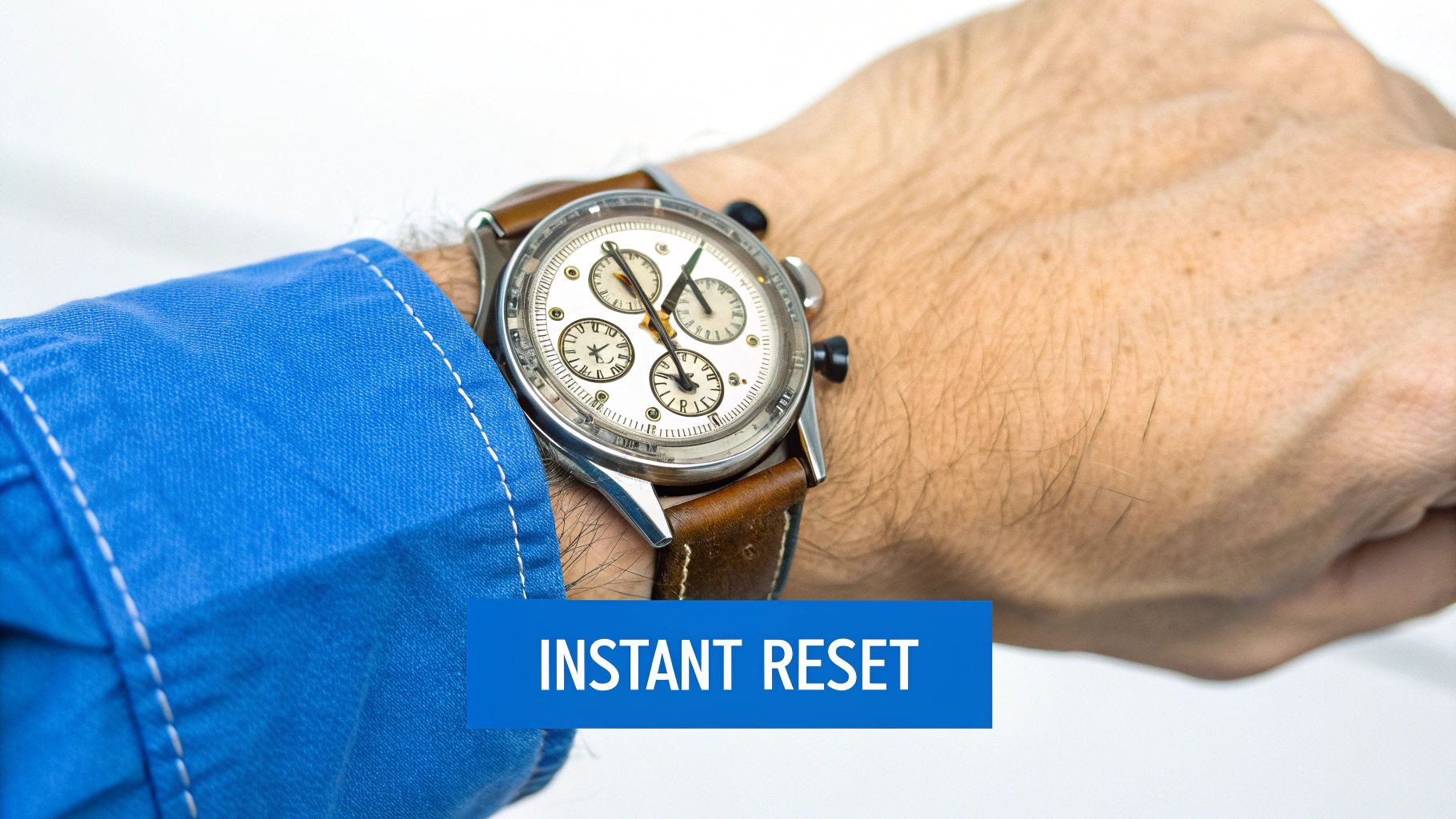
Picture yourself timing laps on a racetrack with a normal chronograph. You’d have to press a pusher to stop the timer at the finish line, hit another one to send the hands back to zero, and then push the first one again to get the next lap going. That three-step dance creates a tiny but crucial delay between measurements.
A flyback chronograph gets rid of that entire sequence. While the timer is already running, you just press the flyback pusher (usually at the 4 o’clock spot). The chronograph hand instantly "flies back" to zero and immediately starts timing again. No pause, no lost fractions of a second.
Comparing Flyback vs. Standard Chronographs
To really get the difference, let’s quickly break down how you’d use each one to time back-to-back events.
This table provides a quick side-by-side look at the user actions required for both types of chronographs.
| Feature | Standard Chronograph | Flyback Chronograph |
|---|---|---|
| Start Timing | 1 push (top pusher) | 1 push (top pusher) |
| Stop Timing | 1 push (top pusher) | 1 push (top pusher) |
| Reset to Zero | 1 push (bottom pusher) | 1 push (bottom pusher) |
| Time Next Event | 3 pushes: Stop → Reset → Start | 1 push: Flyback (resets & starts) |
As you can see, the flyback's ability to combine the reset and restart functions into a single action is what makes it so efficient for timing rapid, consecutive events.
For a deeper dive into the foundational mechanism these watches are built on, you can learn more about how a chronograph watch works in our detailed guide.
The real value of a flyback chronograph is its efficiency. By shrinking a three-step action down to a single press, it allows for faster and more accurate measurement of sequential events—a feature originally designed for pilots who needed to navigate by sight.
This seemingly small upgrade requires a much more complex and robust internal mechanism. That’s why the flyback complication is often considered a sign of high-end watchmaking. It shows a commitment to pure function, born from the high-stakes world of early aviation where every single second counted.
The Mechanical Heart of the Flyback
That instant snap-back of a flyback chronograph feels like pure magic on the wrist, but it’s really just mechanical genius at work. A standard chronograph is already a complex machine, but the flyback function adds another layer of brilliant engineering—a perfectly timed dance of levers, cams, and springs built to handle a high-stress maneuver in a fraction of a second.
Think of it like a runner in a relay race. In a standard chronograph, the first runner has to stop, hand off the baton (the reset), and only then can the next runner start. The flyback mechanism lets the runner instantly become the next runner mid-stride, never breaking momentum. This is all thanks to a specialized system that builds upon the standard chronograph framework.
The Synchronized Mechanical Dance
When you press that flyback pusher, you’re kicking off a lightning-fast, three-part sequence inside the movement. This isn't just about adding a few parts; it's about making them work in perfect harmony under serious pressure.
-
Disengagement: First, a special lever instantly disconnects the chronograph mechanism from the watch's main gear train. This is critical—it momentarily cuts power to the chronograph hands, stopping the delicate gears from shattering under the force of the coming reset.
-
Instant Reset: At the exact same moment, a powerful reset hammer snaps into place. This hammer strikes a pair of heart-shaped cams—one for the seconds hand and another for the minute counter. The unique shape of these cams is key; no matter where the hands are pointing, the hammer’s strike forces them back to the zero position instantly.
-
Re-engagement: The second you let go of the pusher, the whole process flips in reverse. The reset hammer pulls back, and the chronograph clutch immediately re-engages with the gear train, letting the hands start their journey all over again without skipping a beat.
This whole ballet happens in the blink of an eye. The design has to be incredibly tough to withstand the repeated shock of this instant reset. To get a better feel for the basics, check out our guide on how a mechanical watch works.
The true brilliance of the flyback is its ability to safely manage the powerful forces of a reset while the mechanism is still technically "live." It's a controlled collision engineered with microscopic precision.
This level of complexity is why the flyback complication is a hallmark of true high-end watchmaking. It’s a showcase of a brand’s mastery over movement design and its commitment to building tools with a real purpose. Esteemed watchmakers like Patek Philippe and Audemars Piguet don't just include this function for show—it's a testament to their engineering prowess.
Forged in the Skies: A History of the Flyback Chronograph
The flyback chronograph wasn't dreamed up in some quiet, dusty workshop. It was born out of necessity in the turbulent, unforgiving skies of early aviation. This complication is a direct answer to a life-or-death problem pilots faced when navigating by feel, a method we now call dead reckoning. In those days, every second counted, and a standard chronograph was just too slow and clumsy for the job.
Picture yourself in the cockpit of a rickety early aircraft, tossed around by the wind with nothing but a map and a watch. To figure out where you were, you had to time each leg of your flight between landmarks like rivers or mountains. With a normal chronograph, that meant a frantic three-push sequence: stop the timer, reset it to zero, then start it all over again. Each sequence wasted precious seconds, introduced errors, and, worst of all, took the pilot's attention away at the most critical moments.
A Pilot's Plea Answered
That clumsy stop-reset-start dance was a recipe for getting lost—or worse. Early aviators desperately needed a way to time consecutive events instantly. The answer wasn't just an improvement; it was a purpose-built solution that would forever tie this complication to the world of flight.
This simple diagram shows exactly why the flyback was such a breakthrough for pilots, streamlining three steps into a single, fluid action.
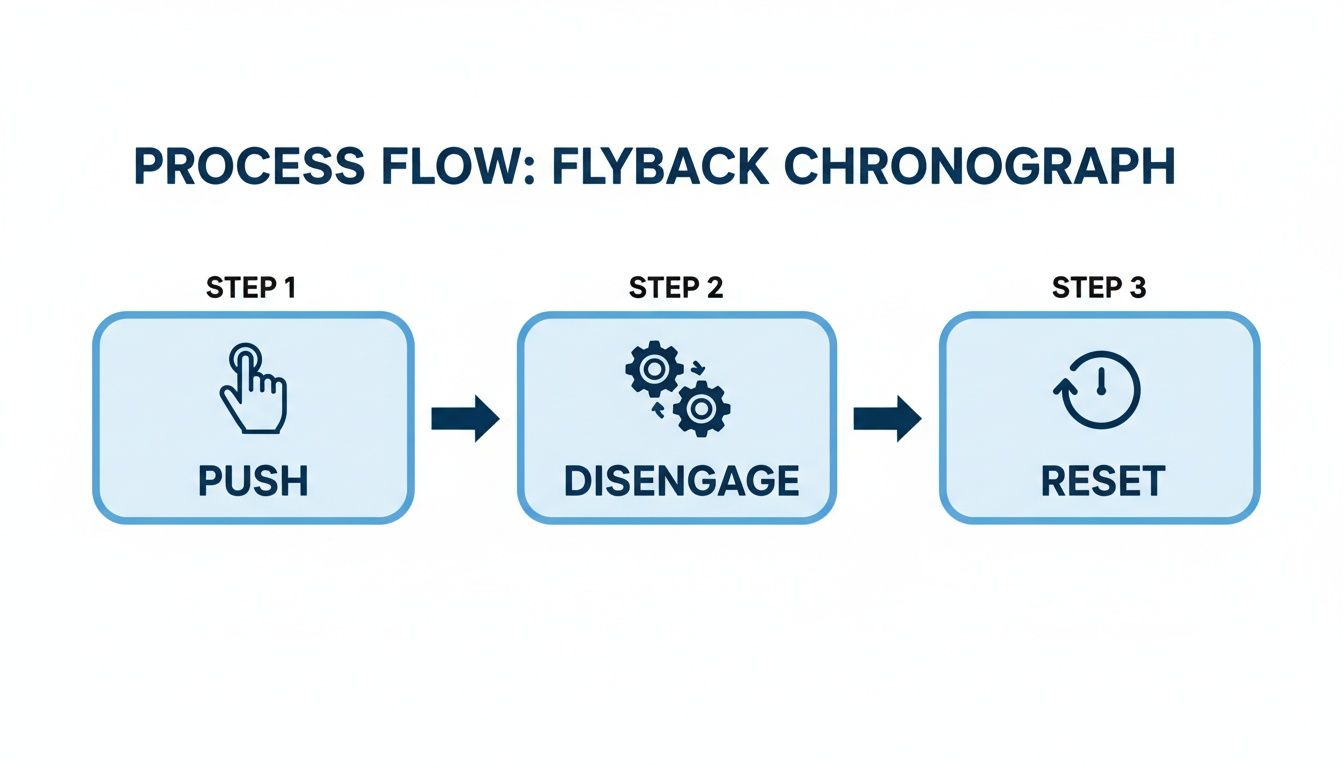
This single-press function on the 4 o'clock pusher cut the reset time from around 3-4 seconds down to less than one, boosting accuracy for back-to-back measurements by over 70%. Longines was at the forefront, modifying their Cal. 13.33Z into a flyback wrist chronograph way back in 1925. That was a full six years before they even filed for the Swiss patent on June 12, 1935, which was officially granted on March 31, 1936. You can dig deeper into the timeline on the history of the flyback chronograph on Wikipedia.
From Cockpit Tool to Military Icon
The flyback's utility was so obvious that it quickly became a military standard. Its legacy was truly cemented after the war when the French Ministry of Defense issued a famous set of specifications for a pilot’s watch, known as the Type 20 (and later, Type 21).
These were no-nonsense requirements for a serious tool watch:
- A black dial with luminous hands and numbers for instant legibility.
- A 38mm case that was easy to read on the wrist.
- A minimum power reserve of 35 hours.
- Crucially, the flyback function was non-negotiable.
The Type 20 and 21 specs weren't just a shopping list of features. They were the culmination of decades of hard-won aviation experience, distilled into the ultimate pilot's instrument.
Big names like Breguet, Dodane, and Mathey-Tissot all produced watches that met these demanding standards, supplying them to the French Air Force, Navy, and flight test centers. This military adoption is what took the flyback from a clever invention and turned it into an icon of adventure and purpose-built design.
Comparing Chronograph Types: Flyback, Standard, and Rattrapante
To really appreciate the genius of the flyback chronograph, it helps to see it alongside its siblings. While all chronographs measure elapsed time, they are specialized tools built for different jobs. Understanding their unique roles makes it crystal clear why the flyback is such a celebrated complication in the watch world.
The most common type is the standard chronograph. It’s the straightforward workhorse of the family, operating with a simple start-stop-reset sequence. You press one pusher to begin timing, the same one to stop, and a second pusher to reset the hands to zero. It’s perfect for timing a single, uninterrupted event, like a parking meter or a soft-boiled egg.
The flyback chronograph takes this a step further, built for timing rapid, back-to-back events. Its key advantage is pure efficiency. Instead of the clunky three-push sequence, a single press of the reset pusher while the chronograph is running instantly sends the hands back to zero and begins a new measurement. This was a game-changer for pilots navigating by sight, but it's just as useful for a track coach timing laps or a chef searing steaks.
Introducing the Split-Seconds Rattrapante
Then there’s the rattrapante, also known as the split-seconds chronograph. This is one of the most mechanically complex and highly prized complications in all of watchmaking. A rattrapante is designed to time two separate events that start together but end at different times.
Imagine timing a race with two runners. You start the chronograph, and both seconds hands move together as one. When the first runner crosses the finish line, you press the split-seconds pusher.
- One hand stops, marking the first runner’s time.
- The other hand keeps running, hidden underneath.
- When the second runner finishes, you press the main stop pusher to record their time.
- A final press of the split-seconds pusher makes the stopped hand instantly "catch up" (from the French rattraper) to the running hand.
This incredible mechanism lets you record an intermediate, or "split," time without ever interrupting the overall timing of the event.
A simple way to remember the difference is by their function: a standard chronograph times one event, a flyback times sequential events, and a rattrapante times simultaneous events with different endpoints.
Choosing Your Chronograph: A Functional Breakdown
Each of these complications represents a different level of mechanical sophistication, created to solve a specific real-world timing problem. To make the choice clearer, this table breaks down what each one does best.
| Chronograph Type | Primary Function | Key Feature | Best For |
|---|---|---|---|
| Standard | Time a single, uninterrupted event. | Simple start-stop-reset sequence. | Everyday timing tasks like cooking or parking. |
| Flyback | Time consecutive events without stopping. | Instantly resets and restarts with one push. | Aviation, motorsports, or timing athletic laps. |
| Rattrapante | Time multiple events that start together. | A second "split" hand records intermediate times. | Timing two runners in a race or other simultaneous events. |
While the standard chronograph is the foundation, the flyback offers a massive leap in operational speed and convenience. The rattrapante, on the other hand, provides a completely different dimension of data capture, solidifying its place at the very peak of watchmaking engineering. Knowing what each was built for helps any collector choose the right tool for the task.
Iconic Watches That Mastered the Flyback

The best way to understand the flyback chronograph is to look at the legendary timepieces that made it famous. This complication has appeared in everything from rugged military tools to impossibly elegant dress watches, proving that pure function can become its own art form. These aren't just historical artifacts; they are icons that truly mastered a demanding mechanism.
Our story starts with Longines. While the brand secured its flyback patent in 1936, it had already integrated the mechanism into its celebrated Caliber 13ZN movement years before. This movement was a groundbreaking piece of engineering that set the stage for the complication’s future, quickly becoming a favorite among aviators who depended on its instant reset.
You really can't overstate the importance of Longines' early work. Their 1925 13.33Z model was in use nearly 3,650 days before their June 12, 1935, patent was even filed—a testament to their pioneering spirit. The later 13ZN (1936) and 30CH (1947) movements were so effective that they equipped an estimated 30% of all World War II pilot watches, cementing the flyback's role as an essential aviation tool. You can explore more about Longines’ pivotal role in the flyback’s history to appreciate its deep roots.
The Military Standard Bearers
After the war, the flyback’s legacy was carried on by the famous French Type 20 and Type 21 military specifications. The most famous of these is undoubtedly the Breguet Type XX. First produced in the 1950s for the French naval air arm, its clean, super-legible design and robust build made it the quintessential pilot’s watch. The Type XX is celebrated for its direct, no-nonsense approach to function, embodying the spirit of a true purpose-built instrument.
Another key player from this era was Blancpain. Their Air Command was a mythical flyback chronograph from the same period, produced in extremely small numbers. Today, its modern counterpart, the Fifty Fathoms Bathyscaphe Flyback Chronograph, continues that legacy by adapting the complication for divers timing decompression stops.
These early military-issue watches weren’t luxury items; they were precision instruments where reliability and speed were non-negotiable. Their designs have since become timeless, influencing countless modern sports watches.
Modern Masters of the Complication
Today, the flyback chronograph remains a benchmark of skilled watchmaking and a highlight in the collections of the world’s most prestigious brands.
- Patek Philippe: Known for ultimate refinement, Patek Philippe incorporates the flyback into sophisticated models like the Ref. 5905, often pairing it with other high complications like an annual calendar.
- Omega: The legendary Speedmaster, famous for its lunar connection, also comes in flyback variations. The modern Calibre 9900 movement brings cutting-edge coaxial escapement technology to this historic complication.
From the skies of the 1930s to the wrists of today’s collectors, these iconic watches show the flyback chronograph's enduring appeal. Each one tells a story of innovation, purpose, and the relentless pursuit of mechanical perfection, securing its place as a truly special feature in the world of horology.
Is a Flyback Chronograph Right for Your Collection?
So, you're thinking about adding a flyback chronograph to your collection. This is a big step, moving beyond simply admiring the complication to actually owning one. But before you pull the trigger, it's wise to look past the beautiful mechanics and consider the practical side—things like service history, provenance, and whether it comes with the original box and papers. These details are critical for ensuring its long-term value.
Make no mistake, the engineering tucked away inside a flyback is worlds more complex than a standard chronograph. That intricacy means it needs a specialist—a watchmaker who truly understands these delicate, high-performance movements. Yes, servicing will cost more, but that expert care is what preserves the watch's function and, ultimately, helps it hold its value.
Understanding Its Place and Value
A flyback chronograph is often a very smart buy, largely because they are less common and represent an incredible level of watchmaking skill. These weren't just fancy gadgets; they were essential tools born from necessity, and that utility is what fueled their innovation and desirability.
Just look at the golden age of aviation. As pioneering pilots in the 1920s pushed the boundaries of flight, the need for rapid, back-to-back timing became absolutely critical. This real-world demand drove the development that now translates into strong market performance. For example, a vintage Longines 13ZN—one of the earliest and most important flyback models—can command anywhere from $15,000 to $25,000 at auction today. That's a staggering 150% increase since 2010. You can explore more of the flyback chronograph's rich history on hautehorlogerie.org.
A flyback isn't just another watch; it's a piece of functional art. Its value is rooted in its historical importance, mechanical complexity, and the story it tells about a time when precision was paramount.
At the end of the day, a flyback chronograph is for the collector who gets a thrill from purpose-built engineering. It’s a nod to horological history and a clear statement of sophistication. If you're ready to take the next step, our guide on how to read a chronograph watch is the perfect place to build on your practical knowledge.
Common Questions About Flyback Chronographs
When you dive into the world of watch complications, a few questions always pop up. Here are some straightforward answers to the things collectors and enthusiasts most often ask about flyback chronographs.
Can You Use a Flyback Chronograph Like a Standard One?
Yes, absolutely. A flyback chronograph does everything a standard chronograph can do. You still use the pusher at 2 o'clock to start and stop the timer, and the pusher at 4 o'clock to reset it after it's been stopped.
The "flyback" is an extra layer of functionality, not a replacement. You only activate it by pressing the reset button while the chronograph is running. It's a bonus feature that enhances the watch without taking away its core timing capabilities.
Are Flyback Chronographs a Good Investment?
While no watch is a guaranteed investment, flyback chronographs tend to hold their value very well and often appreciate. This is because they are mechanically complex, require incredible skill to produce, and are much rarer than standard chronographs.
Models from top-tier brands with historical importance, like early military-issued pieces or those with in-house movements, are especially desirable. This strong demand from collectors helps prop up their long-term value.
What Are Some Modern Uses for a Flyback Chronograph?
Even though it was born in the cockpit, the flyback is incredibly useful for any activity that involves timing one thing right after another. Its ability to instantly restart a measurement makes it far superior to a standard chronograph for many modern tasks.
- Coaching: A track coach can time laps for multiple runners without fumbling between a stop, reset, and start sequence.
- Cooking: A chef can flawlessly time consecutive stages, like searing a steak for 90 seconds and then immediately timing its resting period.
- Fitness: Anyone at the gym can time exercise and rest intervals with a single, seamless button press.
It’s still a fantastic tool for sailors timing tacks, doctors taking pulse readings, or anyone who needs to capture a series of timed events with no dead time in between.
At ECI Jewelers, we offer a curated selection of the world's finest timepieces, including exceptional flyback chronographs from legendary brands. Explore our collection and find the perfect watch to elevate your collection at https://www.ecijewelers.com.


