


Reading a chronograph is simpler than it looks. It's all about using the pushers to control the big central seconds hand, then adding up the time recorded on the smaller minute and hour subdials. Think of it as a stopwatch built right into your watch. Once you get the hang of what each part does, it becomes second nature.
Understanding Your Chronograph's Anatomy
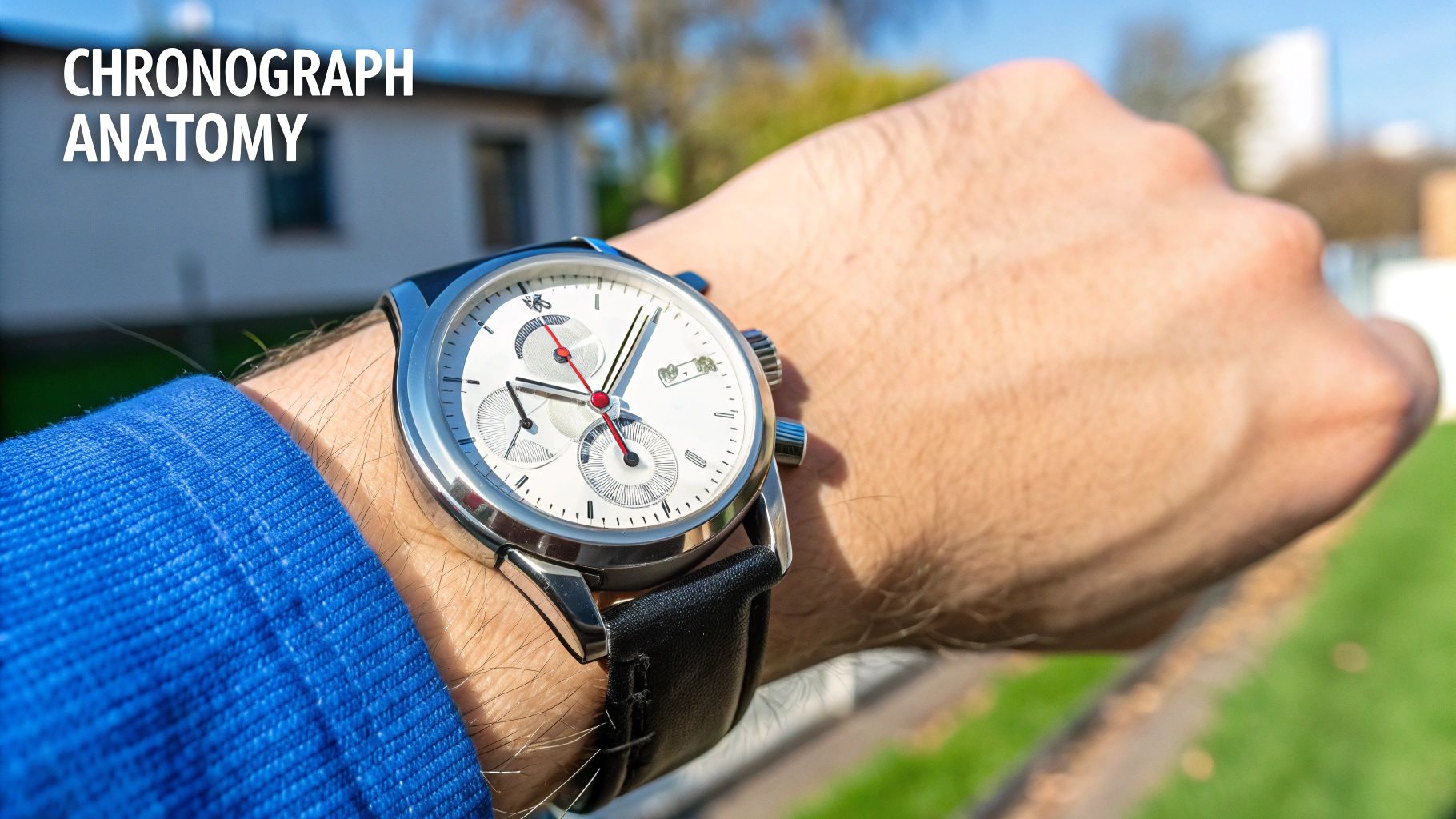
Before you start timing anything, the first step is to get familiar with your watch's layout. A chronograph isn't just a time-teller; it's a precision instrument with a job to do. When you look at iconic models like the Omega Speedmaster, you start to see past the "stopwatch on your wrist" idea and appreciate the functional design.
At first glance, the dial can seem busy, but every element has a purpose. The standard timekeeping—the hour, minute, and sometimes a small seconds hand—operates completely independently of the chronograph complication. This separation is fundamental to its mechanics. If you're curious about the intricate engines that power these timepieces, our guide on how a mechanical watch works is a great place to start.
The Pushers and Crown
The most hands-on parts of a chronograph are the two pushers that typically flank the main crown. The crown itself works just like on any other watch: you use it to set the time and date. The pushers, however, are your controls for the stopwatch function.
- Top Pusher (usually at 2 o’clock): This is your start/stop button. A single press gets the timer going, and a second press pauses it right where it is.
- Bottom Pusher (usually at 4 o’clock): This is the reset button. After you've stopped timing, a press of this button snaps all the chronograph hands back to their zero position.
This two-pusher system became the gold standard after Willy Breitling introduced the separate reset pusher back in 1934. Today, this intuitive layout is found in over 95% of modern chronographs.
Key Takeaway: Think of it this way: Top pusher is for "go" and "pause." Bottom pusher is for "reset." This simple two-button operation is the foundation for using almost every chronograph out there.
Hands and Subdials
The hands and subdials are where you'll actually read the elapsed time. This is a common point of confusion for new owners, but the layout is perfectly logical once you know what to look for.
That big, prominent central hand that looks like a seconds hand? On a chronograph, it's actually the chronograph seconds hand. It stays parked at 12 o'clock until you press the start pusher.
The actual running seconds for telling time are usually relegated to a small subdial, often called a "register." The other subdials are there to track the elapsed minutes and, on many models, the elapsed hours. This is what allows you to time events that last much longer than just 60 seconds.
Here's a quick cheat sheet to make sense of it all.
Chronograph Components at a Glance
This table breaks down the main parts of a typical chronograph, helping you quickly identify what does what.
| Component | Typical Location | Primary Function |
|---|---|---|
| Top Pusher | 2 o'clock position | Starts and stops the chronograph timer. |
| Bottom Pusher | 4 o'clock position | Resets the chronograph hands to zero. |
| Main Crown | 3 o'clock position | Sets the watch's time and date. |
| Central Sweep Hand | Center of the dial | Measures elapsed seconds for the stopwatch. |
| Minute Subdial | Often at 3 or 9 o'clock | Records elapsed minutes (usually up to 30). |
| Hour Subdial | Often at 6 or 9 o'clock | Records elapsed hours (often up to 12). |
| Seconds Subdial | Often at 6 or 9 o'clock | Displays the watch's running seconds. |
With these core components in mind, you're ready to start using the watch for what it was built for: precise timing.
How to Time an Event with Your Chronograph
Alright, you understand the hardware. Now it’s time to put that beautiful machine to work. The real joy of owning a chronograph isn’t just looking at it; it's the tactile experience of timing something that matters to you, whether it’s a perfect medium-rare steak, a crucial business presentation, or your personal best at the track.
The process is a simple, mechanical dance that quickly becomes muscle memory. It all comes down to a three-part action: start, stop, and reset. This sequence is universal across almost every chronograph, from a vintage classic to a modern beast.
Let’s run through a real-world scenario. Imagine you're making French press coffee and need to steep it for exactly four minutes. Your chronograph hands are all at zero, ready to go.
The Start, Stop, Reset Sequence
The entire operation is handled by those two pushers flanking the crown.
-
Start the Timer: The second you pour the hot water, give the top pusher (at 2 o’clock) a firm press. You'll feel a satisfying mechanical click, and the large central seconds hand will spring to life, beginning its sweep. Your timer is now running.
-
Stop the Timer: Once your four minutes are up, press that same top pusher again. The central seconds hand will instantly freeze in place, marking the exact elapsed time. The minute and hour subdials lock in their positions, too.
-
Reset to Zero: After you’ve noted the time, press the bottom pusher (at 4 o’clock). In a single, crisp motion, all the chronograph hands—the central seconds, the minute counter, and the hour counter—will snap back to their starting positions.
This simple process is the key to using your timepiece effectively. For a deeper dive into the mechanics and history behind this function, check out our guide that answers the question, "What is a chronograph watch?" It’s a fascinating look at how this complication evolved.
Reading the Elapsed Time
Once you’ve stopped the timer, figuring out the result is just simple addition. You read the central hand and the subdials together to get the total time.
Let's use a popular model like the Tudor Black Bay Chrono for a clear example.
Scenario: You've just timed a drive between two local spots. You hit start when you left and stop when you arrived. Here's what your watch dial now shows:
- The big central seconds hand is stopped at the 15-second mark.
- The minute subdial (which on this watch is a 45-minute register) shows the hand has moved past the 22-minute mark.
- The hour subdial is still at zero, since the trip took less than an hour.
To get your total time, you just combine the readings. You can confidently say the drive took exactly 22 minutes and 15 seconds. That’s all there is to it. Read the central seconds, add the minutes from the subdial, and then the hours. It's the same method every single time.
Decoding the Subdials and Registers
Those little dials inside the main dial are the heart and soul of a chronograph. Officially called registers or subdials, they are the memory bank for your timing session, tracking the elapsed minutes and hours as the main chrono hand sweeps around.
Getting a feel for them is the last big step in mastering your watch. Their layout is what gives each chronograph its unique character and is where you'll find the two most common configurations in the luxury watch world.
Two vs Three Register Layouts
The number and placement of the subdials pretty much define a chronograph's visual DNA.
- Bicompax (Two-Register): This is the classic, often beautifully symmetrical layout you'll see on vintage-inspired pieces. It has two subdials. One is typically for the running seconds (the regular timekeeping seconds hand), while the other counts the chronograph minutes, usually up to 30 or 45 minutes.
- Tricompax (Three-Register): This is the modern standard, the workhorse layout you'll find on icons like the Rolex Daytona or Omega Speedmaster. It adds an hour counter to the mix, letting you time events all the way up to 12 hours.
Here's a common point of confusion for new owners: one of those subdials is always for the watch's normal, ticking seconds. The others only come to life when you press the start pusher. Before you time anything, just look at the dial. The one that's already moving? That's your running seconds display.
This simple flowchart breaks down the three core actions—Start, Stop, and Reset—that you'll use to control the chronograph and read those subdials.
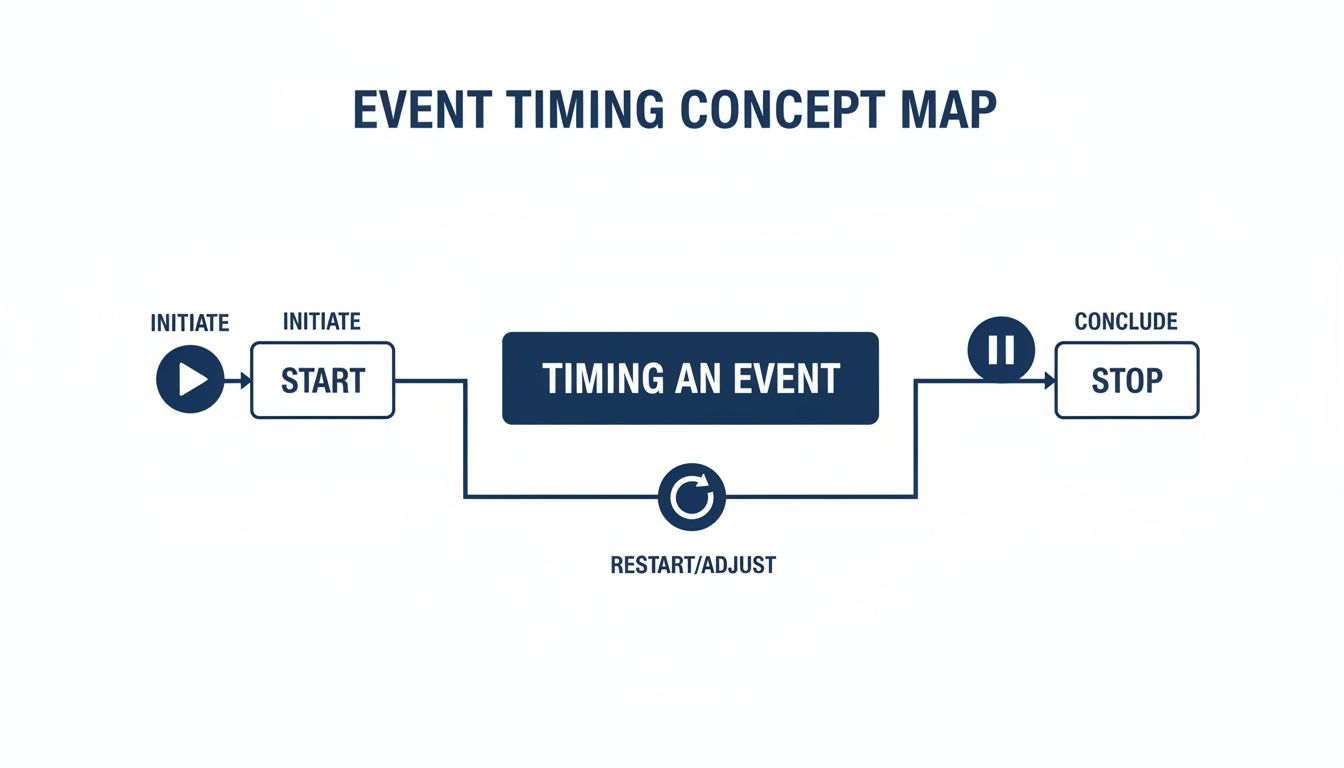
Think of it as the basic sequence of operations for any standard chronograph.
Putting It All Together
Whether you're dealing with a modern automatic or a vintage manual-wind piece, the process is the same. The pusher at 2 o'clock kicks the central seconds hand into gear, and the pusher at 4 o'clock brings everything back to zero.
The subdials tell you the rest of the story. On a typical Tricompax layout, you'll often see the 3 o'clock register counting up to 30 minutes, the 6 o'clock register tracking up to 12 hours, and the 9 o'clock register displaying the running seconds.
Expert Insight: Remember, the large central hand is for the stopwatch seconds, not telling time. The small subdial that is constantly moving is your actual seconds hand for the time of day. This is the most common mistake new owners make.
These layouts were truly cemented in watchmaking history after 1969, driven by the intense demands of aviation and motorsports. During the 1970s, chronographs were featured in around 35% of watches issued to the U.S. Air Force. That legacy is stronger than ever today, with market reports suggesting that nearly 75% of all luxury chronographs sold now feature automatic movements. It's a testament to the enduring appeal of these incredible complications.
Using Advanced Scales Like the Tachymeter
Once you’ve mastered the basic timing functions, you'll notice that many chronographs have another layer of utility printed right on the bezel or the outer edge of the dial. These scales turn your watch into a surprisingly powerful analog computer.
The most common scale you'll find is the tachymeter, which is all about calculating speed over a known distance. It’s a classic feature with deep roots in motorsports.
Here’s a real-world example: you're driving on a highway with mile markers. The moment you pass one, you start your chronograph. When you hit the next marker exactly one mile down the road, you stop it. The central seconds hand will now be pointing to a number on the tachymeter scale.
If it took you 45 seconds to cover that mile, the hand would point to 80 on the scale. That means your average speed was 80 miles per hour. No calculator needed—the watch does the math for you by converting elapsed seconds into units per hour.
How to Use the Telemeter and Pulsometer
Beyond the tachymeter, a few other fascinating scales pop up on vintage and specialty chronographs, each designed for a specific purpose.
-
Telemeter: This scale is designed to measure your distance from an event you can both see and hear. Think of a thunderstorm. You see the flash of lightning, and you start the chronograph. When you hear the boom of thunder, you stop it. The seconds hand will point to your distance from the storm on the telemeter scale, usually in kilometers or miles.
-
Pulsometer: Often found on vintage "doctor's watches," this scale makes taking a pulse incredibly fast. Most are calibrated to 15 or 30 pulsations. You find a pulse, start the timer, and count the required number of heartbeats. Stop the chronograph, and the central hand points directly to the patient's heart rate in beats per minute.
A Practical Tip: These scales are unit-agnostic. That tachymeter doesn't just work for miles per hour. If you're timing an item on a factory conveyor belt over a one-foot distance, the scale will tell you its speed in feet per hour. The key is always to time a single, known unit.
From Timekeeper to Tool
Learning to use these scales unlocks a whole new level of appreciation for your watch. It transforms from a simple stopwatch into a beautifully engineered instrument tied to the history of aviation, medicine, and, of course, racing.
The tachymeter, in particular, is what links iconic watches like the Rolex Daytona and Omega Speedmaster to their motorsport heritage. Drivers and their pit crews needed to calculate lap speeds instantly, and this was the tool that made it possible.
When you use these built-in calculators, you're not just timing something; you're interacting with the world in a more measured way. You’re tapping into the full potential of that complex machine on your wrist, deepening your connection to the history and purpose behind its design.
Going Deeper: Flyback and Rattrapante Complications
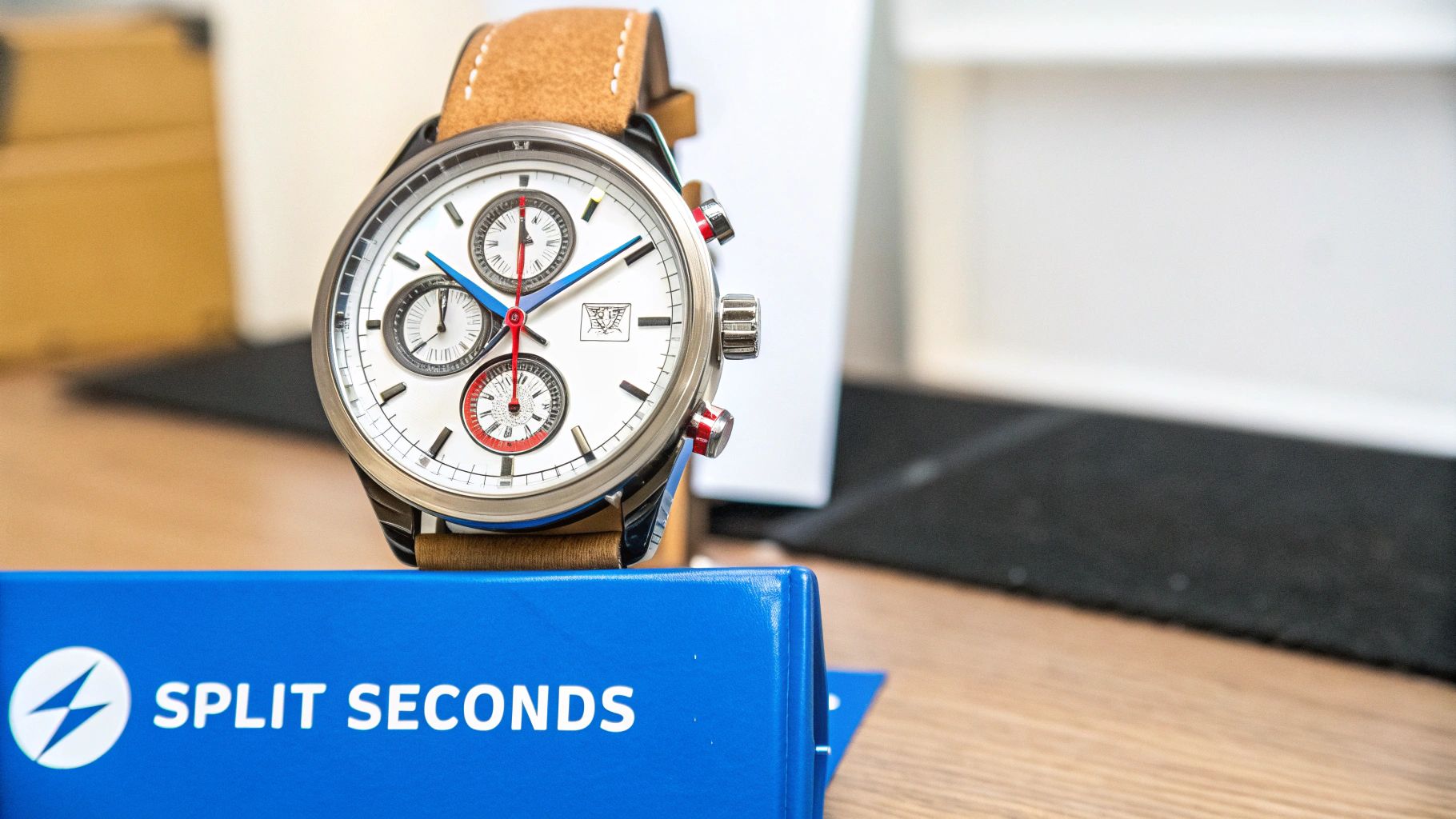
Just when you get comfortable with the basics, the world of high horology throws a few curveballs. Beyond the standard start-stop-reset function are some truly next-level complications that represent the absolute pinnacle of watchmaking. Two of the most respected are the flyback and the rattrapante.
These aren't just minor tweaks to the movement. They are profoundly more complex mechanisms built to handle very specific timing scenarios. While your everyday chronograph is a fantastic tool, these specialized versions offer capabilities that are non-negotiable in certain high-stakes environments.
The Efficient Flyback Chronograph
Picture a pilot timing flight legs. With a normal chronograph, they’d have to push the buttons three separate times to time a new leg: once to stop, once to reset, and a third time to start again. In aviation, that multi-step process wastes precious seconds.
The flyback complication cuts right through that problem with beautiful efficiency.
A flyback lets you reset the timer and restart it instantly with a single push of the reset pusher (usually at 4 o’clock) while the chronograph is still running. This function is a lifesaver for timing consecutive events with zero delay.
- Standard Chronograph: Requires three actions (stop, reset, start).
- Flyback Chronograph: Requires only one action (reset and restart simultaneously).
This immediate reset-and-restart feature is exactly why the flyback has a long and storied history with aviators, where every single second counts during navigation.
The Intricate Rattrapante Chronograph
If the flyback is all about efficiency, the rattrapante—also known as a split-seconds chronograph—is about timing multiple things that start together but end at different times. It’s one of the most mechanically demanding complications to create in all of watchmaking.
You can spot a rattrapante by its two central chronograph seconds hands, with one stacked perfectly over the other. It also has a third pusher, which you'll often find at 10 o’clock or sometimes built into the crown itself.
How It Works: When you start the chronograph, both seconds hands move in unison. To time the first event (like a lap), you press the third pusher. This freezes one hand in place while the other keeps running. Pressing it again makes the stopped hand instantly "catch up" (from the French rattraper) to the one still moving.
This lets you record a "split" time—like a runner's individual lap—without ever interrupting the total elapsed race time. Legends like Patek Philippe and A. Lange & Söhne are celebrated for their mastery of this incredible mechanism. Learning to read a watch with a rattrapante is to appreciate true horological art.
How to Properly Care for Your Chronograph Watch
A luxury chronograph is a finely tuned machine. Its complex movement isn't just for show—it's an intricate piece of engineering that demands respect and proper care to perform flawlessly for generations. Knowing how to maintain your investment is just as important as knowing how to use it.
The single most critical rule involves the pushers. Unless you own a specialized diver’s chronograph with screw-down pushers specifically designed for underwater action, never, ever operate the start, stop, or reset functions while submerged. It's a surprisingly common mistake, and water can easily seep past the gaskets and wreak havoc on the movement inside. Think of it as leaving a car window open in a rainstorm—a simple oversight with catastrophic results.
Servicing and Daily Wear
Regular servicing isn't just a suggestion; it's essential for a high-end mechanical chronograph. Most top watchmakers recommend a full service every five to seven years. A certified watchmaker will completely disassemble the movement, clean every tiny component, replace any worn parts, re-lubricate the entire mechanism, and test it for accuracy and water resistance. Skipping this crucial maintenance can lead to accelerated wear and much more expensive repairs down the road.
For daily care, a quick wipe with a microfiber cloth is usually all you need to keep the case and crystal looking sharp. If your chronograph is manually wound, getting the technique right is key. You can find detailed instructions in our guide on how to wind a mechanical watch to ensure you do it correctly without causing any damage.
Collector's Insight: If you're buying a pre-owned chronograph, always go through a trusted, authenticated dealer. A complete service history with original box and papers doesn't just guarantee authenticity—it significantly adds to the watch's long-term value and your peace of mind.
Ultimately, taking care of your chronograph ensures it remains a precise and reliable tool. By following these simple guidelines, you're not just protecting a timepiece; you're preserving a piece of mechanical art that you can enjoy for a lifetime and proudly pass on.
Your Top Chronograph Questions, Answered
Even after years of collecting, certain questions about chronographs pop up time and again. Getting the right answers isn't just about satisfying curiosity—it's about properly using and protecting the complex machine on your wrist. Here are a few of the most common queries we hear from both seasoned collectors and first-time buyers.
Is It Okay to Leave My Chronograph Running Constantly?
Technically, you can, but we’d strongly advise against it. Think of it like redlining your car's engine for hours on end—it puts unnecessary and continuous strain on the movement.
Running the chronograph non-stop accelerates wear and tear on very delicate, hard-working components. Over time, this can degrade the watch's overall timekeeping accuracy and lead to a need for premature, costly servicing.
Our advice is simple: Use the chronograph when you need to time something. When you're done, stop and reset it. This single habit is the best thing you can do to preserve the health and longevity of your watch.
What's the Difference Between a Chronograph and a Chronometer?
This is easily one of the most common points of confusion in the watch world. The terms sound alike, but they refer to completely different things. It’s a classic mix-up.
- A chronograph is a function. It’s a complication that adds a stopwatch capability to the watch.
- A chronometer is a certification. It’s a label given to a high-precision watch that has passed a series of grueling accuracy tests conducted by an official body, most famously the COSC (Contrôle Officiel Suisse des Chronomètres).
A watch can absolutely be both. A watch like a Rolex Daytona or an Omega Speedmaster is a chronograph (it has a stopwatch) that has also been certified as a chronometer (its movement is exceptionally accurate). This combination represents the pinnacle of performance.
Why Isn't the Big Second Hand on My Watch Moving?
If you're new to chronographs, this can be alarming, but don't worry—it's supposed to be that way. On virtually all chronographs, that large, prominent central hand isn't for telling the time. It's the chronograph sweep-seconds hand.
It stays parked at the 12 o'clock position until you start the timer with the top pusher. The watch's actual, constantly running seconds are shown on one of the small subdials. This design choice is intentional; it declutters the main dial and makes reading the elapsed time from the stopwatch clear and unambiguous.
At ECI Jewelers, we believe that understanding your timepiece is the first step to truly appreciating it. Whether you are looking for your first luxury chronograph or adding a rare reference to your collection, our experts are here to guide you. Explore our authenticated collection of the world's finest watches at https://www.ecijewelers.com.


