


Choosing between a cushion cut and a round diamond is one of the biggest decisions you'll make when creating the perfect engagement ring. At its core, the difference is simple: a round brilliant diamond is engineered for maximum, fiery sparkle, while a cushion cut diamond offers a softer, more romantic glow with tons of unique character. Your decision really comes down to whether you prefer that timeless, jaw-dropping brilliance or a more subtle, vintage-inspired charm.
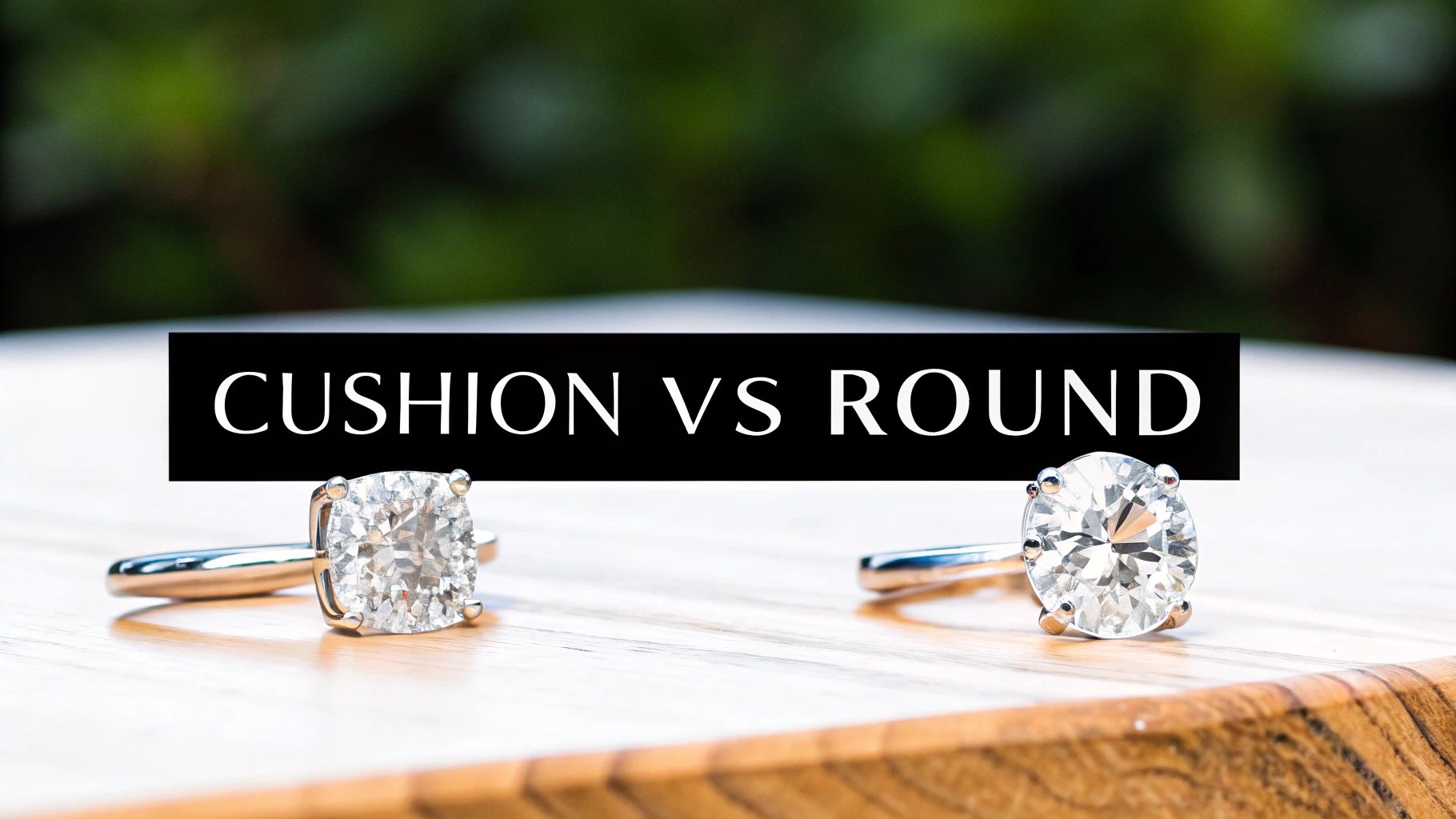
Comparing Cushion Cut vs. Round Diamond
Getting into the details between these two popular diamond shapes is one of the most exciting parts of the ring design process. Each cut has its own personality, a different way of playing with light, and a price point that appeals to different priorities. Understanding these foundational differences is the first step toward making a confident choice you'll love for a lifetime.
The round brilliant is the quintessential diamond. It represents the vast majority of all diamonds sold, and for good reason. Its 58 precisely angled facets are mathematically perfected to deliver an incredible combination of brilliance, fire, and scintillation. It's the classic, iconic choice for anyone who wants an undisputed symbol of elegance that will never go out of style.
The cushion cut, on the other hand, is a beautiful alternative with a rich history. As the third most popular shape, it’s a go-to for those seeking something a little different. In fact, approximately 9% of diamond buyers choose the cushion cut for its soft, pillowy outline and romantic feel. You can discover more insights about cushion cut popularity and see how it stacks up in the market.
A round diamond is like a perfectly tailored tuxedo—classic, sharp, and always in style. A cushion cut is more like a vintage couture gown—full of character, history, and a one-of-a-kind romantic feel.
To really get a feel for which one is right for you, it helps to see them compared side-by-side across the most critical attributes. This quick overview will set the stage for a much deeper dive into how each shape performs in the real world.
Quick Comparison: Cushion Cut vs. Round Diamond
Here’s a high-level summary of the key differences between cushion and round brilliant diamonds to help guide your initial decision.
| Attribute | Round Brilliant Diamond | Cushion Cut Diamond |
|---|---|---|
| Overall Shape | Perfectly circular with 58 facets | Square or rectangular with soft, rounded corners |
| Light Performance | Unmatched brilliance and intense, fiery sparkle | Softer, "crushed ice" brilliance with big flashes of colorful fire |
| Style & Vibe | Timeless, classic, and traditional | Romantic, vintage-inspired, and unique |
| Price Per Carat | The highest price per carat among all shapes | Typically 15-30% less expensive than a comparable round diamond |
| Perceived Size | Appears true-to-size or slightly larger due to its brilliance | Can appear slightly smaller for its carat weight due to a deeper cut |
| Durability | Very durable with no corners that can easily chip | Also very durable, thanks to its rounded, chip-resistant corners |
| Popularity | The #1 most popular diamond shape by a landslide | A stylish and increasingly popular "fancy shape" alternative |
This table gives you a snapshot, but the real magic is in the nuances. Now, let's explore these differences in more detail.
Understanding Diamond Sparkle: Brilliance, Fire, and Scintillation
When you put a cushion cut and a round diamond side-by-side, you're looking at two completely different philosophies of light performance. Both are designed to sparkle, of course, but how they handle light gives them their distinct personalities. The word "sparkle" itself is actually a catch-all for three separate visual effects that make a diamond come alive.
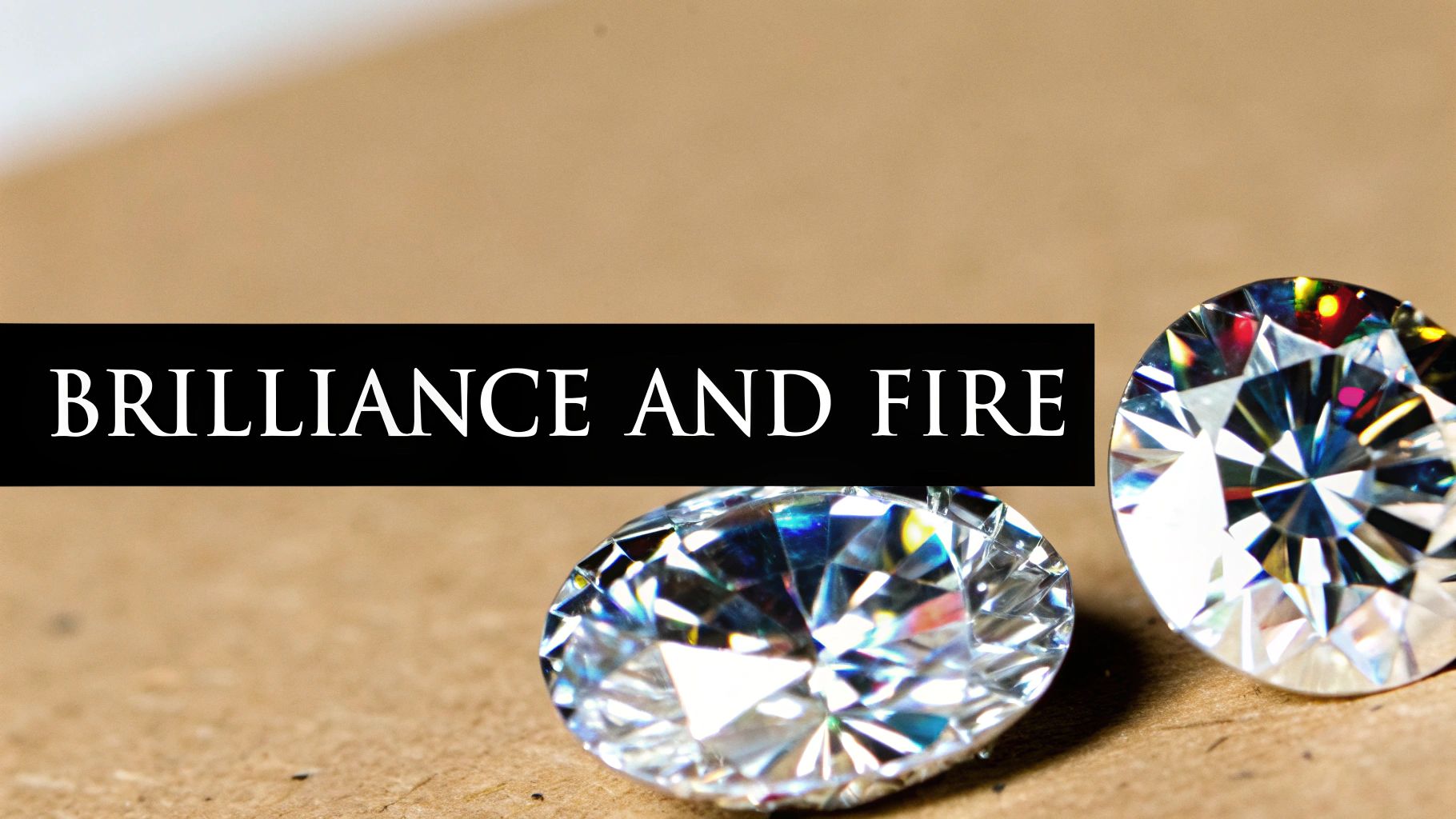
Getting a handle on these components is the real secret to understanding why one diamond looks blindingly bright while another shoots out flashes of rainbow color. It's the science behind the magic.
The Science of Light Performance
Think of a well-cut diamond as a tiny, complex system of mirrors. Every facet is angled with incredible precision to grab any available light, bounce it around inside the stone, and then shoot it straight back out to your eye as a dazzling display.
This light show is made up of three core elements:
- Brilliance: This is the intense, bright white light that reflects from the diamond’s surface and interior. It’s what gives a diamond that crisp, vibrant look.
- Fire: This refers to the beautiful dispersion of white light into a rainbow of spectral colors. Fire adds warmth and those colorful flashes that people love.
- Scintillation: This is the dynamic pattern of light and dark flashes that seem to dance across the diamond's surface as it moves. It creates a sense of life and movement.
All three work together to create what we call "sparkle." But the faceting patterns of round and cushion cuts prioritize these elements very differently.
Round Brilliant: The Gold Standard for Brilliance
The round brilliant diamond is a true marvel of optical engineering. Its 58 facets are arranged in a mathematically perfected pattern with one main goal: maximize brilliance. The angles and proportions are obsessively calculated to capture light and reflect it back as intense, powerful white flashes.
This cut is so standardized and effective that it's the only shape to receive an official cut grade from the Gemological Institute of America (GIA). An "Excellent" or "Ideal" cut round diamond will have a nearly perfect balance of all three light effects, but its defining trait is that undeniable, overwhelming brightness.
The round brilliant cut acts like a hall of mirrors, creating an intense, fiery return of white light that is simply unmatched by any other shape. It’s engineered for pure, powerful sparkle.
This is why round diamonds look so consistently bright and lively from every angle. Their faceting is less about creating broad, colorful flashes and more about producing a rapid, powerful flicker of white light. To see how these optical properties influence what you see, check out our complete guide on the diamond size chart and how it relates to brilliance.
Cushion Cut: A Softer, More Fiery Glow
In contrast, the cushion cut offers a more romantic, varied light performance. Its larger facets and deeper proportions tend to produce more fire, breaking light into broader, more distinct flashes of rainbow color. This gives it a softer, more "glowy" appearance compared to the sharp, splintery brilliance of a round.
What makes cushions so interesting is that there isn't just one type. You'll often hear jewelers use terms like "chunky" or "crushed ice" to describe the different faceting patterns.
- Chunky Cushion: This style has larger, more defined facets that you can easily see. It’s a nod to the antique Old Mine cut and is known for producing bold, colorful flashes of fire.
- Crushed Ice Cushion: This version has a higher number of smaller facets on the bottom of the stone. It creates a shimmering, glittery effect with thousands of tiny sparkles, much like looking into a glass of crushed ice.
This variety means that when you're evaluating a cushion cut vs. a round diamond, you're choosing a specific style of sparkle, not just a shape. A chunky cushion puts fire first, while a crushed ice cushion delivers a more chaotic, glitter-like scintillation. Neither is better than the other; they are simply different expressions of beauty, perfect for someone who values character and color over sheer brightness.
How Cut Quality and Proportions Affect Appearance
While sparkle is the goal, a diamond's cut quality—its specific proportions and angles—is the technical blueprint that makes the magic happen. For round and cushion diamonds, the approach to creating that brilliance is fundamentally different, and it directly impacts how they look and even how large they seem.
Getting this right is everything. The cut is easily the most important of the 4Cs. A poorly cut diamond will look dull and lifeless, no matter its color or clarity. An expertly cut stone, on the other hand, can appear brighter, larger, and more vibrant, truly unlocking its beauty.
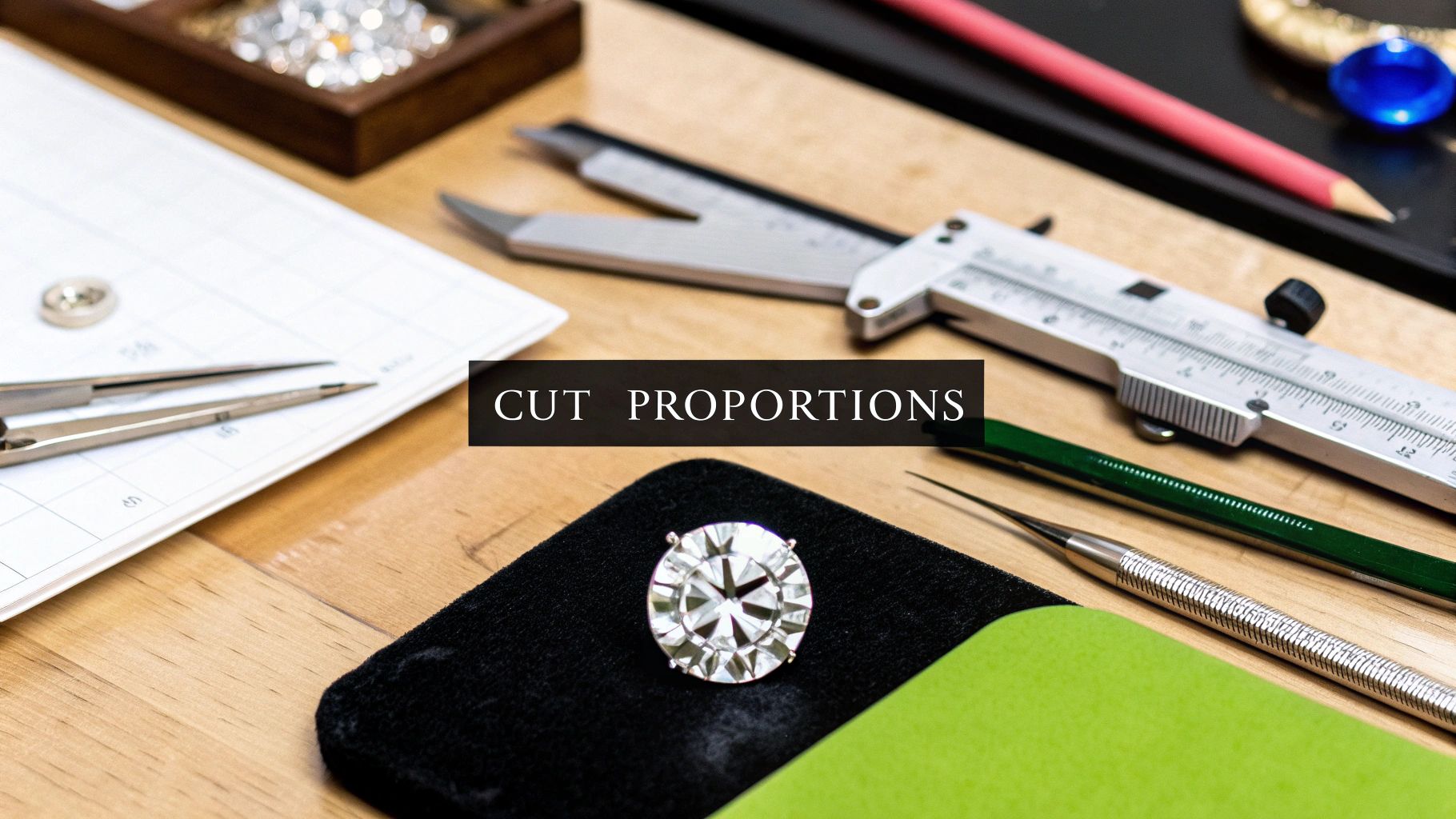
The Standardized Perfection of a Round Brilliant Cut
The round brilliant diamond is the gold standard for a reason: its proportions are mathematically perfected and universally graded. The Gemological Institute of America (GIA) provides a clear-cut grade for round diamonds, from Excellent down to Poor. This grade is a reliable shortcut for buyers because it boils down complex measurements into a single, trustworthy rating.
This standardization has cemented its place at the top. Round cuts are the undisputed market leader, accounting for roughly 50% of all diamonds sold in the US. Some data even shows they make up 82% of center stones in natural diamond jewelry. This isn't just a trend; it's a direct result of superior, engineered light performance.
To earn an "Excellent" cut grade from GIA, a round brilliant must hit strict benchmarks:
- Table Percentage: The top facet's width versus the diamond's total width. The sweet spot is 54-57%.
- Depth Percentage: The diamond's height compared to its width. You want to see 60-62.5% for maximum light return.
- Crown and Pavilion Angles: These critical angles work together like mirrors. If the pavilion angle is off, light leaks out the bottom, and the stone goes dim.
When you buy a GIA-certified round diamond with an Excellent cut grade, you’re essentially guaranteed a stone with top-tier brilliance. Our complete guide to buying engagement rings breaks down these technical details even further.
Navigating the Nuances of Cushion Cut Proportions
Here’s where things get tricky. Unlike the round brilliant, the cushion cut has no standardized GIA cut grade. Why? Because "cushion" is a broad category covering a huge variety of facet patterns, outlines, and proportions. This means evaluating a cushion requires a more hands-on, expert approach.
Without a GIA cut grade to rely on, your eyes become the most important tool when choosing a cushion diamond. Two cushions with similar specs on paper can have dramatically different visual appeal.
Since you can't just look for a single grade, you need to pay closer attention to the numbers to find a beautiful stone. Here are some expert guidelines to get you started:
Ideal Cushion Cut Proportions
| Parameter | Excellent | Very Good |
|---|---|---|
| Table % | 61-67% | 58-60% or 68-70% |
| Depth % | 61-67% | 58-60% or 69-70% |
| Girdle | Thin to Slightly Thick | Very Thin to Thick |
| Culet | None | Very Small |
These numbers are a great starting point, but the length-to-width ratio is just as crucial for getting the shape you want.
Length-to-Width Ratio and Perceived Size
The length-to-width (L/W) ratio defines the cushion's silhouette. A perfectly square cushion has a ratio of 1.00, while elongated or rectangular cushions have higher ratios.
- Square Cushions: Look for an L/W ratio between 1.00 and 1.05.
- Elongated Cushions: Ratios between 1.15 and 1.25 create a graceful, rectangular shape that many people love.
One final, critical point is how all this affects the diamond's "spread"—how big it looks face-up. Round diamonds are typically cut shallower, giving them an excellent spread that often looks true to their carat weight.
Cushion cuts, however, are often cut deeper to enhance their fiery flashes. This means more of their weight is hidden in the pavilion (the bottom of the stone), which can make them look slightly smaller than a round diamond of the very same carat weight. If maximizing visual size is a priority, pay close attention to a cushion's measurements, not just its carat weight.
Comparing Diamond Price and Market Value
When it comes to the cushion cut vs round diamond debate, price is often a deciding factor. The difference in cost isn't just a few dollars here and there; it’s a significant market reality shaped by demand, how the diamonds are cut, and the raw material itself. Getting a handle on these details is the key to making a smart purchase.
Round brilliant diamonds are, without question, the most expensive diamond shape per carat. This isn't an accident. It's the result of two powerful forces working together. First, the cutting process to create that perfect round sparkle is notoriously wasteful. Cutters often have to shave off more than 50% of the original rough diamond to hit the ideal proportions.
Second, the market demand for round diamonds is just massive. The global diamond market is a behemoth, valued at USD 101.03 billion in 2024, and American buyers—who make up over half of that demand—have always preferred the classic round brilliant. This has cemented its place as the industry's pricey gold standard. You can discover more about these market trends and see how they drive up the cost.
The Value Proposition of a Cushion Cut Diamond
This is where the cushion cut really shines as a fantastic alternative. Because its softer, squared shape is closer to the natural form of a rough diamond crystal, the cutting process is far more efficient, creating much less waste. That efficiency translates directly into savings for you.
A cushion cut diamond will typically cost 15-30% less than a round brilliant with the exact same carat weight, color, and clarity. This price gap opens up some amazing possibilities for maximizing your budget.
For the same budget, choosing a cushion cut over a round brilliant often means you can afford a larger stone, a higher clarity grade, or a better color. It's a strategic choice for maximizing value.
Let's put that into a real-world context. Say your budget is set for a one-carat, G-color, VS2-clarity diamond. If you choose a cushion cut instead of a round, the money you save could easily let you jump up to a 1.20-carat cushion or even upgrade the color to a premium D grade, all for the same price.
Practical Budget Allocation Scenarios
Seeing the numbers laid out makes the choice much clearer. The lower price-per-carat of a cushion diamond gives you the freedom to decide what matters most to you in a ring.
Here’s how you could use the savings from picking a cushion cut:
- Go Bigger on Carat Weight: This is what most people do. That 15-30% savings can be poured directly into getting a visibly larger diamond, giving you more impact on the finger without stretching your budget.
- Boost the Color or Clarity: If a pristine, flawless look is your priority, you can use that extra budget to climb the grading scale—maybe from a G color to a colorless E, or from a VS2 clarity to a VVS1.
- Invest in an Incredible Setting: The money saved on the main diamond can be put towards a more detailed and luxurious setting, like a band covered in pavé diamonds or a custom-designed halo that makes the whole ring pop.
At the end of the day, both shapes hold their value well, but they cater to different priorities. The round brilliant is a timeless, premium investment with incredible demand behind it. The cushion cut is the savvy buyer's secret for getting more size and beauty for their money, making it an unbeatable value proposition.
Matching Your Diamond to the Perfect Ring Setting
Once you've landed on the perfect diamond, whether it's a cushion or a round brilliant, the real fun begins: pairing it with the perfect setting. A ring setting is so much more than just the metal that holds the stone; it’s what gives the ring its soul, enhances its best features, and keeps your diamond safe for a lifetime.
While both cushion and round diamonds are incredibly versatile, certain styles just work better to highlight their unique personalities. The metal you choose also plays a huge part. Platinum and white gold provide a sleek, modern stage that makes a diamond look even brighter and whiter. On the other hand, yellow and rose gold lend a warm, romantic glow that can either create a stunning contrast with a colorless stone or beautifully complement the warmth of a near-colorless one.
Best Ring Settings for a Round Brilliant Diamond
The round brilliant is the undisputed champion of versatility. Its perfect symmetry and classic proportions mean it looks incredible in just about any setting you can dream up, making it a foolproof and breathtaking choice.
These are the styles that truly let a round diamond sing:
- Solitaire Setting: You can't go wrong with a timeless solitaire. A simple four or six-prong setting lifts the diamond up, letting light pour in from every angle for that explosive brilliance round cuts are famous for.
- Pavé Setting: If you're after non-stop sparkle, a pavé band adds a whole other layer of glitter. The tiny diamonds encrusting the band create a seamless river of light that complements the center stone without stealing its thunder.
- Bezel Setting: For a clean, modern aesthetic and maximum protection, the bezel setting is a fantastic option. A thin metal rim wraps around the diamond's edge, offering a sleek profile that’s perfect for anyone with an active lifestyle.
Best Ring Settings for a Cushion Cut Diamond
With its soft corners and romantic, pillowy shape, the cushion cut feels right at home in settings that play up its vintage charm and unique outline. It was born for more detailed, intricate designs.
The gentle, pillowy outline of a cushion cut diamond is perfectly suited for designs that feel both substantial and romantic. Its history as an antique cut makes it a perfect match for vintage-inspired and halo settings.
Take a look at these gorgeous options for a cushion cut:
- Halo Setting: This is hands-down the most popular pairing for a cushion cut, and for good reason. A "halo" of tiny pavé diamonds tracing the stone's perimeter makes the center diamond look significantly larger while framing its soft shape beautifully. It's a powerhouse look, and you can see plenty of examples in our guide explaining what a halo engagement ring is.
- Vintage-Inspired Settings: The cushion cut's old-world vibe is a perfect match for designs featuring milgrain edging, intricate filigree, or delicate hand-engraving. These styles honor its heritage and create a ring that feels like a treasured heirloom from day one.
- Three-Stone Setting: Placing a cushion cut center stage and flanking it with smaller side stones—like tapered baguettes or even smaller rounds—adds gorgeous dimension and symbolism. Many choose this style to represent a couple's past, present, and future.
At the end of the day, the best setting is the one that speaks to you. Whether you love the clean, classic lines that let a round brilliant do its thing or the romantic details that make a cushion cut feel special, the right combination will create a ring that’s 100% yours.
Making the Final Decision: Which Diamond Is Right for You?
When it comes down to it, the choice between a cushion cut and a round diamond is all about your personal style and what you prioritize in a stone. After comparing sparkle, price, and proportions, the final step is aligning your decision with the aesthetic you truly love. It's a classic battle: timeless tradition versus romantic character.
To make it simple, just ask yourself which of these two profiles sounds more like you.
Who Buys Which Diamond?
You Might Be a Round Diamond Person If... You're drawn to classic, iconic elegance that never goes out of style. Your absolute top priority is maximizing the diamond's brilliance—that sharp, fiery white sparkle that just commands attention. You also value the peace of mind that comes with a GIA-certified cut grade and are willing to invest a bit more for proven, top-tier light performance.
You Might Be a Cushion Cut Person If... You love unique, vintage-inspired beauty with a softer, more romantic glow. For you, it's about character and individuality, not standardized perfection. You adore the colorful flashes of fire that cushion cuts are famous for. Getting the most size for your budget is a key factor, and you enjoy the process of hunting for that perfect stone with a one-of-a-kind personality.
The round brilliant is for the traditionalist who wants unmatched sparkle and a timeless symbol. The cushion cut is for the individualist seeking romantic character, a softer glow, and fantastic value.
This decision tree can help you visualize how your style preferences might lead you to one or the other.
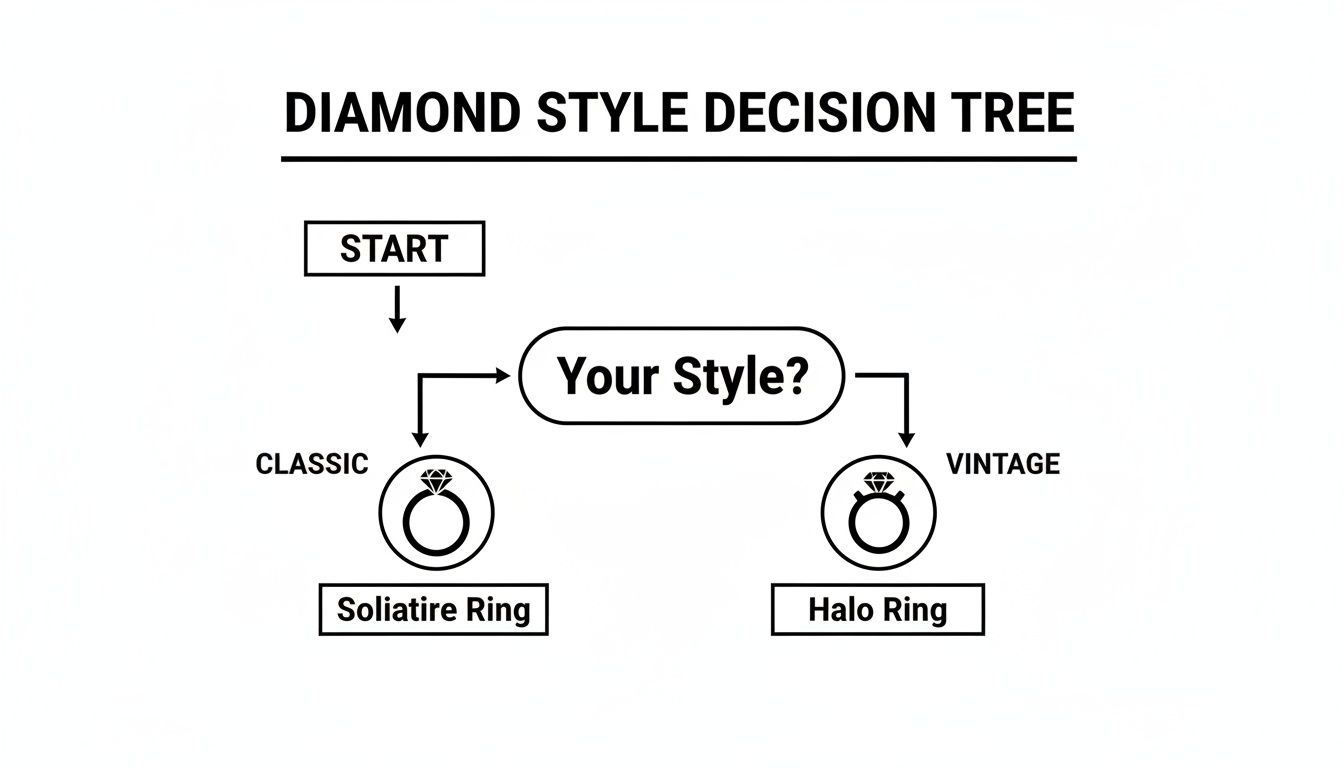
As the graphic shows, a preference for classic, clean styles often points toward a solitaire setting—a perfect match for a round diamond. On the other hand, a love for vintage detail aligns beautifully with halo settings, which make cushion cuts truly shine.
Ultimately, reading about diamonds only gets you so far. The most important step is to see them for yourself. At ECI Jewelers, we always encourage clients to view both shapes in person. It’s the only way to truly appreciate their distinct beauty and decide which one captures your heart.
Answers to Your Top Diamond Shape Questions
Choosing between a cushion cut vs round diamond always brings up a few key questions. Getting solid, practical answers is the final step before you can pull the trigger with total confidence. Let’s clear up the most common ones.
Do Cushion Cuts Look Smaller Than Round Diamonds?
This is probably the most common question we get, and the short answer is yes, a little. Even at the same carat weight, a round brilliant diamond often looks slightly bigger than a cushion. It's an optical illusion—the round cut's incredible brilliance tricks our eyes into seeing a larger surface area because of all that light return.
There's a technical reason, too. Cushion cuts are usually cut deeper to maximize their fiery, colorful flashes. This means more of the diamond's weight is hidden below the girdle, in the pavilion. A round cut, by contrast, is often shallower, spreading that same carat weight out for a wider face-up appearance. If you want to maximize perceived size, look at the millimeter dimensions on the GIA report, not just the carat weight.
Which Diamond Shape Is More Durable?
Both shapes are incredibly tough and more than suitable for daily wear. A diamond's hardness is part of its DNA, not a result of its shape. The real difference comes down to the edges. A round diamond has a perfectly smooth, continuous outline with no corners at all, making it the undisputed champion of chip resistance.
That said, a cushion cut is no slouch. Its rounded corners give it a huge durability advantage over shapes with sharp points, like a princess or marquise cut. While the round brilliant is technically the most resilient shape you can buy, a properly set cushion cut is still an extremely secure and practical choice for a ring you'll wear every day.
Why Don't Cushion Diamonds Have a GIA Cut Grade?
This is a big one. The Gemological Institute of America (GIA) only issues a full, official cut grade for round brilliant diamonds. Why? Because the round brilliant follows a very strict, standardized formula. Its facet pattern is so consistent that its light performance can be judged against a clear mathematical ideal.
Cushion cuts are a whole different ballgame. As a "fancy shape," there’s a huge amount of variation—they can be square or rectangular, have different facet patterns ("chunky" or "crushed ice"), and come in all sorts of proportions. There's simply no single standard for an "ideal" cushion.
Because there's so much variation in how a cushion cut can be faceted, a simple cut grade can't capture its unique beauty. This is why a visual inspection by a trained expert is absolutely essential when selecting a cushion diamond.
This is where working with a good jeweler becomes non-negotiable. Without a cut grade to lean on, the beauty of a cushion is in the eye of the beholder, and you’ll want an expert to help you assess its fire and brilliance in person.
At ECI Jewelers, our experts can guide you through the nuanced process of selecting the perfect diamond, whether it's a classic round brilliant or a unique cushion cut. Explore our collection of fine diamond jewelry and find the ring that tells your story.


