


When you start looking for diamond engagement rings new york city style, you're stepping into a world with history, incredible choice, and an energy you just can't find anywhere else. New York, and its famous Diamond District, is the heart of America's jewelry trade. That concentration of expertise, selection, and straight-up competition means you get access to options that are simply off the table in other cities.
Why New York City Is the Ultimate Destination for Your Diamond Ring
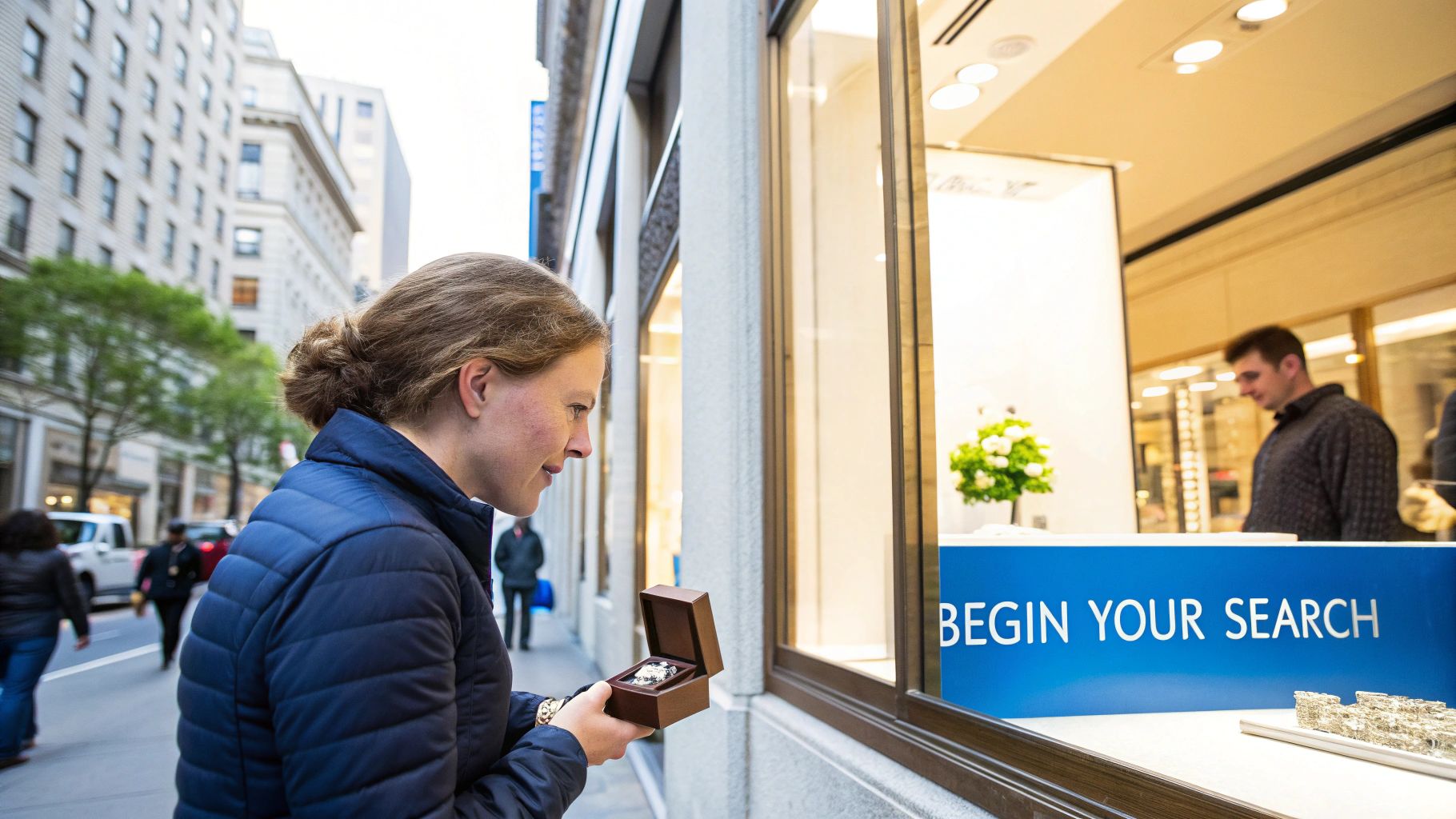
Starting the search for the perfect engagement ring can feel like a huge undertaking, but making NYC your starting point is the smartest first move you can make. Think of this guide as your personal roadmap, designed to turn a potentially stressful process into a genuinely exciting adventure.
We're here to cut through the noise—from setting a realistic budget to understanding the tiny details that make a diamond pop. Our goal is to give you an insider's view of the city's market so you can forget the pressure and focus on finding the ring.
A Hub of Unmatched Selection and Expertise
There's a reason New York's Diamond District on 47th Street is the stuff of legends. It's packed with thousands of independent jewelers, diamond cutters, and wholesalers, all crammed into a few city blocks. This creates a marketplace with an unbelievable depth of inventory.
You can find everything from a classic round brilliant to a rare antique cushion or a trendy oval, often right next door to each other.
- Vast Inventory: Direct access to a global supply chain means you'll see diamonds of every shape, size, and quality imaginable.
- Generations of Knowledge: So many of these businesses are family-owned, with skills and secrets passed down for generations.
- Competitive Environment: With so many sellers in one place, pricing stays sharp. It's just good for the buyer.
This unique ecosystem ensures that whether your budget is modest or unlimited, you're getting access to premier quality and craftsmanship. The city itself, with its focus on luxury and style, makes the whole experience feel that much more special.
More Than Just a Transaction
Buying a ring in New York City is an experience. You're walking the same streets where iconic designs were first imagined and working with artisans who are true masters of their craft. For those looking to complete the picture, the city is also a fantastic source for luxury wedding inspiration in New York.
This guide is designed to give you the confidence to navigate this world like a pro. You’ll learn how to spot a trustworthy jeweler, what questions to ask, and how to choose a ring that tells your unique story. You aren’t just shopping—you’re creating a memory that will last a lifetime.
Setting a Smart Budget for Your NYC Diamond Ring Purchase
Before you even think about the 4Cs or step into a showroom on 47th Street, the first move you need to make is setting your budget. And let's get one thing straight: forget the old, high-pressure "three-month salary" rule. That's a marketing gimmick from another era.
A smart budget is simply a number you're truly comfortable with—one that lets you celebrate this huge milestone without adding a shred of financial stress. This isn't about being cheap; it's about being strategic. Knowing your number ahead of time empowers you to shop confidently and focus on getting the absolute best ring for what you want to spend.
Ditching Old Myths for Modern Realities
The way people buy engagement rings has changed. Today, it’s all about transparency and what works for your life, not some arbitrary formula. Your budget should reflect your personal financial picture—your savings, income, and other goals you're working toward.
The great thing about shopping in New York is the sheer variety. Whether you’re looking to spend a few thousand dollars or something more significant, there’s an incredible ring waiting for you. The key is to be upfront with your jeweler. A good one will respect your budget and work with you to find the perfect piece within your range.
We're also seeing a massive shift in the market that's giving buyers more power than ever. The average spend on an engagement ring in the US was around $5,200 in 2024, and a huge reason for that is the rise of lab-grown diamonds. They now make up over half of all center stones sold, giving buyers access to bigger, better stones for their money. You can see more on these trends in these diamond industry trade statistics.
How to Maximize Value Within Your Budget
Once you’ve landed on a number, the fun begins. Now you get to figure out how to stretch that budget to get the most impressive ring possible. It all comes down to understanding the trade-offs.
- Natural vs. Lab-Grown Diamonds: This is the biggest game-changer. A lab-grown diamond is physically and chemically identical to a mined one but costs a whole lot less. That difference means you can get a much larger or higher-quality diamond without increasing your spend.
- Carat Size vs. Cut Quality: Don’t get seduced by a big carat number if the cut is poor. A masterfully cut diamond will outshine a larger, clumsier one every single time. A great cut makes a diamond look bigger, brighter, and more alive.
- Color and Clarity: You don't need a perfectly colorless and flawless diamond for it to look stunning. The sweet spot for value is in the near-colorless range (G-J grades) and with an "eye-clean" clarity (like VS2 or SI1). Any inclusions at this level are impossible to see without a jeweler's loupe.
The goal is to put your money into what you can actually see. A brilliant cut and a clean appearance to the naked eye will always have more impact than a flawless clarity grade that only shows up under magnification.
Making these smart choices is how you make your budget work harder for you. For a more detailed breakdown, check out our guide on how much you should really spend on an engagement ring. An experienced NYC jeweler will walk you through these options, ensuring every dollar is invested in what matters most: a ring that will take her breath away.
Making Sense of the Diamond 4Cs for Maximum Sparkle
To get the absolute best diamond for your money in New York City, you need to understand the 4Cs: Cut, Color, Clarity, and Carat. Think of this less like a science lesson and more like a secret weapon. It’s all about knowing where to invest your budget to get a stone that explodes with light.
Each "C" plays a part in a diamond's final look and price, but they aren't all equally important. Far from it. One of them is the undisputed king of sparkle, and it's the one place you should never compromise.
Cut: The Uncompromising C
If you take away just one piece of advice, let it be this: Cut is the most important factor. This has zero to do with the diamond's shape (like round or oval) and everything to do with how well its tiny facets handle light. A beautifully cut diamond is a masterpiece of optics, acting like a hall of mirrors that pulls in light and shoots it back out as fire and brilliance.
A poorly cut diamond, on the other hand, will look dull and glassy, leaking light out of the bottom instead of reflecting it back to your eye. It doesn't matter if it's a perfectly colorless and flawless stone—a bad cut will make it look lifeless. On the flip side, an excellent cut can make a diamond with a slightly lower color grade look brighter and even hide small imperfections.
Your budget should always prioritize the cut. An "Excellent" or "Ideal" cut grade from a reputable lab like the GIA isn't just a suggestion; it's a non-negotiable investment in your diamond's beauty. This is what creates the sparkle.
How the 4Cs Influence Your Diamond's Price and Brilliance
To make the best decision, it helps to see how each "C" works together. This table breaks down what each one measures and where you can find the most value.
| The 'C' | What It Measures | Impact on Appearance | Value Tip |
|---|---|---|---|
| Cut | The quality of a diamond's angles and facets. | The #1 factor for sparkle. An excellent cut maximizes brilliance, fire, and scintillation. | Never compromise here. An "Excellent" cut grade is the best investment you can make. |
| Color | The absence of color, graded from D to Z. | Determines how icy-white or warm the diamond appears. Subtle differences are hard to see. | Go for a "near-colorless" G-J grade. It looks white to the naked eye and saves you money. |
| Clarity | The presence of internal and external flaws. | Measures how "clean" a diamond is. Most flaws are microscopic and invisible to the eye. | Look for "eye-clean" VS1-SI1 grades. You get a visually perfect stone without the high cost. |
| Carat | The weight of the diamond, not its dimensions. | Relates to the diamond's size, but the cut determines how large it actually appears. | Buy just shy of popular weights (e.g., 0.90 instead of 1.0 carat) to save significantly. |
As you can see, a smart strategy involves prioritizing cut above all else, then finding the sweet spot in color and clarity that looks perfect to the naked eye.
Color: Finding Value in Near-Colorless Diamonds
Diamond color is graded on a scale from D (colorless) to Z (light yellow or brown). But here's the secret: the difference between one grade and the next is almost impossible to see without a gemologist's tools. This is where you can be smart with your money.
Sure, a D-color diamond is the best of the best, but you pay a massive premium for that label. Diamonds in the G to J range are "near-colorless" and offer the perfect blend of beauty and value. Set in a ring, a G or H color diamond will look just as icy white as a D to anyone who isn't looking at it through a loupe.
- For white gold or platinum settings: G, H, or I color grades will look bright and white without the top-tier price tag.
- For yellow or rose gold settings: You can easily go down to a J or even K color. The warm hue of the metal actually makes the diamond appear whiter in contrast.
This graphic breaks down how modern, savvy buyers approach budgeting versus relying on outdated myths.
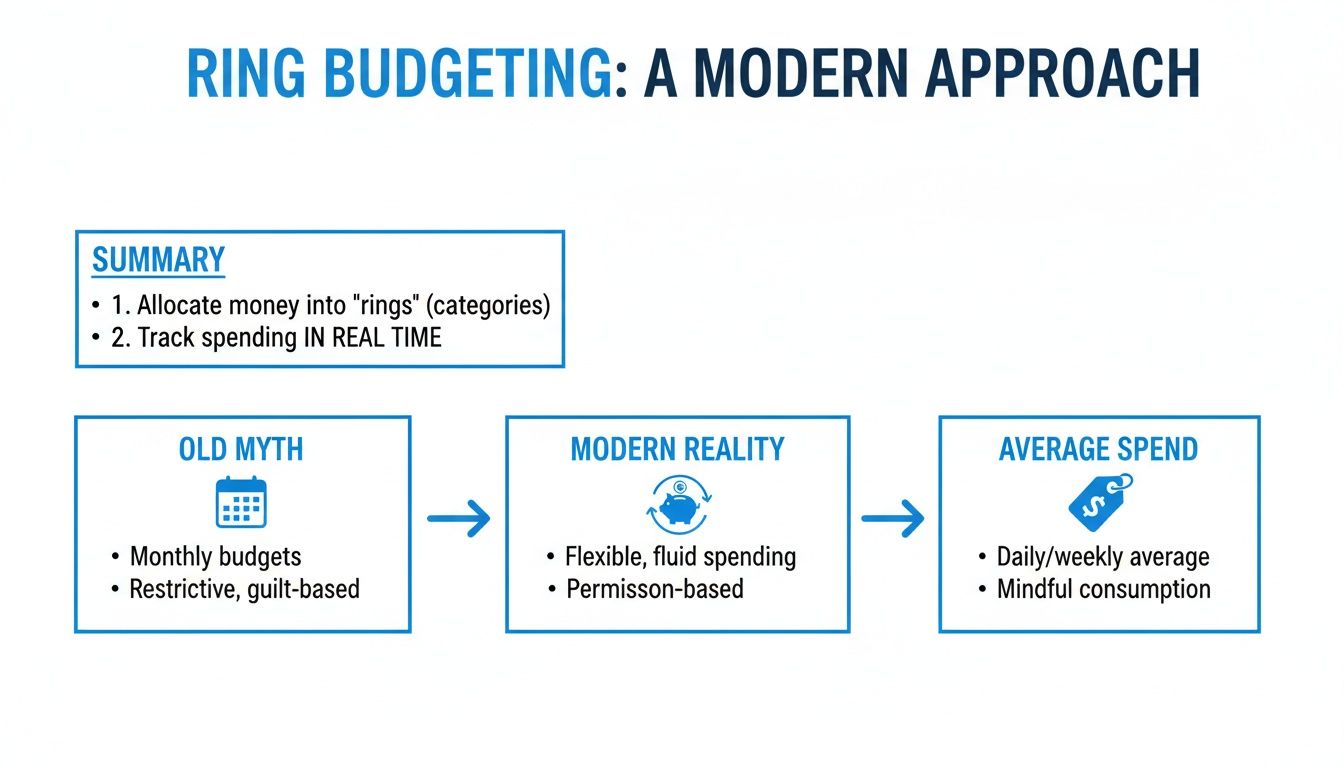
The takeaway is simple: focus on real-world value and what you can actually see, not just what's on a certificate.
Clarity: The Art of Being "Eye-Clean"
Clarity grades tell you about a diamond's tiny natural imperfections—internal ones are called inclusions, and external ones are blemishes. The GIA scale runs from Flawless (FL) down to Included (I3). Just like with color, paying for the top grades means you're paying for a level of perfection that is completely invisible to the naked eye.
Your goal should be to find an "eye-clean" diamond. That means no inclusions are visible when you look at the stone from a normal distance. For most diamonds, grades like VS1, VS2, and even SI1 are the sweet spot. They look identical to flawless stones but cost a whole lot less.
Some shapes are also better at hiding inclusions. Brilliant cuts like the round, oval, and cushion have tons of facets that break up light and camouflage small spots. Step cuts like the emerald or Asscher have a large, open "table" that acts like a window, so clarity is more important. To learn more, check out our in-depth diamond clarity and color guide.
Carat: Size Does Not Equal Sparkle
Finally, we have carat. This is a measure of a diamond's weight, not its size. It's often the first thing people ask about, but ironically, it's the least important factor when it comes to a diamond's beauty.
Two diamonds of the exact same carat weight can look completely different in size based on their cut. A well-cut diamond with a wider surface area will appear much larger than a deep, poorly cut diamond of the same weight. This is yet another reason to prioritize cut—it maximizes both sparkle and visual size.
Instead of getting fixated on a magic number like 1.0 carat, look at stones just below it, such as 0.90 carats. This simple trick can save you as much as 20% without any noticeable difference in size once the ring is on a finger.
Choosing a Ring Style and Metal That Lasts a Lifetime
The diamond might get all the glory, but it's the setting—the metal framework holding it—that gives a ring its soul. A great setting doesn't just hold the diamond; it showcases it, complements your partner's hand, and says something about their personal style. From a timeless solitaire to a glittering halo, the workshops of NYC have perfected every design you can imagine.
But choosing a style is about more than just looks. It has to fit their life. An active person might need something different than someone who works at a desk. This is where a seasoned jeweler becomes your best friend, helping you navigate the subtle but critical differences between each option.
Popular Engagement Ring Styles in NYC
New York is a fashion capital for a reason, and that extends to engagement rings. You'll see everything from enduring classics to the latest trends. Getting familiar with the most popular styles is the best place to start.
- Solitaire: The icon. A single, spectacular diamond held up by prongs to catch as much light as possible. It’s pure elegance and keeps all the attention right where it belongs—on that brilliant center stone.
- Halo: For anyone who wants maximum sparkle. A circle of smaller diamonds frames the main stone, making it look bigger and adding an incredible layer of fire. It’s a glamorous, high-impact style.
- Three-Stone: This one is full of meaning, representing a couple's past, present, and future. Two side stones flank the main diamond for a balanced and seriously impressive look.
- Bezel Setting: A sleek, modern, and ultra-secure choice. A thin metal rim wraps around the diamond's edge, either fully or partially. It’s a low-profile design that's perfect for an active lifestyle because it protects the stone from snags and bumps.
- Vintage-Inspired: These rings are all about intricate details. Think milgrain (tiny metal beads), filigree (delicate wirework), and unique shapes that call back to the romance of eras like Art Deco or the Victorian period.
While classic designs are still king, we're seeing some interesting shifts. In the US, 35% of buyers stick with traditional prong settings. But the hidden halo—a subtle ring of diamonds just below the main stone—has jumped to 18% popularity, even overtaking the traditional halo, which sits at 13%. It's that mix of classic feel with a modern secret that people are loving right now. You can discover more insights about these diamond industry trends.
Selecting the Perfect Precious Metal
The metal you pick does more than just hold the diamond. It sets the ring's entire mood and dictates its durability and how much care it'll need down the road. Each metal has its own personality, so think about what works best with the diamond and your partner’s skin tone.
Your choice of metal is the canvas for your diamond. Platinum’s cool luster makes a diamond appear brighter, while yellow gold’s warmth offers a classic, romantic contrast. The right metal elevates the entire design.
Let's break down the top choices for engagement rings here in New York.
Platinum
This is the top-tier choice for a reason. Platinum is a naturally white metal, so its color will never fade or change. It’s also incredibly dense and strong, making it the most secure option for holding a diamond safely in place.
- Pros: Hypoallergenic, extremely durable, and makes diamonds look even brighter and whiter.
- Cons: It's the most expensive option. Over time, it can develop a soft, matte look called a patina—some people love this distinguished finish, while others prefer to have it polished back to a high shine.
Gold (Yellow, White, and Rose)
Gold is the classic choice for jewelry, and its versatility is unmatched. It’s measured in karats (k), with 14k and 18k being the sweet spots for engagement rings, offering a great balance of purity and strength.
- Yellow Gold: Warm, traditional, and gorgeous on warmer skin tones. It creates a beautiful contrast that can make diamonds in the near-colorless range appear even whiter.
- White Gold: Gives you that bright, platinum look but at a more accessible price. It's an alloy of gold mixed with white metals, then plated with rhodium for a brilliant, mirror-like finish. Just know that this plating will need to be redone every few years to keep it looking its best.
- Rose Gold: A romantic, modern favorite. It gets its warm, pinkish hue from adding copper to the gold alloy. It's surprisingly durable and looks fantastic on virtually every skin tone.
By taking the time to consider both the setting and the metal, you’re not just buying a piece of jewelry—you're creating a ring that truly reflects your love and will last a lifetime.
How to Navigate the New York City Diamond District
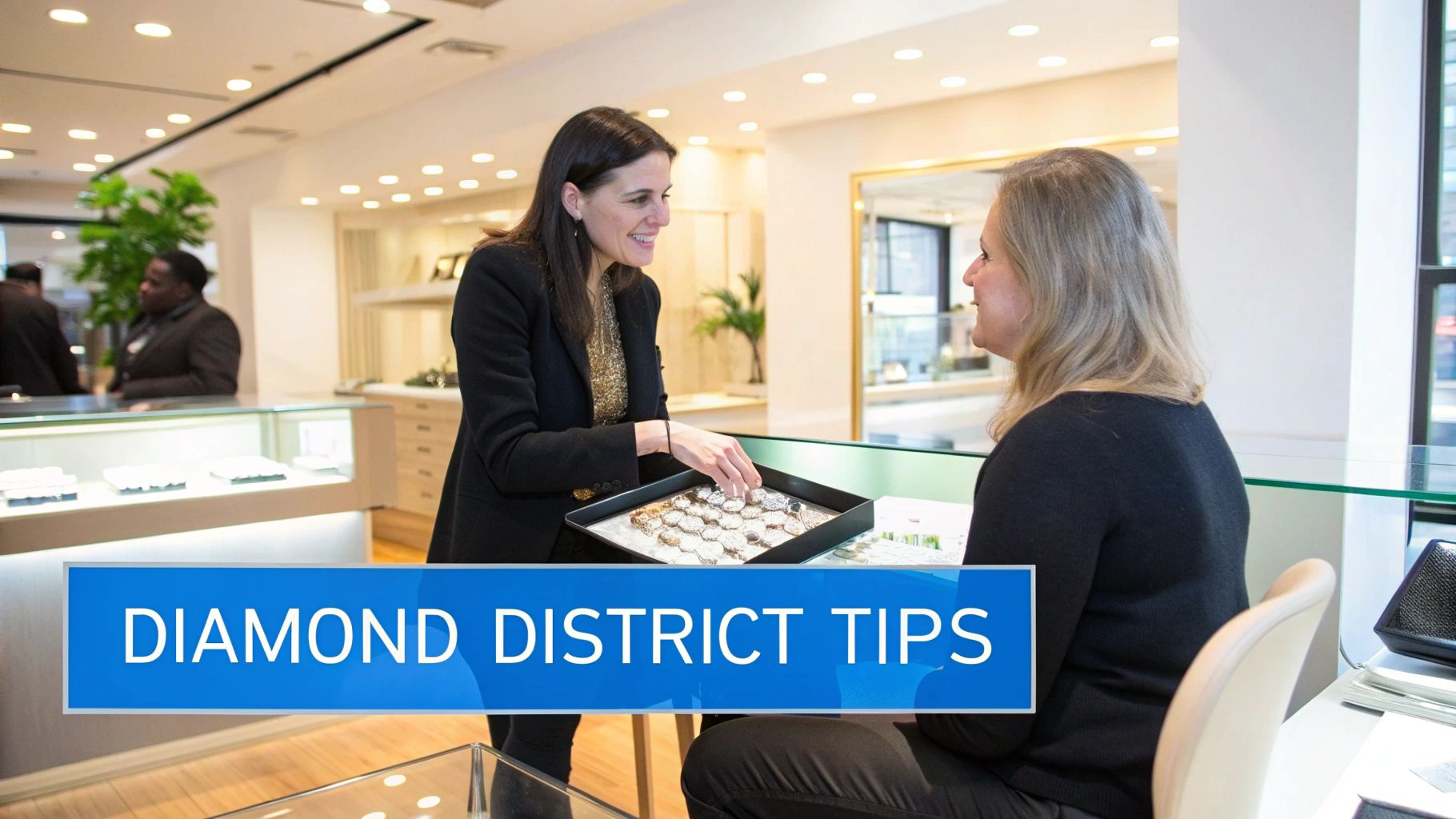
Shopping for a diamond on 47th Street is a classic New York experience, but it can feel like stepping into another world. The energy is intense, with countless vendors and barkers trying to grab your attention. It's easy to get overwhelmed. This is your insider's guide to navigating the district like a pro, not a first-time tourist.
The single most important strategy? Sidestep the chaos of the main exchange floors. Those open-concept booths often thrive on high-pressure tactics and creating a false sense of urgency to close a sale on the spot. Instead, smart shoppers do their homework and schedule a private appointment with a reputable jeweler in a dedicated showroom.
This one move completely changes the game. An appointment turns a potentially stressful hunt into a personalized, educational consultation. You get the undivided attention of an expert who is focused on you, answers your questions without distraction, and guides you through their collection at your own pace.
Setting the Right Tone From the Start
Once you're in the right environment, your approach makes all the difference. You don't need to be a diamond expert, but coming in with some baseline knowledge shows you're a serious buyer and helps establish a productive conversation.
Here's how to get started on the right foot:
- Discuss Your Budget: Be upfront but firm about your spending limit. A trustworthy jeweler will respect your budget and work to find the best possible options within it, not push you beyond it.
- Talk About Style: Mention the ring styles and diamond shapes you’ve been looking at. Using terms like "solitaire," "halo," or "vintage-inspired" gives them a clear direction.
- Specify Certification: This is non-negotiable. Immediately ask to see diamonds with grading reports from top-tier labs. For natural diamonds, insist on the Gemological Institute of America (GIA). For lab-grown stones, the International Gemological Institute (IGI) is the standard.
"A GIA or IGI certificate is your non-negotiable proof of quality. It’s an unbiased, third-party verification of your diamond’s characteristics, ensuring you get exactly what you pay for. Never consider a diamond without one."
Focusing on certification is your best defense against misrepresented quality. It removes the guesswork and levels the playing field, letting you compare diamonds based on verified data, not just a salesperson’s pitch. It's a critical step when buying diamond engagement rings in New York City.
Knowing What to Look for and What to Avoid
In the Diamond District, where over 90% of diamonds entering the US pass through, you can see market trends up close. Lately, the demand for larger diamonds has been surging. The average size of loose diamonds sold jumped from 1.30 carats in 2023 to 1.39 carats in 2024. And now, 2-carat diamonds make up a full 10% of all sales. You can read the full research about US jewelry market trends to see the data for yourself. This shift really underscores the importance of verifying the quality of these bigger, more significant investments.
When you're examining a stone, ask the jeweler to show it under different lighting—not just the hyper-flattering spotlights designed to maximize sparkle. Look at it against a plain white background. This is also your chance to verify its authenticity. Ask to see the laser inscription on the diamond's girdle; that number must match the number on its GIA or IGI report.
Stay alert for red flags. If you feel high-pressure tactics, if a jeweler is reluctant to show you a certificate, or if you get vague answers about a diamond's origin, it's time to walk away. The experience should feel transparent and collaborative, not like a back-alley negotiation.
While some dealers build haggling into their prices, a reputable jeweler like ECI Jewelers prices their pieces fairly from the start, focusing on value and service. This approach gives you a fair, transparent price without all the stress. Your goal isn't just to find a vendor for one transaction—it's to find a trusted partner for this major life milestone.
Finding a Jeweler You Can Trust in New York City
In a city with a jeweler on every corner, the most important choice you'll make has nothing to do with a diamond. It’s about the jeweler you choose to work with. Finding a trusted expert turns what can be an overwhelming process into a confident, memorable experience.
This is about much more than just finding a ring. It’s about partnering with an expert who listens, educates, and puts your best interests ahead of a quick sale. That's where a long-standing reputation for transparency and trust really makes a difference.
The Value of a Pressure-Free Showroom
The right environment changes everything. Imagine stepping into a private, modern showroom where you can explore options at your own pace, far from the chaotic, high-pressure sales floors common in the district. It’s a space designed for clarity and thoughtful decisions, not impulse buys.
At ECI Jewelers, this concierge-level service is our standard. We believe the buying process should be as special as the proposal itself. You’ll get dedicated one-on-one time with an expert who can answer every single question, show you diamonds side-by-side, and help you see the subtle differences that make each one unique.
A great jeweler doesn't just sell you a ring—they empower you with knowledge. The goal is for you to leave feeling absolutely certain you made the perfect choice for your style and budget.
This personalized approach is crucial when you're searching for diamond engagement rings in New York City. It’s how we ensure you feel heard, respected, and confident from start to finish.
More Than a Purchase—It's a Partnership
Finding the perfect ring is just the beginning. A real relationship with your jeweler pays dividends for years to come, from professional cleanings and servicing to future upgrades. This isn’t a one-time transaction; it's a lifelong connection built on trust.
We offer a full suite of services designed to support you long after you leave our showroom:
- 100% Authenticity Guarantee: Every single piece we sell is rigorously inspected and backed by our unwavering guarantee. You get complete peace of mind.
- Custom Design Services: Have a specific vision in mind? Our expert designers can bring it to life, creating a one-of-a-kind ring that tells your story perfectly. You can learn more about our process for creating custom engagement rings in NYC right here on our blog.
- Fair Trade-In Valuations: As your life and style evolve, your jewelry can too. We provide honest, market-based valuations for future trades and upgrades.
- Flexible Financing: We offer practical financing options to help make your dream ring a reality without the financial strain.
When you choose ECI Jewelers, you're not just another customer—you become a client for life.
Questions People Always Ask When Buying an Engagement Ring in NYC
To wrap things up, let's get into some of the most common questions people have when they're shopping for a diamond ring in New York. Getting solid answers here is what helps you make that final decision with total confidence.
One of the biggest conversations we have with clients is about natural versus lab-grown diamonds. Honestly, this is a completely personal choice, and there’s no wrong answer. Natural diamonds have that timeless magic because of their rarity and incredible history, while lab-grown diamonds—which are identical in every chemical way—give you a lot more size for your money. The great thing about the NYC market is that you can find absolutely stunning examples of both.
What's the Most Important Diamond Certification?
You should always, always get a grading report from a top-tier gemological lab. For natural diamonds, the Gemological Institute of America (GIA) is the gold standard. There's really no substitute; their standards are known for being the strictest and most consistent in the world.
When it comes to lab-grown diamonds, a report from the International Gemological Institute (IGI) is highly reputable and what you'll see most often. Think of an authentic certificate from one of these labs as your non-negotiable guarantee. It’s an unbiased, expert assessment of exactly what you're buying.
Is It Okay to Negotiate on the Price?
You'll definitely see some haggling going on in the smaller booths in the Diamond District, but that's not how reputable, modern jewelers operate. A good jeweler focuses on transparent, fair value right from the start. A stressful negotiation just isn't the right vibe for such a happy, momentous occasion.
Instead of playing pricing games, a trusted expert will offer competitive prices based on certified quality, authenticity, and the service they provide. It's a much more reassuring way to know you're getting an exceptional ring at a fair price, without any of the pressure.
Once you've made such a significant purchase, it's a smart move to think about how you'll protect it. This includes getting familiar with how to handle homeowners insurance claims, as high-value jewelry is often covered under these policies.
At the end of the day, the best experience comes from partnering with an expert who cares more about educating you and earning your trust than just making a quick sale. That's what makes the journey as special as the ring itself.
Your search for the perfect ring ends here. At ECI Jewelers, we combine generations of expertise with a pressure-free showroom experience to help you find a piece you'll cherish forever. Explore our collection online or schedule your private appointment today. https://www.ecijewelers.com


