


An engagement ring is given at the proposal and usually has a prominent center stone. A wedding band is exchanged at the ceremony and is usually a simpler metal or diamond-set ring worn closest to the heart. Most couples wear both, and the smartest way to choose is to plan them as one set, so the band sits well next to the engagement ring and both fit one budget.
Below we explain how the two rings differ, how metal and setting affect the pairing, how to fit and stack them, and how to split your budget. We also show a few pieces from our current inventory and answer the most common questions.
In this article
- What is the difference between an engagement ring and a wedding band?
- How do design and metal choices differ?
- How should the rings fit and stack together?
- How do couples budget for the whole bridal set?
- How do you choose a matching set?
- How can you pay for it?
- Frequently asked questions
What is the difference between an engagement ring and a wedding band?
An engagement ring marks the promise to marry. It is presented at the proposal and usually draws attention to a center diamond or gemstone, often in a solitaire, halo or three-stone setting. A wedding band, also called a wedding ring, is exchanged during the ceremony and stands for the marriage itself. Its design is usually quieter: plain metal, small accent diamonds or a continuous row of diamonds.
The two rings have separate histories. Ring exchange became part of the Christian marriage ceremony in the Middle Ages, and the first well-known diamond engagement ring dates to 1477, when Archduke Maximilian of Austria proposed to Mary of Burgundy. Diamond engagement rings only became widespread in the 20th century, according to Britannica's history of wedding rings.
| Feature | Engagement ring | Wedding band |
|---|---|---|
| When it's given | At the proposal | During the wedding ceremony |
| What it stands for | The promise to marry | The marriage itself |
| Typical design | Center stone in a raised setting | Plain metal or a low row of diamonds |
| Who wears it | Usually the person proposed to | Often both partners |
| Main wear concern | Keeping the center stone secure | Scratches, shape and daily comfort |
| Share of budget | Usually the larger share | Usually the smaller share |
You don't have to buy both. Some people prefer one substantial band, while others want the traditional pair. A bridal set pairs the two rings by design, while buying them separately gives you more control over timing, fit and spending. Our guide to buying engagement rings covers the center stone and setting before you think about the band.
How do design and metal choices differ?
The two rings face different kinds of wear. An engagement ring holds a center stone, so its prongs, gallery and shoulders must protect that stone every day. The gallery is the metal framework under the stone. A wedding band has a simpler build, but it rubs against the engagement ring, your other rings and whatever you touch.
That affects the metal. Platinum is a common choice for engagement settings because it is dense and wears slowly at the prongs. 14K gold is a common choice for bands because it balances hardness, wear and cost. 18K gold has a richer color but is softer, so it shows scratches sooner.
Match the metal with intention
Matching metals is the easiest way to get a unified set. Platinum next to platinum, or white gold next to white gold, keeps the color even and the two rings wearing at a similar rate. White gold is usually plated with rhodium, a bright white metal, so it may need re-plating every few years to stay white.
Mixed metals can work when the contrast is deliberate. A yellow gold band next to a white metal engagement ring makes a clear line between the two pieces. Keep the profiles compatible, and avoid mixing metals only because one ring was bought without thinking about the other.
Stone placement matters as much as metal. A detailed engagement ring usually looks best next to a plain or lightly set band. If both rings are heavily set, the stack can look crowded and the stones can rub. Our guide to choosing a wedding band goes deeper on width, profile and setting style.
How should the rings fit and stack together?
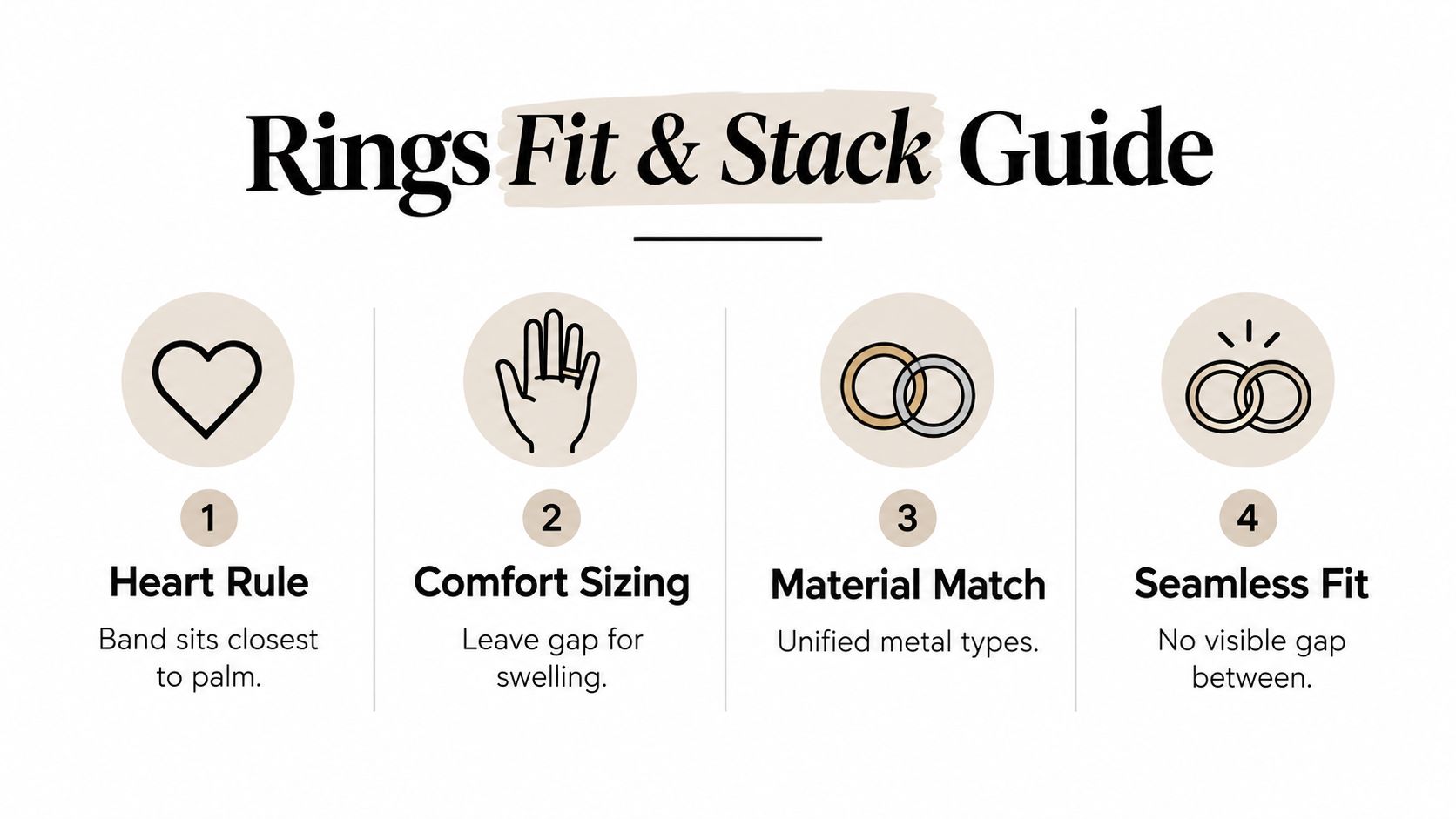
By Western tradition, the wedding band goes on the left ring finger first, closest to the heart, and the engagement ring sits above it. Many people wear the engagement ring on the right hand during the ceremony so the band can go on first, then move it back afterward, as The Knot explains in its ring-order guide.
Physical fit matters more than ceremony rules. Two rings take up more room than one, so a stack can feel tighter and rub more. Many jewelers suggest sizing a two-ring stack about a quarter to a half size larger than a single ring, depending on band width and how much your fingers swell. Narrower bands, a low total height and comfort-fit interiors make daily wear easier.
Styled image.
Check the setting before choosing the band
A low-set solitaire usually takes a straight band that sits flush. A high cathedral setting may leave a visible gap, and a low or wide gallery can block a straight band entirely. In those cases a contour band, which curves around the engagement ring, or an open band, which leaves room for the setting, is the better fit.
Practical rule: bring the engagement ring when you shop for the wedding band. Your ring size alone can't tell us whether the two rings will sit comfortably together.
Choose a comfort-fit interior if you plan to wear both rings all day. Check whether the rings spin, pinch, catch on fabric or press against your other fingers. Take rings off for heavy work, the gym and cleaning with harsh chemicals, and have the prongs checked once a year.
The video below shows the basics of stacking and wearing two rings.
How do couples budget for the whole bridal set?
A common mistake is setting one engagement ring budget and treating the bands as an afterthought. That can leave little room for two ceremony bands, a future eternity band, resizing or a setting change. We recommend planning the whole set first, then deciding what each piece should get.
The engagement ring usually takes the larger share. A center stone and a detailed setting cost more to make than a simple metal band. A diamond band shifts that balance: in our current inventory, several engagement rings are listed between about $650 and $3,500, while several of our diamond eternity bands are listed between about $5,000 and $12,000.
Build the budget in layers
- Proposal ring: enough for the center stone, a well-made setting and a comfortable fit.
- Ceremony bands: set aside money for both partners' rings before committing the full budget to the engagement ring.
- Future stack: decide whether an eternity or anniversary band is part of the plan.
- Upkeep: leave room for cleaning, prong checks, resizing and repairs.
If you are weighing a full eternity band, where diamonds go all the way around, against a half eternity band, our eternity band guide compares styles, cuts and prices.
How do you choose a matching set?
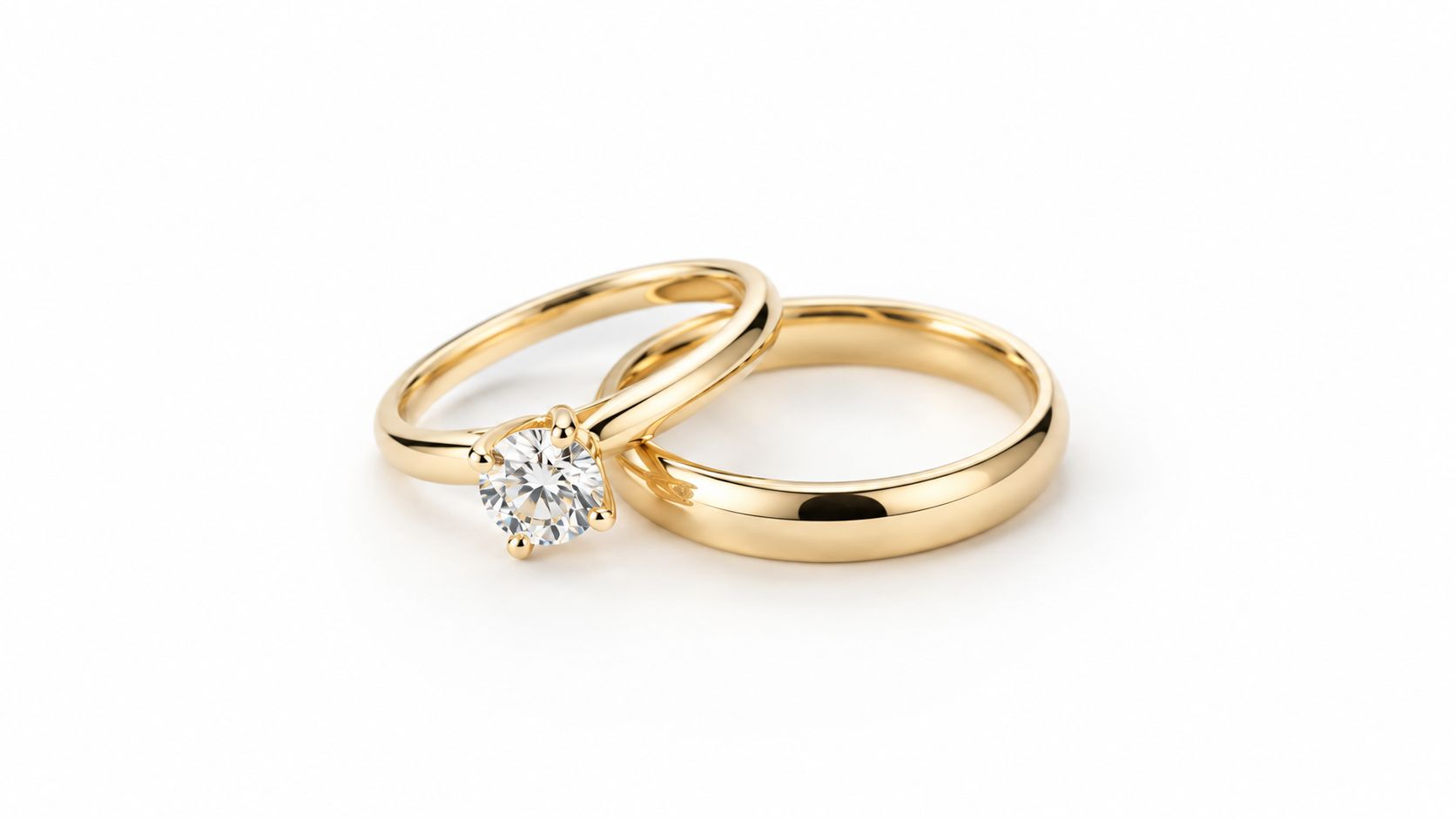
Start with the engagement ring's shape, not the metal color. A straight band may sit neatly beside a solitaire, but a halo, low gallery or wide shoulders may need a contour, open or enhancer band. A ring that looks right in a photo can leave a gap on your hand.
Styled image.
Use this selection order
- Measure the real stack. Try the engagement ring with each band on the same finger, and check the side view as well as the top.
- Balance visual weight. A large center stone usually needs a band that supports it. A plain band keeps the focus on the engagement ring, while a pavé or eternity band adds sparkle across the stack.
- Choose the metal relationship. Matching metals look calm and unified. Mixed metals look personal when one metal clearly leads.
- Decide on the stones. Natural and lab-grown diamonds share the same crystal structure and look alike to the eye, but they have very different origins, as GIA explains. Always check which one a listing describes.
For help deciding between a coordinated set and two separate rings, see our bridal set vs engagement ring comparison.
Rings from our current inventory
These pieces are in stock as of September 2026. Browse all engagement rings for more center-stone designs.

18K White Gold Oval Engagement Ring 2.50 CT
An oval center stone in 18K white gold that pairs well with a white gold band. About $3,250.
View ring →

14K White Gold Pear Shaped Diamond Engagement Ring 2.54 CT
A pear-shaped design in 14K white gold, a harder alloy for everyday wear. About $3,200.
View ring →

Emerald Cut Eternity Wedding Band 4.07 CT
A continuous row of emerald-cut diamonds for a band that looks complete on its own. About $6,700.
View band →

18K White Gold Eternity Wedding Band 3.99 CT
An 18K white gold eternity band that matches the metal of a white gold engagement ring. About $11,600.
View band →
How can you pay for it?
You can buy a bridal set in stages, which helps protect the budget for the engagement ring, both bands and any later eternity band. ECI Jewelers offers financing through Affirm, Synchrony, Acima and Snap Finance, with approval and terms set by each provider. See our financing and leasing options before you apply.
Frequently asked questions
Do you need both an engagement ring and a wedding band?
No. You can wear one ring, a bridal set or two separately chosen pieces. Buy both when the meaning, style and daily comfort matter to you, not because tradition requires it.
Which ring goes on first?
The wedding band traditionally goes on first, closest to the heart, with the engagement ring above it. Many people wear the engagement ring on the right hand during the ceremony and move it back afterward.
Can you wear the wedding band without the engagement ring?
Yes. Many people wear the band alone for work, travel or the gym, where a raised center stone could catch or take a knock. A well-chosen band should look complete on its own.
Do the two rings have to match?
No. Matching metals give a traditional look, but mixed metals can be deliberate and attractive. What matters most is that the profiles sit comfortably together.
Should you buy the rings together?
Buying together makes it easier to test the fit and plan the full budget. Buying separately also works when the proposal and wedding are far apart, as long as you bring the engagement ring when you choose the band.
Find your matching pair
Try our engagement rings and wedding bands side by side to see how your set will sit together.
Prices shown are as of September 2026. Availability can change.


