


A Rolex watch isn't just built for a single lifetime—it's engineered to keep ticking for generations. With the right care, it's not uncommon for a well-maintained Rolex to perform flawlessly for 50, 75, or even over 100 years, transforming it from a simple accessory into a true family heirloom.
How Long a Rolex Can Truly Last
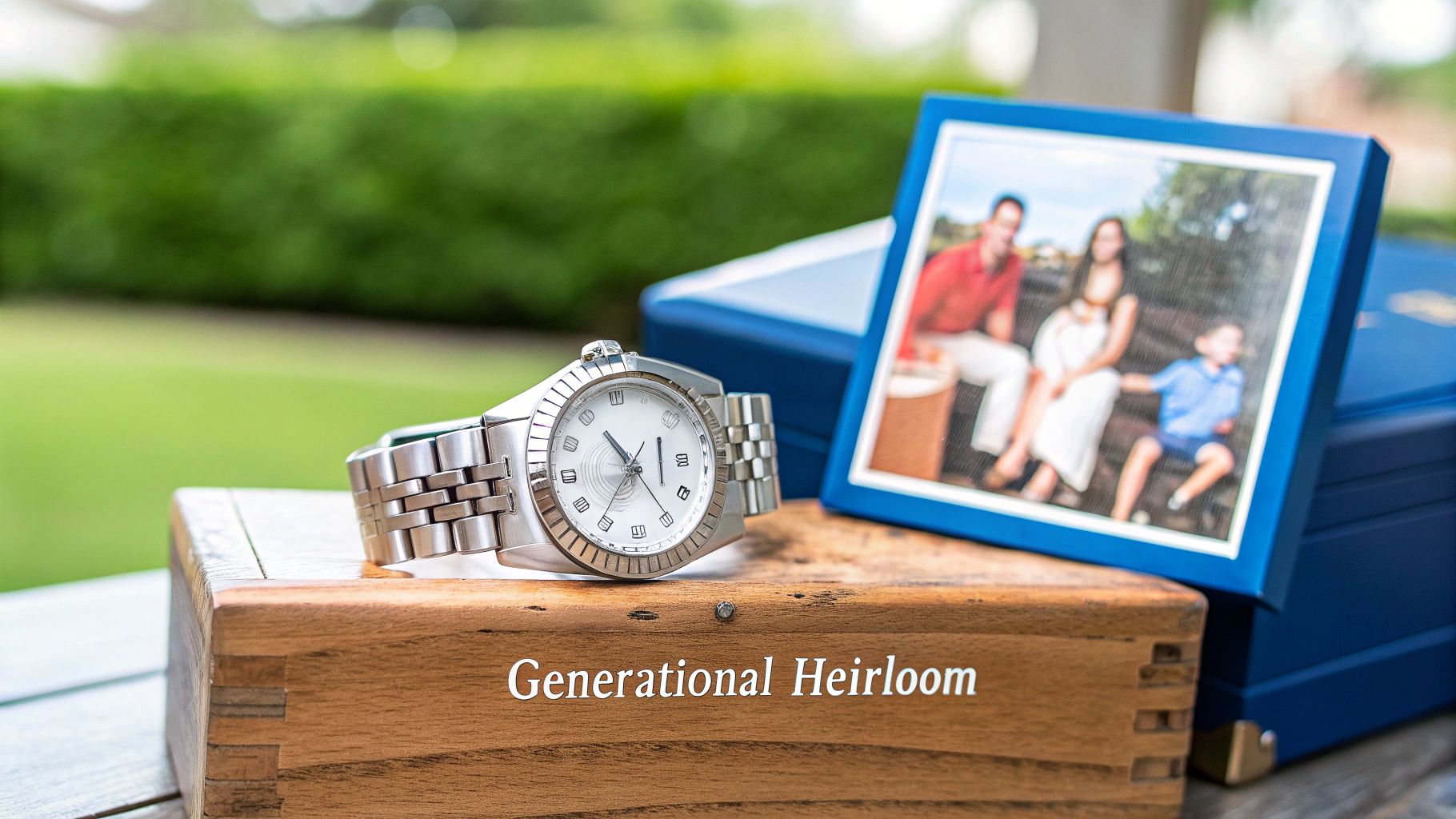
Owning a Rolex is less like buying a product and more like starting a long-term relationship with a piece of horological art. Unlike so many modern gadgets designed to be replaced, these timepieces are created for permanence. The real question isn't "how long do Rolex watches last?" but rather, "how committed is the owner to its care?"
Think of it like a vintage car. With routine tune-ups and the right mechanic, it can run indefinitely, often becoming more valuable and cherished with each passing decade.
This incredible durability is no accident. It's the direct result of a painstaking manufacturing process where every single watch is hand-assembled from the finest materials money can buy. It's this obsession with quality that explains why vintage Rolex models from the mid-20th century are not only still ticking but are highly prized on the pre-owned market.
Baseline vs. Potential Lifespan
It's crucial to understand the difference between a Rolex's operational life without any service and its true potential with proper maintenance. Left to its own devices, a Rolex might run for 3 to 10 years before its internal lubricants dry up and the tiny components start to wear down. But that's just scratching the surface of what's possible.
The standard lifespan of a properly maintained Rolex watch is often cited as 20 to 30 years, but this is just the beginning. When owners stick to a regular service schedule, the watch's functional life can stretch on for much, much longer. You can learn more about the long-term durability of Rolex watches on goldenanvil.com.
To unlock that incredible potential, you need periodic professional servicing. It’s just like a high-performance engine needing regular oil changes. A Rolex movement has hundreds of intricate parts working in perfect harmony, and they need professional attention to stay that way.
To put it in perspective, here's a quick look at how servicing impacts your watch's lifespan.
Rolex Lifespan at a Glance
This table breaks down the expected operational lifespan of a Rolex based on its maintenance history, showing just how critical regular servicing is.
| Maintenance Level | Expected Operational Lifespan | Key Outcome |
|---|---|---|
| No Servicing | 3–10 Years | Watch stops; risk of permanent internal damage. |
| Infrequent Servicing | 10–20 Years | Performance degrades; repairs become more costly. |
| Regular Servicing | 30+ Years to Generations | Preserves peak performance, value, and heirloom status. |
As you can see, the difference is dramatic. Consistent care is the secret to turning a great watch into a legacy.
What Determines Rolex Longevity?
So, what are the key factors that decide whether your Rolex lasts for a few decades or for generations? It really boils down to a few simple things.
- Routine Servicing: This is, without a doubt, the most important factor. A professional service every 5 to 10 years cleans, lubricates, and recalibrates the movement. This simple act prevents the friction and wear that lead to permanent damage.
- Daily Wear and Habits: How you wear your watch really matters. Simple habits like avoiding major shocks, always keeping the crown screwed down to maintain water resistance, and giving it a regular wipe-down all add up to a longer, healthier life for your timepiece.
- Authentic Parts: When it comes time for a service, using genuine Rolex parts is non-negotiable. At ECI Jewelers, we can't stress this enough. Authentic components are machined to the exact tolerances needed for peak performance and durability, ensuring your watch runs just as it did the day it left the factory.
The Engineering Behind Rolex Durability
A Rolex’s incredible lifespan isn’t an accident; it’s the direct result of obsessive, over-engineered design. To really get why a Rolex can tick for generations, you have to look past the luxury label and see the fortress-like construction protecting its delicate mechanical heart.
Think of the watch’s movement as a high-performance engine, built for both precision and pure endurance. But that engine is constantly under attack from the outside world—shocks, magnetic fields, and temperature swings. Rolex’s answer was to develop a whole suite of proprietary technologies that act as a sophisticated defense system.
A Fortress for Time
At the core of this protection are several key innovations that work together seamlessly. Each component isn't just designed to do its job; it's designed to withstand the rigors of daily life for decades. This philosophy of resilience is built into every single millimeter of the watch.
- Parachrom Hairspring: This is the guardian against magnetism and temperature shifts. Made from a proprietary alloy of niobium and zirconium, the hairspring is up to 10 times more resistant to shocks than traditional ones and is completely unfazed by magnetic fields. That means consistent, reliable timekeeping no matter what.
- Paraflex Shock Absorbers: Imagine a tiny, highly advanced suspension system for the movement's most fragile parts. The proprietary Paraflex system boosts shock resistance by up to 50%, shielding the balance wheel and escapement from the jolts and bumps of an active life.
These features make sure the "engine" inside your watch stays stable and protected, which is fundamental to its longevity.
Materials Built for a Lifetime
A Rolex’s toughness goes far beyond its internal mechanics. The case and bracelet are crafted from materials chosen specifically for their ability to resist wear and tear, ensuring the watch not only runs perfectly but looks great doing it. You can learn more about how these choices built the brand's reputation in our guide explaining why Rolex watches are so durable.
The brand’s commitment to using superior materials is a cornerstone of its identity.
A Rolex is engineered to handle daily wear in even the harshest environments. From the corrosion-resistant steel to the virtually scratch-proof bezels, every material is selected to ensure the watch can be passed down as both a functional timepiece and a meaningful heirloom.
Two materials, in particular, really stand out:
- Oystersteel: Rolex doesn't just use any old stainless steel. They use 904L stainless steel, which they’ve branded as Oystersteel. This is an alloy you’d typically find in the aerospace and chemical industries because it offers incredible resistance to corrosion and pitting, especially from saltwater and sweat. An Oystersteel case will keep its polished finish and structural integrity far longer than ordinary steel.
- Cerachrom: Look at the bezel on many modern Rolex Professional models—it’s made from an extremely hard ceramic material called Cerachrom. It's practically impossible to scratch, and its color will never fade from UV rays. This innovative material keeps one of the most exposed parts of the watch looking brand new, even after years of adventure.
This combination of a protected movement and a resilient outer shell is what makes a Rolex a true "forever" watch. Every single element, from the sapphire crystal to the screw-down crown, is part of a system designed for one purpose: to last indefinitely.
The Critical Role of Professional Servicing
Think of a Rolex like a high-performance engine in a classic sports car. It's a masterpiece of engineering, built to last. But even the finest engine needs an oil change. Letting it sit for a decade without one would be a disaster—oils would degrade, gears would grind, and that pristine machine would turn into a heap of worn-out parts.
A Rolex movement, with its hundreds of tiny, synchronized components, works on the same principle. Its incredible longevity isn't just a result of its initial build quality; it depends entirely on the preventative care it gets throughout its life. Professional servicing is the non-negotiable health check-up that keeps your timepiece’s engine running smoothly for generations.
What Happens During a Rolex Service
A proper Rolex service is far more than a quick tune-up. It's a meticulous, top-to-bottom restoration that brings the watch back to its original factory specifications. An expert watchmaker will completely disassemble the movement, piece by piece, until hundreds of individual components are laid out.
Each part is then ultrasonically cleaned to strip away old, gummy lubricants and microscopic debris that cause friction. The watchmaker then carefully inspects every single gear, spring, and jewel for wear, replacing anything that doesn't meet Rolex's famously exacting standards. This is the step that truly answers "how long do Rolex watches last," because replacing worn parts prevents a domino effect of damage down the line.
The process is intense:
- Complete Disassembly: The entire movement is taken apart.
- Ultrasonic Cleaning: Every component is deep-cleaned to remove old oils and grime.
- Component Inspection: Parts are checked for wear and replaced with genuine Rolex parts if necessary.
- Precise Reassembly & Lubrication: The movement is rebuilt, with specialized lubricants applied to key points to reduce friction.
- Recalibration & Testing: Finally, the watch is regulated for accuracy and tested for water resistance and power reserve to ensure it performs like new.
This chart shows some of the key components built for durability, whose performance is maximized by regular servicing.
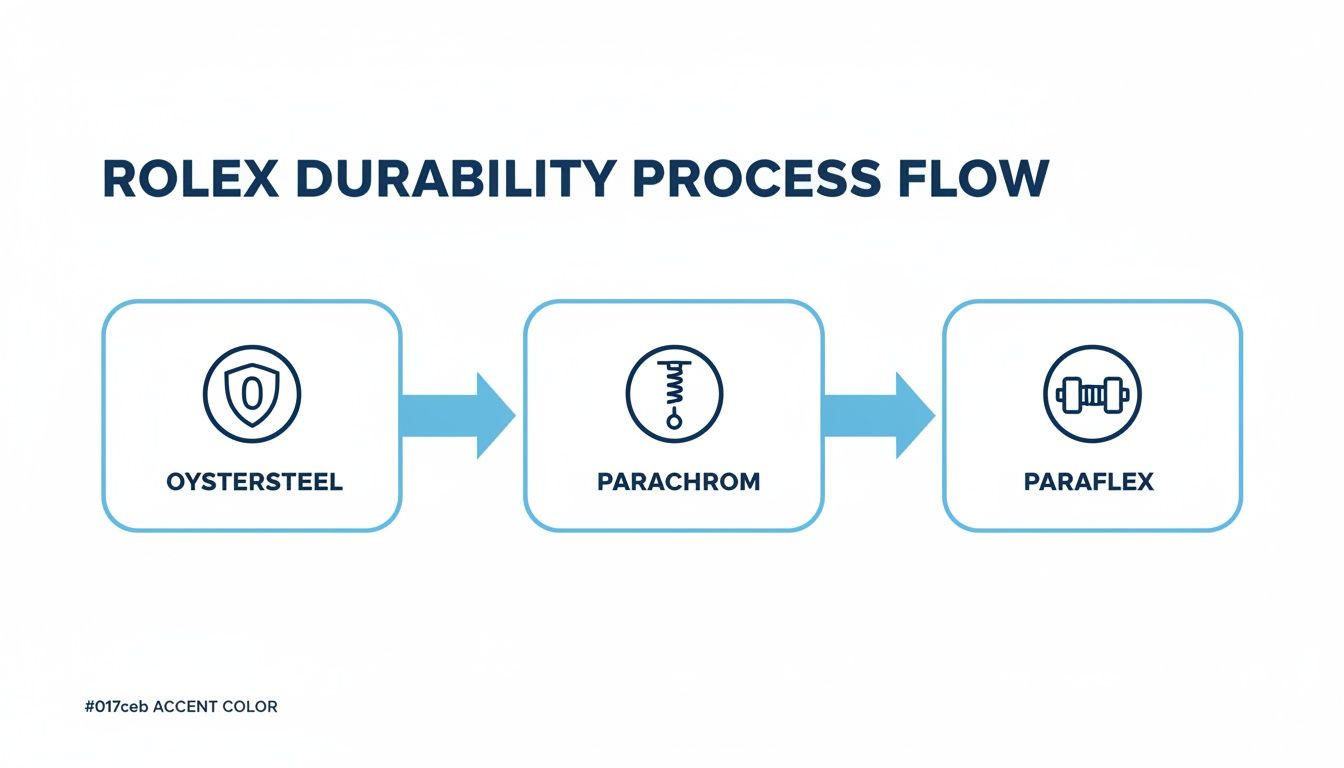
Innovations like the corrosion-resistant Oystersteel and Paraflex shock absorbers are built for a lifetime of use, but only professional maintenance can ensure they deliver on that promise.
Rolex Recommended Service Intervals
If your watch is still keeping good time, it's easy to think a service can wait. This is a dangerous misconception. By the time you notice a problem like poor timekeeping, internal damage has likely already started.
Rolex officially recommends servicing modern watches every 10 years. For older, vintage models, a check-up every 4 to 5 years is a safer bet. Think of this not as a countdown to failure, but as a preventative schedule designed to achieve indefinite performance.
Skipping a service is like ignoring your car's oil change light. The engine might still run for a while, but inside, friction is causing silent, cumulative damage that will eventually lead to a costly breakdown.
For watches used in tough conditions—like a Submariner that sees regular dives—it’s wise to shorten that interval. And yes, servicing is an investment, but it pales in comparison to the cost of a major repair. Check out our guide on the cost to service a Rolex to see why it's a smart financial move.
The Consequences of Neglect
So, what actually happens if you skip a service? Over time, the specialized lubricants inside the movement dry out and break down. Instead of gliding smoothly, tiny metal parts start grinding against each other.
This friction creates a fine metallic dust that mixes with the remaining oils, forming an abrasive paste that eats away at gears and springs. The first symptom is usually a loss of accuracy—the watch will start running fast or slow. If you keep ignoring it, you’re looking at serious mechanical failures that turn a routine service into a complex and expensive overhaul.
Preventative maintenance is the secret to preserving your watch’s value and ensuring it becomes a true family heirloom. And while professional servicing handles the internals, simple upkeep like cleaning your watch's stainless steel band is also key to preserving its overall condition for decades to come.
How Your Lifestyle Impacts Your Watch
While professional servicing is the foundation of your Rolex's health, it’s not the whole story. The journey from a new watch to a family heirloom is really paved with good daily habits. Think of it like a classic car: one that’s driven carefully and garaged every night will need far less work than one that’s raced on weekends and left out in the rain. Your Rolex is no different.
How you live with your watch—the environments you take it into and the care you show it—directly affects how long it will last between services and its overall lifespan. A Rolex Submariner worn by a desk-bound executive will face far less stress than the same model on the wrist of a construction manager or an avid scuba diver.
Small, consistent actions add up over the years. By mastering a few simple habits, you become an active partner in preserving your watch's performance and value, ensuring it keeps ticking flawlessly for decades.
The Impact of Daily Wear and Tear
Is your Rolex a daily companion or a special occasion piece? The answer really changes the conversation about wear. A watch worn every day accumulates more "mileage" on its movement, just as a daily driver racks up more miles. While Rolex Perpetual movements are built for this, constant use means the lubricants are always working and components are always moving.
On the other hand, a dress watch like a Cellini that's only worn a few times a month faces different challenges. Long periods of inactivity can cause the lubricants to settle or thicken. That’s why it’s a good practice to manually wind a Rolex you don't wear often—about 30-40 turns of the crown once a week is perfect to keep the oils distributed and the movement healthy.
An automatic Rolex generally needs at least 8 hours of daily wear to keep its mainspring fully wound through your natural motion. If your lifestyle is less active or you wear the watch sporadically, it might not get enough power to run optimally.
The takeaway? Neither daily nor occasional wear is "bad," but each scenario calls for a slightly different approach to care.
Environmental Stress Factors You Must Avoid
Your Rolex is a tough machine, but it isn't invincible. Certain environmental factors can interfere with its delicate mechanics and disrupt its accuracy, potentially causing damage. Being mindful of these can save you an unnecessary trip to the service center.
Here are the most common risks to watch out for:
- Extreme Temperatures: Rapid temperature swings can cause the tiny metal parts inside your watch to expand and contract, affecting accuracy. This can even lead to condensation forming under the crystal. Try to avoid leaving your watch in direct sun on a hot day or jumping from a hot tub into a cold pool.
- Magnetic Fields: Everyday items like speakers, laptops, and even magnetic clasps on bags can disrupt the sensitive Parachrom hairspring inside the movement. Modern Rolexes have excellent magnetic resistance, but a strong enough field can still make the watch run erratically. If you suspect this has happened, a watchmaker can demagnetize it in minutes.
- Harsh Chemicals: Chlorine, solvents, and strong detergents can degrade the rubber gaskets that keep your watch water-resistant. It’s a simple but crucial habit: always rinse your watch with fresh water after swimming in a pool or the ocean.
Just being aware of these factors helps you easily protect your watch from the invisible forces that cause premature wear.
The Cardinal Rule of Water Resistance
If there's one habit every Rolex owner needs to master, it's this: always ensure the screw-down crown is fully secured. The crown is the gateway to the movement. When it's unscrewed, even slightly, the watch is completely vulnerable to dust, humidity, and water.
Think of the crown and gaskets as the hatch on a submarine—they have to be sealed perfectly to protect what's inside. Forgetting to screw it down just once before washing your hands or getting caught in the rain can lead to catastrophic moisture damage, which is one of the most expensive watch repairs possible.
Make it a habit to check the crown every time you put your watch on. This simple, two-second action is your best line of defense.
To put it all together, think about where you fit in as an owner. Your daily routine dictates the level of care your watch needs to perform at its best for years to come.
| How Your Lifestyle Affects Rolex Care | ||
|---|---|---|
| Owner Profile | Common Exposures | Recommended Actions & Service Frequency |
|
The Daily Driver (Office worker, commuter) |
Minor bumps, magnetic fields from electronics, occasional hand-washing. | Check crown is screwed down weekly. Rinse if exposed to sweat. Service every 8-10 years. |
|
The Weekend Adventurer (Hiker, boater, traveler) |
Bumps, shocks, sweat, chlorine/saltwater, temperature changes. | Rinse with fresh water after every exposure to salt or chlorine. Check crown before any water activity. Service every 5-7 years. |
|
The Occasional Wearer (Worn for special events) |
Long periods of inactivity, dust. | Wind watch 30-40 turns weekly to keep lubricants distributed. Store in a dry place. Service every 10 years, regardless of wear. |
|
The Professional (Diver, pilot, construction) |
High-impact shocks, extreme pressures, magnetic fields, dust, chemicals. | Daily checks of the crown. Frequent rinsing. Demagnetize as needed. Service every 3-5 years to ensure peak performance and safety. |
Ultimately, treating your Rolex with mindful awareness is the key. By understanding how your life interacts with your watch, you can easily adapt your habits to protect your investment and ensure it remains a reliable companion for a lifetime.
Recognizing When Your Rolex Needs Attention
 Rolex suggests a service roughly every 10 years, but your watch isn't a calendar—it's a high-performance machine. Long before that decade is up, it will often drop subtle hints that it’s time for a professional tune-up. Learning to read these signs is how you shift from reactive repairs to proactive care.
Think of it as your watch trying to tell you something. When you catch these symptoms early, you can get minor issues fixed before they snowball into complex and expensive problems. This is what truly determines how long your specific Rolex will last.
Timekeeping Irregularities
The most obvious red flag is when your watch stops keeping good time. A Rolex is a certified chronometer, built to perform within an incredibly tight tolerance of just -2/+2 seconds per day. If you notice it’s suddenly running much faster or slower, something inside needs attention.
This kind of inaccuracy is usually the first sign of old lubricants or increased friction, which can wear down the movement’s tiny, intricate components. Don’t just shrug off a watch that’s gaining or losing a few minutes a week; that's a clear signal the engine's delicate balance is off and needs a professional recalibration.
Paying attention to your watch's performance is like listening to a high-performance engine. A sudden change in its rhythm or sound is a warning that it's time to look under the hood before a small problem becomes a major one.
Physical and Audible Clues
Beyond just telling time, your Rolex can give you physical and audible hints that it needs a check-up. These are often easy to spot if you know what to listen and feel for.
You should bring it to a professional if you notice any of these signs:
- Gritty or Stiff Winding: When you unscrew the crown to wind your watch, the motion should feel buttery smooth. If you feel any grinding, resistance, or a sandy texture, it’s a classic sign of dried-up lubricants or debris in the winding mechanism.
- Rattling Sounds: A gentle shake should be almost silent, aside from the faint whir of the Perpetual rotor. If you hear a distinct rattle, it could mean a screw or another small part has come loose inside the case. A loose part can cause catastrophic damage if it gets into the gear train.
- Stuttering Second Hand: The sweep of a Rolex second hand is famous for being smooth and continuous. If it starts to stutter, jump, or pause, it means the power transfer from the mainspring is being blocked or interrupted.
- Moisture Under the Crystal: Seeing condensation or fog under the sapphire crystal is an emergency. This means the water-resistant seals have failed, and moisture is attacking the movement. This can cause rust and irreversible damage in a very short time.
Functional and Power Reserve Issues
Finally, pay attention to how your watch performs day-to-day. A healthy Rolex has a robust power reserve, typically lasting between 48 and 72 hours after being fully wound and set down.
If you wear your watch all day but find that it’s stopped by the next morning, that's a huge sign the self-winding system isn't working right. This could be an issue with the Perpetual rotor or other parts that capture your motion to power the watch. It’s not just an annoyance; it’s a sign the watch’s “engine” isn’t charging itself properly and needs a service.
How Longevity Translates to Investment Value
A Rolex's ability to keep perfect time for generations isn't just a cool feature—it's the very foundation of its value as a hard asset. Think about it: most luxury goods start losing money the second you buy them. A well-cared-for Rolex, on the other hand, often does the exact opposite. Its worth is directly tied to that legendary performance and timeless look.
This is why buying a Rolex feels less like a purchase and more like an investment in a legacy. Iconic models like the Submariner and Daytona are stars of the vintage market, with some rare references blowing past traditional investments like stocks or real estate. What fuels that fire? The mechanical integrity, perfectly preserved over decades.
The Makings of a Collectible Asset
So, what turns a tough watch into a prized collectible? It’s that magic blend of brilliant engineering and consistent, expert care.
Rolex's entire design philosophy is built around serviceability. The parts are modular, designed to be taken apart, cleaned, and put back together indefinitely. You only need to look at the vintage market for proof—models from 50 years ago still fetch premium prices. It gives you real confidence that a modern Rolex, built with even better technology, can easily last a few lifetimes.
Of course, this potential for appreciation all comes down to two things: authenticity and condition. And both are locked in through expert servicing.
A Rolex is one of the few mechanical objects you can buy that has the potential to function perfectly a century from now while being worth significantly more than you paid for it. This makes proper maintenance not just a cost, but a crucial part of your investment strategy.
For anyone looking to maximize their return, knowing the market is a must. Learning the ins and outs of mastering online auctions for watches can give you a serious edge.
Securing Your Watch's Future Value
Expert servicing and authentication are the two pillars holding up your watch's investment potential. Every service done at a trusted specialist like ECI Jewelers, using only genuine Rolex parts, maintains the watch's integrity and protects its value down the road.
Without that documented history of proper care, a watch's story gets murky, and its value can take a serious hit. We dive deeper into this relationship in our article covering the resale value of Rolex watches.
At the end of the day, a Rolex becomes a treasured heirloom for the next generation precisely because its longevity is matched by its power to hold—and often grow—its financial worth.
Common Questions About Rolex Longevity
Even after you understand what makes a Rolex tick, a few practical questions usually pop up. Here are some straight answers to the most common things owners ask, reinforcing what it takes to keep your watch running for a lifetime.
Can a Rolex Watch Really Last Forever?
Yes and no. While some individual parts will naturally wear out after decades of use, the watch itself is built to be serviced indefinitely.
Think of it like a classic car—the original chassis and body remain, but you might replace the spark plugs or tires over the years to keep it running beautifully. With routine maintenance and genuine Rolex parts, the intricate movement inside can be kept in perfect working order, allowing the watch to be passed down through generations. It's truly a "forever" timepiece.
What Does a Typical Rolex Service Cost?
A standard service usually runs from several hundred to over a thousand dollars. The final price depends on your watch's model, age, and how complex its movement is.
It’s best to see this as a critical investment, not just a cost. This preventative care protects the watch's much greater value and guarantees flawless performance for another decade. More importantly, it helps you avoid far more expensive repairs that can pop up from neglect.
A huge misconception is waiting for a problem to show up before getting a service. By the time a Rolex starts losing time, damage from dried-up lubricants may have already started inside. Preventative servicing is key because it fixes wear before it becomes a serious, costly issue.
Should I Service My Rolex if It Still Keeps Perfect Time?
Absolutely. A Rolex can keep its chronometer-certified accuracy for years, even while its internal oils are slowly breaking down. This can give you a false sense of security.
The purpose of the recommended 10-year service interval is to clean and re-lubricate the movement before that friction starts causing silent, accumulating damage to the gears and other delicate parts. Sticking to this schedule is the single best thing you can do to ensure a long, healthy life for your watch.
At ECI Jewelers, we believe owning a Rolex is just the start of a lifelong journey. Whether you're buying your first one or preserving a family heirloom, our team of experts provides authenticated sales and professional servicing to protect your investment for generations.
Explore our curated collection of luxury watches at https://www.ecijewelers.com.


