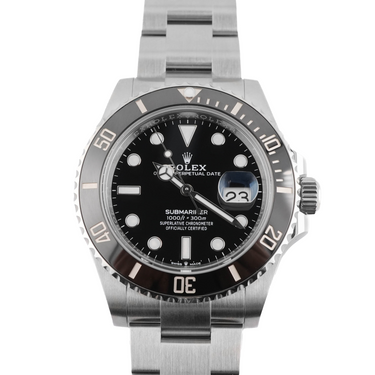
The 2026 Rolex Submariner Date 126610LN has a retail MSRP of $11,350. In the secondary market, unworn examples are commonly trading around $15,675 to $16,320, which means the watch enthusiasts ask about has two very different prices depending on how you buy it.
That gap is the whole story in 2026. If you're asking how much is a Rolex Submariner 2026, you aren't really asking for one number. You're asking what you will have to spend to get one, how much a seller can realistically expect to receive, and why a steel dive watch with a published retail price often changes hands far above that figure.
From a Diamond District standpoint, buyers often get tripped up. They see the boutique price, then they see the dealer price, then they hear about waitlists, purchase history, "allocation," and unworn premiums. Sellers run into the opposite problem. They know the watch is hot, but they don't always know whether they're looking at an asking price, a trade number, or a real cash offer.
A Submariner in 2026 is still one of the cleanest benchmarks in luxury watches because the model is liquid, widely recognized, and easy to compare across references. But "easy to compare" doesn't mean "simple to price." Material, reference, condition, set completeness, and who is standing behind the watch all affect the final number.
Your Definitive Rolex Submariner Price Guide for 2026
The first thing to understand is that Rolex retail and Rolex market price are not the same thing. For the benchmark steel Submariner Date 126610LN, the spread is substantial. Unworn examples have been listed on dealer platforms between $15,675 and $16,320, which sits about 38% to 43% above the official $11,350 MSRP according to current dealer-market listings for the 126610LN.

That tells you two things right away. First, the official price matters because it sets the floor for new inventory at authorized retail. Second, the actual-world acquisition cost is often much higher because access is limited and buyers pay for immediate availability.
If you're buying, that difference changes the whole conversation. You're no longer deciding only whether the watch is "worth eleven thousand dollars." You're deciding whether skipping the wait, getting a full set, and buying from a dealer with verification is worth paying the live market number.
If you're selling, the same gap works in your favor, but only if the watch is presented properly. A strong listing price is not the same as a strong payout. Clean condition, complete accessories, and a credible seller channel matter because buyers don't pay top money for uncertainty.
For shoppers comparing options, it helps to view the market through a current Rolex Submariner inventory lens. Looking at actual available pieces often tells you more than retail lists alone, because it reflects the cost of getting the watch now, not the cost of hoping one gets allocated later.
The practical price of a Submariner in 2026 is the number attached to immediate, verified access.
That's why buyers and sellers both need a two-part answer. There's the Rolex answer, and there's the market answer. The rest of the pricing conversation starts there.
The Two Prices of a Rolex Submariner in 2026
A Rolex Submariner in 2026 has what I call a sticker price and a street price. If you think of a rare collector car, the MSRP is what the manufacturer prints. The market price is what someone pays when there aren't enough cars available at that sticker.
The Submariner works the same way.
MSRP is real, but access is limited
For the steel Submariner Date 126610LN, Rolex's 2026 retail MSRP is $11,350, and that reflects a 5.8% increase from 2025 pricing. The two-tone Submariner 126613LB "Bluesy" rose to $18,900 with a 7.4% increase, showing that Rolex's 2026 pricing moved up more aggressively on models with precious metal content, as outlined in this 2026 Rolex retail pricing breakdown.
That retail number matters because it's the official baseline. It tells you where the brand values the watch at the boutique level. It also shapes insurance, trade discussions, and buyer psychology.
But for many shoppers, retail is theoretical. You can't buy a Submariner at MSRP just because you know the number. You still need allocation, timing, and often a relationship with an authorized dealer.
Market price is what gets the watch on your wrist
The second price is the one attached to availability. That's the dealer, collector, and secondary-market figure. It reflects how much buyers will pay to avoid uncertainty.
People either overcomplicate the process or get burned by simplistic thinking. A seller sees one high listing online and assumes every watch is worth that. A buyer sees MSRP and assumes anything above it is unreasonable. Neither view is practical.
Practical rule: Retail tells you what Rolex charges. Market tells you what access costs.
Here's a working comparison based on the verified 2026 figures available.
| Reference (Nickname) | Material | 2026 MSRP (USD) | Est. 2026 Market Price (USD) |
|---|---|---|---|
| 126610LN (Submariner Date) | Oystersteel | $11,350 | $15,675 to $16,320 |
| 126610LV (Starbucks) | Oystersteel | $11,900 | Qualitatively above retail |
| 126613LB (Bluesy) | Two-tone steel and gold | $18,900 | Qualitatively above retail |
| 126619 (white gold Submariner) | White gold | Qualitatively higher retail tier | Price increases exceeding $4,000 versus January 2025 levels |
| Full yellow gold Submariner variants | Yellow gold | Qualitatively higher retail tier | $40,000+ depending on configuration |
A few things stand out in that table.
- Steel remains the benchmark. The 126610LN is the cleanest read on the mainstream market because there are verified retail and live dealer-market numbers for it.
- Material changes the slope of the price curve. The two-tone and full precious metal references move on a different track.
- Not every premium behaves the same. Steel premiums usually reflect access and demand. Gold pricing carries more weight from material cost and a smaller buyer pool.
Why the gap persists
The reason this spread exists is simple. Rolex controls retail distribution tightly, while buyer demand for sports models remains stronger than immediate supply. That creates a parallel market where the watch is available now, but not at the same number printed by the brand.
Consider it comparable to a limited sneaker release. The launch price is one thing. The price to own it this afternoon is something else.
For buyers, the key question isn't "Which price is real?" Both are real. The right question is which route matches your priorities. If your priority is lowest official cost, you pursue retail and accept uncertainty. If your priority is immediate ownership, you pay market and focus on authentication, condition, and complete documentation.
For sellers, understanding these two prices keeps expectations disciplined. A dealer's ask, a private-party target, a trade value, and a same-day buy offer are related, but they aren't identical. The watch market rewards clarity more than optimism.
What Drives a Submariner's Value in 2026
Once you understand why there are two prices, the next question is why one Submariner sells faster and stronger than another that looks almost identical in photos. In practice, five levers do the heavy lifting.

Reference and material
Start with the reference number. A steel 126610LN, a green-bezel 126610LV, and a two-tone 126613LB may share the same family name, but they don't trade the same way.
Steel usually has the broadest buyer pool. Two-tone attracts a narrower but committed customer. Full gold can command much higher dollars, but the audience is smaller and more selective. That's why sellers shouldn't assume the most expensive Submariner is automatically the easiest one to move.
Collectors also react to details that non-collectors miss. Bezel color, date versus no-date, and whether the model has a long-established following all influence how quickly a watch converts from listing to transaction.
Condition is money
Condition isn't just about scratches. It's about whether the watch accurately reflects its condition and whether the wear matches the asking price.
A clean, unworn watch trades in a different lane than a polished watch with stretch, denting, or service replacement parts that don't line up with what buyers expect. Even before anyone opens the caseback, a trained eye notices lugs, bracelet sharpness, clasp wear, bezel feel, and crystal condition.
Here's the practical side:
- Unworn inventory: Usually draws the strongest buyer interest because the watch feels closest to retail acquisition.
- Excellent pre-owned: Often gives the best value balance for buyers who want a strong watch without paying the absolute top premium.
- Overpolished examples: Tend to create hesitation because buyers know they can't put metal back once it's gone.
- Incomplete or rough pieces: Still sell, but mostly at a discount and to a more price-sensitive customer.
Buyers forgive honest wear faster than they forgive undisclosed work.
Box, papers, and provenance
"Box and papers" isn't dealer jargon for decoration. It's shorthand for confidence. Original accessories, warranty card, tags, receipts, and service records help a buyer feel that the watch's story checks out.
A naked watch can still be real and desirable. Plenty of strong watches trade without a full set. But once the price moves up, buyers start asking harder questions. A complete set narrows those questions.
That matters because watches at this level aren't bought purely on aesthetics. They're bought as luxury goods, collecting objects, and in many cases portable assets. Provenance supports all three.
Technical merit still affects value
The Submariner doesn't hold demand on branding alone. The movement matters. The caliber 3235 is a real value driver because it offers a 70-hour power reserve, uses Rolex's Chronergy escapement, and is tied to ±2 seconds per day Superlative Chronometer performance. Verified 2026 market commentary connects that technical package to the steel model's premium pricing, with collectors paying up for reliability and performance in the 126610LN, as discussed in this analysis of the caliber 3235 and 2026 pricing.
That matters in the showroom. Buyers don't just see a black dial and a rotating bezel. They see a movement with a strong reputation, modern architecture, and day-to-day practicality.
For anyone who tracks luxury pricing more broadly, some of the same logic appears in retail strategy work around pricing insights for online retailers. Watches aren't e-commerce commodities, but the principle holds. Demand doesn't react evenly across product tiers, and buyers tolerate price movement differently depending on perceived scarcity and trust.
Market demand and timing
The last lever is demand, and this one moves fastest. A watch can be objectively excellent and still underperform if the market has shifted toward another reference or if buyers have become more selective at a given price band.
This is why timing matters for sellers. A watch sold into active demand usually gets cleaner offers than the same watch held too long while everyone chases the next thing. It's also why buyers should separate trend from substance. The strongest long-term purchases usually combine stable demand, recognizable design, and easy resale language.
In plain terms, value isn't one feature. It's the stack. Reference, material, condition, provenance, and movement quality work together. If one of those is weak, the watch can still sell. But the number usually adjusts to reflect it.
2026 Price Ranges for Popular Submariner Models
The easiest way to understand Submariner pricing is to look at the watches people ask for. In the District, the conversation usually starts with steel, then branches into green-bezel steel, two-tone, and gold.
126610LN Date in steel
This is the benchmark piece for most buyers. It has the black dial, black Cerachrom bezel, and date display that make it the default modern Submariner.
At retail, the 2026 number is already established earlier in this guide. In the live market, it's the watch that shows the clearest premium for immediate, unworn availability. Buyers who choose it usually want the most liquid current-production Submariner and the easiest future resale conversation.
Why it works:
- Universal configuration: Black on black appeals to almost everyone.
- Daily wear credibility: It fits business, casual, and travel use.
- Exit flexibility: If you sell later, the buyer pool is broad.
126610LV Starbucks in steel
The green-bezel version lives in a different emotional category. It isn't just a color change. It attracts buyers who want a standard production watch with a more distinct identity.
Its 2026 MSRP is $11,900, and that reflects the same 5.8% increase noted for the steel pricing tier in the earlier verified pricing source. In the market, these pieces generally command stronger attention than a plain black steel Submariner because the look is more collectible without becoming hard to wear.
A Starbucks buyer usually falls into one of two camps. Either they want one Submariner and want it to feel special, or they already know the standard black model and specifically want the green bezel variant.
126613LB Bluesy in two-tone
The Bluesy is the watch that changes minds in person. Photos rarely do the blue dial and blue bezel justice, but once it's on the wrist, people either love it or know immediately that it isn't for them.
Its 2026 MSRP is $18,900, and Rolex applied a 7.4% increase to that reference in the 2026 retail update covered earlier. That larger increase, compared with steel, reflects how differently Rolex treated precious metal content in this cycle.
What affects Bluesy pricing on the market is less about mass-market utility and more about profile. It isn't trying to disappear. It signals taste, flash, and confidence.
A Bluesy buyer isn't shopping for subtlety. They're buying presence.
White gold and yellow gold Submariners
These references sit in another category entirely. They're still Submariners, but they aren't entry points. They're luxury sports watches with metal value, a smaller buyer pool, and a very different ownership mindset.
Verified 2026 market notes show that the white gold Submariner 126619 saw a price increase of more than $4,000 compared with January 2025 levels, while full yellow gold variants trade in the $40,000+ range depending on configuration in the dealer market noted earlier. At this level, buyers are less concerned with chasing the lowest possible spread and more focused on getting the exact dial, bracelet, and condition they want.
What about the No-Date
The No-Date Submariner matters to collectors because it's the cleanest expression of the line. But without verified 2026 numbers in the approved data set here, the honest way to price it is qualitatively. In practice, it sits as a core steel option and remains heavily watched by buyers who prefer a symmetrical dial and a more traditional tool-watch feel.
That's the right way to look at model ranges in 2026. Some references are purchased for flexibility. Others are bought for personality. The price follows the buyer psychology as much as the spec sheet.
How to Verify a Rolex Submariner Is Authentic
A Submariner can be expensive enough that one missed detail turns into a costly mistake. The safest approach is to separate what you can inspect yourself from what only a professional should verify.

What you can check yourself
Start with the dial and overall finishing. Rolex doesn't do sloppy printing, fuzzy markers, or weak lume application. The text should be crisp, the hands should align correctly, and the bezel should feel precise rather than loose or gritty.
Then check the bracelet and clasp. A genuine modern Submariner has a very specific sense of solidity. The bracelet shouldn't feel tinny, and the clasp action should feel deliberate. Modern fakes often look decent in listing photos but break down the minute you handle them.
A smart buyer should also look at:
- Dial quality: Text spacing, marker placement, and handset shape should look exact, not approximate.
- Bezel action: The bezel should rotate with confidence and clean alignment.
- Crystal details: The crystal and cyclops should present properly, without distortions that look off.
- Serial and card consistency: The watch, warranty card, and accessories should tell one coherent story.
For people organizing larger purchases, trades, or liquidation plans, the same discipline that matters in watch verification also matters in money management. Clear records, invoices, and tax documentation are part of achieving financial clarity, especially when you're moving high-value assets.
What needs a professional
A serious authentication goes beyond visual checks. You want the movement inspected, the case and bracelet evaluated for replacement parts, and the serial and reference details checked against the watch's generation and configuration.
That's where many private buyers get overconfident. They know the obvious tells, so they assume they're safe. Good counterfeiters know those tells too.
If the seller resists inspection, the watch isn't the only problem.
A detailed walkthrough can help buyers understand the difference between a basic glance and a real authentication process. This guide on how to authenticate a Rolex watch is a useful reference point before you commit to a purchase.
Here's a visual explainer worth watching before buying pre-owned:
The practical standard
For a purchase at this level, DIY checks are screening tools, not final proof. If you're spending serious money on a Submariner, insist on specialist inspection, matching documentation, and a seller who can answer technical questions without deflecting.
That's especially true with watches described as "unworn," "full set," or "investment grade." Those words carry pricing weight. If the watch doesn't support the description, the number should change.
Smart Strategies for Buying and Selling Your Submariner
Good Submariner transactions usually come down to discipline, not luck. Buyers need to know what they value before they shop. Sellers need to know what kind of exit they want before they ask for a number.

For buyers
The first step is choosing your lane. Some buyers want the lowest official price and are willing to wait. Others want the watch now and are prepared to pay the market for that convenience. Trouble starts when someone wants instant availability at retail and treats every realistic offer as unreasonable.
A better approach is to rank your priorities.
- Pick the reference first: Decide whether you want black steel, green-bezel steel, two-tone, or gold before looking at random listings.
- Decide how much condition matters: Unworn commands a different number than excellent pre-owned. Don't overpay for "like new" language if honest wear doesn't bother you.
- Buy the seller as much as the watch: Reputation, inspection standards, return terms, and documentation matter.
- Ask direct questions: Has the watch been polished, serviced, resized, or had parts changed?
If you want to move efficiently, one practical route is using a dealer that handles authenticated inventory, trade-ins, and market-based valuations in one place. ECI Jewelers' guide to selling your Rolex watch is useful even for buyers because it shows how dealers think about condition, liquidity, and payout.
For sellers
Sellers usually lose money in one of two ways. They either chase the highest visible asking price and waste time, or they take the first low offer because they don't know how the watch should be positioned.
The smarter move is to know what you're optimizing for:
- Highest possible private sale: More effort, more time, more buyer screening.
- Fast dealer sale: Less friction, but a spread between trade buy and retail ask.
- Trade toward another watch: Often the cleanest route if you're moving up or changing references.
Before you request offers, get your watch presentation right.
- Gather the full set: Box, warranty card, tags, receipts, and service records all help.
- Photograph accurately: Good light, clear clasp shots, case sides, lugs, and bracelet condition.
- Disclose work: If the watch was polished or serviced, say so up front.
- Know your floor: Decide the minimum acceptable number before negotiations start.
What works and what doesn't
What works is transparency. Clean watch, clean story, clean paperwork.
What doesn't work is pricing a worn watch like a perfect one, hiding bracelet stretch, or acting as if every online listing is a completed sale. Dealers and experienced buyers spot that immediately.
Strong transactions happen when both sides know exactly what is being sold, what is included, and why the number makes sense.
For both buyers and sellers, the best strategy is to reduce ambiguity. Every unanswered question widens the spread. Every verified detail tightens it.
Final Verdict Is a Submariner a Good Investment in 2026
A Submariner can be a strong watch to own in 2026, but "investment" needs to be used carefully. It isn't a bond, and it isn't guaranteed upside. It's a luxury asset with durable demand, deep brand recognition, and an unusually active resale market for a modern production watch.
That combination is why the Submariner keeps showing up in both collector conversations and practical money conversations. Buyers know what it is. Dealers know how to price it. Sellers can usually explain it in one sentence. That kind of market fluency matters.
Why it still holds its ground
The model works because several forces line up at once.
- Design stability: Rolex hasn't diluted the identity of the Submariner.
- Technical credibility: The movement and build quality support the watch's reputation.
- Resale language: The reference numbers are understood across the market.
- Broad demand: Steel, two-tone, and gold each serve different buyers without losing the core model identity.
A good Submariner purchase in 2026 is usually one where the buyer enters at a fair number, buys authentic condition rather than a marketing story, and chooses a reference they'll still want if the market cools.
The real answer for buyers and sellers
If you're buying, the watch makes the most sense when you value wearability, liquidity, and long-term desirability. If you're selling, it remains one of the cleaner luxury watches to value because there is an active market and a strong base of informed buyers.
For higher-value transactions, trust mechanics matter almost as much as price mechanics. In other industries, buyers often look for structured protection such as CoinPay's non-custodial trust service to reduce counterparty risk. The same mindset applies in watches. Verified funds, authenticated goods, and clear transfer terms protect both sides.
The short version is this. A Rolex Submariner in 2026 is still one of the most defensible luxury watch purchases you can make if you buy the right reference, verify the details, and don't confuse an asking price with actual market value.
If you're weighing a purchase, sale, or trade, ECI Jewelers offers authenticated luxury watches, market-based valuations, and insured transaction support for clients in NYC and nationwide.