


Before you even think about listing your Rolex, let’s be clear: preparation is profit. The effort you put in now will directly translate into the final offer you get. Think of it like staging a home before you sell it—you’re showing off your timepiece in its absolute best light to command the highest possible price.
This isn't just about a quick wipe-down. It's about building a complete package that tells a story of authenticity, meticulous care, and undeniable value to any serious buyer.
Preparing Your Rolex to Maximize Its Sale Price
Gather Every Piece of Documentation
First things first: track down everything that originally came with your watch. This is non-negotiable if you want to get top dollar. Experienced collectors and reputable dealers will always pay a significant premium for what’s known in the industry as a “full set.”
- The Original Box: This means both the green presentation box and the outer cardboard sleeve. It’s the very first sign that a watch has been well-kept.
- Warranty Card/Papers: This is your Rolex's birth certificate. The original, dated warranty card with the matching serial number is the single most important piece of paper for proving its authenticity and history.
- Receipts and Service Records: The original sales receipt is a great bonus, but any official service papers are just as valuable. They prove the watch has been professionally maintained, giving buyers confidence in its mechanical health.
- Extra Bracelet Links: Did you have links removed to size the bracelet? Find them. A buyer with a larger wrist will need them, and not having them is an easy reason for them to negotiate the price down.
A complete set—box, papers, and all the original accessories—can boost a Rolex's resale value by as much as 15-25% compared to selling the watch by itself. It completely removes any doubt and proves you have a cherished, legitimate timepiece.
To Service or Not to Service
This is a question I get all the time, and the right answer really depends on your watch’s current condition.
If your Rolex isn't keeping accurate time or has obvious signs of wear and tear, a professional service can be a very smart investment. A freshly serviced watch comes with a new warranty and proof of its perfect working order, which helps justify a higher asking price.
However, if your watch is running perfectly fine, a full overhaul might not be necessary. In fact, aggressive polishing can sometimes hurt the value of vintage models by softening the sharp, original lines of the case that collectors prize.
Instead, a thorough but gentle cleaning can work wonders. Just removing the daily buildup of dust, fingerprints, and grime from the case, bracelet, and crystal will instantly improve how it looks. For a safe, step-by-step walkthrough, check out our comprehensive guide to cleaning your Rolex watch. This simple step makes a massive difference, both in photos and in person.
Master Your Photography
You don't need a fancy photo studio, but blurry smartphone pictures taken under a dim lamp just won't do. Your photos are your number one selling tool—they are the very first impression a potential buyer gets.
Follow these simple tips to take pictures that sell:
- Use Natural Light: Find a spot near a window with soft, indirect sunlight. You want to avoid harsh glares or deep shadows that hide the details.
- Capture Every Angle: Get clear shots of the dial, the sides of the case, the bracelet, the clasp, and the case back. Don't leave any part to the imagination.
- Highlight the Details: Take close-ups of the tiny Rolex crown on the winder, any engravings on the clasp, and the glowing markers on the dial.
- Showcase the Full Set: Stage a "hero shot" with the watch beautifully displayed next to its box, papers, and any other accessories. This one photo visually confirms you have the complete, valuable package.
By putting in a little time upfront, you're not just selling a watch; you're presenting a valuable, authenticated asset. This groundwork paves the way for a smooth sale and, most importantly, puts more money in your pocket.
Determining Your Rolex Watch's Real Market Value
Figuring out what your Rolex is truly worth is more art than science, and it definitely takes more than a quick Google search. The real market value is a moving target, influenced by a blend of factors that go far beyond the model name on the dial. A professional valuation is the only way to get an accurate, data-driven price.
Understanding the core drivers of value is your first step. It helps you set realistic expectations and empowers you to see your watch the way a serious buyer would.
The Key Factors Driving Rolex Prices
Not all Rolexes are created equal, even within the same model family. A vintage Submariner from the 1960s has a completely different valuation profile than a brand-new one, and the reasons are all in the details.
Here’s what really determines your watch’s market price:
- Model and Reference Number: This is the big one. A stainless steel Daytona (ref. 116500LN) will always command a higher price than a steel Datejust from the same year. Why? Immense demand and lower production numbers. The reference number tells a story of rarity and desirability.
- Condition: Minor scratches on the bracelet are one thing; a deep gouge on the case or a chipped crystal is another. The closer your watch is to its original factory condition, the higher its value. Collectors especially prize unpolished cases with sharp, defined edges.
- Box and Papers: We can't stress this enough. Having the original warranty card, box, and manuals—a "full set"—is crucial. It instantly verifies authenticity and provenance, often adding 15-25% to the final sale price. It’s the difference between a good offer and a great one.
- Rarity and Age: Certain vintage models with unique quirks, like a "tropical" dial that has faded to a rich brown color, can be exceptionally valuable. Age doesn't automatically mean more value, but rarity combined with age almost always does.
The image below breaks down the most critical elements to have ready before you seek a valuation. It shows just how much documentation, servicing, and presentation contribute to that final number.
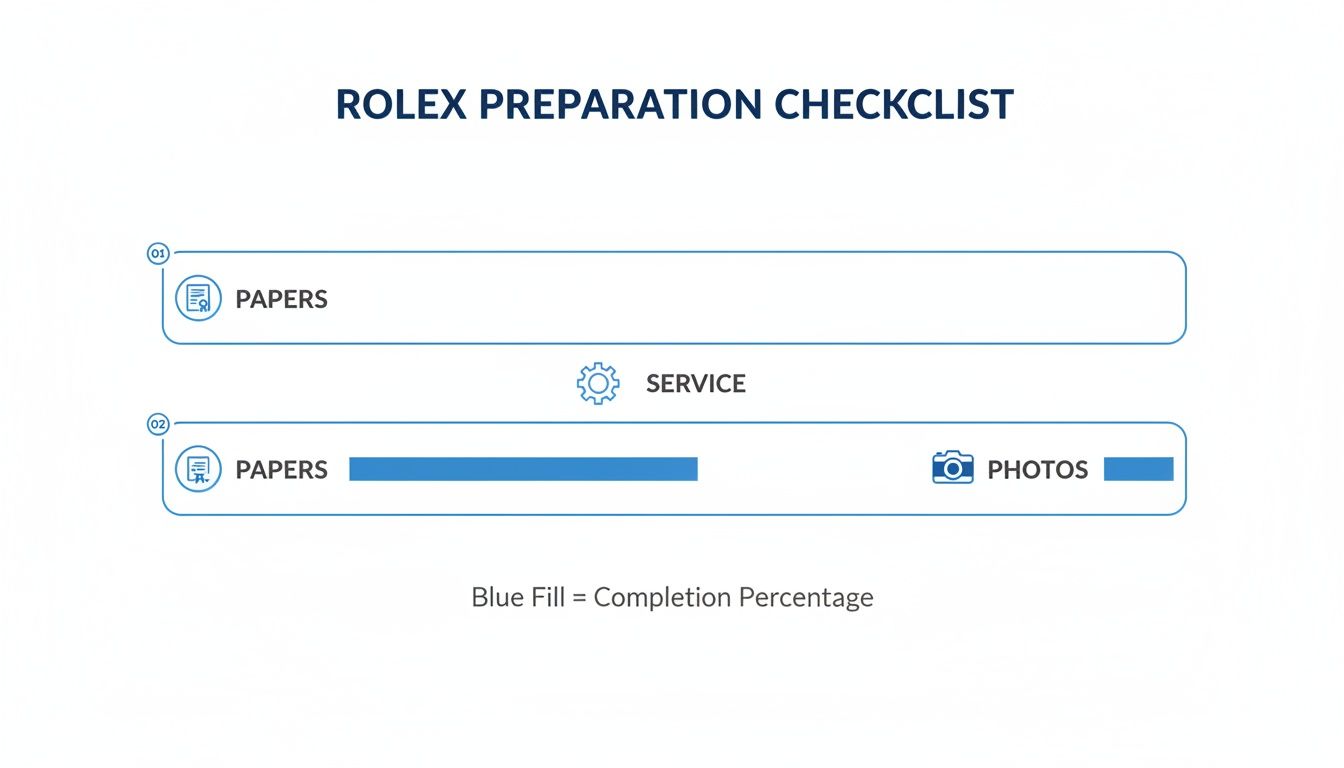
Think of this as your pre-sale checklist. Getting these foundational steps right—papers, potential service, and quality photos—is how you maximize what buyers are willing to pay.
Understanding Market Dynamics and Timing
The pre-owned Rolex market isn’t static. It behaves a lot like other asset markets, with bull runs and sharp corrections. In fact, data from Bob’s Watches shows the average Rolex resale price jumped over 550% in just 15 years, from about $2,050 in 2010 to $13,426 in 2025. You can read more about the top-selling Rolex models over the last 15 years on National Jeweler to see how different references have performed.
This history means a watch bought a decade ago has likely gained significant value. But timing your sale to avoid market troughs can change your proceeds by thousands.
A professional valuation from an expert like ECI Jewelers isn’t just a price guess. It's a data-backed assessment of your watch's worth in today's specific market, protecting you from underpricing your asset or setting an unobtainable goal.
This is exactly why a generic online "Rolex value calculator" can be so misleading. They simply can't account for the subtle nuances of condition, the completeness of your set, or real-time buyer demand.
A formal valuation gives you a realistic baseline and a powerful anchor point for negotiations. It transforms the conversation from subjective opinions to objective facts. At ECI Jewelers, our free, no-obligation valuation leverages decades of market data and hands-on expertise. We'll clarify exactly what your Rolex is worth and why, so you can move forward with total confidence.
Choosing the Right Buyer for Your Rolex
You've done the prep work and have a solid idea of your watch's market value. Now for the most important part: deciding where to sell it. This decision is about more than just the final number; it's a balancing act between price, speed, and your peace of mind.
Each selling channel comes with its own set of trade-offs. Let's break down your options so you can figure out which path makes the most sense for you.
Honestly, the strategy for selling a high-value watch isn't that different from what you'd find in a guide on how to sell a business. It all comes down to finding the right market and buyer who aligns with your goals.
Selling Directly to a Trusted Dealer
For most people, selling directly to a reputable luxury watch dealer like ECI Jewelers is the cleanest and safest route. This option puts speed, security, and simplicity first. The process couldn't be more straightforward: we give you a professional valuation, you accept the offer, and you get paid. Immediately.
You completely sidestep the waiting games and headaches that come with other methods.
- Speed: Payment is fast, often the same day via bank wire or check.
- Security: You’re working with a licensed business with a physical storefront and a hard-earned reputation. The risk of getting scammed is virtually zero.
- Convenience: The dealer handles everything. No need to take professional photos, write listings, or field questions from strangers.
We recently had a client who needed to sell his Rolex Submariner to fund a down payment on a house. Could he have potentially made a little more in a private sale? Maybe. But for him, the guarantee of a fair, instant payment within 24 hours was far more valuable than weeks of uncertainty.
Using a Consignment Service
Consignment is another option. You leave your watch with a dealer, and they sell it for you. You only get paid once it finds a new home. While this can sometimes lead to a higher payout than a direct sale, it’s a slow game with real drawbacks.
The dealer takes a commission, usually between 15% to 30% of the final sale price. But the bigger issue is the unpredictable timeline. Your watch might sell in a week, or it could sit in a display case for the next six months. If you need the money by a certain date, consignment is not the way to go. It’s really only for sellers who are in no rush at all.
The Risks and Rewards of a Private Sale
Selling your Rolex yourself on a platform like eBay or Chrono24 can look appealing on the surface. By cutting out the middleman, you have the potential to get the absolute top dollar for your watch. But this path is loaded with risk and requires a lot of work on your part.
Suddenly, you’re responsible for everything:
- Taking professional-grade photographs.
- Writing a detailed, compelling listing.
- Answering an endless stream of questions.
- Filtering out the lowballers and time-wasters from serious buyers.
- Figuring out the logistics of secure payment and insured shipping.
The biggest threat in a private sale is fraud. Scammers are incredibly good at what they do, using everything from fake payment confirmations to elaborate stories to cheat you out of your watch. One slip-up, and you could lose everything. For a deeper dive, check out our guide on where to sell luxury watches to see how the different options stack up.
Trading In Your Watch
Finally, you can always trade your Rolex toward a new watch at a jeweler. This is a fantastic option if your goal is to upgrade your collection rather than get cash. The process works just like a direct sale: we’ll assess your watch’s value and apply that amount as a credit toward your next piece. It’s a seamless way to get into that new model you've had your eye on.
At the end of the day, picking the right buyer comes down to what you value most. If a fast, secure, and guaranteed sale is your top priority, then a trusted dealer is the clear winner.
Navigating the Negotiation Process with Confidence
Walking into a negotiation for your Rolex can feel like a high-stakes game, but it really doesn’t have to be. When you’re armed with a professional, data-driven valuation, you’ve already set a powerful anchor for the entire conversation. This isn’t about winning an argument; it’s about confidently reaching a fair, market-based agreement where both you and the buyer walk away feeling respected.
Think of your valuation as your north star. It grounds the discussion in objective data, steering it away from vague opinions about what the watch "should" be worth. When you can point to real-time market comps and the specific details driving your watch’s price, you immediately establish a position of strength.
Use Rolex’s Own Prices as Your Leverage
One of the most powerful tools a seller has—and one that many overlook—is Rolex's own pricing strategy. To intelligently sell a Rolex, you have to understand how the brand’s constant retail price increases directly pump up the value of pre-owned models.
From 2023–2026, for example, Rolex rolled out steeper-than-average price hikes. In January 2026 alone, European prices for core models like the Submariner and Daytona shot up by 2.5–6%.
- Stainless steel models jumped by roughly 3.5%.
- Two-tone versions saw a 4.5% bump in that single adjustment.
- Gold models got hit even harder, sometimes adding over €2,400 to a watch's retail price overnight.
You can see the full breakdown of these Rolex price increases on Wristler.eu to get a sense of the impact.
This is critical information for you. A Datejust that retailed for $7,000 just a few years ago might now list for over $9,000 new at an authorized dealer. This rising tide lifts the entire pre-owned market, because the cost to replace these watches keeps climbing. Reputable buyers like ECI Jewelers always use current MSRP and historical price data as a key benchmark for our offers.
Knowing that Rolex has tacked on 10–15% to its list prices in just a few years gives you a powerful counterpoint in any negotiation. It backs up your valuation and helps justify a strong offer, whether you're looking for cash or a trade-in.
Responding to Common Buyer Tactics
During negotiations, you’ll probably run into a few classic moves designed to get you to lower your price. Staying calm and being prepared is the best way to handle them.
Here are a few scenarios you might face and how to respond:
- The Lowball Offer: This is the most common tactic—an initial offer that’s dramatically below market value. Don't get offended; just see it as their opening gambit. Politely bring the conversation back to your professional valuation and the market data you have, explaining that your price is based on current, verifiable figures.
- Focusing on Minor Flaws: A buyer might make a big deal about tiny, hairline scratches on the clasp or normal signs of wear. Acknowledge what they're seeing, but calmly remind them that these factors were already considered in the professional valuation for a pre-owned watch of its age.
- The "Cash Today" Pressure: Some buyers will push for a deep discount in exchange for an immediate cash payment. It can be tempting, but remember that established dealers like ECI Jewelers offer same-day payment as a standard part of a fair market offer, not as an excuse to lowball you.
A successful negotiation should feel like a win-win. You want to feel you received fair compensation for a valuable asset, and the buyer wants to feel they paid a fair price. That only happens through a transparent process built on mutual respect.
Knowing When to Accept an Offer
So, when is the right time to say yes? It’s when an offer lines up with the fair market value you established from the start and meets your personal goals. A strong offer from a reputable buyer will be close to your professional valuation, transparent, and hassle-free.
When you work with a trusted partner, the "negotiation" feels much more like a collaborative discussion. At ECI Jewelers, our offers are built on transparent market data. We’ll walk you through exactly how we arrived at our number, making sure you feel confident and informed. Our goal is to give you a fair, competitive offer that leads directly to a secure, same-day payment—taking all the stress and uncertainty out of the equation.
Completing the Sale Securely
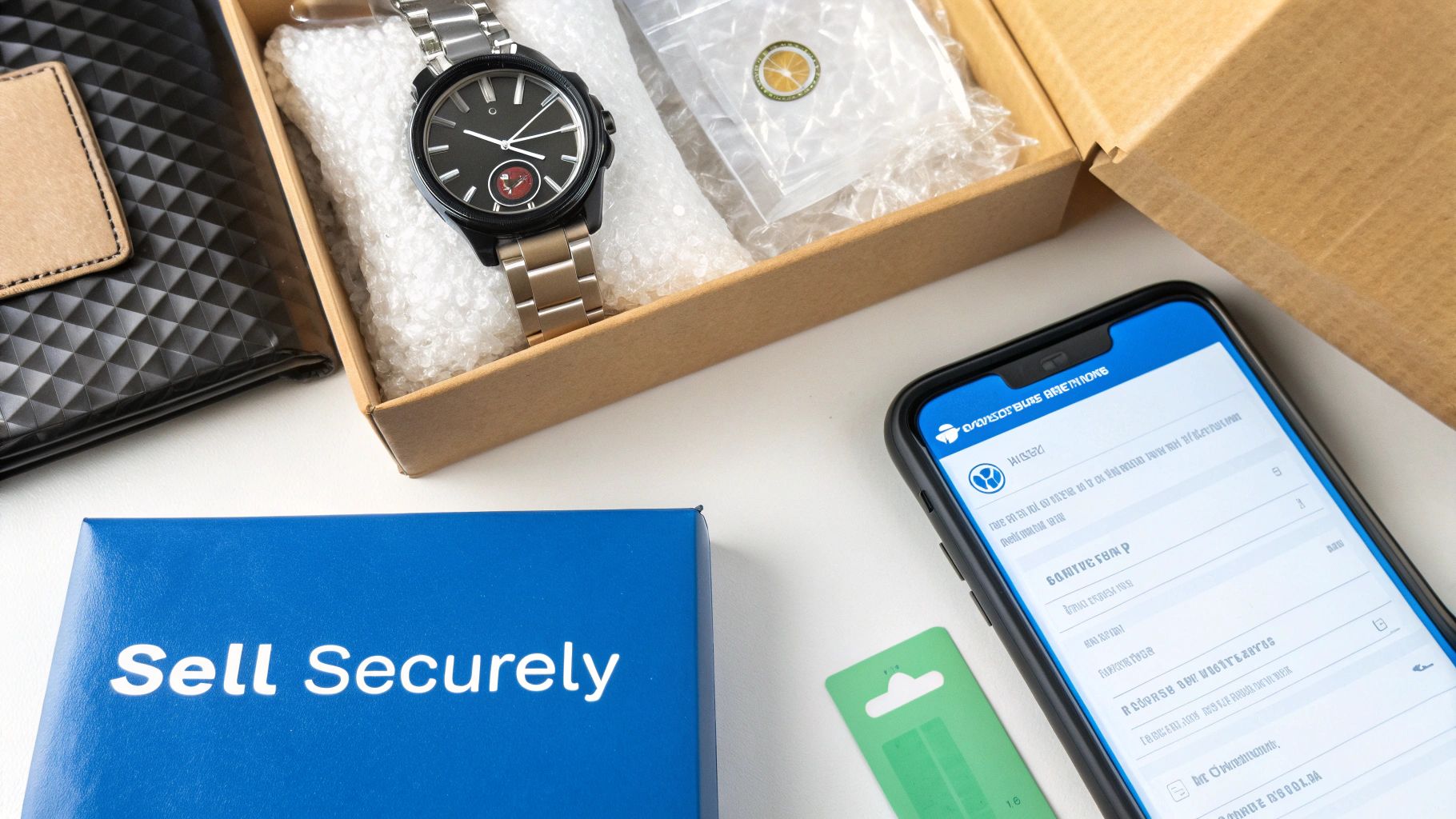
You’ve done the hard work—navigating the valuation, photography, and negotiations. Now comes the most critical part: closing the deal. This final stage is all about security, where the actual exchange of your high-value timepiece and the buyer's money happens. Getting this right is what separates a smooth, successful sale from a potential disaster.
The goal here is to completely eliminate risk. Whether you're meeting a buyer in person or shipping your watch across the country, every step has to be deliberate and secure. It’s why so many sellers prefer working with an established buyer like ECI Jewelers. Our entire process is built around verified, insured, and guaranteed transactions, giving you total peace of mind from start to finish.
Choosing the Safest Payment Method
When it comes to getting paid for a Rolex, not all payment methods are created equal. For a transaction of this value, your absolute priority is choosing an option that is irreversible and verifiable. This is completely non-negotiable.
Bank Wire Transfer: This is the gold standard for a reason. A bank wire is a direct, bank-to-bank transfer that, once cleared, cannot be reversed. It creates a clean, traceable record of the transaction, protecting both you and the buyer. Having a solid understanding of transaction IDs for secure payments can add another layer of confidence.
Cashier's Check: Drawn directly from the buyer's bank, a cashier's check is another solid option. It's far safer than a personal check, but you should still wait for your bank to fully verify and clear the funds before you hand over the watch. This can take a few business days, so be patient.
Red Flag Alert: Be extremely wary of any buyer who insists on using peer-to-peer payment apps (like Venmo or Zelle), personal checks, or any method that can be disputed or reversed. These are common tools used by scammers in sophisticated fraud schemes.
At ECI Jewelers, we take all the guesswork and anxiety out of getting paid. We offer immediate, verified payment via bank wire or company check, ensuring you get a secure and documented transaction every time.
How to Ship a High-Value Watch
If your buyer isn't local, shipping requires serious attention to detail. You can't just drop a Rolex in a standard box and hope it arrives safely. Proper packing and, most importantly, correct insurance are essential to protect your asset in transit.
Here’s a quick rundown on how to ship securely:
- Double-Box for Security: First, place the Rolex box inside a slightly larger, sturdy cardboard box. Fill any empty space with bubble wrap or packing peanuts to stop it from moving around. Then, place that box inside an even larger shipping box, again using plenty of padding. This double-boxing method adds shock absorption and makes the package less obviously a high-value item.
- Choose the Right Carrier: Stick with a reputable carrier like FedEx or UPS that has proven experience with high-value shipments. Critically, you must always require a signature upon delivery.
- Insure for Full Value: This is the most important step. Standard carrier insurance is often capped at a laughably low amount. You need to buy third-party parcel insurance (from a company like Parcel Pro) or work with a buyer who provides it. Never under-declare the value to save a few bucks on shipping—if anything happens, you'll only be covered for the declared amount.
Honestly, this process can feel like a headache, which is exactly why we've made it effortless for our clients. When you sell to ECI Jewelers, we just send you a pre-paid, fully insured shipping label. All you have to do is pack the watch according to our instructions and drop it off. Your Rolex is completely protected from the moment it leaves your hands until it arrives safely with us. No risk, no stress.
Common Questions About Selling a Rolex
When you decide it’s time to part with your Rolex, a few key questions almost always come up. It can feel like a complicated world to step into, but getting straight answers is the best way to move forward with confidence. From paperwork to pricing, let’s tackle what most sellers are wondering.
Do I Absolutely Need the Box and Papers?
This is usually the first thing people ask. The short answer is no, but it definitely affects the final price.
A watch that comes as a “full set”—meaning it has the original box, warranty card, manuals, and hang tags—will always command a premium. For collectors, that complete package is gold, as it confirms the watch's history and authenticity beyond a doubt. They’ll pay more for it, simple as that.
But if you’ve lost track of them over the years, don't worry. It’s not a deal-breaker. An experienced buyer like ECI Jewelers can authenticate your watch on its own merits and make a strong, fair offer based on its condition and the current market. The offer will just be adjusted to account for the missing pieces.
How Much Can I Realistically Expect to Get?
Ah, the big one. The value of your Rolex isn't one fixed number; it’s a moving target determined by its model, reference number, condition, and what the market is willing to pay for it right now. A vintage steel Submariner that's been kept in great shape is in a completely different league than a modern two-tone Datejust that shows signs of being a daily companion.
The specific model and configuration can swing the value by tens of thousands of dollars, which is why collectors obsess over specific references. For instance, in 2024, a stainless-steel Submariner 126610LN is trading for around $14,800, while a Cosmograph Daytona 116500LN can pull in an average of $42,000. Even after the market corrected from its 2022 highs, in-demand steel sports models still fetch huge numbers, while a more common Datejust might land in the mid-four-figure range. You can dive deeper into the latest numbers and Rolex watch trends and values at WYWATL.com.
Here's the bottom line: a truly accurate valuation comes from real-time market data. A professional appraisal looks at your watch and the entire market landscape to give you a price grounded in reality, not just a guess.
What Is the Safest Way to Sell My Rolex?
Finally, let’s talk about safety. When you’re dealing with an item worth thousands of dollars, security is everything. Private marketplaces might seem attractive because you think you can squeeze out a slightly higher price, but they are crawling with risks—from payment scams to straight-up robbery. You’re on your own vetting buyers, figuring out insured shipping, and taking on all the liability if something goes wrong.
This is why working with a trusted, established luxury watch dealer is, by far, the safest and most hassle-free route. A reputable buyer creates a secure, professional environment from the first contact to the final payment. They’re set up to protect you with services that private sales just can’t offer:
- Insured Shipping: We provide pre-paid, fully insured shipping labels, so your watch is completely protected the second it leaves your hands.
- Verified Payments: You get paid through secure, irreversible methods like a bank wire or company check. No bounced payments or chargebacks to worry about.
- Professional Authentication: The entire verification process is handled by experts in a secure facility.
Going with a trusted dealer removes all the guesswork and danger, ensuring your sale is transparent and secure.
When you're ready for a secure, transparent, and fair valuation, trust the experts at ECI Jewelers. We provide free, no-obligation offers, same-day payments, and fully insured shipping to make selling your Rolex simple and safe. Get your professional valuation today by visiting us at https://www.ecijewelers.com.


