


If you're asking, "what is my Rolex worth," you're asking a question with a moving answer. The value isn’t one fixed number—it’s a living range that can span from $5,000 for a common, well-loved model to well over $100,000 for something truly rare. The price on the original tag is ancient history; the real story is told by its condition, history, and what collectors are willing to pay for it right now.
Understanding What Your Rolex Is Really Worth
Forget thinking about your Rolex like a simple accessory. It’s much more like a small, unique piece of real estate. A house’s value depends on its neighborhood, age, and upkeep, right? It’s the same with your watch. The price you paid for it years ago has almost no bearing on what it’s worth in today's secondary market, where rarity and collector demand are king.
The first step to finding its true value is realizing that no two Rolex watches are the same in the eyes of the market. A vintage Submariner from the 1960s with a story to tell is in a completely different universe than a modern Datejust bought last year. This guide will walk you through the essential details, so you can start seeing your watch just like a professional appraiser would.
The Core Factors That Drive the Price
To get a real, accurate picture of your watch's value, we have to look past the iconic crown logo and dig into the specifics. All these little details add up to create its final market price.
Here’s what really matters:
- Model and Reference Number: This is the watch's unique fingerprint, its DNA.
- Physical Condition: Every scratch, polish, and replacement part tells a story that impacts the final number.
- "Box and Papers": Having the original packaging and documentation is like having the title and deed to a house. It proves everything.
- Market Demand: Is your watch a hot commodity right now, or are collectors chasing something else?
It’s a classic mistake to overlook the small stuff. A "full set"—meaning the watch comes with its original box and warranty card—can boost its value by 15-20% or even more. For collectors, that complete package provides a verifiable history that is worth paying a premium for.
Moving Beyond the Sticker Price
At the end of the day, the answer to "what is my Rolex worth" is simple: it's worth whatever an informed buyer will pay for it today. That figure is constantly being shaped by auction results, private sales, and what dealers are asking. It’s a dynamic number that reflects a global marketplace of enthusiasts and investors.
Once you get a handle on the factors driving that number, you'll have the confidence to decide your next move—whether that's selling, trading, or simply insuring your timepiece. Now, let’s break down each of these value drivers one by one.
The Seven Factors That Define Rolex Value
So, what's my Rolex actually worth? To get a real answer, you need to start thinking like a seasoned appraiser. A watch’s value isn't just about the gold or steel on your wrist; it’s a complex mix of seven distinct factors. Each one plays a part in the final price, and knowing them is the key to understanding your watch's true market potential.
Think of these seven elements as the unique DNA of your timepiece. Some are genetic—like the model it was born as—while others are environmental, shaped by its life story and the world around it. Let's decode them one by one.
1. Model and Reference Number: The Blueprint
The single most important factor is the watch's model and reference number. This is its fundamental identity, like a car's make and model. A Daytona is not a Datejust, and a Submariner is not a GMT-Master II. Certain models, especially the professional steel sports watches, consistently fetch higher prices simply because of their iconic status and overwhelming demand.
The reference number, that four- to six-digit code engraved between the lugs, drills down even deeper. It tells an expert the specific version of the model, its production era, bezel type, and what it’s made of. This code is the blueprint that sets the baseline for its entire valuation.
2. Condition: The Time Capsule
How well has your watch been preserved? The condition is a massive value driver. It’s simple: a watch in pristine, "like-new" condition with sharp, unpolished case lines is far more desirable than one showing a lifetime of wear. Every scratch, dent, or blemish on the case, bracelet, crystal, and dial will affect the final number.
A common mistake is thinking a professional polish right before selling will boost the value. In reality, over-polishing can soften the sharp, original lines of the case that collectors prize. This can actually decrease its worth significantly.
For vintage pieces especially, originality is everything. An original, untouched dial that has developed a unique patina over decades can sometimes be worth more than a "perfect" but newer replacement dial.
3. Box and Papers: The Birth Certificate
Having the original box and papers is like having a birth certificate and passport for your watch. These documents—the warranty card, chronometer certificate, and maybe even the original purchase receipt—confirm the watch's authenticity and tell its origin story. When a watch is sold as a "full set," it gives a buyer complete confidence.
This infographic breaks down the core pillars of Rolex value, visually connecting the watch to its condition, history, and market demand.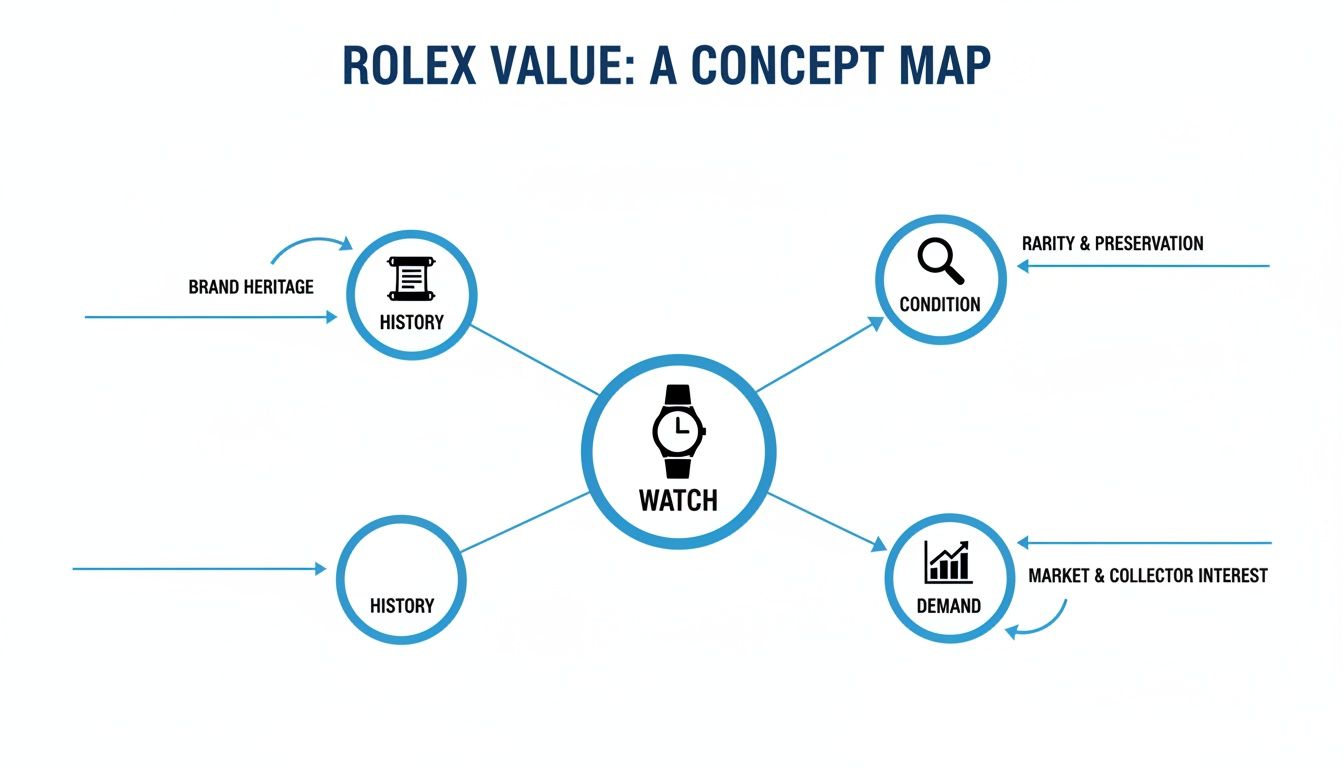
As you can see, a watch's value isn't a single point but a balance of these interconnected elements.
The presence of these items can easily increase a watch's value by 15-20% or more. For a serious collector, paying a premium for a complete set is a small price for total peace of mind. Authenticity is everything, which is why a professional appraisal is so crucial. You can learn more in our expert guide on how to authenticate a Rolex watch.
4. Provenance: The Story
Does your watch have a story to tell? Provenance is the documented history of a timepiece's ownership. While most watches won't have a headline-grabbing past, some do. Was it owned by a notable person? Was it worn during a historic event?
A Rolex Submariner worn by a military diver and accompanied by their service records, for example, is far more valuable than an identical model without that history. Just look at the most famous examples, like Paul Newman's own Daytona which sold for a staggering $17.8 million. It shows just how powerful a compelling story can be.
5. Service History: The Health Record
A detailed service history acts as a health record for your watch. Regular maintenance from Rolex or a certified watchmaker ensures the movement is in perfect working order. Official service papers prove that the watch has been cared for properly and that any replacement parts are genuine.
But an improper service can be a disaster for value. If a vintage watch had its original dial or hands swapped out for modern service parts, it could crush its collector value. Remember, originality is king.
6. Rarity and Production Status: The Scarcity Factor
It all comes down to simple supply and demand. The rarity of a watch plays a huge role in what it’s worth. This can happen for a few reasons:
- Limited Production: Some models were only made for a short time or in very small numbers.
- Discontinued Models: Once Rolex stops making a reference, the existing supply becomes finite, and prices often climb.
- Unique Features: "Error dials," special editions, or watches with unusual configurations (like a left-handed GMT-Master II) are highly sought after by collectors.
A watch that was hard to get when it was new often becomes even more valuable on the secondary market.
7. Market Demand: The Current Climate
Finally, the current market demand ties everything together. Collector tastes change, and certain models can become "hot" almost overnight. A watch's value is ultimately set by what someone is willing to pay for it today. This is the most dynamic factor of all, influenced by auction results, economic trends, and even social media buzz.
The impact of these factors is huge. A watch in mint condition can fetch 15-30% more than an average example, and having the original box and papers can add another 15-20% on top of that. On the flip side, significant wear or non-original parts can slash the value by up to 40%.
Navigating Current Rolex Market Trends
Knowing what makes your specific watch valuable is only half the battle. The other half is understanding the market itself—a living, breathing ecosystem where values can shift with surprising speed. Answering "what is my Rolex worth?" means looking beyond your watch and into the economic currents shaping the entire industry.
Think of the pre-owned Rolex market less like a straight line and more like the stock market. It has its peaks, valleys, and corrections. Knowing when to sell can be just as important as what you're selling. If you can time your sale to line up with peak demand for your specific model, you could see a significant bump in your final offer.
For instance, professional sports models like the Daytona and GMT-Master II almost always lead the pack, consistently trading far above their original retail prices. But even these icons aren't immune to market shifts. After hitting unbelievable highs a couple of years ago, some of these references have cooled off, settling into a more stable—though still very high—price range.
The Power of Long-Term Appreciation
While short-term swings grab all the headlines, the long-term view tells a much more compelling story of growth. Many classic Rolex models have proven to be incredible assets, quietly appreciating far beyond what anyone might have expected. A perfect example of this slow-and-steady growth is the classic Rolex Datejust.
Imagine you had a Rolex Datejust from around 2010. Back then, you could find one on the pre-owned market for about $1,150. Fast forward to today, and that same model now fetches around $8,500, marking a staggering 639% appreciation over 15 years. This kind of growth shows how even models once considered standard have become highly sought-after assets.
Interpreting Current Market Signals
So, how can you get a feel for the current climate for your watch? It’s all about reading the market signals. This takes more than a quick Google search; it means understanding the context behind the numbers you see.
Here are a few things to keep an eye on:
- Auction Results: Major auction houses like Phillips and Sotheby’s offer a transparent, public record of what serious collectors are willing to pay for top-tier examples.
- Dealer Inventories: If dealers have long waitlists for a model, it’s a clear sign of white-hot demand. On the flip side, if you see inventory sitting for a while, the market for that reference might be softening.
- Economic Indicators: The luxury market is often a reflection of broader economic health. When consumer confidence is high, discretionary spending on items like luxury watches tends to go up.
The market isn't a monolith. While a stainless steel Submariner might be cooling from its peak, a rare vintage gold Day-Date could be heating up. Each model family behaves differently based on collector tastes and its own unique scarcity.
Understanding these nuances is where real expertise comes in. A professional appraiser doesn't just know about watches; they live and breathe these market trends every single day. Their insight is what separates a good offer from a great one.
To dive deeper into which models are currently trending up or down, check out our complete guide on Rolex price trends for 2025. It will give you a much clearer picture of where your timepiece fits into today's market.
How to Prepare Your Rolex for Valuation
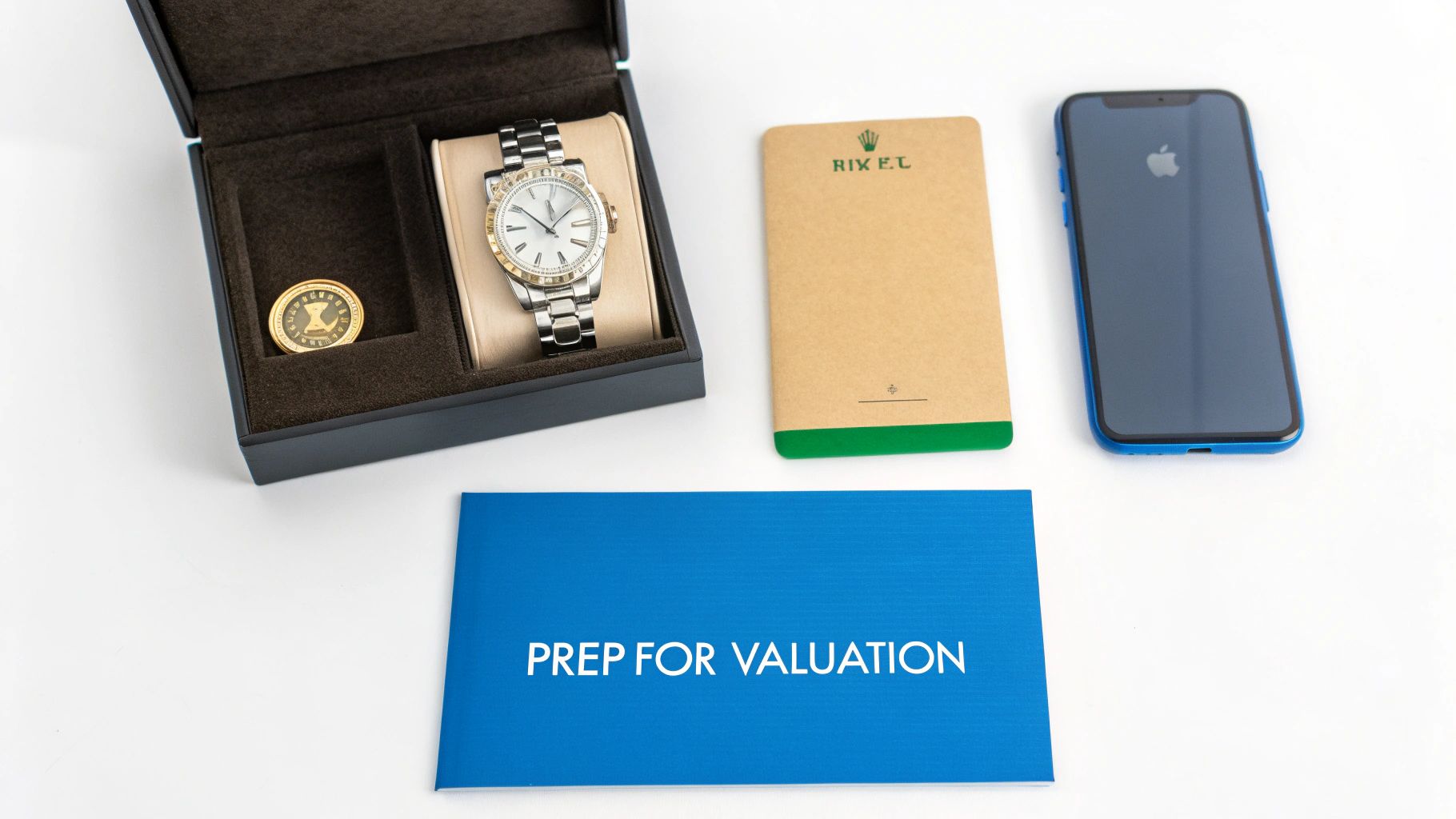
Before you bring your Rolex to an expert, a little prep work goes a long way. Taking a few simple steps can speed up the whole process and help you get the most accurate—and best possible—valuation. Think of it like organizing a property's deed and records before a sale. The clearer the picture, the more confident the valuation.
This isn't about making your watch look "better." In fact, some of the most common well-intentioned moves can actually hurt its value. It’s about presenting your watch and its history honestly so an appraiser can see every detail that adds to its worth. When everything is in order, the expert gets the full story, leading to a much more precise answer to "what is my Rolex worth?"
Step 1: Gather Every Piece of Documentation
This is the big one. Round up everything that originally came with your watch. This is the tangible proof of its history and authenticity. Collectors call a watch with all its original materials a “full set,” and it always commands a premium on the market.
Before you get an appraisal, find and organize these items:
- The Original Box: Both the inner presentation box and the outer cardboard sleeve matter.
- Warranty Card or Papers: This is the watch’s birth certificate. It's the single most important document.
- Instruction Manuals and Booklets: These small details add to the completeness and prove nothing was lost.
- Original Sales Receipt: If you still have it, this is fantastic proof of the purchase date and origin.
- Service Records: Any paperwork from official Rolex services adds to the watch's verifiable history and shows it was cared for properly.
Think of it this way: a watch without its papers is like a classic car without its title. It might still be the real deal, but proving its lineage is much harder. That makes buyers cautious and can lower the value by as much as 15-20%.
Step 2: Do Not Clean or Polish Your Watch
This might sound backward, but one of the worst things you can do before an appraisal is try to clean or polish your Rolex yourself. Wiping off some surface dust with a microfiber cloth is fine, but anything more can be a very expensive mistake.
A bad polish can permanently ruin the watch's case. Aggressive buffing rounds off the sharp, crisp lines and bevels that define a Rolex case's original design. Collectors prize those factory-finished edges. An over-polished watch is seen as damaged goods, and its value will drop dramatically. Even using the wrong cleaning chemicals can damage the seals or the dial.
Just leave the watch in its honest, as-is condition. An expert appraiser knows exactly how to look past surface grime to assess the true state of the metal underneath. They’ll see the potential and value it correctly, without the risk of you causing irreversible damage.
Step 3: Take Clear and Detailed Photographs
Finally, take a series of clear, well-lit photos of your watch from every important angle. These images are great for your own records and are essential if you’re looking for an initial online quote. Good photos let an appraiser do a solid preliminary check of your watch's condition, model, and unique features before you even send it in.
Here’s a quick checklist for the shots you need:
- A direct shot of the dial: Make sure the hands aren't covering the Rolex logo or any text.
- A photo of the case back: Capture any engravings clearly.
- Shots of both sides of the case: This shows the condition of the crown and the case profile.
- A close-up of the clasp: Get a sharp focus on the Rolex coronet.
- A picture of the full bracelet: Lay it out flat to show its overall condition and any stretching.
- A group shot of everything: The watch, its box, and all the papers you gathered.
Use natural, indirect light to avoid glare. With these documents, an untouched watch, and a good set of photos, you are perfectly set up to get a true, expert valuation.
Comparing Your Options for Selling a Rolex
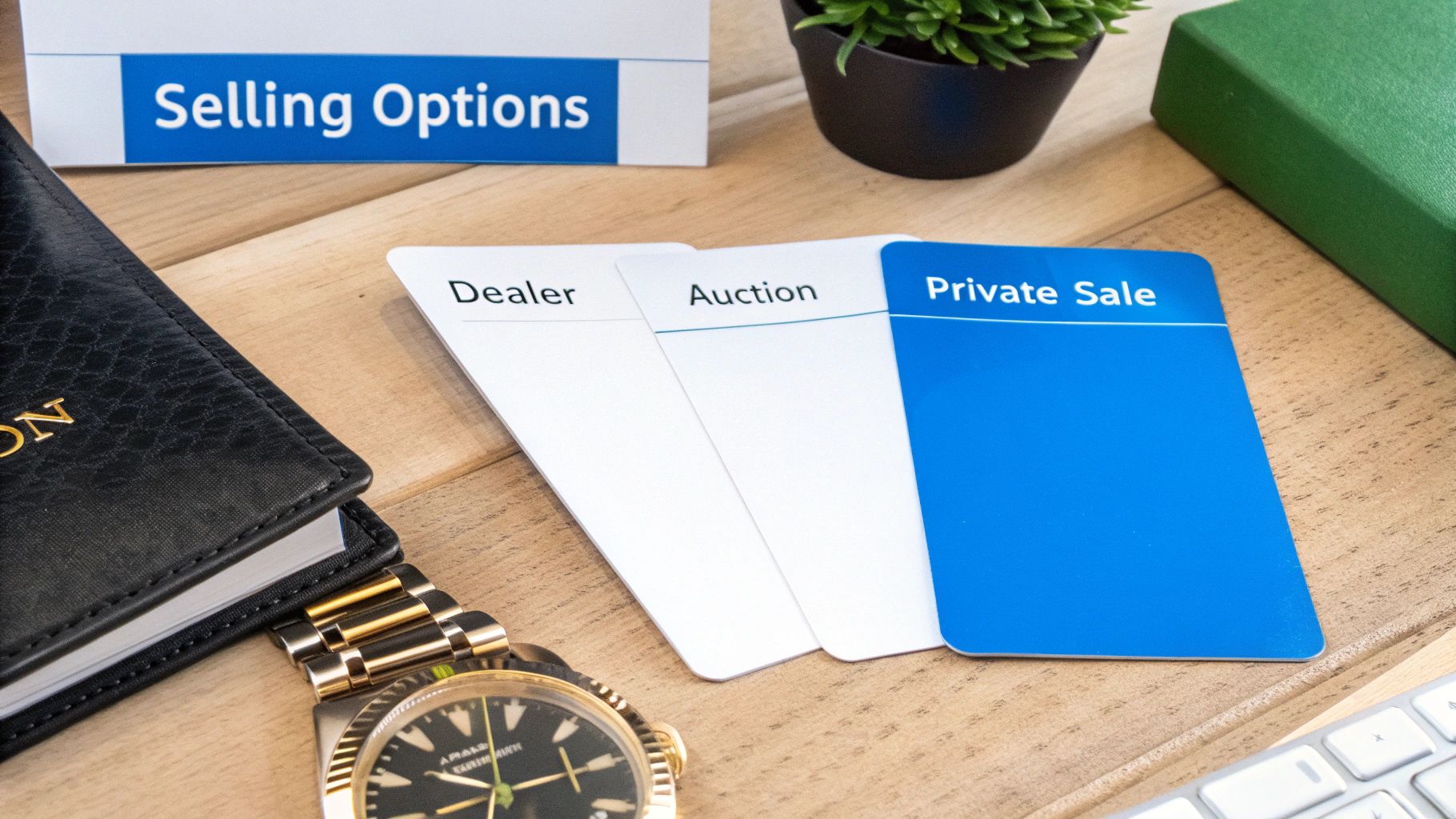
Once you have a solid idea of your Rolex's value, the big question becomes: where do you actually sell it? The best answer really boils down to what you prioritize. Are you chasing the absolute highest price possible, no matter how long it takes? Or is a fast, secure, and convenient sale more important?
There’s no single "right" way—it's always a trade-off. Think of it like selling a high-end car. You can take it to a dealership for a quick, guaranteed offer, or you can go through the hassle of selling it privately to pocket a bit more cash. Each path has its own distinct pros and cons.
Selling to a Specialized Dealer
Going directly to an expert luxury watch dealer, like us here at ECI Jewelers, is easily the most straightforward and secure route. We live and breathe the pre-owned market and have the capital ready to buy your watch outright, often in a single day.
The process is built for simplicity and speed. You get a professional appraisal, and if you like the offer, you get paid on the spot. This method completely removes the waiting, uncertainty, and risk that comes with other options.
- Pros: Quick transaction, immediate payment, maximum security, and absolutely zero risk of fraud.
- Cons: The offer will be below the watch's full retail market price. As a business, the dealer has to factor in overhead and a margin for resale.
This is the perfect choice for anyone who values a guaranteed, safe, and completely hassle-free sale over trying to squeeze every last potential dollar out of their watch.
Consigning Through an Auction House
For truly rare or historically important watches, an auction house can be an incredible stage. Putting your Rolex in front of a global audience of dedicated collectors can sometimes ignite a bidding war, pushing the final price far beyond anyone's expectations.
But this path is neither fast nor a sure thing. The auction process is long, often taking months from the time you consign your watch to the actual auction day. On top of that, auction houses take a hefty seller’s premium, which can be anywhere from 15% to 25% of the final sale price.
Selling at auction is a high-risk, high-reward game. You might hit a home run and set a new record, but there’s also a real chance your watch doesn't meet its reserve price and fails to sell, leaving you right back where you started.
This option is really only for owners of unique, high-value timepieces who are in no hurry to sell and are comfortable with the significant fees and risks involved.
Attempting a Private Sale
On the surface, selling your Rolex privately to another individual through an online marketplace looks like the best deal. By cutting out the middleman, you can theoretically keep 100% of the sale price. It sounds great, right?
Unfortunately, this route is littered with serious risks. You're on your own when it comes to vetting buyers, fending off endless lowball offers, and figuring out how to handle a secure payment and delivery for a multi-thousand-dollar item. The risk of fraud, fake payments, or even physical danger during an in-person meetup is frighteningly real.
Comparison of Rolex Selling Methods
To make the decision clearer, here’s a head-to-head comparison of your options. This table breaks down the key trade-offs in speed, price, security, and effort.
| Selling Method | Pros | Cons | Best For |
|---|---|---|---|
| Specialized Dealer | Fast, secure, guaranteed sale, immediate payment, no fees. | Offer is below full retail market value. | Sellers who want a quick, safe, and hassle-free transaction. |
| Auction House | Potential for a very high sale price, access to global collectors. | Slow process (months), high fees (15%-25%), no guaranteed sale. | Owners of exceptionally rare or valuable watches who aren't in a rush. |
| Private Sale | Highest potential net return (keep 100% of the sale price). | High risk of fraud/scams, time-consuming, requires personal effort. | Experienced sellers who are comfortable managing high-value transactions and risks. |
| Trade-In | Convenient, immediate credit toward a new watch purchase. | Credit value is typically lower than a cash offer. | Buyers who want to upgrade their watch at the same time they sell. |
Ultimately, choosing the right avenue ensures your valuable asset is handled correctly from start to finish. For a deeper dive into the nuances of each option, our detailed guide on how to sell luxury watches provides even more valuable insights to help you prepare.
Get Your Free, No-Obligation Rolex Valuation Today
Figuring out what your Rolex is worth is more than just getting a number—it’s about finding a partner you can trust. You’ve learned all the factors that go into a valuation, from the model and condition to its service history. Now, it's time for the final step: getting a professional opinion.
That's where we come in. With decades of hands-on experience, we provide honest, market-based valuations that reflect the true, current value of your watch. Our entire process is built on transparency. We offer a completely free, no-obligation appraisal to give you the clarity you need to make an informed decision. We don’t just give you a price; we walk you through how we got there, so you understand exactly what your watch is worth and why.
Why Choose ECI Jewelers?
Working with us is designed to be a seamless, secure, and rewarding experience from start to finish. We've structured our service to eliminate the typical headaches and risks that come with selling a high-value timepiece.
Here’s what you can expect:
- A 100% Authenticity Guarantee: Every watch that comes through our doors is meticulously inspected by our in-house specialists. You get total peace of mind.
- Transparent Market-Based Offers: Our valuations are directly tied to current, real-world market data. No guesswork, just fair and competitive pricing.
- Same-Day Payment: If you decide to sell, you won't wait. We offer immediate payment via check or wire transfer.
- Fully Insured Shipping: For our clients outside of NYC, we provide fully insured, prepaid shipping labels. The process is safe and effortless.
Your Rolex is a significant asset. It deserves to be handled by experts who respect its value and your trust. Our goal is to provide a five-star experience, whether you sell to us or simply want to understand your watch’s place in today's market.
We take the risk out of the equation, allowing you to move forward with certainty. Getting an accurate answer to “what is my Rolex worth?” should be a straightforward, professional experience. With our team, you can be sure you're getting an honest assessment backed by years of industry knowledge.
Ready to find out the true value of your timepiece? Start the process today by filling out our simple and secure online form. Get the expert valuation you deserve.
Rolex Valuation FAQs
If you're thinking about selling your Rolex or are just curious about its value, you probably have a few questions. The world of watch valuation can feel complicated, but getting clear answers is the first step. Here are some of the most common questions we hear from clients every day.
Is My Rolex Worth More With the Original Box and Papers?
Yes, without a doubt. When you have the original box, warranty card, manuals, and sales receipt, it’s known in the industry as a "full set." Think of it as your watch's birth certificate—it proves authenticity and tells its story in a way nothing else can.
For serious collectors, a full set is non-negotiable. It provides peace of mind and completeness that they will pay a premium for. Having everything can easily boost your watch's value by 15% to 20%, and sometimes even more for rare vintage models. It's the single best way to maximize your offer.
Should I Service My Rolex Before Selling It?
Our advice is almost always no. It seems logical—get the watch looking pristine before an appraisal—but this move can seriously backfire. A bad service, especially an aggressive polish that softens the sharp, factory-fresh lines of the case, can permanently reduce your watch's value.
Vintage collectors prize originality above all else. A service that swaps an aged, beautifully patinated dial for a modern replacement can strip a watch of its soul and collector appeal, potentially slashing its worth in half. Always let an expert see it as-is first.
How Can I Tell if My Rolex Is Real?
Spotting a fake is a job for a seasoned professional. While there are a few tell-tale signs for spotting obvious counterfeits, like a stuttering, ticking seconds hand (a real Rolex sweeps smoothly), true verification goes much deeper.
A professional appraiser knows exactly where to look, focusing on the details that counterfeiters can never get quite right:
- The Movement: The intricate, in-house mechanism is the heart of a Rolex and the most difficult component to fake convincingly.
- Weight and Feel: Real Rolex watches have a satisfying heft to them, a result of the high-grade steel and precious metals used.
- Engravings and Markings: All text, from the dial to the engraved serial number, should be perfectly crisp, with sharp, clean edges.
At the end of the day, the only way to be 100% certain your watch is authentic is to have it opened and examined by a trusted specialist. This step is essential for an accurate valuation and a secure sale.
Ready to finally find out what your Rolex is worth? At ECI Jewelers, our experts provide free, no-obligation valuations based on real-time market data and decades of experience. Get the clarity you deserve by starting your secure appraisal today. Get a Free Rolex Valuation


