


Getting the time and date right on your Rolex Datejust is one of those small, satisfying rituals every owner should master. It's not just about precision; it's about connecting with the incredible piece of engineering on your wrist. While the process itself is straightforward, you need to know what you're doing to avoid any costly mistakes.
How to Set Your Rolex Datejust: A Clear Guide

The Rolex Datejust, first released in 1945, was a true game-changer with its automatic date-changing window. Fast forward to today, and the process is even simpler, especially on the "quickset" models made from 1977 onward—which account for over 80% of Datejusts you'll see out there.
The very first thing you'll do is unscrew the crown by turning it counterclockwise. This signature Twinlock or Triplock crown is what gives the Datejust its impressive 100 meters of water resistance, so handling it properly is non-negotiable. You can learn more about this iconic watch from the experts at Happy Jewelers.
Understanding the Crown Positions
Before you start turning and pulling, you absolutely have to understand what each crown position does. Getting this wrong is the fastest way to damage the delicate date mechanism. Think of it like a gearshift in a car—each click has a specific job.
To make it easy, here’s a quick reference table for modern, quickset Datejust models.
Rolex Datejust Crown Positions for Quickset Models
| Crown Position | Primary Function | What It Achieves |
|---|---|---|
| Position 0 | Screwed Down | The normal, water-resistant running state. |
| Position 1 | Winding | Manually winds the watch. Turn clockwise 30-40 times. |
| Position 2 | Quickset Date | Lets you rapidly change the date without moving the hour hand. |
| Position 3 | Time Setting | Stops the seconds hand and allows for precise time adjustment. |
Memorize these positions. Knowing that the first click out is for the date and the second is for the time will save you a world of trouble.
A Quick Tip for New Owners: If your watch has completely stopped, don't just set it and go. After unscrewing the crown, give it a good manual wind of about 30-40 clockwise turns. This fully charges the mainspring, ensuring the watch has enough power to keep accurate time right from the start.
Now that you've got the basics down, we can walk through the exact steps to set your Datejust with complete confidence.
Preparing Your Datejust for a Safe Adjustment
Before you start fiddling with the time or date on your Rolex, there are a few careful steps you need to take to protect the intricate movement inside. It all starts with the crown.
Your first move is to gently unscrew it by turning it counterclockwise (toward you). You'll feel a little pop as it releases from the threads on the case. This simple action is what gives you access to the heart of the watch.
If your watch has stopped, the very next thing you should do is wind it. Give the crown 30 to 40 full clockwise turns. This isn't just a suggestion; it's essential for giving the mainspring enough power to keep accurate time right after you set it. If you skip this, you might find your watch running slow or stopping altogether just a few hours later. We cover this in more detail in our guide on how to wind a mechanical watch.
Understanding the Danger Zone
Here’s one of the most important rules for any Datejust owner: never, ever adjust the date when the time is between 9 PM and 3 AM. Watchmakers call this the "danger zone" for a good reason.
During these hours, the watch's internal gears are already engaged and slowly moving into position to change the date automatically.
Key Takeaway: Forcing a date change with the quickset function between 9 PM and 3 AM can strip the gears or damage the date-changing mechanism. It’s a simple mistake that can lead to a very expensive repair.
To be safe, always advance the hands past 3 AM before you even think about touching the quickset date. It's a small precaution that marks the difference between a responsible owner and one who’s in for a surprise repair bill.
Finally, a quick word on authenticity. Making sure you have a genuine timepiece is the first step in proper care. If you have any doubts, there are some great guides out there that show you how to authenticate Rolex watches. Following these prep steps ensures the whole process is smooth and, most importantly, completely safe for your investment.
Setting the Time and Date on Modern Datejust Models
If your Rolex Datejust was made after 1977, you're in luck. It almost certainly has a "quickset" feature, which makes adjusting the date a simple and deeply satisfying task. This function isolates the date wheel, meaning you don’t have to spin the hands through a full 24-hour cycle just to advance the day.
Let’s walk through the process with complete confidence. It's a precise little dance, but once you get a feel for the crown positions, you'll master it in no time.
Using the Quickset Date Function
After you've unscrewed the crown and given the movement a good wind, gently pull it out to the first notch. This is Position 2, and you’ll feel a distinct little click as it pops into place. Now, when you turn the crown, only the date in the window will change—the hour and minute hands stay put.
Pro Tip: Before you touch that date, figure out if your watch is set to AM or PM. Pull the crown all the way out to the final time-setting position and advance the hands past 12. If the date flips over, you've just hit midnight. Now you know you're in the AM hours. Set the correct time first, then push the crown back in one stop to set the date.
This simple check prevents the common mistake of having your date change at noon instead of midnight. It's a rookie error, and it's easily avoidable.
Synchronizing the Time Precisely
Once the date is correct, pull the crown out to its final stop, Position 3. You'll notice the second hand freezes in place. This is called "hacking," and it’s designed for perfect, to-the-second synchronization.
With the second hand paused, you can now set the exact hour and minute. For dead-on accuracy, old-timers will tell you to turn the minute hand a few minutes past the current time, then turn it back to the precise mark. This little move eliminates any slack in the gears.
Wait for a reliable time source (like your phone) to match the second hand's position, then push the crown all the way in. The second hand will spring back to life, perfectly in sync. The whole process, thanks to that quickset feature, takes less than two minutes—a huge upgrade that boosted owner satisfaction to 98% in early surveys. For more details, you can always reference the official Rolex user guides.
The prep work—unscrewing, winding, and staying out of that danger zone—is absolutely critical for a safe adjustment.
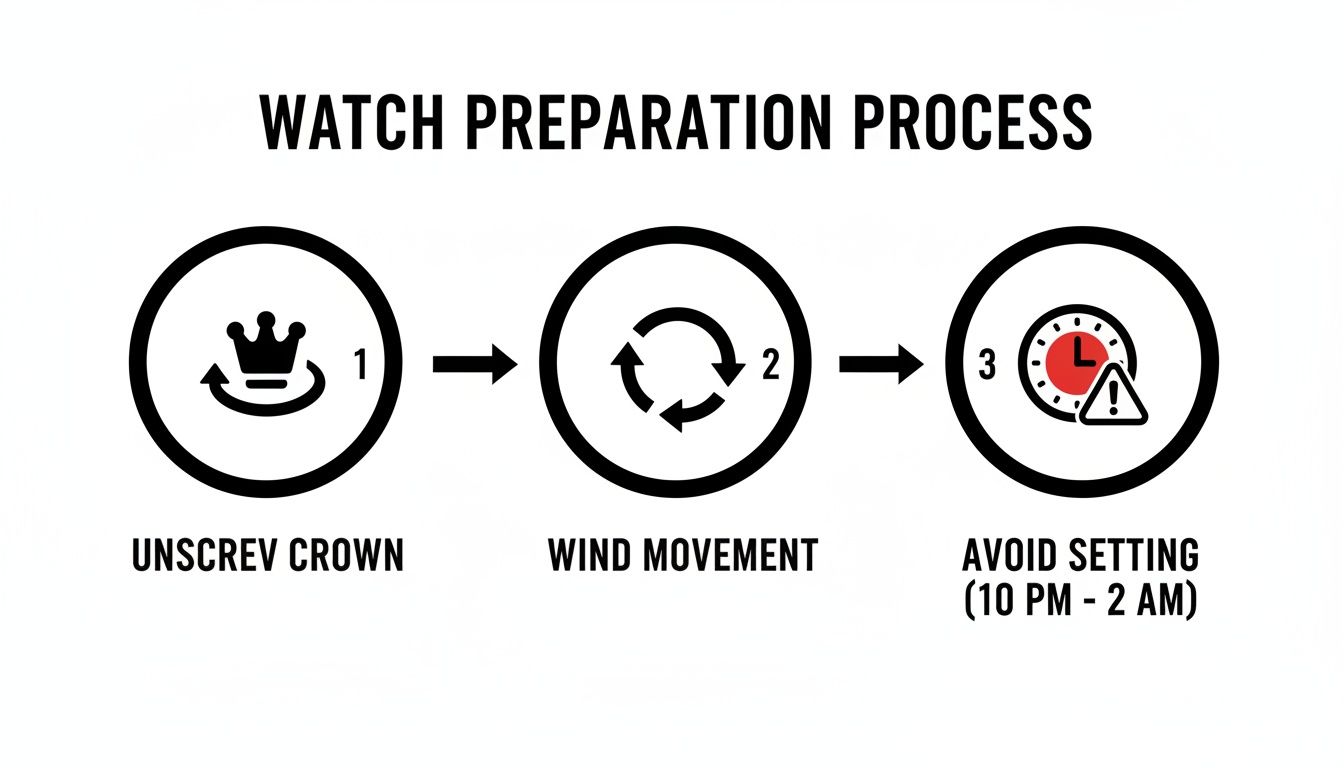
This visual guide lays out the three non-negotiable steps to take before you ever pull the crown to change the time or date. Following this sequence protects the delicate movement from unnecessary stress and potential damage. And of course, the final step is always screwing the crown back down tightly to restore its water resistance.
How to Adjust a Vintage Non-Quickset Datejust
If you own a Rolex Datejust from before 1977, you've got a true piece of watchmaking history. But setting the date on these "non-quickset" models is a completely different ritual compared to their modern counterparts—a unique and patient process that many collectors find deeply satisfying.
Unlike new watches, there’s no dedicated crown position for changing the date. The entire adjustment is done through the time-setting function. You'll pull the crown all the way out and turn the hands clockwise, advancing them past midnight until the date wheel clicks over to the next day. This is the only way to move the date forward.
The Back-and-Forth Method
So, what if the date is the 5th and you need to get to the 15th? Spinning the hands through ten full 24-hour cycles would be incredibly tedious and put a lot of unnecessary wear on the movement.
Luckily, vintage owners developed a clever shortcut known as the "back-and-forth" method.
Here’s how it works: after the date flips past midnight, don't keep going. Instead, reverse the hands by turning the crown counter-clockwise back to approximately 9 PM. Then, move them forward past midnight again. The date will advance one more day without a full rotation.
This technique is far more efficient and much safer for the delicate date-change mechanism. In fact, mishandling these vintage movements can lead to expensive repairs; historical data shows that service claims related to the date gear on pre-1977 models accounted for 12% of issues before modern updates were introduced. You can learn more about properly setting Rolex Datejust models on ewwatches.com.
A Note on Vintage Care: This method requires a gentle touch. Aggressively spinning the crown can harm the intricate gears inside. Patience is the key to preserving the mechanical health and value of these classic timepieces.
Mastering this technique is part of the charm of owning a vintage watch. It connects you more deeply to the timepiece and its history. For a closer look at the engineering that makes this possible, our article on how a mechanical watch works offers a fascinating peek under the hood.
Final Steps and Common Mistakes to Avoid

Alright, you’ve set the time and date perfectly. Now for the most important step: resealing the crown. This simple action is what guarantees your Datejust’s water resistance, protecting the complex movement inside from moisture, dust, and damage. Don't skip it.
Gently push the crown back in towards the case. You should feel it click into place as the threads engage. From there, start turning it clockwise while keeping just a bit of inward pressure.
The crown should screw in smoothly. Once you feel it become snug against the case, stop. That’s it. There is absolutely no need to muscle it down.
Over-Tightening Is a Costly Mistake
One of the most common errors we see is people cranking down on the crown, thinking a tighter seal is a better one. This is a myth, and it can do real harm.
Over-tightening crushes the delicate rubber gaskets that create the waterproof seal. Do it enough times, and you’ll compromise your watch's water resistance entirely, leading to a very expensive repair.
Expert Insight: Treat the crown like a jar lid. You tighten it just until it's secure, not until your knuckles turn white. A gentle, finger-tight turn is all it takes to protect your investment.
A Checklist of Common Errors
To build good habits when you adjust the time on your Rolex, keep these common slip-ups in mind. Avoiding them will prevent the vast majority of user-inflicted damage we see.
- Forgetting to Wind First: If your watch has stopped completely, always give it 30-40 manual winds before you start setting anything. If you keep your watch in a storage case, you can learn more about what a watch winder is and how it helps keep it ready to wear.
- Adjusting in the "Danger Zone": A cardinal sin. Never, ever use the quickset date function between 9 PM and 3 AM.
- Leaving the Crown Unscrewed: This is the easiest and most critical mistake to make. It leaves the movement completely exposed. Always give it a quick visual check to make sure the crown is fully screwed down.
Common Questions About Setting Your Datejust
Even after walking through the steps, a few questions always seem to come up. It's completely normal. Getting comfortable with a high-end timepiece takes a little practice, so let's tackle the most common issues we see.
My Date Changes at Noon, Not Midnight
This is a classic one, and thankfully, the fix is incredibly simple. It just means your watch is on a reversed 12-hour cycle.
To get it back on track, just pull the crown out to the final time-setting position. From there, wind the hands forward a full 12 hours. This simple action resets the watch’s internal AM/PM calendar, ensuring the date complication clicks over right at midnight, just as it should.
What If I Set the Date in the "Danger Zone"?
Accidentally using the quickset feature between 9 PM and 3 AM is a common worry. During these hours, the watch's internal gears are already beginning to engage to change the date. Forcing it with the quickset can put extra stress on the movement.
Modern Rolex movements are built tough, so doing it once is unlikely to cause damage. Don't panic. Just make it a habit to first advance the time to a safe spot, like 6 AM, before you adjust the date.
Expert Tip: Not sure if your Datejust has a quickset function? Here's an easy way to check. Pull the crown to the first position. If turning it changes the date, you've got a quickset model. If you have to spin the main hands past midnight to advance the date, you're likely holding a vintage, non-quickset piece.
How Often Should I Get My Rolex Serviced?
Rolex officially recommends a full service roughly every 10 years, but this isn't a hard-and-fast rule. Your lifestyle and how often you wear the watch play a big part.
The best approach is to pay attention to its performance. If you notice it's losing or gaining significant time, or the power reserve doesn't seem to last as long as it used to, that's your watch telling you it's time for a professional tune-up. Consistent maintenance is the secret to a lifetime of reliability.
For more general advice, checking out some common FAQs on watch care can be a great resource for any owner.
For professional servicing or to explore a curated collection of authenticated luxury timepieces, trust the experts at ECI Jewelers. Visit us online or at our New York City showroom for a personalized experience. https://www.ecijewelers.com


