


Adjusting your Rolex Datejust is straightforward: you unscrew the crown, pull it to the correct position for the date or time, make your changes, and then securely screw it back down. When done right, this simple process keeps the mechanical heart of your watch safe, sound, and ticking accurately.
Understanding Your Rolex Datejust Before You Adjust
Before you even touch the crown, it’s worth taking a moment to appreciate the incredible engineering on your wrist. Changing the time on a Datejust isn't just about moving the hands; it's about interacting with a piece of horological history. Knowing your way around its core components, like the screw-down crown and the delicate movement inside, is the best way to protect your investment.

First released in 1945, the Rolex Datejust was a true landmark in watchmaking, boasting the world's first automatic date-changing mechanism. Decades later, it remains Rolex's best-selling model, making up an estimated 40% of their annual production. It's an icon for a reason.
Key Components to Know
The crown is your direct line to the watch's internal movement. Most modern Datejust models feature a Twinlock screw-down crown, a critical feature that helps guarantee water resistance. It has a few distinct positions that control different functions.
The feeling of unscrewing the crown connects you directly to the watch’s movement. It's a tactile reminder of the hundreds of tiny, orchestrated parts working inside.
Here are the essential functions you'll be using:
- Winding: After unscrewing the crown, this first position lets you manually power the watch. This is what you'll use if it has stopped running.
- Date Setting: For modern models, pulling the crown out one click (to position 2) engages the date wheel.
- Time Setting: Pulling the crown all the way out (to position 3) stops the second hand and allows you to set the hour and minute hands with precision.
Each part is engineered for absolute reliability, but understanding how they work together is crucial. To get a better sense of what's happening inside, take a look at our guide on how a mechanical watch works. Getting familiar with these basics makes the whole process of setting your Datejust much smoother and safer.
Quick Guide to Datejust Crown Positions
For a quick reference, here’s a breakdown of what each crown position does. Just remember to always screw the crown back down when you're finished to maintain water resistance.
| Crown Position | Primary Function | Applicable Models |
|---|---|---|
| Position 1 | Winding the mainspring | All Datejust models |
| Position 2 | Quickset Date adjustment | Datejust models from ~1977-present |
| Position 3 | Time Setting (hours/minutes) | All Datejust models |
This table covers most modern Datejusts, but keep in mind that vintage, non-quickset models will have a different procedure for changing the date, which we'll cover next.
Preparing Your Datejust for a Safe Adjustment
Before you even think about changing the time or date, the first move is always the same: unscrew the crown. You’ll find it on the side of the case at the 3 o’clock position.
Grip the crown between your thumb and forefinger and turn it towards you (counter-clockwise). After a few smooth rotations, you'll feel a distinct little "pop." That's the crown disengaging from the threads and moving into its first position, ready for you to get to work.
Wind Before You Set
If your watch has stopped, this next step is critical and something a lot of owners miss. Don't just jump straight to setting the time. With the crown in this first popped-out position, give it a good manual wind.
Turn the crown clockwise for about 30-40 full rotations. This builds up a solid power reserve in the mainspring, ensuring the watch has enough energy to run accurately right after you set it.
Winding your watch first is non-negotiable if it's stopped. It prevents unnecessary stress on the movement's delicate parts when you start adjusting the hands and date wheel.
Once the watch is wound, you’re ready for the real fun: setting the date and time. If you want a more in-depth look at this fundamental process, check out our guide on how to properly wind a mechanical watch.
Setting the Date: Quickset vs. Non-Quickset Models
This is where knowing the age of your Datejust really matters. Setting the date is probably the most delicate part of the process, and it’s completely different for a modern Quickset model versus a vintage Non-Quickset piece.
When Rolex introduced the quickset date feature in 1977, it was a game-changer. It transformed a slow, careful process into something that took just seconds. Before that, owners of non-quickset models had to spin the hands a full 24 hours just to advance the date by one day. Vintage watch data shows this older method could cause extra wear on the date wheel in about 12% of cases. You can dive deeper into this feature in this complete step-by-step guide.
Navigating the Date "Danger Zone"
Before you even think about adjusting the date on a Quickset model, you have to be aware of the "danger zone." This is the window of time between roughly 9 PM and 3 AM. During these hours, the watch's internal mechanism is already starting to engage the gears to flip the date at midnight.
If you try to force a manual date change during this period, you’re essentially grinding metal against metal. It’s a surefire way to cause serious damage to the movement, leading to an expensive trip to the watchmaker. This is one of the most common—and completely avoidable—mistakes owners make.
The Golden Rule: Always move the hands to a "safe" time, like 6:30, before you change the date. This simple step ensures all the date-changing parts are disengaged and out of harm's way.
Adjusting Your Quickset Datejust
For any Datejust made after 1977, setting the date is a breeze once you're out of that danger zone.
- Unscrew the crown and pull it out to the first position (Position 2).
- Turn the crown clockwise. You'll see the date window click forward with each turn.
- Set it to the day before today's date. For example, if it's the 15th, stop when you see the 14th.
- Pull the crown out to the final position (Position 3). Now, advance the hands forward past midnight. You'll see the date flip over to the 15th. This confirms you've set the watch to AM.
This two-step process is crucial for making sure your watch knows the difference between noon and midnight, so the date changes correctly every 24 hours.
The image below shows the first few critical actions for preparing any Rolex for an adjustment.
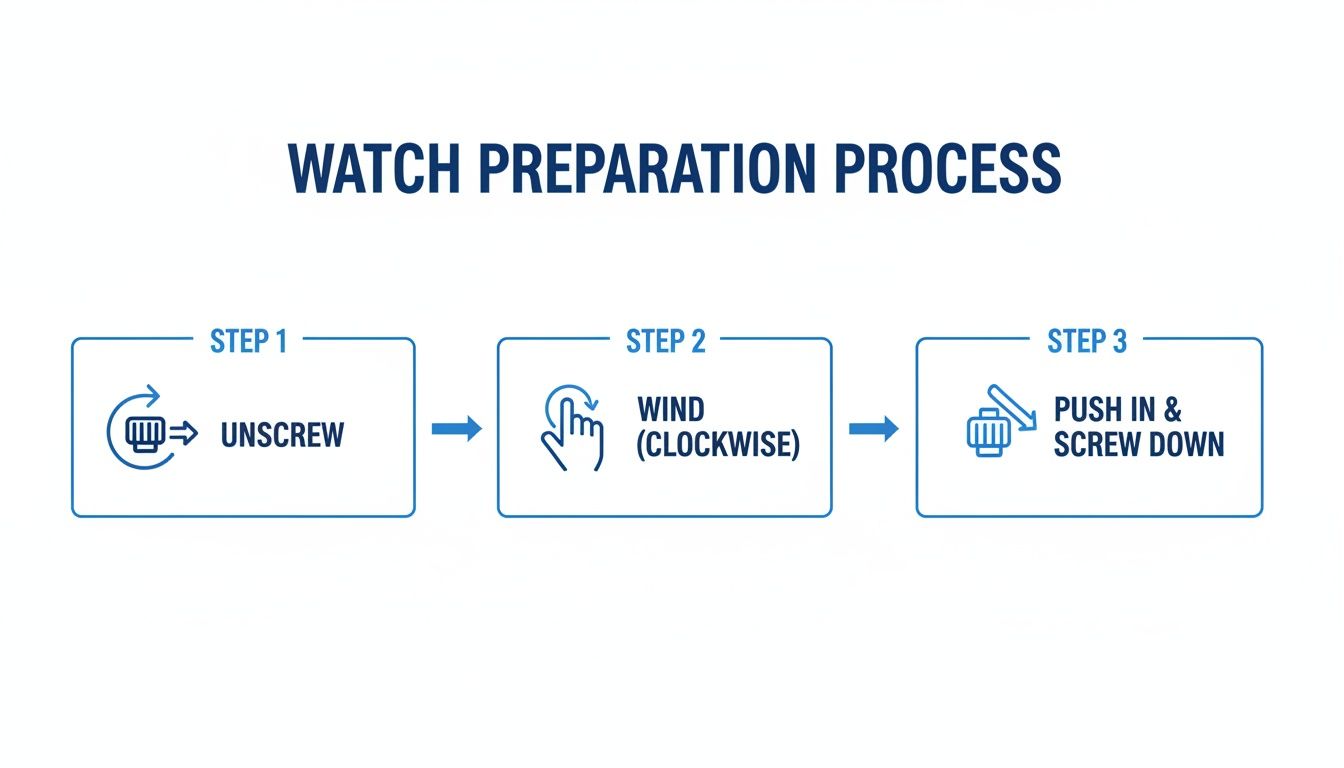
As the diagram shows, properly handling the crown is the foundation for protecting your watch's movement before you start making any changes.
Setting a Vintage Non-Quickset Datejust
If you have an older Datejust from before 1977, there is no separate crown position for the date. The only way to change it is the old-fashioned way: by advancing the time.
Unscrew the crown and pull it all the way out to the time-setting position. From there, you just have to wind the hands forward, hour by hour, past the 12 o'clock marker until the date wheel clicks over. It takes patience, but it’s a process that gives you a real connection to the history and mechanical soul of these iconic timepieces.
How to Adjust the Time with Precision
Alright, with the date locked in, you're ready for the final, most satisfying part: setting the exact time. This is where you can really appreciate the engineering that goes into a modern Rolex, allowing you to sync your watch down to the second.
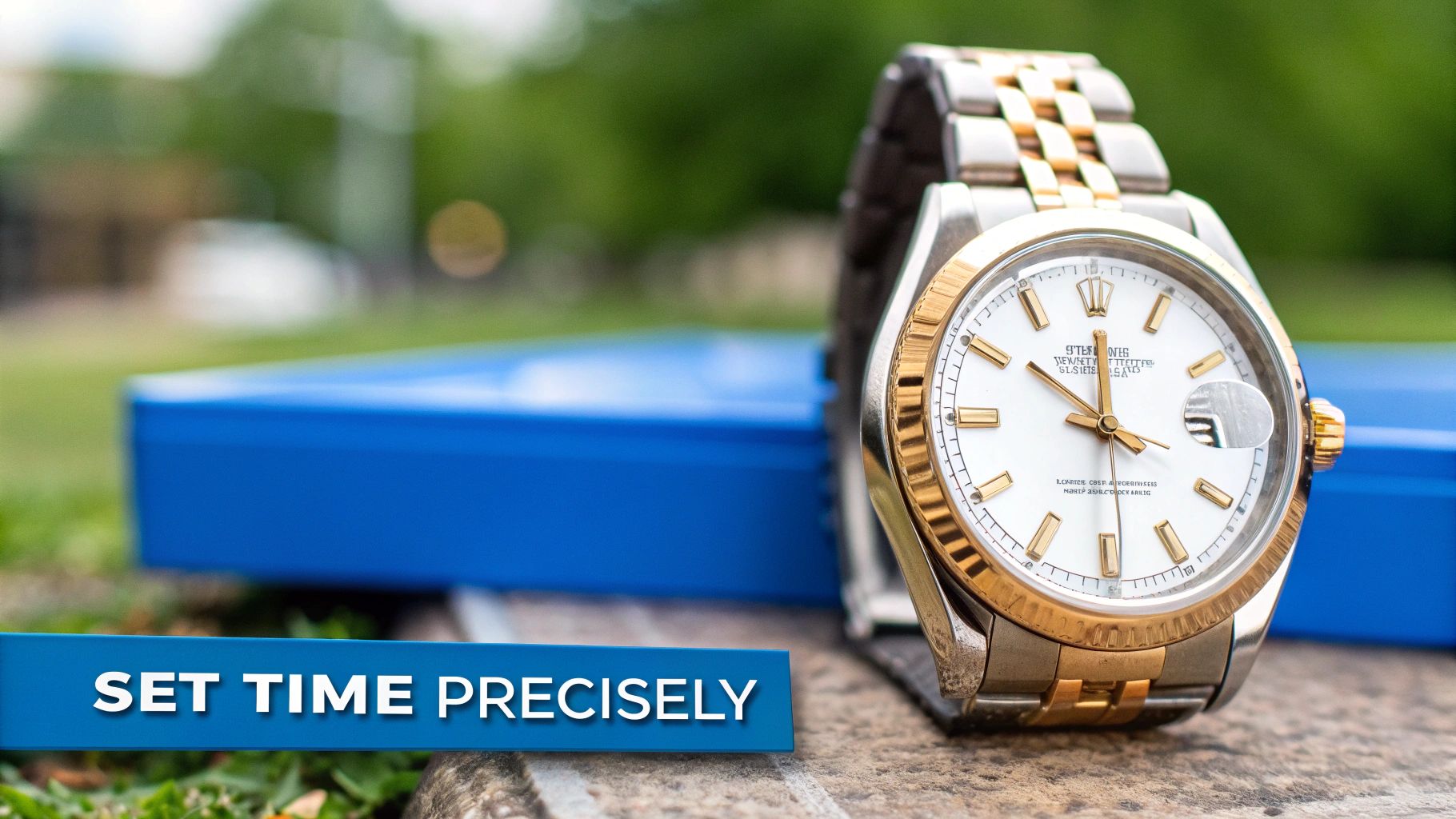
From the date-setting position, give the crown another gentle pull until it clicks into its last notch (Position 3). The first thing you'll see is that the second hand has stopped dead in its tracks. This is the "hacking seconds" feature, and it’s designed specifically for this moment—letting you set the time with perfect accuracy.
Syncing to a Reference Time
Now you can turn the crown either way to move the hour and minute hands. Here's a pro tip I've learned over the years: always set the minute hand a few minutes past the current time, then slowly turn it backward to line it up with the correct minute marker.
This little maneuver removes any slack in the gears, ensuring the minute hand starts moving the instant you push the crown back in. No lag, just precision.
With the hands positioned, grab a reliable time source—your smartphone, a computer clock, anything you trust. Wait for it to hit the top of the next minute (like 10:30:00). The second it does, push the crown all the way back in. Your second hand will immediately spring back to life, perfectly in sync.
Setting your Rolex isn't just a task; it's a ritual. Pushing the crown in at the exact second a reference clock strikes the new minute is how you achieve true precision.
Confirming AM vs PM and Securing the Crown
The last check is arguably the most important: making sure you're on the right AM/PM cycle. If you get this wrong, your date will change at noon instead of midnight.
The easiest way to be sure is to wind the hands forward past 12 o'clock. If the date window flips over, you've just crossed into the AM hours. If nothing happens, you're in the PM. Simple as that.
For quickset models made after 1977, this time-setting happens in the second position, where that hacking seconds feature is perfect for syncing with atomic clocks—which are accurate to within one second every 300 years. You can dive deeper into the Rolex setting process with more expert tips on ewwatches.com.
Finally—and please don't forget this—screw the crown back down. Apply gentle inward pressure and turn it clockwise until it feels snug against the case. Do not overtighten it. A firm, gentle turn is all it needs. This crucial step seals the deal, restoring your Datejust's water resistance and protecting the movement from dust and moisture.
Common Mistakes and When to See a Professional
Knowing how to set your Datejust is half the battle. Knowing how not to break it is the other half. Even small missteps can compromise your watch's complex mechanics, leading to repairs that are anything but cheap.
A classic mistake I see is forcing the crown. If you feel any resistance when you’re turning or pulling it out, just stop. Applying that extra bit of pressure is a fast track to stripping the threads or bending the stem, turning a simple time change into a real headache.
Then there's the infamous date-change "danger zone"—that window between roughly 9 PM and 3 AM. During these hours, the watch's gears are already moving into place to flip the date automatically. Trying to manually change it during this time can snap a delicate component inside the movement. It’s an easy mistake to make, but a costly one.
The most crucial final step is also the most forgotten: screwing the crown back down tightly. Leaving it even slightly unscrewed destroys the water resistance, leaving the sensitive movement exposed to moisture and dust.
Knowing When to Get Help
Sometimes, you just have to hand it over to a pro. Your watch will give you clues when it needs an expert's touch, and learning to spot them is just as important as the setting process itself.
You should definitely seek out a watchmaker if you notice any of these signs:
- A Gritty Feeling: Winding the crown should feel silky smooth. If it feels sandy or rough, you could be dealing with debris or worn-out parts inside.
- A Stubborn Crown: The crown should unscrew and pop out with very little effort. If you're struggling to get it out or it feels stuck, don't force it.
- Date Function Fails: Is the date wheel stuck between numbers? Or maybe it just won't advance at all? This points to an issue with the date mechanism that needs professional service.
Ignoring these red flags won't make them go away; it'll just turn a minor fix into a major overhaul. To get a better idea of what to expect, it helps to understand the typical Rolex repair costs and why investing in professional service is always the right call.
Common Questions About Setting Your Datejust
Even with the steps down, handling a watch as precise as a Datejust can bring up a few questions. We get these all the time, so here are some quick, clear answers to give you complete confidence.
How Do I Know If My Datejust Is a Quickset Model?
The simplest way to figure this out is by the watch's age. Rolex rolled out the Quickset feature around 1977, so if your watch was made after that, it almost certainly has it.
But for a hands-on check, just unscrew the crown and pull it out to the first position. If turning the crown immediately changes the date in the window, you've got a Quickset. If that position just winds the movement, you're holding a classic Non-Quickset model.
What Really Happens If I Set the Date in the "Danger Zone"?
Forcing the date to change between roughly 9 PM and 3 AM is a bad idea. During these hours, the watch's internal gears are already moving into place to flip the date automatically at midnight. Manually changing it can jam or even break those delicate components.
If you’ve done it once by mistake and everything seems fine, you probably got lucky. But doing it repeatedly is asking for trouble—it can misalign the mechanism or strip a gear, which means a trip to the watchmaker. If you notice the date isn't changing correctly anymore, stop what you're doing and get it looked at by a professional.
The golden rule is simple: if you feel any resistance when changing the date, stop. It's always safer to wind the hands forward past 3 AM before using the Quickset function. This one habit can save you from a costly and completely avoidable repair.
Is It Possible to Overwind My Rolex?
Nope, you can't overwind a modern automatic Rolex like the Datejust. They are built with a smart slipping clutch system that protects the mainspring. Once the spring is fully wound, this clutch disengages, preventing any damage.
You might even hear a very faint click when it's at full power—that's just the clutch doing its job. So go ahead and give it 30-40 full winds to build up a solid power reserve. There's no risk.
At ECI Jewelers, we believe that owning a luxury timepiece is an experience built on trust and expertise. Whether you're adding to your collection or seeking the perfect first Rolex, our specialists are here to guide you. Explore our curated selection of authenticated luxury watches at https://www.ecijewelers.com.


