


Owning a Rolex is a commitment, and part of that is understanding the investment required to keep it running perfectly. For a routine overhaul, you can generally expect Rolex repair costs to range from $800 to $1,600. Of course, this can climb depending on your watch's age, complexity, and whether it needs specific replacement parts.
Understanding the Real Cost of Rolex Service
Think of a standard Rolex service less like a simple tune-up and more like a full engine rebuild for a high-performance vehicle. The price tag reflects the incredible detail, expert craftsmanship, and specialized equipment needed to bring your timepiece back to its original factory specifications. It's a process designed to ensure every single component works flawlessly for another decade.
So, what justifies the cost? A master watchmaker will completely disassemble the movement—hundreds of tiny, intricate parts—and give them an ultrasonic cleaning. They'll replace any worn components with genuine Rolex parts before painstakingly reassembling, lubricating, and calibrating everything. This isn't just a repair; it's a meticulous restoration of precision.
For a deeper dive into all the factors that can influence the final price, check out our detailed guide on the cost to service a Rolex.
A Look at Standard Service Pricing
To give you a clearer picture, it helps to see how the starting prices vary by model. It's no surprise that servicing a mechanically straightforward Oyster Perpetual costs less than a Daytona with its sophisticated chronograph functions.
Most authorized service centers in the U.S. will tell you that a basic tune-up starts at around $800. For a more complex watch like a Daytona, however, the standard movement overhaul alone can easily hit $1,300 to $1,600, and the total can surpass $2,500 if parts need replacing.
Here's a quick reference guide showing the typical starting prices you can expect for a standard overhaul on some of the most popular models.
Estimated Rolex Service Costs by Model (USA)
| Rolex Model | Estimated Standard Service Cost |
|---|---|
| Oyster Perpetual | $800 - $1,000 |
| Submariner (Date/No-Date) | $800 - $1,100 |
| GMT-Master II | $1,000 - $1,200 |
| Daytona | $1,300 - $1,600+ |
These figures are just a starting point, but they give you a solid idea of what to plan for.
A proper service is much more than an expense—it's a critical investment. You're preserving the accuracy, water resistance, and long-term value of your watch. Regular maintenance is the key to protecting its legacy for generations to come.
Getting a handle on these foundational costs helps you appreciate the true value behind the service and sets realistic expectations for when your Rolex is due for its essential maintenance.
The Key Factors That Determine Your Final Bill
Ever wonder why a standard Rolex service might start around $800, but a more complex job can easily climb past $3,000? Your final invoice is rarely a flat fee. Instead, it’s a detailed breakdown shaped by several critical factors that determine the time, skill, and parts needed to get your watch running perfectly again.
Think of it like taking a car to the shop. A routine oil change on a daily driver is predictable and affordable. But if you bring in a vintage sports car needing a full engine rebuild with rare, hard-to-find parts, the bill is going to look very different. The same exact logic applies to luxury timepieces.
Watch Model and Mechanical Complexity
The single biggest factor driving your Rolex repair costs is the specific model on your wrist. A simple, time-only Rolex Oyster Perpetual has a beautiful but straightforward movement. Compare that to a Daytona, which is packed with a highly intricate chronograph mechanism made of hundreds of extra components.
Every function beyond telling time—what we call a "complication"—adds layers of complexity, demanding more labor and specialized expertise.
- Simple Models: Watches like the Datejust or Submariner have robust, well-understood movements. Servicing them is a familiar process for any certified watchmaker, which helps keep the base cost in check.
- Complex Models: A GMT-Master II, with its iconic dual-time function, requires careful calibration of the extra hand. And then you have the Sky-Dweller, an engineering marvel with a sophisticated annual calendar. Servicing that is a far more demanding and time-consuming task, which is reflected in its higher starting price.
Bottom line: the more gears, springs, and levers inside, the more time a master watchmaker has to spend taking it all apart, cleaning every piece, and putting it back together with perfect precision. That specialized labor is why a Daytona service costs significantly more than an Oyster Perpetual's.
Age and Overall Condition
The life your watch has lived plays a huge part in what it needs today. A modern Rolex that’s been worn with care for a decade will probably just need a standard overhaul. On the other hand, a vintage piece from the 1980s that saw heavy daily use—or worse, sat in a drawer for twenty years—is likely to need a much more intensive restoration.
Time takes its toll on the inside. Lubricants dry up and turn gummy, rubber gaskets perish and lose their water-sealing properties, and older parts can wear down. If a component is no longer in production, it has to be sourced, which adds to both the timeline and the final cost. Naturally, a watch that’s suffered a hard knock or gotten water inside will also require a far more involved (and expensive) service.
The condition of your watch when it arrives at the service center is a major cost determinant. A well-maintained watch needs a standard service; a neglected one often requires a full restoration.
The Need for Replacement Parts
A standard service fee covers the complete disassembly, deep cleaning, re-lubrication, and precision calibration of the movement. It also includes replacing essential wear-and-tear items like gaskets and seals to ensure water resistance.
What it does not cover is the cost of major components that are broken, damaged, or worn beyond repair. These are always quoted separately.
Some of the most common replacement parts that can add to your Rolex repair costs include:
- Sapphire Crystal: A new crystal to replace a scratched or chipped one can run anywhere from $300 to $600, depending on your model.
- Crown and Tube: If the threads that screw the crown down are stripped, these must be replaced to keep water out. This is a critical repair.
- Bezel or Bezel Insert: A cracked ceramic bezel on a modern Submariner or GMT is a particularly costly replacement part.
- Dial and Hands: If moisture got inside or they’ve been damaged by age, replacing these can be expensive, especially if they are for a rare vintage model.
During the initial diagnostic phase, our watchmakers will identify every part that needs to be replaced. You’ll receive a detailed, itemized estimate for your approval before any work begins, so there are absolutely no surprises when you get the final bill.
Authorized Center vs. Independent Specialist
Once your watch needs attention, you face a big decision: where do you take it? This choice is about more than just a simple repair; it affects your total Rolex repair costs, how long you'll be without your watch, and even its future value. You have two main paths—an official Rolex Service Center (RSC) or a reputable independent specialist, like the experts here at ECI Jewelers.
Think of it like servicing a high-end car. You can go to the official dealership or a trusted, top-tier independent mechanic. The dealership offers a brand-backed guarantee and follows a rigid, one-size-fits-all process. The independent specialist, on the other hand, often provides more personalized service, flexibility, and better pricing without ever compromising on quality.
Each route has its own pros and cons. The right choice depends on what you prioritize—an ironclad factory warranty, a faster turnaround, or the careful touch needed for a cherished vintage piece.
The Official Rolex Service Center Experience
Going through an official RSC is the factory-approved path. For many owners, it offers the ultimate peace of mind because every service comes with a two-year international warranty straight from Rolex. They use only brand-new, genuine Rolex parts and follow the company’s strict standards to the letter.
But that level of assurance comes with a few trade-offs. The cost is almost always higher, and the wait times can be significant, often stretching from four to eight weeks, sometimes longer. RSCs also have a firm policy of replacing any worn parts with modern ones. If you own a vintage Rolex, this can be a serious problem, as swapping an original dial or hands can strip the watch of its history and tank its market value.
The Independent Specialist Advantage
A trusted independent watchmaker brings a different, more flexible mindset to the table. Specialists like those at ECI Jewelers can often offer more competitive pricing and complete a full service in a fraction of the time—sometimes in just two to four weeks. You also get to speak directly with the expert working on your watch, which is a huge plus.
This flexibility is a game-changer for vintage Rolex owners. An independent specialist gets why preservation matters. They’ll work with you to keep original parts whenever possible, protecting your watch's unique story and value. While they don't offer a Rolex-backed warranty, any reputable shop provides its own service guarantee, usually for one to two years.
Choosing a service provider is a balance. An RSC offers brand assurance at a premium, while a trusted independent provides flexibility, value, and a more personal connection to the craft.
To help you see the difference clearly, let's break down the key points side-by-side. This comparison will help you decide what's best for you and your watch.
Rolex Service Provider Comparison RSC vs Independent
A side-by-side look at the key differences between servicing your watch at an authorized Rolex center versus a reputable independent specialist.
| Feature | Rolex Service Center (RSC) | Independent Specialist (e.g., ECI Jewelers) |
|---|---|---|
| Cost | Generally higher, reflecting the official brand premium. | Often more competitive, providing excellent value. |
| Turnaround Time | Slower, typically 4-8+ weeks due to high volume. | Faster, often 2-4 weeks, with more direct processing. |
| Parts Used | Exclusively new, genuine Rolex parts are used. | Uses genuine Rolex parts, with flexibility for sourcing. |
| Warranty | A 2-year international guarantee backed by Rolex. | A shop-specific warranty, typically for 1-2 years. |
| Vintage Models | May replace original parts with modern ones, affecting value. | Focuses on preserving originality and vintage character. |
| Communication | Often indirect, with communication through service advisors. | Personalized service with direct access to the watchmaker. |
In the end, there's no single "right" answer. If you own a modern Rolex and the official stamp of approval and international warranty are your top priorities, an RSC is a solid choice. But if you value a faster turnaround, more competitive Rolex repair costs, and personalized care—especially for a vintage timepiece—a distinguished independent specialist like ECI Jewelers is an exceptional alternative.
Inside the Rolex Service: A Step-by-Step Journey
Ever wonder what actually happens when you hand over your Rolex for service? It’s far more than a simple tune-up. Think of it as a complete restoration performed by a master craftsman, designed to bring your watch back to its original factory glory.
Understanding this meticulous process helps demystify the Rolex repair costs and shows you the incredible value packed into every overhaul. Let's walk through the journey of a classic Rolex Submariner as it undergoes a full factory-spec service. Each stage is a testament to precision, ensuring your watch returns to you meeting the same tough standards it did the day it was made.
Step 1: Initial Diagnosis and Detailed Estimate
The second your watch arrives, it’s under the microscope. A certified watchmaker performs a complete external and internal examination. They’ll look for any dings on the case, test the integrity of the bracelet, and measure the watch's current performance on a specialized timing machine.
This initial check is critical. It uncovers not just the obvious issues but also any hidden wear that could cause problems down the line. From there, you get a detailed, itemized estimate outlining all the necessary work and the cost of any replacement parts. No work begins until you approve it, so you have complete control and there are no surprises.
Step 2: Complete Movement Disassembly
Once you give the green light, the real artistry begins. The watchmaker carefully removes the bracelet and opens the case back to reveal the heart of your Rolex—its intricate movement.
Then, the movement is completely dismantled, piece by tiny piece. Every gear, spring, jewel, and screw is methodically taken apart and arranged in a special tray. A Rolex movement can have over 200 individual components, and each one is handled with the utmost care.
This complete disassembly is absolutely essential for a proper overhaul. It's the only way a watchmaker can inspect every surface of every single component for microscopic signs of wear and tear.
Step 3: Ultrasonic Cleaning and Part Replacement
With the movement fully disassembled, all the parts are placed into special baskets and submerged in an ultrasonic cleaner. This machine uses high-frequency sound waves to blast away all traces of old, gummy lubricants, dust, and microscopic gunk.
After cleaning, each part is rigorously inspected under high magnification. Any component that doesn't meet Rolex's strict factory specifications—whether it’s a worn gear or a tired mainspring—is swapped out for 100% genuine Rolex parts. This step is vital for guaranteeing the longevity and reliability of the repair.
Step 4: Meticulous Reassembly and Lubrication
Now, the watchmaker starts the painstaking process of putting the movement back together. With specialized tools and steady hands, they rebuild the watch piece by piece, bringing it back to life.
As each component is reinstalled, the watchmaker applies several different types of synthetic oils and lubricants. It’s not a one-size-fits-all situation; different parts of the movement require different viscosities to minimize friction. Applying the perfect amount in exactly the right spot is an art form that is crucial for the watch's long-term accuracy.
Step 5: Precision Timing and Rigorous Testing
Once reassembled, the movement is placed on a timing machine to regulate its accuracy. The watchmaker makes micro-adjustments to the balance wheel until the watch is performing well within the strict chronometer standards of just a few seconds per day.
The serviced movement is then sealed back into its newly polished and cleaned case, which has been fitted with brand-new gaskets for water resistance. Finally, the watch undergoes a series of tough tests:
- Water Resistance Test: The watch is put through both vacuum and high-pressure tests to ensure its seals are perfect and it can handle its rated depth.
- Power Reserve Test: The watch is fully wound and left to run, confirming it can hold its power for the full 48-70 hours as specified.
- Final Quality Control: For several days, the watch's performance is monitored in various positions to ensure its timekeeping remains consistent and reliable before it's finally ready to come home to you.
Real Rolex Repair Scenarios and Cost Breakdowns
Price ranges are a great starting point, but seeing how they play out with real watches makes everything click. To show you what Rolex repair costs look like in the wild, let's walk through three common, real-world scenarios.
Each example highlights how different factors—from a watch's age and model to unexpected accidents—can dramatically shape the final bill. These case studies will give you a much clearer idea of what to expect when it's your timepiece on the bench.
Scenario 1: The Modern Rolex Datejust Standard Service
First up is a stainless steel Rolex Datejust, about 10 years old. The owner noticed it was losing around 15 seconds a day and wasn't holding a charge over the weekend anymore. These are textbook signs that the movement's lubricants are breaking down and it’s time for a routine overhaul.
- Service Performed: The watch needed a complete movement overhaul. This is a meticulous process involving full disassembly, an ultrasonic deep clean of every component, replacing the mainspring and all gaskets, reassembling with fresh lubricants, and calibrating the timing for precision.
- Cost Breakdown: The base service for a Datejust movement came in at $850. This covered all the labor and standard replacement parts like seals and gaskets. Fortunately, no major components were broken or worn out.
- Final Cost and Outcome: The total was $850. After a three-week turnaround, the watch was back on its owner's wrist, looking brand new and running perfectly within chronometer specs at +1 second per day.
Scenario 2: The Vintage GMT-Master Restoration
Next, we have a GMT-Master from the early 1980s. This was a family heirloom worn daily for decades without a single service. Its acrylic crystal was a web of scratches, the crown's threads were shot, and the original "Pepsi" bezel insert was cracked, though it had a beautiful, natural fade.
For vintage watches, the mission is often preservation over simple replacement. Finding period-correct parts is an art in itself and a huge part of the final cost. This is where a great independent specialist really shines.
The owner’s goal was clear: restore its function and water resistance but keep as much of its original soul as possible.
- Service Performed: On top of the full movement overhaul, this job was a hunt for rare parts. We sourced a period-correct faded bezel insert and installed a new-old-stock crown and tube to make it water-resistant again.
-
Cost Breakdown:
- Movement Overhaul: $1,100
- Sourced Vintage Bezel Insert: $750
- Crown and Tube Replacement: $250
- Final Cost and Outcome: The total restoration cost was $2,100. The parts search pushed the timeline to six weeks, but the result was a fully functional, water-resistant GMT-Master that still had all of its priceless vintage charm.
This visual shows the essential stages every Rolex goes through during a complete service, from the initial takedown to the final reassembly.
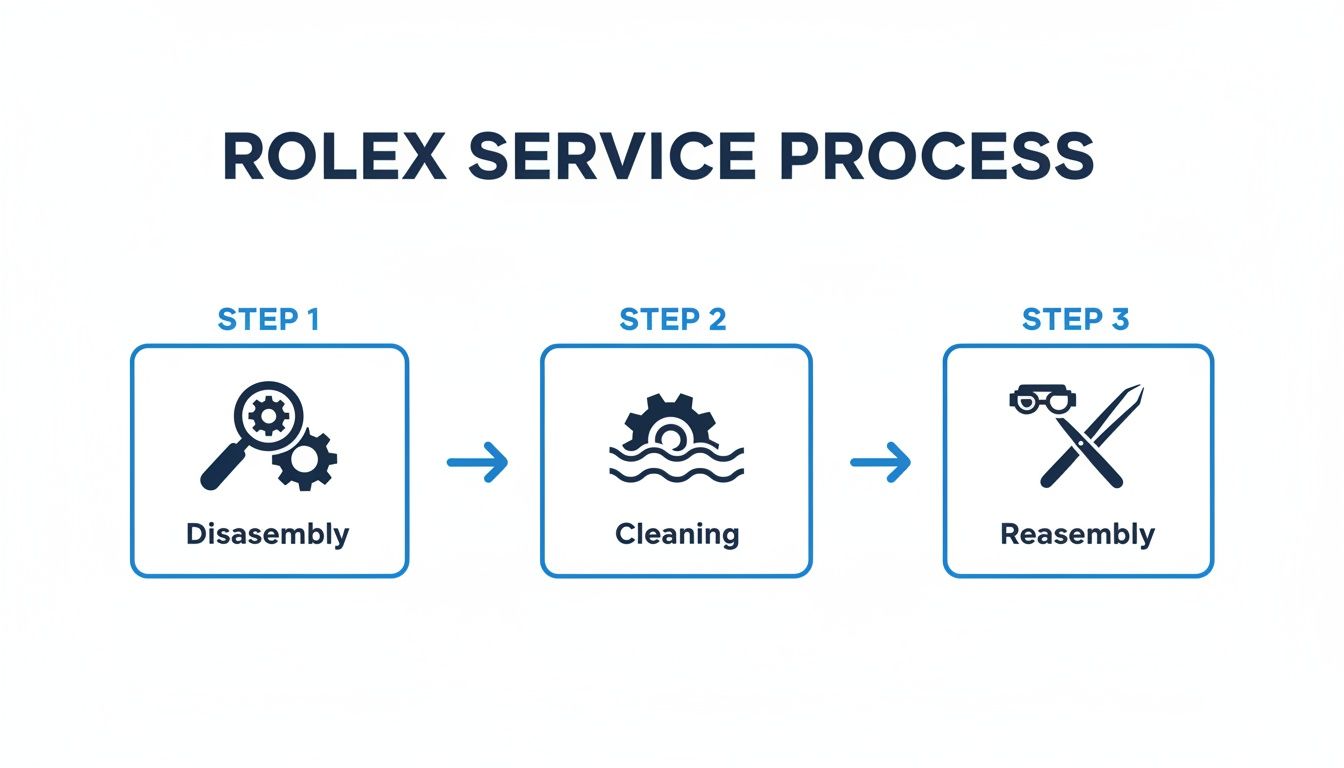
Each step is a painstaking effort designed to bring the watch's intricate movement back to its original factory precision.
Scenario 3: The Water-Damaged Rolex Daytona
Our last example is a modern Rolex Daytona that took a swim with its chronograph pushers unscrewed—a huge mistake. Water got inside the case, and rust began forming on delicate movement parts and staining the dial. This is pretty much a worst-case scenario and one of the most expensive repairs out there.
- Service Performed: This was a rescue mission. The entire chronograph movement had to be stripped down. Several rusted gears, levers, and screws had to be replaced with genuine Rolex parts. The dial, which had started to corrode, also had to be replaced to save the watch.
-
Cost Breakdown:
- Complex Chronograph Overhaul: $1,500
- Replacement Movement Parts (gears, springs): $600
- New Daytona Dial: $800
- Final Cost and Outcome: The grand total was $2,900. It’s a steep bill, but this intensive service saved a very valuable watch from being completely ruined. For those curious about much simpler maintenance, you might wonder if a Rolex needs a battery change—our guide explains why their automatic movements don't.
Making an Informed Service Decision
Servicing your Rolex is way more than just a repair—it's a deliberate investment in the watch's long-term health, performance, and value. If you go into it with a smart game plan, you'll protect your asset and get the best possible result. It all starts with a few simple but non-negotiable steps.
First, always, always get a detailed written quote before you give the green light for any work. This isn't just a single number; it should break down every single recommended task, from the standard movement service to the cost of each individual replacement part. This kind of transparency is crucial for managing your Rolex repair costs and makes sure there are no nasty surprises on the final invoice.
Next, make it a habit to document everything. Before sending your watch out, take clear, bright photos from every angle. Get close-ups of the case, bracelet, bezel, and crystal. When the watch comes back, repeat the process with the exact same shots. This before-and-after library is your best proof of the work done and the quality of any polishing or refinishing.
Building Your Watch’s Provenance
Beyond pictures, keeping a full service history is absolutely vital for your watch’s provenance—its documented story. Hold onto every receipt, warranty card, and piece of paperwork from any service your Rolex ever receives.
A well-documented service history from a reputable shop is like a meticulous maintenance log for a vintage car. It proves the watch has been cared for by experts, which can seriously boost its value and appeal to future collectors.
This paper trail becomes a core part of your watch’s identity, telling a story of professional care over its lifetime. This is especially important for vintage models, where a clean and clear history can make a huge difference in its market value.
The ECI Jewelers Promise
Picking the right partner for this process is everything. At ECI Jewelers, our entire service is built on a foundation of trust, deep expertise, and total transparency. We live by these best practices to protect your investment.
- 100% Genuine Rolex Parts: We only use authentic Rolex parts, period. This guarantees your watch keeps its integrity and performs exactly how it was designed to.
- Specialized Watchmakers: Our team is made up of highly skilled watchmakers with years of hands-on experience with Rolex movements, from classic vintage calibers to the newest, most complex mechanisms.
- Transparent Communication: We keep you in the loop every step of the way. You’ll get a detailed estimate upfront and regular progress updates, so you always know what’s happening with your watch. If you're ever concerned about authenticity, you can learn how to authenticate a Rolex watch in our detailed guide.
In the end, servicing your Rolex is about preserving a legacy. By taking these few proactive steps and working with a trusted expert, you’re ensuring your timepiece will run with precision and hold its value for generations to come.
Answers to Your Top Rolex Repair Questions
When it comes to maintaining a Rolex, a few key questions always come up. From how often you really need a service to the age-old debate about polishing, getting straight answers helps you protect your watch and manage your Rolex repair costs. Here are the direct, no-nonsense answers to the questions we hear most often.
How Often Should I Service My Rolex?
Rolex's official recommendation is about every 10 years for most modern watches. That's thanks to huge leaps in the quality of their lubricants and internal materials. But think of that as a baseline, not a hard rule.
The best gauge is how you actually wear your watch. If it’s on your wrist every day or sees a lot of action, bringing it in every 5-7 years is smart preventative care. For vintage pieces with older, more delicate parts, a 3-5 year interval is the safest bet to keep them running beautifully and preserve their value.
Will Polishing My Rolex Decrease Its Value?
This is a big one, especially for collectors, and for good reason. A light, professional polish can bring back that stunning factory finish. The problem comes from an overly aggressive polish, which can round off the sharp, crisp lines of the case and lugs—a detail that can seriously tank the value of a vintage or collectible model.
The decision to polish is always up to you. Many collectors of rare or vintage models prefer to leave the watch completely unpolished. They see the scratches and dings as part of the watch's story and character.
At any quality service center, this should be a choice. You can, and should, tell your watchmaker exactly what you want.
What Is Included in a Standard Rolex Overhaul?
A true overhaul is a deep, meticulous process. It starts with the complete disassembly of the watch case and the entire movement—every last screw and gear. Each tiny component is then put through an ultrasonic cleaning to strip away old oils and any microscopic gunk.
From there, the watchmaker inspects every part under high magnification, swapping out anything worn with genuine Rolex parts. The movement is then painstakingly reassembled, lubricated with precision oils, and calibrated for accuracy. To finish, the case is put back together with fresh gaskets and goes through a series of tough tests to ensure it meets Rolex's strict standards for performance and water resistance.
At ECI Jewelers, our certified watchmakers offer transparent, expert service to protect the legacy of your timepiece. We use only genuine Rolex parts and provide a personal, concierge-level experience from start to finish. Contact our specialists for a complimentary service estimate today.


