


The fastest way to tell if a Rolex is real is to check the details counterfeiters struggle to copy. Look for a Cyclops lens that magnifies the date 2.5x, razor-sharp dial printing, a "ROLEX" engraving around the inner ring that lines up with the hour markers, and a solid, weighty feel in the hand. Then make sure the serial and reference numbers match the papers. A real Rolex has a high-beat movement, so its second hand glides in 8 small steps per second instead of ticking once a second. No single check is proof on its own. A real Rolex passes all of them, while most fakes fail at least two or three. For high-value pieces, only an expert who opens the case can confirm the movement.
Below are the 12 checks our watch specialists use every day at ECI Jewelers in New York's Diamond District, in the order we perform them. Use them to screen a watch before you buy it, then let a professional make the final call.
In this guide
- How can you tell if a Rolex is real in 60 seconds?
- Why are fake Rolex watches so hard to spot now?
- Checks 1 to 4: What should you look for on the dial and crystal?
- Checks 5 to 8: What does a real Rolex feel and sound like?
- Checks 9 to 11: How do you inspect the case, bracelet and clasp?
- Check 12: How do you verify the serial number and papers?
- What are the red flags for specific Rolex models?
- What can only a watchmaker confirm?
- Do you need authentication, an appraisal or a service?
- What should you do if you think your Rolex is fake?
- How do you avoid buying a fake Rolex in the first place?
- The complete 12-point checklist
- Frequently asked questions
How can you tell if a Rolex is real in 60 seconds?
Before you reach for a loupe, run a quick first-glance check. A surprising number of fakes fail right here, and if a watch stumbles on any of these four points, you can stop and walk away.
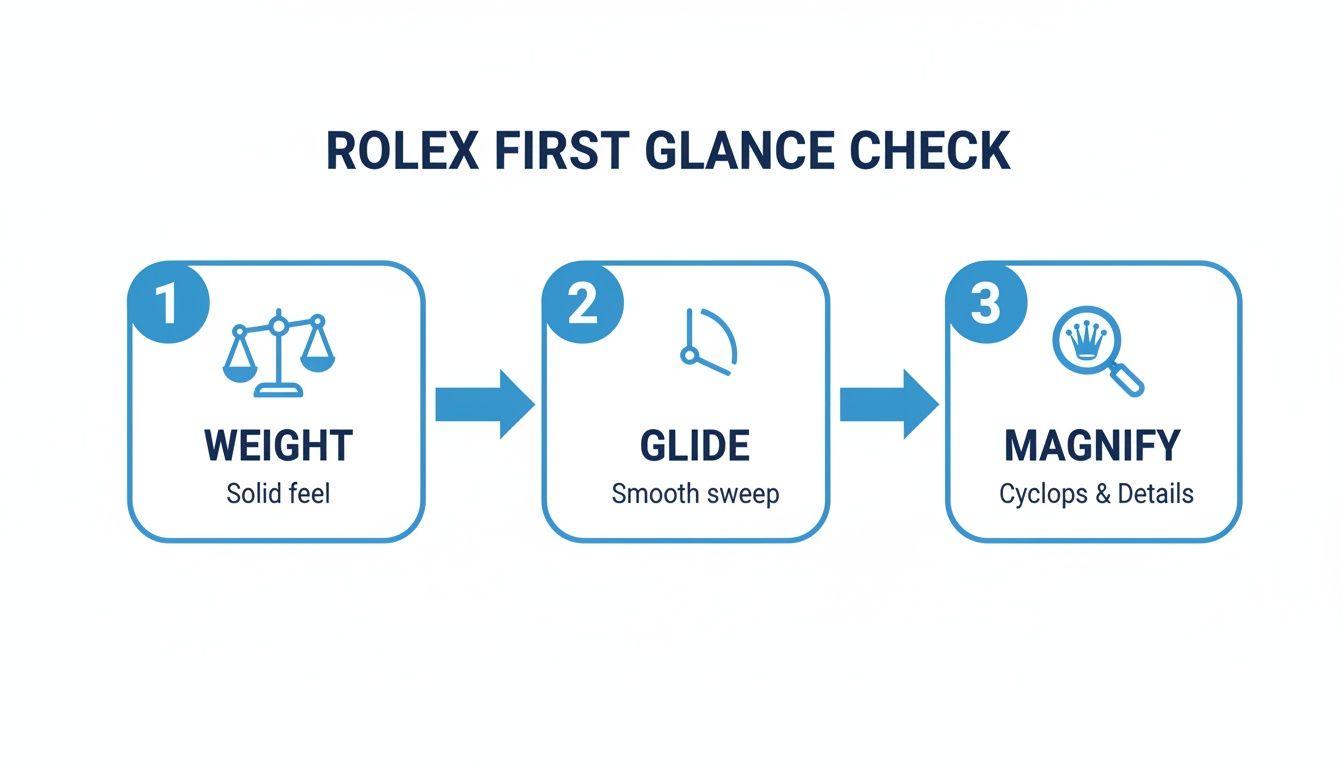
| Feature | Real Rolex | Common fake red flags |
|---|---|---|
| Cyclops lens | Magnifies the date 2.5x, so the number fills the bubble. Perfectly centered. | Weak magnification (around 1.5x), a flat look, or a lens sitting off center. |
| Dial printing | Crisp, evenly spaced lettering with clean edges under a loupe. | Fuzzy, wavy or crowded text, uneven spacing, smudged lume. |
| Second hand | Glides in 8 small steps per second, looking almost smooth. | A clear once-per-second tick (quartz) or a visibly choppy sweep. |
| Weight | Dense and balanced, from solid Oystersteel or precious metal. | Surprisingly light, hollow-feeling or top-heavy. |
| Caseback | Plain, solid and smooth on almost every model. | A clear display back, logos or decorative engravings. |
| Price | In line with the current pre-owned market. | Far below market, often with a story about why. |
Passing this table doesn't make a watch genuine. It simply tells you the watch deserves a closer look. The 12 detailed checks below are where good counterfeits get caught.
What you need for a proper inspection
You don't need a workshop to run most of these checks. A few simple tools make a big difference:
- A 10x jeweler's loupe for dial printing, the rehaut, engravings and the laser-etched crown.
- Good, even light, ideally daylight or a bright desk lamp you can angle.
- A small digital scale if you know the expected weight of the model.
- A UV flashlight to check lume and some security printing on documents.
- Reference photos of the exact model and year from a trusted dealer, so you can compare fonts, hands and markers side by side.
Why are fake Rolex watches so hard to spot now?
Rolex is the most copied luxury watch brand in the world. Industry estimates put counterfeit Swiss watch production in the tens of millions of pieces a year, while Rolex itself makes roughly one million watches annually. That means fakes vastly outnumber genuine pieces, and plenty of them end up on resale sites, social media and private sales.
The quality gap has also narrowed. Ten years ago, most fakes had ticking quartz movements and printing you could spot across a room. Today's "super fakes" use automatic movements, sapphire crystals, ceramic bezels and even weighted cases designed to match a genuine watch on the scale. Resale authentication platforms routinely report rejecting a meaningful share of the watches sent to them, and Rolex models make up the majority of those rejections.
Two other threats make things harder still:
- Frankenwatches: watches assembled from a mix of genuine and fake parts, such as a real case and bracelet hiding a clone movement. Because some parts are real, they can pass a quick inspection.
- Fake paperwork: counterfeit boxes, booklets and warranty cards printed with a serial number that matches the fake watch exactly.
Vintage watches add another layer. Older Rolexes may have had their dials refinished ("redials"), service hands or replacement bezels fitted over the decades. None of these makes a watch fake, but they change its value significantly and are often hidden by sellers, which is why vintage pieces deserve an expert's eye every time.
The good news is that even the best fakes fail somewhere. Counterfeiters can copy the look of a Rolex, but copying its finishing, tolerances and patented technology costs more than a fake can sell for. That is exactly what the checks below are designed to expose.
Checks 1 to 4: What should you look for on the dial and crystal?
The dial side of the watch is where counterfeiters most often slip, because it demands microscopic precision. You'll want a 10x jeweler's loupe and good, even light.

Check 1: Does the Cyclops lens magnify the date 2.5x?
On date models such as the Datejust and Submariner Date, Rolex fits a small sapphire bubble, the Cyclops, over the date window. A genuine Cyclops magnifies the date by exactly 2.5x, so the numeral fills the lens and looks bold and sharp. It sits perfectly centered over the window.
Many fakes manage only around 1.5x magnification, which leaves the number looking small and lost inside the bubble. Others print a larger date to compensate, or glue the lens slightly off center. Look at the watch from a few angles: a genuine Cyclops also has an anti-reflective coating on its underside, so the date stays easy to read without heavy glare.
Check 2: Is the dial printing flawless under magnification?
Rolex printing is close to perfect. Every letter in "Oyster Perpetual" and "Superlative Chronometer Officially Certified" has sharp edges, even thickness and consistent spacing. Under a loupe, look for:
- Fuzzy or wavy text: letters that look blurred, raised or slightly uneven.
- Spacing problems: letters crowded together or spaced awkwardly apart.
- Messy lume: luminous paint on the markers that looks splotchy, uneven or spills over its borders. On a real watch the lume is applied cleanly and glows evenly in the dark.
- A soft coronet: the applied crown logo at 12 o'clock should be a separate, finely made piece with sharp points, not a flat or rounded stamping.
Also check the hands. Genuine hands are perfectly finished and aligned, and they sweep over the markers without touching each other or the crystal.
Check 3: Is the rehaut engraving crisp and aligned?
The rehaut is the angled inner ring between the dial and the crystal. Since the mid-2000s, Rolex has engraved "ROLEXROLEXROLEX" around it as an anti-counterfeiting feature, with the watch's serial number at the 6 o'clock position.
- The engraving should be crisp, deep and evenly spaced all the way around.
- The letters should line up precisely with the hour markers. On a genuine watch, the "R" and the "X" sit squarely against the markers.
- The serial number at 6 o'clock should be cleanly engraved and match the papers.
Counterfeit rehauts often look shallow or etched, drift out of alignment with the markers, or use the wrong font. This is one of the hardest details for fakers to reproduce accurately.
Check 4: Can you find the laser-etched crown on the crystal?
Since the early 2000s, Rolex has micro-etched a tiny coronet into the sapphire crystal just above the 6 o'clock marker. It is so small that you usually need a loupe and the light at just the right angle to see it. That subtlety is the point. If the crown is easy to spot with the naked eye, or looks like a printed sticker, the watch is almost certainly fake. Keep in mind that older watches made before this feature won't have it, so its absence on a vintage piece isn't a red flag by itself.
Checks 5 to 8: What does a real Rolex feel and sound like?
Authenticity is something you feel and hear as well as see. The tactile quality of a genuine Rolex is one of the hardest things for counterfeiters to match, and these checks often expose a fake faster than any loupe.
Check 5: Does the watch feel dense and balanced?
Genuine Rolex steel watches are made from Oystersteel, Rolex's name for its 904L stainless steel alloy, which is denser and more corrosion resistant than the 316L steel used in most other watches and nearly all fakes. Gold and platinum models are heavier still. A steel Submariner Date, for example, weighs roughly 155 grams with a full bracelet.
Fakes often feel light or top-heavy because they use cheaper steel and hollow bracelet links. Be aware, though, that some super fakes now add weight with heavier metals, so a heavy watch isn't automatically genuine. Treat a light watch as a strong red flag, and a heavy one as simply passing the test.
Check 6: Does the second hand glide or tick?
A modern Rolex mechanical movement beats at 28,800 vibrations per hour, which moves the second hand in 8 small steps every second. The result looks like a near-smooth glide. Hold the watch to your ear and you'll hear, at most, a faint, fast whir.
A cheap quartz fake ticks once per second with an obvious jump and an audible tick. Low-grade automatic fakes sweep, but often more slowly, at 6 steps per second, which looks visibly choppier side by side with a genuine watch. Better clone movements can match the beat rate, so a good sweep is a pass, not proof. If you'd like to understand what's happening inside, our guide to how a mechanical watch works explains it.
Check 7: Does the crown wind smoothly?
Unscrew the winding crown and give it a few turns. On a genuine Rolex the action is smooth, consistent and nearly silent, with a light, even resistance as the mainspring winds. There should be no grinding, scraping or catching. The crown itself should carry a crisp coronet with dots or a bar beneath it, which indicate the crown type, and its grip grooves should be sharp. A gritty, noisy or uneven winding feel points to poorly finished parts inside.
Check 8: Does the bezel click precisely?
On sport models with rotating bezels, such as the Submariner and GMT-Master II, the bezel is a revealing test. A genuine Submariner bezel turns in one direction only, with 120 firm, evenly spaced clicks and no backward play. Each click locks cleanly into place with a solid, refined sound. A GMT-Master II bezel turns both ways with 24 clicks, each landing exactly on an hour.
Fake bezels often feel loose or gritty, wobble when you push on them, sound tinny, or have the wrong number of clicks. A diver's bezel that turns both ways is an instant giveaway. On ceramic Cerachrom bezels, the numerals should be crisp and evenly filled, with no bubbling or patchy coating.

In stock, inspected by our specialists
Rolex GMT-Master II 116710LN, 2017
Black Cerachrom bezel with the crisp 24-hour scale described above. Box and papers.
$15,500
View this watch →
Checks 9 to 11: How do you inspect the case, bracelet and clasp?
Turn the watch over. The case, bracelet and clasp are where counterfeiters cut costs, because buyers often focus on the dial and forget the rest.

Check 9: Is the caseback plain and solid?
Almost every Rolex has a smooth, solid, screw-down caseback with no engravings, logos or display window. Rolex's Oyster case is built around that sealed back. A few exceptions exist, such as the Deepsea with its engraved titanium caseback and a handful of models with display backs, including the 1908, some Cellini models and the platinum Daytona 126506, so know the model you're looking at. As a rule, though, a sport or Datejust model with a clear caseback showing the movement, or a back covered in stickers and engravings, is a fake.
Check 10: Are the bracelet links solid and properly finished?
Whether it's a three-link Oyster, a five-link Jubilee or a President bracelet, every link on a modern Rolex is solid metal. The bracelet feels dense and moves fluidly, with no rattle and no sharp edges when you run a finger along the sides of the links.
- The shake test: give the bracelet a gentle shake. A cheap, tinny jingle suggests hollow or folded links.
- End links: where the bracelet meets the case, the fit should be flush and tight, with no uneven gaps.
- Screws, not pins: modern Rolex bracelets join their removable links with precisely machined screws that sit flush with the link. Many fakes use simple friction pins, or a decorative screw head on top of a pin.
- Two-tone finishing: on Rolesor bracelets, the gold center links should be solid gold, with a rich, even color and crisp lines where gold meets steel.

For a closer look at every bracelet style and which models wear them, see our guide to Rolex bracelets.
Check 11: Does the clasp close with precision?
A genuine Rolex clasp closes with a firm, precise click and has no wiggle once it's shut. On sport models, the Oysterlock safety latch should engage smoothly every time, and many models include the Glidelock or Easylink extension systems, which should slide and lock cleanly. Check the details:
- Engravings: the Rolex name and coronet inside the clasp are deeply and cleanly engraved, not shallow, fuzzy or printed on.
- The coronet: the crown on the outside of the clasp should be crisp, with sharp, well-formed points.
- Finishing: brushed and polished surfaces should match the rest of the bracelet exactly.


In stock, inspected by our specialists
Rolex Submariner Date 116613LB, 2018
Steel and 18K yellow gold with the solid two-tone Oyster bracelet shown above. Box and papers.
$16,500
View this watch →
Check 12: How do you verify the serial number and papers?
A genuine Rolex has a documented identity. Its serial number and reference number must be engraved cleanly on the watch and must match the paperwork exactly. This is where many fakes and stolen watches get caught.
Where to find the serial and reference numbers
- Serial number, before about 2005: engraved between the lugs at 6 o'clock. The bracelet has to be removed to see it, which is a job for a professional.
- Serial number, about 2005 to 2008: a transition period, so you may find it both between the lugs and on the rehaut.
- Serial number, after about 2008: engraved on the rehaut at 6 o'clock, visible through the crystal. Since around 2010, serials are random alphanumeric codes rather than sequential numbers.
- Reference number: engraved between the lugs at 12 o'clock and printed on the warranty card. It identifies the model, material and bezel. A steel Submariner Date, for example, is reference 126610LN.
Genuine engravings are deep and sharp, made with a diamond-tipped tool, and catch the light with a fine, glittering edge. Counterfeit engravings tend to look shallow, sandy or acid-etched, with fuzzy edges and uneven spacing. If you want to date a watch from its serial, our table of Rolex serial numbers by production year will help.
Do the papers match the watch?

Rolex has changed its warranty documents several times, from paper certificates to plastic cards, and the card design has been updated again in recent years. The document should suit the watch's age: a 2018 watch paired with a 1990s-style paper certificate is a red flag. On any card, check that:
- The serial number and reference number match the engravings on the watch exactly.
- The printing is sharp, the fonts are correct and nothing is smudged or misaligned.
- The dealer stamp and purchase date make sense for the watch's production period.
- A plastic card feels rigid and substantial, like a premium credit card, not thin and bendy.
Remember that papers support authenticity but never prove it on their own. Always authenticate the watch first, then the papers. Our guide to Rolex box and papers explains what a complete set includes and how it affects value.
What are the red flags for specific Rolex models?
General checks catch most fakes, but each popular model also has its own giveaways. Knowing what a model should and shouldn't have is one of the quickest ways to rule a watch out.
| Model | What a genuine one has | Red flags that mean fake |
|---|---|---|
| Submariner | Unidirectional 120-click bezel, Cyclops on date models only, screw-down crown with crown guards. | A Cyclops on a no-date Submariner, a bezel that turns both ways, or a date window with weak magnification. |
| Datejust | Cyclops date at 3 o'clock. Fluted bezels are always solid gold (or white gold on steel models). | A fluted bezel that is plain steel, poorly cut flutes, or a Cyclops that sits off center. |
| GMT-Master II | A 24-hour hand, a bidirectional 24-click bezel with crisp ceramic numerals on modern pieces. | A GMT hand that doesn't track a second time zone correctly, mushy bezel clicks, or colors that bleed at the join. |
| Cosmograph Daytona | Three working chronograph subdials, screw-down pushers, no date and no Cyclops. | A date window or Cyclops, subdials that are only decorative, or pushers that don't start, stop and reset cleanly. |
| Day-Date | Day spelled out in full at 12, date at 3, made only in 18K gold or platinum, usually on a President bracelet. | Any steel or two-tone Day-Date (Rolex has never made one), or a day window with abbreviated text. |
If a watch has a feature its model never came with, you don't need to go any further. Shop our Daytona collection or the other model pages on our site to see genuine examples up close.
What can only a watchmaker confirm?
Even with all 12 checks, a well-made super fake can get through. The one component counterfeiters still can't reproduce economically is the movement, and checking it means opening the caseback with the proper tools. Never try this yourself: you can scratch the case, damage the gaskets and compromise water resistance.
What a genuine Rolex movement looks like
A watchmaker first confirms that the caliber is correct for the model and era. A current Submariner Date should have a Calibre 3235, for example, while the previous generation used the 3135. Then they look at the finishing and for the patented components that clone movements don't have:
- Blue Parachrom hairspring: a proprietary alloy that resists magnetism and shocks. Clones may paint a part blue, but it lacks the real material's metallic sheen.
- Chronergy escapement: fitted to the modern 32xx calibers, with a distinctive skeletonized design that clone movements don't reproduce.
- Microstella regulation: Rolex fine-tunes timing with small regulating nuts on the balance wheel. Clones usually use a standard regulator arm, which looks completely different.
- Finishing: genuine movements are cleanly finished, with signature engravings on the rotor and bridges and no rough edges or stray tool marks.
How clone movements and Frankenwatches are caught
Super fakes typically use clone movements based on Swiss ETA calibers or on Asian-made copies of Rolex calibers. At a glance they can look convincing, complete with fake engravings, but under magnification the finishing is cruder, the regulator is wrong and the proprietary parts are missing.
A movement check also catches Frankenwatches, where a genuine case and bracelet hide a clone movement or an aftermarket dial and hands. What it can't always settle on its own is whether every part is original to the watch's first sale, because authorized servicing legitimately replaces parts over the years. That distinction matters for value: a watch can be entirely genuine and still carry later service parts that affect collectibility and price.
Do you need authentication, an appraisal or a service?
These terms get used interchangeably, but they are different services, and you may need more than one:
- Authentication is an expert opinion on whether the watch and its major components are genuine and correctly identified.
- An appraisal is a value document, usually for insurance, estate planning or resale. It focuses on what the watch is worth, not just whether it's real.
- A service inspection reviews mechanical condition: timekeeping, water resistance, wear and any maintenance needed.
Professional verification is worth paying for whenever the seller is unknown to you, the price is high enough that a mistake would hurt, the watch is vintage or heavily serviced, or it's being sold as all original. Whichever service you choose, ask for specifics rather than a verbal thumbs-up: written condition notes, confirmation of the movement, an assessment of the parts, pressure-test results where relevant, and whether any aftermarket or replacement parts were found. That documentation is what makes the result useful later for insurance or resale.
What should you do if you think your Rolex is fake?
That sinking feeling is common, and it doesn't always mean the worst. Take these steps in order:
- Stop wearing it and don't open it. Opening the caseback yourself can damage the watch and any evidence you might need.
- Gather the paperwork. Collect the receipt, listing, messages with the seller, payment records and any box and papers.
- Get an independent inspection. Take it to an experienced independent watchmaker or a reputable dealer and ask for a written report on the movement and parts.
- Contact the seller and your payment provider. If the watch is confirmed fake, a written report gives you the strongest footing for a refund, a chargeback or a marketplace claim.
- Report it. Counterfeit sales can be reported to the platform and to local consumer protection authorities.
Your options depend heavily on where and how you paid, which is one more reason to buy from an established dealer with a clear return policy.
How do you avoid buying a fake Rolex in the first place?
The most reliable way to avoid a fake is to buy from a seller whose business depends on getting authentication right. Whether you shop in person or online, look for:
- A physical showroom you can visit, which shows an established, accountable business.
- High-resolution photos of the actual watch, including the caseback, clasp and papers, rather than stock images.
- A clear, written authenticity policy and a transparent return policy.
- A price that makes sense. A deal far below the current market almost always has a reason, and it's rarely a good one.
Be especially careful with peer-to-peer marketplaces, social media sellers and anyone who pressures you to pay quickly or by wire transfer. Every watch we sell at ECI Jewelers is inspected by our specialists using the checks in this guide, and you can read more in our Authenticity Pledge.

In stock, inspected by our specialists
Rolex Datejust II 116333, 2016
41 mm, 18K yellow gold fluted bezel, black Roman dial and a Cyclops that does exactly what it should. Box and papers.
$13,500
View this watch →

Collection
Watches with Box and Papers
Complete sets with matching serial numbers, ready for the paperwork checks in this guide.
What is the complete Rolex authentication checklist?
Here are all 12 checks in one place. Save it, screenshot it, or bring it with you when you look at a watch in person.
- Cyclops: the date is magnified 2.5x and centered.
- Dial printing: crisp text, even spacing, clean lume and a sharp applied coronet.
- Rehaut: a deep, aligned "ROLEX" engraving with the serial at 6 o'clock on modern pieces.
- Crystal crown: a tiny laser-etched coronet at 6 o'clock, visible only with a loupe.
- Weight: dense and balanced, never light or hollow.
- Second hand: 8 small steps per second, no once-per-second tick on mechanical models.
- Crown: smooth, silent winding and a crisp coronet.
- Bezel: the right number of firm clicks, the right direction and no play.
- Caseback: plain and solid on almost every model.
- Bracelet: solid links, flush end links and screws rather than pins.
- Clasp: a precise click, deep engravings and matching finishes.
- Numbers and papers: clean engravings that match the warranty card exactly.
If a watch passes all 12, it's a strong candidate. If it fails any one of them, ask questions before you go further, and for any significant purchase, finish with a professional movement inspection.
Frequently asked questions
Does a real Rolex tick?
A modern mechanical Rolex doesn't tick once per second. Its second hand moves in 8 small steps every second, which looks like a near-smooth sweep and makes almost no sound. The exception is the Oysterquartz, a genuine quartz Rolex made from the late 1970s to 2001, which does tick once per second. So a ticking second hand on a modern Submariner, Datejust or GMT-Master II is a strong sign of a fake, but on a vintage Oysterquartz it is normal.
Do the original box and papers prove a Rolex is real?
No. A full set is a good sign, but counterfeiters fake boxes, hang tags and warranty cards too, sometimes with a serial number that matches the fake watch perfectly. Treat the papers as supporting evidence: authenticate the watch first, then confirm the serial number, reference number and purchase date all match it. The reverse is also true. Plenty of genuine pre-owned watches are sold without papers, so a missing box isn't proof of a fake.
Can you verify a Rolex serial number online?
Not with Rolex directly. Rolex doesn't offer a public serial number lookup. You can use a serial number to estimate a watch's production year, and you can check whether it has been reported stolen through watch registries and the police. Neither confirms the watch in front of you is genuine, because a counterfeiter can copy a real serial number. Authenticity comes from inspecting the watch itself.
Does a missing or worn serial number mean it's fake?
Not always. On older watches, the serial between the lugs can be worn or polished away after decades of wear and servicing. On a modern Rolex, though, the rehaut serial sits protected under the crystal and shouldn't wear away. If it's missing, damaged or looks altered, assume the watch is fake or has a problem history until a professional proves otherwise.
Can a fake Rolex be made with real gold?
It's very rare, because the cost of solid gold would wipe out a counterfeiter's profit. Fakes are usually gold-plated steel. A plated watch feels noticeably light for its model, the plating rubs off on the clasp, crown and link edges, and the color is often too brassy or coppery compared with Rolex's own alloys, such as 18K Everose gold. A jeweler can confirm the metal with a non-destructive test, and a "solid gold" Rolex priced below the value of its gold is a fake.
Are super fake Rolexes undetectable?
No. Super fakes can fool a casual look and even some of the checks in this guide, but they almost always fail under expert inspection. The giveaways are tiny font and spacing differences, a rehaut engraving that's slightly off, and above all the movement, whose finishing and proprietary parts can't be copied economically. That's why a professional inspection matters most for expensive purchases.
Can a jeweler tell if a Rolex is real?
A jeweler who specializes in luxury watches can, and many can do it on the spot for the external checks. For a definitive answer, the watch should be opened by a qualified watchmaker who can inspect the movement. A general jeweler without watch experience may be able to test the gold but not authenticate the watch itself.
Is it safe to buy a Rolex online?
Yes, when you buy from an established dealer with a physical showroom, detailed photos of the actual watch, a written authenticity policy and a clear return policy. The risk sits with anonymous marketplace sellers and too-good-to-be-true prices. Never rely on photos alone to judge authenticity, and ask for the caseback, clasp and serial number to be photographed before you commit.
Buy your next Rolex with confidence
Every watch at ECI Jewelers is inspected by our specialists in New York's Diamond District before it's listed. Browse pre-owned Rolex watches with box and papers, or visit our showroom to see them in person.
Shop pre-owned Rolex →Read our Authenticity Pledge


