


Reading a GMT watch is actually pretty straightforward once you get the hang of it. The main hands show your local time just like any other watch, while that extra fourth hand—the 24-hour hand—points to a second "home" time on the bezel's 24-hour scale. This simple, brilliant feature is what makes it an essential tool for anyone navigating our connected world.
The GMT Watch Demystified: A Traveler's Best Friend

That extra hand isn't just for looks—it’s a powerful complication built for people operating across different time zones. It's more than a cool feature for collectors; it offers real-world utility, whether you're hopping between continents for vacation or just coordinating calls with an international team.
The whole concept was born out of necessity, deeply intertwined with the world of aviation. For travelers who appreciate the finer details, it can be just as engaging to explore different aircraft types and their comparisons as it is to understand the mechanics of their timepiece.
A Legacy Born in the Skies
The GMT watch traces its roots back to the golden age of air travel. When the Rolex GMT-Master debuted in 1955, it was purpose-built for Pan Am pilots navigating long-haul international flights. It quickly became the ultimate traveler's companion.
Modern versions with a "true GMT" function allow you to adjust the local hour hand independently without stopping the watch—a total game-changer for frequent flyers. We'll skip the dry technical manuals and get straight to the practical steps and real-world examples. This guide will show you how to master this function, turning your watch into a trusted companion.
The benefits are immediate:
- Effortless Time Tracking: Keep an eye on your home and local time simultaneously.
- Global Coordination: Schedule meetings or calls across continents with zero confusion.
- Day/Night Indication: The 24-hour scale instantly tells you if it's day or night back home, preventing those accidental late-night calls.
This is your starting point for understanding https://www.ecijewelers.com/blogs/recent-posts/what-is-a-gmt-watch and unlocking its full potential. You'll soon see why icons like the Rolex GMT-Master have made global travel seamless for generations of adventurers.
Decoding the Dial: The Four Hands and What They Do
To really get the hang of a GMT watch, you have to know what each hand on the dial is doing. It might look like a regular watch at first glance, but that extra fourth hand is what gives it its globetrotting power. Think of it like a theater stage with four actors—each one has a specific role to play.
The three hands you’re already familiar with work just like you'd expect. The minute hand and the seconds hand are doing their usual job, ticking away the minutes and seconds just like on any analog watch. Then you have the local hour hand—usually the shorter, beefier one—which points to the hour right where you are. Simple enough.
The Star of the Show: The GMT Hand
Now for the main event: the 24-hour GMT hand. This is the one that makes the magic happen. It’s typically longer and thinner, and manufacturers often give it a pop of color or a distinctive shape—like the famous red hand on a Rolex "Pepsi" GMT-Master II—to make it stand out.
What makes it special is its speed. It moves exactly half as fast as the regular hour hand, making a full trip around the dial just once every 24 hours.
This slow, deliberate journey is what unlocks the watch's potential. It points to the 24-hour scale, which is usually printed on the bezel or an inner chapter ring, giving you a clear reference to a second time zone. Most people set this to their "home time" or to UTC.
Pro Tip: That 24-hour scale is your best friend for avoiding jet-lagged mix-ups. When the GMT hand points to "14" on the bezel, you know instantly it's 2 PM back home. There's no guessing whether it's AM or PM, a feature that has saved countless people from making an accidental 3 AM call to a client or family member.
Before we get into setting the watch, let's quickly break down the key players on the dial.
Quick Guide to Your GMT Watch's Dial
This table gives you a straightforward look at what each component on your GMT watch is actually doing.
| Component | Primary Function | What It Tells You |
|---|---|---|
| Local Hour Hand | Tracks the current hour | The time in your current location (e.g., 3 PM). |
| Minute Hand | Tracks minutes | The minutes past the hour for both time zones. |
| Seconds Hand | Tracks seconds | The seconds for both time zones. |
| GMT Hand (24-Hour) | Tracks a second time zone | The hour in your "home" time zone on a 24-hour scale. |
| Bezel / Chapter Ring | Provides the 24-hour scale | The reference track for the GMT hand to indicate the second time zone. |
Understanding how these parts work together is the first step to mastering your GMT.
How They All Work Together
Let's run through a quick real-world scenario. Say you live in New York but you've just landed in Los Angeles for a business trip. Here’s how you’d see the time at a glance:
- Local Hour, Minute, and Seconds Hands: These would be set to your current L.A. time—let's say it's 11:00 AM. The main hour hand points to the 11 on the dial.
- GMT Hand: Meanwhile, your GMT hand is pointing to "14" on the 24-hour bezel. This tells you it's 2:00 PM back in New York.
The minute and seconds hands pull double duty, serving both time zones at once since, thankfully, minutes and seconds are the same everywhere. It's an elegant and incredibly practical system. Once you get the hang of this interplay, you're well on your way to reading your GMT like a pro.
Setting Your Watch for Seamless Travel
Alright, you understand the hands, so let's put that knowledge to work. This is where we go from theory to practice and set up a "true" GMT watch—the kind you'll find on the wrists of pilots and serious travelers—for a real trip.
We'll use a common scenario: you're at JFK in New York, getting ready for a flight to London.
The real beauty of a true GMT movement, like the ones in a Rolex GMT-Master II or Tudor Black Bay GMT, is its "jumping hour" feature. This lets you change your local time without ever stopping the seconds hand, so your timekeeping stays perfectly accurate down to the second.
This graphic breaks down the different jobs each hand does.
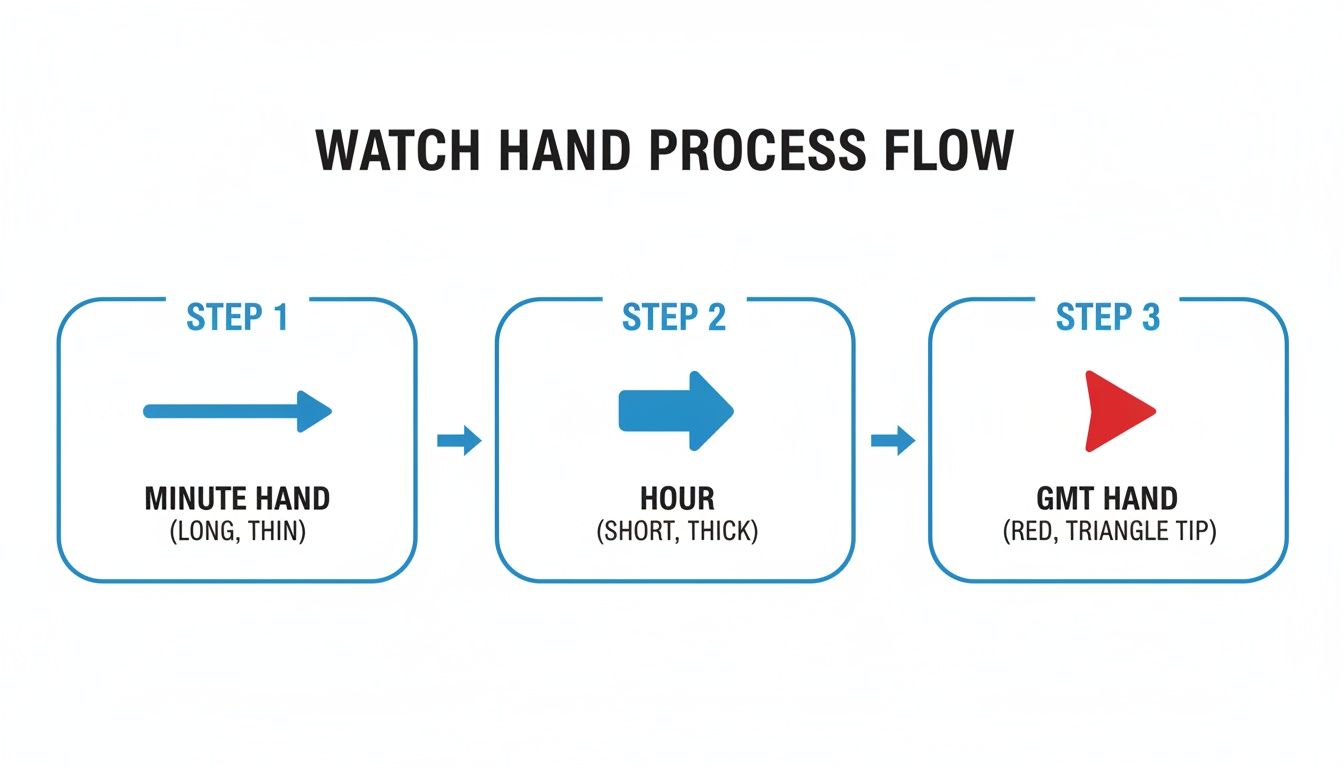
As you can see, the minute hand works for both time zones. It's the hour and GMT hands that move independently to keep your local and home times straight.
Establishing Your Home Base
Before you even head for the airport in New York, your first move is to lock in your "home" time. This becomes your anchor, your point of reference no matter where you go.
- Pull the Crown All the Way Out: First, unscrew the crown and pull it out to the final position (usually the third click). You'll notice the seconds hand stops, which is exactly what we want. This lets you set everything at once.
- Set Home Time: Turn the crown to move the hands forward until both the GMT hand and the local hour hand show your correct home time. Critically, you need to align the GMT hand with the 24-hour scale on the bezel. For example, if it's 10:00 PM (22:00) in New York, point both the GMT and hour hands to the 10 on the dial, but make sure the GMT hand is also pointing to "22" on the bezel.
- Sync and Lock It In: Once the time is set, push the crown all the way back in and screw it down. The watch starts ticking again, and your GMT hand is now locked to New York time.
A very common mistake is setting the GMT hand using the 12-hour markers on the dial. Don't do it. Always, always use the 24-hour bezel or chapter ring as your guide for the GMT hand. This is the only way to correctly distinguish between AM and PM for your home time.
Adjusting to Your New Destination
You've just landed in London, which is five hours ahead of New York. Now you get to see what makes a true GMT so special. There's no need to stop the watch or reset everything from scratch.
- Unscrew the crown and pull it to the middle position (this is typically the second position). In this mode, the main 12-hour hand "jumps" in one-hour increments, either forward or backward, without disturbing the minute, second, or GMT hands.
- Jump the hour hand forward five times. You'll see the local hour hand advance while the red GMT hand stays exactly where it was, still pointing to the time back in New York on the 24-hour bezel.
- Keep an eye on the date. On most true GMTs, the date wheel is linked to this jumping hour hand. As you advance past midnight, the date will click over automatically. Just double-check that it's correct for London.
Once that's done, just push the crown in and screw it back down. That's it. Your main hands now show local London time, and the GMT hand is your faithful reminder of what time it is back home.
If you want to get into the nitty-gritty of specific models, it can be useful to learn more about how to adjust the time on a Rolex. Mastering this simple process is what makes you feel confident using the watch as it was intended—on the fly, anywhere in the world.
Unlocking the Bezel to Track a Third Time Zone
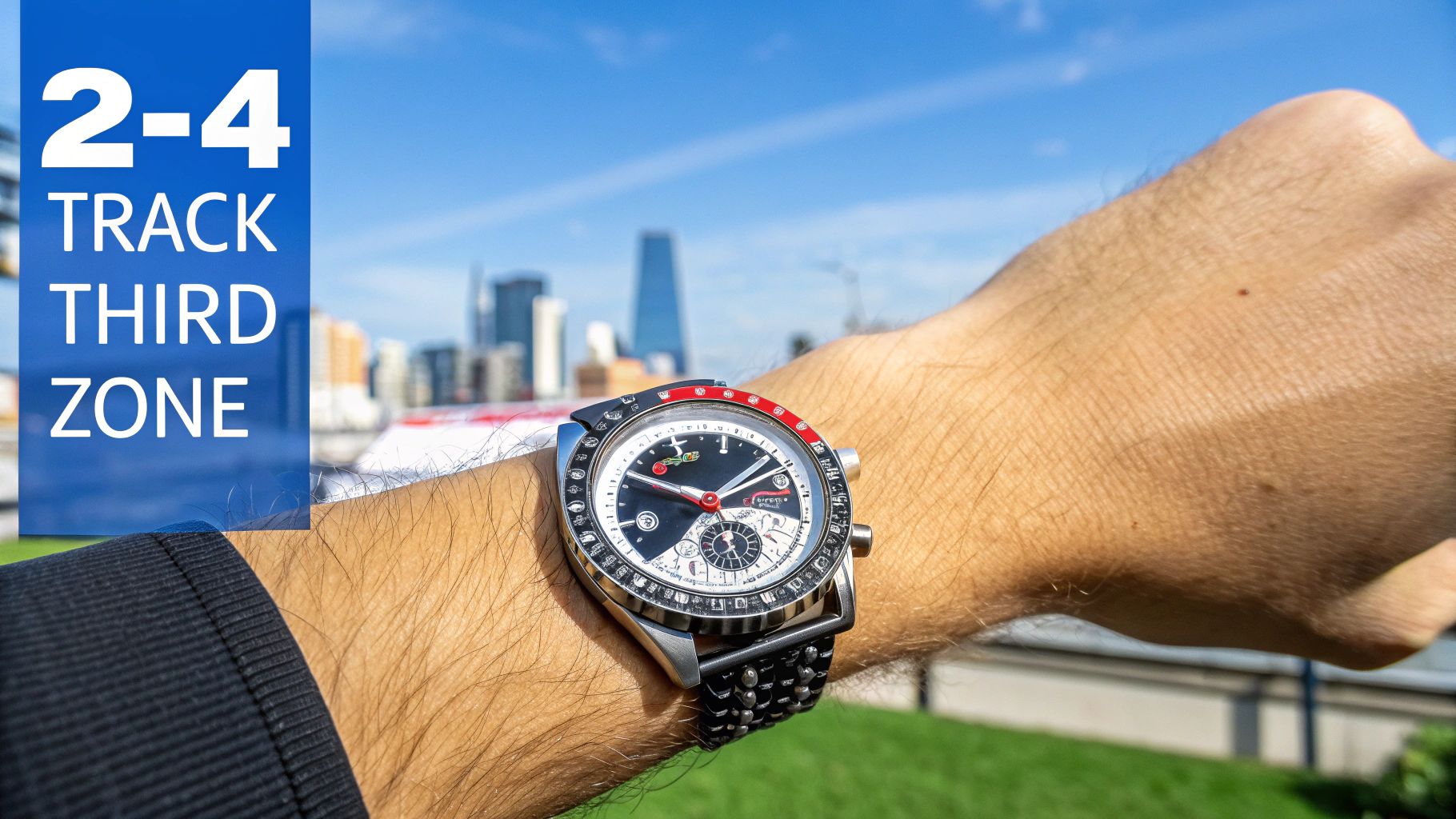
Your GMT watch already has you covered for local and home time. But that rotating 24-hour bezel? That's its real party trick. It transforms your watch from a simple dual-time device into a compact, analog world clock on your wrist, capable of tracking a third time zone without touching the crown.
A lot of people think the bezel is just for looks, but it’s one of the most functional parts of the entire watch. Once you get the hang of it, coordinating across international offices or scheduling calls with clients around the globe becomes second nature. It's a brilliantly simple and elegant mechanical solution to a very modern problem.
The Logic Behind the Rotating Bezel
So, how does it all work? The magic is that the bezel moves independently of the hands. By rotating it, you're essentially changing the frame of reference for the 24-hour GMT hand. Instead of being locked to your home time, the GMT hand can now point to the time in any other city you choose.
Let's walk through a real-world business scenario.
- Local Time (Main Hands): You're on a business trip in London. Your main hour and minute hands show it's 3:00 PM (15:00).
- Home Time (GMT Hand): Your family and home office are in New York, which is five hours behind. Your GMT hand is pointing to "10" on the bezel, telling you it's 10:00 AM back home.
This setup is perfect for two time zones. But now, you need to jump on a call with a colleague in Tokyo.
Putting the Third Time Zone into Action
Tokyo is nine hours ahead of London (UTC+9). Instead of fumbling for your phone to check a world clock app, you can figure this out right on your wrist.
Simply rotate the bidirectional bezel. The goal is to calculate the time difference between your current reference time (New York, at UTC-5) and your new third time zone (Tokyo, at UTC+9). The total difference between them is 14 hours. You'll rotate the bezel counter-clockwise by 14 clicks.
Your GMT hand hasn't moved an inch, but it's now pointing to a different number on the newly positioned bezel. That number is the current time in Tokyo. This quick-glance adjustment is incredibly useful for anyone managing global teams or frequent travel.
This functionality is at the very heart of what makes GMT watches so prized by pilots, collectors, and travelers. It provides a tangible, mechanical connection to the world, turning a beautiful object into a seriously practical instrument for navigating our interconnected lives.
The bidirectional 24-hour bezel, first made famous on the classic "Pepsi" and "Batman" models, is what makes this effortless time-tracking possible. By aligning the bezel's triangle with a reference like UTC, you can quickly calculate any city’s offset just by looking at the numerals. Today’s modern ceramic bezels, with their crisp, laser-etched markings, offer fantastic legibility even in low light—a direct functional descendant of the original 1955 design made for Pan Am pilots.
If you want to see this in action, you can learn more about the history and mechanics of how GMT bezels function on YouTube.
Real-World Scenarios and Daily Pro Tips
Getting your GMT watch set up is one thing, but actually weaving it into your daily life is where it really starts to shine. Let’s go beyond the mechanics and look at a few practical, real-world situations where this complication becomes an absolute game-changer.
Say you’re based in Chicago and have a critical video call at 9:00 AM with your team in Singapore. The time difference is a whopping 13 hours. Instead of doing the mental math every time you think about it, you can just use your bezel as a quick visual reminder. The night before, rotate the bezel so your GMT hand points to "9" on the 24-hour scale. Done. Now, a quick glance at your wrist tells you exactly how many hours are left until the meeting.
It’s a simple habit, but it transforms your watch from a passive timekeeper into an active part of your workflow.
Caller vs. True GMT: What Fits Your Life?
When you dig into GMT watches, you’ll quickly hear about two types of movements. Understanding the difference is key to picking the right tool for the job.
-
True GMT (or "Traveler's GMT"): This is the one where the local 12-hour hand can be adjusted independently in one-hour jumps, all without stopping the watch. It’s the gold standard for frequent flyers. You land, you update your local time in seconds, and you’re good to go. The Rolex GMT-Master II and Tudor Black Bay GMT are prime examples.
-
Caller GMT (or "Office GMT"): With this type, the 24-hour GMT hand is the one that adjusts independently. This setup is perfect for someone who stays put but constantly deals with another time zone—think a remote worker in New York coordinating with headquarters in London. You're "calling" another time zone from your desk.
The GMT-Master II’s journey from a pilot’s tool to a luxury icon is all about mastering its functions. With the main hands for local time and the GMT hand plus bezel for "away" time, its true GMT movement offers incredible flexibility. This is a huge reason for its insane demand. You can see how that utility translates directly into market value.
Pro Tips for Everyday Mastery
Making your GMT feel like second nature comes down to a few key habits.
First, get used to "reading" your home time by looking at where the GMT hand points on the bezel, not the dial's 12-hour markers. This instantly tells you whether it's day or night back home—no guesswork needed.
And while your watch keeps you on schedule, a smart traveler knows that staying safe is just as important as staying on time. Brushing up on essential business travel safety tips is just as crucial as setting your watch correctly. By adopting these little habits, you unlock the true, practical power of this classic complication.
Finding Your Perfect GMT Companion
Now that you've got a handle on how a GMT works, you can really appreciate just how useful this complication is. It’s so much more than an extra hand on the dial—it’s a mechanical passport that connects you to any time zone with just a quick glance.
Once you master this function, a beautiful timepiece becomes an essential tool for travel, international business, or just keeping up with family and friends scattered across the globe.
Your Trusted Source for Luxury Timepieces
The next step, of course, is finding the right model for your wrist. That’s where we come in. At ECI Jewelers, we're more than just a place to buy a watch; we're your partner in the world of fine timepieces, connecting collectors and first-time buyers with expertly authenticated GMT models from premier brands like Rolex, Tudor, and Omega.
Our relationship doesn’t just end with a sale. We’re here for the entire ownership experience:
- Buying and Trading: Looking to upgrade? We provide transparent, market-based valuations for your current watches.
- Expert Servicing: Protect your investment with meticulous care from our team of specialists.
- A Personal Touch: You can explore our curated collection online or get hands-on with your next watch at our NYC showroom.
Choosing a GMT is a personal decision. It's about finding a companion that reflects your lifestyle and is ready to accompany you on your own global adventures.
Whether you have your heart set on the iconic Rolex GMT-Master II or another distinguished model, our team is here to guide you. For a deeper dive into the most legendary GMT of them all, check out our detailed insights on the Rolex GMT-Master. Let us help you find the perfect watch for your journey.
A Few Common Questions About Your GMT
Even after you get the hang of setting it, a few questions always seem to pop up. Here are some of the most common ones we hear from new and seasoned GMT owners alike, along with some straightforward answers.
True GMT vs. Caller GMT: What’s the Difference?
The biggest distinction boils down to one simple thing: which hand you can adjust by itself.
- A True GMT lets you jump the main 12-hour hand forward or backward in clean, one-hour steps. This is the perfect setup for frequent flyers who need to quickly update their local time after landing, all without stopping the watch.
- A Caller GMT (sometimes called an "office GMT") has an independent 24-hour hand. This is better suited for tracking a second time zone from a fixed spot, like your home office. You're "calling" another part of the world, hence the name.
Can I Actually Swim with My GMT Watch?
In most cases, absolutely. High-end GMTs like the Rolex GMT-Master II or the Tudor Black Bay GMT are built for it, usually carrying a water resistance rating of at least 100 meters (330 feet). This is more than enough for swimming, showering, or getting caught in a downpour.
One Crucial Tip: Always, always make sure the crown is fully screwed down before it touches water. An unscrewed crown is the number one reason for moisture damage, and it's a completely avoidable mistake.
How Do I Track Those Odd 30-Minute Time Zones?
This is a great question. What about places like India or parts of Australia with 30 or 45-minute offsets? Standard GMT movements are designed for full-hour jumps. For these unique locations, you'll have to do a little bit of mental math.
Your best bet is to set the GMT hand to the nearest full hour and just remember to add or subtract the extra minutes when you glance at it. It's a simple workaround once you get used to it.
Ready to find the perfect companion for your travels? At ECI Jewelers, we offer a curated collection of authenticated luxury GMT watches from the world's finest brands. Explore our selection today.


