


To get the best possible price when you sell a watch, you need to do a little prep work. It’s not just about the watch itself, but the story you can tell with it. A complete package—what collectors call a "full set"—is your golden ticket to boosting buyer confidence and your final offer.
Laying the Groundwork for a Successful Watch Sale
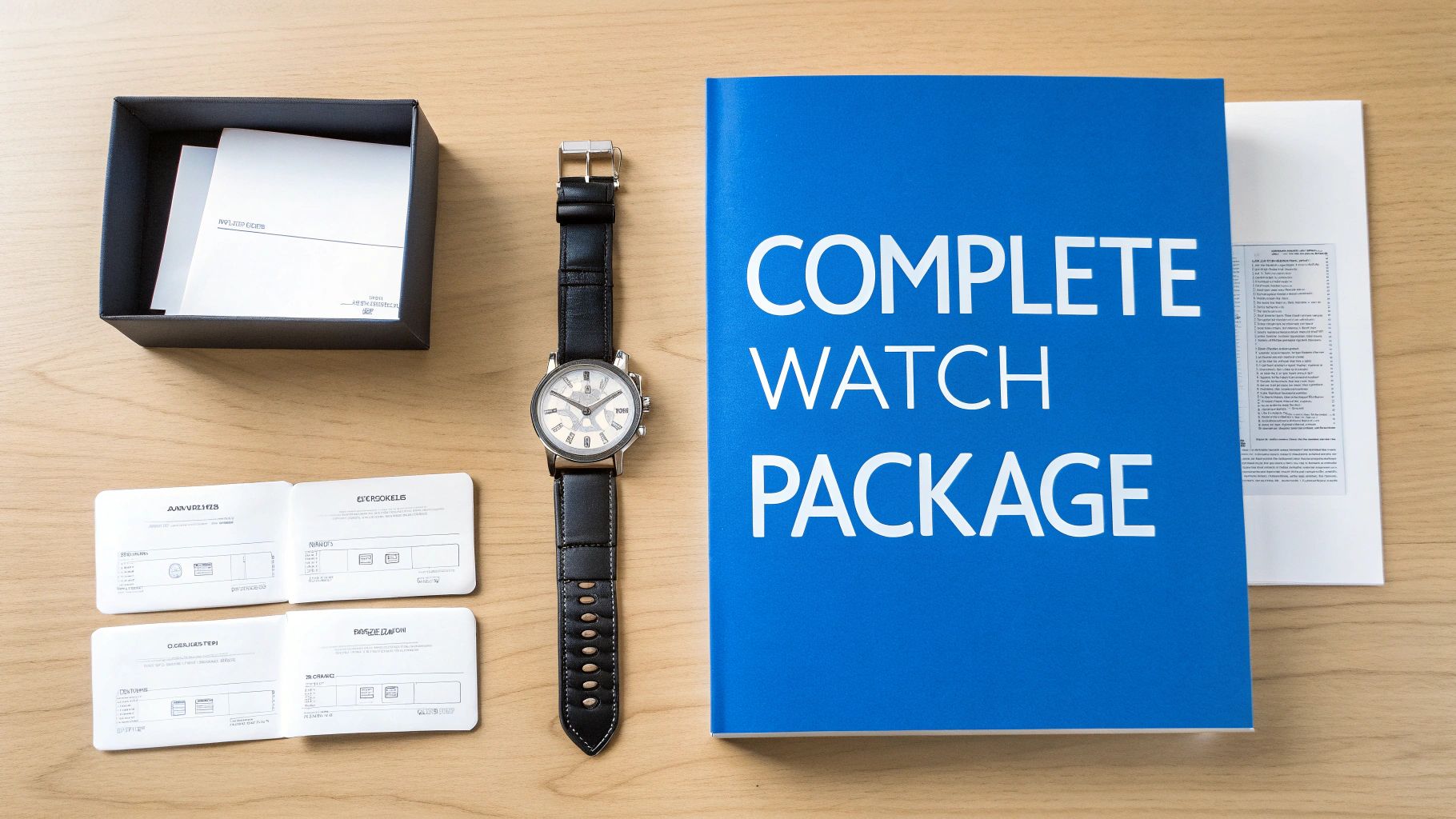
Before you snap a single photo or write a listing, the most important work is done. Getting top dollar isn't about finding some secret buyer; it's about presenting your watch as a valuable, well-documented asset. A bit of effort now can easily add hundreds, if not thousands, to the offers you receive.
Think of this first phase as building a foundation of trust. Every document, every receipt, and every spare link tells a part of your watch's history. Your job is to pull it all together into a compelling package.
Assemble Your Watch's Complete History
It's time to go on a treasure hunt through your desk drawers, closet, and safe. The goal is to find every single piece of paper and packaging that came with your watch when it was new. Serious buyers and collectors will pay a significant premium for a "full set."
What exactly makes up a full set?
- The Original Box: This means the inner presentation box and the outer cardboard sleeve. Don't forget it.
- Warranty Card or Papers: This is the single most critical document. It should be dated and stamped by the original authorized dealer, proving its origin.
- Instruction Manuals: While not as crucial as the warranty card, having the original booklets shows you were a meticulous owner.
- Hang Tags: Those little plastic or paper tags with the model and serial number are often thrown away, but collectors love them.
- Extra Links: If you had the bracelet sized, including the removed links is an absolute must.
- Service Receipts: Any paperwork detailing professional servicing proves the watch has been properly maintained and adds to its story.
A complete package does more than just prove authenticity—it sends a powerful signal that the watch was cared for. That emotional connection translates directly into real money, making your watch far more attractive than a "naked" one without its original accessories.
Prepare the Watch for Its Close-Up
Once you have all the paperwork together, turn your attention to the watch itself. You want it to look its absolute best without erasing its history. A careful, gentle cleaning can make a huge difference.
Grab a soft-bristled toothbrush (a baby toothbrush is perfect), a drop of mild soap, and some lukewarm water. Gently scrub the case and bracelet to remove any grime. Be extra careful around the bezel, and if you have any doubts about its water resistance, skip the water altogether.
When you're done, pat it dry with a soft, lint-free microfiber cloth. This simple step gets rid of the dust and dirt hiding in the crevices and makes the watch pop in photos. It’s a small effort that makes a massive first impression.
Before you list your watch, it’s a good idea to run through a quick checklist to make sure you have everything in order. This table breaks down what you need and why it matters.
Watch Sale Preparation Checklist
| Checklist Item | Why It's Important | Potential Value Increase |
|---|---|---|
| Original Box & Papers | Verifies authenticity and proves provenance. Highly desired by collectors. | 10% – 25% |
| Extra Bracelet Links | Ensures the watch will fit the new owner, avoiding costly link sourcing. | $50 – $500+ |
| Service History Records | Shows the watch was properly maintained, building buyer confidence. | 5% – 10% |
| Gentle Cleaning | Improves visual appeal for photos and in-person viewing. | Enhances salability |
| Honest Condition Assessment | Builds trust by accurately describing scratches or wear. | Prevents disputes |
Making sure you have these items squared away will make the entire sales process smoother and help you command a better price.
The Polish and Service Dilemma
This is a question I get all the time: should you get your watch professionally polished or serviced before selling it? The answer is almost always no.
Believe it or not, polishing a watch—especially a vintage one—can actually kill its value. Collectors want sharp, original case lines, even if that means a few minor scratches from daily wear. A heavy-handed polish can soften those crisp edges, which is a huge red flag for an experienced buyer.
As for a full mechanical service, it's only a smart move if the watch isn't running correctly. If it keeps good time, spending $800 or more on a service that you won't get back in the sale price is just throwing money away. A much better strategy is to price the watch fairly and be transparent about when it was last serviced.
This honesty lets the new owner decide if and when they want to service it, and with whom. As the global watch market grows—projected to jump from USD 77.48 billion in 2024 to USD 120.78 billion by 2033—buyers are more informed than ever and demand this kind of transparency. To see how these shifts are playing out, you can learn more about how global trends influence watch sales.
Uncovering Your Watch's True Market Value
Getting the price right is probably the single most important part of this whole process. Go too high, and your watch will just sit there, collecting digital dust while serious buyers scroll right past it. But price it too low, and you're essentially just handing money to the next person. It's a tough balance.
Your goal here is to become a bit of a market detective. You're hunting for the true market value—not what a dealer is asking for a watch, but what someone like you actually paid for a similar one, and recently.
Mastering the Art of Finding Comps
In the watch game, "comps" are your secret weapon. The term stands for comparable sales, and it refers to watches identical to yours in model, year, condition, and whether it comes with the box and papers. It’s a lot like real estate; you wouldn't list your house without seeing what similar homes on your block sold for.
So, where do you dig up this data?
- Online Marketplaces: Sites like Chrono24 and eBay are absolute treasure troves. The trick is to ignore the active listings and filter for "Sold Listings." An asking price is just a wish. A sold price is reality.
- Auction House Archives: For rarer or vintage pieces, the big auction houses like Phillips, Sotheby's, and Christie's keep fantastic records. Their searchable databases show what collectors have been willing to pay on the open market.
When you're looking at comps, you have to be almost surgically precise. A 2018 Rolex Submariner with its original box and warranty card is a totally different animal than a "naked" 2012 model that's been polished and has a service dial. Get into the weeds and find the listings that match your watch as closely as possible.
Decoding the Nuances of Watch Value
Beyond the big stuff like brand and model, there are subtle details that can create huge swings in value. This is where a little bit of knowledge pays off big time and explains why two watches that look the same at first glance can have wildly different price tags.
Take, for example, a vintage Rolex GMT-Master with a "tropical" dial. This is where the original black dial has faded over decades to a beautiful, rich chocolate brown due to a specific quirk in the original manufacturing process. That "flaw" is now a badge of honor and can add tens of thousands to the watch's value compared to a perfect black dial from the same year.
Other little details that drive value include:
- Patina: That even, creamy aging on the lume of the hands and hour markers.
- Unpolished Case: Collectors will pay a serious premium for the sharp, original lines and bevels on a case, even if it has a few scratches.
- Original Parts: A watch that still has its original crown, crystal, and bracelet is always worth more than one fitted with generic service parts.
Understanding these nuances is critical. A seller who doesn't realize their old Omega Speedmaster has a rare "Dot Over 90" bezel might price it like a standard model, potentially leaving $2,000 to $5,000 on the table.
When to Call in a Professional Appraiser
While doing your own homework can get you pretty close to the right number, sometimes calling in a professional is a smart move. An appraisal isn't just a price guess; it's a formal, documented valuation from a certified expert who also verifies your watch's authenticity and condition.
You should seriously consider an appraisal if:
- You have a rare or vintage piece: There could be hidden details you'd easily miss that completely change the value.
- You just don't feel confident in your own research: An expert's opinion gives you a solid, defensible starting point for any negotiation.
- You're selling a very high-value watch: For big-ticket items, a formal appraisal provides a layer of credibility that serious buyers expect.
An appraisal turns your asking price from a guess into a supported fact, which is a powerful tool when you're negotiating with a sharp buyer or an experienced dealer. The broader economic climate can also play a role, and knowing how factors like tariffs impact the market gives you an edge. To learn more about these forces, you can read up on why recent tariffs on Swiss watches make now a great time to sell your luxury timepiece. A professional valuation from a trusted jeweler like ECI Jewelers will factor in all these conditions to help you land the best possible price.
Finding the Right Place to Sell Your Watch
Once you’ve done the prep work and have a realistic value in mind, the next big question is where to actually sell your watch. This decision is just as critical as the appraisal itself, since each sales channel offers a completely different mix of speed, financial return, and personal risk.
You aren't just picking a platform; you're choosing a strategy. Do you want the fastest possible cash offer, even if it means leaving some money on the table? Or are you willing to play the long game for the highest possible price, taking on more effort and risk yourself?
Let's break down the most common paths so you can align your choice with your personal goals. This decision tree can help you visualize the key factors influencing which channel might be best for your specific situation.
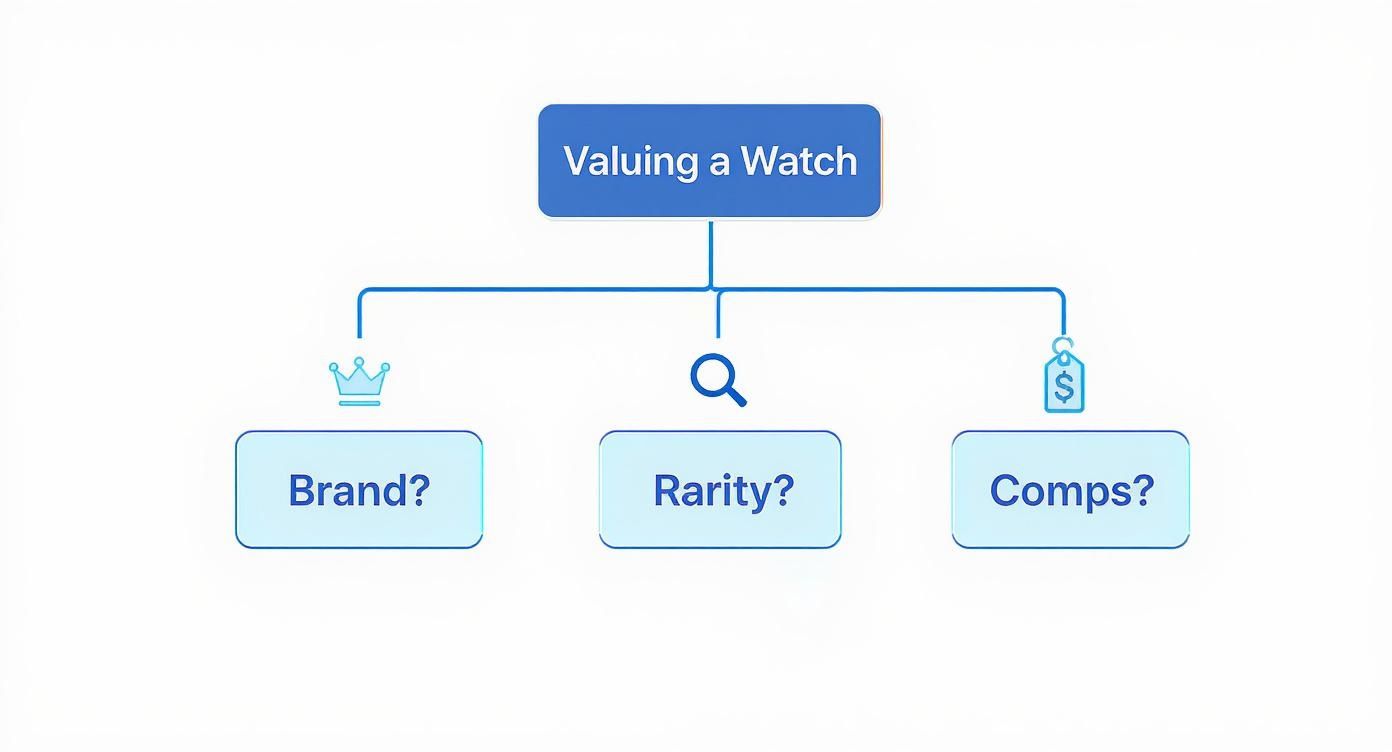
As you can see, the brand's prestige, the model's rarity, and available market data are the primary drivers in deciding the best sales route.
Comparison of Watch Selling Channels
To make it even clearer, here’s an at-a-glance comparison of the different selling methods, highlighting the key differences.
| Selling Channel | Typical Payout | Sale Speed | Seller Effort & Risk | Best For |
|---|---|---|---|---|
| Direct to Dealer | 60–75% of market value | Same-day to 48 hours | Very Low | Speed, security, and convenience |
| Consignment | 70–85% of market value | Weeks to months | Low | High-value or unique watches |
| Online Marketplace | 90–94% of market value | Days to weeks | High | Maximizing profit with high effort |
| Private Sale/Forum | 95%+ of market value | Varies widely | Very High | Experienced sellers with rare pieces |
Each path has its place, and the "best" one really depends on your priorities.
Selling Directly to a Dealer
Selling your watch to a reputable dealer, like ECI Jewelers, is the fastest and most straightforward option out there. You bring in your watch, they inspect it, and you can walk out with a check or wire transfer, often on the same day. It's clean, secure, and requires minimal effort on your part.
The tradeoff for this speed and convenience is the price. A dealer is buying your watch for their inventory, which means they're paying a wholesale price. They need to leave room for their own profit margin when they eventually resell it. You can expect an offer that's roughly 60-75% of the watch's current secondary market value.
This path is ideal for someone who values a quick, guaranteed, and safe transaction above maximizing every last dollar.
The Consignment Option
Consignment is a nice middle ground between selling to a dealer and selling it yourself. You entrust your watch to a dealer who agrees to sell it on your behalf for a commission, typically between 15% and 30% of the final sale price.
The major benefit here is a higher potential return. Since the dealer isn't tying up their own capital to buy your watch, they can list it at a full retail price, and you get a larger piece of that pie. The catch? The process is much slower. It could take weeks or even months to find the right buyer, and there's no guarantee of a sale.
Consignment works best for unique, high-value, or hard-to-price watches where an expert's market reach and reputation can attract the right kind of buyer willing to pay top dollar.
Online Marketplaces and Private Sales
For those willing to put in the work, selling privately through online platforms or forums can yield the highest financial return. The key is that you control the entire process, from setting the price to negotiating with buyers.
- Online Marketplaces (Chrono24, eBay): These platforms offer massive global reach but come with fees (around 6.5% on Chrono24) and require you to handle professional photography, listings, buyer communication, and secure, insured shipping.
- Watch Forums (Rolex Forums, Omega Forums): Selling to fellow enthusiasts can be a great experience, as you're dealing with a knowledgeable community. However, it requires building a reputation on the forum and carries the highest risk of fraud if you don't take proper precautions.
The secondary watch market is booming, and digital platforms now make up a huge share of these sales. This demand is often driven by models with long waiting lists at authorized dealers. Watches with limited availability not only retain value but sometimes appreciate, with online channels expected to grow at a CAGR of about 5.6% in the coming years.
Thinking about the best platform for your watch is similar to figuring out where to sell old electronics—it’s all about finding the right audience and sales channel. This balancing act of profit versus effort is a dilemma we explore further in our detailed guide on https://www.ecijewelers.com/blogs/recent-posts/how-to-sell-luxury-watches.
Crafting a Listing That Sells Itself
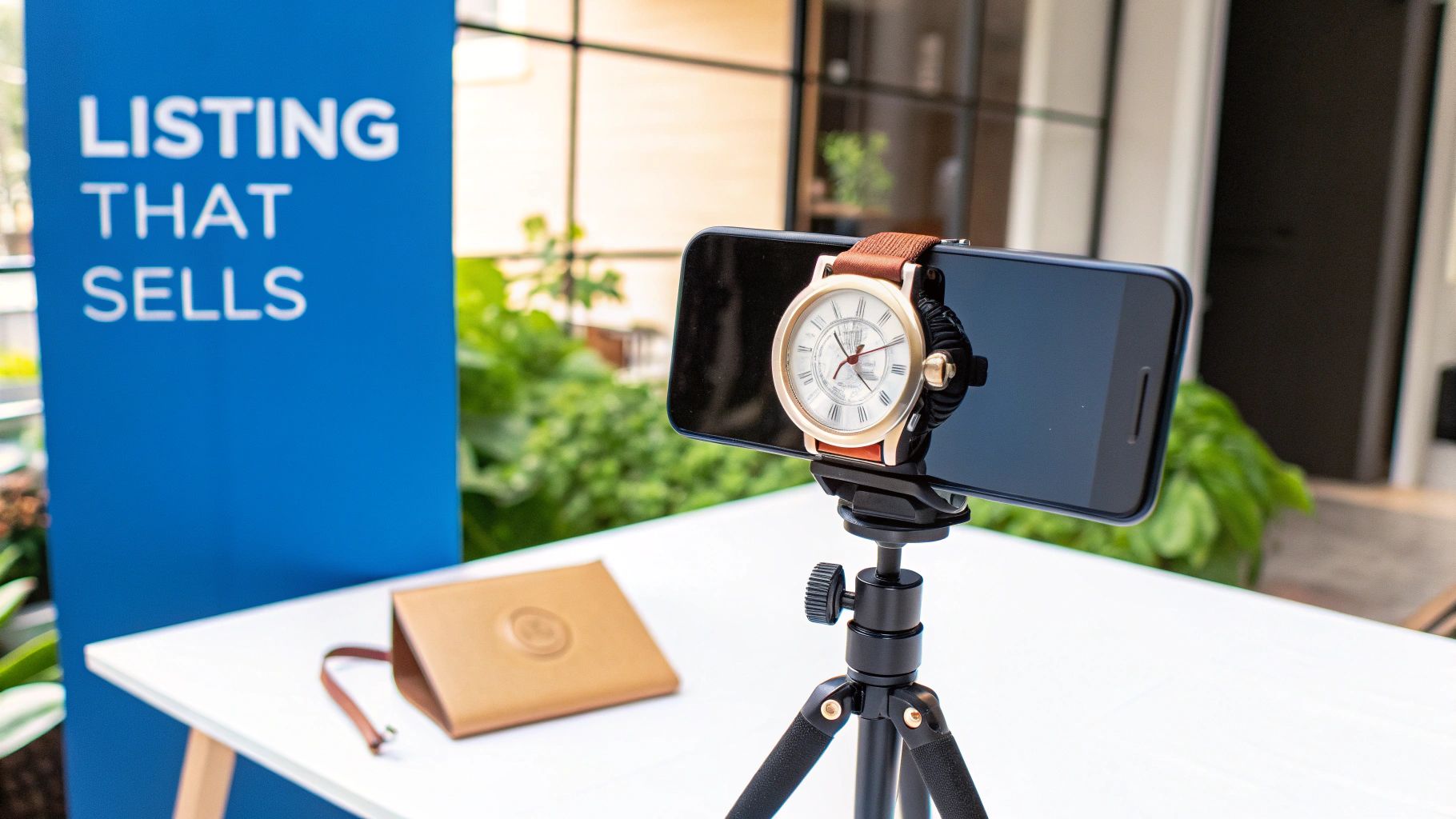
In the crowded world of online watch sales, your listing is everything. It's your digital storefront, your silent salesperson, and your first handshake with a potential buyer. A sloppy presentation will get scrolled past in a heartbeat, while a thoughtful, professional one can captivate a serious collector and command a premium price.
This all comes down to two critical elements: world-class photography and a compelling, honest description. Get these right, and your watch will practically sell itself.
Mastering Watch Photography with Your Smartphone
Forget the professional DSLR camera. Your smartphone, combined with a little technique, is more than capable of producing images that rival those from top dealers. The secret isn't the camera—it's controlling the environment.
The single most important factor is light. Avoid harsh, direct sunlight or the yellow-tinged glow of indoor lamps at all costs. Instead, find a spot near a window that offers soft, diffused natural light. This will illuminate the dial without creating distracting glare or reflections, showing off its true color and texture.
To get those crisp, professional shots, just follow these simple steps:
- Steady Your Shot: A small, inexpensive smartphone tripod is your best friend. It eliminates camera shake and lets you take your time framing the perfect angle.
- Clean the Watch (and Lens): Give both the watch and your phone's camera lens a quick wipe with a microfiber cloth. Smudges and dust are instant credibility killers.
- Focus on the Details: Tap your screen to focus precisely on the dial. You want the brand name and hour markers to be perfectly sharp.
- Capture Every Angle: Don't just take one photo. Serious buyers want to see everything.
A complete photo gallery builds trust. Aim for at least eight to ten high-quality shots covering all the essentials.
Your Essential Shot List
- The Hero Shot: A clean, straight-on view of the watch face.
- Angled Dial Shots: A few shots from different angles to show how light plays with the dial and crystal.
- The Crown Side: A clear view of the case profile, showing the crown and any pushers.
- The Opposite Side: The other side of the case, highlighting its condition.
- The Case Back: A crisp, legible photo of all engravings, including the model and serial number.
- The Clasp: Both open and closed, to show its condition and functionality.
- The Bracelet: A shot showing the full length of the bracelet.
- The "Imperfection" Shot: A close-up of any significant scratch or ding you plan to mention. Don't hide it.
This level of detail shows you have nothing to hide and gives buyers the confidence to make an offer without ever seeing the watch in person.
Writing a Description That Builds Trust
Once you have great photos, it's time to write a description that tells your watch's story. This is where you move beyond a dry list of specs and build a real connection with the buyer. The goal here is radical transparency.
Start with the basics: brand, model name, reference number, case size, and a list of what's included (box, papers, extra links). But don't stop there. Go deeper and describe the watch's condition with honesty and precision. Using collector-friendly terms shows you know what you’re talking about.
A savvy seller knows that highlighting an "unpolished case with sharp lugs" is a major selling point for collectors, even if it means there are a few surface scratches. It signals originality, which is often valued far more than a cosmetically perfect but over-polished appearance.
Be completely upfront about any flaws. Is there a small scratch on the bezel at 4 o'clock? A tiny mark on the crystal that's only visible in certain light? Point it out. Showcasing imperfections builds far more trust than pretending they don't exist. This not only helps you attract the right kind of buyer but also prevents any potential disputes after the sale.
This tailored approach is vital. The global luxury watch market—valued at approximately USD 53.69 billion in 2024 and projected to more than double by 2032—is driven by informed consumers who demand authenticity. Understanding specific market tastes, like the growing demand in Asia-Pacific regions, allows you to highlight features that resonate most. You can discover more insights about luxury watch market trends to better position your listing for a global audience.
Closing the Deal Safely and Securely
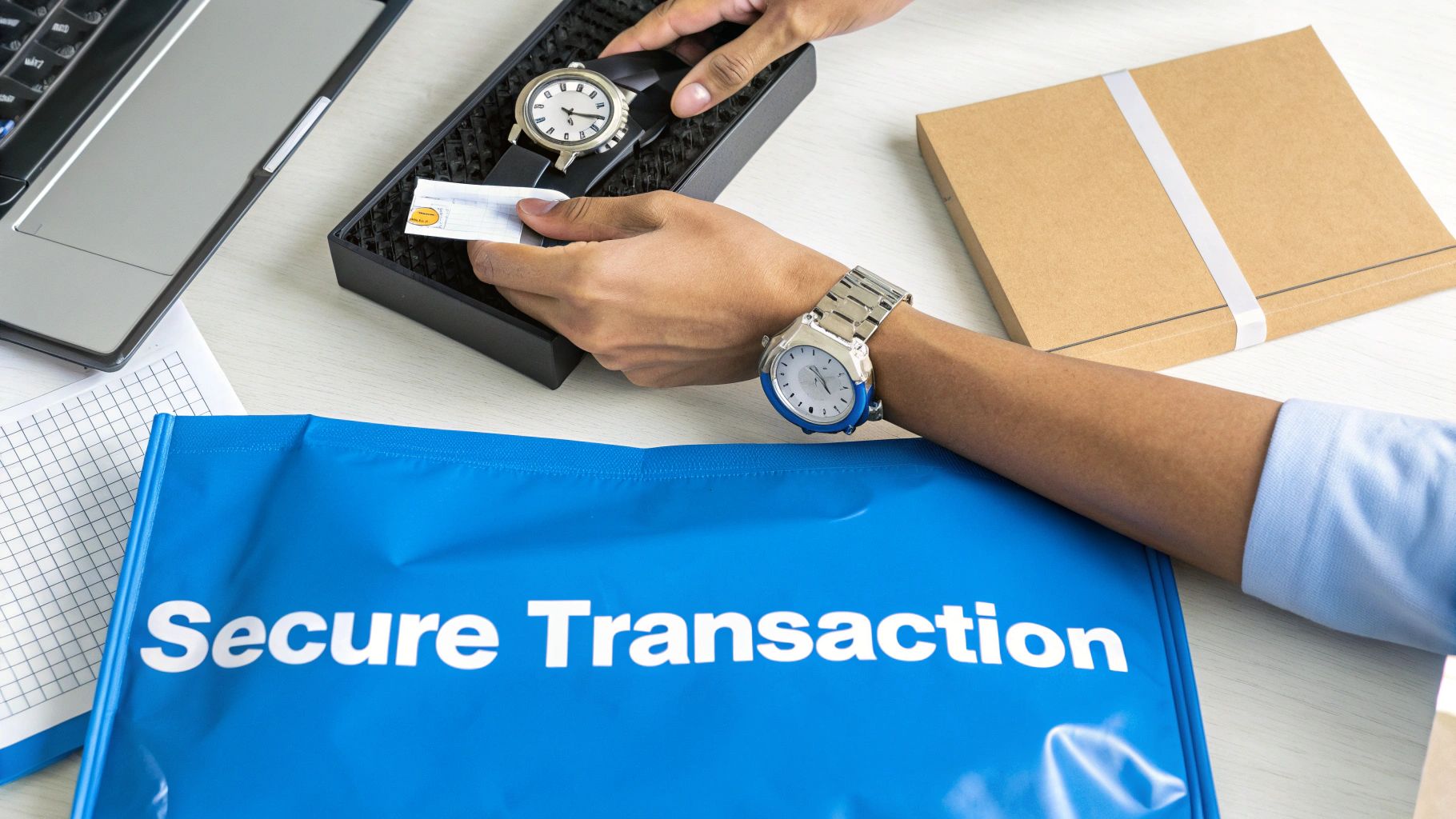
You’ve found a buyer and agreed on a price. Congratulations—the finish line is in sight. But this next part is arguably the most critical stage of the whole process, where a little bit of caution goes a long way.
A smooth, secure transaction doesn't happen by chance. It’s all about protecting yourself and making sure the deal closes without any headaches. From handling the final price haggle to getting paid and shipping the watch, every detail matters. Let's get this right.
Navigating Negotiations and Finalizing the Price
It's always smart to price your watch with a small buffer for negotiation, maybe 5-10% above your rock-bottom price. This gives you some wiggle room to make a small concession, which helps the buyer feel like they got a good deal and often seals the deal faster.
When a lowball offer comes in—and it will—don't take it personally. The best way to respond is to be professional but firm. Something as simple as, "Thank you for your offer, but that's quite a bit lower than I can accept," works perfectly. If you're open to a counter, you could add, "I can't do that, but I could come down to [your slightly lower price]." This keeps the conversation moving in the right direction.
Choosing a Secure Payment Method
When it comes to getting paid, your security is non-negotiable. For any sale that isn't face-to-face, there's really only one gold standard: a bank wire transfer. Once those funds are in your account, they're yours. The transfer is final and cannot be reversed, which is exactly why nearly every professional watch dealer insists on it.
Other payment options exist, but they carry real risks with high-value items like a luxury watch.
- Escrow Services: A reputable escrow service can be a solid middle ground. A neutral third party holds the buyer's money and only releases it to you after the buyer confirms they've received the watch as described.
- PayPal Goods & Services: Just don't. For expensive watches, PayPal's policies heavily favor the buyer, leaving you wide open to fraudulent claims and chargebacks weeks or even months after you've shipped the timepiece.
- Personal Checks or Money Orders: These are far too easy to forge and should be avoided. Never, ever ship your watch until you've called your bank and confirmed the funds are fully cleared and irreversible, a process that can take a surprisingly long time.
A classic scam involves a buyer "accidentally" overpaying with a fake check and asking you to wire them back the difference. By the time your bank discovers the check is fraudulent, your watch is gone—and so is the money you sent back. Stick to verified payment methods, period.
Safely Shipping Your High-Value Timepiece
Once the payment has cleared, it's time to pack and ship. This is not the place to cut corners. Your watch is a finely tuned instrument, and it needs to be treated like one. For something this valuable, it's worth checking out expert advice on how to pack fragile items for shipping like a pro to ensure it arrives in perfect condition.
Here's your must-do shipping checklist:
- Double-Box It: Put the watch box inside a larger, sturdier shipping box. Fill every gap with bubble wrap or packing peanuts so the inner box can't move at all.
- Use Tamper-Evident Tape: Seal the outer box securely. This makes it immediately obvious if someone has tried to open the package en route.
- Get Full Insurance: Never under-declare the value to save a few bucks. Use a trusted carrier like FedEx or UPS, but purchase full third-party insurance from a specialist like Parcel Pro. This is the industry standard for a reason.
- Require a Direct Signature: Always select the "Direct Signature Required" option. This ensures the package is physically handed to your buyer and not just left on their doorstep.
Handling In-Person Transactions
If you're selling to someone locally, your personal safety is the top priority. The absolute best place to meet is a secure, public location with cameras. Your bank—or the buyer's bank—is a perfect choice, as you can watch the funds transfer happen in real-time.
Another great option is meeting at a trusted jeweler's showroom, like ours at ECI Jewelers. It provides a safe, professional environment and gives the buyer the chance to have the watch authenticated on the spot, which builds a ton of confidence. If you're dealing with a specific brand like Rolex, you can learn more from our experts on how to authenticate a Rolex watch. Whatever you do, never agree to meet at your home or in a secluded area.
Common Questions When Selling Your Watch
As you get closer to finalizing a sale, a few key questions almost always pop up. Getting these right is the difference between a smooth transaction and a headache. Let's walk through the most common ones we hear from sellers.
Should I Service My Watch Before Selling It?
This is a classic dilemma, and the short answer is: probably not. A full mechanical service can easily run $800 or more, and you're almost guaranteed not to make that money back in the final sale price.
Of course, if the watch isn't running at all, you'll need a basic service to get it functional. But for most timepieces, especially vintage ones, collectors actually prefer them in original, untouched condition. An aggressive polish can soften the sharp, factory lines of the case, and swapping original parts for modern service ones can seriously tank its value for a purist.
The smarter play is to price the watch honestly, be upfront about its service history (or lack thereof), and let the new owner make the call on servicing.
How Much Do Box and Papers Really Matter?
A ton. The original box and papers—what collectors call a "full set"—are critical, especially for modern heavy-hitters like Rolex, Patek Philippe, and Audemars Piguet. Not having them can knock the market value down by a significant 15% to 25%, and sometimes even more for certain references.
You can still sell a "naked" watch (one without its original accessories), but you'll have to price it much more competitively against complete examples. For some older brands, you might be able to request an "Extract from the Archives." It's an official document from the manufacturer that confirms the watch's details and authenticity, and it can help claw back some of the value you lose without the original papers.
Think of the box and papers as your watch's birth certificate and original packaging. While the watch itself is the main event, these accessories prove its provenance and story, providing a level of assurance that serious buyers are willing to pay a premium for.
What's the Safest Way to Get Paid?
Protecting yourself financially is non-negotiable. For any sale that isn't face-to-face, a bank wire transfer is the undisputed gold standard. Once the funds are confirmed in your account, they are final. They cannot be reversed. This completely sidesteps the chargeback risks you see with other payment methods.
Escrow services are another solid option. A neutral third party holds the buyer's money until they receive the watch and confirm everything is as described. For in-person deals, the safest venue is inside a bank branch, where you can watch the cashier's check get drawn or verify the funds on the spot. Stay away from personal checks or standard PayPal Goods & Services for anything valuable; they offer almost no protection for sellers.
How Should I Handle Lowball Offers?
If you're selling something of value, you're going to get lowball offers. It's just part of the game. The key is to handle them with professional grace and not take it personally. Most of the time, a buyer is just testing the waters to see how flexible you are.
You’ve got two good options here:
- Politely Decline: A simple, "Thanks for the offer, but my price is firm," is a perfect response to an offer that's not even in the ballpark.
- Open the Door to Negotiation: If you have some wiggle room, you can counter with something like, "That's a bit lower than I can do, but I'd consider a reasonable offer closer to my asking price."
This is where doing your homework pays off. When you know what your watch is really worth, you can stand your ground with confidence. Stay polite, stay firm, and the right buyer will come along and respect your price.
At ECI Jewelers, our experts provide fair, transparent market valuations to help you understand your watch's true worth. Whether you're looking to sell, trade, or simply learn more, we offer a secure and professional experience. Visit us online or at our NYC showroom for a complimentary appraisal today.


