

Setting the time on your Rolex Datejust is a simple ritual once you get the hang of it. It’s all about unscrewing the winding crown, pulling it out to the right position, making your adjustments, and—most importantly—screwing it back down securely to protect its water resistance.
Getting to Know Your Rolex Datejust
Before you even touch the crown, it’s worth taking a moment to appreciate the incredible engineering on your wrist. Adjusting your Datejust isn’t like setting a digital clock; you’re interacting with a high-precision mechanical movement. Understanding how it works will help you handle it correctly and avoid any accidental damage.
The key to everything is the Twinlock or Triplock winding crown. This isn't just a simple knob. It’s a sophisticated, screw-down system designed to create a watertight seal. The very first step is always to gently unscrew it. From there, the crown pulls out into distinct positions, or "clicks," each controlling a different function: winding the watch, setting the date, or setting the time.
Key Things to Know Before You Start
First up, is your watch a "Quickset" model? Rolex introduced this feature around 1977, and it lets you change the date independently of the hands. If your watch is older, it’s likely a non-Quickset, which means you have to advance the hour hand past midnight to change the date. Knowing which one you have is the most important first step. If you're curious about the mechanics behind this, our guide on the different Rolex movements is a great place to learn more.
Next, if your watch has stopped running, always give it a good manual wind before setting the time. Give the crown about 40 clockwise turns in its first position (right after unscrewing it). This will give the mainspring a full wind and ensure your watch keeps accurate time right from the start.
CRITICAL TIP: Avoid the "Danger Zone"
Never, ever adjust the date when the time is between 9 PM and 3 AM. During these hours, the watch's internal gears are already moving into position to change the date automatically. Forcing a manual change during this window can put serious strain on the movement and potentially cause damage.
The original Rolex Datejust, launched way back in 1945, was a game-changer. It was the world's first automatic watch to feature a date window that changed on its own. Modern versions are just as impressive, with features like the Triplock crown ensuring water resistance down to 100 meters (330 feet).
Setting Your Modern Quickset Datejust
If your Rolex Datejust was made anytime after 1977, congratulations—you have the Quickset feature. This makes setting the date a breeze compared to older, non-quickset models. Mastering this process is a satisfying ritual that connects you to the incredible machine on your wrist.
First things first: your watch needs power. If it has stopped running, you'll need to give it a manual wind.
Start by gently unscrewing the crown counter-clockwise until it pops out into the first position. Now, turn the crown clockwise for about 40 full rotations. You can't over-wind a modern Rolex, so don't be nervous; a built-in clutch automatically prevents it. This step ensures the watch has a full power reserve to keep time accurately once you're done.
Adjusting the Date and Time
With the watch wound, pull the crown out one more click to the second position. This is where the Quickset date function lives. As you turn the crown, you'll see the date wheel advance.
Here’s a pro tip I always use: set the date to the day before today's date. So, if today is the 16th, set it to the 15th. This little trick is key to making sure you're setting the time in the correct AM/PM cycle.
Setting the date one day behind ensures that when you advance the hands past midnight, the date will click over to the correct day. This is the clearest way to confirm you’ve established the AM hours.
Now, pull the crown all the way out to its final position (the third click). The second hand will immediately stop dead in its tracks. This is the hacking seconds feature, and it’s designed for synchronizing your watch to a precise reference time.
Rotate the hands clockwise, pushing them past the 12 o'clock marker. As you do, you'll see the date flip forward to the correct day—in our example, from the 15th to the 16th. Perfect. You've just confirmed you're in the AM.
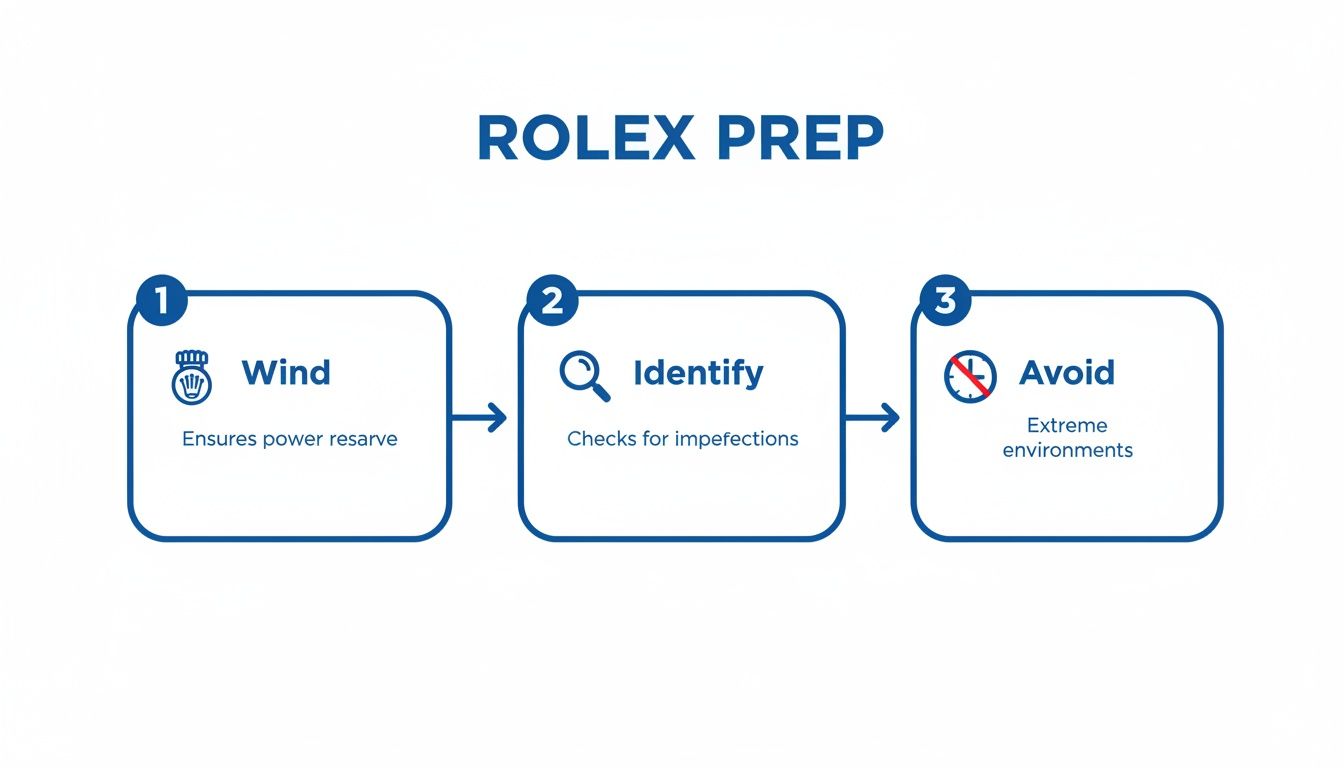
This graphic drives home the core principles of proper watch care: keep it wound, know your model, and always be mindful of the "danger zone" for date changes.
Finalizing and Securing Your Watch
Once you're in the correct AM/PM cycle, continue turning the hands until you reach the current time. I like to use an atomic clock app on my phone for the most accurate reference.
For a perfect sync, try this technique:
- Move the minute hand a minute or two past the current time.
- Then, wind it backward (counter-clockwise) to the correct minute. This little move helps take up any slack in the gear train.
- Wait for your reference time's second hand to hit the 12 o'clock position, and at that exact moment, push the crown all the way back in.
The final step is absolutely critical for protecting your watch. While gently applying inward pressure, screw the crown back down clockwise until it’s just finger-tight. This action seals the Oyster case and guarantees your Datejust's water resistance. Be sure not to over-tighten it—just snug is perfect.
Navigating a Vintage Non-Quickset Datejust
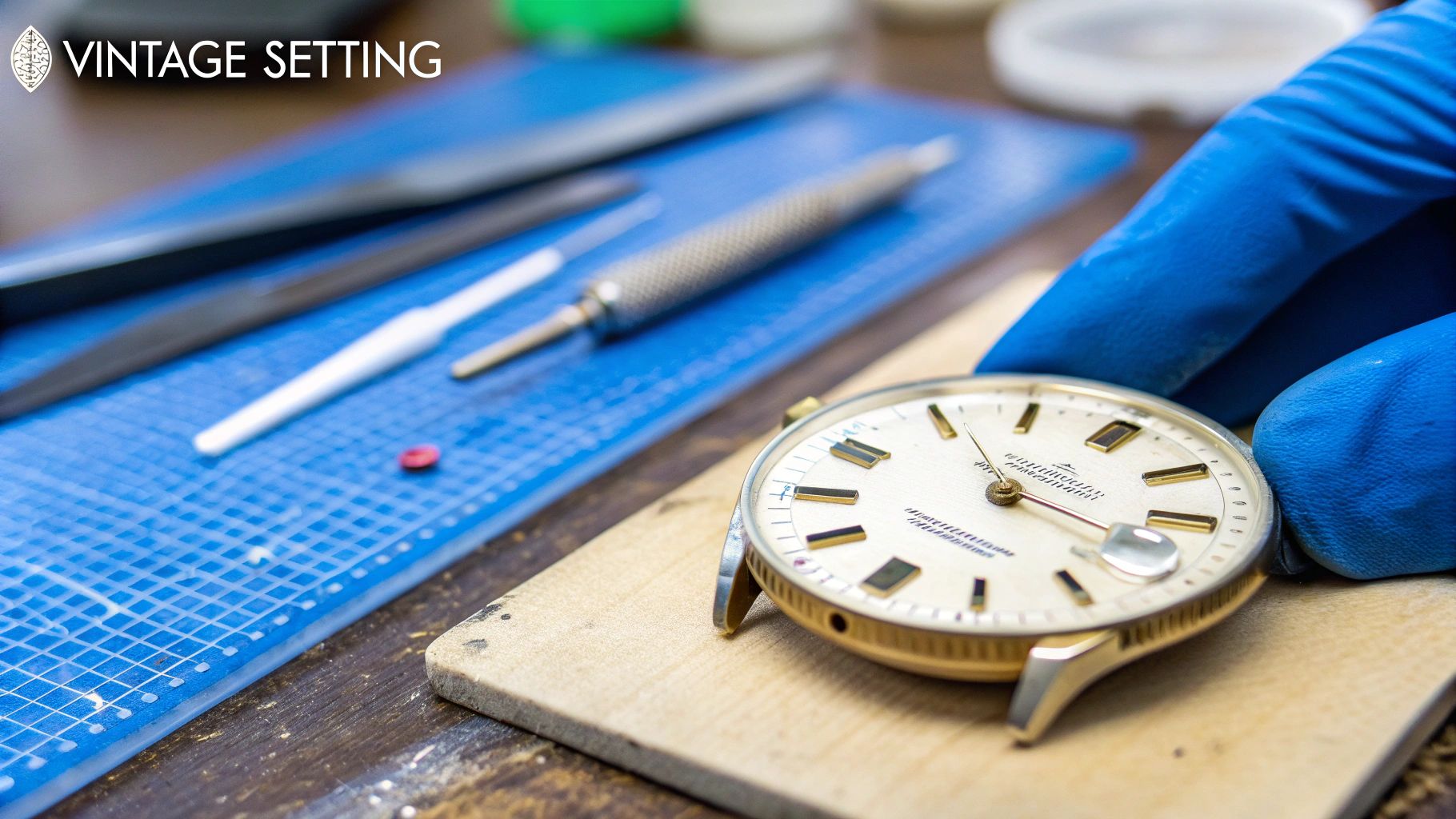
There's a certain charm to owning a vintage Rolex Datejust made before 1977. These classic timepieces lack the modern "Quickset" function, which means setting the date is a more hands-on, traditional affair. It’s a process that genuinely connects you to the watch's mechanical soul and is a huge part of what makes owning horological history so special.
This method is all about patience and precision—no shortcuts here. Before you start, give your watch a good wind by unscrewing the crown and giving it about 40 clockwise turns.
The Classic Method for Setting the Date
With the watch fully wound, pull the crown all the way out to the final position. You’ll notice the second hand stops, which is exactly what should happen. Now, begin rotating the hands clockwise, advancing them through a full 24-hour cycle to change the date by just one day.
For example, if the date window shows the 10th but today is the 16th, you’ll need to spin the hands past midnight six complete times. It can feel a little tedious, but it's the correct and safest way to set the date on these beautiful old movements. If you have an appreciation for the history behind these pieces, you might enjoy our guide on vintage Rolex watches.
A Pro Tip From Collectors: To speed things up a bit, you can use a back-and-forth motion. Once the date flips over at midnight, turn the hands backward to about 9 PM, then forward again past midnight. Repeating this 9 PM to 1 AM cycle is a popular shortcut to advance the date without spinning the hands through the entire day.
Getting the AM and PM Right
Once you’ve landed on the correct date, the last step is to set the actual time. The key is knowing whether you're in the AM or PM hours. Since you just advanced the date by passing midnight, your watch is now set to the early morning hours.
From here, continue turning the hands clockwise until you reach the current time. If it's 4 PM, you'll need to go past the 12 o'clock marker one more time.
When you're happy with the time, push the crown all the way back in and screw it down firmly. This is a critical step to ensure the watch's water resistance is restored. This careful ritual is what preserves the integrity of your vintage timepiece for years to come.
Common Mistakes to Avoid When Setting Your Watch
A Rolex Datejust is a finely tuned instrument, and handling it with care is just as important as knowing the right steps to set it. A few common slip-ups can lead to unnecessary wear on the movement or, worse, an expensive trip to the service center. Think of it as protecting your investment for the long haul.
The single biggest mistake we see is adjusting the date while the hands are in the “danger zone.” This is the window between roughly 9 PM and 3 AM when the watch's internal gears are already moving into place to change the date automatically. Forcing a manual change during this time can strip or break those delicate components.

Forgetting to Secure the Crown
It sounds simple, but you’d be surprised how often people forget to screw the crown back down tightly after making adjustments. This one action is what seals your watch and protects its intricate movement from the elements.
Leaving the crown unscrewed completely compromises the famous Oyster case's water resistance. Dust, humidity, or a splash of water can get inside and cause serious damage over time. Always remember to push the crown back in and screw it down until it’s finger-tight.
Pro Tip: You Can't Over-Wind a Modern Rolex
Many new owners worry about winding their watch too much. The good news is that modern Rolex movements have a built-in slipping clutch that prevents the mainspring from being over-wound. Once it's fully charged, the clutch simply disengages. So go ahead and give it 40 full turns with confidence.
Other Common Pitfalls
Beyond those big two, a couple of other habits are worth avoiding to keep your watch running perfectly.
- Forcing a Stiff Crown: If you ever feel grinding or unusual resistance when turning the crown, stop immediately. It’s a clear signal that something isn’t right, and trying to force it will only make things worse.
- Not Winding a Stopped Watch: If your watch has completely stopped, don't just set the time and go. A watch with no power reserve won't be accurate. Always give a stopped watch a full manual wind before you start setting the time and date.
Avoiding these common mistakes will help you handle your Datejust with the confidence and care it deserves, ensuring it operates flawlessly for years to come.
Knowing When to See a Professional Watchmaker
While setting your Rolex Datejust is something every owner should master, it's just as crucial to know when to put the watch down and step away. Sometimes, what feels like a minor annoyance is actually a symptom of a deeper mechanical issue that needs a trained, professional touch.
Trust your senses. If you feel any grinding, scraping, or unusual resistance when unscrewing or turning the crown, stop immediately. A healthy Rolex mechanism should feel smooth as butter, never forced. Trying to power through a problem on a high-precision machine like this almost always leads to more significant—and expensive—damage.
Signs You Need an Expert
There are a few clear red flags that tell you it's time to visit a watchmaker. These symptoms usually point to problems with the movement that can't be fixed at home and require specialized tools and expertise.
- A Stuck Date Wheel: If the date won't advance properly or gets jammed between two numbers, this signals a problem with the date complication itself.
- Poor Timekeeping: Your watch is losing or gaining significant time, even after a full 40-turn manual wind. This means the movement likely needs regulation or a full service.
- A Stiff or Gritty Crown: A crown that doesn't want to turn is a serious warning. Forcing it can strip the threads or snap the winding stem, turning a small problem into a major repair.
Never try to force a component that feels stuck. A certified watchmaker can diagnose the issue without causing more harm and will ensure only genuine Rolex parts are used for the repair. Understanding potential Rolex watch repair costs can also help you appreciate why professional care is always the smarter choice.
Common Questions About Setting Your Datejust
Even after you get the hang of setting your watch, a few questions always seem to pop up. It's true for first-time owners and seasoned collectors alike. Getting to know the little details of how your Datejust works is the best way to keep it running perfectly for years to come.
Here are a few of the most common things we get asked.
How Often Should I Wind My Datejust?
If your Datejust isn't your daily wearer, its power reserve will eventually wind down. Most have a reserve of 48 to 72 hours. Once it stops, you'll have to reset everything.
A good habit is to give it a manual wind every couple of days. About 40 full, clockwise turns of the crown is all it takes to fully charge the mainspring. This simple step keeps the movement's lubricants evenly distributed and ensures your watch is ready to go whenever you are.
Is It Okay to Set the Time Backwards?
On any modern Rolex Datejust, yes. Winding the hands counter-clockwise is perfectly safe and won't cause any harm to the movement.
However, if you own a much older, vintage non-Quickset model, it's best practice to only move the hands forward. It’s just a precaution to avoid putting any unnecessary stress on those classic, older mechanisms.
A Pro Tip for Perfect Accuracy
The "hacking seconds" feature is your best friend for precision. When you pull the crown all the way out, the second hand stops dead in its tracks. Use an official time source online to sync your watch to the exact second. It's a small detail, but it's what these watches were made for.


