


Authenticating a Rolex isn't just about a single detail; it's about the sum of its parts. You're looking for perfection in the dial printing, the unmistakable 2.5x magnification from the Cyclops lens, and that signature smooth sweep of the second hand—never a tick. A real Rolex also has a heft, a substantial feel that cheap fakes just can't mimic.
Why Rolex Authentication Is More Critical Than Ever
With masterful fakes flooding the market, knowing how to spot a counterfeit Rolex has become an essential skill for any enthusiast or buyer. The prestige of Rolex makes it the world's most copied luxury watch, and today's replicas are getting alarmingly convincing. This guide cuts through the noise, giving you the same insights our experts use every day to separate genuine masterpieces from fraudulent copies.
The scale of this problem is hard to overstate. Did you know counterfeit watches outnumber genuine Rolexes by a staggering margin? Industry estimates suggest criminals produce between 30 and 40 million fake Swiss watches annually. Compare that to Rolex's official production of roughly 1 million pieces, and you realize dozens of fakes are churned out for every authentic watch leaving Geneva.
For a deeper dive into the mechanics of this issue, the complete definition of counterfeiting offers great context. It really highlights why meticulous authentication isn't just about protecting your investment—it's about pushing back against a massive criminal enterprise.
Your First Line of Defense: A Quick Comparison
Before we get into the nitty-gritty, it helps to have a high-level overview. A surprising number of fakes fail at first glance if you know exactly what to look for. Think of this as your initial gut check—a quick scan for the most obvious red flags that can immediately disqualify a watch.
The difference between a real Rolex and a fake often lies in details the average person overlooks. The goal is to train your eye to catch the subtle imperfections that counterfeiters always struggle to replicate perfectly.
Here's a simple table to get you started, comparing authentic Rolex traits against the common flaws we see in fakes. Use this as your go-to reference before we move on to a more detailed, component-by-component inspection.
Quick Rolex Authenticity Checklist
This checklist is your first pass, covering the most critical visual and physical cues that separate the real deal from a convincing copy.
| Feature | Authentic Rolex (What to Look For) | Fake Rolex (Common Red Flags) |
|---|---|---|
| Dial Text | Perfectly crisp, sharp, and evenly spaced lettering. No smudges or bleeding. | Blurry, fuzzy, or slightly raised text. Uneven spacing is a giveaway. |
| Cyclops Lens | Magnifies the date exactly 2.5x and is perfectly centered over the date window. | Weak magnification (e.g., 1.5x) or a flat look. Often misaligned. |
| Second Hand | A smooth, sweeping motion (typically 8 ticks per second), not a jerky tick. | A distinct, once-per-second ticking sound and movement, typical of quartz. |
| Weight | Substantial and balanced feel due to solid 904L steel or precious metals. | Feels surprisingly light, hollow, or poorly balanced due to cheaper materials. |
This table covers the basics, but it's just the beginning. Now, let's dive deeper into the specific components you'll need to examine.
Mastering the Visual Inspection Checklist
The real magic in telling a genuine Rolex from a fake is all in the details—the tiny things an average person might glance right over. Counterfeiters have gotten scarily good, but their work almost always falls apart when you know exactly where to look. This is where you train your eye to spot the imperfections they just can't seem to get right.
We'll go through this piece by piece, showing you what true, flawless execution looks like on a Rolex. Forget the generic advice. This is about knowing the specifics—the look, the feel, and the finish that separates a masterpiece from a convincing but ultimately flawed copy. This visual check is your single most powerful tool.
This diagram breaks down the three pillars of authenticating a Rolex: what you see, what you feel, and the paperwork that proves its story.
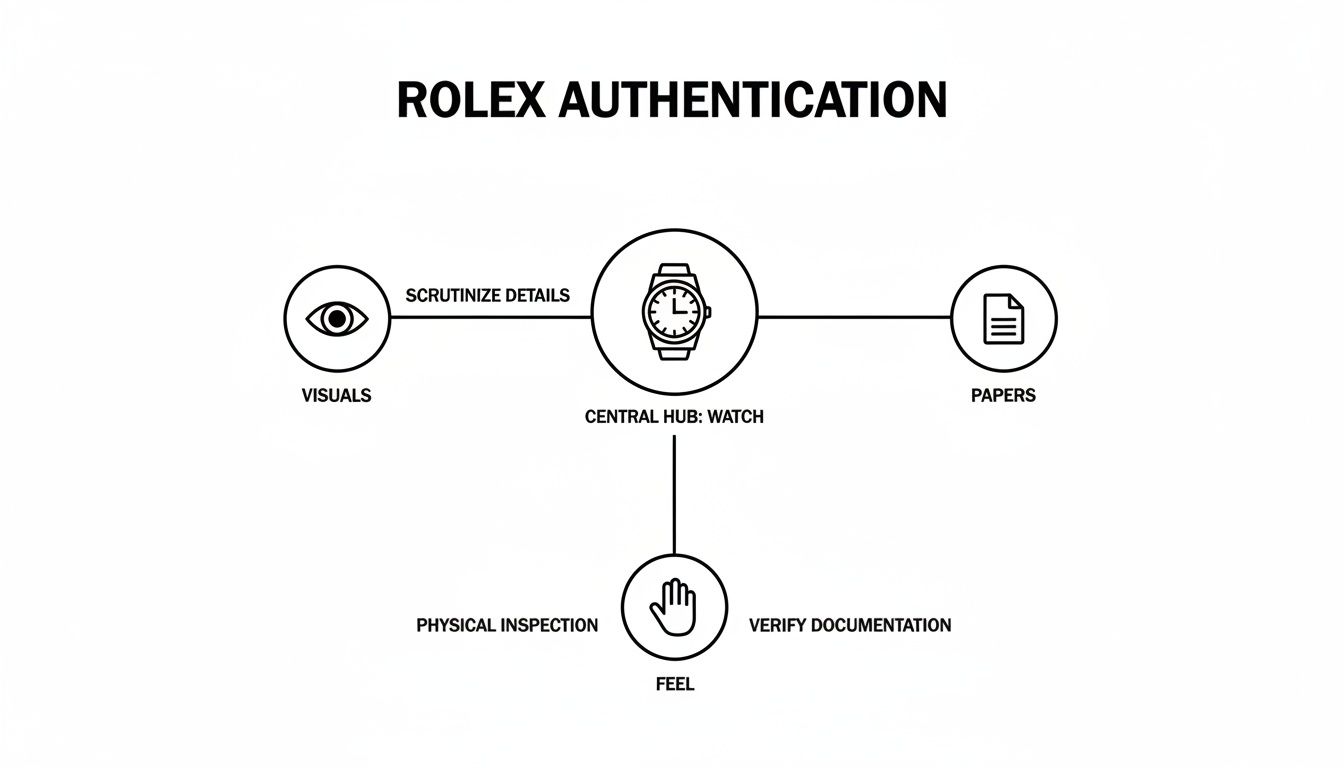
It’s a reminder that a proper check isn't one-dimensional. You need to combine a hands-on inspection with a thorough look at its history to be completely confident.
The Cyclops Lens and Date Window
The Cyclops lens is often the first and most obvious place a counterfeiter messes up. On models like the Datejust and Submariner, this little bubble of sapphire crystal is engineered with mind-boggling precision. A real Rolex Cyclops magnifies the date by exactly 2.5x, making the number pop and fill the entire lens.
Many fakes don't even come close, offering weak magnification around 1.5x or sometimes just printing a bigger font on the date wheel itself. The date on a counterfeit often looks flat and small, lacking that crisp, magnified "jump" in size you see on a real one. Also, check its placement—a genuine Cyclops is perfectly centered over the date window. If it's even slightly off, that’s an immediate red flag.
Dial Printing and Logo Details
Next, get your eyes on the dial itself. Rolex printing is the definition of perfection. Every letter, number, and marker is applied with flawless precision, featuring razor-sharp edges with zero bleeding, smudging, or fuzzy outlines. Get a jeweler's loupe and zoom in on the text like "Oyster Perpetual" or "Superlative Chronometer Officially Certified."
Fake dials often give themselves away under magnification with:
- Wavy or fuzzy text: The letters look slightly blurred or uneven.
- Incorrect spacing: Letters might be crammed too close together or spaced awkwardly apart.
- Poor lume application: The luminous paint on the hour markers can look splotchy, uneven, or misaligned within its borders.
Pay close attention to the applied Rolex coronet at 12 o’clock. It should be a separate, finely crafted piece with sharp, well-defined points. On many fakes, it looks flat, poorly stamped, or has rounded, mushy edges.
The Bezel Sound and Feel
For sport models like the Submariner or GMT-Master II, the rotating bezel is a huge authenticity tell. A genuine unidirectional bezel produces a distinct, solid click for each of its 120 positions. The sound is satisfying and refined, not cheap, tinny, or hollow.
There should be absolutely zero backward play. When you turn it, each click locks firmly into place. Fakes often have sloppy, loose bezels that you can wiggle, or they make a gritty, imprecise sound when rotated. Some may only have 60 clicks or, even worse, turn in both directions—a dead giveaway on a diver's watch.
Remember, Rolex engineering is all about tactile feedback. A genuine bezel feels like a high-precision instrument because that's what it is. A cheap, gritty, or loose-feeling bezel is a sure sign you're holding a counterfeit.
Examining the Rehaut and Crystal
The rehaut is that inner metal ring between the dial and the sapphire crystal. Since around 2005, Rolex has engraved "ROLEXROLEXROLEX" around this ring as a powerful anti-counterfeiting feature. On a genuine watch, this engraving is crisp, deep, and perfectly aligned.
Here’s exactly what to check for:
- The "R" on the left side should line up perfectly with each hour marker.
- The "X" on the right side should also align perfectly with its hour markers.
- The serial number, located down at the 6 o'clock position on the rehaut, should be flawlessly engraved.
Counterfeit rehaut engravings often look shallow, poorly etched, or are misaligned with the hour markers. This is one of the hardest details for fakers to replicate correctly.
As another check, starting around 2002, Rolex began micro-etching a tiny coronet logo into the sapphire crystal at the 6 o'clock position. This mark is incredibly small and almost invisible to the naked eye. You'll probably need a loupe and just the right angle of light to even spot it. If this crown is easily visible, it's almost certainly a fake.
The Crown and Caseback
Finally, take a look at the winding crown and the caseback. The Rolex winding crown has an intricate logo with either dots or a bar underneath it, which signifies the model and metal type. The grooves on the crown itself should be sharp and well-defined to give you an excellent grip. Fakes often have poorly defined, mushy crowns that feel less precise to operate.
Now, flip the watch over. Most Rolex models (with very few exceptions, like the Sea-Dweller) have a completely smooth, unadorned caseback. If you see a watch with a transparent, exhibition-style caseback showing the movement, or one covered in logos and engravings, you are almost certainly looking at a fake. Rolex prides itself on the hermetically sealed Oyster case, and that plain, solid caseback is a core part of its design philosophy.
Checking the Physical Feel and Sound
Authenticity isn't just something you see; it's something you feel and hear. While visual details are absolutely critical, the tactile experience of handling a genuine Rolex is one of the hardest things for counterfeiters to get right.
A real Rolex, machined from solid blocks of precious metal or 904L steel, has a distinct, solid presence in your hand. Fakes made from cheaper, lighter materials simply can’t match it.
This is where we move beyond just looking at the watch. You're about to learn how to gauge its weight, listen for the signature sound of its movement, and feel the quality of the mechanism itself. Often, these checks will expose a fake faster than any visual inspection ever could.
The Substantial Weight of Authenticity
The first physical test is the easiest one: just hold the watch. A genuine Rolex feels dense and impeccably balanced. This comes down to the superior materials, especially the 904L steel Rolex calls "Oystersteel." It's heavier and far more corrosion-resistant than the standard 316L steel used in most other watches and nearly all fakes.
Take a real stainless steel Submariner, for example. It should weigh around 155 grams. Fakes often feel flimsy in comparison, sometimes clocking in at just 120-130 grams because they use lower-grade steel or even hollow bracelet links. If a watch feels surprisingly light or off-balance, that’s an immediate red flag.
Expert Tip: Don't just hold the watch head; feel the bracelet. A genuine Oyster or Jubilee bracelet has solid end links and a reassuring heft. Fakes often have hollow, tinny-feeling links that rattle and feel cheap when you handle them.
Demystifying the Famous Rolex Sweep
One of the most talked-about signs of a real Rolex is the "sweep" of the second hand. But here's a secret: it’s not a perfectly smooth, continuous glide. A genuine Rolex movement actually makes a series of incredibly rapid ticks that create the illusion of a smooth sweep.
- Real Rolex Movement: The second hand moves with 8 ticks per second (or 28,800 beats per hour). This high frequency makes the motion look almost fluid and produces a faint, rapid, almost-silent whirring sound.
- Typical Fake Movement: Most counterfeits use cheap quartz or low-beat automatic movements. A quartz movement will have a very obvious, jerky tick-tock motion once per second. A low-beat automatic fake might be a bit smoother, but it will still be visibly choppier than a genuine Rolex.
Hold the watch close to your ear. That loud, clumsy tick... tick... tick of a quartz movement is an instant giveaway. A real Rolex is nearly silent—you might hear a very faint, fast-paced mechanical sound, but that's it. Understanding the basics of how a mechanical watch works gives you a huge advantage here.
The Feel of Winding the Crown
The final physical test involves interacting with the watch's engine. Unscrew the winding crown and give it a few turns. The feedback you get from a genuine Rolex movement is a dead giveaway of its quality.
When you wind a real Rolex, the action is incredibly smooth, consistent, and almost silent. You'll feel a subtle, buttery resistance as the mainspring tightens, but there should be absolutely no grittiness, grinding, or catching. It feels like a high-precision instrument, because it is.
In stark contrast, the winding mechanism on a fake often feels gritty, rough, or noisy. You might hear scraping sounds or feel inconsistent resistance as you turn the crown, a clear sign of poorly machined and finished internal parts. If winding the watch feels anything less than perfect, you're almost certainly holding a counterfeit.
Verifying Provenance with Papers and Serial Numbers
A real Rolex is more than just a timepiece; it's an asset with a documented history. But in a world where counterfeiters can whip up convincing fake boxes and papers, how can you be sure the story checks out? This is where you need to look beyond the surface.
The "box and papers" that come with a Rolex are your first stop for verifying its history, but you can't just take them at face value. Bogus paperwork is a massive red flag. While fakes can be scarily accurate, a trained eye can spot the fraud. For example, secondary market platforms reported a 24% rejection rate in the first half of 2024 for fakes and misrepresented watches, and bogus warranty cards were a huge part of that problem.
To learn more about what a complete set includes and why it matters, explore why the full set is so valuable in our detailed guide on Rolex box and papers.
This scrutiny is crucial. Forgers often use cheap, glossy paper stock or get lazy with mismatched serial numbers that don't align with the engravings on the watch itself—an instant giveaway.
Decoding the Warranty Card
The warranty card is the single most important document you'll handle. Its design has changed over the years, which actually works in our favor during authentication. If a seller shows you a 2018 watch with a paper certificate from the 1990s, you’ve found your fake. It’s that simple.
Here’s what to check for on modern plastic warranty cards:
- Green Wave Pattern: The front should have a fine, intricate green wave or circuit board design that’s incredibly hard to replicate. Fakes often look blurry or lack sharp detail.
- Hologram: On older green paper certificates (pre-2006), there’s a gold hologram on the back.
- UV Light Test: For cards issued between roughly 2006 and 2015, a repeating "ROLEX" pattern should appear under a UV blacklight.
Every detail printed on the card must be perfect. The font needs to be crisp, and the serial number, model number, and purchase date must match the watch exactly. Any smudging, sloppy alignment, or an incorrect font is a major red flag.
A genuine Rolex warranty card feels substantial, like a premium credit card. It’s rigid, the text is perfectly printed or embossed, and there’s absolutely no flimsiness. A cheap, bendy, or poorly printed card is an immediate dealbreaker.
Matching the Serial Number to the Watch
This is the moment of truth where so many fakes get caught. A Rolex’s serial number is its unique DNA, and it must perfectly match the number on the warranty card. No excuses, no exceptions.
Where you find the serial number depends on the watch's age:
- Pre-2005 Models: The serial number is engraved between the lugs at the 6 o'clock position. You'll need to carefully remove the bracelet to see it. The engraving should be sharp and deep with clean, diamond-dragged edges that catch the light.
- Post-2008 Models: Rolex moved the serial number to the inner rehaut (the metal ring between the dial and the crystal), engraved at 6 o'clock. This was a smart move to fight counterfeiting.
- 2005-2008 Transition: During this period, you might find the serial number in both locations—between the lugs and on the rehaut.
Counterfeit engravings are a dead giveaway. They often look shallow, with a sandy or acid-etched texture, and they just don't have the clean, sharp lines of a genuine Rolex. The numbers might also appear fuzzy or poorly spaced.
Validating the Model or Reference Number
Just as critical is the model number, also known as the reference number. This number tells you everything about the watch—its model, metal, and bezel type.
Like the serial number, its location is consistent:
- On All Models: It's engraved between the lugs at the 12 o'clock position.
- On Modern Cards: It is also printed clearly on the warranty card.
The reference number on the watch case has to match the paperwork. For instance, if you're looking at a stainless steel Submariner Date, the reference should be something like "126610LN." If the card says one thing and the watch says another, you're looking at a fraudulent set. This is a classic mistake forgers make—pairing a generic fake watch with papers from a totally different model. Always double-check the reference number against online Rolex databases to ensure it corresponds to the watch you’re holding.
When to Trust a Professional Eye
Let's be honest: even with the most detailed checklist, you can only go so far. Today's market is flooded with "super fakes"—counterfeits so shockingly accurate they can fool even seasoned collectors at first glance. They get the weight right, the Cyclops magnification is spot-on, and the rehaut engraving looks perfect. This is where DIY authentication hits a hard wall.
The truth is, even the best forgers stumble on one critical component: the movement. This is the heart and soul of the watch, a tiny, complex machine Rolex has spent over a century perfecting. Replicating the finish, precision, and proprietary materials of a genuine Rolex caliber is next to impossible, at least not in a way that’s profitable for counterfeiters.
This is exactly why professional verification is your ultimate safety net.
The Power of Opening the Caseback
When you take a watch to an expert, they have the proper tools to safely open the solid caseback—something you should never attempt on your own. Trying this without the right equipment is a surefire way to scratch the case, ruin the water-resistance gaskets, and void any potential warranty.
Once inside, the difference between real and fake becomes crystal clear. An expert will immediately spot the tell-tale signs of a genuine Rolex movement:
- Signature Finishing: Rolex movements are known for their beautiful, if industrial, finish. Think distinct purple or red anodized gears and signature engravings on the rotor and bridges.
- Correct Caliber: The movement must match the watch's model and production era. A modern Submariner should have a Caliber 3235 or 3135, not a generic Swiss ETA clone.
- Flawless Execution: Under a loupe, every screw, spring, and jewel will be perfectly placed and finished. Fake movements, even the high-end clones, often show rough edges, mismatched screws, or a generally cheaper appearance.
The movement is the watch's fingerprint. Counterfeiters can clone the look, but they can't clone the soul. A professional inspection of the caliber is the only way to be 100% certain you're not holding a very expensive paperweight.
Why a Trusted Dealer is Your Best Defense
At the end of the day, the most reliable way to tell a real Rolex from a fake is to sidestep the risk entirely. The anxiety of self-authentication, the constant fear of missing one tiny detail, can completely overshadow the joy of buying a luxury timepiece.
This is why building a relationship with a reputable dealer is so crucial. A professional doesn't just sell you a watch; they sell you confidence. Their entire business is built on trust and legitimacy. If you're just starting your collection or making a major purchase, find more peace of mind by learning about the role of certified pre-owned Rolex dealers who stand behind every single watch they sell.
When to Call in the Pros
Think about the times when professional help isn't just an option—it's a must.
- High-Stakes Transactions: Buying a rare vintage piece or a hot model like a Daytona from a private seller? The more money on the line, the more critical an expert appraisal becomes.
- Shaky Provenance: If the seller’s story has holes, the papers look a little off, or the service history is missing, don't guess. Let an expert be the judge.
- "Too Good to Be True" Deals: A price that's way below the current market value is almost always a massive red flag. Professional verification can tell you if you've stumbled upon a hidden gem or are about to get burned.
While the skills in this guide will empower you to spot a huge number of fakes, they are your first line of defense, not the last. For absolute certainty, the final word should always come from a trusted watchmaker.
A Few Common Questions We Get
Even with a detailed checklist, certain questions pop up time and time again. These are the practical, real-world situations and common myths we hear from collectors and first-time buyers alike. Let's clear up those last few doubts.
Think of this as your quick troubleshooting guide. It covers those "what if" scenarios that can trip you up when you've got a watch in your hand and need to make a call.
Does a Missing Serial Number Always Mean It's a Fake?
Not always, but it’s a situation that demands a much closer look. On older vintage models that have seen a lot of life, it's not unheard of for the serial number between the lugs to be worn down or even polished away after decades of wear and servicing. It happens.
But on any modern Rolex, a missing serial number from the rehaut (the inner bezel ring) is a massive red flag. That area is protected under the crystal and shouldn't show that kind of wear. If that number is gone, damaged, or looks off, you have to assume it's fake or possibly stolen until a professional proves otherwise.
Key Takeaway: Context is everything. A faint serial number on a 50-year-old Submariner might be plausible. On a 5-year-old model, it's almost certainly a sign of a fake or a watch with a sketchy past.
Can You Spot a Fake Just by the Weight?
Weight is a fantastic clue, but it's not the whole story. A genuine Rolex Submariner in 904L steel has a certain dense, balanced feel to it, typically weighing around 155 grams. Most fakes use cheaper 316L steel or hollow links, making them feel noticeably lighter and cheaper.
The catch? The makers of high-end "super fakes" have caught on. They now use materials like tungsten to add weight, mimicking the heft of a real Rolex almost perfectly. So, while a watch that feels flimsy and light is an easy tell, a heavy watch isn't automatically genuine. You have to combine that feel test with everything else.
Is the Famous "Smooth Sweep" of the Second Hand a Myth?
The idea of a perfectly fluid, unbroken sweep is a bit of a myth, but the concept behind it is solid. A real Rolex movement creates the illusion of a smooth sweep because the second hand ticks incredibly fast—usually 8 times per second. It's this rapid-fire movement that sets it apart from the clunky tick-tock of a cheap quartz fake.
Here's how it breaks down in practice:
- Real Rolex: The second hand glides around the dial. It's not a true sweep, but it’s so fast it looks almost fluid.
- Quartz Fake: You'll see a very obvious, jerky jump from one second marker to the next. It's a dead giveaway.
- Mechanical Fake: These are trickier. They might have a sweeping hand, but it often beats at a slower rate (like 6 ticks per second), making the motion visibly less smooth than a genuine Rolex if you look closely.
So no, the "smooth sweep" isn't technically perfect, but your eyes can absolutely tell the difference between a high-beat Rolex and a low-quality fake.
For ultimate peace of mind and a 100% authenticity guarantee on your next luxury timepiece, trust the experts at ECI Jewelers. Explore our curated collection of authenticated Rolex, Patek Philippe, and Audemars Piguet watches at https://www.ecijewelers.com.


