


Are Luxury Watches a Smart Investment?
Think of a luxury watch less as an accessory and more as a small, wearable portfolio piece. Unlike stocks or bonds, it’s a tangible asset you can actually hold, wear, and enjoy. But its value isn’t just pulled out of thin air—it’s driven by a powerful mix of factors that create a unique and often profitable market. This is where the art of horology crashes right into classic economics.
The core idea is simple: you’re betting on enduring demand for an item with a strictly limited supply. A brand like Rolex or Patek Philippe doesn’t just sell watches; it sells a legacy of precision engineering, deep history, and undeniable status that collectors and enthusiasts will always chase. That persistent demand is the engine that drives value up over time.
The Power of Scarcity and Brand Legacy
So, what makes certain watches so valuable? It really boils down to a few key principles:
- Controlled Production: The top-tier brands are masters of managing their output. They ensure that for their most sought-after models, demand always outpaces supply.
- Timeless Design: Models like the Rolex Submariner or Audemars Piguet Royal Oak have designs that have been iconic for decades. They never go out of style, making them perpetually desirable.
- Mechanical Mastery: The intricate, hand-finished movements inside these watches represent a level of craftsmanship that simply can't be mass-produced, giving them huge intrinsic value.
This combination creates the perfect environment for an investment to grow. In fact, the pre-owned luxury watch market, currently valued at over USD 50 billion, is expanding faster than the new watch market for this very reason.
Between 2013 and 2022, data shows luxury watches saw an average annual appreciation of around 7%. For certain premier models, those yearly value increases hit as high as 20%. You can dive deeper into what makes these timeless investments appreciate in value to see the bigger picture.
Key Investment Factors at a Glance
To quickly get a handle on what really matters, it helps to see the core value drivers laid out. This table breaks down the essential factors that separate a good watch from a great investment.
| Factor | Description | Impact on Value |
|---|---|---|
| Brand Prestige | The reputation and history of the manufacturer (e.g., Rolex, Patek Philippe, Audemars Piguet). | Very High: "Blue-chip" brands provide a strong foundation for value retention and appreciation. |
| Model & Reference | The specific model's popularity, history, and reference number (e.g., Submariner 116610LN). | Very High: Iconic models with a proven track record almost always outperform obscure ones. |
| Rarity & Scarcity | How many were made? Is it a limited edition or a discontinued "neo-vintage" piece? | High: Lower supply combined with high demand is the classic formula for price growth. |
| Condition | The physical state of the watch, including the case, dial, bezel, and movement. Original, unpolished condition is often prized. | High: A pristine, "like-new" watch will always command a premium over one with visible wear and tear. |
| Provenance | The watch's ownership history, especially if it was owned by someone famous or significant. | Situational: Can have a massive impact, but it's rare. For most watches, this is not a major factor. |
| Box & Papers | The original box, warranty card/papers, and any other accompanying documentation. | Medium to High: A "full set" significantly increases resale value and proves authenticity. |
Understanding these factors is the first step toward making an informed purchase. They are the building blocks of a watch's long-term value.
Distinguishing Hype from True Value
Here's the critical part: not every expensive watch is a good investment. The real skill is learning to separate fleeting trends from stable, long-term value. A watch that’s hot on Instagram today might be forgotten tomorrow. But a timepiece with a rich history, a legendary brand, and proven rarity has a much stronger foundation for future growth. Understanding the resale value of Rolex watches is a fantastic starting point for getting a feel for these dynamics.
A true investment-grade timepiece is one whose story and craftsmanship are just as compelling as its looks. It's an asset whose value is woven into its very identity, from the movement ticking inside to the legacy of the name on the dial.
By learning to spot these core attributes—brand prestige, model significance, rarity, and condition— you can start to approach the market with the sharp eye of an investor, not just a fan. This guide will walk you through exactly how to do that.
What Truly Drives a Watch's Value
So, what separates a beautiful watch from a true investment-grade asset? It’s more than just the logo on the dial. A handful of core factors work together to build—and maintain—a watch's value on the secondary market. Getting a handle on these is the key to spotting a piece with genuine potential.
Think of it like sizing up a blue-chip stock. You wouldn't just look at the company's name; you’d dig into its performance history, market position, and how many shares are out there. A valuable watch demands the same level of scrutiny, and it all starts with the most important element: the brand.
Brand Prestige and Model Significance
Brand prestige is the absolute bedrock of a watch’s investment value. Names like Rolex, Patek Philippe, and Audermars Piguet have spent over a century building bulletproof reputations for quality, innovation, and exclusivity. That legacy creates a powerful, lasting demand that acts as a safety net for your investment.
Within those brands, certain models become legends. A Rolex isn't just a Rolex; it's a Submariner, a Daytona, or a GMT-Master. Each model carries its own unique history and market demand, almost like a "ticker symbol" for your investment. Sticking with an iconic model that has a proven track record is almost always a safer bet than going for a more obscure or experimental piece.
The infographic below shows how these core concepts—brand equity, scarcity, and craftsmanship—all intersect to create value.
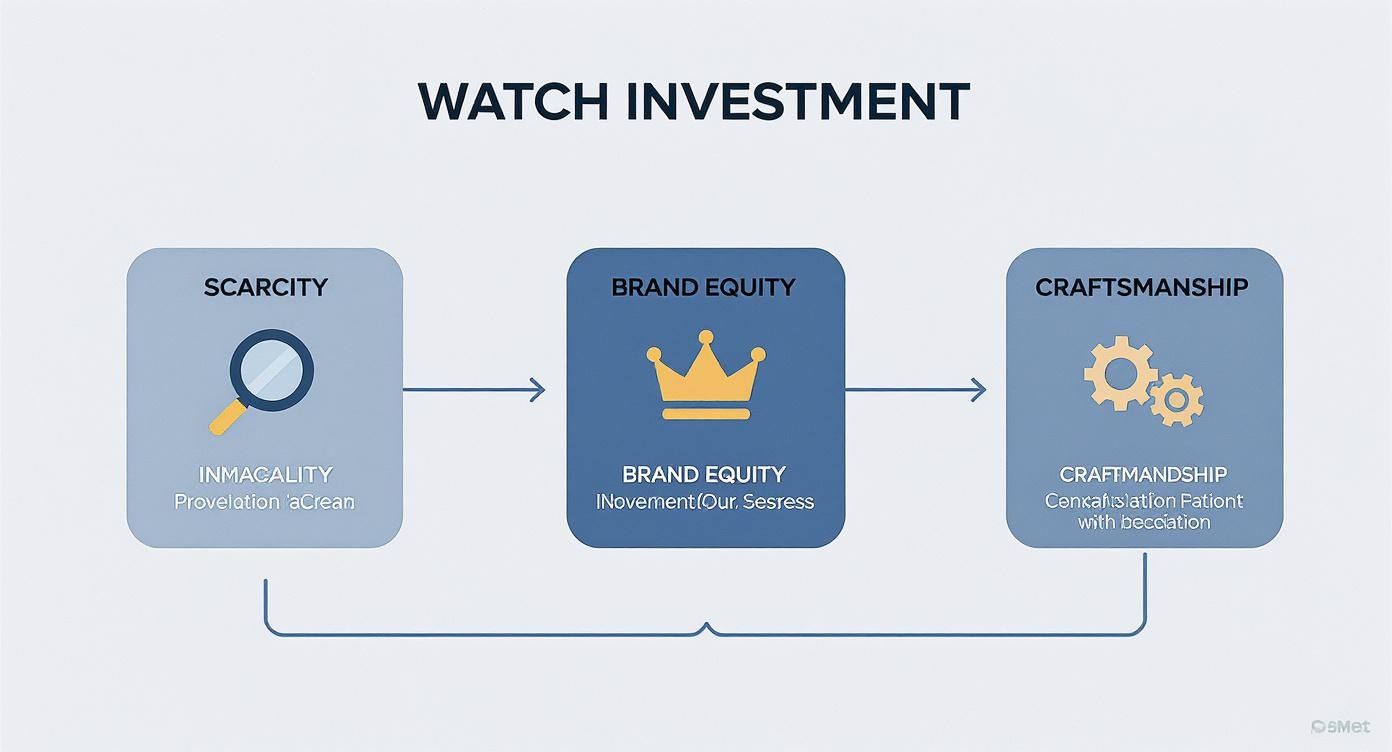
As you can see, a strong brand is the foundation. But real investment potential is unlocked when you combine that with deliberate scarcity and superior craftsmanship.
Rarity and Condition
Rarity is simple supply and demand. Limited editions, discontinued references (often called "neo-vintage"), or models made in small batches naturally become more valuable as collectors compete for a finite number of them.
For example, a standard Rolex Submariner is a fantastic watch. But a rare "COMEX" edition—made specifically for a French deep-sea diving company—can command exponentially more, purely because so few exist. This is where your research really pays off.
Condition, on the other hand, is completely non-negotiable. An investment-grade watch has to be in excellent, preferably original, shape.
- Originality: Collectors want watches with all their original parts—from the dial and hands to the bezel. An unpolished case that still has its sharp factory lines is a huge plus.
- Functionality: The movement needs to be running perfectly and keeping time just as the manufacturer intended.
- Aesthetics: Scratches, dings, and blemishes on the case, crystal, or bracelet will seriously knock down a watch's value.
A watch in pristine, "full set" condition—meaning it comes with its original box and papers—will always fetch a premium. These documents don't just prove it's authentic; they complete the timepiece's story, making it far more desirable to serious collectors.
Provenance and Service History
Provenance is the story behind the watch. While most watches won't have a celebrity owner, a documented ownership history adds a unique layer of appeal and can give its value a real boost. It turns the watch from a simple object into a piece of history.
Just as important is the service history. Think of it as the watch's official maintenance log. Regular servicing from a certified watchmaker keeps the delicate mechanical movement in top shape, protecting its integrity and your investment. A full, documented service history shows a potential buyer that the watch has been meticulously cared for.
When you're looking at what drives a watch's value, the materials used also play a big part. Understanding the difference between white gold and platinum, for instance, can shed light on how composition and durability factor into a luxury timepiece's market price. When you put all these pieces together, you get the complete picture of whether a watch is truly investment-worthy.
Understanding the Secondary Watch Market
So, what happens after a watch leaves the pristine showroom of an authorized dealer? It enters the secondary market—and this is where its true investment potential really comes alive.
Think of it as the stock market, but for timepieces. It’s a dynamic, global arena where pre-owned watches are bought and sold, and prices are set purely by what collectors and enthusiasts are willing to pay. This is the world where an iconic model can fetch double, triple, or even ten times its original sticker price.
Unlike the primary market, where brands set the prices, the secondary market is all about raw supply and demand. When a giant like Rolex or Patek Philippe releases a phenomenal watch in very limited numbers, the official dealers simply can't satisfy everyone. That massive, unmet demand spills over, and prices on the secondary market climb until they find their natural balance.
What Fuels the Fire?
This isn't a random lottery; several key forces keep the secondary market buzzing and turn certain watches into high-flying assets. It's a predictable ecosystem driven by a few powerful dynamics.
- Scarcity and Exclusivity: Limited production runs, waitlists, or discontinued models create a finite supply that collectors will fight for, pushing values up.
- Brand Power: Some brands have reputations so solid they're considered "blue-chip" assets. Their watches hold value exceptionally well, even when the broader economy gets shaky.
- Cultural Moments: A watch spotted on the wrist of a major celebrity or featured in a blockbuster movie can see its desirability explode overnight, creating intense market heat.
And this market is huge. Projections show the global luxury watch market is expected to hit about €58.06 billion in 2025, with forecasts pointing toward €70.23 billion by 2030. Rolex is the undisputed king, accounting for roughly 34.2% of the global trade volume between 2020 and 2024. You can discover more insights about the run on luxury watches on finexity.com to see just how dominant the crown is.
Reading the Market's Ups and Downs
Just like stocks, the luxury watch market has its cycles. You'll see periods of rapid growth—the "booms"—followed by times when prices cool off and find a new floor, known as a "correction." The secret to smart investing is learning to tell the difference between short-term hype and genuine, long-term stability.
For instance, the market saw a wild surge from 2020 to early 2022. Prices for models like the Audemars Piguet Royal Oak and Patek Philippe Nautilus shot to unbelievable heights. That was followed by a healthy correction, where those speculative prices came back down to more sustainable levels. This isn't a crash; it's a normal and necessary part of a mature market.
Investor's Takeaway: A market correction isn't a disaster; it's a reset. For a savvy buyer, these periods can be incredible buying opportunities, letting you snap up blue-chip watches at more reasonable prices before the next growth cycle kicks in.
Navigating this space is much easier with a partner who gets these nuances. When you explore the world of certified pre-owned watches, you’re tapping into an inventory that has already been vetted for value and authenticity. That kind of expertise is crucial for telling a fleeting trend from a timeless investment.
Ultimately, understanding the secondary market is about learning to read its mood. By analyzing the historical price charts of iconic models, you start to see what separates a watch that's just popular right now from one that's a true store of value for years to come. That knowledge is what empowers you to spot the real winners.
How to Navigate Risks and Protect Your Capital
While the upside of a luxury watch investment can be massive, you have to go in with your eyes wide open. Just like any other asset class, there are potential pitfalls. But here’s the good news: the biggest risks are well-known and completely manageable if you know what to look for.
Protecting your capital isn't about avoiding risk altogether—that’s impossible. It's about playing smart. A thoughtful investor learns to anticipate challenges, from market swings to the hidden costs of ownership, and builds a solid defense against them.
Authenticity Is Non-Negotiable
The single greatest threat, especially for new investors, is the counterfeit market. The world of fakes and "Frankenwatches"—pieces cobbled together from genuine and aftermarket parts—is more convincing than ever before. A good fake can easily fool an untrained eye, turning what you thought was a serious investment into a worthless piece of metal.
This is exactly why authentication is the absolute bedrock of watch investing. Without a 100% guarantee of authenticity, you aren't investing; you're just gambling.
Protecting your investment starts long before you hand over any money. When you work with a trusted dealer like ECI Jewelers who provides a rock-solid authenticity guarantee, you immediately eliminate the biggest risk from the equation. Your capital is safe from the start.
Learning to spot the tell-tale signs of a fake is a great skill to develop. For Rolex enthusiasts, our guide on how to authenticate a Rolex watch is a great starting point. But for true peace of mind, nothing beats professional verification.
Navigating Market Volatility
Let's be clear: the secondary watch market has its own cycles of growth and correction, just like the stock market. Prices can swing based on broad economic trends, shifts in collector tastes, and even social media hype. The model that's on fire today might be ice-cold next year. It's crucial not to get swept up in a speculative bubble.
The best defense against this volatility? Diversification. Instead of dumping all your funds into a single, trendy model, think about building a small, resilient portfolio.
- Mix Brands and Models: A collection with a Rolex Submariner, an Omega Speedmaster, and a Cartier Santos is far more balanced than one holding three different Daytona references.
- Balance Modern and Vintage: Newer watches offer contemporary reliability and appeal, while select vintage pieces can deliver stable, long-term growth driven by their historical importance and rarity.
- Focus on "Blue-Chip" Icons: Stick to the legends—models with a long, proven track record of holding their value. These "blue-chip" watches are known to weather market downturns much better than niche or flavor-of-the-month pieces.
Understanding the True Cost of Ownership
Finally, a savvy investor knows that the initial purchase price is just the beginning. These are high-performance mechanical assets, and they need proper care to protect their condition and value. Forgetting to budget for these ongoing costs is a classic rookie mistake.
To help you plan, here’s a breakdown of the most common risks you'll face as an owner and how to get ahead of them.
Risk vs. Mitigation Strategy
| Risk | Description | Mitigation Strategy |
|---|---|---|
| Theft or Damage | Physical loss or accidental damage can instantly erase your entire investment. | Get specialized collectibles insurance. Your standard homeowner's policy almost certainly won't cover the full market value. |
| Mechanical Failure | These intricate machines require periodic maintenance to run properly and avoid costly damage. | Budget for a professional service every 5-7 years. This keeps the watch in top mechanical shape and is crucial for preserving its value. |
| Improper Storage | Exposure to magnetism, extreme humidity, or temperature swings can wreck a movement over time. | Store your watch in a quality watch box or a secure home safe, away from magnets and moisture. |
By thinking through these risks and having a clear plan to counter them, you shift from being a hopeful buyer to a confident, strategic investor. This deliberate, risk-aware approach is what separates a lucky break from sustainable, long-term success in the watch investment game.
Your Step-By-Step Guide to Buying and Selling
Knowing how to navigate the luxury watch market is everything. Whether you're buying your first piece or selling a prized part of your collection, you need a clear, repeatable strategy. It can feel intimidating at first, but having a solid playbook makes all the difference.
This is your roadmap for every step of the journey, from spotting the right watch to getting the best possible return when you decide to sell.
It all starts with where you buy. Each channel—dealers, auctions, online sellers—comes with its own set of pros and cons. The right choice really depends on your goals, your timeline, and how much risk you're comfortable with. Let's break them down.
Choosing Your Buying Channel
Where you source your timepieces is the first major decision you'll make. Here are the most common avenues:
- Authorized Dealers (ADs): This is where you buy a brand-new watch at its retail price, guaranteed authentic. The catch? For the hottest models, you're looking at notoriously long waitlists. It's a game of patience and relationship-building.
- Reputable Pre-Owned Specialists: This is often the fast track to getting the exact watch you want without the wait. Specialists like ECI Jewelers offer a curated inventory of authenticated, high-quality pieces at transparent market prices. You get access and security.
- Auction Houses: If you're hunting for something truly rare or historically important, this is the place. You can uncover incredible finds, but be prepared for intense competition and a hefty buyer's premium that gets tacked onto the final price.
- Online Platforms: Marketplaces have an enormous selection, but they also require the most caution. The risk of running into fakes or watches that aren't as described is very real. Rigorous seller vetting is an absolute must.
For most people looking to invest, partnering with a trusted pre-owned dealer like ECI Jewelers strikes the perfect balance. You get accessibility, expert insight, and peace of mind.
Your Due Diligence Checklist for Every Purchase
Once you've zeroed in on a watch, it's time for a thorough inspection. Think of this as your pre-flight check before making a serious financial move. The details are what separate a smart buy from a costly mistake.
Here’s what to look for every single time:
- Verify Serial and Reference Numbers: Check that the numbers on the watch case match the warranty card. A quick search online can help you confirm the production year and model are correct.
- Inspect for Over-Polishing: Pay close attention to the lugs (the "horns" where the bracelet attaches). You want to see sharp, defined edges. If they look soft or rounded, it's a sign of excessive polishing, which can seriously ding a watch's value for collectors.
- Check for Originality: Make sure the dial, hands, bezel, and bracelet are all original and period-correct. Any replacement parts, especially on a vintage piece, will hurt its investment potential.
- Examine the "Full Set": Does the watch come with its original box, warranty papers, booklets, and hang tags? A complete set is more than just a nice bonus—it helps prove authenticity and can dramatically increase the resale value.
A meticulous due diligence process is your best defense against a bad investment. It turns you from just another buyer into a savvy collector who knows the small details are what drive long-term value.
Proven Strategies to Maximize Your Return
When you're ready to sell, the goal is simple: get the highest possible price. This takes more than just listing it online and hoping for the best. Timing, presentation, and who you sell to are all critical.
First, get a feel for the market. Is your model hot right now, or has demand cooled off? Selling when a watch is trending can add a huge premium to your final price. Sometimes, a little patience pays off in a big way.
Next, get the watch ready for sale. A professional cleaning and a quick check-up to make sure it's running smoothly are smart moves. When it comes to presentation, high-quality images are non-negotiable. Consider using professional jewelry product photography services to make sure your watch looks as good as it is.
Finally, pick your sales channel. Selling privately might seem like the most profitable route, but it also comes with the most risk and hassle. Going through a trusted dealer like ECI Jewelers guarantees a secure transaction, a fair market price, and immediate payment. It's the cleanest way to cash in on your luxury watches as investment and ensure you're getting what your asset is truly worth.
Safeguarding Your Investment After Purchase
Buying an investment-grade watch is a huge milestone, but your work isn't done when you walk out of the store. In fact, it's just beginning. Taking care of your new tangible asset requires the same smart planning as any other part of your financial portfolio.
This is all about protecting its physical safety and preserving its market value for the long haul. A clear plan for storage, insurance, and eventual taxes will safeguard your watch against unexpected risks and give you complete peace of mind.
Secure Storage and Specialized Insurance
First things first: where are you going to keep it? A high-quality, fireproof home safe is a great starting point for easy access. But for maximum security, you really can't beat a bank's safe deposit box. This shields your watch from theft, fire, and damaging environmental factors like humidity.
Next up is insurance. Your standard homeowner's policy is almost certainly not enough. These policies usually have very low coverage limits for valuables like jewelry and fine watches, leaving you seriously exposed if something happens.
It's critical to get a separate, specialized collectibles insurance policy. These plans offer "agreed value" coverage, which means you'll be reimbursed for the watch's current market value—not just what you paid for it—in case of loss, theft, or damage.
Understanding Tax Implications
Finally, let's talk taxes. It's not the most exciting part, but it's essential. When you eventually decide to sell, the IRS views luxury watches as "collectibles." This means any profit you make is typically taxed at the long-term capital gains rate for collectibles, which can be as high as 28%.
That's a higher rate than you'd pay on profits from stocks or real estate, so it's crucial to factor this into your potential return on investment.
Keep meticulous records of everything—your purchase price, any servicing costs, and the final sale price. This is non-negotiable for accurate tax reporting. Chatting with a financial advisor can help you navigate these rules smoothly. This kind of foresight is what separates a casual buyer from a serious investor when it comes to handling luxury watches as an investment.
Answering Your Watch Investing Questions
Dipping your toes into the world of luxury watch investing always brings up a few common questions. Getting straight answers is the first step before you put any serious money on the table.
So, which brands should you be looking at for the best investment potential? A few names consistently top the charts. The unofficial "holy trinity" of watchmaking—Patek Philippe, Audemars Piguet, and Vacheron Constantin—are considered blue-chip assets for their incredible craftsmanship and built-in rarity. And of course, Rolex is still the undisputed king of the secondary market, thanks to its immense brand power and solid value retention across nearly every model.
Should I Actually Wear My Investment Watch?
This is the classic dilemma every collector faces. The short answer is yes, but you have to be smart about it. Unlike a stock certificate you file away, a watch is a tangible piece of art meant to be enjoyed on the wrist.
That said, protecting its condition is everything when it comes to preserving its value. Avoid wearing it during yard work, at the gym, or anywhere it could easily get dinged or scratched. The goal is a healthy balance: enjoy the watch for what it is, but be a mindful owner to keep it in prime shape for its next chapter.
If you're new to this, remember one core principle: buy the best example of the watch you can afford. This means prioritizing a watch in excellent condition with its original box and papers over simply chasing a bigger name in poor shape. A mint-condition Tudor will always be a smarter buy than a beat-up Rolex.
What's a Realistic Price to Get Started?
You don't need a six-figure budget to start a respectable collection. While icons like the Patek Philippe Nautilus are in a different stratosphere, there are fantastic entry points.
Brands like Tudor offer an incredible bang for your buck with amazing build quality, often serving as the perfect gateway to its bigger sibling, Rolex. You can also find certain Omega or Cartier models that deliver a great mix of brand heritage and investment potential without requiring a massive initial outlay. Your first move should be to find a high-quality piece from a reputable brand that you'll actually love to own.
Ready to find a timepiece that's both a personal passion and a smart financial move? The experts at ECI Jewelers can walk you through a curated collection of fully authenticated luxury watches to find the perfect addition to your portfolio. Explore your options at https://www.ecijewelers.com.


