


That string of digits on your Omega is so much more than a random number—it’s the key to unlocking your watch’s entire history and proving it's the real deal. Running an Omega check serial number is the first, most critical step for any owner digging into their watch's past or a potential buyer doing their homework.
This guide will show you exactly why that number is your watch’s unique DNA.
Why Your Omega Serial Number Is a Critical Asset
Think of your Omega’s serial number as its birth certificate, passport, and fingerprint all rolled into one. It’s a unique sequence of digits giving you a direct window into its past, tying a physical object to a specific point in time and confirming its place in the brand’s incredible legacy.
For an owner, this number is a gateway to discovery. It lets you pinpoint the approximate year your watch was made, putting it right into a historical context. Suddenly, your grandfather's old Seamaster isn't just a watch; it's a timepiece from the early 1960s, a contemporary of the space race and massive cultural shifts.
A Tool for Buyers and Investors
For anyone looking to buy, the serial number is an essential verification tool. In a market where sophisticated fakes are a real problem, that number is your first line of defense. An incorrect, missing, or tampered-with serial number is a huge red flag that should stop any potential deal in its tracks.
It’s also fundamental to the watch's value as an asset. Verifying the serial number against the watch’s reference number and physical features helps ensure all the parts are correct for that specific model and era. This cohesive identity is crucial for anyone interested in the finer points of investing in luxury watches, where originality is everything.
For over a century, the ability to accurately date an Omega watch was a defining feature for collectors. This consistency provided a level of transparency that built trust and added to the brand’s prestigious reputation.
Omega’s Systematic Approach to Identification
Omega has kept one of the most organized serial numbering systems in the luxury watch world since around 1894. For decades, the company used sequential seven or eight-digit numbers, which lets specialists figure out production years with amazing accuracy.
This reliable system stayed in place until about 2019, when Omega switched to randomized serials to better fight counterfeiting. These changes are part of broader online brand protection strategies that help protect the brand's integrity and keep consumers safe from fakes.
Before we get into finding and decoding your number, just knowing how important it is sets the stage for your journey as a responsible Omega owner or collector.
Finding the Serial Number on Your Omega Watch
Before you can start piecing together your watch's history, you first have to play detective and locate its serial number. This unique seven or eight-digit string is the key to everything, but where Omega put it depends entirely on whether you're holding a vintage classic or a modern masterpiece.
Locating the Number on Modern Omegas
Luckily, with most modern Omegas, this first step is pretty simple. Omega laser-etches the serial number right onto the watch's exterior, making an Omega check serial number something any owner can do at home.
The most common spot is on the underside of one of the lugs—those little arms connecting the case to the bracelet. You'll likely need to tilt the watch under a bright light to catch the faint engraving.
Here's where to look on a contemporary model:
- On the back of a lug: This is the go-to placement for modern Omegas. The number is tiny, so good eyes or a magnifier are a must.
- On the caseback: While the reference number is more common here, some special editions or specific models might feature the serial number on the outer caseback instead.
- Between the lugs: This is more of a Rolex signature, but it's not unheard of for Omega, so it's always worth a quick check.
Pro Tip: Don't just trust your eyes. A basic jeweler's loupe or even the magnifier on your phone can be a game-changer. These laser-etched numbers are notoriously faint and can be almost impossible to read without a little help.
Uncovering the Serial Number on Vintage Omegas
If you have a vintage Omega, especially one from before the 1990s, the hunt for the serial number gets a bit more involved. Back then, Omega engraved the number directly onto the movement—the intricate mechanical heart of the watch.
This kept the number safe from wear and tear, but it means you can't see it without opening the watch. And this is a job that should never be done without the right tools and a steady hand.
Trying to pop open a vintage caseback with a pocket knife is a recipe for disaster. It's incredibly easy to gouge the steel, ruin the water-resistance gasket, or let a speck of dust into the delicate movement. A single slip can turn into a repair bill worth hundreds of dollars.
Why Professional Help Is a Must for Vintage Pieces
When it comes to a vintage Omega, the smartest and safest move is to take it to a professional watchmaker. They have specialized caseback wrenches and openers designed to get inside without leaving a single mark.
Here’s what a watchmaker will do:
- Identify the caseback type (snap-on, screw-down, etc.) and select the exact tool needed.
- Carefully open the case in a clean, dust-free environment to protect the movement.
- Locate the serial number on the movement bridge or plate and record it for you.
- Properly reseal the watch, making sure the gasket is seated correctly to maintain its integrity.
This small investment doesn't just protect your timepiece; it ensures you get the right number to begin your research. Plus, a good watchmaker can give the movement a quick once-over while it's open, giving you a better sense of its overall health and authenticity. Getting this first step right is the foundation for everything that follows.
Dating Your Omega Using a Serial Number
So you've found your Omega's serial number. Fantastic. You're holding the key that unlocks its history. That string of digits is a direct link to the watch's production era, and this is where the detective work—and the fun—really begins.
For most Omega watches made before roughly 2019, the company used a sequential numbering system. It's a straightforward concept: the numbers were assigned in chronological order. A higher serial number almost always means a newer watch, which gives us a reliable way to pin down its age.
How to Use an Omega Dating Chart
To turn that serial number into a production year, you need a good reference chart. Enthusiasts and experts have spent decades compiling production data, creating tables that map specific serial number ranges to the years they were made.
First things first, you need to be sure you're looking in the right place, which depends entirely on the age of your watch.
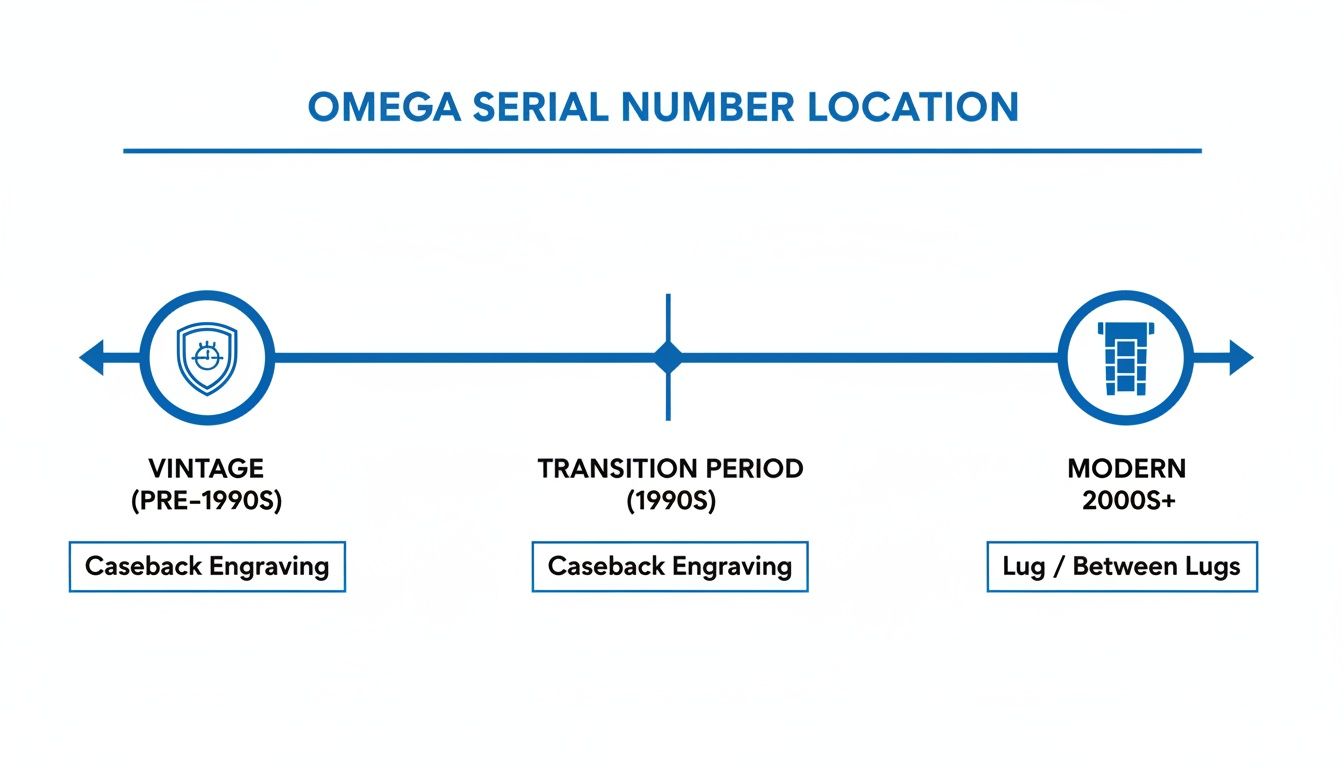
As you can see, for older vintage pieces, you'll need to open the caseback to find the number engraved on the movement itself. On modern Omegas, they've made it much easier by placing it on the outside of a lug.
Once you have the number, it's just a matter of cross-referencing. For instance, say your watch has the serial number 13,654,321. You'd scan a dating chart to find which range that falls into. Established data shows that serial numbers around 13,500,000 correspond to 1952. Your number is a bit higher, placing its production squarely in 1952, or maybe early 1953.
A Quick Word of Caution: These charts give you an estimated production year. The serial number is tied to when the movement was manufactured, not necessarily when the finished watch was cased, shipped, or sold. It wasn't uncommon for there to be a lag of a few months or even a year between these steps.
Omega Production Years by Serial Number for Pre-2019 Models
Here is a handy chart to help you cross-reference your Omega's serial number with its estimated year of production. Find the range that your number falls into to get a solid idea of its birth year.
| Serial Number Range | Estimated Production Year |
|---|---|
| 9,000,000 | 1940 |
| 10,000,000 | 1944 |
| 12,000,000 | 1950 |
| 15,000,000 | 1956 |
| 20,000,000 | 1963 |
| 30,000,000 | 1969 |
| 40,000,000 | 1977 |
| 50,000,000 | 1986 |
| 60,000,000 | 1999 |
| 80,000,000+ | 2006+ |
While this table works as a great quick reference, you can find more granular charts online from dedicated collectors. The important takeaway is the clear, logical progression: as the years go by, the serial numbers climb higher in a predictable pattern.
Understanding Special Cases Like the Speedmaster
Now, while that general chart is accurate for most models, some of Omega's heavy hitters have their own unique timelines. The Omega Speedmaster is the perfect example.
The "Speedy" has its own dedicated dating parameters, which makes sense given its legendary status as one of the most famous professional watches ever made. Its immense collector base has led to highly specialized research, and you can learn more about how Omega reference numbers help sort these details out.
Here’s a glimpse into the Speedmaster's unique progression:
- 1957: Serial numbers were in the 14,000,000 range.
- 1960: The numbers climbed to the 17,000,000 range.
- 1964-1965: They reached the 22,000,000 range.
This highlights why context is everything. A serial number in the 22 million range on a Seamaster would point to a later production date than it does for a Speedmaster from the same period.
Navigating Nuances and Discrepancies
As you dive deeper, you might notice slight variations between different online dating charts. Don't worry, that's normal. These minor discrepancies exist because Omega's original records weren't perfectly linear, and today's databases are patched together from multiple historical sources.
The best practice is to check your number against two or three reputable charts. If they all place your watch within the same one or two-year window, you can be very confident in that date. The goal is to build a credible story for your watch, and these charts are the best tool you have for the job.
Beyond the Numbers: Advanced Authenticity Checks
So, you’ve dated your Omega using the serial number. That’s a great first step, but it’s just one piece of a much larger puzzle. To truly authenticate a luxury watch, every single detail has to line up perfectly. This is where the real detective work begins for any serious collector or buyer.
A serial number that matches a production chart isn't a guarantee of authenticity on its own. Counterfeiters have gotten incredibly good at faking these details. Real confidence comes from cross-referencing that number with the other critical markings on the watch.
It’s time to move past a simple Omega check serial number and start looking with a more critical, forensic eye.
The All-Important Caseback and Reference Number
Pop open an Omega caseback, and you’ll find another crucial piece of information: the reference number. This number is the watch’s specific model identifier, telling you about its design, case material, and sometimes even the original bracelet style.
Think of it this way: the serial number is the watch’s birthday, but the reference number is its official name and title.
For an Omega to be genuine and original, these two numbers have to tell the same story. If you have a reference number for a 1960s Seamaster, the movement’s serial number had better date to the 1960s, too. Spot a 1980s-era serial number inside a case clearly marked with a 1960s reference? That's a huge red flag. You've likely stumbled upon a "Frankenwatch"—a timepiece cobbled together from various watches and eras.
This kind of mismatch is an absolute deal-breaker for collectors. Even if the individual parts are genuine Omega, the watch itself isn't in its original factory configuration, which craters its value and desirability.
Spotting Red Flags in the Engravings
The quality of the engravings themselves can tell you a lot. Omega's manufacturing standards are legendary, and their markings reflect that precision. When you're looking at a serial number, inspect it for cleanliness and consistency.
Here are a few dead giveaways of a counterfeit or doctored number:
- Wrong Font or Style: The font should match known examples from that specific time period. A modern, laser-etched font on a vintage 1950s movement is an immediate sign that something is wrong.
- Uneven Spacing or Depth: Authentic Omega engravings are crisp and uniform. If the numbers look crooked, are spaced erratically, or vary in depth, it suggests they were applied by hand or with subpar tools.
- Signs of Tampering: Look closely for faint outlines of previous numbers or tool marks around the serial number. Fakers will sometimes polish off an original number and re-engrave a new one to make a watch seem rarer or more valuable than it is.
An authentic Omega serial number—whether it’s machine-engraved on a vintage calibre or laser-etched on a modern lug—will always look deliberate and clean. Anything that appears sloppy, rushed, or out of place should be treated with extreme suspicion.
This level of scrutiny isn't unique to Omega. The same principles apply across high-end timepieces, as you can see in our guide on how to authenticate a Rolex watch.
The Power of "Box and Papers"
Beyond the watch itself, the accompanying documents—the "box and papers"—are your best friends in authentication. For collectors, a watch with its original paperwork can command a premium of 20% or more. Why? Because these documents provide provenance, a verifiable history tracing the watch back to its origins.
The single most valuable document is the original warranty card or certificate. This card should have the watch’s serial and reference numbers printed or stamped on it. These numbers must be an exact match to the ones physically engraved on the watch. No excuses.
Be very skeptical of blank or altered warranty cards. A common trick is to use a genuine-looking but unfilled card, which is completely useless for verification. A properly completed card from an authorized dealer, on the other hand, creates a solid paper trail right back to the original sale.
When you have a correct serial number, a matching reference number, clean engravings, and the original paperwork to back it all up, you’ve built an ironclad case for authenticity. Each element supports the others, creating a complete and trustworthy story for your watch.
When to Trust a Professional for Authentication
Online databases and serial number charts are fantastic starting points. They give you a solid first impression, but they can only take you so far. What they can't do is physically inspect a movement, spot a high-quality "superfake," or confirm that every single component is original to the watch.
Sooner or later, every serious collector hits the limits of DIY research. Knowing when to call in a professional with a trained eye isn't just a good idea—it's non-negotiable, especially when real money is on the line.
High-Stakes Scenarios Demanding Expert Eyes
Some situations are simply too risky to leave to chance. If your Omega falls into any of these categories, think of an expert opinion as essential insurance for your investment, not an expense. A simple serial number lookup just won't cut it here.
-
High-Value Vintage Models: For a rare 1950s Speedmaster or a solid gold Constellation Pie-Pan, originality is everything. An expert can verify that the dial, hands, crown, and movement are all period-correct for that specific reference and serial number. Online charts can't provide that level of detail.
-
Watches with Unclear Histories: Maybe you inherited a watch with no box or papers, or you stumbled upon a deal from a private seller that seems a bit too good. A professional can spot replaced parts, signs of poor servicing, or other red flags that are invisible to the rest of us.
-
Pre-Purchase Peace of Mind: Before you finalize a major purchase, especially from a source you don't know, having an unbiased third-party expert inspect the watch is your ultimate safety net. It provides the absolute certainty you need before committing thousands of dollars.
A professional appraisal isn't just about confirming a watch is real—it's about confirming it's right. Verifying the originality and correct configuration of all components is where true value is protected.
What a Professional Inspection Involves
So, what happens when you hand your Omega over to an expert? It’s a whole lot more than a quick look at the serial number. A proper authentication is a meticulous, multi-point inspection that examines the watch from every angle, inside and out.
A thorough service will almost always include:
- Movement Analysis: A watchmaker will open the caseback to examine the calibre. They'll confirm the movement's serial number, check for authenticity, and hunt for any signs of damage, rust, or non-genuine replacement parts.
- Component Verification: Every single part—from the dial and hands to the bezel and crown—is scrutinized to ensure it's authentic and correct for that watch's specific model and production year.
- Documentation Review: If you have the original box and papers, an expert will verify that the serial numbers on the warranty card match the watch and check the documents for any tell-tale signs of forgery.
This detailed process results in a formal appraisal. This official document not only serves as a record of authenticity but also provides an accurate market and replacement value for insurance. When the details get too complex, knowing where to turn is key; collectors often seek out top appraisal options for collectibles to ensure they get an accurate valuation from a trusted source.
Finding a Trusted Partner for Verification
Choosing the right professional is just as important as the decision to get an appraisal in the first place. You need a partner with a proven track record in luxury timepieces and, ideally, specific experience with the Omega brand.
Reputable jewelers and certified watchmakers, like the specialists here at ECI Jewelers, offer these exact services. For many collectors, working with dealers who provide in-house verification is the most straightforward and confident path, especially when navigating the world of certified pre-owned watches where a guarantee of authenticity is paramount.
Ultimately, trusting a professional provides a level of security and financial peace of mind that no online tool can replicate.
Common Questions About Omega Serial Numbers
As you get deeper into the world of Omega, certain questions always come up. The details around serial numbers, reference numbers, and how Omega has changed its methods over the years can feel a bit confusing at first. Let's clear up some of the most common questions we hear from collectors and owners.
Does My Omega Watch Have Two Different Numbers?
Yes, it absolutely should. Seeing two distinct numbers is a good sign, and it's exactly what you want to find. Every authentic Omega has two key identifiers:
- The Serial Number: This is the watch's unique ID, a seven or eight-digit number that tells you when the movement was produced. On vintage models, it’s engraved directly on the movement itself. On modern Omegas, you’ll find it etched on the back of one of the lugs.
- The Reference Number: Sometimes called the case number, this is found inside the caseback. It identifies the specific model—think Seamaster, Speedmaster, etc.—along with its case material and design features.
For any Omega to be considered correct and original, these two numbers have to align. A reference number for a 1960s Seamaster needs to be paired with a movement serial number from that same era. If the numbers suggest a huge time gap, you're likely looking at a "Frankenwatch," a timepiece cobbled together from mismatched parts.
Can I Check My Omega Serial Number Online for Free?
You can get a solid starting point, especially for vintage Omegas made before 2019. There are several fantastic, free online charts and resources that let you perform an initial omega check serial number search. These are great for getting a ballpark production date and understanding your watch's history.
But—and this is a big but—these free tools cannot confirm authenticity. They are databases built by dedicated collectors and enthusiasts, not by Omega. They can tell you a movement with that serial number was likely made in a certain year, but they can't tell you if the dial is a repaint, if the hands are original, or if the case is a high-end fake.
For true verification, you have two routes: a paid Extract from the Archives from Omega, or a hands-on inspection by a professional who knows what they're looking at.
Why Is My New Omega's Serial Number Not on Any Dating Chart?
If you bought an Omega made in the last few years, you’ve probably noticed its serial number doesn’t show up on any of the popular online charts. That’s not a mistake; it’s by design.
Around 2019, Omega switched from its traditional sequential serial numbering system to randomized eight-digit serial numbers. They did this to make life much harder for counterfeiters, who could no longer easily guess or replicate a valid sequence of numbers.
For these modern watches, authentication is less about charts and more about the complete package:
- The official Omega warranty and pictograms cards
- The Master Chronometer certificate
- Records from the Authorized Dealer of original purchase
These documents, all linked by the same serial number, are the new gold standard for proving a modern Omega is the real deal.
What If the Serial Number on My Watch Is Missing or Illegible?
A missing, polished-down, or unreadable serial number is a major red flag. While it's possible for the engraving on a very old, heavily worn watch to fade over many decades, it's not something you see every day.
More often than not, a deliberately removed number points to a shady past. It could mean the watch was stolen and the number was scrubbed to hide its identity. It’s also a classic sign of a Frankenwatch, where someone assembled mismatched parts and removed the original serial number to cover their tracks.
If you find yourself in this situation, the next step is non-negotiable: take it to a qualified watchmaker. They can open the watch and examine the movement, case, and dial for other tell-tale signs of tampering that an untrained eye would easily miss.
Navigating the complexities of watch authentication requires a trusted partner. At ECI Jewelers, our specialists provide expert verification services to give you complete peace of mind with every purchase, sale, or trade. Discover our curated collection of authenticated luxury timepieces at https://www.ecijewelers.com.


