


At its core, the choice is simple: the Omega Speedmaster is a legendary chronograph born from motorsports and destined for space, while the Omega Seamaster is a rugged dive watch built for the deepest oceans and embraced by silver-screen spies. Your decision hinges on whether you're drawn to historic timing precision or cinematic style backed by serious water resistance.
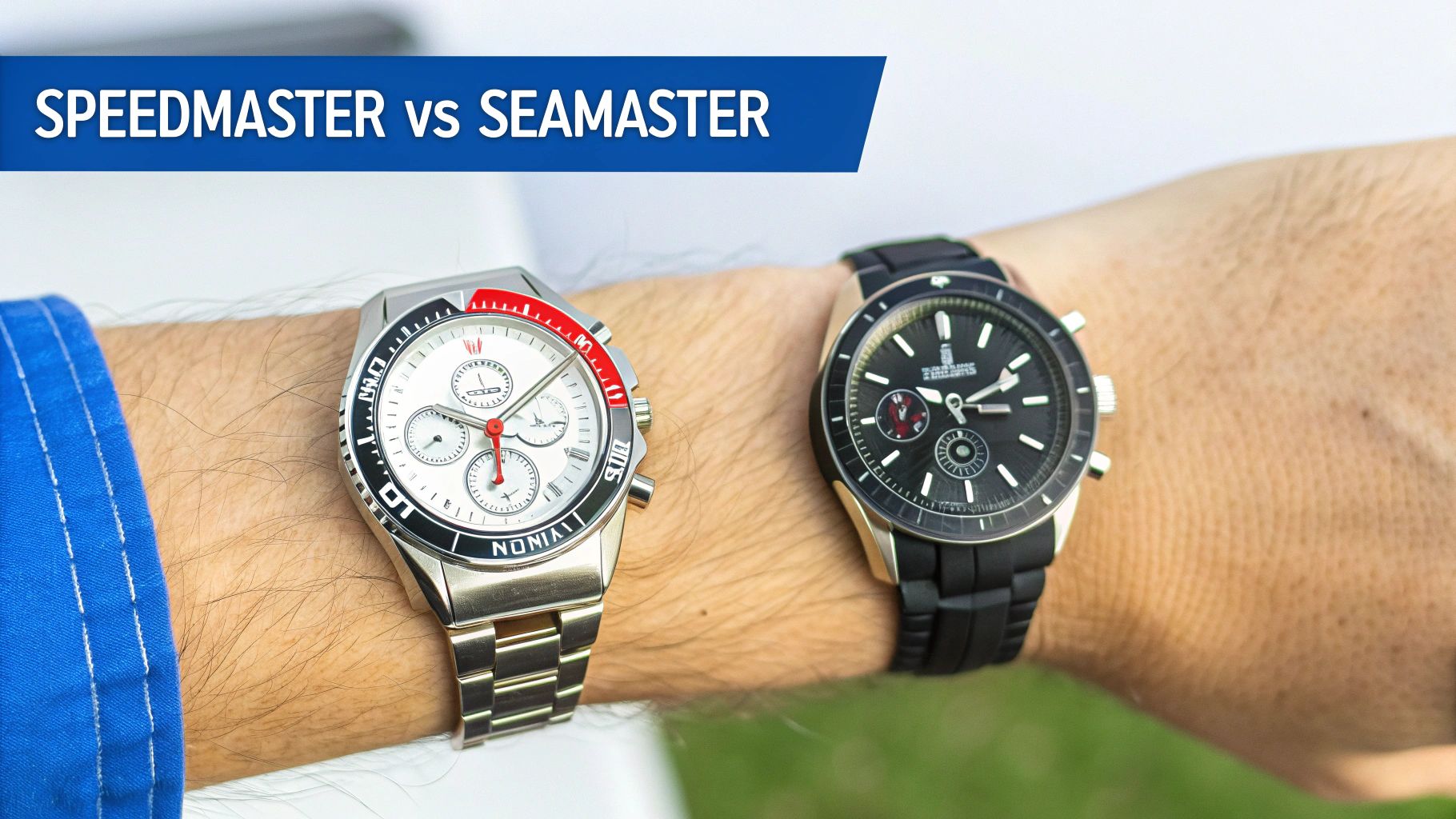
Choosing Between Two Omega Legends
Picking between an Omega Speedmaster and a Seamaster is a fantastic problem to have. You're choosing between two icons of the watch world, each representing a pinnacle of engineering but built for entirely different purposes. One conquered the final frontier; the other mastered the abyss.
This guide goes deeper than the usual spec sheet comparison. We’ll explore their unique legacies, design philosophies, and what they’re actually like to own and wear, helping you figure out which icon truly fits your life.
To make the right choice, it helps to understand their core identities:
- The Speedmaster: Forever linked to racing and its legendary status as the official NASA Moonwatch. It’s a pure tool watch designed to measure speed and time with absolute precision.
- The Seamaster: A symbol of aquatic adventure, made famous on the wrist of James Bond. It’s engineered for extreme durability and water resistance, ready for any mission—above or below the waves.
Getting a handle on these foundational differences is the first step. For a quick snapshot, here’s how they stack up side-by-side.
At a Glance Speedmaster Vs Seamaster
This table breaks down the essential DNA of the two most popular models from each family: the classic "Moonwatch" and the modern Diver 300M.
| Attribute | Omega Speedmaster Professional 'Moonwatch' | Omega Seamaster Diver 300M |
|---|---|---|
| Primary Function | Chronograph (Stopwatch) | Dive Watch |
| Bezel Type | Fixed Tachymeter Scale (Measures Speed) | Unidirectional Rotating (Tracks Dive Time) |
| Water Resistance | 50 meters (Splash Resistant) | 300 meters (Professional Diving) |
| Movement Type | Manual-Wind or Automatic Chronograph | Automatic with Co-Axial Escapement |
| Defining Legacy | First Watch Worn on the Moon (NASA) | Official Watch of James Bond |
| Ideal User | History buffs, racing fans, collectors | Divers, adventurers, "one-watch" owners |
Ultimately, choosing between these two isn’t about which one is "better." It’s about which story speaks to you and which set of capabilities you’ll actually use day-to-day.
A Legacy Forged in Space and at Sea
To really get the Omega Speedmaster vs. Seamaster debate, you have to go back to their roots. These aren't just watches; they're pieces of history. Each was born from a specific need and became legendary through decades of real-world performance. Their stories are as different as the sky and the sea, and those origins shape every single design choice you see today.
The Speedmaster’s story starts not in space, but on the racetrack back in 1957. It was launched as one-third of Omega's "Professional" collection, alongside the Seamaster 300 and the Railmaster. Its original job was to be a tough, precise chronograph for race car drivers timing laps. Its destiny, however, was written in the stars.
The Speedmaster: From Racetrack to Rocket Ship
In the early 1960s, NASA quietly bought chronographs from several top watch brands, hunting for a timepiece that could survive the brutal conditions of space travel. The watches went through hell—massive temperature swings, violent shocks, and intense vibrations. Only one survived: the Speedmaster.
That incredible performance earned it the official title of "Flight-Qualified by NASA for all Manned Space Missions." Its biggest moment came on July 21, 1969, when it became the first watch worn on the Moon, locking in its "Moonwatch" nickname and its place in human history forever. This isn't just marketing fluff; it's the very soul of the Speedmaster.
The Speedmaster's history is one of human exploration. It wasn't designed for space, but it was so well-engineered for its original purpose that it was the only watch capable of surviving it. This accidental legacy makes it one of the most authentic tool watches ever created.
The Seamaster: A Heritage Rooted in the Depths
While the Speedmaster was aiming for the stars, the Seamaster had its eyes on the ocean. Its story starts way earlier, in 1948, building on Omega's experience making waterproof watches for the British military during WWII. The first Seamasters were actually more like elegant dress watches with better-than-average water resistance, not the hardcore dive tools we know today.
The collection evolved, giving us the professional-grade Seamaster 300 in 1957—a direct competitor to the other big dive watches of the day. But the Seamaster truly blew up in 1995 when it appeared on James Bond's wrist in GoldenEye. That single moment in pop culture turned it from a niche tool for divers into an international symbol of adventure and sophistication.
These different paths directly influenced how each watch was produced and positioned. The Seamaster became a high-volume flagship model with huge mainstream appeal. The Speedmaster, on the other hand, kept a more focused, collectible status. You can see this play out in the market today, where an early 1957 Speedmaster Ref. 2915-1 sold for a mind-blowing $3.4 million at auction—proof of its rarity and iconic history. You can learn more about the record-setting Omega watch sale and what it means for the market.
Comparing Functional Design Philosophies
Once you get past the incredible stories behind these watches, the real debate between the Omega Speedmaster and Seamaster comes down to the hardware. Every single component, from the bezel down to the crown, is a direct result of its intended purpose. One is a precision tool built for timing speed on the track, while the other is an over-engineered beast designed to survive the crushing pressures of the deep.
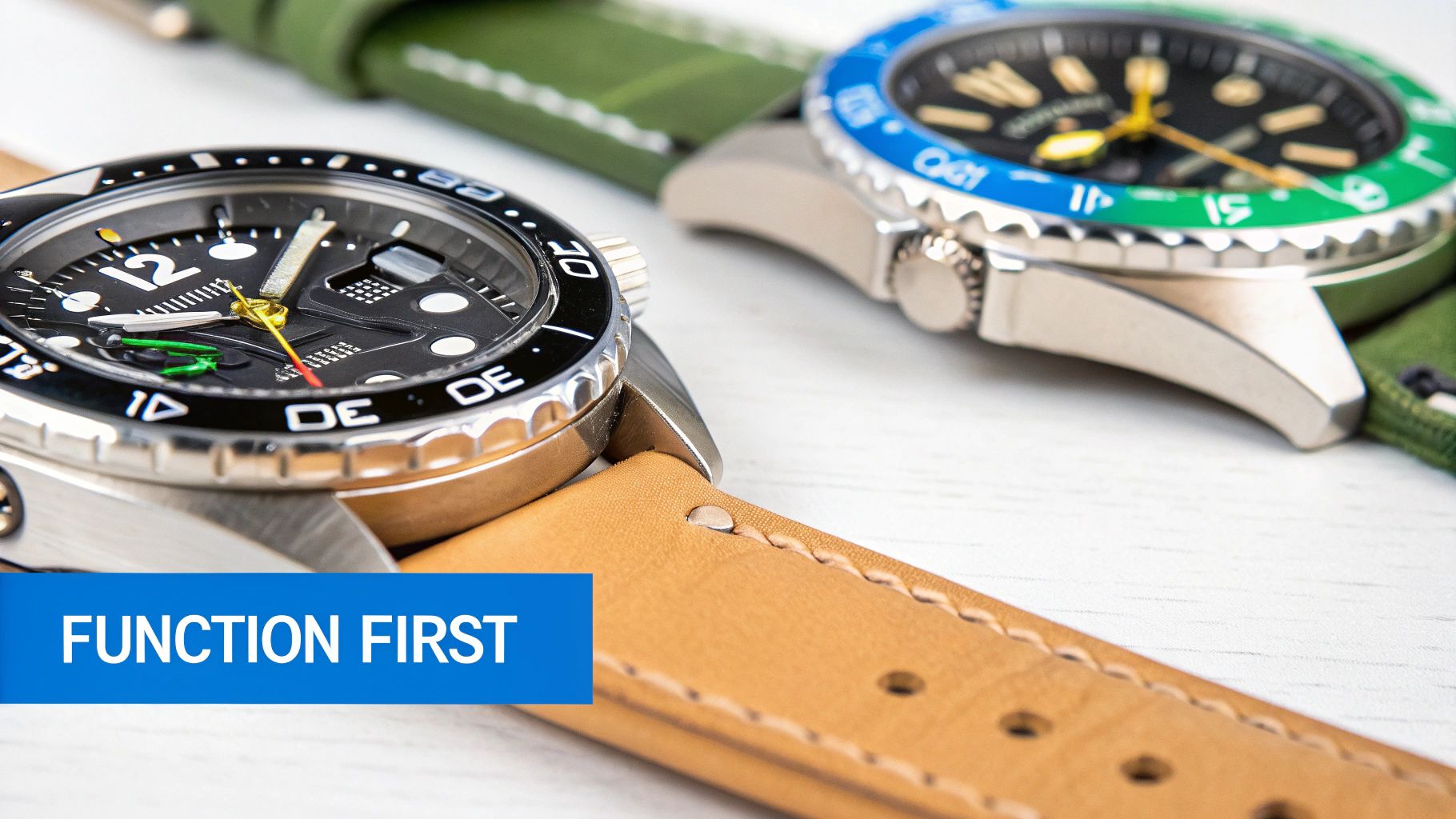
You can see this difference immediately just by looking at their bezels. The Speedmaster Professional has a fixed bezel etched with a tachymeter scale. This is a specific, almost vintage tool used with the chronograph to calculate speed over a known distance. It’s a clear nod to its motorsport roots and, frankly, isn't much use for anything else.
The Seamaster Diver 300M, however, features a unidirectional rotating bezel—a critical piece of safety gear for divers. Before a dive, you line up the bezel's zero marker with the minute hand. This lets you read elapsed time instantly, ensuring you know exactly how much air you have left. It only turns one way (counter-clockwise) so that an accidental knock can only ever shorten your dive time, never extend it. It's a simple, life-saving fail-safe.
Dial Design Readability And Purpose
The functional differences are just as clear on the dial. A Speedmaster's dial is a busy, data-heavy dashboard. It usually has three sub-dials for tracking seconds, minutes, and hours for its chronograph function. The entire layout is designed to give you a ton of timing information at a glance. If you're curious about how it all works, our guide on what is a chronograph watch breaks it down.
The Seamaster’s dial is the polar opposite—it’s a masterclass in clean, at-a-glance legibility. Its only job is to be readable in dark, murky water. Omega achieves this with:
- Large, bold indices: Filled with tons of Super-LumiNova for a bright, lasting glow.
- Broad, distinct hands: The hour and minute hands have different shapes, so there's zero chance of confusion.
- High-contrast design: Clean layouts against deep black, blue, or white backgrounds make everything pop.
Even the famous laser-etched wave pattern on modern Diver 300M dials adds texture without ever getting in the way of its primary mission: immediate readability.
The Speedmaster's dial asks you to stop and analyze data. The Seamaster's dial is designed to give you a single, critical piece of information—the time—in a fraction of a second, no matter the conditions. This is the fundamental split in their design philosophies.
Water Resistance and Structural Integrity
Nowhere is the difference in purpose more obvious than in their construction. A standard Speedmaster Professional Moonwatch is rated for 50 meters of water resistance. Let’s be clear: this is "splash-proof." It’s fine for washing your hands or getting caught in the rain, but you should never, ever take it swimming. Its push-pull crown and chronograph pushers simply aren't built for submersion.
The Seamaster, on the other hand, is in a completely different league. A Diver 300M is rated for a massive 300 meters (or 1,000 feet), making it a true professional dive watch. It gets this toughness from key features like a screw-down crown that creates a perfect seal, a thicker sapphire crystal, and a heavy-duty case. Many models also include a helium escape valve (HEV) at 10 o'clock—a very specific feature for saturation divers who live in pressurized chambers for days at a time.
This table puts their core hardware differences side-by-side, showing how their intended jobs dictated every design choice.
Speedmaster Vs Seamaster Key Functional Differences
| Feature | Omega Speedmaster Professional | Omega Seamaster Diver 300M |
|---|---|---|
| Bezel Function | Measuring speed (Tachymeter) | Timing dives (Elapsed Time) |
| Dial Focus | Data-rich chronograph information | High-contrast underwater legibility |
| Crown System | Push-pull | Screw-down |
| Water Resistance | 50 meters (Splash-proof) | 300 meters (Professional diving) |
| Special Features | Chronograph complication | Helium escape valve, rotating bezel |
From the bezel to the caseback, every detail reinforces what each watch was born to do, making this a fascinating look at purpose-driven engineering.
Analyzing the Movements Inside
When you compare an Omega Speedmaster vs Seamaster, you have to look past the case and dial and get to the very heart of the watch: its movement. These internal engines define everything about the ownership experience, and they represent two completely different philosophies in watchmaking. One is a direct, tangible link to history; the other is the pinnacle of modern engineering.
The classic Speedmaster Professional Moonwatch is, of course, famous for its manual-wind chronograph movement. Today's version, the Calibre 3861, is a direct descendant of the one that went to the moon. This isn't just a piece of machinery; it's living history that demands a bit of your attention every day.
Winding the crown each morning is a small ritual, a tactile process that connects you to the intricate machine on your wrist in a way an automatic watch just can't replicate. If you want a deeper dive into what makes these tiny engines tick, our guide on how does a mechanical watch work is a great place to start.
The Seamaster's Technological Powerhouse
The Seamaster, on the other hand, is a different beast entirely. It’s powered by Omega's most advanced automatic Co-Axial Master Chronometer calibers. These are "set it and forget it" movements, built for the convenience and durability that modern life demands. The motion of your wrist keeps the watch running, so there’s no need for that daily wind.
But the tech here goes way beyond just being automatic. A modern Seamaster movement is packed with features:
- Co-Axial Escapement: This clever design significantly reduces friction inside the movement. The result? Better accuracy over the long haul and longer periods between services compared to traditional designs.
- Master Chronometer Certification: To get this certification from METAS, the watch has to pass eight brutal tests, proving its precision under all sorts of conditions.
- Extreme Anti-Magnetism: These movements are built to withstand magnetic fields up to 15,000 gauss. That means everyday things like laptops, tablets, and speakers won't throw off its timekeeping.
The Speedmaster asks for a daily commitment and rewards you with a piece of history. The Seamaster offers technological peace of mind, engineered to perform flawlessly without you ever having to think about it. That's the core difference.
Real-World Implications: Manual Vs Automatic
So, what does all this technical jargon mean for you day-to-day? Choosing between these movements really comes down to your lifestyle and what you want from a luxury watch.
A manual-wind Speedmaster is perfect for the enthusiast who geeks out on the history and enjoys that hands-on connection. But you have to be disciplined. Forget to wind it, and it stops. It’s also less protected from water, so you need to be more careful.
In contrast, an automatic Seamaster is the ultimate "one-watch collection" for a lot of people. Its incredible water resistance, self-winding convenience, and magnetic shielding make it a worry-free companion for just about anything, from a day at the office to a week at the beach. It’s a high-performance tool built to handle whatever you throw at it. Your choice really boils down to whether you prefer a classic, interactive experience or a modern, do-it-all machine.
Which Omega Fits Your Lifestyle
Specs and history are great, but the real question when choosing between an Omega Speedmaster and a Seamaster is much simpler: which one is built for your life? Forget the technical sheets for a moment and think about who you are and what you do every day.
The right choice comes down to whether you want a tangible connection to an incredible story or a high-tech tool that can handle anything you throw at it. When you frame it that way, the decision gets a whole lot easier.
The History Buff and Purist
For this person, a watch is more than just a watch—it's history on the wrist. If that’s you, the Omega Speedmaster Professional Moonwatch is your only choice. Its manual-wind movement is a direct link to the caliber that passed NASA’s brutal tests, creating a daily, hands-on connection to that legacy.
Winding the crown each morning becomes a small ritual, connecting you to the astronauts who did the same. The fixed tachymeter bezel isn't just for show; it's a throwback to its 1950s racing roots. This is a watch for someone who appreciates the story just as much as the steel.
The Modern Adventurer and "One-Watch" Guy
This is the person who needs a single, do-it-all timepiece that looks just as good with a suit as it does with swim trunks. The Omega Seamaster Diver 300M is the clear winner here. With its tough-as-nails build, 300 meters of water resistance, and a cutting-edge automatic movement, it's a completely worry-free companion.
Think about the real-world advantages:
- Go-Anywhere Durability: From a client meeting to a weekend at the beach, the Seamaster is built to perform without you ever having to think twice.
- Set-It-and-Forget-It Convenience: The self-winding Co-Axial Master Chronometer movement is incredibly accurate, anti-magnetic, and doesn't need the daily interaction of a manual movement.
- Big Screen Style: Let's be honest, the James Bond connection gives it a cool, adventurous vibe that's instantly recognizable and works anywhere.
For the person who just wants one fantastic watch that can handle everything, the Seamaster's blend of modern tech and rugged looks is almost impossible to beat.
This chart breaks down the fundamental engineering difference, helping you decide between tradition and modern convenience.
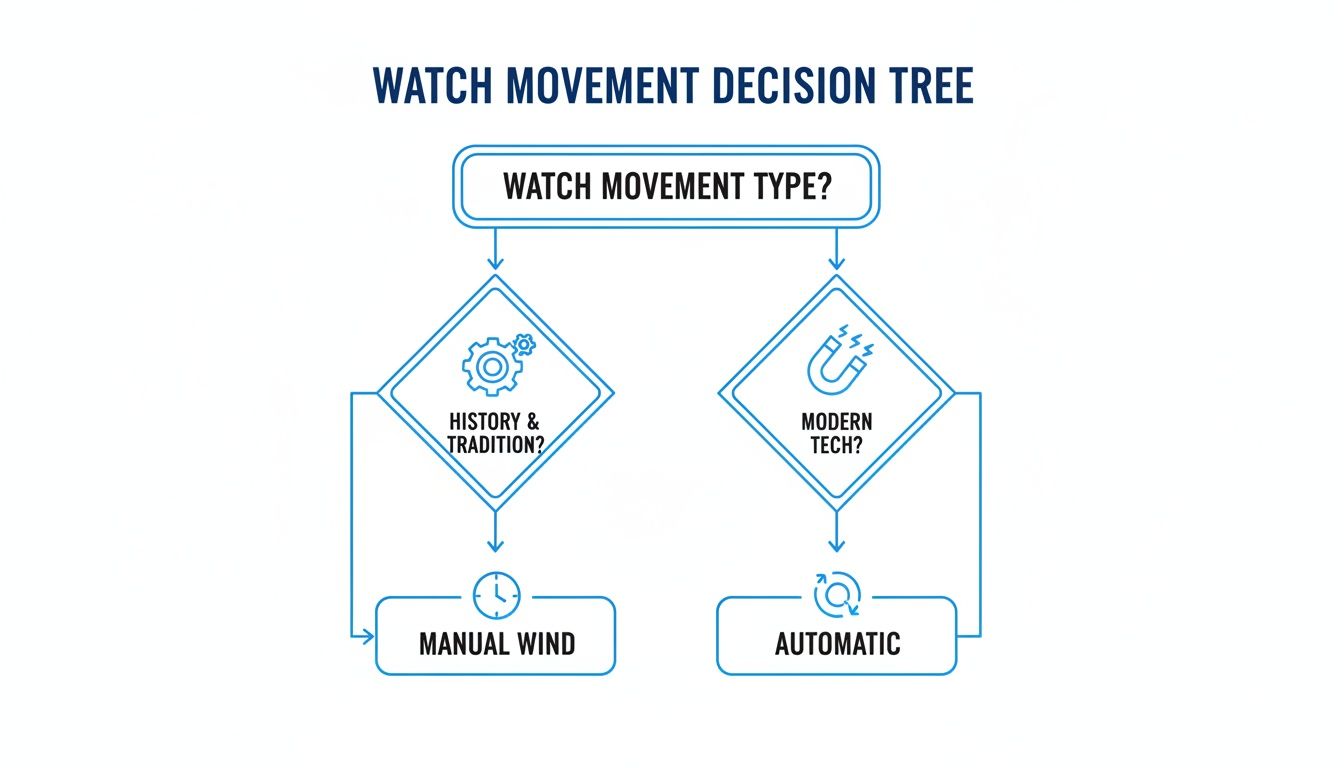
It really comes down to this: choose the manual-wind Speedy for a classic, interactive experience, or the automatic Seamaster for state-of-the-art, hassle-free performance.
Matching the Watch to Your World
Your job, your hobbies, your personal style—they all point toward the right watch. A professional who spends most of their time in an office might love the Speedmaster's classic design and the stories it can tell. But someone with an active lifestyle who’s always near the water will find the Seamaster’s superior durability far more practical.
Choosing between them isn't about which watch is objectively 'better.' It's about which one is a better reflection of you. The Speedmaster is a statement about heritage and precision; the Seamaster is a testament to resilience and modern capability.
Think about your daily routine. Do you like the idea of a daily ritual and owning a piece of history? Or do you need a tool that can keep up with a spontaneous, demanding schedule without skipping a beat? Answer that question honestly, and you'll know exactly which Omega belongs on your wrist.
Investment Potential and Resale Value
When you start talking Omega Speedmaster vs. Seamaster, the conversation always turns to value. Beyond just what they do, these two watch families hold very different places in the pre-owned market. Getting a handle on these differences is crucial for making a smart buy, whether you're after a solid daily watch or a potential long-term asset.
The Speedmaster, especially the classic Moonwatch and its many limited editions, is fueled by a seriously passionate collector base. Its history with NASA is a story that almost no other watch can touch. That historical weight gives it a much higher ceiling for appreciation, particularly for vintage references and special releases made in small batches.
On the other hand, the Seamaster collection, with the incredibly popular Diver 300M at the forefront, is one of Omega's biggest sellers. Its widespread availability and huge popularity mean it's easy to sell and holds its value predictably. A Seamaster is a reliable, stable piece that you can almost always find a buyer for.
Speedmaster: The Collector's Choice
The real investment-grade Speedmasters are a select group. While a standard Speedmaster Professional holds its value just fine, the serious money is in the rarer versions.
- Vintage Models: We're talking about the pre-Moon references from the 1950s and 60s. These are the grails for many collectors and can fetch huge prices at auction.
- Limited Editions: Think "Snoopy" award models, anniversary editions, and other special releases. These often trade for well above their original retail price on the secondary market almost immediately.
- Provenance: Any Speedmaster with documented history—especially one tied to the space program or a notable figure—carries a massive premium.
For anyone looking to sell their Omega or just gauge its liquidity, mastering online auctions for watches can offer critical insights on how to get the best return. Knowing this landscape is vital if you're looking at a Speedmaster as an investment.
Seamaster: The Stable Performer
The Seamaster's strength is its consistency. As one of Omega's best-selling lines, there's a constant, healthy demand for models like the Diver 300M and Aqua Terra in the pre-owned world. This makes it an exceptionally liquid asset—easy to buy, sell, or trade whenever you want.
You won't typically see Seamasters hitting the crazy price spikes of a rare Speedy, but what you do get is fantastic value retention. They are a safe bet for someone who wants a top-tier luxury watch that will hold a huge chunk of its value over time, without all the intense speculation that follows some collector pieces. Our guide on investing in luxury watches digs deeper into what makes a watch a solid financial move.
Recent market data really shows these two different paths. Some reports track steady, single-digit growth for core Seamaster Diver 300M models (around +5.9% to +6.0% year-over-year). Certain Aqua Terra versions have done even better, showing appreciation closer to +13% on some resale platforms. This points to broad, solid demand.
The Speedmaster market is a different story. While rare vintage models break records at auction, the resale value for modern, standard-production Moonwatches is more modest. It's a market where the big returns are concentrated in a very narrow slice of historic models.
Key Takeaway: The Speedmaster offers a higher potential for major appreciation, but that potential is almost entirely locked up in rare, vintage, and historically important models. The Seamaster offers broader, more predictable value retention and is far easier to sell, making it a safer and more stable asset for the average buyer.
Frequently Asked Questions
Even after a side-by-side comparison, it’s the practical, real-world questions that often make the final decision. We get asked these all the time in our showroom, so here are some straight answers to clear up any lingering doubts.
Is the Omega Speedmaster a Good Daily Watch?
Absolutely, the Speedmaster can be a fantastic daily companion. If you opt for an automatic version, you get that grab-and-go convenience. The classic manual-wind Moonwatch is also perfectly wearable, but it does ask for that small daily ritual of winding it up each morning.
The main thing to remember is its standard 50m water resistance. It's fine for washing your hands or getting caught in the rain, but it’s definitely not built for swimming or showering. For a true "do-it-all" watch that you never have to take off, the Seamaster's superior water resistance often makes it the more practical choice.
Which Holds Its Value Better: The Speedmaster or Seamaster?
Both are top-tier performers on the pre-owned market, but they play the value game differently. The Speedmaster, especially the classic Moonwatch and sought-after limited editions, has a much higher ceiling for long-term appreciation. It’s a collector's darling, and rare models can become serious investment pieces.
The Seamaster, on the other hand, is a model of stability. Its immense popularity means it’s always in demand, making it an incredibly liquid and predictable asset. It's one of the easiest watches to buy or sell.
The bottom line on value is this: The Speedmaster is a collector's prize with a higher potential upside for specific models. The Seamaster is a rock-solid, liquid tool watch that you can count on to hold its value reliably.
Can You Swim With an Omega Seamaster?
Without a doubt. The Seamaster Diver 300M is a professional-grade dive watch, purpose-built for the water with a rating of 300 meters (1,000 feet). It's more than ready for swimming, snorkeling, and recreational scuba diving.
Just remember the golden rule: always make sure the screw-down crown is fully tightened before you hit the water. That's what ensures its seal.
Why Is the Speedmaster So Famous?
The Speedmaster's fame comes down to one thing no other watch can claim: it was the first—and only—watch worn on the Moon.
It earned this title after NASA put a group of chronographs through a series of brutal tests that none of the others survived. That incredible legacy, cemented with every lunar landing, elevated the Speedmaster from a simple racing chronograph to a true cultural and historical icon.
Whether you’re captivated by the space-faring legend of the Speedmaster or the go-anywhere capability of the Seamaster, ECI Jewelers has a curated selection of authenticated models to fit your life. Explore our collection online or visit us to find the perfect Omega, backed by our expertise and guarantee. https://www.ecijewelers.com


