


You're probably looking at a few very different Patek options right now and realizing the brand name alone doesn't make the decision easier. A preowned Patek Philippe sits at the top of modern watch collecting, but the market is split sharply between sport models, dress pieces, and complications, so the right buy for a first-time owner isn't always the loudest one. This guide is for the serious buyer who wants lasting value, real context on Nautilus and Aquanaut history, practical model selection, secondary pricing, and a clean way to authenticate before money changes hands. By the end, you'll have the context to buy with confidence.
- Standout design fact: The Nautilus was introduced in 1976 as Patek Philippe's luxury sports watch during the quartz crisis, and it was created by Gérald Genta with a porthole-inspired design that became one of the most recognizable shapes in watchmaking, as outlined in Sotheby's guide to the Patek Philippe Nautilus.
- Easiest entry point: If you want a modern sports Patek without jumping straight into Nautilus pricing, the steel Aquanaut 5167A-001 was reported around $70,137 as of September 2026 in Enthuster's Aquanaut market guide.
- Value position: Nautilus usually gets the attention, but Aquanaut often gives a more usable daily-wear proposition, while many Calatrava and complicated dress references trade softer than the steel sports models. That spread matters more than the logo on the dial.
If you're shopping seriously, stop thinking of Patek as one resale curve. There are distinct eras, sports lines, and ownership costs to understand first. You can browse the broader Patek Philippe watch collection at ECI once you know which lane fits your wrist and your budget.
Introduction to the Preowned Patek Philippe Buying Guide
You are about to wire serious money for your first Patek. The mistake is treating every preowned Patek Philippe the same because the name on the dial is the same.
It is not one market. It is several. Steel sports models such as Nautilus and Aquanaut trade on scarcity, waitlist history, and fast resale. Calatrava references trade on proportion, movement quality, and quieter demand. Complications add another layer because the purchase price is only part of the bill. Service cost matters, and on annual calendars, chronographs, and perpetual calendars, that cost can change the value equation quickly.
A 2023 Boston Consulting Group report noted a wide gap inside the preowned luxury watch field between the hottest integrated-bracelet sports watches and softer dress categories. That split is the starting point for a smart Patek purchase, not a footnote.
What serious first-time buyers should do
Buy by segment first, reference second.
If liquidity matters most, start with Nautilus or Aquanaut. If watchmaking value matters more than headline demand, spend real time on Calatrava and selected complications. If long-term ownership cost will bother you, be stricter with complicated references than with time-only pieces.
That one decision will save you from two common errors. The first is paying a sports-model premium for a watch you will not enjoy wearing. The second is buying a dress watch or complication because it looks cheap relative to retail, then learning that resale is thinner and service is materially heavier.
What you are actually shopping for
A preowned Patek Philippe usually falls into one of three lanes:
- Sports references with strong liquidity. Nautilus and Aquanaut usually sit here. They get the most attention, the firmest pricing, and the quickest buyer response when it is time to sell.
- Dress watches with weaker momentum but better value entry. Calatrava often makes more sense for a buyer who wants classic Patek finishing and proportions without paying for hype.
- Complications with more ownership drag. The sticker price can look reasonable, but servicing a complicated Patek is a different commitment from servicing a simple three-hand watch.
That is why buying preowned Patek Philippe requires more than brand recognition. You need to match the segment to your budget, your wrist, and your tolerance for maintenance. If you want to compare the brand's broader catalog before narrowing down a reference, browse the Patek Philippe watch collection at ECI Jewelers.
The History of Patek Philippe Nautilus and Aquanaut
You walk into the preowned Patek market expecting one brand story. You quickly find two very different sports-watch stories. Nautilus is the older icon with stronger symbolism, broader collector recognition, and a price structure shaped as much by status as by watchmaking. Aquanaut arrived later and built demand on wearability, modern styling, and a buyer base that often wants a Patek for regular use, not just for the safe.
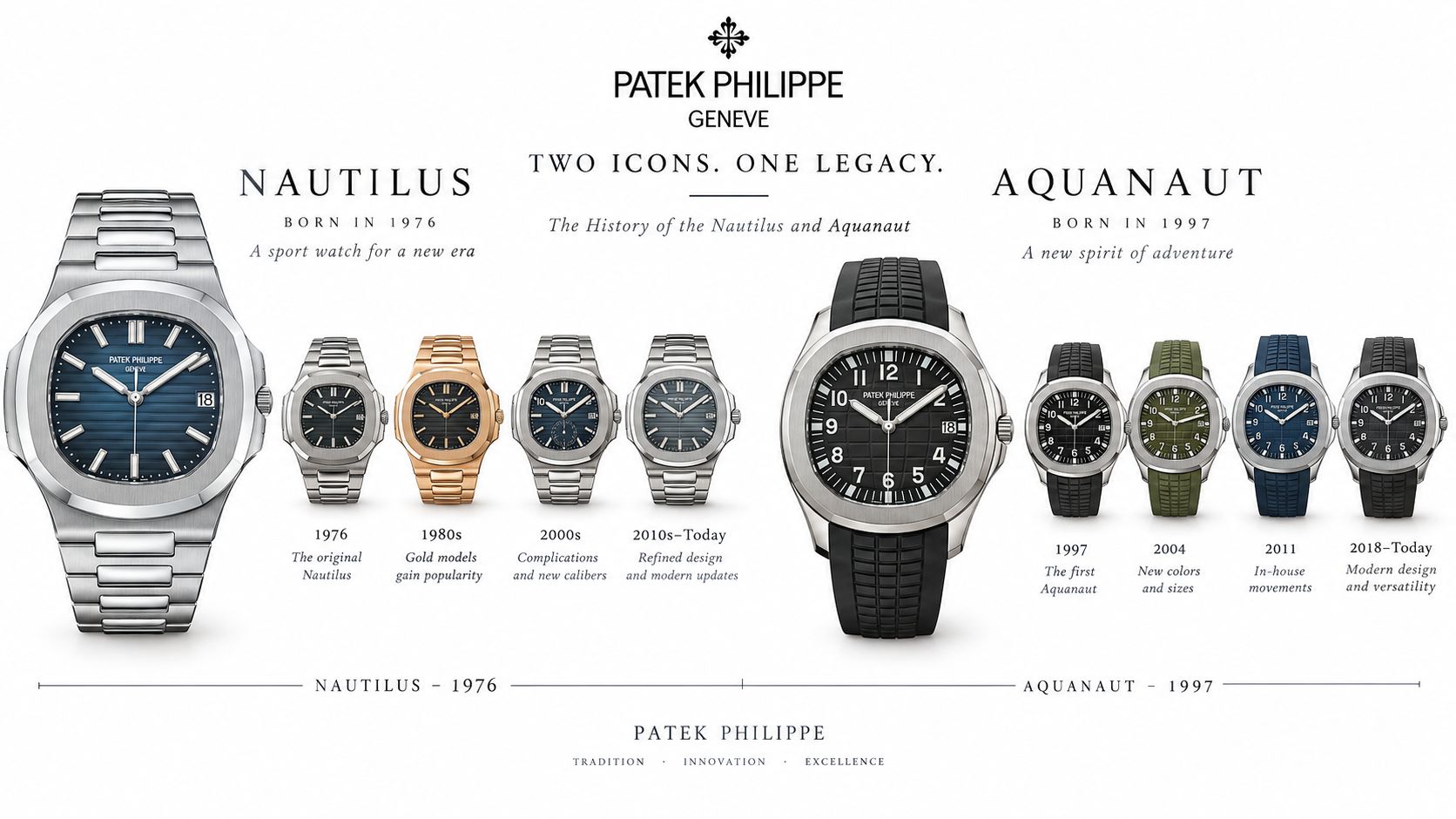
The Nautilus started in 1976, during the quartz crisis, and it changed Patek's public identity. Gérald Genta gave the brand a steel luxury sports watch with a porthole case, integrated bracelet, and a shape that still reads instantly. That matters in the secondary market. Buyers are not just paying for a steel watch with a date. They are paying for the reference family that made conservative Patek collectors accept the idea of casual prestige.
The original ref. 3700/1A set the tone. It was large for its era, thin, and deliberately different from the smaller dress references that defined the house. Later generations kept that formula alive, and the return of the simple steel time-and-date Nautilus in the 5711 era turned the line from respected to feverishly chased. If you want a quick reference point for how anniversary releases amplified that story, ECI's guide to the Patek Philippe Nautilus 50th Anniversary limited editions is useful context.
Aquanaut took a different route. It launched in the late 1990s as a younger, less formal sports Patek, with a rounded octagonal case and composite strap instead of the full integrated bracelet look. That one decision changed the ownership proposition. Aquanaut usually feels less precious on the wrist, less rigid in styling, and more practical for the buyer who will wear the watch several days a week.
This history matters because it explains today's segmentation.
Nautilus trades on lineage, bracelet design, and cultural weight. Aquanaut trades on modern wear, easier daily use, and a more casual image. Both are sports Patek references, but they do not behave like the same asset class in the preowned market, and they should not be evaluated that way.
Key milestones that still affect preowned demand
- 1976: Nautilus launches with the ref. 3700/1A and establishes Patek's luxury sports category.
- Later Nautilus generations: The line evolves from niche statement piece into one of the strongest names in modern preowned watch liquidity.
- Late 1990s: Aquanaut arrives as the more casual sports alternative, aimed at a younger client and a different wearing context.
- Anniversary and limited-edition period: Nautilus gains even more collector attention as milestone references sharpen scarcity and visibility.
- Current market reality: Nautilus and Aquanaut sit in the same sports lane, but they carry different entry prices, buyer pools, and long-term ownership expectations.
Core Differences Between Nautilus and Aquanaut
A lot of first-time buyers frame this as “Nautilus if money is no object, Aquanaut if you want the cheaper one.” That's lazy thinking. The Aquanaut isn't a budget Nautilus. It's a different proposition in design, wear, and market behavior.
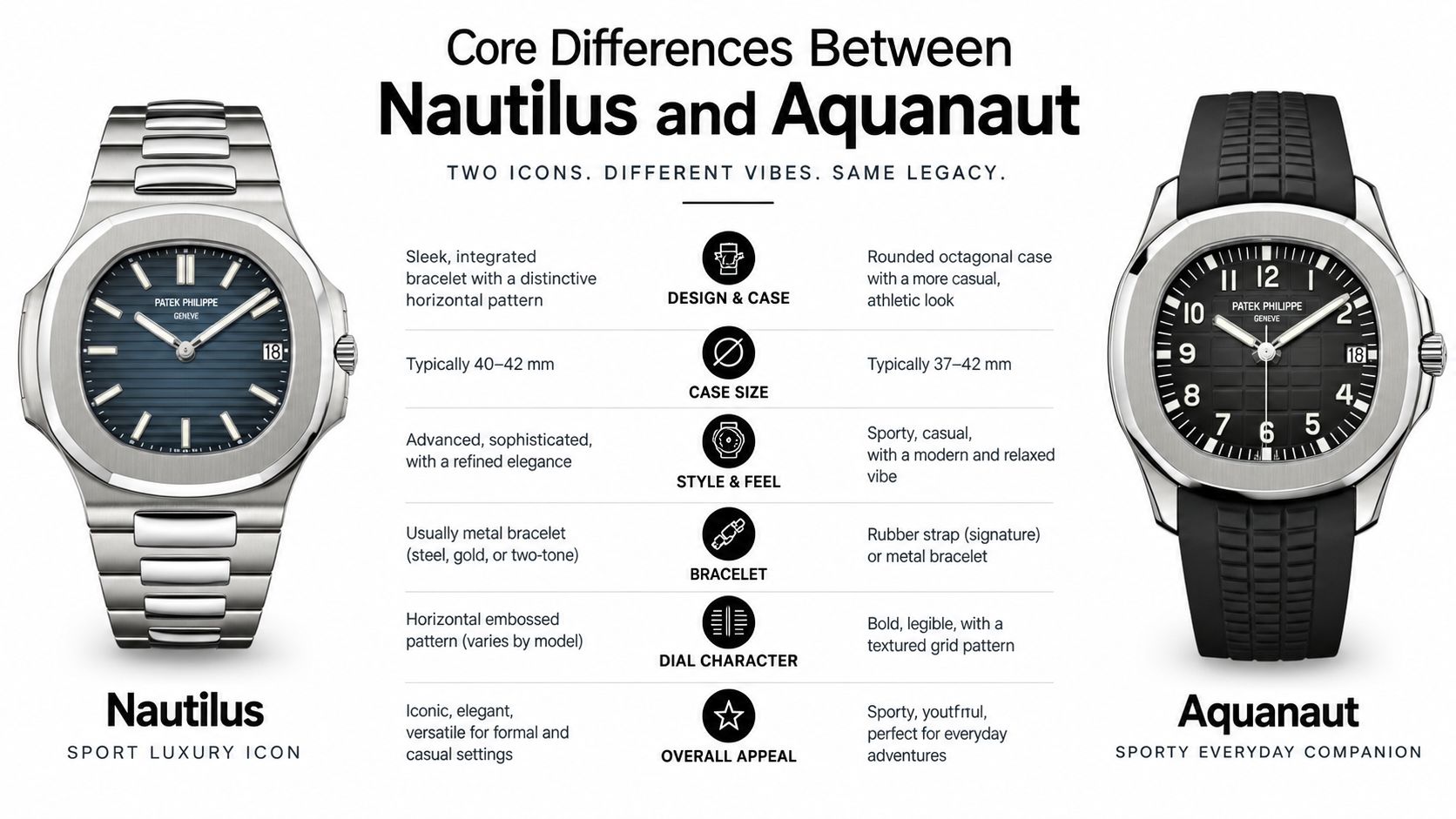
Nautilus is the more architectural watch. It wears like integrated luxury, with the bracelet doing as much of the talking as the dial. Aquanaut is more relaxed. The strap changes the whole experience. It's lighter in mood, easier in daily use, and often better for the buyer who wants a real wearing watch instead of a watch they'll baby.
For a quick visual walkthrough, this comparison video is useful before you start comparing listings and references:
Why the distinction matters in the preowned market
Nautilus usually carries the stronger symbolic value. Aquanaut often carries the stronger practical value. If you wear short sleeves, travel often, or want one Patek that can absorb regular use, Aquanaut makes a very hard-to-ignore case.
If you want a deeper side-by-side on buyer fit, ECI's Aquanaut vs Nautilus comparison is worth reviewing after you settle on your preferred wear style.
Nautilus vs Aquanaut Design Comparison
| Design Element | Nautilus | Aquanaut |
|---|---|---|
| Case Dimensions | Original ref. 3700/1A is associated with roughly 40 mm sizing | Varies by reference, but generally wears more casual due to strap configuration |
| Bezel and Crown Detail | Porthole-inspired case with signature lateral “ears” | Rounded octagonal style with a softer, less architectural feel |
| Dial Pattern | Horizontal embossed style is the visual signature most buyers associate with the line | Grenade-style textured pattern gives it a more contemporary sports look |
| Crown and Pushers | More bracelet-driven, integrated-luxury presentation | Simpler sport-watch presentation, often more relaxed on wrist |
| Water Resistance | Sports-watch positioning within Patek's luxury category | Sports-watch positioning with stronger daily-use appeal for many buyers |
Buying lens: Choose Nautilus if you want the icon. Choose Aquanaut if you want the sports Patek you'll actually wear most.
The Modern Lineup and How to Choose Your Configuration
You are standing at the counter with two very different Pateks in front of you. One is a steel Nautilus that will cost more to buy because demand is heavier. The other is an Aquanaut that may fit your life better and still keep strong resale support. A few trays over, a Calatrava or annual calendar offers far more traditional Patek watchmaking, but with a very different ownership profile on liquidity and service cost.

Treat the modern preowned Patek Philippe market as four lanes, not one brand decision: Nautilus, Aquanaut, Calatrava, and complications. They do not trade the same way. They do not wear the same way. They do not cost the same to maintain.
Nautilus time and complication paths
Start with a basic question. Do you want the strongest icon in the catalog, or the strongest fit for how you wear a watch?
If the answer is icon, focus on simple Nautilus references first. Time and date models carry the cleanest link to the design buyers know, and they are usually the easiest to resell because the market is broad. Once you move into chronographs, travel time, moon phases, or annual calendars, you are paying for more than the case shape. You are paying for a smaller buyer pool, more mechanical complexity, and higher service exposure later.
That does not make complicated Nautilus references a bad buy. It makes them a buyer-specific buy. If you want one watch with maximum liquidity, stay simple.
Aquanaut as the practical first Patek
Aquanaut is the better first purchase for many serious buyers, especially if this watch will see real wrist time. It is easier to wear in heat, on travel, and with casual clothes. The rubber strap changes the whole ownership experience. You get less visual weight than a full steel bracelet and less anxiety about desk wear.
Aquanaut also sits in a useful middle ground. Demand is strong enough to keep resale interest healthy, but the watch still reads more personal than performative. That matters. A first Patek should fit your routine, not just your spreadsheet.
For a one-watch Patek collection, I would usually direct a buyer to Aquanaut before I direct them to a complicated Nautilus.
Calatrava and complications require a different buying lens
First-time buyers often get lazy and overpay. A Calatrava, annual calendar, world time, or chronograph is not competing with a Nautilus on the same terms. These references often deliver more traditional Patek substance per dollar on the preowned market, but they tend to move slower and they can cost more to service once calendar or chronograph work enters the equation.
That split matters. A sport model buyer is often paying for liquidity and visibility. A dress or complication buyer should be paying for movement, case quality, dial execution, and long-term enjoyment.
If you want a quieter, more classically Patek ownership experience, preowned Calatrava and Complications references deserve serious attention. Just do not expect sport-watch exit speed.
Precious metal, special dial, or collector-specific configuration
Gold cases, gem-set variants, and unusual dial combinations narrow the field fast. Buy them only if you love that exact reference. Do not buy them because the badge says Patek Philippe.
Auction history helps explain why the brand carries so much gravity at the top end. The unique stainless-steel Grandmaster Chime Ref. 6300A-010 sold for CHF 31 million in November 2019, the Henry Graves Supercomplication sold for CHF 23.237 million in November 2014, and a stainless-steel Ref. 1518 from 1943 achieved CHF 14.19 million at Phillips Geneva in 2025. One summary source also notes that as of 2023, 9 of the world's 10 most expensive watches ever sold at auction were Patek Philippe, and 46 of the top 58 watches sold for over US$2 million were also Patek Philippe, according to Le Watch Buyers' history of Patek Philippe.
Use that context correctly. It supports the brand. It does not guarantee that every modern preowned reference behaves like a trophy asset.
The right configuration is usually simple. Buy Nautilus if you want the strongest icon and easiest conversation starter. Buy Aquanaut if you want the best balance of prestige, wearability, and daily use. Buy Calatrava or a complication if you care more about traditional Patek watchmaking than fast resale.
Real Market Valuation and Retail vs Secondary Pricing
You walk into the market expecting one answer on value and get four. A steel Nautilus trades like a liquid status asset. An Aquanaut often sits one tier below it on hype but still carries real resale strength. A Calatrava follows a different curve entirely. Complications can offer better horology per dollar, but resale depends on the exact reference, metal, dial, condition, and service history.
Treat preowned Patek Philippe as four markets sharing one name. That mindset will save you money.
Secondary pricing moves by segment, not by logo. Recent market coverage and dealer data have shown the same split. Nautilus and Aquanaut usually attract the deepest buyer pool and the fastest offers. Calatrava and many dress-led complications have a smaller audience, longer selling windows, and wider bid-ask spreads. If you price all of them by brand prestige alone, you will overpay.
What actually drives the spread between retail and resale
Retail price is only the starting point. Secondary value comes from scarcity, waitlist pressure, wearability, service cost, and how many buyers want that exact watch today.
Steel sports Patek sits at the top of that stack. The most sought-after Nautilus references often trade well above retail, and Aquanaut is usually close behind. Calatrava is different. Many references can trade below retail on the secondary market, which is not a flaw. It is the normal price of entry into a less liquid category. Complications split again. A simple annual calendar may behave one way. A precious-metal chronograph or world time may behave another. Service estimates also matter more here, because a buyer will discount a watch that could require a costly factory visit.
If you want a clean framework for pricing reference by reference, use this market-based watch valuation method. For dealer-side context on sourcing and margin pressure, the JewelryBuyDirect wholesale watch playbook is useful.
Patek Philippe Retail vs Secondary Market Pricing
| Reference / Model Type | Core Material | Approx. Retail (MSRP) | Approx. Secondary Value |
|---|---|---|---|
| Aquanaut 5167A-001 | Steel | Retail varies by market and timing | Trades at a strong premium in many periods |
| Nautilus top sports models | Steel | Varies by reference | Often commands the highest premiums |
| Aquanaut top sports models | Steel | Varies by reference | Usually trades above retail, but below comparable Nautilus models |
| Calatrava family | Typically dress-oriented materials and configurations | Varies by reference | Commonly trades closer to retail or below it, depending on reference and demand |
| Complications and Grand Complications | Mixed | Varies widely | Highly reference-specific. Buyer pool and service exposure matter as much as brand prestige |
Here is the practical advice. Buy Nautilus if you want the strongest liquidity. Buy Aquanaut if you want strong demand with a more wearable daily profile. Buy Calatrava if your priority is classic Patek design and a lower entry point, not quick resale. Buy complications only after you price the next service, because service cost can erase the apparent bargain.
Essential Checklist for Buying Preowned With Confidence
You are about to wire five figures for a watch that may look right in photos and still be wrong in three expensive ways. That is the preowned Patek market. It is not one market, either. A steel Nautilus or Aquanaut trades on liquidity and originality pressure. A Calatrava or complication trades on condition, service exposure, and a much narrower resale audience.
Value comes from three things. Originality, condition, and paperwork that matches the watch. Get all three right and you have a clean buy. Miss one and the discount needs to be real.
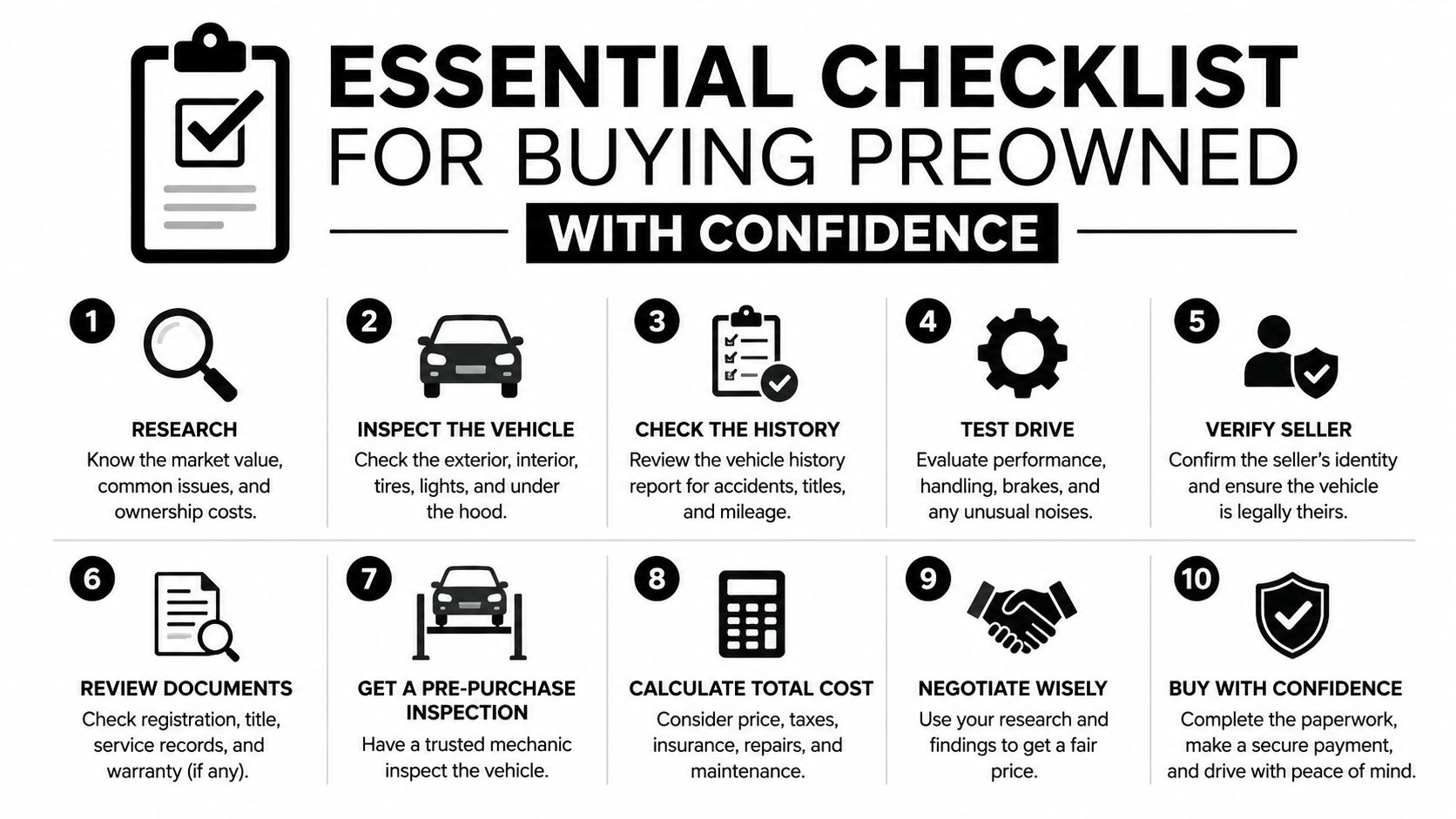
The four checks that matter most
- Start with the case and bezel. Patek finishing should look crisp. On Nautilus and Aquanaut, soft edges, rounded transitions, and washed-out brushing usually mean polishing has removed metal. On a sport model, that hits value harder because buyers pay a premium for sharp geometry and strong resale. On a Calatrava, polishing still matters, but the market is often more forgiving if the watch is otherwise honest.
- Check the parts buyers miss. Inspect the dial, hands, crown, clasp, bracelet, strap, and buckle against the correct specification for the reference. A worn rubber strap is routine. A service hand set, replacement bezel, swapped clasp, or non-matching bracelet is not. Those details matter more on Nautilus and Aquanaut because the market prices them like collectible sport references, not generic used luxury watches.
- Verify the watch, not just the accessories. Box and papers help, but they do not prove the watch is correct. Confirm the reference, case number, movement number, and visible configuration against seller records and supporting documents. If provenance is thin, insist on independent verification or brand support before payment. Forged certificates and separated sets exist, as explained in this guide to servicing and verifying a Patek Philippe.
- Check function before funds move. Test winding feel, crown action, time setting, date change if applicable, clasp closure, and general movement behavior. On complications, confirm every function works in the proper sequence. If the seller cannot demonstrate operation clearly, pass or price the watch as a service case.
Full set status adds value only after the watch itself checks out.
Service history changes the real price
Service timing matters because preowned Patek is a segmented market. A time-only Aquanaut or Calatrava can absorb a routine service bill without wrecking the deal. A complication bought at an apparent discount can stop looking cheap the moment you price overdue maintenance, parts replacement, and time out of circulation.
Patek Philippe lists published service costs on its own service page. Mechanical servicing starts at 900 to 1000 CHF, and complications run 1500 to 2700 CHF, according to Patek Philippe's service cost page. Those numbers are the floor for your thinking, not an afterthought.
That is why I would judge overdue service differently by category. On a Nautilus or Aquanaut, strong demand can support buying a sharp, original watch even if service is approaching. On a Calatrava, the buyer has more room to negotiate because liquidity is softer. On a complication, I would want service timing, function, and parts correctness clarified before I called anything a bargain.
My recommendation
For a first preowned Patek, keep it simple and liquid. Buy the cleanest example you can verify, with correct parts, honest finishing, and documented service history or a price that clearly covers the next one.
My order is straightforward. Aquanaut first for wearability and simpler ownership. Nautilus first only if you accept the higher premium and stricter originality standards. Calatrava if you want Patek craft more than resale speed. Complications only after you are comfortable underwriting the service bill.
Securing Your Preowned Patek Philippe at ECI Jewelers
The smart preowned Patek buy depends on honesty about your priorities. If you want icon status and stronger symbolic pull, Nautilus still leads. If you want the sports Patek most owners wear more often, Aquanaut is usually the cleaner answer. If you care more about value per dollar than social signaling, softer dress and complication references deserve a harder look than most buyers give them.
Timing is decent if you stay selective. The secondary market has shown recovery, but not evenly, and that's healthy. It gives disciplined buyers room to choose by reference instead of chasing broad hype. That's especially useful if you're comparing liquid sport references against quieter categories that may offer better long-term enjoyment.
For buyers who want a dealer route rather than a private-market gamble, ECI Jewelers' watch concierge is one example of a service built around authenticated sourcing, specialist inspection, valuation support, and insured delivery. That matters more with Patek than with many brands because originality, service timing, and matching numbers have such a direct effect on future liquidity.
Buy from the seller who can explain the watch calmly, document it properly, and price it transparently. Skip the one selling urgency.
A serious first Patek should leave you with conviction, not loose ends. If the watch is right, the numbers are sensible, and the provenance is clean, you won't need a sales pitch to move forward.
If you're weighing Nautilus, Aquanaut, or another preowned Patek Philippe reference, ECI Jewelers offers authenticated inventory, market-based valuations, and concierge support that fits this kind of purchase. It's a practical place to compare real watches, verify condition and set completeness, and buy with insured shipping and transparent pricing.


