


A buyer standing in the Diamond District usually isn't asking, “Which Rolex is nicer?” He's asking which one will make sense on wrist, in rotation, and on resale when the honeymoon ends. That's where the Rolex GMT-Master II vs Explorer II decision gets real, because these two watches look related but behave very differently for a traveler, a collector, or a daily wearer who doesn't want to overpay for status.
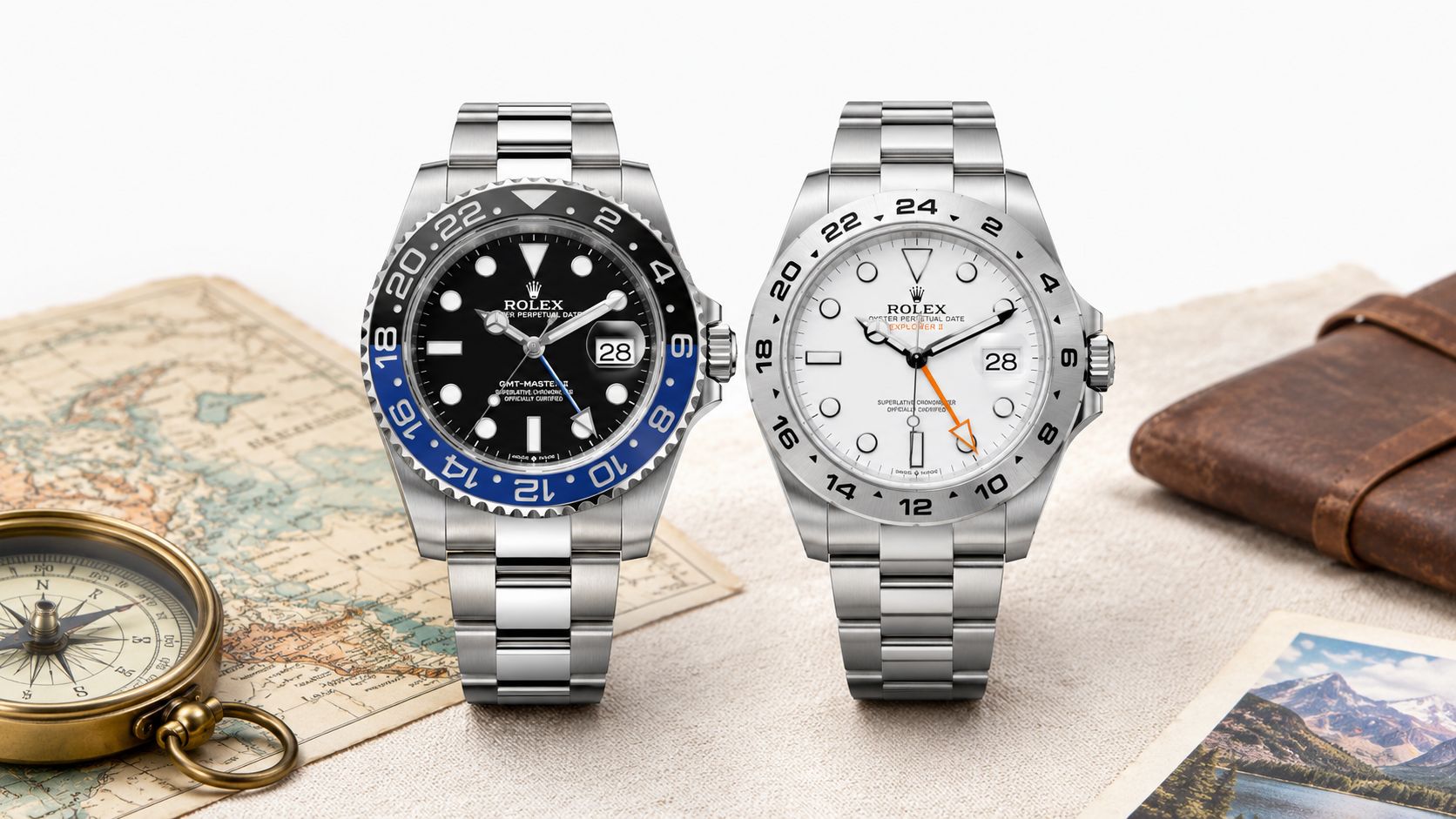
Introduction to Two Iconic Rolex Travel Watches
A buyer in the Diamond District usually wants one answer. Which watch will wear hard, hold value, and avoid costing more than it should over time? The GMT-Master II is the louder choice, with stronger status pull and a more obvious travel identity. The Explorer II is the sharper practical buy, built for legibility, daily wear, and less friction on the wrist.
That distinction matters in 2026, because the secondary market is no longer running on pure hype. If you want a watch that looks like a trophy, the GMT-Master II does that better. If you want a Rolex you can wear often without paying extra for attention, the Explorer II makes a cleaner case. The better buy depends on whether you value cachet, utility, or total cost of ownership.
Key takeaways
- Same modern engine, different use case. Current GMT-Master II and Explorer II references share Rolex Calibre 3285, about 70 hours of power reserve, and −2/+2 seconds per day precision. The bezel and hand layout still make them behave differently on wrist. Rolex brochure
- Explorer II usually costs less to own. Recent market summaries show the Explorer II 226570 as the cheaper entry point, which matters if you want a serious Rolex without paying the strongest premium for the name. Rolex market data
- GMT-Master II carries the higher status tax. The market still rewards the GMT with heavier collector demand, while the Explorer II tends to be the more rational purchase for a buyer focused on value and daily use. Market guide
The family history explains why buyers keep splitting on these two models. Rolex built each watch for a different kind of wearer, and the broader GMT line is worth checking through the current GMT-Master II collection for context. ECI Rolex GMT insights
History and Evolution of Both References
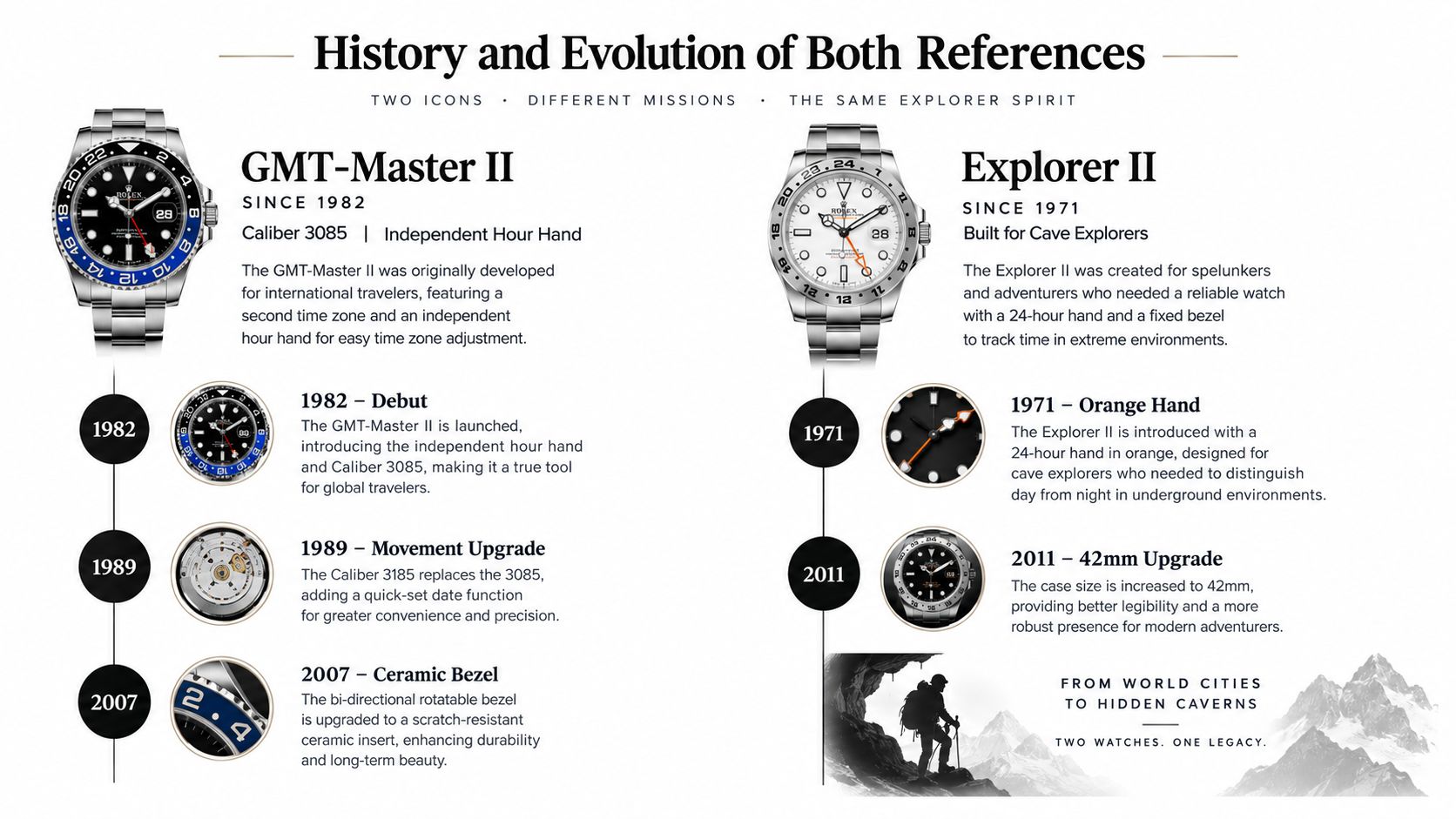
The Explorer II came first, debuting in 1971 as the Ref. 1655 for cave explorers and polar researchers who needed a clear 24-hour readout when daylight cues were unreliable. Rolex kept the setup intentionally straightforward, with a fixed 24-hour bezel and a 24-hour hand tied to the main hour hand, so it was a specialist instrument rather than a true dual-time travel watch. That origin still matters if you want the watch for hard use instead of hype. Explorer II history
The GMT-Master II arrived later, in 1982, and the turning point was the Caliber 3085, which separated the 12-hour and 24-hour hands so the watch could track local time and a second time zone independently. That made it a true travel tool, not just a watch with extra display information. Rolex's later updates, including ceramic bezel changes in 2013 and the blue-and-black version before the red-and-blue one followed in 2014, changed its look as much as its material story. GMT-Master II history
Key milestones in the model story
- 1971: Explorer II launches as the Ref. 1655, built for cave and polar work, with a fixed 24-hour bezel.
- 1982: GMT-Master II debuts with the Caliber 3085, which separates local time from home time.
- 1985: Explorer II Ref. 16550 adds independent 24-hour hand function and the white Polar dial.
- 2011: Explorer II grows to 42 mm with the 216570, making it the larger tool watch.
- 2013 to 2014: GMT-Master II adopts ceramic bezel milestones, first blue-and-black, then red-and-blue.
The collector-friendly lesson is simple. The Explorer II did not start life as a cheaper GMT. It began as a specialized land watch and only later borrowed GMT-style utility. The GMT-Master II started as a true travel instrument from day one, and that split still shapes buyer behavior in the secondary market today. If you want a broader view of the GMT line, the ECI Rolex GMT insights piece is a useful reference point.
Head to Head Specifications and Functions Compared
Start with the movement, because Rolex keeps the mechanics close. Modern GMT-Master II and Explorer II references both run on Calibre 3285, a 28,800 vph automatic movement with roughly 70 hours of power reserve, COSC/Superlative Chronometer performance around −2/+2 seconds per day, and an independently adjustable hour hand for travel use. That means the decision is not inside the case. It is on the wrist and in the bezel. Rolex brochure
The GMT-Master II uses a bidirectional rotatable 24-hour Cerachrom bezel. That gives you the flexibility to track another time zone by setting the bezel against the 24-hour hand. The Explorer II uses a fixed 24-hour bezel, so the watch stays simpler and more foolproof. If you want a true multi-zone travel watch, the GMT-Master II does the job better. If you want a cleaner, harder-to-mess-up setup for local time and home time, the Explorer II makes more sense. For a plain-English explanation of how the complication works, see this what is a GMT watch guide.
Practical rule: choose the GMT-Master II for flexibility, choose the Explorer II for day-in, day-out simplicity.
| Design Element | GMT-Master II | Explorer II |
|---|---|---|
| Case Dimensions | 40 mm | 42 mm, with a broader, more tool-like presence |
| Bezel/Crown Detail | Bidirectional rotatable Cerachrom bezel | Fixed 24-hour bezel |
| Dial Pattern | Travel-first dial with rotating bezel context | High-contrast tool layout, especially in the Polar version |
| Crown and Pushers | Standard Rolex crown, no chronograph pushers | Standard Rolex crown, no chronograph pushers |
| Water Resistance | 100 m | 100 m |
That table shows the spec sheet. The wrist shows the trade-off. The GMT-Master II wears smaller and more refined, which is why it gets pulled toward status and cuff-friendly wear. The Explorer II feels more purposeful, with a stronger tool-watch stance and less flash. In 2026's normalized secondary market, that matters because the Explorer II usually gives you more practical use per dollar tied up in the watch, while the GMT-Master II charges a premium for the name, the bezel, and the image.
The Explorer II's broader case also changes the experience in real wear. Rolex's 42 mm execution has a heavier presence and a more direct readout, which is why serious buyers who care about legibility often give it a hard look. The GMT-Master II remains the sharper dress-adjacent option, but the Explorer II is the smarter pick if you value utility over the social signal of the crown on the bezel.
Wearability Legibility and Everyday Practicality
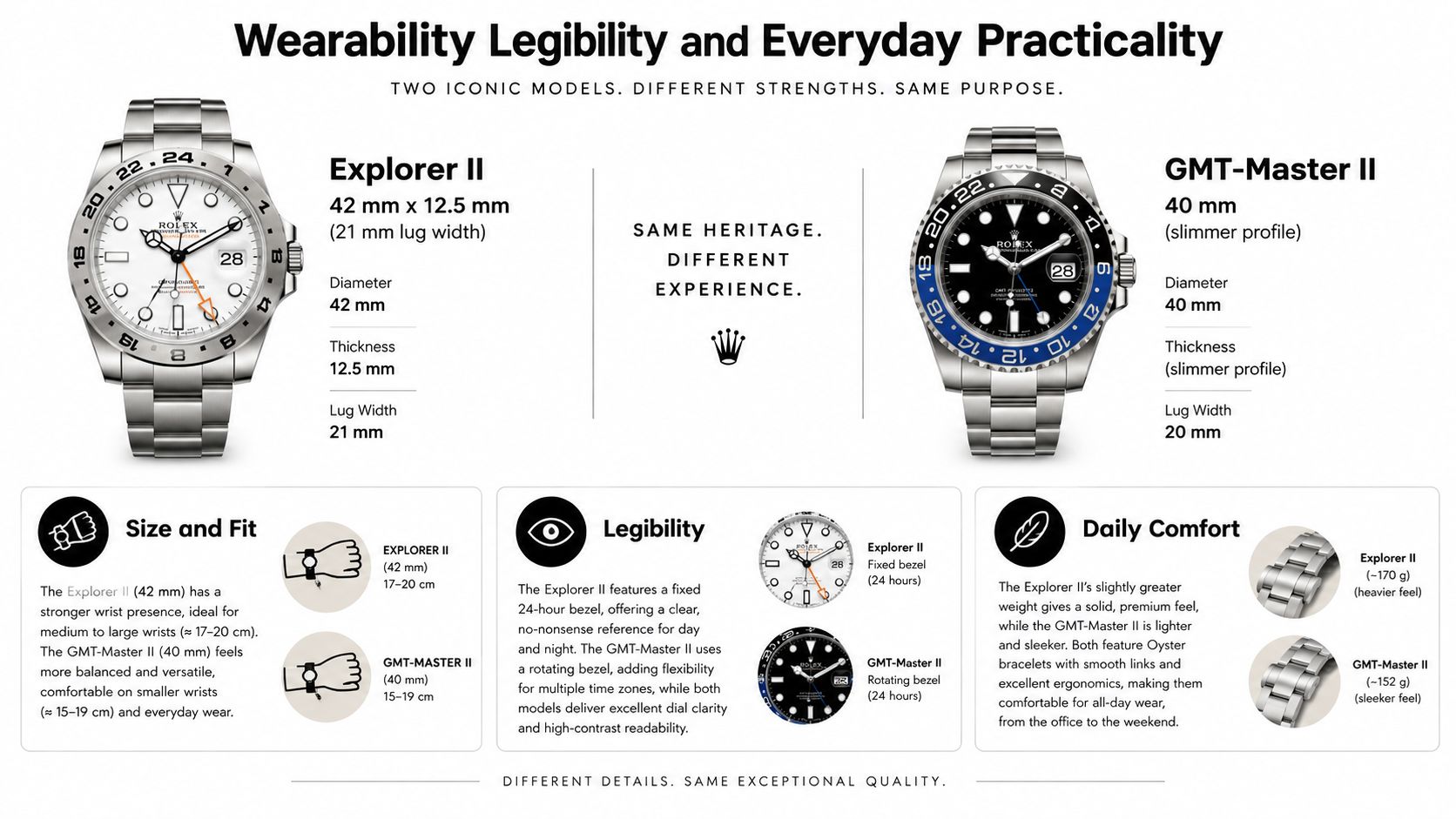
A few millimeters change the whole watch. The Explorer II 226570 measures 42 mm with about 12.5 mm of thickness and 21 mm lugs, while the GMT-Master II stays at 40 mm with 20 mm lugs. On a larger wrist, the Explorer II gives you more dial presence and faster reading in bad light or outdoors. That is the better daily-wear setup for buyers who plan to use the watch. Explorer II buying guide
The GMT-Master II wears smaller and looks more polished. Its 40 mm case and ceramic bezel give it a cleaner profile, so it slips under a cuff more easily and reads like the more refined choice in a suit. The Explorer II carries more tool-watch attitude, and that extra presence is exactly what many serious buyers want. Explorer II vs GMT travel watch
Readability and daily use
Both watches are strong on legibility, but they do it differently. The Explorer II's fixed bezel keeps the dial calmer, so the time jumps out faster, especially on the white Polar dial. The GMT-Master II gives you more visual complexity because the rotating bezel adds another layer around the dial.
The Explorer II also asks less of you in daily life. There is no bezel setting to think about, which makes it easier to grab, wear, and move on. That matters in airports, on trains, and in normal office wear, where a watch should help the day, not add another thing to manage.
The GMT-Master II still wins on status. The Explorer II wins on ease. If you want the cleaner tool watch with stronger wrist comfort and straightforward reading, the Explorer II is the better practical buy. For a closer look at the 42 mm case and how it wears, see the Rolex Explorer II 42 mm overview.
Pricing Resale Value and Cost of Ownership in 2026
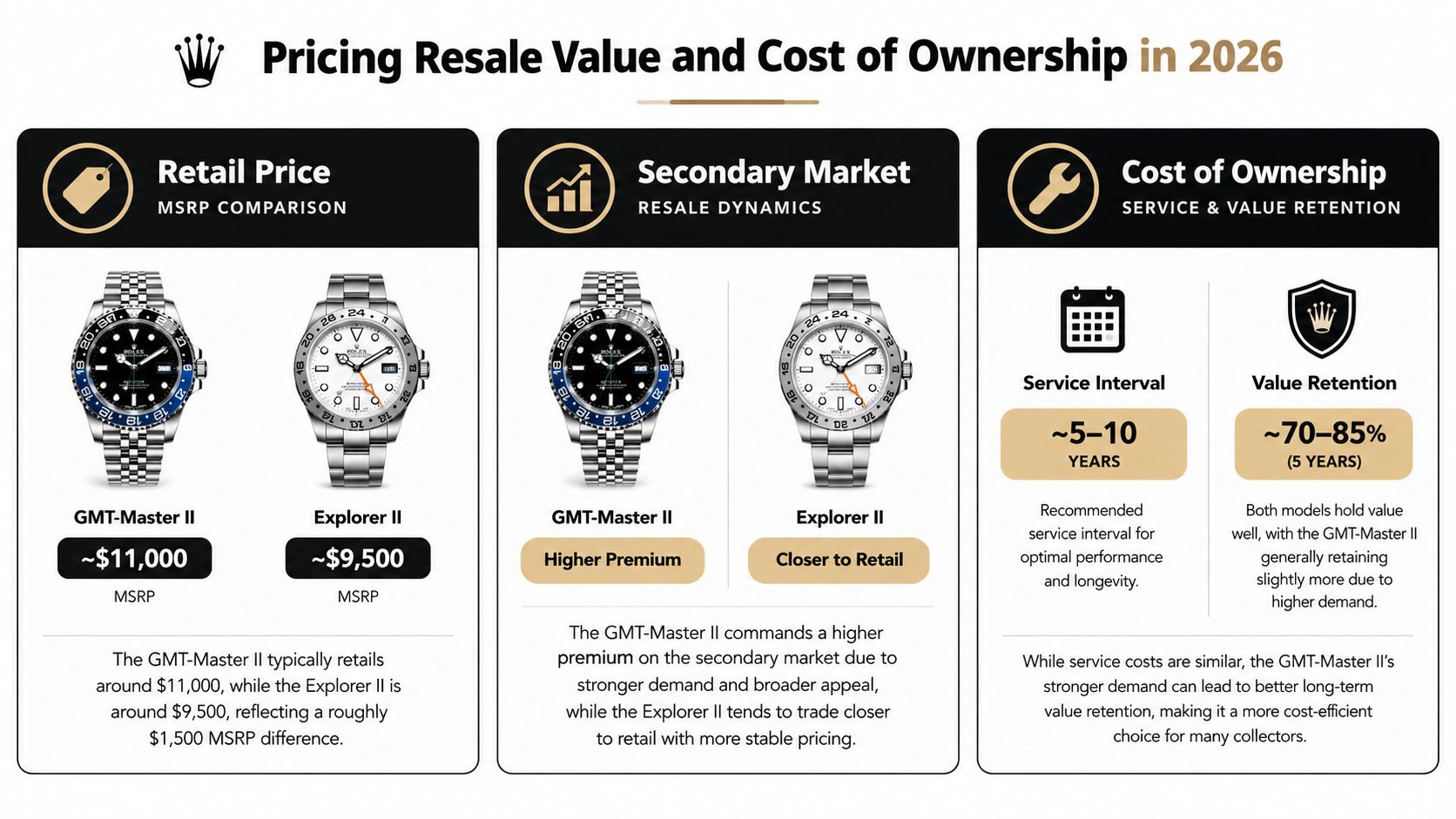
The purchase decision is straightforward in 2026. The GMT-Master II still commands the bigger premium, while the Explorer II sits much closer to a normal ownership curve. In a current market snapshot, the Pepsi ref. 126710BLRO lists around US$31,084 against US$11,300 MSRP, while the Explorer II 226570 sits around US$13,426 against US$8,550 MSRP. If you want the icon, you pay for the icon. If you want a Rolex that still makes financial sense, the Explorer II is the cleaner buy. Rolex market data
That gap matters if you plan to wear the watch. The buyer chasing the Rolex name, liquidity, and collector pull can justify the GMT surcharge. The buyer who wants more money left in the asset and less tied up in hype will usually choose the Explorer II. Current pricing guides show the same pattern, with GMT demand running hotter and Explorer pricing staying more restrained. Rolex price guide
Retail versus secondary market snapshot
Treat these figures as reference points, not fixed quotes. Bracelet, papers, dial, and completeness all move the number.
| Reference | Approx Retail | Approx Secondary |
|---|---|---|
| GMT-Master II Pepsi 126710BLRO | US$11,300 | Around US$31,084 |
| Explorer II 226570 | US$8,550 | Around US$13,426 |
| Steel GMT-Master II market band | About US$11,700 to US$11,900 | Often above US$12,000 and higher by reference |
| Explorer II market band | About US$9,550 to US$10,600 | Often in the US$6,000 to US$14,000 range |
The broader market still favors the GMT family on demand. Rolex transaction data for 2026 shows three GMT references among the eight best-selling Rolex references by transaction volume, with the Pepsi up 24.0% YoY and the Batman up 6.3% YoY. The Explorer side is quieter and less dramatic, which is exactly why disciplined buyers like it. They are not paying for heat they may never recover.
For a clear view of how that premium behaves over time, see our analysis of Rolex resale value in 2026. The same pattern shows up in pre-owned buying. A clean certified pre-owned watch with solid provenance protects value better than a watch bought on excitement alone.
Essential Checklist for Buying Pre Owned With Confidence
A pre-owned Rolex lives or dies on case condition, original parts, and paperwork. One bad polish job or a swapped component can erase value fast, even on a watch this liquid. A certified pre-owned Rolex gives you a cleaner starting point because provenance is already part of the conversation.
- Check the case finishing. You want crisp chamfers, even brushing, and sharp lug transitions. Soft, rounded edges usually mean aggressive polishing.
- Inspect the bezel and crystal. On the GMT, the ceramic insert should look clean and even. On either watch, chips, cracks, or cloudy discoloration are red flags.
- Confirm box, papers, and service records. Matching paperwork and a clean service history support authenticity and resale confidence. Missing documents do not kill the deal, but they should lower the price.
- Test the crown and bezel action. The crown should wind and set smoothly, and the GMT bezel should turn with controlled resistance. On the Explorer II, the fixed bezel should sit perfectly and the date should change cleanly.
If a dealer cannot explain what is original and what is not, walk away. Good steel Rolex buying depends on discipline, not hope. A serious pre-owned buyer should also demand a specialist inspection, not just a sales pitch.
Which Rolex Fits You and How ECI Jewelers Helps You Buy
If you want the watch with the louder name and the stronger status pull, choose the GMT-Master II. If you want the better daily wearer, the Explorer II is the smarter buy. In 2026, with the secondary market normalized, that choice is really about cost of ownership and wrist comfort, not just bezel function.
The GMT-Master II makes sense for frequent flyers, collectors who care about liquidity, and buyers who want the Rolex still chasing. The Explorer II is the better pick if you want a true tool watch, easier fit, lower entry cost, and less pressure to baby it.
If I were standing with you in the Diamond District, I'd be blunt. Buy the GMT-Master II if you want icon status and plan to keep value highly liquid. Buy the Explorer II if you want more steel Rolex for the money and a watch you can wear without second-guessing it.
ECI Jewelers supports both paths with specialist inspection, authenticated inventory, buying, selling, and trading support, a 100% authenticity guarantee, and insured nationwide shipping.


