


When you get down to it, the difference is simple: quartz watches are battery-powered and electronic, while automatic watches are purely mechanical, powered by the motion of your wrist. This single choice between quartz and automatic defines everything about your timepiece, from how it feels on your wrist to its accuracy, maintenance, and soul.
The Power Source That Defines Your Watch
At the heart of every watch is its movement—the intricate engine, or caliber, that keeps time. The distinction between quartz and automatic starts with how they get their power, creating two completely different philosophies of timekeeping.
A quartz movement runs on a battery. This battery sends a tiny electrical current to a small, fork-shaped quartz crystal, making it vibrate at an incredibly precise frequency of 32,768 times per second. An electronic circuit counts these vibrations and generates a single electrical pulse each second, which moves the watch's hands with that familiar "tick."
An automatic movement, on the other hand, is a marvel of traditional micro-engineering with zero electronics. A weighted rotor inside the watch spins with the natural motion of your arm, which winds a mainspring to store mechanical energy. That energy is then released through a complex dance of gears, springs, and levers, all regulated by a delicate balance wheel oscillating back and forth. You can dive deeper into this fascinating process in our guide on how a mechanical watch works.
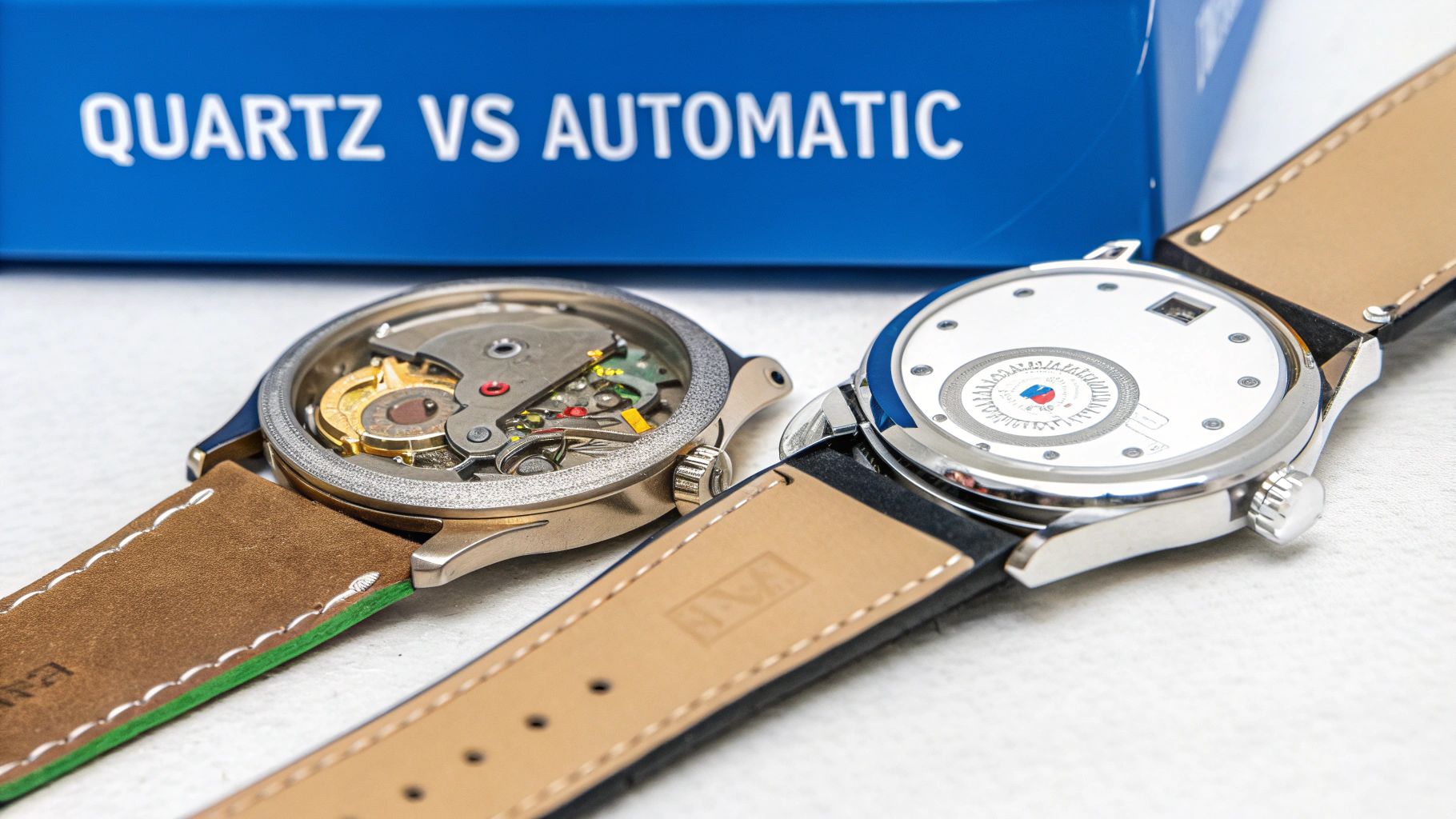
Core Mechanical Differences
This fundamental split in power sources is why quartz movements dominate the market by sheer volume. In fact, a 2023 industry report showed that quartz watches make up 71% of the global market, while mechanical and automatic watches account for the remaining 29%.
While enthusiasts and collectors celebrate the artistry of automatic movements, the undeniable practicality and precision of quartz have made it the world's most common timekeeping engine since the 1970s.
Let's quickly break down the key differences between the two.
Quartz vs Automatic Movement at a Glance
This table gives you a quick, high-level comparison of the two movement types, helping you see the core distinctions at a glance.
| Attribute | Quartz Movement | Automatic Movement |
|---|---|---|
| Power Source | Battery & Electronic Circuit | Kinetic Energy & Mainspring |
| Regulation | Vibrating Quartz Crystal | Oscillating Balance Wheel |
| Second Hand Motion | Staccato "tick" per second | Smooth, sweeping motion |
| Core Principle | Electronic Precision | Mechanical Craftsmanship |
As you can see, one is all about modern efficiency, while the other is rooted in centuries of horological tradition. This choice sets the stage for everything else we'll compare.
Comparing Daily Performance and Precision
Beyond what’s ticking inside, the most telling difference between a quartz and an automatic watch is how each one feels to live with day-to-day. This really comes down to two things: raw accuracy and how well it stands up to the bumps and knocks of daily life. For many people, these practical points are what seal the deal.
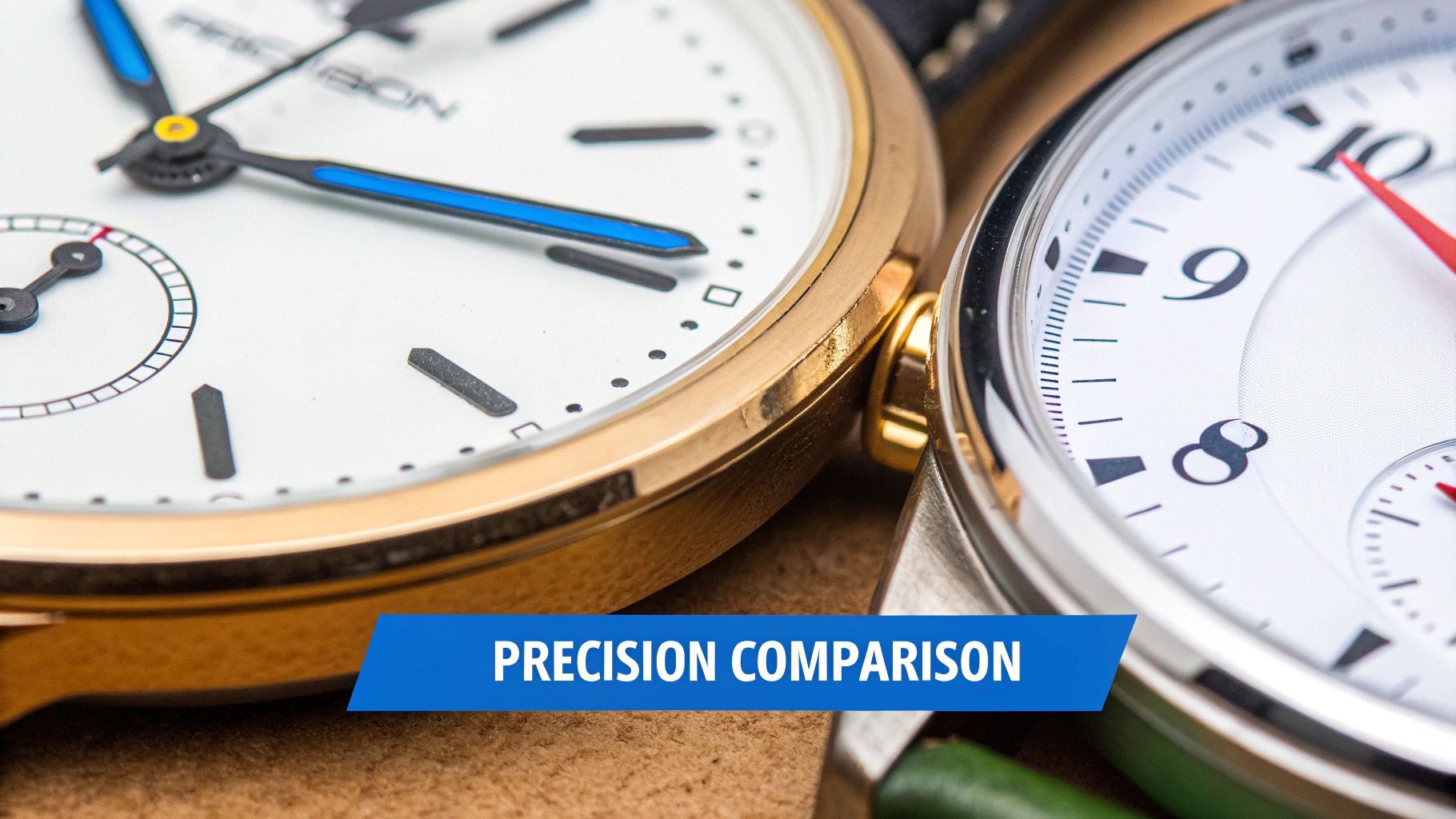
When it comes to pure accuracy, quartz runs away with it. No contest. A standard quartz movement might drift by about ±15 seconds per month. An automatic, on the other hand, is considered excellent if it stays within ±10 to 20 seconds per day.
That means a typical quartz is around 40 to 60 times more precise. The reason is simple physics: a quartz crystal's vibration is incredibly stable, unlike the mechanical balance wheel in an automatic, which is susceptible to gravity, temperature, and motion. If you want to dive deeper, this watch movement comparison on skyrimwrist.com offers a great breakdown.
This level of precision makes a quartz watch the ultimate "set-it-and-forget-it" tool. You’ll probably only adjust it twice a year for daylight saving. An automatic, however, will likely need a quick time correction every week or two to stay perfectly on the mark.
The World of High-Accuracy Quartz
For those who are truly obsessed with precision, High-Accuracy Quartz (HAQ) movements take things to another level entirely. These aren’t your average quartz calibers; they use thermocompensation and other advanced tech to achieve incredible accuracy.
- Grand Seiko 9F Caliber: Famous for its sealed movement and twin-pulse motor, the 9F is rated to an astonishing ±10 seconds per year.
- Longines V.H.P. (Very High Precision): True to its name, this movement boasts an accuracy of ±5 seconds per year, making it one of the most precise watches you can buy.
- Breitling SuperQuartz: All of Breitling's thermocompensated quartz movements are chronometer-certified and are ten times more accurate than their standard counterparts.
These examples prove that quartz isn't just for entry-level watches. It's the foundation for some of the most technologically sophisticated timepieces on the planet.
Daily Durability and Shock Resistance
Durability is another area where the two movement types are fundamentally different. An automatic movement is a tiny, intricate machine with hundreds of moving parts. Its most sensitive component is the balance wheel, a delicate wheel that oscillates constantly. A sharp impact—like dropping your watch on a tile floor—can easily damage this assembly, throwing off its timekeeping or stopping it completely.
A quartz movement, by contrast, is a solid-state device with very few moving parts. Its inherent simplicity makes it far more resistant to shocks and vibrations. This makes it a much more robust choice for sports, travel, and any physically demanding activity.
This isn’t to say automatic watches are fragile. Modern luxury automatics feature sophisticated shock-absorption systems like Incabloc or KIF to protect the balance wheel. But in a head-to-head showdown of quartz movement vs automatic movement for pure, worry-free toughness, the electronic simplicity of quartz wins every time.
Ultimately, the choice comes down to what you value more: the rugged, reliable precision of quartz or the engaging, hands-on ritual of owning a mechanical marvel.
Understanding Long-Term Cost and Maintenance
The sticker price is just the beginning. The real cost of owning a watch reveals itself over years of maintenance, and your choice between a quartz and an automatic movement creates two completely different financial paths. One is defined by predictable, minimal upkeep; the other demands a serious investment to protect its mechanical heart.
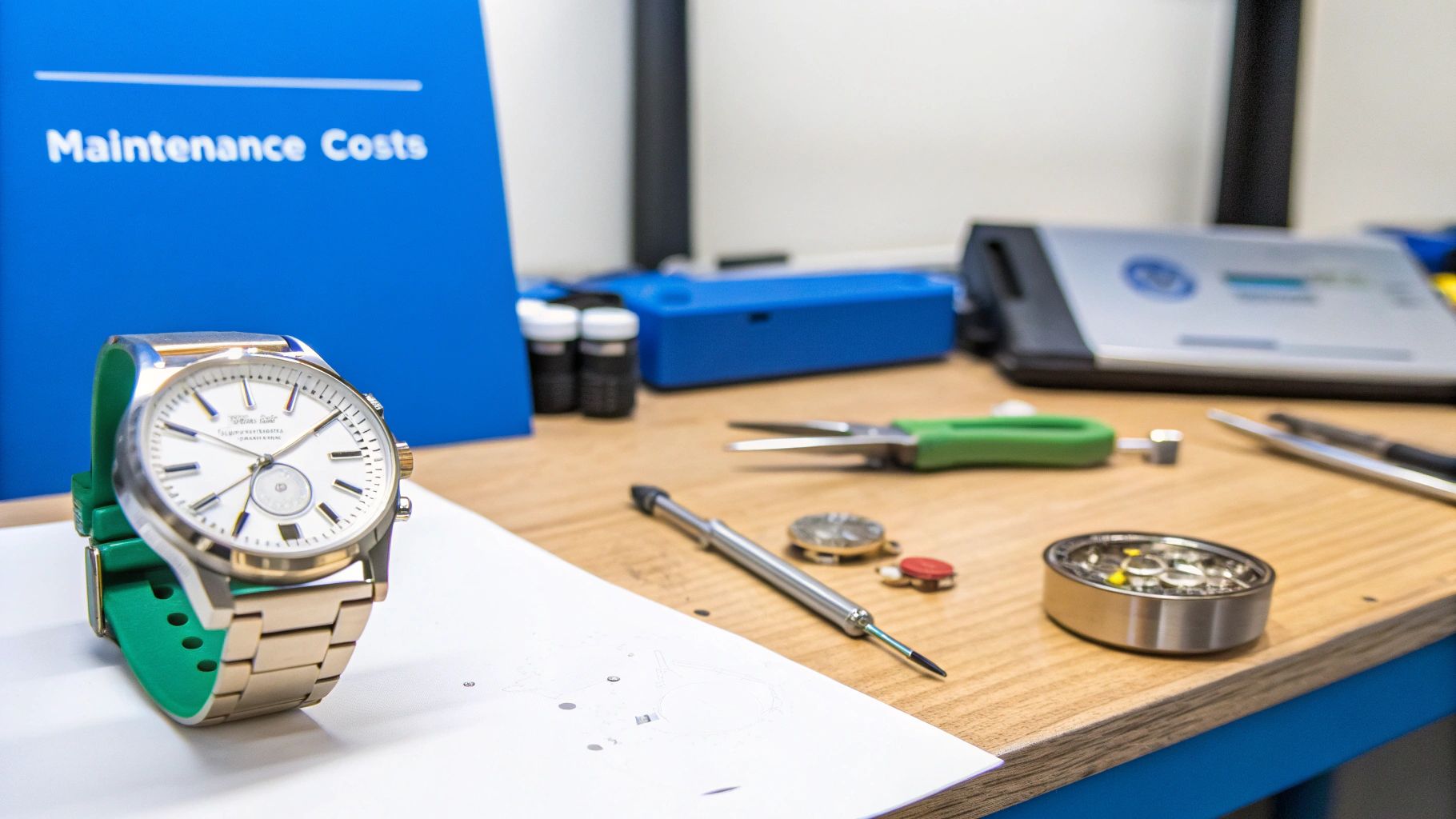
A quartz watch is the definition of low-maintenance luxury. Its main recurring cost is a battery replacement, something you'll only need to think about every 2-5 years. This is a simple, inexpensive job, typically running between $20 to $75, depending on the brand and water resistance seals. For a closer look at what this entails on a high-end piece, our guide to a Rolex battery change offers some great insight.
An automatic watch, however, requires a much deeper level of care. Its complex world of tiny gears and springs needs a full overhaul every 5-7 years to keep it running true and prevent damage from friction and dried oils.
The Cost of Mechanical Artistry
Servicing an automatic movement isn’t like changing a battery—it's a meticulous craft performed by a skilled watchmaker. The entire movement is disassembled, with hundreds of components being cleaned, inspected for wear, and replaced if necessary. It’s then carefully lubricated, reassembled, and regulated for accuracy.
This level of expertise comes at a price. A standard service for a luxury automatic watch can easily cost anywhere from $400 to over $1,000. For more complicated movements like chronographs, the price goes up from there. This isn’t an optional expense; it’s essential for preserving the watch's function and value.
An automatic watch can last a lifetime and be passed down for generations, but only with a commitment to its upkeep. This is the complete opposite of a quartz watch's practical, "set-it-and-forget-it" nature.
Let's break down what this looks like over a couple of decades.
Estimated 20-Year Ownership Cost Scenario
This table gives a rough sketch of the long-term financial commitment for servicing and maintaining each type of movement over twenty years.
| Expense Category | Quartz Movement Estimate | Automatic Movement Estimate |
|---|---|---|
| Recurring Maintenance | Battery changes (approx. 5-8 times) | Full servicing (approx. 3-4 times) |
| Specialized Labor | Minimal; basic technical skill | Requires a certified watchmaker |
| Total Estimated Cost | $100 - $600 | $1,200 - $4,000+ |
As you can see, the debate over quartz movement vs automatic movement goes far beyond the initial price. It's a choice between the affordable convenience of modern technology and the enduring, but costly, tradition of mechanical craftsmanship.
The Soul of the Machine: Craftsmanship and Value
Beyond pure mechanics, the real heart of the quartz vs. automatic debate is about emotional connection. A quartz watch is a marvel of efficiency—a logical, perfect tool for telling time. An automatic watch, however, is something else entirely. It’s an expression of artistry, a direct link to centuries of human ingenuity.
You can literally see this difference in philosophy. The second hand on a quartz watch moves with a distinct, staccato "tick" once per second, driven by an electronic pulse. In contrast, an automatic’s second hand glides in a smooth, continuous sweep, a visual cue that a living, mechanical heart is beating inside.
The Art of Micro-Engineering
For collectors, the obsession with automatic watches is all about the craftsmanship. Flip one over to a display caseback, and you're staring into a miniature city of hundreds of tiny, hand-finished parts—gears, springs, jewels, and rotors—all working in perfect harmony without a battery. This intricate dance is a testament to incredible skill. You can learn more about this mechanical marvel in our guide explaining what an automatic watch is.
Quartz movements are functional and usually hidden away. They’re built for performance, not for admiration. That distinction is key to understanding why one inspires passion while the other commands respect for its sheer practicality.
The choice really boils down to what you value more: the unerring precision of a modern electronic device or the character and soul of a traditional mechanical masterpiece that needs a connection with its owner to keep running.
Long-Term Value and Collectibility
This divide directly influences a watch’s financial journey. Automatic watches from heritage brands like Rolex, Patek Philippe, or Omega are often treated as tangible assets. Their value is deeply tied to brand history, movement complexity, and timeless design. Because of this, many well-maintained automatic timepieces can retain or even appreciate in value.
On the other hand, most quartz watches are viewed like consumer electronics and tend to depreciate after purchase. While there are exceptions—think high-end models like a Grand Seiko 9F or a Breitling SuperQuartz—the general rule holds. Their value is in their function, and as technology moves on, older models are often left behind.
Ultimately, an automatic watch is an investment in craftsmanship and history—a potential heirloom that can be passed down for generations. A quartz watch is an investment in convenience and reliability—a flawless tool for a modern world. The right choice is simply about whether you’re looking for a piece of art or a perfectly efficient instrument.
Which Movement Matches Your Lifestyle?
When you're choosing between a quartz and an automatic movement, you’re not just picking a piece of hardware. You’re making a choice that reflects your daily life, your priorities, and even your personal philosophy. Is it about pure, pragmatic efficiency? Or is it about the romance and tradition of mechanical craftsmanship?
There's no "better" option here—only what's better for you.
This flowchart really gets to the heart of the matter, pitting the practical benefits of quartz against the artistry of automatic movements. It’s the perfect visual for understanding the core of the debate.
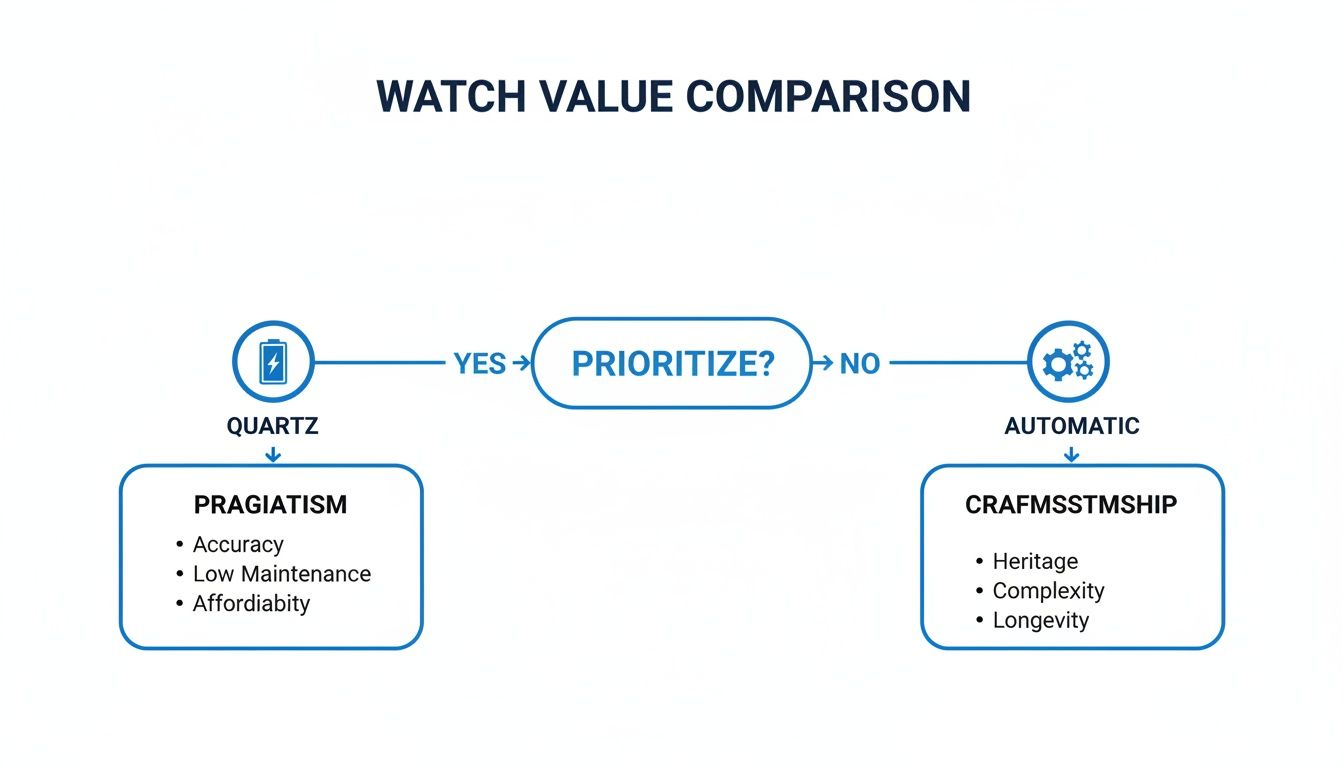
Ultimately, your choice hinges on what you value more: a perfectly reliable tool that just works, or a tiny mechanical engine you get to wear on your wrist.
For The Busy Professional
If your days are a blur of meetings, deadlines, and flights, the last thing you need is another thing to manage. Reliability isn't just a feature; it's a necessity. This is where a quartz watch shines.
It’s the definition of grab-and-go convenience. A quartz watch will be ticking away accurately, ready to go, even if it's been sitting on your dresser for a month. It eliminates that small but annoying task of winding and resetting a watch that’s stopped, ensuring you’re always on time, every time.
For The Adventurer and Athlete
When you’re hitting the trail, the gym, or the slopes, your gear needs to be tough. Durability is non-negotiable. With its solid-state electronics and minimal moving parts, a quartz movement is built to take a beating.
It's simply more shock-resistant than a delicate automatic movement. You get peace of mind knowing that a hard jolt or a sudden drop won't wreck the intricate mechanics inside. For any kind of high-impact or rugged activity, quartz is the smarter, tougher choice.
The decision often comes down to this: Do you want a watch that serves you with flawless, quiet efficiency, or one that you serve as a custodian of its mechanical soul?
For The Watch Aficionado
If you see watches as more than just tools—if you appreciate the history, the artistry, and the incredible complexity of micro-engineering—then the automatic movement is the only way to go. For a true enthusiast, a watch is a piece of wearable art.
That smooth, sweeping second hand, the mesmerizing dance of gears visible through a display caseback, the connection to centuries of horological heritage—these are things a battery can never replicate. Owning an automatic is an experience. It’s a relationship where you actively participate in keeping its mechanical heart beating.
For The Style-Conscious Buyer
Maybe your main goal is finding the perfect accessory to complete an outfit, without making a huge financial or maintenance commitment. Quartz offers unbelievable versatility and value here.
Because the movements are simpler and less expensive to produce, brands can focus on creating an endless variety of fashionable designs at really accessible prices. This lets you build a whole collection of different styles for any occasion, without worrying about the long-term service costs that come with mechanical timepieces.
Real-World Examples: Iconic Quartz and Automatic Watches
Sometimes, the best way to understand the difference between quartz and automatic is to look at the watches themselves. Seeing how top-tier brands execute each movement type really brings the debate to life and gives you a feel for what each camp truly represents.
Forget the idea that quartz is just a budget option. High-end quartz is a world of its own, defined by relentless precision and incredible electronic engineering. These watches prove that battery power can be every bit as luxurious as a mainspring.
The Pinnacle of Quartz Precision
Some of the most respected names in horology have pushed quartz technology to its absolute limits. The results are nothing short of astounding.
- Grand Seiko 9F Series: Often hailed as the holy grail of quartz, Grand Seiko's 9F movements are legendary. They're hermetically sealed, use a twin-pulse motor to move longer, heavier hands, and are rated to an unbelievable ±10 seconds per year. The SBGX261 is a masterclass in this kind of quiet, confident excellence.
- Longines Conquest V.H.P.: The "Very High Precision" line isn't just a name—it's a promise. These watches deliver an accuracy of ±5 seconds per year. They even have a clever system that uses a smart crown and gear position detection to realign the hands after an impact, ensuring they stay dead-on accurate.
- Breitling SuperQuartz: Every quartz watch from Breitling, like the bold Endurance Pro, houses a thermocompensated SuperQuartz movement. This makes them 10 times more accurate than standard quartz and earns them a COSC-chronometer certification, perfectly blending rugged tool-watch aesthetics with professional-grade precision.
While a quartz movement offers flawless accuracy you can set and forget, an automatic movement offers a living, breathing connection to centuries of watchmaking. It's the difference between perfect function and mechanical art.
Icons of Automatic Craftsmanship
On the other side of the aisle are the automatics—celebrated for their complex mechanics, rich history, and the simple magic of a self-winding engine on your wrist. These models aren't just watches; they're institutions.
- Rolex Submariner: Is there a more recognizable watch on the planet? Probably not. The Submariner is the blueprint for the modern dive watch, and its rock-solid, in-house automatic caliber has set the standard for reliability and performance for decades.
- Omega Speedmaster Professional: While the legendary "Moonwatch" is famous for its hand-wound mechanical movement, the broader Speedmaster family includes incredible automatic versions that carry that same spirit of exploration and precision engineering.
- Tudor Black Bay: A modern icon with serious vintage charm. The Black Bay collection pairs throwback design cues with fantastic modern, in-house automatic movements, all from a brand with deep historical ties to Rolex.
Common Questions Answered
Even after comparing the nuts and bolts, you might still have a few practical questions. Let's tackle some of the most common ones we hear from buyers trying to decide between quartz and automatic movements.
Can a Quartz Watch Last as Long as an Automatic?
Absolutely. While a well-serviced automatic can be passed down for generations, don't underestimate a high-quality quartz watch. With proper care and routine battery changes, a premium quartz timepiece can easily last 20-30 years or more. The real determining factor is the quality of the electronic components and the movement's construction, not just the power source.
Is It Bad to Let an Automatic Watch Stop Running?
Not at all. It's completely harmless to let an automatic watch's power reserve wind down. Mechanical movements are built to be stopped and restarted without any risk of damage. That said, keeping the watch wound—either by wearing it or using a watch winder—helps keep the internal lubricants evenly distributed, which is good for its long-term health.
Why Do Luxury Brands Even Make Quartz Watches?
Top-tier brands like Grand Seiko, Breitling, and TAG Heuer produce high-end quartz watches for a simple reason: some clients demand ultimate precision and convenience but refuse to compromise on luxury finishing.
These aren’t your average quartz movements. They are high-accuracy quartz (HAQ) marvels of engineering, offering a level of grab-and-go reliability that no mechanical movement can touch. This appeals to a specific type of luxury buyer who values performance as much as prestige.
These exceptional timepieces are proof that a battery-powered watch can deliver a world-class ownership experience.
Whether you prefer the effortless precision of quartz or the intricate artistry of an automatic, the right timepiece for you is waiting at ECI Jewelers. Explore our curated collection of the world's finest authenticated luxury watches at https://www.ecijewelers.com.


