


The history of Tudor is really the story of a brilliant idea from one of the most famous names in watchmaking: Rolex founder Hans Wilsdorf.He envisioned a watch that offered the same rock-solid dependability as a Rolex but at a price point that was easier on the wallet. Tudor officially hit the scene in 1946, but it was never meant to be a "lesser" brand. It was built from the ground up to be a tough, reliable companion for a much wider audience.
The Vision Behind Tudor: Wilsdorf's Second Brand

To really get Tudor, you have to understand the mind of Hans Wilsdorf. By the 1920s, he had already cemented Rolex as the gold standard for luxury and precision. But he saw a huge gap in the market. There were plenty of people who wanted and needed a highly reliable watch but couldn't quite stretch to a Rolex.
His masterstroke wasn't to dilute the Rolex name. Instead, he decided to create a completely separate brand that could piggyback on Rolex's technical know-how while carving out its own unique path. This wasn't a spur-of-the-moment decision; he first registered the "The Tudor" trademark way back in 1926. The name was a deliberate nod to the English Tudor period, signaling strength, heritage, and staying power.
A Calculated Launch with Rolex's Blessing
It took another two decades for the vision to become a reality. In 1946, Wilsdorf officially established the company "Montres TUDOR S.A." with an incredibly clear mission. He laid it all out in a declaration that is still quoted by watch fans today:
"For some years now, I have been considering the idea of making a watch that our agents could sell at a more modest price than our Rolex watches, and yet one that could attain the standards of dependability for which Rolex is famous. I decided to form a separate company, with the object of making and marketing this new watch. It is called the TUDOR watch company."
This wasn't just marketing fluff; it was the brand's core promise. The goal was never to create a "poor man's Rolex." It was about making top-tier watchmaking accessible. Wilsdorf's strategy was as simple as it was effective: let Tudor use Rolex's proven technology to guarantee its performance right out of the gate.
This family connection gave Tudor a massive head start. Early models were equipped with key Rolex innovations that no competitor could touch, including:
- The Oyster Case: Rolex’s famous waterproof case instantly gave Tudor models serious credibility for their toughness and water resistance.
- The Perpetual Rotor: The self-winding movement, another Rolex signature, made sure Tudor watches were just as convenient and reliable as their more expensive siblings.
By sharing these critical parts, Tudor was born with a legacy of durability. You'll often see vintage Tudor watches with Rolex-signed crowns and case backs. The key difference, and the secret to its accessible pricing, was the movement. Tudor used dependable, off-the-shelf Swiss movements from respected suppliers like ETA. This smart move kept costs down without sacrificing the watch's fundamental reliability. For more on how the brand fits into the watch world, check out this Tudor brand overview.
From day one, Tudor was built to be a workhorse. It was a tool watch, designed for a purpose, not just for show. This practical, performance-first approach laid the foundation for Tudor to grow from Rolex's little brother into a powerhouse watchmaker in its own right, earning respect for its own unique history and an unshakable commitment to quality.
Forging an Identity with the Tudor Oyster Prince
Sharing parts with Rolex gave Tudor an incredible head start on quality, but it also created a huge challenge: how could the brand ever step out of its older sibling’s massive shadow? The answer came in 1952 with the launch of the Tudor Oyster Prince. This wasn't just another watch; it was Tudor's declaration of independence.
The Oyster Prince was the first Tudor to bring together the bulletproof Oyster case and the self-winding Perpetual "rotor" movement. While Rolex invented these technologies, Tudor presented them with a completely fresh, almost defiant energy. Hans Wilsdorf didn't just sell the watch; he set out to prove its toughness in the most public and punishing ways imaginable.
What followed was one of the most brilliant marketing campaigns in watchmaking history. Tudor skipped the typical luxury photo shoots. Instead, it subjected its watches to brutal, real-world torture tests that proved their resilience beyond any doubt.
Proving Its Mettle in the Field
The entire campaign was built around "destruction tests"—real watches on the wrists of people doing grueling jobs. This wasn't a simulation. It was proof.
- Construction Sites: An Oyster Prince was worn by a worker operating a pneumatic drill for months, surviving constant, violent vibrations.
- Motorcycle Racing: A professional racer wore one during the punishing 2,500-kilometer (1,553-mile) Bol d'Or endurance race.
- Coal Mining: Another watch spent 252 hours strapped to the wrist of a miner doing manual excavation deep underground.
After every trial, the watches were shown to be ticking away perfectly. This strategy was genius. It shifted the conversation from "Tudor is a cheaper Rolex" to "Tudor is an unbelievably tough tool watch." The ads were direct, focusing on strength and reliability, building a reputation for toughness that defines Tudor to this day.
This campaign was a masterstroke. It established that Tudor wasn't just guaranteed by Rolex; it was tested by the world's toughest professions. This built a foundation of trust that appealed directly to a new kind of buyer—one who needed a watch that just wouldn't quit.
Expanding Technical Horizons
With its reputation for robustness cemented, Tudor started to get more ambitious. The brand's identity was no longer just about marketing; it was showing up in the watches themselves. Tudor proved it could do more than just simple, time-only pieces, venturing into complications that offered real utility.
A pivotal moment arrived in 1970 with the brand's very first chronograph. The Oysterdate, powered by a manually wound Valjoux 7734 movement, was a huge step forward. It showed Tudor could deliver sophisticated mechanical functions at a price its competitors couldn't match. This single move opened up a whole new product category for the brand, which you can read more about in this overview of Tudor's technical milestones.
The success of the Oyster Prince and the chronographs that followed proved Tudor had finally carved out its own space. It was no longer just the sister brand; it was the go-to for anyone who needed a watch that could perform under pressure—a reputation that would soon lead it into the deep, dark world of professional diving.
Conquering The Depths With The Tudor Submariner
After proving its mettle on land, Tudor turned its attention to a new, unforgiving frontier: the deep sea. The brand's mastery of the waterproof Oyster case was the perfect launching pad for what would become one of the most important chapters in its history. In 1954, just a year after Rolex debuted its own icon, Tudor introduced its first dedicated dive watch—the Oyster Prince Submariner reference 7922.
This wasn't just another watch. The Tudor Submariner was a purpose-built tool for professional divers who needed absolute, life-or-death reliability hundreds of feet below the surface. It shared the core DNA of its Rolex cousin—a tough-as-nails case, a rotating bezel to track elapsed time, and crystal-clear legibility—but it was ready to carve out its own legacy.
The Ultimate Proving Ground: Military Adoption
Tudor’s reputation for building durable, no-nonsense tool watches quickly got the attention of the world's most demanding clients: military forces. In the late 1950s, the French Navy, the Marine Nationale (MN), started issuing Tudor Submariners to its elite combat divers. This partnership became the ultimate field test, pushing the watches to their absolute limits day in and day out.
This collaboration wasn't just a stamp of approval; it directly shaped the watch's evolution. Feedback from MN divers led to one of the most iconic design traits in Tudor's entire history. To really appreciate the engineering behind these watches, it helps to understand the world they were built for; you can get a sense of it when you explore the best scuba diving destinations.
The timeline below shows just how methodically Tudor built its reputation for toughness, laying the groundwork for its acceptance by these elite units.
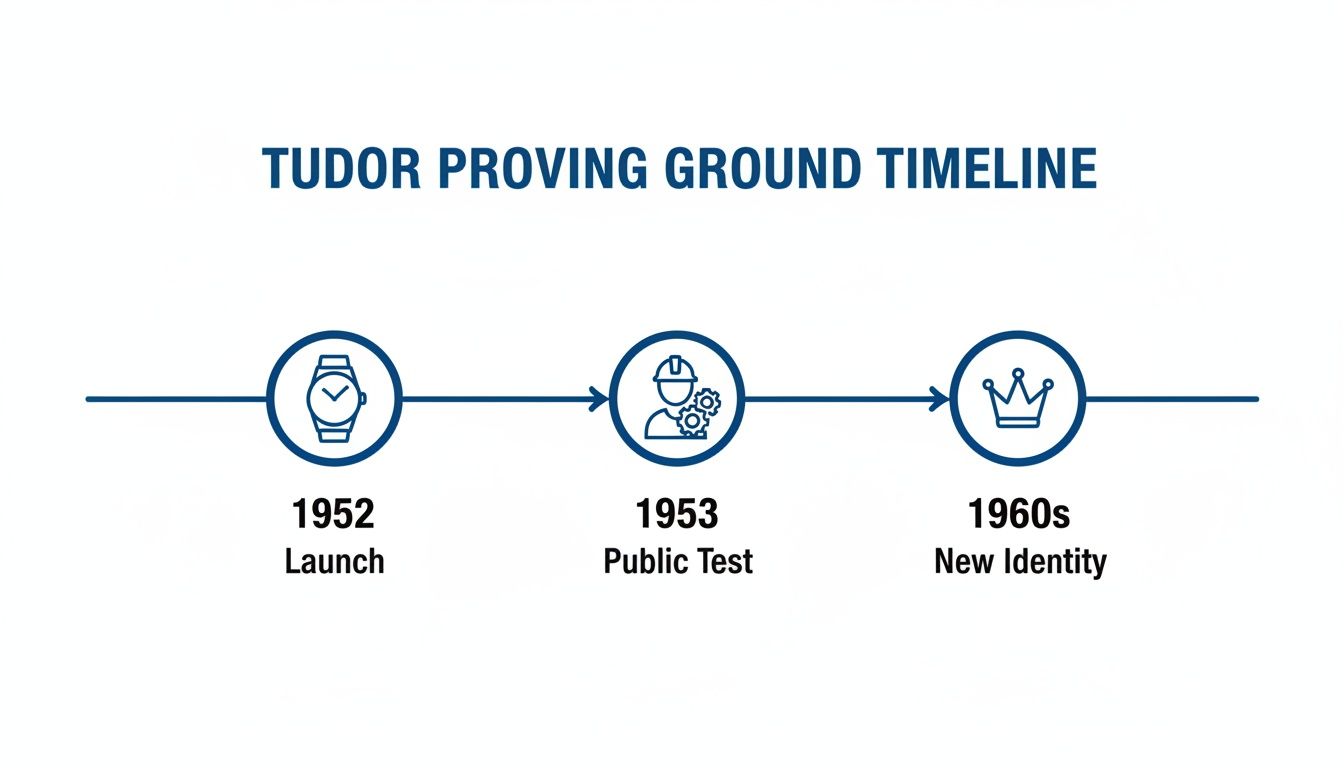
This visual journey shows how Tudor systematically built its reputation for toughness, laying the groundwork for its acceptance by elite military units.
The Birth Of The Iconic Snowflake Hands
In 1969, Tudor made a change that would define its aesthetic for decades. Responding to a specific request from the Marine Nationale for even better underwater legibility, Tudor introduced a new handset on its Submariners. Featuring a distinctive square hour hand and a diamond-tipped seconds hand, the design was quickly nicknamed the "snowflake" by collectors.
The snowflake hands were a perfect example of Tudor’s philosophy: form follows function. What started as a practical solution for military divers became the brand’s most recognizable design signature, a visual link to its rugged past that continues in models like the Black Bay today.
This design wasn't just for the French. Tudor Submariners were also issued to other elite forces, including the US Navy. These military-issued watches, often with "M.N." engravings and issue years, are now grail pieces for collectors, each with a unique story etched into its caseback. If you're curious about the technical specs that made these watches so reliable, our guide on what is a dive watch breaks down the key features.
The evolution of the Tudor Submariner is a story told through a series of references, each adding a new layer to the legend. Below is a look at some of the most significant models that collectors hunt for today.
Key Tudor Submariner References And Innovations
This table provides a chronological overview of the most significant Tudor Submariner models, highlighting their key features and historical importance for collectors.
| Reference | Approx. Year | Key Features | Significance |
|---|---|---|---|
| 7922 | 1954 | "Big Crown" (8mm), gilt dial, pencil hands | The very first Tudor Submariner. Highly collectible and rare. |
| 7923 | 1955 | Manual-wind movement (Felsa 390) | The only manual-wind Tudor Submariner ever made. Extremely rare. |
| 7924 | 1958 | Thicker case, 200m depth rating, 8mm crown | The "Big Crown" Tudor, engineered for greater water resistance. |
| 7928 | 1959 | Crown guards, 200m depth rating | Introduced crown guards for better protection, a defining Submariner trait. |
| 79090 | 1989 | Date window with cyclops, Mercedes hands | The last generation of Tudor Submariners, transitioning to a more modern look. |
| 7016/0 | 1969 | First appearance of "snowflake" hands | A pivotal reference that introduced the iconic hands at the MN's request. |
| 9401/0 | 1975 | Offered with snowflake or Mercedes hands | Provided options, widely issued to military forces like the Marine Nationale. |
These references are more than just model numbers; they are milestones in Tudor's journey. Each one represents a step forward in performance, durability, and design, driven by the real-world needs of the professionals who wore them.
From the early reference 7922 to the snowflake-equipped military models, the Submariner line cemented Tudor's reputation as a maker of premier professional instruments. This rich military heritage is the historical bedrock of Tudor's modern dive watches, ensuring every Black Bay and Pelagos carries a piece of that battle-tested legacy.
The Modern Renaissance and In-House Movements
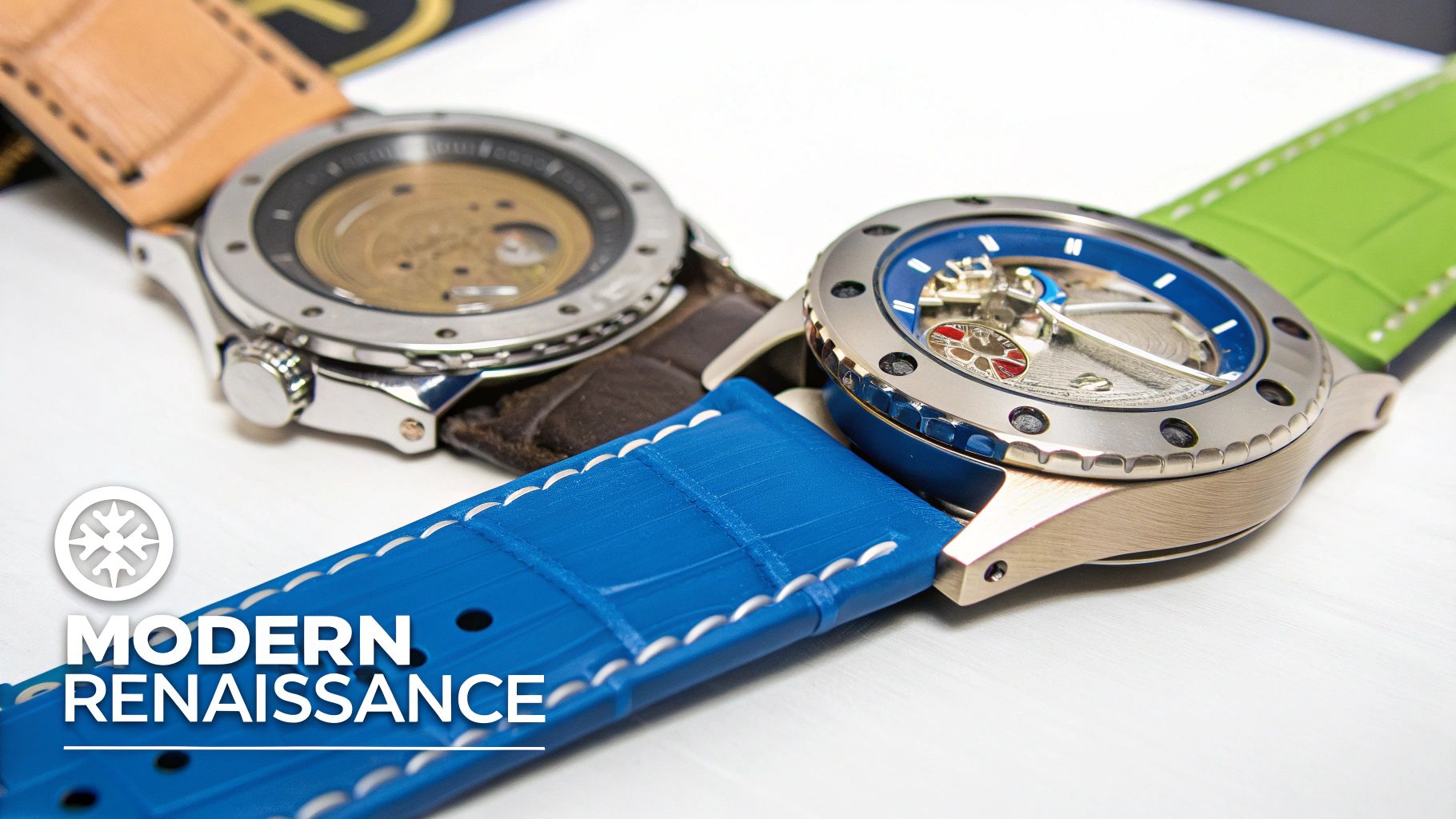
After a relatively quiet period, the 2010s kicked off an explosive return to form for Tudor. Collectors often call this its modern renaissance, and for good reason. The brand dug deep into its archives, pulling its most celebrated designs into the spotlight for a new generation of watch lovers.
This wasn't just about rehashing old ideas. It was a brilliant strategy, blending a vintage soul with truly modern engineering.
The real turning point hit in 2012 with the launch of the Heritage Black Bay. This single watch sent a shockwave through the industry, capturing the imagination of enthusiasts everywhere. It masterfully cherry-picked historical details from Tudor's dive watch lineage and combined them into one cohesive design that felt both timeless and brand new.
The Black Bay wasn't a one-for-one reissue of a specific vintage model. Think of it more as a "greatest hits" album, pulling the best elements from decades of Tudor watch history.
- Snowflake Hands: The unmistakable handset from the late 1960s Submariners was back.
- Big Crown: Its oversized winding crown was a direct tribute to the very first Tudor dive watch from 1954, the reference 7922.
- Dial Details: Gilt accents and a domed crystal gave it the warm, inviting feel of early mid-century pieces.
This watch proved Tudor could honor its past while building something fresh and exciting. It was an instant commercial home run and laid the groundwork for the brand's meteoric rise over the next decade.
Pushing The Boundaries With The Pelagos
While the Black Bay was a love letter to Tudor's heritage, another watch released in 2012 showed off its technical muscle: the Pelagos. If the Black Bay looked to the past, the Pelagos was a clear signal about the future.
This was a no-compromise, professional-grade dive watch. It was built with cutting-edge materials and packed with forward-thinking features that screamed innovation.
The Pelagos was a technical beast. Its case and bracelet were machined from titanium—a lightweight, corrosion-resistant metal that’s notoriously tough to work with. Better yet, it featured a patented, auto-adjusting clasp that lets the bracelet expand and contract with the pressure changes a diver feels at depth.
The Pelagos was a huge step in forging Tudor's modern identity. It was an advanced tool watch that stood entirely on its own, sharing no design DNA with Rolex. This was Tudor flexing its own engineering prowess and stepping out as a confident, independent watchmaker.
The message to the watch world was clear. Tudor was no longer just the "sister brand"; it was a serious competitor capable of producing highly specialized, purpose-built instruments. This momentum paved the way for the single most important move in its modern history.
The Game-Changing Shift To In-House Movements
For most of its life, Tudor used tough, reliable movements from third-party suppliers like ETA. This was a core part of Hans Wilsdorf's original plan: offer Rolex-level quality at a more accessible price. But to truly step out of the shadows and be seen as a top-tier watchmaker, Tudor had to build its own engines.
That moment finally came in 2015. Tudor announced its very first in-house manufacture caliber, the MT5621, which made its debut in the North Flag model. This was a monumental leap.
Developing a proprietary movement is an incredibly expensive and complex process. For a brand to take it on is a massive statement of intent—a commitment to becoming a true, vertically integrated manufacturer.
This wasn't just a technical upgrade; it fundamentally changed the brand's status in the watch world. Ditching ETA movements allowed Tudor to:
- Gain Complete Independence: The brand now controlled every piece of the watchmaking puzzle, from the initial design sketch to the final assembly.
- Enhance Performance: These new movements brought better specs to the table, including a beefy 70-hour power reserve and COSC chronometer certification.
- Elevate Its Prestige: In the world of high horology, an in-house "manufacture" movement is the mark of a "true" watchmaker. It instantly placed Tudor in a higher league.
The introduction of in-house calibers was the final piece of the puzzle. Getting to know the tiny engines inside these watches can really deepen your appreciation for the craft, and you can learn more about how a mechanical watch works to see what makes them tick. This critical step cemented Tudor's transformation, proving it was no longer just a brand with a great past, but a modern horological powerhouse standing firmly on its own.
A Collector's Guide to Navigating the Tudor Market
Getting into Tudor collecting is a fantastic journey through military history and iconic design. Whether you’re chasing a battle-hardened vintage piece or a rock-solid modern classic, understanding the market is everything. It's a field rich with opportunity, but knowing what to look for is the difference between a good buy and a great one.
The real value isn't just the name on the dial. It's the story, the scarcity, and the tiny details that define an era.
Spotlighting Highly Coveted Vintage Grails
For most seasoned collectors, the golden age of Tudor produced some of the most soulful and valuable tool watches ever made. These aren't just timepieces; they're historical artifacts that command serious attention and even more serious prices.
Two categories, in particular, are the undisputed kings of vintage Tudor:
- Military-Issued Submariners: Watches supplied to forces like the French Marine Nationale (MN) are the ultimate prize. Their value is supercharged by their documented history, caseback engravings (like "M.N. 76"), and the honest wear from real-world missions. Finding one with solid provenance is like discovering a missing piece of Tudor watch history.
- "Montecarlo" Homeplate Chronographs: The reference 7031/7032 from the early 1970s is pure legend. Its vibrant, colorful dial—which looks a bit like a casino roulette wheel—was completely radical for its time. Their rarity and audacious design make them one of the most desirable and expensive vintage Tudors out there.
For true enthusiasts, the magic of these vintage pieces is in their imperfections. A faded "ghost" bezel on a Submariner or a perfectly patinated dial isn't damage—it's character. It's proof of a life lived.
Authentication Essentials For Buyers
Once you start hunting in the pre-owned market, authentication becomes your single most important skill. You absolutely have to know how to spot fakes, "Frankenwatches" (watches cobbled together from non-original parts), and over-polished examples. Focusing on a few key areas will protect your investment.
Pay close attention to the serial and model numbers engraved between the lugs. From 1956 to 1984, Tudor used a simple, continuous numerical sequence. Around 1984, the system reset and later switched to alphanumeric formats, like the 'B' prefix that appeared in 1990. Knowing this timeline is a powerful tool for dating a watch correctly. You can learn more about these specific Tudor serial number sequences.
On top of that, always verify these three things:
- Dial Originality: Look for consistent aging, correct fonts, and proper lume application for the specific era. A reprinted dial kills the value of a vintage watch.
- Case Condition: You want to see sharp, thick lugs. Over-polishing smooths out the case's original crisp lines and dramatically reduces its value.
- Movement and Parts: Make sure the movement is correct for the reference number and that parts like the crown and hands are period-appropriate. For example, seeing a Rolex-signed crown is actually correct on many vintage Tudors.
Modern Tudors With Strong Value Retention
The modern Tudor catalog is also packed with fantastic opportunities for collectors. A few models have become instant classics, known for holding their value incredibly well on the secondary market.
The Black Bay 58 is without a doubt the superstar of the modern lineup. Its perfectly proportioned 39mm case and vintage vibe made it a runaway hit. It consistently trades at or very near its retail price, a clear sign of strong, sustained demand.
Likewise, the Pelagos line—especially the FXD models developed with the Marine Nationale—offers incredible bang for your buck. Its hardcore technical specs, titanium build, and military heritage make it a legitimate modern tool watch that enthusiasts absolutely love. Building a collection with modern staples like these is a great way to start, and if you're just getting into the hobby, our guide on how to build a watch collection is a great place to get your bearings.
Your Tudor History Questions, Answered
As you dive into the world of Tudor, a few key questions always come up. It's a brand with a rich story, a famous big brother, and a serious following among collectors. Here are the straight answers to the most common queries we hear from both new fans and longtime enthusiasts.
Is Tudor Owned By Rolex?
Yes, and no. It’s complicated. Tudor was founded in 1946 by none other than Hans Wilsdorf, the genius who also gave us Rolex. To this day, both brands fall under the umbrella of the private Hans Wilsdorf Foundation.
Think of them as siblings who grew up in the same house but have very different personalities. Back in the day, this family tie meant Tudor could use Rolex’s bomb-proof Oyster cases and crowns, giving them instant credibility. Today, however, Tudor is its own brand through and through, with its own design studio, marketing, and in-house movements. The shared origin story is there, but they walk their own path.
What Makes Tudor Watches So Collectible?
It’s not just one thing—it’s the perfect storm of history, design, and ruggedness that makes collectors go crazy for Tudor. You’ve got a unique mix that few other watchmakers can claim.
Here's what really drives the demand:
- The Rolex Connection: Let’s be honest, sharing DNA with Rolex provides a foundation of quality and historical clout that collectors can't ignore.
- Military Grit: Tudor wasn't just a desk diver. These watches were issued to elite military units like the French Navy (Marine Nationale). That kind of real-world provenance is priceless.
- Unmistakable Looks: Those iconic "snowflake" hands and the vibrant "Montecarlo" chronograph dials are pure Tudor. They're design signatures that are instantly recognizable and highly sought after.
- Tool-Watch Soul: At its heart, Tudor has always been about building tough, no-nonsense watches that just work. That purpose-built identity resonates deeply with people who appreciate a watch made to do a job.
This blend elevates Tudor far beyond being a mere "alternative." It's a brand with a celebrated, rugged identity that has more than earned its spot in the collecting hall of fame.
Do Tudor Watches Hold Their Value Well?
Absolutely. Tudor watches are known for excellent value retention, performing near the top of the luxury watch world. While you won't see the wild market speculation that follows certain Rolex models, their value is incredibly stable and strong.
Popular modern watches, like the Black Bay 58 and the Pelagos, often trade at or very near their retail price for years after release. That kind of stability speaks volumes about the brand's solid reputation and the consistent demand from watch lovers.
On top of that, key vintage references and limited editions have seen serious appreciation over the years, making them a smart pickup for collectors with a long-term view.
What Are "Snowflake" Hands?
The "snowflake" hands are probably Tudor's most famous design element. Instantly recognizable, this handset features a square tip on the hour hand and a diamond shape on the seconds hand, making the watch incredibly easy to read at a glance.
They first appeared in 1969 on Tudor Submariner models, starting with the reference 7016. But this wasn't just a funky design choice—it was a functional upgrade requested by the French Navy. They needed better underwater legibility for their divers. What started as a military-spec solution quickly became a beloved symbol of Tudor's dive watch legacy.
Whether you're starting your collection or hunting for that rare vintage piece, ECI Jewelers offers authenticated timepieces with the expert guidance you need. Explore our curated selection of Tudor and other fine watches at ECI Jewelers.


