

Upgrading your engagement ring diamond is a beautiful way to mark a new chapter in your life, celebrate how far you've come, or simply get a ring that truly reflects your style today. An upgrade doesn't replace the original memory; it enhances it, making the ring an even truer symbol of your journey together.
Why Upgrading Your Engagement Ring Diamond Is a Great Idea
An engagement ring is so much more than jewelry. It's a promise, a memory, a snapshot of a moment in time. But as your relationship grows and your life changes, it’s only natural for your tastes and circumstances to evolve, too.
Think of it less as replacing a cherished memory and more like adding a brilliant new chapter to your love story. Your original ring laid the foundation. An upgrade celebrates the incredible life you've built on top of it, honoring your past while celebrating your present and future.
Common Reasons for an Upgrade
Couples come to us for an upgrade for countless personal and meaningful reasons. It's almost never a spontaneous choice but one that reflects a significant milestone or a shift in their lives.
Here's a look at some of the primary reasons couples choose to upgrade their engagement ring, helping you see where your own story fits in.
Common Motivations for a Diamond Upgrade
| Milestone or Reason | Common Scenario Example | What the Upgrade Achieves |
|---|---|---|
| Celebrating a Milestone | A 10, 15, or 25-year anniversary is approaching, and you want to commemorate the journey. | Marks a significant passage of time with a stone that reflects the strength and brilliance of the marriage. |
| Improved Financial Stability | You're in a much better financial place now than when you first got engaged. | Allows you to finally get the dream diamond you couldn't afford back then, without financial strain. |
| Evolving Personal Style | The simple solitaire that felt right in your twenties no longer matches your current aesthetic. | Updates the ring to a style—like a modern oval or a glamorous halo setting—that feels more "you" today. |
| Desire for More Presence | The original diamond feels too small, or you've always wished for better sparkle and clarity. | Fulfills the simple, straightforward desire for a larger, more brilliant, or higher-quality centerpiece. |
Ultimately, the reason is always personal. It’s about making sure the symbol on your finger feels just as vibrant and full of life as your relationship does today.
The Rise of Lab-Grown Diamonds
One of the biggest game-changers making diamond upgrades more accessible is the incredible quality and value of lab-grown diamonds. These stones are chemically, physically, and optically identical to their mined counterparts but come at a significantly lower cost.
The lab-grown market has exploded into a $12.8 billion global industry, now making up 31% of all diamond engagement ring sales in the U.S.
The savings are staggering. For example, a 1-carat natural diamond might run you about $3,900, while a lab-grown version with the same specs is closer to $850—a potential savings of up to 90%. This price difference empowers couples to upgrade to impressive sizes, often over 2 carats, that would have been out of reach just a few years ago. You can explore more about these market dynamics to see just how much this trend has reshaped the industry.
How to Assess Your Current Ring and Its Value
Before you start dreaming about a bigger, brighter diamond, the first practical step is to figure out exactly what you have now. Getting a clear, objective look at your existing engagement ring builds the foundation for your entire upgrade journey. It tells you your starting point, helps shape your budget, and sets realistic expectations for what it's worth.
This part of the process is a bit like detective work. Your mission is to round up all the official paperwork that came with the ring. This isn't just a sales receipt—it’s the birth certificate for your diamond, detailing its identity and quality.
Gather Your Original Paperwork
The single most important document you can find is the diamond's grading report, which most people call a certificate. This report, usually from a respected gemological lab like GIA (Gemological Institute of America) or IGI (International Gemological Institute), is your diamond's official blueprint.
It breaks down the critical stats that determine its value:
- Carat Weight: The precise weight of the diamond, measured to the hundredth of a carat.
- Color Grade: Where it falls on the D-to-Z color scale, which measures how colorless it is.
- Clarity Grade: A rating from Flawless (FL) to Included (I3), based on tiny internal and external marks.
- Cut Grade: How well the diamond’s facets are angled to reflect light—this is what creates its sparkle.
Finding this certificate is a huge win. It gives any jeweler a universally accepted baseline for evaluating your stone. If you can’t find it, don't panic. A professional can recreate this data for you.
Get a Professional Appraisal
Whether you have the original paperwork or not, your next move should be a professional appraisal. This is different from the grading report. An appraiser assigns a current monetary value to the entire ring, looking at the diamond's qualities plus the setting's metal and any smaller accent stones.
It’s important to find a qualified, independent appraiser. Look for someone with credentials from organizations like the National Association of Jewelry Appraisers (NAJA) or the American Society of Appraisers (ASA). Their job is to give you an unbiased valuation based on today's market, not what you paid years ago. For a deeper dive into this process, especially for older pieces, check out this practical guide to valuing antique jewellery.
An appraisal does two key things in an upgrade. First, it gives you an updated replacement value for your insurance policy. Second, and more importantly for your upgrade, it establishes the fair market value—the number a jeweler will likely use to calculate your trade-in credit.
Understanding Trade-In Value vs. Retail Price
This is where managing expectations is key. The trade-in value you’ll be offered will almost always be lower than the original retail price or the current insurance appraisal value. This doesn't mean you're getting a bad deal; it's just how the jewelry business works.
Think of it like trading in a car. The dealership has to account for its own costs and profit before reselling it. A jeweler is no different. They have to factor in the cost to inspect, polish, and remarket your diamond before it can be sold again.
For example, a ring originally purchased for $5,000 might have an insurance appraisal of $6,000, but a realistic trade-in offer could be in the $2,500 - $3,500 range. This value depends heavily on how desirable your diamond is in the current market. A high-quality, 1-carat round brilliant will always fetch a stronger trade-in offer than a marquise cut with lower clarity, even if they're the same size.
By arming yourself with the original certificate and a fresh appraisal, you can walk into any upgrade conversation with confidence. You’ll know exactly what you’re bringing to the table, which empowers you to make the best possible decision for your new ring.
Navigating Your Diamond Upgrade Options
Once you know what your current ring is worth, the fun part begins: exploring where to find its replacement. The world of fine jewelry has changed dramatically, giving you more ways than ever to find the perfect new diamond. Your main choices boil down to the classic brick-and-mortar jeweler or a modern online retailer.
Each route offers a totally different experience, with its own pros and cons. The right choice really depends on what you value most—seeing a diamond in person, getting the absolute most for your budget, or having a massive selection to choose from.
The Traditional Jeweler Experience
There’s something special about visiting a local jewelry store. You get a hands-on, personal experience that a lot of people still prefer. It’s a chance to speak directly with an expert, hold the diamonds, and try on different settings to see how they actually look and feel on your hand.
That tactile interaction can be really comforting, especially for a purchase this important. Plus, building a relationship with a local jeweler is great for future cleanings, repairs, and appraisals. The trade-off? This personalized service comes with higher overhead costs—rent, staff, inventory—which often gets baked into their prices. Their selection can also be limited to what they have in stock.
The Power of Upgrading Online
Online jewelers have completely changed the game for diamond upgrades. Because they operate with lower overhead, they can offer much more competitive pricing for diamonds of the same quality. We're seeing a huge shift online, with some retailers offering 30-40% lower prices than traditional stores.
In a U.S. jewelry market valued at $78 billion, where Americans spend an average of $240 per person annually, going online means you can get significantly more diamond for your money. You can find more details on these engagement ring market trends if you're curious.
Beyond just the price, the sheer volume of inventory online is a massive advantage. You can browse thousands of diamonds from suppliers all over the world, filtering down to the exact specs you want. This makes it far easier to find a stone that perfectly nails your dream carat weight, cut, color, and clarity.
Key Takeaway: Online jewelers often deliver better value and a much bigger selection because their costs are lower. This lets you secure a larger or higher-quality diamond within the same budget you'd have at a physical store.
The Ethical Dimension: Natural vs. Lab-Grown
A huge consideration in today's upgrade market is the choice between a natural, mined diamond and a lab-grown one. This decision is a mix of budget, ethics, and what feels right to you personally.
- Natural Diamonds are the classic choice, formed over billions of years deep inside the Earth. They have a timeless legacy and are seen by many as a rare, natural treasure.
- Lab-Grown Diamonds are identical to natural diamonds—physically, chemically, and optically. They are created in controlled environments, which means they have a traceable origin and often a much smaller price tag.
We see many couples trading in their original, smaller mined diamond for a significantly larger, ethically sourced lab-grown stone. It's a popular way to get that "wow" factor while aligning with modern values like sustainability. Understanding the finer points is key, and you can learn more in our complete guide to diamond clarity and color.
How to Choose a Reputable Jeweler
Whether you go online or local, doing your homework is non-negotiable. A diamond upgrade is a major investment, and you need to work with a jeweler you can absolutely trust.
Start by looking for a solid history of positive, verifiable customer reviews on independent sites like Google or Trustpilot. A good jeweler will have a transparent upgrade policy and will happily explain how they determine your trade-in value. Most importantly, they should only offer diamonds certified by respected labs like GIA or IGI—this third-party verification is your guarantee of quality.
Ultimately, a trustworthy jeweler acts as your partner. They should listen to your goals, respect your budget, and guide you with genuine expertise, not high-pressure sales tactics. At ECI Jewelers, we blend the best of both worlds, offering an in-person concierge experience at our New York showroom alongside the incredible value and selection of an online retailer.
Choosing Your New Diamond and Setting
Now for the fun part. You've figured out your current ring's value and your trade-in options, so it's time to bring your vision to life by picking the perfect new diamond and deciding what to do with the setting. This is where your personal style meets practical expertise.
The first big choice is the diamond itself. The great thing about upgrading is that you're not starting from a blank slate. You already know what you loved about your first diamond and, just as importantly, what you’d like to improve.
Revisiting the 4 Cs for an Upgrade
You probably remember the 4 Cs—Cut, Color, Clarity, and Carat—but looking at them as an upgrader is a totally different ballgame. The goal now is to get the biggest visual impact for your budget.
- Cut Is King: Seriously. If you want that jaw-dropping sparkle, prioritize the Cut grade over everything else. An "Excellent" or "Ideal" cut diamond can look bigger and more brilliant, often hiding minor inclusions or a slightly lower color grade.
- Carat and Color: For most people, upgrading means going bigger (Carat). To make that happen without breaking the bank, look at diamonds in the "Near Colorless" range (G-H). To the naked eye, they look perfectly white, but they're much more affordable than D-E-F grade stones.
- Clarity's Sweet Spot: You want a diamond that's "eye-clean," which just means you can't see any flaws without a jeweler's loupe. Grades like VS1, VS2, or a carefully selected SI1 usually offer the best bang for your buck. This lets you put more money toward a better cut or a larger stone. Our comprehensive guide to buying engagement rings dives much deeper into how to balance these factors perfectly.
The Great Debate: Natural vs. Lab-Grown Diamonds
Today, one of the biggest decisions is whether to go with a natural or a lab-grown diamond. They are identical in every physical and chemical way, but their origins and price tags are worlds apart—and that has a huge impact on your upgrade.
Values have shifted, and ethical sourcing is a major factor now. In fact, 78% of U.S. consumers are now demanding ethically sourced gems. This change in mindset is clear when you see that 52% of new engagement rings in the U.S. now feature lab-grown diamonds, a massive jump from just 12% five years ago.
Trading a mined diamond for a lab-grown one can mean 80-90% savings, which often makes that dream of a 2+ carat diamond a reality.
Natural vs. Lab-Grown Diamond Comparison for an Upgrade
Here's a head-to-head look at the key factors to help you decide which diamond type best fits your goals, budget, and values.
| Consideration | Natural Diamond | Lab-Grown Diamond |
|---|---|---|
| Origin | Formed over billions of years in the Earth's mantle and mined. | Grown in a controlled laboratory environment in a matter of weeks. |
| Cost | Significantly higher due to rarity and mining costs. | Typically 80-90% less expensive for the same quality and size. |
| Value | Historically holds long-term resale value, though this can fluctuate. | Lower resale value, but offers incredible upfront savings. |
| Appearance | Optically, physically, and chemically identical to a lab-grown diamond. | Optically, physically, and chemically identical to a natural diamond. |
| Ethical Sourcing | Can be conflict-free (e.g., Kimberley Process), but mining has an environmental impact. | Generally considered more sustainable with a smaller environmental footprint. |
Ultimately, choosing a lab-grown diamond is a popular and very smart way to maximize your upgrade budget, allowing you to get a much larger and higher-quality stone than you could with a natural diamond for the same price.
To help you see how your upgrade journey might look, here’s a simple flowchart mapping out the key decisions.
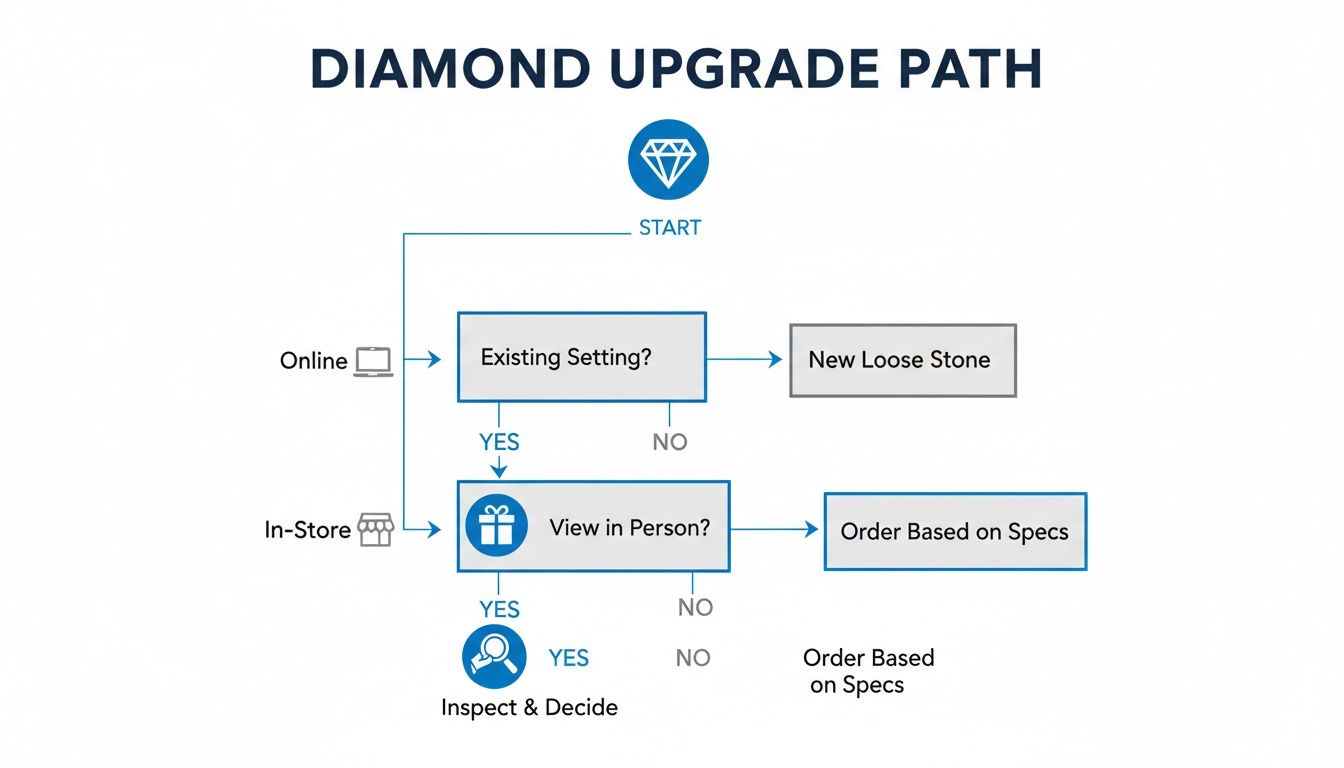
As you can see, whether you start online or in our showroom, you'll decide whether to use your existing setting or design something new from scratch.
To Keep, Modify, or Replace Your Setting
Once your new center stone is picked out, it's time to decide where it will live. You've got three solid options.
- Keep the Original Setting: If you still adore your ring's design and your new diamond is a similar size and shape, this is a fantastic choice. A jeweler can easily and securely set the new stone right into the existing head.
- Modify the Existing Setting: Got your heart set on a much larger diamond? A skilled jeweler can often modify the head (the prongs holding the stone) to fit it. This is a great way to preserve the sentimental value of the original ring while giving your new diamond the spotlight it deserves.
- Choose a Completely New Setting: This is your chance for a total refresh. You get complete creative freedom to change the metal—maybe upgrading from yellow gold to platinum—or switch up the entire style. Think moving from a classic solitaire to a flashy halo setting to add even more sparkle.
No matter which path you take, the final step is getting the diamond professionally mounted. This is delicate work that should only be trusted to an experienced jeweler. They’ll set the stone perfectly, making sure the prongs are tight and aligned to maximize both the diamond's security and its brilliance. This is the moment it all comes together—a beautiful fusion of your past, present, and future in one stunning ring.
Budgeting and Finalizing Your Upgrade
Once you've found the perfect new diamond, the next step is mapping out the finances. A dream upgrade deserves a smart financial plan, and creating a clear budget is the key to bringing your vision to life without any stress or surprises.
Most people focus on the price of the new stone, but a successful upgrade involves a few other costs. Knowing what they are from the start ensures your final invoice matches your expectations perfectly.
Mapping Out the Total Cost
So, what goes into the final number? Your total investment is more than just the diamond itself. A realistic budget accounts for every piece of the puzzle so there are no last-minute financial hurdles.
Here are the key expenses to plan for:
- The New Diamond: This is obviously the largest expense. The final cost here depends on its size, quality, and whether you chose a natural or lab-grown stone.
- Setting Modifications or a New Setting: If you're using your original ring, you'll need to budget for the jeweler's labor to modify the setting for the new stone. If you're getting a whole new setting, that will be its own line item.
- Labor and Mounting Fees: A professional jeweler charges a fee for the highly skilled work of securely setting your new diamond. This isn't just a fee; it's a service that protects your investment for a lifetime.
- Final Appraisal: After the ring is finished, you’ll need a new appraisal reflecting its higher value. This document is absolutely essential for updating your insurance policy.
Taking a comprehensive approach like this prevents any surprises when it's time to pay. For more on this, check out our guide on how much you should spend on an engagement ring, which has great advice that applies to upgrades, too.
Understanding Financing Options
Many of our clients use financing to make their dream ring more accessible. These plans allow you to spread the cost over time, often with promotional interest rates like 0% APR for 12 months. It's a popular way to manage a significant purchase without tapping into your savings all at once.
When you're looking at financing, the most important things are clear terms and transparency. We'll always walk you through the interest rates, payment schedule, and any promotional periods. Always take a moment to understand what happens if the balance isn’t paid off within that promo window.
Pro Tip: Before you commit to a financing plan, quickly calculate the total cost with interest (if any applies). Making sure that final number still fits comfortably in your long-term budget ensures your beautiful new ring remains a source of joy, not financial stress.
Finalizing the Logistics and Timeline
With your budget and financing handled, it’s time for the exciting part—making it happen! This is where your vision becomes a reality, and good communication with your jeweler is everything.
Here’s how the process usually unfolds:
- Submit Your Original Ring: You'll bring your current ring to us so the work can begin. We’ll provide a detailed receipt describing the ring for your records.
- Approve the Final Design: If you're going with a custom setting or making big changes, you'll review and approve a final design rendering (like a CAD drawing) before we touch any metal.
- Understand the Timeline: We'll give you an estimated completion date. This can be anywhere from a few days to several weeks, depending on how complex the job is.
Once you give the final sign-off, our master jewelers get to work. They’ll carefully remove your old stone and expertly mount the new one, making sure it’s secure, perfectly aligned, and ready to shine.
The Most Important Final Step: Insurance
Your upgraded ring is complete, sparkling, and more valuable than ever. Before you even walk out the door, there is one last critical task: update your insurance policy. This is non-negotiable.
Contact your insurance provider right away with the new appraisal document. They will adjust your policy to reflect the ring's new, higher replacement value. If you skip this step, you'd only be covered for the original, lower value in the event of loss, theft, or damage.
Protecting your new investment gives you invaluable peace of mind. With that updated policy in place, you can finally wear your stunning new engagement ring with absolute confidence and joy.
Common Questions About Upgrading a Diamond
Even with a clear plan, it's natural to have a few questions pop up. An engagement ring upgrade is a big deal—it’s an emotional decision just as much as a financial one. We get these questions all the time, so we've answered the most common ones our clients ask to help you move forward with confidence.
These are the practical details that really matter once you start getting serious about the process.
How Long Does a Diamond Upgrade Take?
The timeline really depends on what you have in mind. A simple swap—placing a new diamond of a similar size into your current setting—is quick. That can often be done in just a few business days.
But if you're going for a major change, it'll take longer. Modifying the setting to hold a much larger stone or creating a brand-new custom ring is a more detailed process. You should plan for anywhere from two to six weeks. This gives our team the time for CAD design, casting the new setting, and carefully hand-setting your new diamond.
We always recommend getting a clear timeline upfront. A good jeweler will give you an estimated completion date and keep you in the loop, so you know exactly when your new ring will be ready.
Can I Trade a Mined Diamond for a Lab-Grown Diamond?
Absolutely. This is one of the most popular upgrade paths we see today, and for good reason. Many of our clients trade in their smaller, natural diamond for a much larger and higher-quality lab-grown stone. The value you get with lab-grown diamonds is incredible, allowing for a huge visual impact without a huge budget increase.
For instance, the trade-in value from a 1-carat natural diamond could easily cover most, or even all, of the cost of a breathtaking 2-carat lab-grown diamond. You get a show-stopping ring without compromising on quality, since lab and mined diamonds are visually and chemically identical.
Will I Get the Full Purchase Price for My Trade-In?
This is probably the most important question for setting realistic expectations. The short answer is no, you won't get back the original retail price. The value a jeweler offers is based on the current wholesale market price of your diamond, not what was paid for it years ago.
Think of it like trading in a car. The original price included the dealership's markup for their business costs. Similarly, the original jewelry price included things like rent, marketing, and staff. Your trade-in value reflects what the diamond itself is worth on the market today. Typically, you can expect an offer between 50% and 75% of the original purchase price, depending on the diamond's quality and current demand.
Do I Have to Upgrade with the Original Jeweler?
Not at all. You’re free to work with any expert you trust. While some stores have "upgrade policies" that lock you into buying from them again, that’s not a universal rule.
The most important thing is finding a jeweler who gives you a fair, transparent valuation and has the skill to bring your vision to life. It's smart to shop around to compare trade-in offers and find a partner who understands your style and budget. Here at ECI Jewelers, we happily accept trade-ins from anywhere, because our focus is on giving you a competitive value and an amazing upgrade experience.
Ready to see what's possible for your engagement ring? At ECI Jewelers, our experts provide transparent, market-based valuations and a personalized concierge experience to guide you through every step of your diamond upgrade. Start your upgrade journey with a free, no-obligation valuation today.


