


So, you're looking to figure out what your Rolex is worth. It's a question with a lot of moving parts, but it really boils down to three core things: the specific model, its current condition, and whether you have the original "box and papers."
Together, these pieces tell the full story of your watch and are the biggest drivers of its price on the open market.
Your Starting Point for Rolex Valuation
To get a realistic value for your Rolex, you need to step into the mindset of a serious collector. It's not just about the iconic crown logo; it’s about the nitty-gritty details that make your specific watch either common or incredibly sought-after.
This process is less about finding one single "correct" price and more about establishing an accurate range. You also need to be clear on your goal. Are you after the market value—what a buyer would realistically pay for it today? Or are you looking for its insurance value, which is the full replacement cost if it were lost or stolen? The numbers can be quite different.
Key Valuation Pillars
Before you get the loupe out and start inspecting for tiny scratches, let's cover the foundational concepts that underpin any Rolex appraisal.
- Model and Reference Number: This is your watch's DNA. A rare reference, like a vintage "Paul Newman" Daytona, can be worth a fortune compared to a more common Datejust model. It's the first thing any expert will ask for.
- Physical Condition: Scratches, dings, and especially a case that has been over-polished can seriously hurt the value. On the flip side, an even, attractive patina on a vintage piece can actually make it more desirable to collectors.
- Provenance and Documentation: This is huge. Having the original box, warranty card, receipts, and service records (known as a "full set") is your proof of authenticity. This alone can boost a watch's value by 20% or more.
This infographic breaks down how these pillars work together, starting with identifying the model and moving through the hands-on assessment of its condition and paperwork.
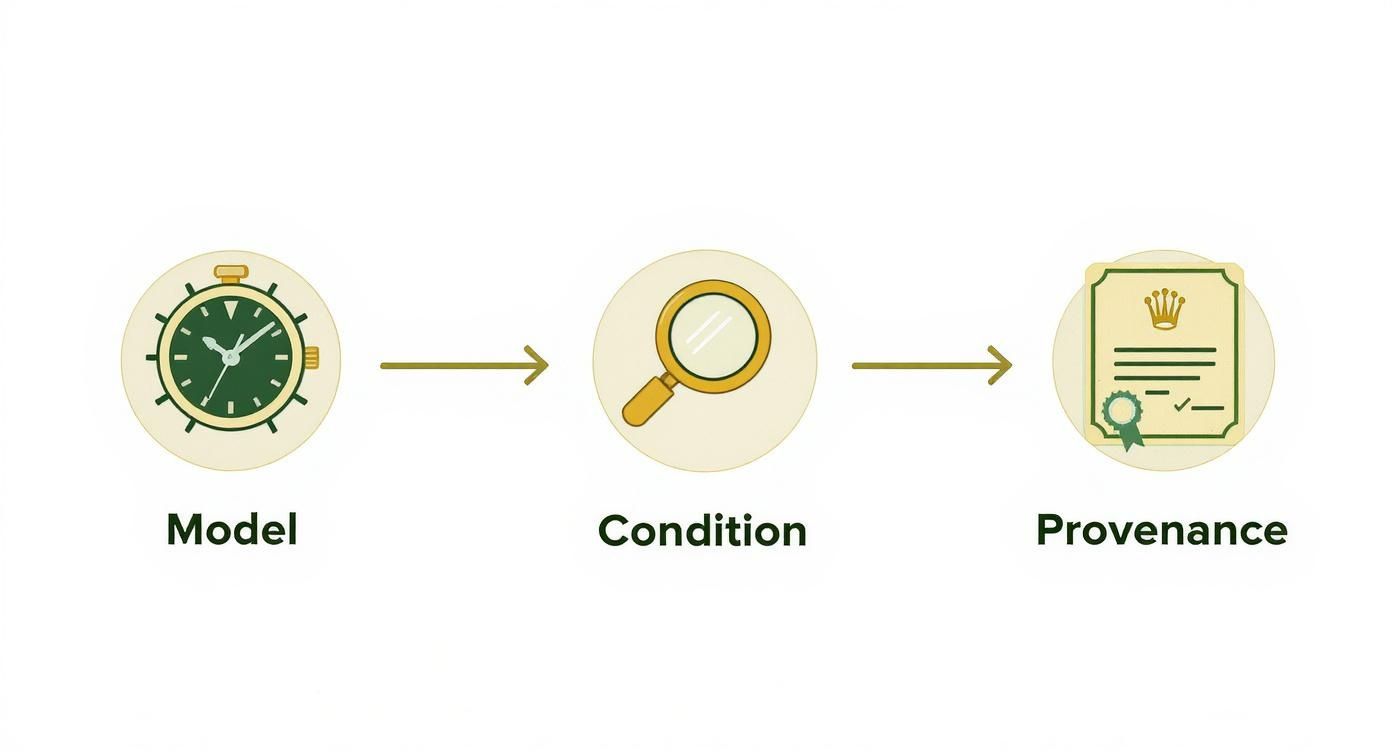
As you can see, each element builds on the last to create a complete and defensible valuation.
The pre-owned Rolex market is anything but static; prices shift constantly based on global demand and collector trends. Even with a market correction in 2022, Rolex watches appreciated by roughly 28% between 2020 and 2025. That kind of performance shows just how resilient the brand is as an asset. For a deeper dive into these market dynamics, the data from platforms like Chrono24 is always a great resource.
To make things easier, here's a quick summary of the main factors we've just discussed.
Quick Guide to Rolex Value Factors
| Factor | What It Means | Impact on Value |
|---|---|---|
| Model & Reference | The specific type of Rolex, identified by its unique reference number. | High: The single most important factor. Rare or highly desirable models command top dollar. |
| Condition | The physical state of the case, crystal, dial, and bracelet. Includes scratches, patina, and polishing. | High: A mint-condition watch is always worth more. Over-polishing can significantly decrease value. |
| Box & Papers | The original packaging, warranty card, manuals, and receipts. Also called a "full set." | High: Adds 20% or more to the value by proving authenticity and completeness. |
| Provenance | The documented history of the watch, including service records and previous owners. | Medium to High: A well-documented history, especially for vintage pieces, adds significant appeal. |
| Market Demand | Current popularity and scarcity of the specific model on the secondary market. | Medium: Prices fluctuate. A "hot" model can see its value spike based on trends. |
Think of these factors as a checklist. The more boxes you can tick, the stronger the final valuation will be.
Identifying Your Watch’s Model and Reference Number
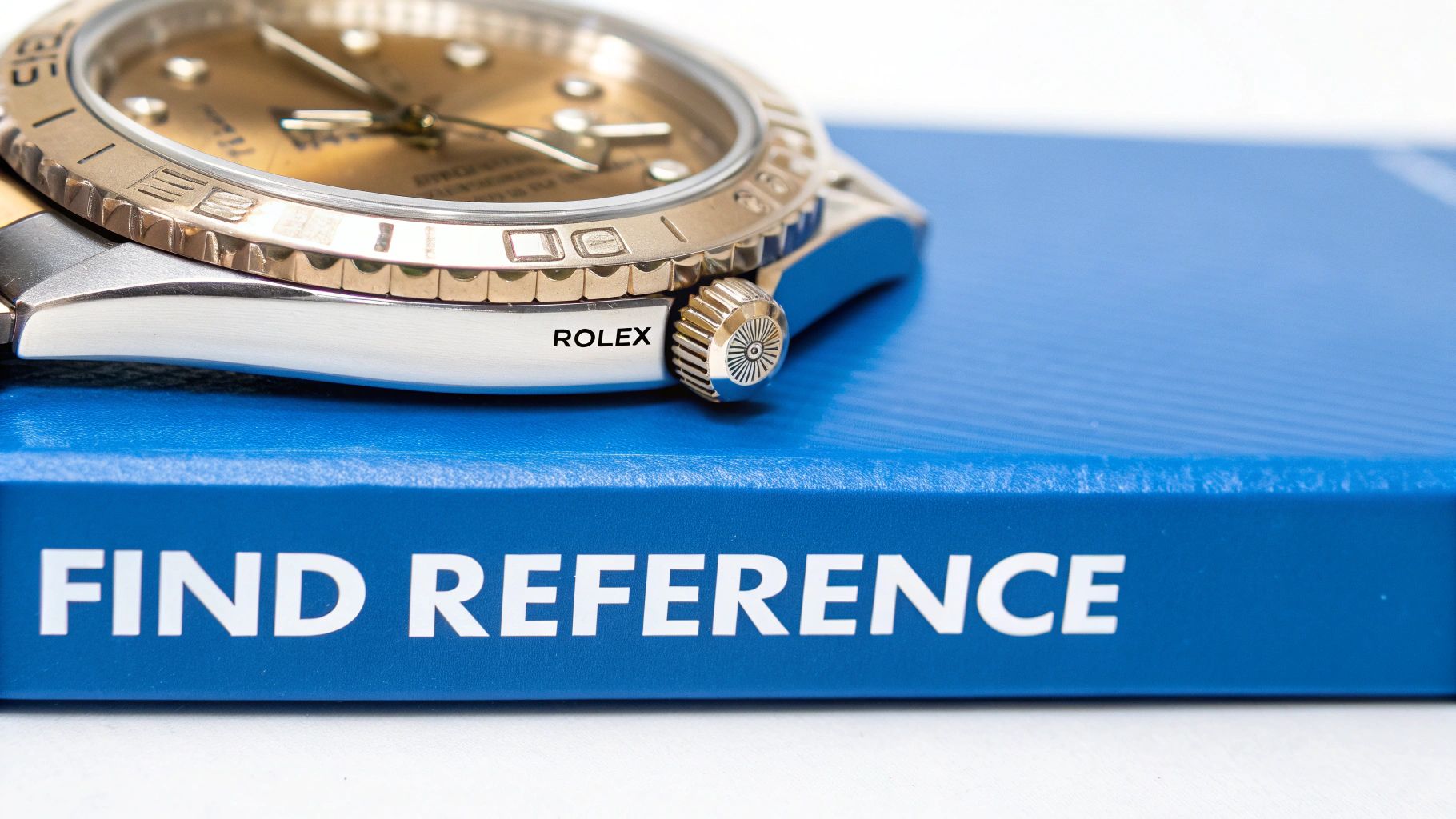
Before you can get anywhere close to valuing your Rolex, you need to play detective for a minute. Every single Rolex has two key identifiers engraved right onto its case: a model number (often called a reference number) and a unique serial number. These codes are the watch’s DNA, telling you everything from its exact model and materials to a rough idea of when it was made.
Think of it this way: the reference number is the "make and model," like a "Submariner 16610." The serial number is its VIN—totally unique to that one specific watch. Finding these is always the first real step in the valuation journey.
Where to Find the Numbers
For most Rolex models made before 2007, these numbers are tucked away. You’ll have to carefully pop off the bracelet to see them.
- The reference number is usually engraved between the lugs right at the 12 o'clock position.
- The serial number is engraved between the lugs down at the 6 o'clock position.
You'll need a simple spring bar tool to do this, which lets you gently compress the tiny spring bars holding the bracelet to the case. Take your time here—the last thing you want is to scratch the lugs. On newer models (generally after 2010), Rolex made things easier by engraving the serial number on the inner bezel ring, what collectors call the "rehaut," so you can see it without taking anything apart.
Pro Tip: When you take the bracelet off, always work on a soft microfiber cloth. I like to put a small piece of clear tape over the lugs before I even touch them with a tool. It’s an extra layer of defense against an accidental slip and a nasty scratch.
Once you’ve got those numbers, the real work begins. The reference number is critical for valuation because it pinpoints the exact model, bezel type, and metal. For example, a reference 16610 is a classic stainless steel Submariner Date. But a reference 16613 is the two-tone steel and gold version, a difference that has a massive impact on its value.
Decoding Your Rolex Reference
Getting a handle on what the digits in your reference number actually mean is how you unlock its story. The system has changed a bit over the decades, but there are some general rules that will give you a pretty clear picture of what you're holding. For a deep dive, our guide to understanding Rolex reference numbers breaks down how to read these codes for both modern and vintage pieces.
A typical four-to-six-digit number can tell you:
- Model Type: The first few digits almost always identify the watch family (like Submariner, Daytona, or Datejust).
- Bezel Style: One of the digits is often a code for the bezel type—think fluted, smooth, or rotating.
- Material: The very last digit is a dead giveaway for the metal used, whether it’s steel, yellow gold, or even platinum.
Knowing these details isn't just helpful; it's non-negotiable for an accurate appraisal. It lets you compare your watch to others on the market with total precision, making sure you’re truly comparing apples to apples when you value your Rolex watch.
How to Objectively Assess Your Watch's Condition
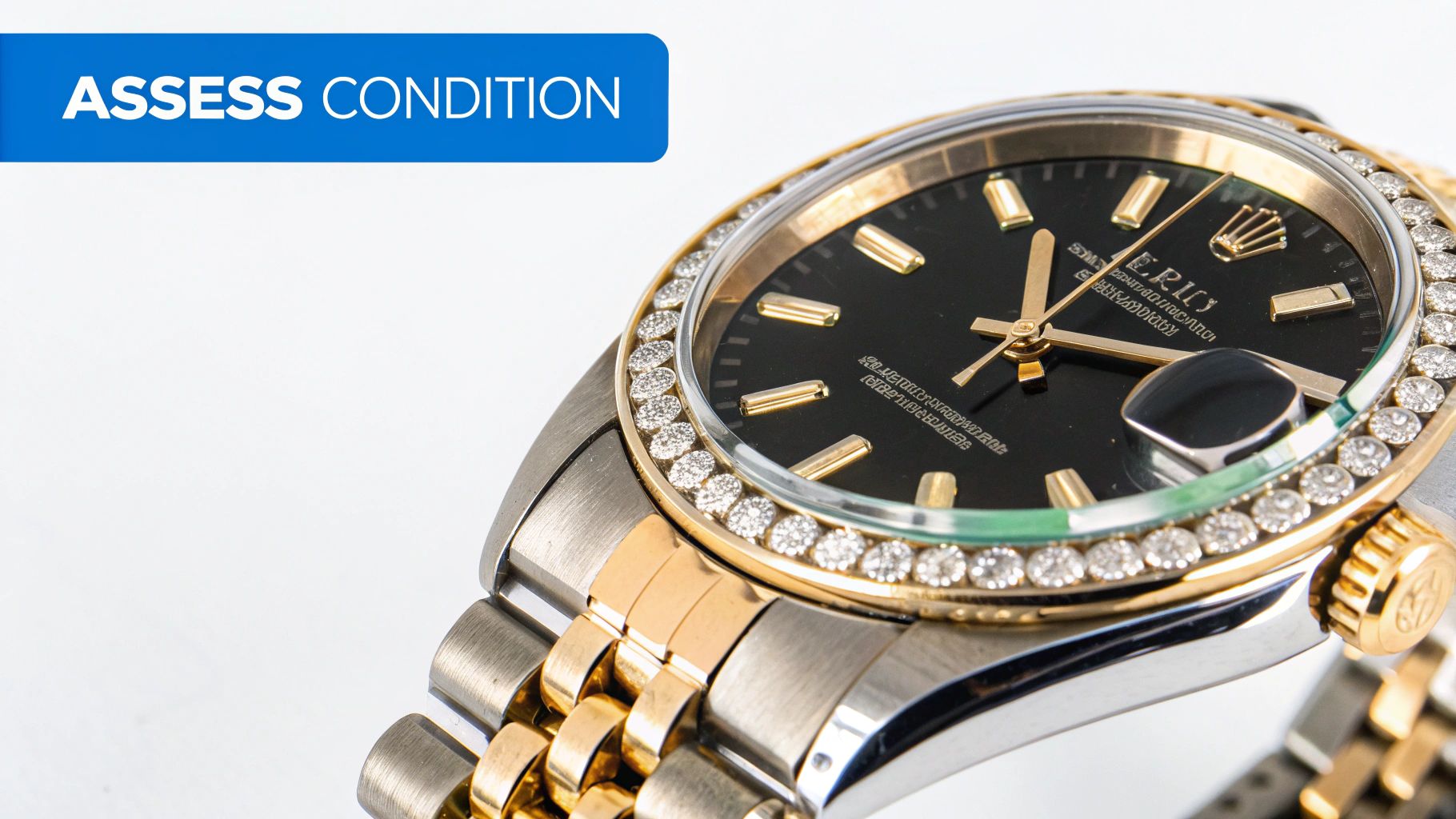
When you need to value your Rolex, its physical state is one of the most critical factors. It's not an exaggeration to say that two watches with the exact same reference number can have wildly different price tags based on condition alone. Learning to grade your watch like a pro means going beyond a quick glance for obvious dings and scratches.
This kind of objective assessment helps you set realistic price expectations from the get-go. It also means you can describe your timepiece accurately to a potential buyer or appraiser, which builds trust and just makes for a much smoother transaction.
Examining the Case and Lugs
Let's start with the case—the metal body of the watch. Grab a bright light and look at it from every possible angle. Are the edges, what we call bevels or chamfers, sharp and well-defined? While decades of honest wear can soften these lines, the real value-killer is aggressive polishing.
Over-polishing is what happens when a watch is serviced and too much metal gets buffed away to remove scratches. This thins the case, rounds off its sharp, factory-fresh lines, and makes the lugs (the horns where the bracelet connects) look skinny and weak. Collectors will always pay a premium for a watch with a "fat" case and sharp lugs.
Assessing the Dial and Crystal
The dial is the face of your watch, and it's often the most scrutinized part. Interestingly, what might seem like a flaw can sometimes be a very desirable trait. Take, for instance, vintage Rolex dials that have been exposed to sunlight over the years. Some develop a unique, even discoloration called a "tropical" patina. This browning effect is highly sought after by collectors and can seriously increase a watch's value.
On the other hand, you need to be on the lookout for clear signs of damage:
- Water Damage: Stains, bubbling paint, or corroded hands are all major red flags.
- Reluming: Check if the luminous material on the hands and hour markers looks like it's been reapplied. It might glow brighter, but it's not original and hurts the value.
- Scratches or Cracks: Carefully examine the crystal (the glass) for any deep scratches or chips, paying close attention to the edge.
A pristine, original dial is always the goal. Any sign of refinishing or moisture getting inside is a huge concern. When you're not sure, an expert can tell you definitively. For more tips from the pros, check out our detailed article on how to authenticate a Rolex watch.
Inspecting the Bracelet
Last but not least, don't forget the bracelet. A very common issue with older Rolex bracelets, especially the hollow-link Jubilee and Oyster styles, is "stretch." This happens gradually over years of wear as the pins and links loosen up, causing the bracelet to droop when you hold it sideways.
It's easy to check. Just hold the watch case firmly and extend the bracelet out horizontally. A tight, new bracelet will stay almost perfectly straight. A heavily worn one will sag quite a bit. While a little bit of stretch is expected on vintage pieces, too much droopiness makes it less comfortable, less secure, and ultimately, less valuable.
The watch's condition has a direct impact on its market perception and resale price. For example, a popular model like the Rolex Datejust ref. 126234 has seen a 44% value increase since 2020, while the Daytona ref. 116500LN rose by 18%. These figures are for watches in excellent condition; a poorly maintained example simply won't see that kind of growth. You can dive deeper into these price development trends on Chrono24.com.
Why the Box and Papers Matter So Much
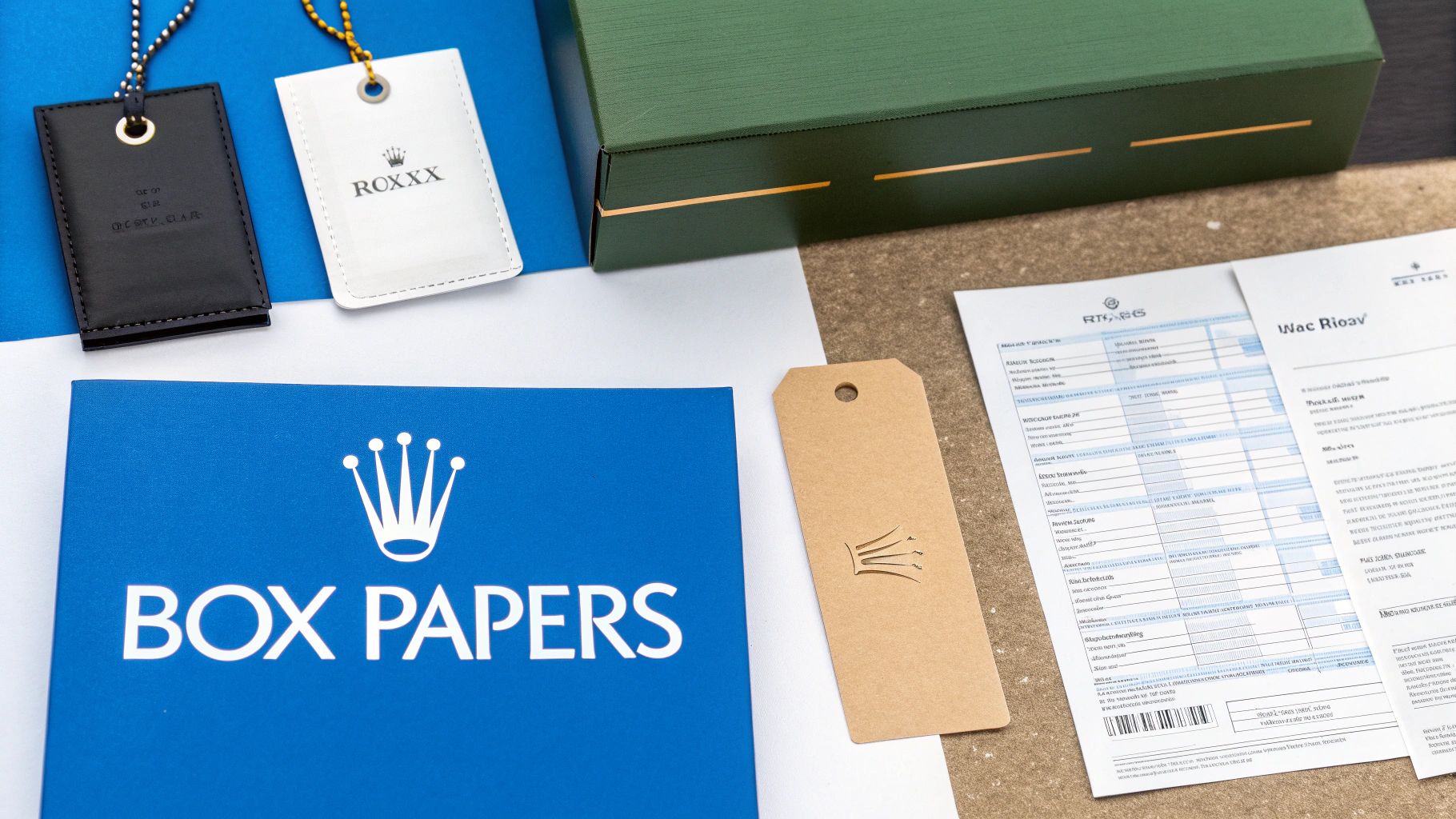
When you're trying to figure out what a Rolex is worth, the watch itself is just one piece of the puzzle. In the world of high-end watches, provenance—the documented history of a timepiece—is king. This is where the original box, warranty card (the "papers"), hang tags, and maybe even the original sales receipt play a huge role.
Collectors have a term for a watch that comes with all these original goodies: a "full set." Having a full set isn't just about proving the watch is real; it tells the watch's life story. It confirms its journey from the authorized dealer to you, giving a sense of security and history that's impossible to fake. Because of this, a full set can seriously bump up a Rolex's value, often adding 20% or more to its final sale price.
Decoding the Warranty Card
Of everything in the box, the warranty card is the single most important document. Think of it as the watch's birth certificate. A legitimate card will show the watch's unique serial number, its model reference number, and the original date and location of its sale.
Learning to spot a real warranty card from a fake one is a critical skill. Here’s a quick rundown on what to check for, depending on the watch's age:
- Older Paper Certificates: These were easier to forge. You'll want to check for perfectly crisp printing, the correct Rolex fonts, and perforated serial numbers that are an exact match to the watch.
- Modern Plastic Cards: Rolex switched to credit card-style warranty cards in the mid-2000s. These are much tougher to replicate, featuring details like UV security markings that you can check with a blacklight.
A watch with papers that match its serial number is the gold standard. It builds an incredible amount of trust, which almost always means it sells faster and for more money. It's what every serious buyer is looking for.
What If You Don't Have the Papers?
Look, it happens. Over decades, boxes get misplaced and papers get lost. If you're in this boat, don't panic—you're not out of luck. While you can never replace that original warranty card, you can create a new layer of official documentation.
Your best move is to get the watch serviced by Rolex or an authorized service center. Once the work is done, they'll give you official Rolex service papers. These documents function a lot like the originals, officially verifying the watch's authenticity and its serial number.
While they aren't quite as valuable as the original full set, having recent service records from Rolex is a massive plus. It proves the watch is authentic, has been professionally maintained, and is running well, giving any potential buyer some serious peace of mind.
Finding the True Market Price for Your Rolex
https://www.youtube.com/embed/UINxTK-QWFg
Okay, you’ve got the essential details: your watch’s reference number, a solid assessment of its condition, and all the provenance paperwork you could find. Now it's time for the fun part—finding out what your watch is actually worth in today's market. This isn't about guesswork; it's about digging into real-world data to pinpoint a realistic price range.
The trick is knowing where to look and, more importantly, how to read the numbers you find.
Your first move should be to check the big players in the secondary watch market. Websites like Chrono24 and Bob’s Watches are goldmines of information, but only if you use them the right way. A common mistake is just glancing at the current asking prices—that’s only giving you half of the picture.
Think of a listing price as a starting point. It's what a dealer is hoping to get for the watch, not necessarily what it will sell for. To get a much clearer idea of value, you need to find examples of sold watches that are as close to yours as possible in model, condition, and completeness (box and papers).
Building Your Price Comparison
Let's run through a quick example. Say you have a classic Rolex Submariner Date, reference 16610, in good shape, complete with its original papers.
Here’s how you’d approach the research:
- Start Broad: Kick things off by searching for "Rolex Submariner 16610" on a couple of reputable platforms. You'll get a flood of results.
- Filter Like a Pro: This is the most important step. Start narrowing down the listings. Filter for watches in a similar condition (look for terms like "good" or "very good") and, crucially, ones that include the original papers.
- Analyze the Results: Now look at the asking prices for the watches that are left. You'll probably see a bit of a spread. Make a note of the highest and lowest prices for the listings that are a genuine match for your watch.
This simple process gives you a realistic snapshot of the current market. The true value of your specific timepiece is almost certainly sitting somewhere within that filtered price range.
It’s crucial to remember that the market is always moving. For instance, between 2010 and 2025, the average price of Rolex watches sold through Bob's Watches shot up by over 550%. A hero model like the Submariner hit a peak average price of $18,889 in May 2022 before leveling out around $17,295 in 2023. You can find more data on these Rolex market trends on Bob's Watches.
Differentiating Dealer Price from Private Sale Value
Here’s another key distinction you have to make: the difference between a dealer's price and what you could expect from a private sale.
A dealer's listing price isn't just the value of the watch. It’s baked in with all their overheads—things like rent for their showroom, staff salaries, marketing costs, and, of course, their profit margin. They also provide a guarantee of authenticity, which is a huge value-add for a buyer.
Because of all this, if you were to sell your watch directly to another collector, you should aim for a price that’s below a dealer’s retail listing but higher than what a dealer would offer to buy it from you. Understanding the resale value of Rolex watches in these different contexts is essential for setting your expectations correctly.
By comparing multiple sold listings and getting a feel for the market landscape, you can arrive at a fair market value for your Rolex with confidence, knowing it’s backed by real, hard data.
Right, so you've done your homework and have a solid idea of what your Rolex is worth. That's fantastic. For most situations, a well-researched ballpark figure is all you really need.
But there are a couple of scenarios where "close enough" just doesn't cut it. We're talking about times when you need a formal, legally recognized valuation from a certified pro. Knowing when to make this investment can save you a world of headaches later on.
A professional appraisal isn't just getting a second opinion. It's a formal, documented verification of your watch's authenticity and, crucially, its replacement value. This is non-negotiable for two big reasons: insurance and high-stakes sales.
If you want to properly insure your Rolex (and you absolutely should), your insurance company will require an official appraisal. This is the only document that lets you "schedule" the watch on your policy, ensuring you're covered for its full replacement cost if it's ever lost or stolen.
Finding the Right Expert
When it’s time to get that official number, you can't just go to any jeweler. You need to find a reputable, certified appraiser.
Look for experts with credentials from well-respected organizations like the National Association of Jewelry Appraisers (NAJA) or the American Society of Appraisers (ASA). These pros do way more than just a quick look-see. A qualified appraiser will conduct a meticulous inspection, often examining the movement, verifying serial numbers, and assessing the watch's condition with a highly trained eye.
Here’s a glimpse of what the process looks like:
- Deep Dive Examination: The appraiser will actually open the case back to inspect the movement, confirming its authenticity and checking its condition.
- Paperwork Verification: They'll cross-reference your box and papers with the watch itself to make sure everything lines up perfectly.
- Market Analysis: Using their deep industry knowledge and proprietary tools, the expert determines a precise value based on real-time market data.
- The Official Report: You walk away with a signed, formal document that details everything about your watch—its condition, serial and reference numbers, and its official appraised value.
The Value of Certainty
Sure, there's a cost involved, but what you're really paying for is certainty. A formal appraisal gives you undeniable proof of your watch's worth. This provides incredible peace of mind, whether you plan to sell it, insure it, or eventually pass it down.
This is more important than ever, especially given the wild appreciation we've seen in certain models. Market analysis from 2025 shows that the Rolex Datejust has shot up by about 639% and the GMT-Master II by over 500% in the last 15 years alone. That's a better return than most other luxury assets. You can read more about these remarkable used Rolex trends here.
Getting a professional appraisal transforms your Rolex from a prized possession into a fully documented asset. It provides the concrete evidence you need for insurance claims, estate planning, or getting top dollar in a private sale or at auction. It's the ultimate validation of your watch's true value.
A Few Final Questions About Valuing Your Rolex
As you get closer to pinning down the true value of your Rolex, a few last-minute questions always seem to pop up. Let's tackle them head-on so you can move forward with total clarity.
What Does a Professional Appraisal Actually Cost?
You can generally expect a professional appraisal to run you between $100 and $300. The final price tag depends on who you go to and where they're located. This isn't just a quick look-over; this fee covers a meticulous inspection and gets you a formal document detailing your watch's specifics and its official replacement value, which is exactly what you need for insurance.
Does Servicing a Rolex Increase Its Value?
Sometimes, yes. A recent, official Rolex service can definitely boost a watch's value, especially for a potential buyer who wants peace of mind knowing it’s running perfectly and is 100% authentic.
But—and this is a big but—when it comes to vintage pieces, things get tricky. Seasoned collectors prize originality above all else. Polishing an old case or swapping out a beautifully aged dial and hands for new ones can crater a vintage watch's value. If you're servicing an older Rolex, always insist on a "sympathetic" service that aims to preserve every original component possible.
A quick note on those online valuation tools: they’re fine for a ballpark figure, but they can't replace an expert’s eye. They use basic info like model and age but completely miss the critical details—physical condition, subtle shifts in the market, or the story behind the watch. Use them for your initial homework, nothing more.
Ready to get a precise, market-based valuation for your Rolex? The experts at ECI Jewelers offer a transparent and trusted appraisal process. Visit https://www.ecijewelers.com to get started today.


