

If you’ve ever found yourself admiring a watch with an extra hand sweeping across a numbered bezel, you’ve likely encountered a GMT. So, what does GMT actually stand for? The term is an initialism for Greenwich Mean Time, the original global time standard that, quite literally, synchronized the world.
A GMT watch is far more than just a fancy feature; it's a piece of history right on your wrist.
What GMT Means for Your Watch
The GMT complication is easily one of the most celebrated and practical features in horology, born from a very real need to connect a rapidly expanding world. Its story didn’t begin in a quiet watchmaker's workshop. Instead, it started in the cockpit of a transatlantic airliner, where pilots desperately needed a reliable way to track multiple time zones at a glance.
The foundation for this was laid long before, at the International Meridian Conference in Washington, D.C., on October 22, 1884. In a landmark meeting, 25 nations agreed to establish the Prime Meridian at Greenwich, London, as the zero point for the world's 24 time zones. You can dive deeper into this historic decision and its impact on watchmaking over at ItalianWatchSpotter.com. This agreement set the stage for the timekeeping function we value so much today.
A GMT watch is essentially a bridge between the golden age of aviation and the modern needs of global professionals, frequent travelers, and discerning collectors.
Today, its utility has expanded far beyond the cockpit. The function serves anyone who operates across different time zones, from international business executives to families staying connected across continents. For collectors, it represents a perfect blend of elegant form and indispensable function, making it a staple in any serious collection.
Before we get into the mechanics of how it all works, let's lock in the core concepts with a quick summary.
GMT Essentials at a Glance
| Concept | Brief Explanation |
|---|---|
| GMT | Stands for Greenwich Mean Time, the historical time standard based on the Prime Meridian in London. |
| Complication | Any feature on a watch beyond telling the hours, minutes, and seconds. A GMT function is a prime example. |
| Purpose | To simultaneously display the time in at least two different time zones. |
| Origin | Developed for Pan Am pilots in the 1950s to track their home time and local time during long-haul flights. |
With these basics covered, we can explore how this clever piece of engineering actually ticks.
The Story Behind the First GMT Watches
The GMT watch wasn't dreamed up in a design studio; it was born out of pure necessity, forged in the skies during the golden age of intercontinental flight. Back in the 1950s, the world was shrinking fast. As passenger jets started connecting continents, pilots faced a brand-new problem.
This exciting era was led by Pan American World Airways, whose crews were routinely crossing multiple time zones in a single trip. This created a serious challenge: they needed to track their local time for navigation while simultaneously keeping an eye on their home time—which was GMT—as a constant reference. Juggling the two was critical for avoiding fatigue and preventing dangerous calculation errors.
A Partnership Forged in the Skies
To solve this, Pan Am went straight to Rolex with a specific request: build us a watch that can serve as an essential tool for our pilots. The legendary Rolex GMT-Master was the answer. It was a watch engineered from the ground up to meet the intense demands of professional aviators, and the collaboration created one of the most iconic "tool watches" of all time.
The timing couldn't have been better. With the post-WWII boom in air travel, the GMT concept took off. By 1955, the year the GMT-Master was released, international flights had exploded by a staggering 500% compared to 1939 levels. Pan Am alone was flying over 150 planes to 85 cities across 50 countries, which shows you just how urgent the need for this technology was. You can read more about the history of this complication at Oracle of Time.
The GMT-Master wasn't just a watch; it was a solution. It gave pilots a simple, reliable way to manage global time, making air travel safer and more efficient.
This origin story is a massive part of the GMT's identity. It's why the complication is so deeply connected to Rolex and that incredible era of aviation. You can learn more about the enduring legacy of the Rolex GMT-Master in our detailed insights.
So, what were the key innovations that made it all work? It was a simple but brilliant system:
- A Fourth Hand: An extra, easily distinguishable hand was added to the dial.
- 24-Hour Rotation: Unlike a normal hour hand, this one only circled the dial once every 24 hours.
- A Rotating Bezel: Marked with 24-hour increments, it allowed a pilot to set a second time zone and read it instantly against the fourth hand.
This trio of features was revolutionary. It created a powerful, intuitive way to track time across the globe and set the standard for every GMT watch that has followed since.
How a GMT Watch Actually Works
Getting a handle on how a GMT watch works is much easier than you might think. Just picture two separate clocks: one you leave set to your home time, and another you adjust when you're on the road. A GMT watch beautifully merges both functions into one elegant machine on your wrist.
The real genius is how three core parts work in harmony. First, you have the standard 12-hour hands—hour, minute, and seconds. These are the ones you already know and use to tell your local time.
Then comes the main event: the fourth hand, which we call the GMT hand. It’s usually designed to stand out with a different color or an arrow tip. This hand moves at half the speed of the regular hour hand, making only one full rotation around the dial every 24 hours.
The Core Components
Finally, you've got the 24-hour bezel, which is the numbered ring encircling the watch face. This bezel acts as the scale for that special fourth hand, letting you read a second time zone with a quick glance. When you put them all together, you get a remarkably intuitive tool for keeping track of the world. You can dive deeper into what makes a GMT watch so functional in our complete guide.
This simple chart shows how the demands of global air travel were the direct catalyst for the GMT watch's creation.

As you can see, this wasn't just a gimmick. The GMT was a practical solution born out of a real-world problem facing pilots in the jet age.
Setting and Reading Your GMT
So, how do you actually use it? The process is simple and unlocks the watch's true power.
- Set Your Reference Time: Start by setting the 24-hour GMT hand to your "home" time, or a universal standard like Greenwich Mean Time. If it’s 2 PM (14:00) back home, you'll point the GMT hand to the “14” on the bezel.
- Set Your Local Time: Now, set the main 12-hour hands to whatever the local time is where you are. This lets you read your current time just like you would on any other watch.
- Track a Third Time Zone: Here's the cool part. The rotating bezel lets you track yet another time zone. By simply turning the bezel, you can shift the 24-hour scale to line up with a third location, all while using the same GMT hand as your guide.
Once you get the hang of these three elements—the main hands, the GMT hand, and the rotating bezel—you can effortlessly track up to three time zones simultaneously. It transforms a beautiful timepiece into an indispensable tool for any world traveler.
GMT vs Dual Time vs World Timer Explained
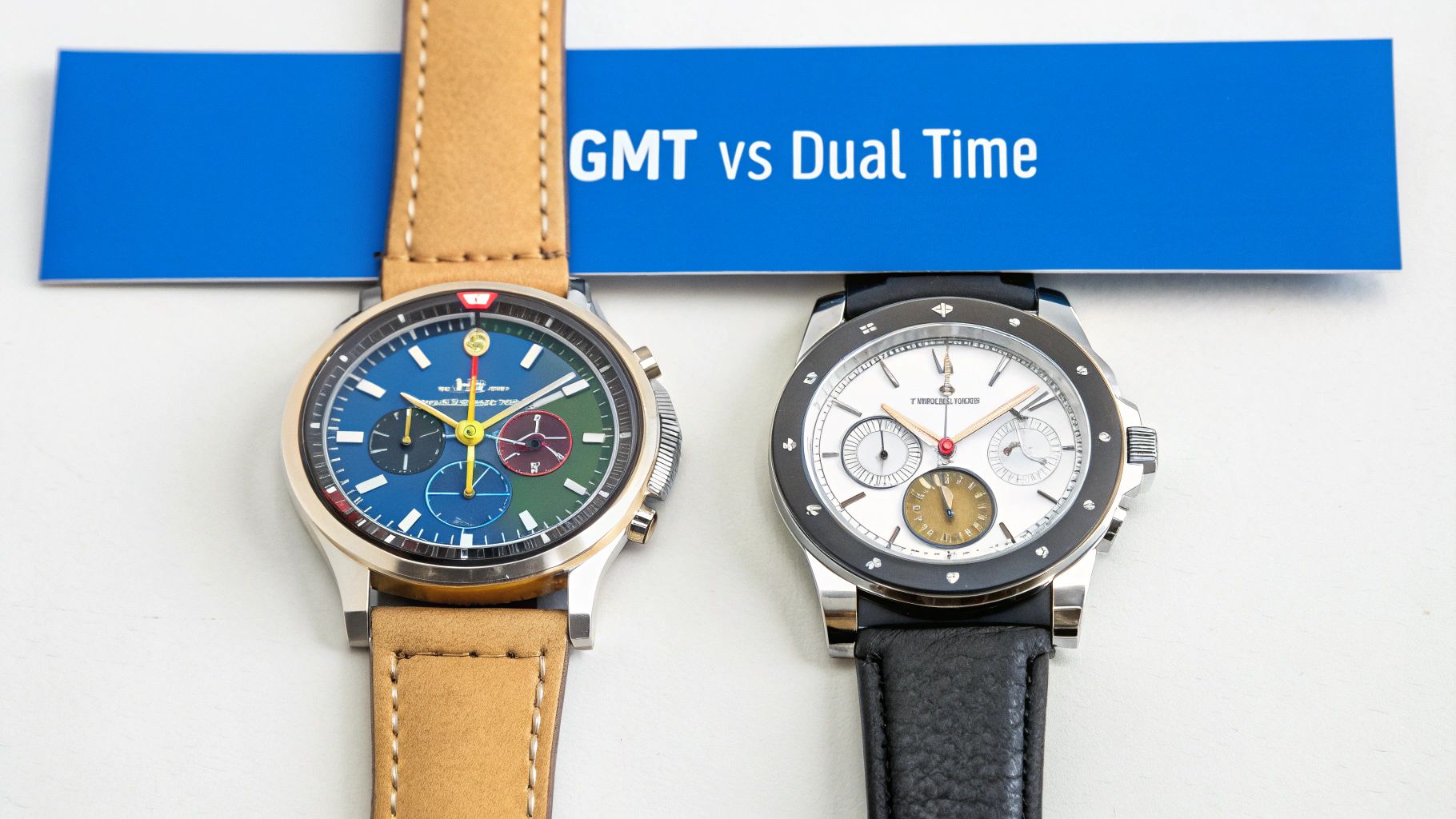
The term "GMT" gets tossed around a lot, often as a catch-all for any watch that tracks more than one time zone. But in the world of watchmaking, there are key differences between the major types of traveler's complications. Getting to know them helps you find the function that actually fits your life.
Let's break down the big three: GMT, Dual Time, and World Timer.
How They Differ at a Glance
A true GMT watch uses that distinct fourth hand—the 24-hour hand—and a matching 24-hour scale, which is usually on that ever-so-useful rotating bezel. This design is brilliantly versatile, letting you track a second time zone at a glance and often a third just by turning the bezel.
A Dual Time watch approaches things a bit differently. It typically shows a second time zone on its own separate sub-dial, almost always in a traditional 12-hour format. Because of this, it needs a small AM/PM indicator to keep day and night straight, resulting in a cleaner, more compartmentalized display.
Finally, we have the World Timer, the undisputed king of global timekeeping. This beast of a complication shows you the current time in 24 major cities across the planet simultaneously. You get an instant snapshot of the entire globe, usually with a rotating ring of city names that lines up with a 24-hour scale.
The real choice comes down to display and functionality. A GMT gives you flexible tracking for two or three zones. A Dual Time offers a classic, separate display for a second home base. And a World Timer puts the entire planet on your wrist.
To make it even clearer, here's a quick comparison of how these complications stack up and who they're really for.
Comparing Traveler's Watch Complications
This table simplifies the key differences to help you decide which complication is the right copilot for your journeys.
| Complication Type | How It Works | Best For |
|---|---|---|
| GMT | A 24-hour hand points to a 24-hour scale, often on a rotating bezel. | Frequent travelers and pilots who need to track home, local, and a potential third time zone. |
| Dual Time | A second time zone is shown on a separate 12-hour sub-dial with an AM/PM indicator. | Professionals who primarily track one other office or family time zone from a fixed location. |
| World Timer | Displays the current time in 24 different cities around the world at once. | Global investors, international executives, and collectors who manage connections across the entire globe. |
Each has its own unique charm and purpose. A GMT is the practical tool for the person in motion, the Dual Time is the elegant solution for staying connected to one special place, and the World Timer is for the true global citizen.
Why a GMT Belongs in Your Watch Collection
Sure, a GMT is a practical tool. But its real appeal goes way beyond just tracking time zones. For any serious enthusiast, a GMT is an essential piece that speaks to a history of adventure and a globally connected world. It's more than a complication; it's a statement.
For the modern professional, a GMT is an absolute workhorse. It makes coordinating international calls, tracking market openings, and syncing with teams across the globe completely seamless. Having that second or third time zone right on your wrist offers a real, practical edge in a world that’s always on.
A Symbol of Adventure and Heritage
If you're a traveler, a GMT becomes an anchor to home. No matter how far you roam, a quick glance down reminds you what time it is for your loved ones. That simple connection is a huge part of what makes this complication so special to so many owners.
But for the dedicated collector, the appeal is even deeper.
A GMT watch is the perfect blend of three things every collector loves: impressive mechanical engineering, a rich history tied to the golden age of aviation, and a timeless design that just works.
Think about icons like the Rolex GMT-Master. These watches haven't just stayed relevant; they've become serious investment pieces. Owning one isn't just about having a cool watch—it's about appreciating the history and craftsmanship that created a complication that genuinely changed how we travel and connect. It’s functional art that tells a story, making it a cornerstone for any well-rounded collection.
Finding and Caring for Your GMT Watch
Adding a GMT watch to your collection is an exciting step, whether you're buying a brand new piece or a vintage classic. For any purchase, you'll want to focus on three critical areas to make sure you’re making a smart investment: authenticity, provenance, and the condition of that intricate GMT movement.
Always, always buy from a trusted, reputable dealer who can guarantee the timepiece's legitimacy. When considering a pre-owned watch, its history—or provenance—is king. The original box and papers don't just look nice; they significantly add to its value and confirm its origins.
Maintaining Your GMT for Longevity
A fine watch is a precision instrument, and proper care is essential to protect your investment. The complex mechanics of a GMT complication require regular attention to maintain its accuracy and reliability for a lifetime of wear.
Think of it like a high-performance car. You wouldn't skip its scheduled maintenance, and your watch is no different.
- Regular Servicing: Plan on a professional service every five to seven years. This is when a watchmaker will replace gaskets, clean the movement, and apply fresh lubricants to keep everything running smoothly.
- Proper Winding: If you don't wear your GMT daily, give it a manual wind every few days. This simple action keeps the lubricants evenly distributed and the entire mechanism in motion.
Following these simple tips will ensure your GMT remains a dependable and accurate companion on all your adventures. Now that you've got the basics down, get comfortable with your new timepiece with our full guide on how to read a GMT watch.
Answering Your Top GMT Watch Questions
Even after you get the hang of what a GMT watch is all about, a few common questions always seem to pop up. Here are some quick answers to the things collectors and enthusiasts ask most often.
Can I Track Any Time Zone?
You sure can. That's the beauty of a classic GMT design. The rotating 24-hour bezel is completely independent, so you can spin it to align with any time zone on earth.
Some savvy owners even figure out how to track a third time zone by doing a little mental math—they calculate the offset between the GMT hand and another position on the bezel. It’s a surprisingly powerful tool for anyone with a global mindset.
What's the Difference Between a "Caller" and "True" GMT?
This is a great question, and it really comes down to how the hands are set. The distinction is a huge deal for frequent travelers.
A "true" GMT is built for jet-setters. You can jump the main 12-hour hand forward or backward in one-hour increments without stopping the second hand. This means you can land in a new city and update your local time in seconds, all while the watch keeps perfect time.
On the other hand, a "caller" GMT is designed for someone who stays put but needs to track another time zone. With these, you set the 24-hour GMT hand independently. It’s perfect for someone in a home office who needs to know what time it is for colleagues in London or Tokyo.
Do I Have to Be a Pilot to Wear One?
Not at all! While GMTs earned their wings in the golden age of aviation, their appeal today is universal.
Plenty of collectors wear them simply because they love the history, the brilliant mechanical solution, and the iconic, purposeful look. Whether you're connecting with family overseas, keeping tabs on global financial markets, or just appreciate a legendary piece of watchmaking, a GMT is always a fantastic choice.


