


A dress watch is, quite simply, a timepiece designed for formal occasions. Its defining traits are its simplicity, elegance, and discretion. It’s crafted to complement your attire, not command it, slipping easily under a shirt cuff to tell the time with quiet confidence.
Understanding the Philosophy of Elegance
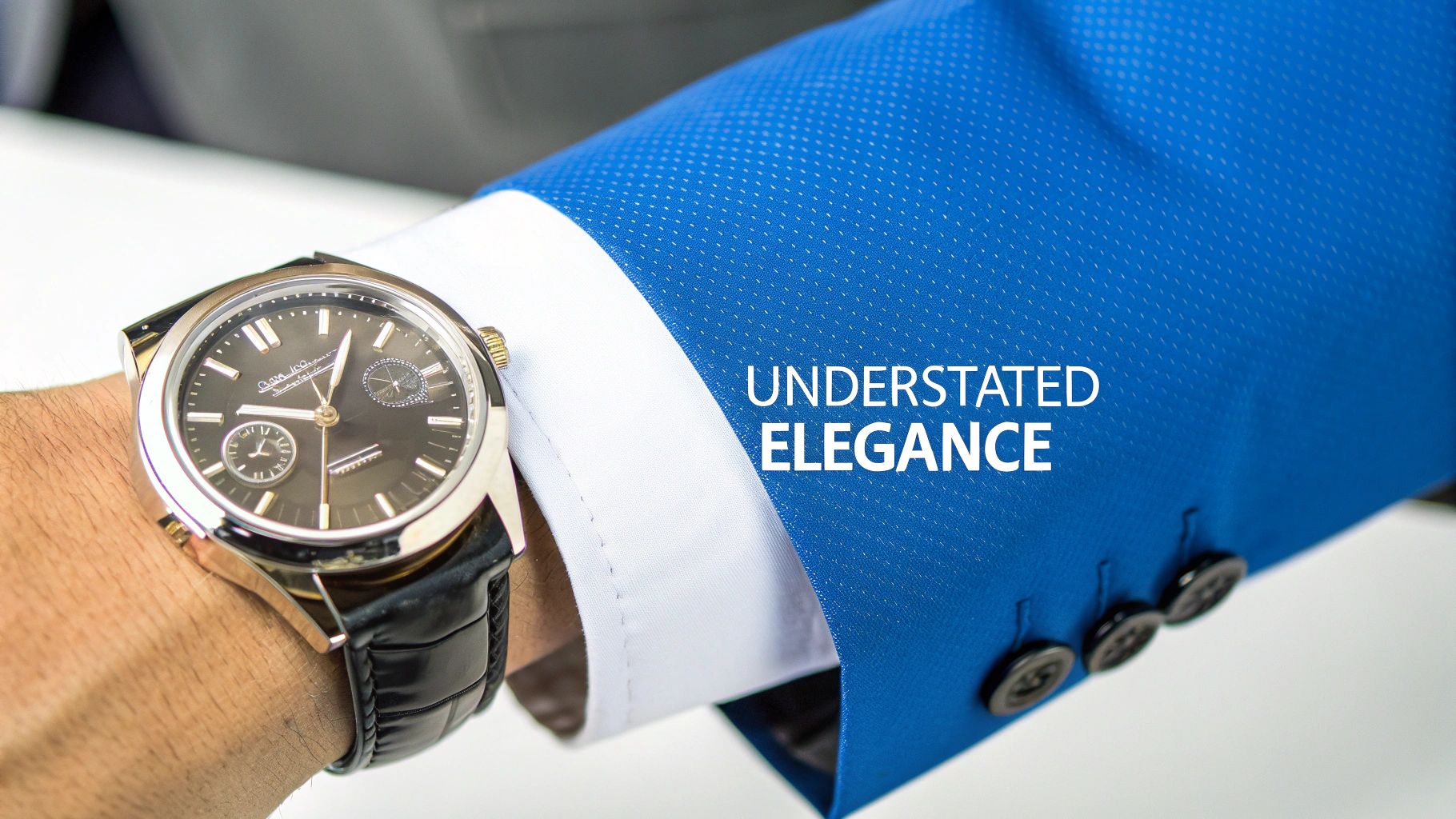
More than just a set of features, a dress watch is all about a specific design philosophy. Think of it less like a tool and more like a piece of fine jewelry whose primary job is to be unobtrusive.
Its entire purpose is to be the perfect finishing touch to a formal or business outfit, much like a well-chosen tie or a pair of cufflinks. It doesn’t scream for attention; it earns it through refined details and flawless execution.
The core idea is to strip away anything unnecessary. A sports watch is built for action—it’s rugged, often large, and packed with functions like chronographs and rotating bezels. A dress watch is the polar opposite. It boils timekeeping down to its purest form.
The Hallmarks of Discretion
The real beauty of a dress watch is in its purposeful subtlety. Every single component is chosen to create a sleek, cohesive, and sophisticated whole. These key characteristics all work together:
- A Slender Profile: It has to be thin enough to slide effortlessly under a shirt cuff without snagging or creating an awkward bulge.
- A Clean Dial: The face is typically minimalist. You'll often see simple stick indices, classic Roman numerals, or sometimes no markers at all.
- Precious Materials: Cases are frequently made from precious metals like gold or platinum, adding a touch of warmth and luxury that’s perfect for a formal setting.
- Minimal Complications: Its function is telling time, sometimes with a simple date window. You won’t find cluttered subdials or complex features here.
A true dress watch doesn’t just tell you the time; it tells the world you understand that elegance is found in simplicity. It is the quietest, yet most powerful, statement in the room.
Dress Watch vs. Sport Watch At a Glance
To really get what a dress watch is, it helps to put it side-by-side with its more robust cousin, the sport watch. The differences in their design philosophy are stark and show the specific role each is meant to play.
This comparison makes it clear why one belongs in the boardroom while the other is ready for the great outdoors.
| Characteristic | Classic Dress Watch | Modern Sport Watch |
|---|---|---|
| Primary Goal | Elegance & Discretion | Durability & Functionality |
| Case Size | Thin & modest (typically 34-40mm) | Thick & robust (often 40mm+) |
| Materials | Precious metals (gold, platinum), steel | Stainless steel, titanium, ceramic, rubber |
| Dial Design | Simple, clean, minimalist indices | Bold, high-contrast, often with luminous markers |
| Complications | Minimal (time-only, date) | Multiple (chronograph, GMT, diver’s bezel) |
| Strap/Bracelet | Leather strap | Metal bracelet, rubber or nylon strap |
| Water Resistance | Low (splash-resistant) | High (often 100m+) |
Now that we've covered the basics, we can dive into the specific details that give the dress watch its timeless appeal.
The Anatomy of Understated Elegance
A dress watch pulls off its sophisticated look not with one standout feature, but through the perfect harmony of several key elements. Every component is a deliberate choice—a decision to favor refinement over ruggedness and subtlety over spectacle. Once you understand this anatomy, you see why a true dress watch feels so balanced and timeless.
It all starts with the case. The single most important feature of a dress watch case is its slender profile. This isn't just for looks; it's about function. The watch has to be thin enough to glide effortlessly under the cuff of a dress shirt or blazer without ever snagging or creating an awkward bulge. This need for a slim design often pushes watchmakers to create incredibly precise, compact movements to fit inside.
The Face of Sophistication: A Minimalist Dial
The dial of a dress watch is a masterclass in minimalism. While a sports watch might scream for attention with bold, glowing numerals, a dress watch speaks in a quiet, clear voice.
- Simple Indices: You'll typically see clean, simple markers, like applied "stick" indices or classic, elegant Roman numerals.
- Uncluttered Space: The goal is to cut out all the visual noise. The dial is usually free of extra text, sub-dials, or complex scales, creating a calm, easy-to-read face.
- Elegant Hands: The hands are usually simple and slender—think classic Dauphine, Breguet, or leaf styles—to match the refined aesthetic.
This clean layout makes the watch easy to read at a quick glance without drawing too much attention. It’s there to provide information, not make a loud statement.
Precious Materials and Luxurious Finishes
The materials chosen for a dress watch are all about warmth, beauty, and a sense of occasion. Stainless steel is a popular and versatile choice today, but the most traditional and sought-after dress watches are made from precious metals.
A dress watch is the epitome of "less is more." Every element, from the sweep of the second hand to the texture of the strap, is chosen to contribute to a singular, cohesive vision of elegance.
Gold, whether yellow, white, or rose, adds a touch of classic luxury that’s perfect for formal events. Platinum offers a cool, understated heft and a real sense of exclusivity. If you're exploring gold watches, it's helpful to understand the key differences between 14k, 18k, and 24k gold to appreciate how the metal's purity affects its look and value.
Even for the biggest names, market tastes can shift. For instance, recent market data showed that while Patek Philippe saw overall gains of +2.8% in 2025, this was driven by its sports models. In contrast, its legendary dress watch collections like the Calatrava and Grand Complications saw declines of -5.3% and -6.1% respectively. It’s a great example of how market dynamics can affect even the most established classics.
The Soul of Simplicity: Complications and Movement
At its core, a dress watch is built to do one thing gracefully: tell the time. That's why it traditionally features minimal complications—that’s the term for any function beyond hours, minutes, and seconds. The purest form is a simple time-only display. A discreet date window is often the only other feature you'll find, as it keeps the dial clean.
Under the hood, a high-quality mechanical movement is the preferred choice, celebrating the true art and tradition of watchmaking. The intricate dance of tiny gears and springs powering the watch is a huge part of its charm. To really appreciate this level of craftsmanship, it’s worth learning how a mechanical watch works and the incredible engineering behind it.
Finally, a high-quality leather strap—usually alligator or calfskin—is the traditional choice to complete the look, providing a comfortable and classic finish.
Tracing Its Origins from Pocket to Wrist
To really get what a dress watch is, you have to look at where it came from. Before the 20th century, the go-to personal timepiece wasn't on the wrist—it lived in a pocket. A gentleman would pull out his pocket watch with a certain flair, but it was always a hidden, separate object.
Everything changed with the harsh realities of the early 1900s. Soldiers needed to coordinate attacks with split-second timing, and fumbling for a pocket watch in the trenches was a non-starter. This brutal necessity gave birth to the "trench watch," which was basically a small pocket watch with lugs crudely soldered on to hold a strap.
The Shift from Utility to Elegance
Born from pure function, the wristwatch quickly caught on with the public. It was just so much more convenient than its pocket-bound ancestor. Visionary watchmakers, most notably Louis Cartier, saw the chance to turn this practical tool into a new symbol of style.
Cartier’s creations, like the legendary Tank from 1917, weren't just repurposed pocket watches; they were designed from the ground up to be worn on the wrist. They were accessories first, tools second. With their elegant rectangular cases and clean, artistic dials, they broke away from the traditional round shape and set a new standard for sophistication. This was the moment the wristwatch began its journey to becoming a staple of formal wear.
The move from pocket to wrist was more than just a change in location; it was a total shift in philosophy. The watch went from being a hidden tool to a visible statement of taste and elegance.
This new design era prioritized aesthetics and comfort. A watch now needed to be slim enough to slip gracefully under a shirt cuff and refined enough to complement a suit. The design codes we now consider classic for a dress watch—the thin case, the clean dial, the leather strap—were all forged in this post-war period of sartorial refinement.
The infographic below breaks down these core anatomical features that define a dress watch.
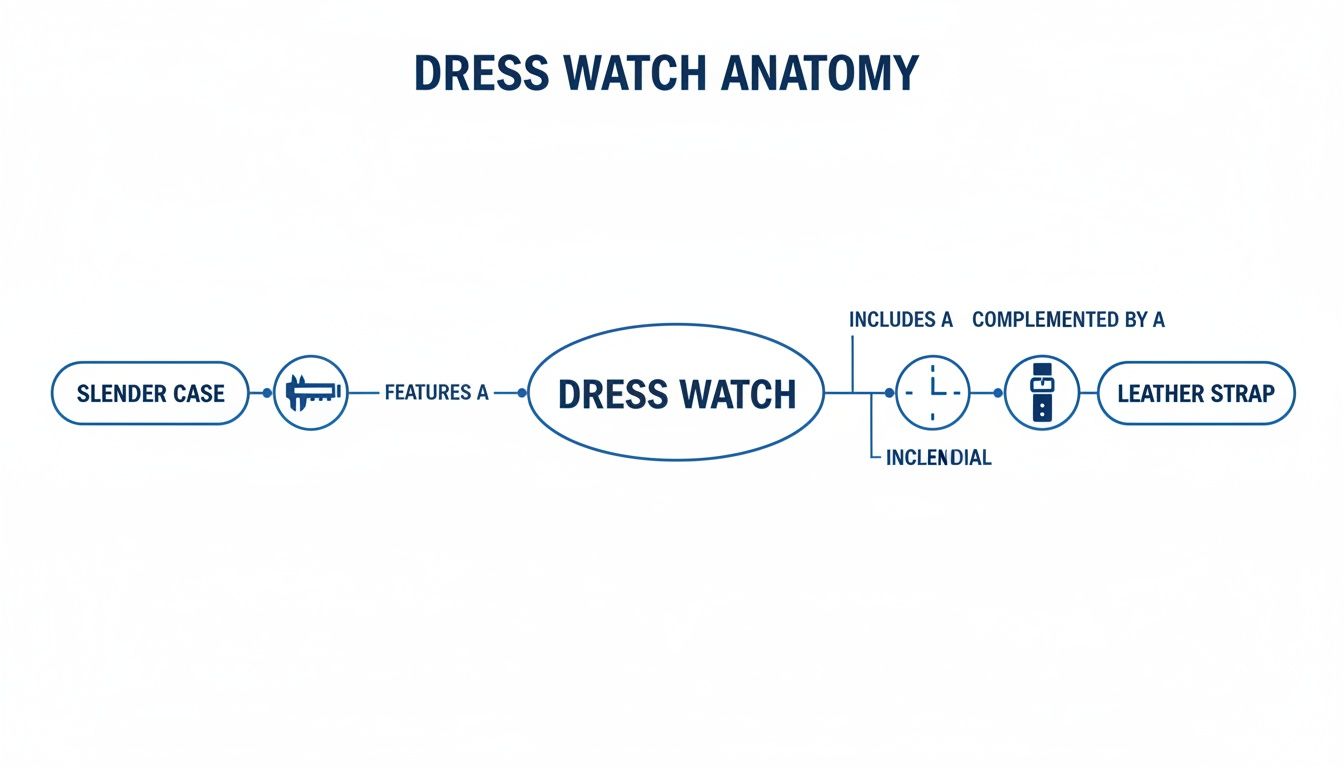
As you can see, the slender case, uncluttered dial, and classic leather strap all work in concert to create a look of cohesive, understated elegance.
Solidifying a Timeless Style
By the mid-20th century, the dress watch had cemented its place as essential formal attire. It became the default choice for business meetings, weddings, and black-tie galas.
Its history explains its key traits:
- Its size and thinness are a direct response to the need for a watch to fit discreetly under a cuff.
- Its simple dial is a holdover from the pure function of telling time, refined into an art of legibility and minimalism.
- Its leather strap offers a soft, classic touch that complements the metal case, unlike the rugged bracelets built for tool watches.
When you understand this evolution, you see that a dress watch is so much more than a style. It's a piece of horological history on your wrist, telling a story of innovation, adaptation, and the enduring power of quiet confidence.
How to Choose Your Ideal Dress Watch
Finding the right dress watch isn't about ticking off boxes on a checklist. It's a personal journey. Whether this is your first serious watch or just the latest addition to a growing collection, the real goal is to find a timepiece that feels like it’s always been a part of your style. It should be as comfortable at a black-tie event as it is with a sharp suit.
The whole process gets a lot easier when you break it down. By thinking through your personal taste, your budget, and the story behind the brand, you can make a choice you’ll be happy with for decades to come.
Define Your Personal Style
Before you even start browsing, take a minute to think about your own aesthetic. Do you gravitate towards classic, almost vintage designs that look like they could have been worn 50 years ago? Or are you more interested in a modern, minimalist take on elegance? Your answer points you in very different directions.
-
The Timeless Classic: If your style is more traditional, you'll probably appreciate watches with Roman numerals, clean stick indices, and warm cases in yellow or rose gold. Think of icons like the Patek Philippe Calatrava or the Cartier Tank. These watches are pure, refined, and have been style cornerstones for generations.
-
The Modern Minimalist: If you prefer a more contemporary vibe, you might lean toward clean dials—maybe with no numerals at all—and cooler metals like stainless steel, white gold, or platinum. These timepieces often have sharper lines and a more understated feel, offering a fresh perspective on formal wristwear.
Set a Realistic Budget
The world of dress watches is vast, with prices ranging from surprisingly accessible to six-figure works of art. Setting a budget early on is the best way to narrow the field and keep from feeling overwhelmed. And remember, a higher price tag doesn't automatically mean it's the better watch for you.
A great dress watch is an investment in your personal brand, but it has to be at a price you're comfortable with. There are fantastic options at every level, from the most established luxury houses to respected independent makers. The trick is finding the best quality and design within your budget.
Choosing a dress watch is an intimate process. It's about finding the piece that quietly communicates your sense of style and appreciation for craftsmanship without shouting for attention.
Explore Brand Heritage and Movement
Sometimes, the story behind a watch is just as captivating as its looks. Brands with a rich history, like Cartier or Jaeger-LeCoultre, carry a legacy of innovation and timeless design. When you wear one of their watches, you become a small part of that heritage. Looking into a brand’s history can add a much deeper meaning to your purchase.
Of course, what’s inside the case is just as important. The movement is the engine that drives the watch. While quartz movements are exceptionally accurate and require very little maintenance, many collectors and enthusiasts are drawn to the intricate craftsmanship of a mechanical movement. To learn more, check out the key differences in our detailed guide on automatic vs. quartz movements and see which one fits your life better.
At the end of the day, the perfect dress watch is the one that finds that sweet spot between aesthetics, your budget, and the story it tells. If you keep these factors in mind, you'll find a timepiece that not only elevates your formal attire but becomes a cherished heirloom.
Wearing Your Dress Watch with Confidence

A beautiful dress watch isn't just an accessory; it's the final, deliberate detail that completes a polished look. Knowing how to style it correctly transforms it from a simple timepiece into an integral part of your ensemble, signaling a real appreciation for nuance and tradition.
The fundamental principle here is harmony. Your watch should complement your outfit, not compete with it. This starts with one of the most classic rules in menswear: matching your leathers. If your watch has a leather strap, its color should coordinate with your belt and shoes. A brown strap goes with brown shoes, black with black.
It’s a small detail, but it creates a cohesive and intentional look, showing that every element of your attire has been thoughtfully considered.
Matching the Watch to the Occasion
Knowing when to wear a dress watch is just as important as knowing how. While its natural habitat is formal and business settings, its role can adapt based on the specific dress code.
-
Black-Tie Events: For the most formal occasions like galas or weddings, a dress watch is non-negotiable. The ideal choice is a simple, time-only model on a black leather strap. Its purpose here is pure discretion.
-
Business and Boardroom Meetings: In a professional setting, a dress watch conveys seriousness and attention to detail. Both leather straps and elegant metal bracelets are appropriate, adding a touch of authority to a suit or blazer.
-
Smart-Casual Gatherings: For upscale dinners or refined social events, a dress watch can elevate a more relaxed outfit, like a sports coat and trousers. This is where you can experiment a bit with different strap colors or a slightly more contemporary design.
A dress watch is the perfect choice for any occasion where your goal is to appear polished, respectful, and sophisticated. It demonstrates an understanding of decorum that a bulky sports watch simply cannot match.
Key Styling Dos and Don'ts
Mastering a few simple guidelines will ensure your watch always enhances your appearance. Think of them less as rigid rules and more as best practices for achieving a timeless, elegant look. A well-fitted watch is paramount; a strap that's too loose or too tight can ruin the effect. For guidance on achieving the perfect fit, our article on how to properly size a watch bracelet offers essential tips for both comfort and style.
Styling Best Practices:
| Do | Don't |
|---|---|
| Match Metals | Overpower Your Wrist |
| Coordinate the watch case metal with other accessories like cufflinks, rings, or belt buckles. | Choose a watch size that is proportional to your wrist; a dress watch should be modest. |
| Ensure a Proper Fit | Wear with Casual Attire |
| The watch should sit comfortably just above your wrist bone and slide easily under your cuff. | Avoid pairing a classic dress watch with very casual clothing like t-shirts or athletic wear. |
Interestingly, the appeal of this classic timepiece is growing stronger, especially with younger generations. A recent report revealed that dress watch purchases by Gen Z have surged by an incredible 44% since 2018, far outpacing other age groups. Today, these elegant timepieces make up 12% of all watches bought by this demographic, signaling a major shift away from the oversized sports watches that previously dominated.
You can find more details in the full Chrono24-Fratello report on market trends. This resurgence highlights a renewed appreciation for the personal, understated elegance that a dress watch provides.
Caring for Your Timeless Investment
A luxury dress watch isn't just an accessory; it’s an heirloom in the making. Think of it as a precise, mechanical instrument designed to outlive you, and with a little thoughtful care, it absolutely will. Protecting this investment isn't complicated—it's about building a few simple, consistent habits that preserve its beauty, accuracy, and value for a lifetime.
I like to compare a high-quality dress watch to a classic car. It’s a finely tuned machine that just runs better with regular attention. You wouldn't skip an oil change on a vintage Porsche, and you shouldn't neglect professional servicing for your timepiece, either. Trusting a certified watchmaker is the only way to maintain its integrity and performance.
Essential Maintenance Practices
Keeping your watch a reliable and elegant companion comes down to a few straightforward practices. This is the foundation of responsible ownership, protecting both its mechanical heart and its polished exterior.
- Routine Servicing: A mechanical watch has hundreds of tiny, moving parts that need proper lubrication to work correctly. A full service every 3-5 years by a certified technician is non-negotiable. They'll clean the components, replace any worn parts, and ensure its long-term health.
- Gentle Cleaning: Dust, skin oils, and moisture can build up over time. Make a habit of wiping the case and crystal with a soft, dry microfiber cloth. For a deeper clean, you can use a slightly damp cloth, but always follow it immediately with a dry one. And always make sure the crown is pushed in securely first.
- Safe and Secure Storage: When it's not on your wrist, your watch needs a safe home. To keep it pristine for years, apply proper designer jewelry storage techniques to guard against scratches, dust, and humidity. A dedicated watch box with a soft lining is the perfect solution.
Winding and Handling With Care
How you handle your watch every day is just as important as its long-term maintenance schedule. When you're winding a manual dress watch, do it gently until you feel a slight resistance. Never, ever force it further. It's also best to wind it while it's off your wrist to avoid putting unnecessary stress on the winding stem.
Your dress watch is a piece of living history, powered by intricate mechanics. Treating it with respect—from daily winding to periodic servicing—ensures its story will continue long after your own.
Try to avoid exposing your watch to extreme temperatures, strong magnetic fields (like those from speakers or other electronics), or harsh chemicals. These can all wreak havoc on its delicate movement and finish. By adopting these simple habits, you're not just maintaining a watch; you’re becoming the custodian of a fine horological instrument. You’re preserving a legacy, ensuring its timeless elegance can be appreciated by the next generation.
Your Dress Watch Questions Answered
Even after getting the basics down, a few specific questions always pop up. Let's clear up some of the finer points about this classic style of timepiece.
Can You Wear a Dress Watch Every Day?
Absolutely. While a dress watch is the undisputed champion for formal events, many modern designs are right at home in professional or smart-casual settings. Their built-in elegance makes them a sophisticated choice for the office.
That said, their refined construction isn’t built for rugged stuff like sports or yard work. Think of it like a pair of fine leather shoes—perfect for the boardroom, not so much for a hiking trail. For daily wear, a dress watch sends a clear signal of polish and professionalism.
Is a Metal Bracelet Okay on a Dress Watch?
Traditionally, the calling card of a true dress watch is a high-quality leather strap. But style never stands still. Today, an elegant metal bracelet is widely accepted, especially when it’s beautifully integrated into the watch design and made from precious metals.
The iconic Rolex Day-Date on its "President" bracelet is a perfect example. It's considered perfectly appropriate for all but the most rigid formal dress codes.
For the absolute strictest black-tie or white-tie events, a simple, slim timepiece on a classic black leather strap is still the gold standard. It sticks to the core principle of understated elegance.
What's the Difference Between a Dress Watch and a Minimalist Watch?
This is a great question, and one we hear all the time. The simplest way to think about it is this: all true dress watches are minimalist, but not all minimalist watches are dress watches.
Minimalism is a wide-ranging design approach focused on simplicity. A dress watch uses this philosophy but adds a specific set of formal rules:
- A thin case profile made to slide easily under a shirt cuff.
- The use of refined or precious materials like gold, platinum, or highly polished steel.
- An overall feeling of formal elegance, not just bare-bones utility.
A minimalist field watch, for instance, might have a clean dial, but its chunky, rugged case and canvas strap mean it just doesn't have the refinement needed to be a dress watch.
How Much Water Resistance Does a Dress Watch Really Need?
Dress watches are not built for a life aquatic. Their purpose is elegance, not durability against the elements. Most will have a basic water resistance rating of 30 meters (or 3 ATM).
This is more than enough to protect the watch from accidental splashes, getting caught in the rain, or washing your hands. Just remember, they should never be worn while swimming, showering, or in a sauna. That kind of exposure can cause permanent damage to the movement and dial. Their job is to adorn, not to dive.
Whether you're searching for your first sophisticated timepiece or adding a classic to your collection, ECI Jewelers offers a curated selection of the world's finest authenticated luxury dress watches. Explore our inventory and find the perfect expression of your style at https://www.ecijewelers.com.


