


So, what exactly is a mechanical watch? At its heart, it's a tiny, intricate engine that runs purely on springs and gears—no batteries, no electronics. Think of it as a living machine on your wrist, ticking with the soul of centuries-old engineering and artistry.
A quick overview can help set the stage for what makes these timepieces so special.
Mechanical Watch at a Glance
| Characteristic | Description |
|---|---|
| Power Source | A wound mainspring; no battery required. |
| Movement | A complex system of hundreds of tiny, synchronized gears, levers, and springs. |
| Second Hand | Exhibits a smooth, sweeping motion rather than a ticking one. |
| Craftsmanship | Valued for its intricate engineering, precision, and artistry. |
| Longevity | Designed to last for generations with proper care and regular servicing. |
| Appeal | Connects the wearer to the rich history and tradition of watchmaking (horology). |
This table captures the essence, but the real magic is in the details.
The Enduring Appeal of Mechanical Watches
A mechanical watch is so much more than a simple time-teller; it's a testament to human ingenuity. While a quartz watch depends on a battery for power, a mechanical movement is a self-contained world of hundreds of minuscule parts, all working together in perfect harmony. This traditional approach is what connects the wearer to the long and storied history of horology.
The fascination really comes from its complexity and the tangible sense of life it has. That smooth, sweeping motion of the second hand is the visual signature of a mechanical watch, a world away from the jerky, once-per-second tick of its quartz counterpart.
A Symphony of Craftsmanship
Every single component, from the impossibly thin hairspring to the delicate escapement, is a marvel of micro-engineering built to last for generations. It’s this dedication to craft that gives each mechanical watch its unique soul, representing a deep commitment to precision and durability in our modern age of disposable tech.
A well-maintained mechanical watch isn't just an accessory; it's a legacy item. It doesn’t just track the hours and minutes of your life—it carries your stories forward, becoming a tangible link that can be passed down between family members.
Beyond the purely functional engineering, this deep connection to artistry is why collectors cherish them. To get a better sense of how this same spirit applies to other handcrafted pieces, it's worth exploring the broader world of artisan jewelry.
How a Mechanical Watch Movement Works
At its heart, a mechanical watch is a tiny, self-powered engine built for one purpose: the controlled release of energy. Think of a tightly wound spring that wants to unleash all its power at once. The entire job of the watch's intricate movement is to slow that release down, transforming it into a series of precise, measured impulses that glide the hands across the dial.
It's a beautiful, elegant process. The potential energy you store by winding the crown—or that's generated by the motion of your wrist—is converted into the kinetic energy of the ticking hands. Every single component works in perfect harmony, a mechanical ballet with no electronics in sight.
The Journey of Power From Spring to Hands
To really understand what makes a mechanical watch tick, you have to follow the path of that energy. The whole system is a brilliant showcase of micro-engineering where power is handed off from one component to the next, like runners in a relay race.
This diagram shows the basic flow, from the power source to the hands on your dial.
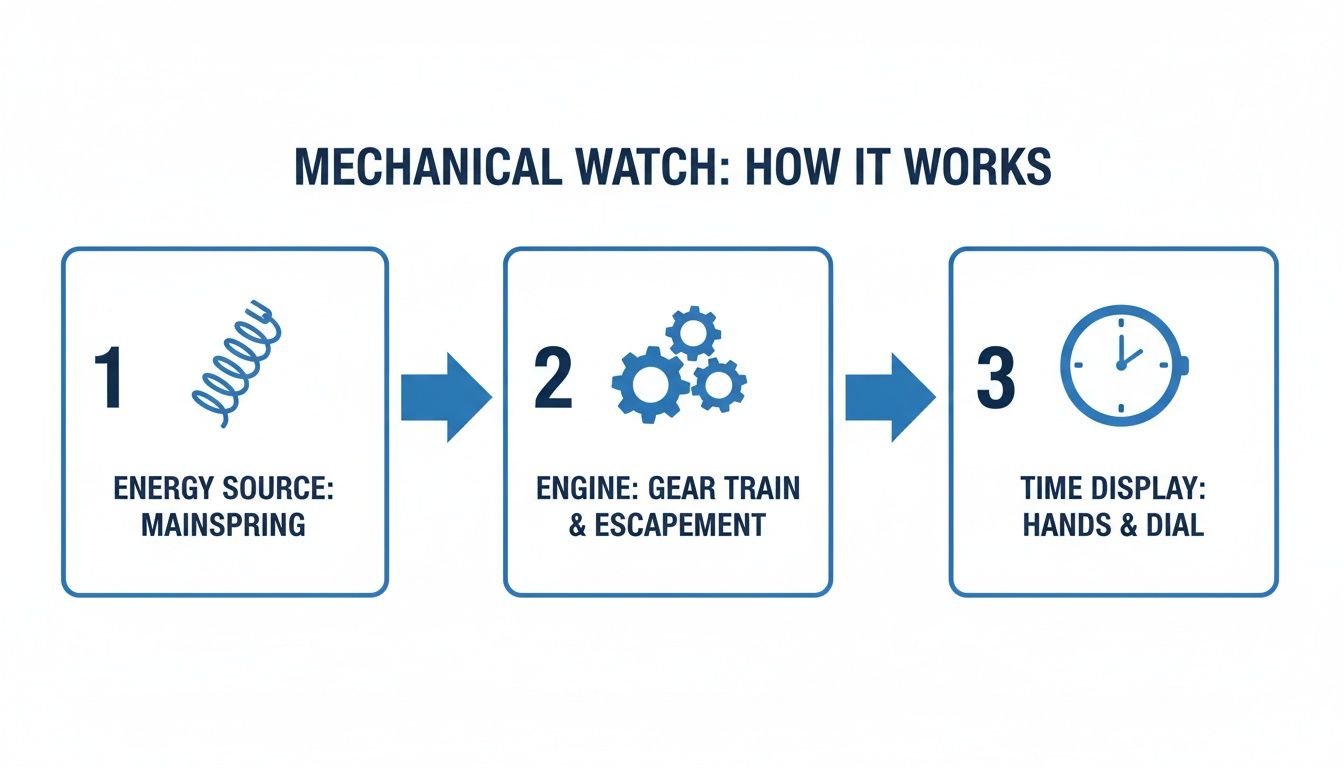
As you can see, it’s a direct, linear transfer of controlled power. Let's break it down.
- The Mainspring (The Fuel Tank): It all starts here. The mainspring is a coiled ribbon of metal tucked inside a small drum called the barrel. When you wind the watch, you're tightening this spring, effectively filling up its "fuel tank" with potential energy.
- The Gear Train (The Transmission): As the mainspring gradually unwinds, it releases its power into a series of interconnected gears. This is the gear train, and it works just like a car's transmission, managing the power to precisely drive the hands.
- The Escapement (The Brakes): This is the genius of the whole system and what creates the watch's signature ticking sound. The escapement takes the steady force from the gears and chops it up into tiny, perfectly timed bursts of energy.
- The Balance Wheel (The Heartbeat): The escapement sends these little energy kicks to the balance wheel, a weighted wheel that oscillates back and forth at a very specific rate. It’s attached to a tiny hairspring that ensures each swing is perfectly timed.
The rhythmic oscillation of the balance wheel—typically beating 5 to 10 times per second—is the true heartbeat of the watch. This constant, predictable motion is what regulates the speed at which the hands turn, giving the watch its accuracy.
Centuries of Refined Engineering
This incredible system is a direct descendant of watchmaking principles perfected centuries ago. The lever escapement, for example, was fine-tuned in the late 1700s, finally making it possible to create portable timekeepers accurate to within seconds per day. While materials and manufacturing have come a long way, the fundamental engineering remains a testament to timeless design.
If you really want to get into the weeds, you can explore a detailed guide to watch parts and how a watch works.
Choosing Between Manual and Automatic Movements
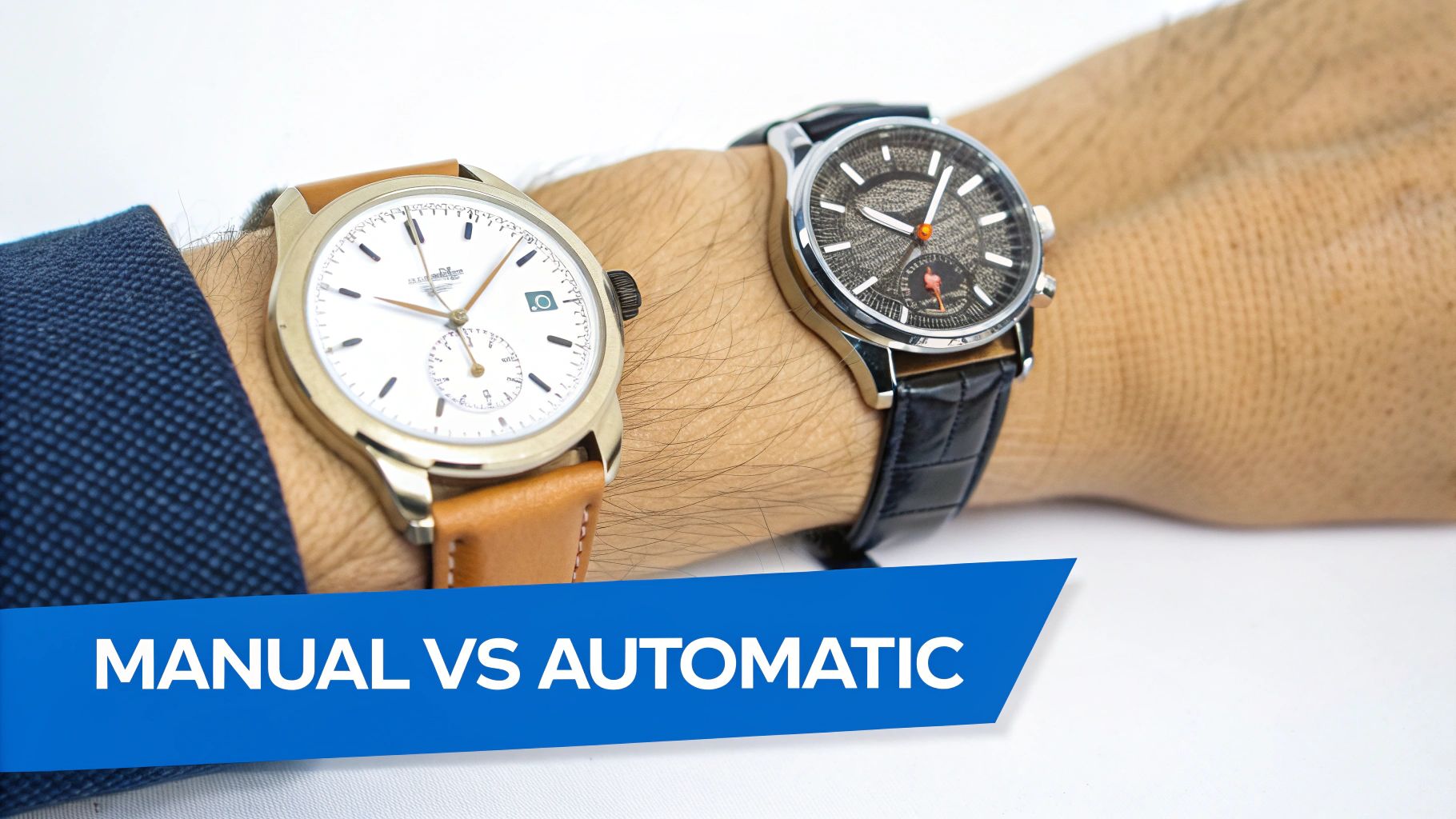
Now that you understand the intricate engine inside a mechanical watch, the next big question is: how do you want to power it? Every mechanical movement falls into one of two families: manual-wind or automatic.
Your choice here isn’t just technical; it's about the kind of relationship you want with your watch. One is a hands-on, daily ritual, while the other is all about modern, effortless convenience. Let's dig into what makes each one tick.
The Tactile Charm of Manual-Wind Watches
A manual-wind, or hand-wound, movement is mechanical watchmaking in its purest form. Just as the name suggests, you have to physically turn the crown—usually once a day or so—to tighten the mainspring and give the watch its power.
For most enthusiasts, this is far from a chore. It’s a cherished ritual. That daily interaction creates a deep, personal connection to your timepiece, a quiet moment to appreciate the micro-engineering at your fingertips. Because they don't have the extra self-winding parts, manual watches are often slimmer and more elegant, sometimes offering a beautiful, unobstructed view of the movement through a display caseback.
The Ingenuity of Automatic Movements
The automatic (or self-winding) movement was a brilliant evolution in watchmaking. It adds a weighted, semi-circular component called a rotor, which spins freely with the natural motion of your wrist as you go about your day. This spinning automatically winds the mainspring for you.
The genius of the automatic is its seamless convenience. It literally harnesses your own kinetic energy to keep itself running, making it the perfect "set it and forget it" mechanical option for daily wear.
As long as you wear it regularly, an automatic watch will keep running without any need for manual winding. This incredible practicality is why automatic movements have become the standard in the vast majority of modern luxury watches today.
If you want to learn more about how this works, be sure to check out our complete guide on automatic watches and their unique benefits.
Comparing Manual and Automatic Watch Movements
So, which one is right for you? It really boils down to what you value most in a watch. Are you drawn to the classic, interactive experience, or do you prefer the effortless convenience of modern engineering?
To make it easier, we've put together a simple side-by-side comparison.
| Feature | Manual-Wind | Automatic (Self-Winding) |
|---|---|---|
| Winding | Requires daily winding via the crown. | Winds itself with the wearer's motion. |
| Interaction | Creates a daily, tactile connection with the watch. | Offers a convenient, low-maintenance experience. |
| Case Design | Often slimmer and lighter due to fewer parts. | Can be thicker and heavier to house the rotor. |
| Power Reserve | Typically 40-80 hours; stops when not wound. | Stays wound if worn regularly; has a similar power reserve when static. |
| Best For | Collectors who appreciate tradition and a hands-on feel. | Individuals seeking a practical, everyday mechanical watch. |
Ultimately, there's no wrong answer. Both manual and automatic movements represent a passion for craftsmanship and a love for the art of telling time without a battery.
The World of Watch Complications Explained
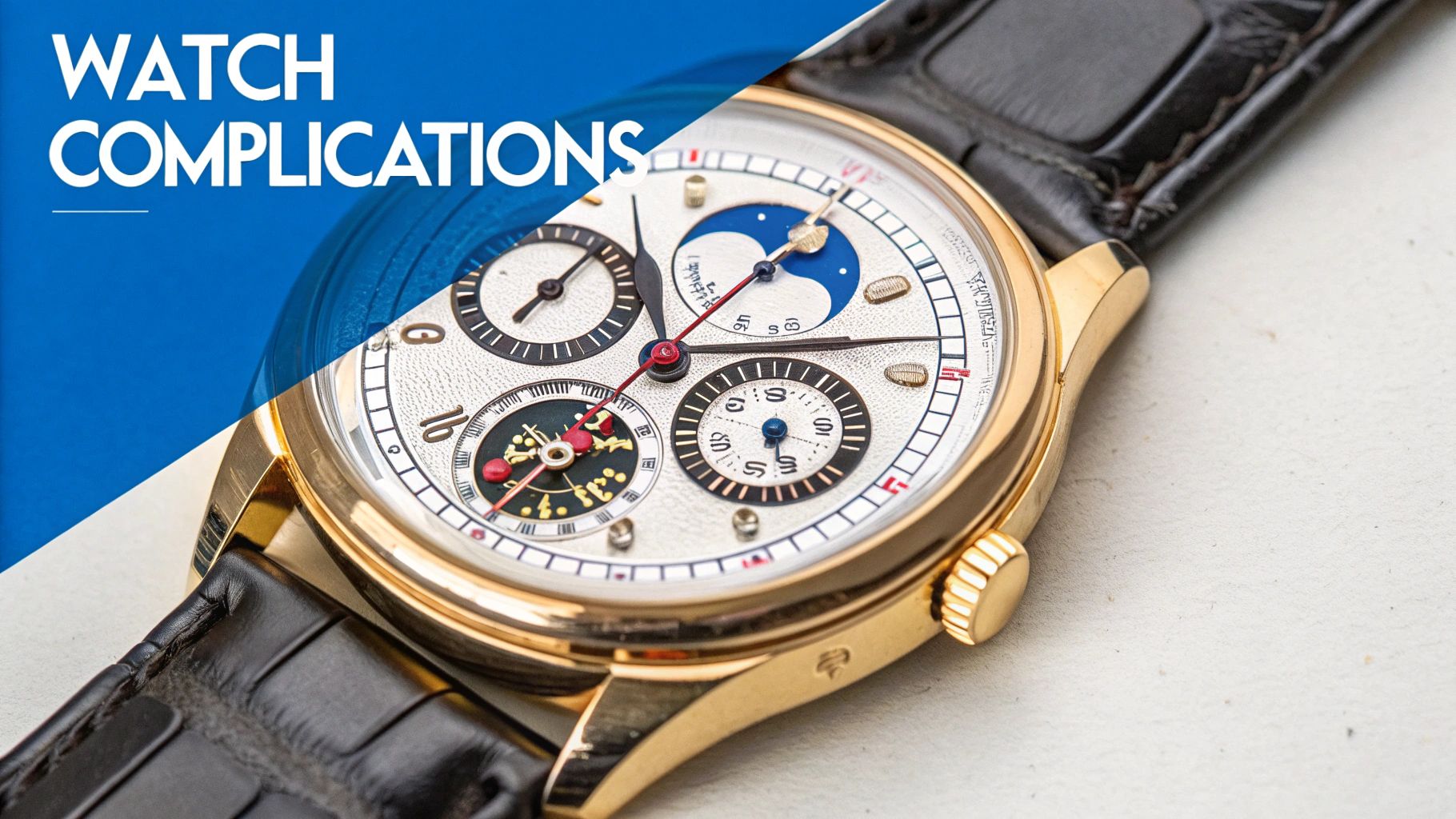
In the fascinating world of mechanical watches, anything a timepiece does beyond telling the hours, minutes, and seconds is called a complication. These aren't just extra features; they are tiny, intricate marvels of engineering that transform a simple time-telling device into a sophisticated instrument.
A complication is the ultimate showcase of a watchmaker's talent, often requiring hundreds of additional parts to be perfectly integrated into an already complex movement. They can range from the incredibly practical to the downright poetic, each one adding a new dimension of character and capability to the watch on your wrist.
Common Complications and Their Uses
While some complications are extraordinarily rare and complex, a few have become celebrated mainstays in the world of luxury watchmaking. These provide real-world functionality that truly enhances the owner's experience, whether it's for travel, sports, or simply appreciating the art of fine craftsmanship.
Here are some of the most popular complications you’ll come across:
-
The Chronograph: At its core, a chronograph is a built-in stopwatch, usually operated by pushers on the side of the case. It lets you time events with precision without messing with the watch's main job of telling time. Think timing laps at a racetrack or just making sure your steak is cooked to perfection.
-
The GMT Function: This one is a must-have for frequent flyers or anyone working across different regions. A GMT complication displays a second time zone, typically with an extra 24-hour hand and a matching bezel. It lets you keep track of local time and "home" time with just a glance.
-
The Moonphase Display: Easily one of the most visually stunning complications out there. A moonphase display accurately tracks the lunar cycle, showing you the current phase of the moon—from new to full—through a small window on the dial. It follows the 29.5-day cycle with incredible accuracy.
-
The Perpetual Calendar: This might be one of the most mechanically impressive feats in all of watchmaking. A perpetual calendar knows the date, day, month, and even accounts for leap years. It automatically adjusts for months with different lengths and only needs to be corrected once every hundred years.
A complication does more than add a function; it adds a story. It speaks to the incredible human ingenuity required to create a machine that can measure not just moments, but also the movements of the moon and the turning of the calendar.
The Pinnacle of Mechanical Artistry
Think about this: adding even a simple date window requires dozens of extra parts. Now imagine the sheer complexity involved in building a perpetual calendar or a chronograph. The most advanced timepieces, often called "grand complications," weave multiple complex functions together into a single, seamless movement.
At the very highest level of this craft sits the tourbillon, a mesmerizing rotating cage built to counteract gravity's effect on the watch's accuracy. This mechanism is a true signature of horological excellence. To get a better sense of this amazing invention, check out our guide explaining what a tourbillon watch movement is and why it's so revered by serious collectors. Each and every complication is a triumph of micro-engineering.
Why Collectors Choose Mechanical Over Quartz
Anytime you talk about mechanical watches, you have to talk about their battery-powered sibling: the quartz watch. Let’s be honest—on paper, a quartz movement is superior in almost every technical way. It's incredibly accurate, far cheaper to make, and barely needs any maintenance besides a new battery every few years.
So why would anyone pick the complex, less precise, and more expensive mechanical option?
The answer has nothing to do with pure utility and everything to do with artistry, history, and a real, tangible connection. A quartz watch is a highly efficient tool for telling time. A mechanical watch is a piece of living history on your wrist—a direct link to centuries of human ingenuity and meticulous craftsmanship. The choice isn't about which is better, but what you want your watch to represent.
The Beauty of Imperfect Precision
One of the first things people notice is the difference in accuracy. Even the most finely-tuned mechanical timepieces can't compete with the precision of a basic electronic circuit.
A modern, COSC-certified Swiss mechanical watch might aim for an accuracy of −4/+6 seconds per day. A standard quartz watch? It’s often accurate to within ±15 seconds a month. For a deeper dive into the market dynamics, Fortune Business Insights offers great analysis.
But for a true collector, this "imperfection" is exactly the point. It’s a constant, ticking reminder that you're wearing a miniature engine, not a circuit board. Its performance is the beautiful result of physical gears, springs, and jewels all working together in perfect harmony.
An Investment in Longevity and Artistry
The real magic of a mechanical watch unfolds over decades. Unlike a quartz watch that often gets tossed once its electronics die, a mechanical timepiece is built to outlive you. With proper servicing every 3–7 years, it can be passed down for generations, carrying stories and memories with it. It’s a sustainable choice and a powerful symbol of legacy.
Then there’s the sheer craftsmanship. Many high-end mechanical watches feature an exhibition caseback—a see-through window that lets you admire the intricate dance of the movement inside. It’s mesmerizing. This visible artistry transforms the watch from a simple accessory into a piece of kinetic sculpture you can wear.
Finally, you can't ignore the emotional and financial side of things. Owning a mechanical watch connects you to a rich tradition of horology. It’s also a tangible asset that often holds, or even increases, its value over time. It’s not just a purchase; it’s a true investment. For collectors, it's this blend of art, heritage, and enduring worth that makes the mechanical choice the only one that truly matters.
Essential Tips for Maintaining Your Mechanical Watch
Owning a beautiful mechanical watch is more like a long-term relationship than a one-time purchase. Just like a high-performance car, it needs regular care and attention to keep its intricate engine running flawlessly for decades. Protecting your investment isn't just about avoiding scratches—it's about understanding its needs, from daily handling to professional servicing.
Proper maintenance does more than just keep your timepiece accurate. It preserves its aesthetic and financial value for generations to come. A few simple, consistent habits can prevent costly damage and extend the life of your watch significantly, making it a true heirloom.
Regular Professional Servicing
Think of a professional service as a complete engine overhaul for your watch. Over time, the microscopic oils that lubricate the gears, wheels, and springs can dry up or thicken. Tiny particles of dust or metal can get inside and cause friction and wear. Ignoring this is a recipe for serious mechanical problems down the road.
Most luxury watch brands recommend a full service every 3 to 7 years, though this depends on the model, its complexity, and how often you wear it. Don't skip this interval—it's absolutely crucial for the long-term health of your watch.
A standard professional service isn't just a quick cleaning. It involves a complete disassembly of the movement, where each of the hundreds of parts is inspected, ultrasonically cleaned, and re-lubricated before being meticulously reassembled, calibrated, and tested.
Daily Care and Best Practices
Beyond the watchmaker's bench, how you handle your watch daily has a huge impact on its longevity. A few simple practices can make all the difference.
- Proper Winding: For a manual-wind watch, turn the crown gently until you feel a clear resistance, then stop immediately. Over-winding can cause damage. For automatics, a few turns are enough to get it started before the motion of your wrist takes over.
- Avoid Magnetic Fields: Strong magnets from speakers, tablets, laptops, and even some phone cases can magnetize the hairspring—a tiny, delicate coil that acts as the heartbeat of your watch. Magnetism is a top cause of a watch running wildly fast or slow.
- Understand Water Resistance: A rating of "30 meters" doesn't mean you can dive 30 meters deep. It really just means it's splash-resistant. Know your watch's limits before you ever expose it to water.
- Safe Storage: When you're not wearing it, store your watch in a soft-lined box, watch roll, or pouch. This protects it from scratches, dust, and accidental knocks.
Starting Your Mechanical Watch Collection
Making the leap from learning about mechanical watches to actually owning one is a huge milestone for any enthusiast. Your first timepiece isn't just a purchase; it's the start of a story—an investment in artistry that reflects who you are and can be passed down for generations.
But with so many options, how do you make a choice you’ll love for years to come? It's about looking beyond the dial. You need to consider the brand's history, the quality of the movement inside, and its reputation in the market. These are the things that ensure long-term value and deep satisfaction. This is where having a trusted expert in your corner makes all the difference.
Navigating Your First Purchase
A great jeweler does more than just sell watches; they guide you through this intricate world. They can spot a fake from a mile away, give you a fair and honest valuation, and help you find a piece that truly clicks with your personal style and collecting goals.
There's a reason the luxury watch world is built on mechanical movements. In 2023, Swiss watch exports hit an incredible CHF 26.7 billion. Mechanical pieces claimed a massive share of that value, even though far fewer are made compared to quartz. Want to dive deeper? Read the full research on the mechanical watch market.
Building a collection is one of the most rewarding journeys you can take. It’s a process of discovery. By working with experts and focusing on quality, you’re not just buying a watch—you're acquiring a future heirloom. The key is to start with a smart approach, so it's worth understanding how to build a watch collection with a clear strategy from day one.
At ECI Jewelers, our specialists are here to guide you through every step of the process. From authenticating your first major purchase to servicing it for decades to come, we've got your back. Explore our curated collection of fine timepieces at https://www.ecijewelers.com.


