


At its core, a moon phase watch is a timepiece with a special feature—what watch folks call a ‘complication’—that beautifully shows you the current phase of the moon just as you’d see it in the night sky. It's more than just a watch; it's a tiny celestial theater on your wrist, tracking the moon’s journey through its 29.5-day cycle.
The Art and Soul of a Moon Phase Watch
A moon phase watch captures the romantic, ancient connection between humanity and the cosmos. Long before we had digital calendars, the lunar cycle governed everything from agriculture to navigation. This complication is a nod to that history, translating the predictable, poetic rhythm of the heavens into a mesmerizing mechanical show.
Think of it as a small, animated painting. Behind the dial, a disc painted with two identical moons rotates ever so slowly, driven by a series of precise gears. An opening on the dial, often shaped like a crescent or a figure-eight, reveals only a piece of this disc at a time, perfectly mimicking the waxing and waning of the moon.
You can learn more about the rich history of this complication at Crown & Caliber.
This complication isn’t really about modern-day usefulness. It's about celebrating the artistry of watchmaking. It represents a maker's skill and an owner's appreciation for detail, history, and pure mechanical beauty.
Unlike a simple date window, the moon phase display adds a layer of dynamic, visual storytelling to the watch. It connects you to the natural world in a way few other objects can. The key parts you’ll see are:
- The Aperture: This is the window on the dial where you see the moon.
- The Lunar Disc: The rotating disc underneath the dial, usually featuring two moons against a star-filled background.
- The Moon Illustrations: The drawings of the moon itself, which can range from simple prints to incredibly detailed, hand-engraved masterpieces.
The 8 Lunar Phases on Your Watch Dial
A moon phase watch isn't just showing a pretty picture; it's accurately tracking the 8 distinct phases of the moon. This table breaks down the complete lunar cycle your watch follows, helping you quickly identify each stage.
| Phase Number | Phase Name | What You See on the Dial |
|---|---|---|
| 1 | New Moon | The moon is completely hidden or just barely visible. |
| 2 | Waxing Crescent | A small sliver of the moon appears on the right side. |
| 3 | First Quarter | The right half of the moon is fully illuminated. |
| 4 | Waxing Gibbous | More than half the moon is lit, growing toward full. |
| 5 | Full Moon | The entire moon is visible in the center of the aperture. |
| 6 | Waning Gibbous | The lit portion starts to shrink from the right side. |
| 7 | Third Quarter | The left half of the moon is fully illuminated. |
| 8 | Waning Crescent | A final small sliver remains on the left before disappearing. |
From the invisible New Moon to the bright Full Moon and back again, this entire cycle is what gives the complication its life and character.
How a Moon Phase Watch Actually Works
Beneath that elegant little window on the dial lies a true marvel of micro-engineering—a mechanical ballet of gears and discs designed to mirror the cosmos. It all starts with the watch's movement, the intricate engine that powers everything else. Tucked away inside is a special set of gears dedicated solely to the moon phase complication.
This system turns a rotating disc that has two identical moons painted on it. As the disc slowly inches forward each day, it passes behind a specially shaped aperture on the dial. This little window has two curved edges that perfectly mimic the silhouette of the Earth's shadow, revealing just the right sliver of the moon illustration below. The real magic is in the gearing that controls the disc's snail-like pace.
To really get how this works, you have to look at the two main systems used in watchmaking. Each one represents a different level of precision and, frankly, obsession.
The Classic 59-Tooth Gear System
The most common and traditional way to track the moon involves a gear with exactly 59 teeth. This isn't a random number; it's a clever watchmaker's solution to a math problem. Since the actual lunar cycle is about 29.5 days, the 59 teeth on the gear perfectly represent two full lunar cycles (29.5 x 2 = 59).
A tiny "finger" attached to the hour wheel nudges this gear forward just once every 24 hours. As the gear completes its full rotation over 59 days, the disc with the two moons also completes its journey, showing everything from the new moon to the full moon and back again. If you want to get a better sense of the bigger picture, check out our guide on how a mechanical watch works.
This diagram helps visualize how the core components connect the lunar cycle to the watch's internal mechanism.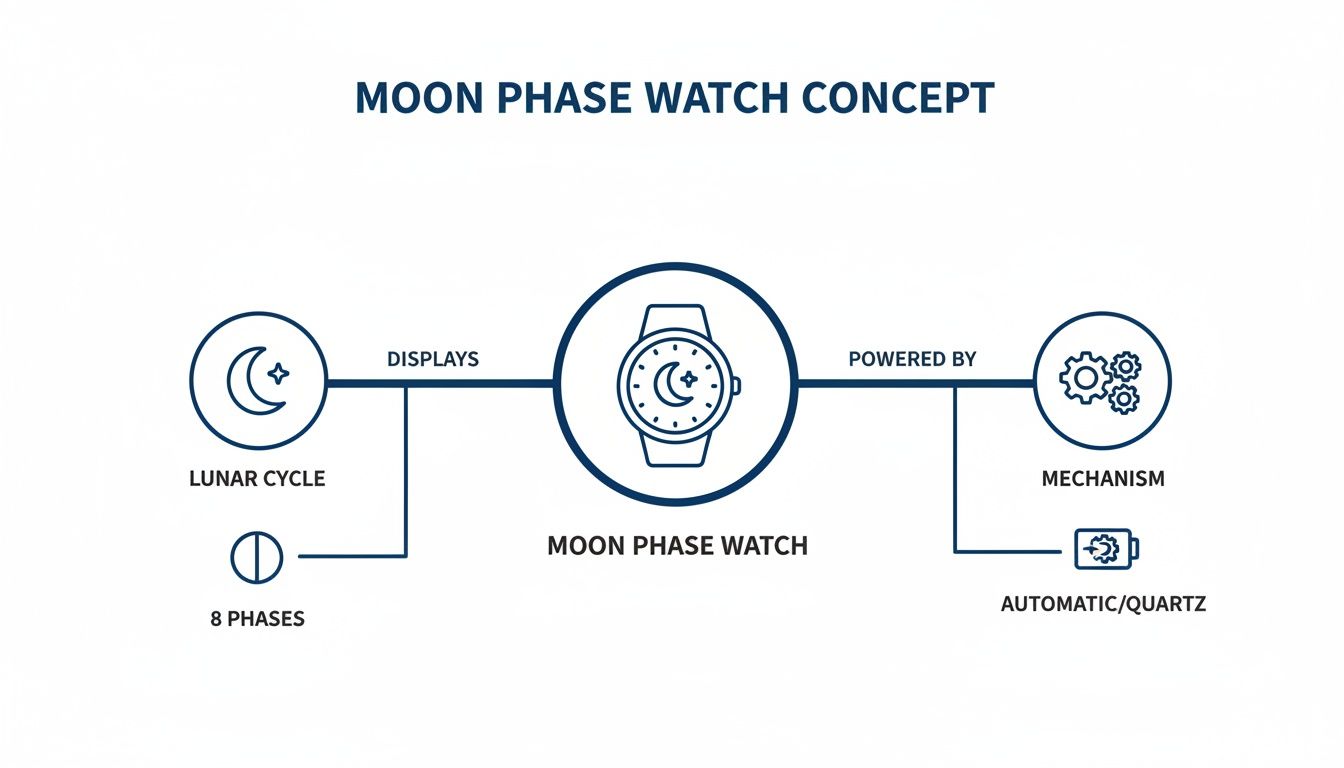
It shows how the watch's gearing is engineered to translate the 29.5-day lunar reality into that beautiful, rotating display on your wrist.
There's a catch, though. The true lunar cycle is slightly longer than 29.5 days. This small discrepancy means a standard 59-tooth moon phase will eventually drift out of sync, needing a manual tweak every two or three years.
Astronomical Moon Phase Precision
For those who demand the absolute highest level of accuracy, watchmakers developed the "astronomical" moon phase. This is a far more complex system that uses a gear with 135 teeth.
This advanced mechanism is engineered to track the lunar cycle so precisely that it will remain accurate for an astonishing 122 years before needing a one-day correction.
Think of it this way: the 59-tooth gear is like a standard calendar that needs a leap day every few years to stay on track. The 135-tooth system, on the other hand, is like a hyper-accurate observatory clock that remains correct for over a century.
This incredible precision is a testament to the watchmaker's skill and a key reason why high-end moon phase watches are so prized by collectors. It’s the pinnacle of turning celestial motion into mechanical art.
The Pursuit of Precision in Moon Phase Watches
While the visual poetry of a moon phase watch is what draws most people in, its real soul lies in the mechanical chase for accuracy. Not all moon phase complications are built the same; their precision is a direct reflection of the watchmaker's skill and ambition.
This quest for perfection creates different tiers of accuracy, separating a charming timepiece from a true horological masterpiece.
Standard Moon Phase Watches
At the most common level, you'll find standard moon phase watches. The vast majority of these rely on a classic 59-tooth gear system. They're beautifully engineered and give you a reliable picture of the lunar cycle.
However, there's a tiny mathematical mismatch between the 29.5-day gear cycle and the true lunar month. Because of this, these watches typically need a manual correction every two to three years. This is the entry point into this beloved complication.
High-Precision Astronomical Accuracy
Climbing up the ladder, we get into high-precision, or "astronomical," moon phase complications. These are the work of legendary brands like Patek Philippe and Jaeger-LeCoultre, which use more complex gearing, like a 135-tooth wheel, to dramatically close that accuracy gap.
A high-precision moon phase watch is engineered to stay accurate for over a century—often for 122 years—before needing a single day's adjustment. Owning one is like holding a piece of clockwork that has almost conquered the celestial clock itself.
This level of precision is a signature of fine watchmaking. It shows a brand's dedication to pushing the boundaries of mechanical art and is highly prized by collectors who appreciate the intricate problem-solving involved.
The Pinnacle: Perpetual Moon Phases
At the absolute peak of watchmaking are the ultra-precise or "perpetual" moon phase watches. These are mechanical wonders designed to outlast generations, with some engineered to stay accurate for thousands of years. Their technical brilliance lies in how closely their gearing simulates the true synodic month of 29 days, 12 hours, and 44 minutes.
While many perpetuals use advanced versions of the 59-tooth gear, masters like A. Lange & Söhne and Patek Philippe create versions accurate for over 1,000 years, showcasing incredible mastery.
For an extreme example, Andreas Strehler’s Sauterelle à lune perpétuelle 2M holds a mind-boggling record: its moon phase needs an adjustment only once every 2.045 million years. Feats like this elevate the complication from a simple display to a profound statement on time and human ingenuity.
These incredible mechanisms are often found alongside other "grand complications." You can learn more about how they work together in our guide on what a perpetual calendar watch is. It's this astonishing precision that collectors chase—the feeling of owning a true mechanical legacy.
Exploring Different Moon Phase Watch Designs
A moon phase complication is so much more than a technical feature; it's a tiny canvas for artistry and storytelling right on your wrist. The way a watchmaker decides to show the lunar cycle says everything about the timepiece's character, turning it from a simple instrument into a piece of wearable art. This incredible design diversity means there’s a moon phase watch for every taste, from sleek dress watches to beefy sports chronographs.
When you boil it all down, the stunning variety in moon phase designs comes down to two main display styles, and each one offers a totally different look and feel.
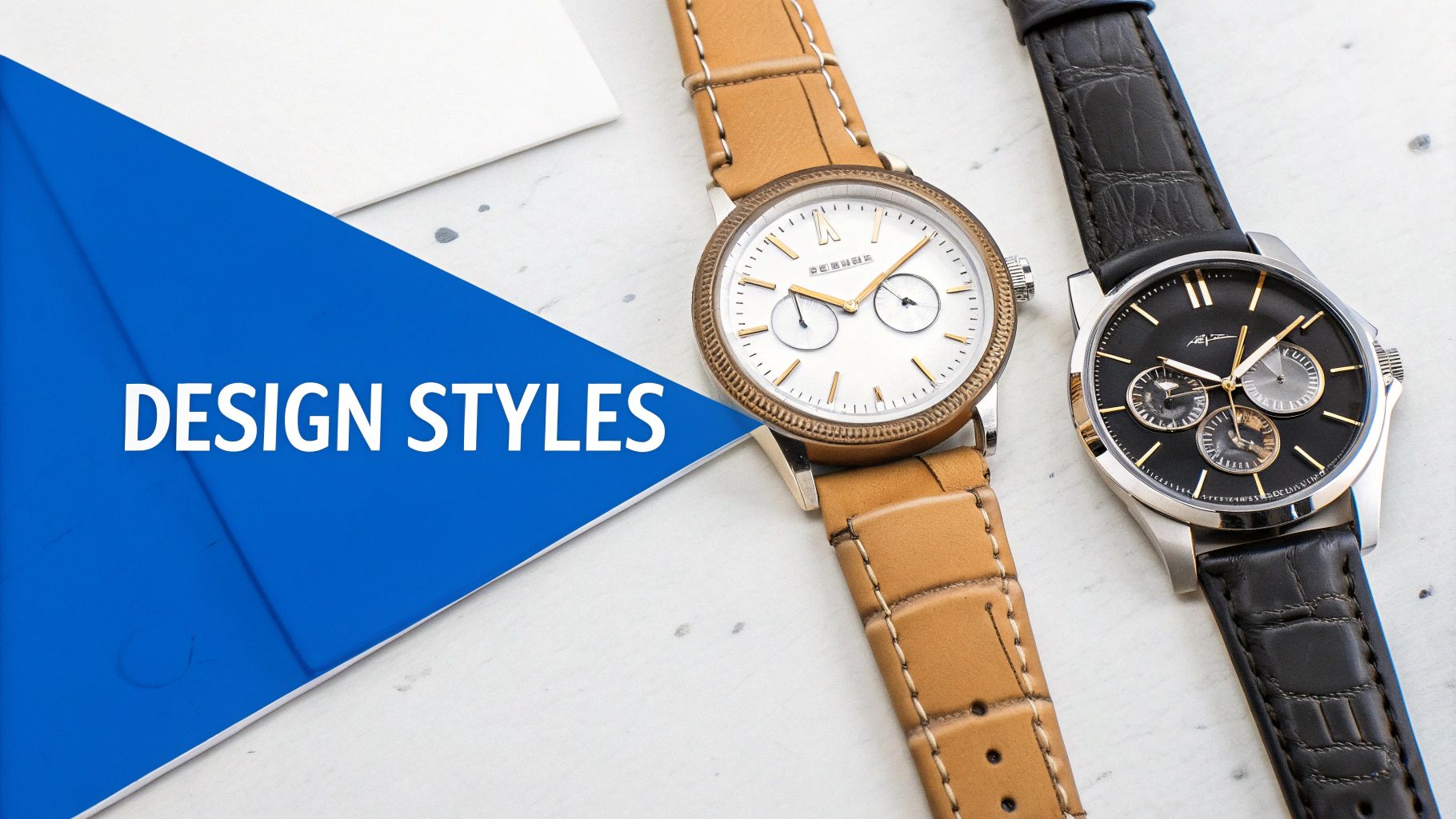
The Classic Bosom Display
The most traditional and, let's be honest, romantic design is the "bosom" moon phase. You'll also hear it called an aperture or crescent display. This style uses a crescent-shaped window on the dial to reveal just a sliver of a rotating disc hidden beneath. That disc is usually a deep, starry blue and features two beautifully illustrated moons.
As the disc slowly turns, the curved edges of the window perfectly hide parts of the moon, elegantly mimicking its natural waxing and waning. It’s a poetic, almost theatrical presentation that has captivated watch lovers for centuries.
The bosom style is the quintessential look for a moon phase watch. It just screams history and artistry, making it the perfect match for classic dress watches like a Patek Philippe Calatrava or a Jaeger-LeCoultre Master Ultra Thin Moon.
The Modern Radial Display
For a more contemporary take, you have the "radial" moon phase. This version uses a pointer hand to indicate the current lunar phase on a sub-dial. Instead of a disc peeking through a window, a dedicated hand moves along a track marked with little illustrations of the different phases, from new moon to full moon and back again.
This design gives off a more technical, instrument-like vibe. It's clean, precise, and often gets paired up with other complications like a date function inside the same sub-dial.
You’ll see this style pop up frequently in sportier or more modern watches. For example, some Omega Speedmaster models seamlessly integrate a radial moon phase into the chronograph layout, adding a touch of celestial flair without compromising the watch's tool-watch identity.
Versatility Across Watch Styles
The real beauty of the moon phase complication is just how versatile it is. It can be the star of the show on a minimalist dial or a perfectly integrated piece in a wildly complex "grand complication" watch.
The aesthetic possibilities are nearly endless. To help you find the style that resonates with you, here’s a quick comparison of how the moon phase complication is expressed across different types of watches.
Moon Phase Watch Style Comparison
| Watch Style | Typical Characteristics | Example Brands (e.g., Rolex, Patek Philippe, Omega) |
|---|---|---|
| Dress Watch | Elegant, minimalist dials. Often features a classic "bosom" display. Focuses on artistry and sophistication. | Patek Philippe, Jaeger-LeCoultre, Blancpain, A. Lange & Söhne |
| Sports Watch | Bold, functional design. Often uses a "radial" display integrated with chronographs or other tools. | Omega, IWC, Zenith |
| Complicated Calendar | Part of a larger display, often paired with perpetual or annual calendars. Blends technical prowess with classic looks. | Vacheron Constantin, Audemars Piguet, Breguet |
| Avant-Garde/Modern | Unconventional displays, unique materials, and creative interpretations of the moon itself (e.g., photorealistic, 3D). | Arnold & Son, De Bethune, Greubel Forsey |
Ultimately, this adaptability is what makes the moon phase so beloved by collectors. It proves that a single complication can be interpreted in countless ways, each telling a different story of time, art, and our connection to the cosmos.
Why Collectors Love the Moon Phase Complication
So, what is it about that tiny moon on the dial that gets watch collectors so excited? Beyond the clever mechanics, the moon phase complication has a special place in the hearts of enthusiasts for reasons that go way beyond telling time.
It’s more than just another function; it’s a piece of storytelling that connects you to centuries of history, artistry, and the timeless pull of the cosmos.
A Symbol of Artistry and Romance
First off, it’s a nod to history. Long before we had weather apps and GPS, the lunar cycle was everything—it guided farming, navigation, and the very concept of a month. A moon phase watch is a tangible link to that era, a little tribute to the astronomical observations that laid the groundwork for modern watchmaking. Owning one feels like wearing a small piece of that legacy.
The complication is also just plain beautiful. There's an undeniable romance to seeing a tiny golden moon glide across a star-filled sky on your wrist. It creates a sense of wonder and poetry that few other features can match. It’s a dynamic, visual story that changes every single day, reminding us of the natural rhythms of the world around us.
For many collectors, the moon phase is the ultimate expression of a watchmaker's skill. Its creation requires not just technical precision but also an artistic eye, transforming gears and levers into a captivating celestial theater. It’s a complication that is admired, not just used.
This blend of technical mastery and aesthetic grace makes the moon phase a cornerstone of any serious watch collection.
If you're curious about what elevates a watch from a simple timepiece to a collector's item, it's worth exploring the guides on the most collectible luxury watches. You'll see how rarity, brand heritage, and design all come together to create lasting value.
Ultimately, collectors love the moon phase because it delivers on so many levels:
- Historical Connection: It honors the ancient relationship between humanity and the stars.
- Mechanical Prowess: It's a clear sign of high-quality, complex watchmaking.
- Artistic Expression: It adds a layer of beauty and poetic charm that's hard to resist.
For these reasons, the moon phase isn't just a feature; it's a statement. It says you appreciate the finer, more thoughtful aspects of time itself.
A Practical Guide to Owning a Moon Phase Watch
Bringing a moon phase watch into your life is a real milestone, whether it's your first serious timepiece or a thoughtful addition to a growing collection. But before you pull the trigger, there are a few things that separate a good watch from a great one. Knowing what to look for will give you the confidence to choose the right piece.
What to Look For Before You Buy
First up is the movement. A standard moon phase complication will need a manual tweak every 2.5 years or so, which is perfectly fine—and even a pleasant ritual—for most collectors. If you’re after ultimate precision, an astronomical moon phase offers accuracy for over a century, a testament to next-level craftsmanship. The choice between quartz versus automatic movements also plays a huge role here, affecting everything from maintenance to the watch's daily feel on your wrist.
Beyond the mechanics, you'll want to look at the watch's overall condition, the heritage of the brand, and its provenance. A watch that comes with its original box and papers is always a huge plus. It’s not just about proving it’s authentic; it significantly bolsters its long-term value.
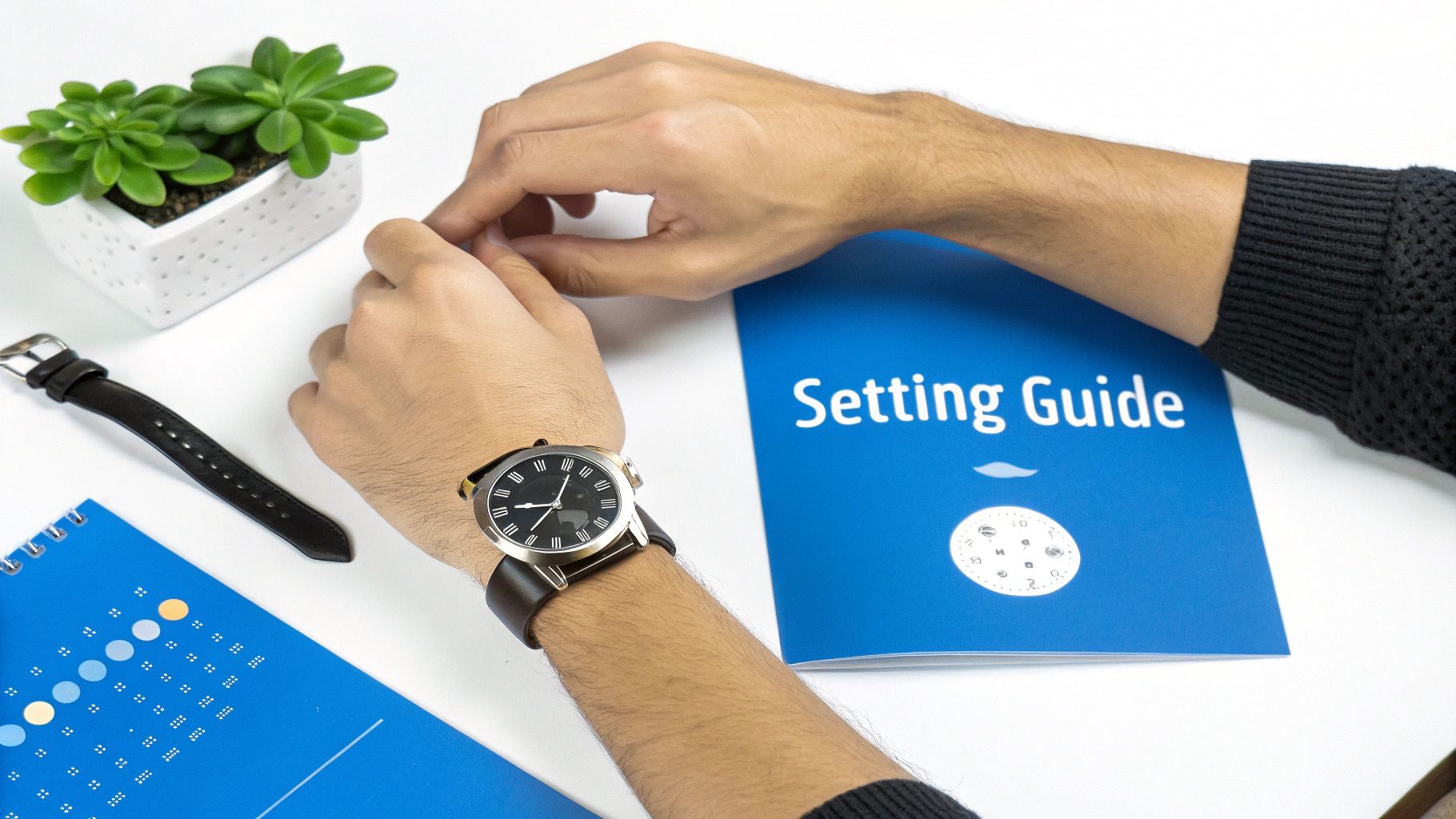
Setting Your Moon Phase Correctly
Once it's yours, setting the moon phase is one of the most satisfying parts of owning one. First, you'll need to find the date of the last full moon—a quick search for a lunar calendar online will do the trick. From there, it's just a few simple steps to sync your watch with the cosmos.
- Find the Full Moon: Pull the crown out to the correct position (your watch manual will tell you which one) and turn it until the full moon sits perfectly centered in the display.
- Count the Days: Check your lunar calendar and count how many days have passed since that last full moon.
- Click Forward: For every day you just counted, advance the moon disc forward by one "click" or position. That's it—your watch is now in sync with the sky.
The Golden Rule of Watch Care: Never, ever adjust the moon phase or date when your watch's hands are between 9 PM and 3 AM. In this window, the watch's internal gears are already engaged to change the date automatically. Forcing a manual adjustment can snap a gear or cause serious damage. Always play it safe and move the hands to the bottom half of the dial (like 6:30) before setting anything.
Common Questions About Moon Phase Watches
As you dive into the captivating world of moon phase watches, it’s only natural for a few questions to pop up. Let's clear up some of the most common ones so you can feel more confident as an enthusiast or a potential buyer.
Is a Moon Phase Watch Actually Useful?
In our modern world? Not really. Your smartphone can tell you the lunar cycle in an instant. But that’s missing the point entirely. A moon phase watch isn't valued for its day-to-day utility; it's cherished for its mechanical artistry, rich history, and romantic connection to the cosmos.
Think of it less as a tool and more as a piece of kinetic art on your wrist—a testament to the watchmaker's incredible skill.
Why Do Some Moon Phase Watches Have Two Moons?
That classic display with two moons on one disc is actually a brilliant piece of engineering. The lunar cycle is roughly 29.5 days long. To track it, watchmakers use a gear with 59 teeth (which is just 29.5 multiplied by 2).
This gear turns the disc one full rotation every two lunar cycles. With two moons on the disc, one is always perfectly positioned to appear in the crescent-shaped window on the dial while the other completes its journey hidden from view. It’s a simple, elegant solution.
How Often Do I Need to Set It?
This really comes down to the quality and complexity of the movement inside.
- Standard Moon Phase: Most models use that 59-tooth gear we just talked about. They’re quite accurate but will need a one-day correction every two to three years.
- Astronomical Moon Phase: Higher-end watches use more sophisticated gearing, like a 135-tooth wheel, pushing their accuracy to over a century. You'll only need to adjust it once every 122 years.
- Perpetual Moon Phase: These are the marvels of horology. They are engineered to be accurate for over 1,000 years.
For many collectors, the need for that occasional tweak on a standard model is part of its charm. It creates a hands-on connection between you and the intricate little machine on your wrist.
Is It Difficult to Maintain?
Not at all. A moon phase complication doesn't require any special care beyond what you’d give any fine mechanical watch—a regular servicing every five to seven years will keep it happy.
There is one golden rule, though: never adjust the moon phase between 9 PM and 3 AM. During these hours, the watch's internal date-changing gears are engaged. Forcing the moon phase to move at this time can cause serious damage to the movement.
If you have broader questions about watch care, a general list of frequently asked questions about watches can be a great resource for additional insights.
At ECI Jewelers, we believe a moon phase watch is more than an accessory—it's a piece of history and artistry you can wear every day. Explore our curated collection of exceptional timepieces from the world's most revered brands. https://www.ecijewelers.com


