


At its most fundamental level, a pilot watch is a purpose-built tool designed for the unforgiving environment of an aircraft cockpit. Think of it as the original flight computer, strapped right to an aviator's wrist. Its one and only mission? To provide instant, crystal-clear, and utterly reliable information, especially when flight instruments might fail.
Understanding the Original Flight Computer

Long before GPS and digital displays, pilots navigated with little more than maps, a compass, and a watch they could trust with their lives. This wasn't a fashion statement; it was a life-saving instrument. The entire design philosophy is built around function over form, answering the real-world needs of someone wrestling with a complex machine miles above the earth.
Just imagine trying to wind a tiny watch crown while wearing thick leather gloves in a vibrating, unpressurized cockpit. That exact problem is why pilot watches feature huge "onion" or "diamond" crowns—so you could operate them without taking off essential gear.
Core Principles of Pilot Watch Design
Every single feature on a classic pilot watch was engineered to solve a specific problem in the air. This design DNA is what separates them from other tool watches, and it all boils down to a few non-negotiable principles:
- Unmatched Legibility: Dials are almost always large, high-contrast (think bold white numerals on a matte black background), and free of clutter. The goal is to get crucial time data in a single, split-second glance.
- Rugged Durability: Built to handle constant vibrations, wild temperature swings, and the magnetic fields thrown off by cockpit instruments, these watches were made to be bombproof.
- Practical Functionality: From chronographs used to time flight legs to GMT hands for tracking multiple time zones, every complication served a real navigational purpose.
To give you a clearer picture, here’s a quick breakdown of these key features and why they were so critical.
Key Characteristics of a Pilot Watch
| Feature | Purpose in the Cockpit |
|---|---|
| Large, Legible Dial | To read the time instantly, even with cockpit vibrations and poor lighting. |
| High-Contrast Numerals | Maximizes readability at a quick glance, often using luminous materials for night flights. |
| Oversized Crown | Allows pilots to operate the watch easily while wearing thick flight gloves. |
| Anti-Magnetic Casing | Protects the movement from magnetic interference from cockpit instrumentation. |
| Chronograph Function | Enables precise timing of fuel consumption, flight legs, and navigational calculations. |
| GMT/Dual Time Zone | Helps pilots track both local time and a reference time (like GMT/UTC). |
These aren't just design quirks; they are battle-tested solutions that have defined the category for nearly a century.
A true pilot watch is more than just an aesthetic. It's a piece of history forged by necessity. Every element, from the oversized crown to the anti-magnetic case, tells a story of an aviator who needed a tool that simply would not fail.
This perfect blend of historical purpose and timeless, functional design is what allowed the pilot watch to transition so smoothly from an essential cockpit tool to a celebrated style icon. For any serious watch collector, it represents a legacy of adventure, precision, and the pioneering spirit of early aviation.
The Pioneering History of Aviation Timepieces
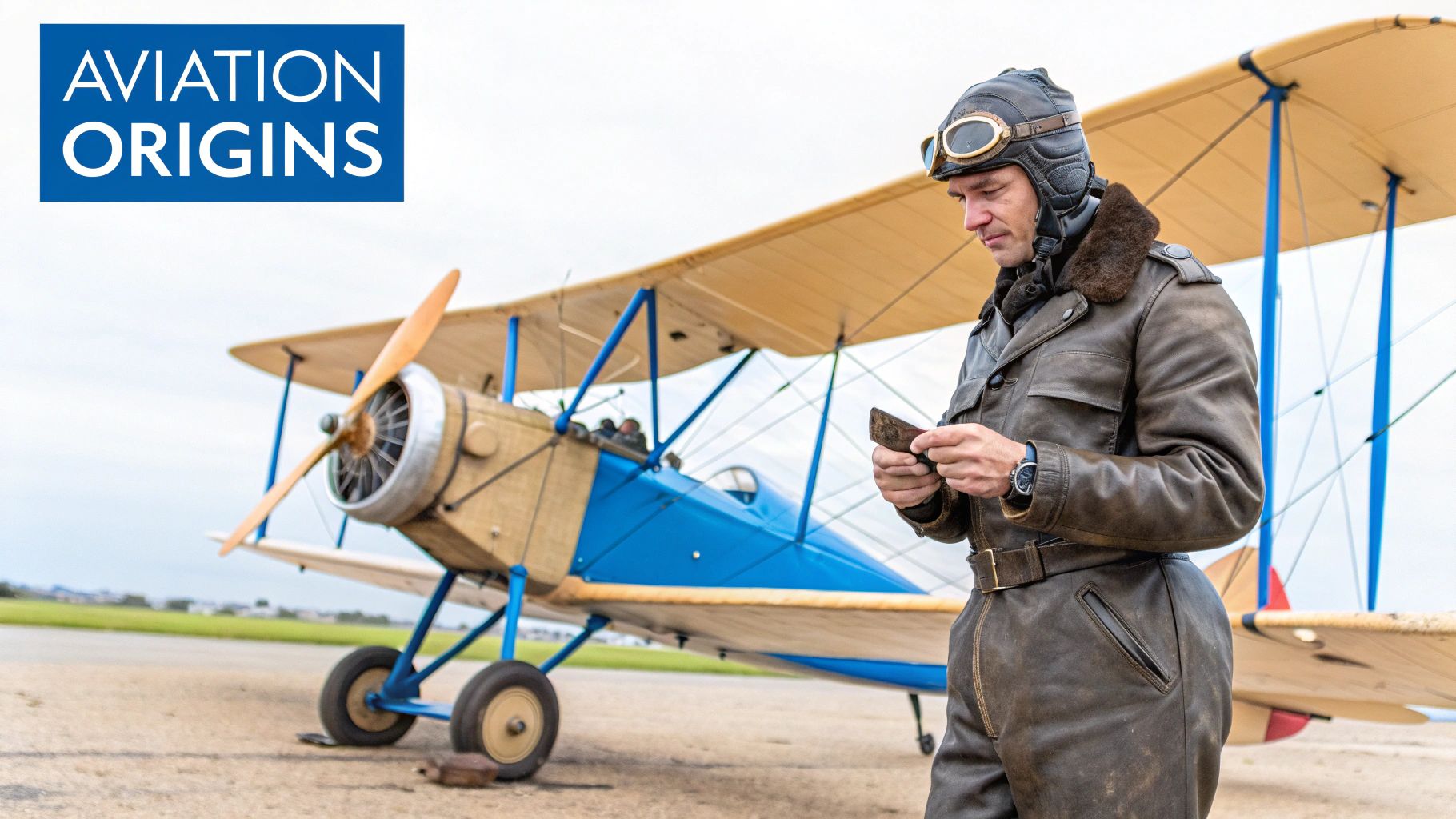
To really get what a pilot watch is, you have to go back to the very dawn of aviation. Think early 1900s—a time when flying was a raw, seat-of-your-pants adventure. Pilots were navigating with the most basic instruments, and a reliable timepiece wasn't just a nice-to-have; it was a critical piece of gear. The only problem? All they had were bulky pocket watches.
Now, imagine you're wrestling the controls of a rickety, open-cockpit plane. You need both hands just to stay in the air. The last thing you can do is start digging through layers of flight gear to fish out a pocket watch. It was more than just impractical; it was dangerous. And this exact problem set the stage for one of the biggest moments in watchmaking history.
The story really kicks off in 1904 with the legendary Brazilian aviator, Alberto Santos-Dumont. He was in Paris, complaining to his friend, the famous jeweler Louis Cartier, about how impossible it was to check his pocket watch mid-flight. That one conversation planted a seed.
In response, Cartier designed a unique, square-cased watch with a leather strap that Santos-Dumont could wear right on his wrist. It was a game-changer. He could now keep both hands on the controls and just glance down at the time. When Santos-Dumont made the first officially recognized powered flight in Europe on October 23, 1906, that Cartier Santos was on his wrist, cementing its place as the world's first purpose-built pilot watch. You can read more about this historic flight and its massive impact on watch design.
From Fashion Accessory to Essential Tool
This single invention completely flipped the script. Before the Cartier Santos, wristwatches were seen as delicate, feminine accessories. But here was Santos-Dumont—a celebrated, masculine public figure—making the wristwatch a symbol of the modern, adventurous man. It marked a clear shift from decorative jewelry to an indispensable tool.
This new perception couldn't have come at a more critical time. As the world barrelled toward World War I, aviation’s role in warfare exploded. Aerial dogfights and reconnaissance missions demanded that pilots execute perfectly synchronized maneuvers.
The wristwatch became standard military issue out of pure necessity. Synchronizing an attack or a patrol required every pilot to be on the exact same time, and a pocket watch was simply too clumsy for the cockpit.
This era forged the pilot watch’s true identity. It was no longer just a convenient way to tell time. It was military hardware, an instrument of navigation, and a symbol of the courage and innovation that defined the age of flight. This rich heritage, born from solving a simple problem and proven in the crucible of conflict, is what gives the pilot watch its enduring appeal and makes it such a prized category for collectors today.
Decoding the Essential Features of a Pilot Watch
A true pilot watch is much more than a timepiece with an aviation-inspired name; it’s a masterclass in functional design where every component was born from necessity. These watches were engineered as critical cockpit instruments first and stylish accessories second. To really appreciate them, you have to understand the problems each feature was designed to solve for early aviators.
Take one look, and the first thing you’ll probably notice is the oversized crown, often called an "onion" or "diamond" crown. This wasn't a style choice. Inside the freezing, unpressurized cockpits of early planes, pilots wore thick leather gloves. A standard-sized crown was impossible to grip, so watchmakers enlarged it, letting aviators wind their watch or set the time without risking frostbite.
That same problem-solving DNA runs deep inside the watch. Cockpits are buzzing with magnetic fields from all the instruments, which can easily magnetize a mechanical watch's delicate movement and throw its accuracy out the window. The solution? An anti-magnetic casing—usually a soft iron inner case that acts like a Faraday cage, shielding the movement and keeping it reliable when it mattered most.
Mastering Time and Calculation in the Air
Beyond telling time, pilot watches quickly became airborne calculators. Their features are all about helping aviators with mission-critical tasks, from running pre-flight checks to making vital in-air calculations. One of the most fundamental of these is the chronograph.
A chronograph is simply a stopwatch built into the watch. For a pilot, this was an indispensable tool for timing flight legs between waypoints, calculating fuel burn, or even coordinating bombing runs during wartime. By timing how long it took to cover a known distance, a pilot could figure out their ground speed—a core part of dead reckoning navigation. If you want to dive deeper, our guide breaks down exactly what a chronograph watch is.
The genius of a pilot watch isn't in a single feature, but in how all the features work together. It's a cohesive system designed for clarity, reliability, and quick decision-making under immense pressure.
Advanced Navigational Tools on the Wrist
As aviation matured, so did the watches on pilots' wrists. Two of the most legendary complications—the slide rule bezel and the GMT function—effectively turned the pilot watch into a wearable flight computer.
These complications represent the pinnacle of analog flight instrumentation. Below, we'll break down how each one transformed the pilot's workflow.
Comparing Key Pilot Watch Complications
| Complication | Primary Function | Iconic Model Example |
|---|---|---|
| Chronograph | Acts as a stopwatch to time intervals for speed, distance, or fuel calculations. | IWC Pilot's Watch Chronograph |
| Slide Rule Bezel | A circular logarithmic scale for performing complex in-flight math like fuel consumption, climb rates, and unit conversions. | Breitling Navitimer |
| GMT Function | Tracks a second time zone using an extra 24-hour hand, essential for long-haul pilots crossing multiple time zones. | Rolex GMT-Master |
Each of these tools addressed a specific challenge, making the watch an indispensable backup for cockpit instruments.
H3: The Slide Rule Bezel
Made famous by the Breitling Navitimer, the slide rule bezel is a rotating logarithmic scale that lets a pilot perform multiplication and division right on their wrist. By aligning the outer rotating bezel with the fixed inner scale on the dial, a pilot could quickly calculate:
- Fuel consumption rates
- Ground speed and estimated flight time
- Rate of climb or descent
- Conversions between nautical miles, kilometers, and statute miles
H3: The GMT Complication
The GMT function, developed hand-in-hand with Pan Am pilots at the dawn of the jet age, was made iconic by the Rolex GMT-Master. It was designed to solve the new problem of transcontinental jet lag and logistical confusion.
Featuring an additional 24-hour hand pointing to a 24-hour bezel, it allowed pilots on international flights to track their home time (or a reference like Greenwich Mean Time) alongside the local time at their destination. This simple, brilliant solution was crucial for coordinating with air traffic controllers and flight crews across the globe.
How Military Demands Forged the Modern Pilot Watch
While early aviation sparked the initial idea, it was the intense pressure of global conflict that truly forged the pilot watch into the rugged, high-performance tool we know today. The life-or-death realities of aerial combat, particularly during the World Wars, fast-tracked its evolution. It went from a neat accessory to standardized military equipment where function dictated every single design choice.
This shift was most obvious during WWI and WWII, which supercharged development. In the first World War, pilots started strapping watches to their wrists to synchronize maneuvers, ditching clumsy pocket watches. But it was the second World War that saw an explosion in production and innovation.
The German Luftwaffe, for instance, commissioned IWC's Special Pilot's Watch back in 1936. This was a massive 43mm instrument built for bomber crews navigating without modern GPS. For them, a single minute of timing error on fuel calculations could mean the difference between returning home and crashing into the sea. That stark reality drove the creation of over 20,000 of these watches by 1945. For more on this, you can explore a deeper history of the pilot watch and its critical role in wartime.
The Rise of Standardized Military Issue
The most famous examples of this new military-grade standard were the German 'B-Uhr' and the American A-11. The B-Uhr, short for Beobachtungsuhr (Observation Watch), wasn't just a timepiece; it was a core piece of navigational equipment with brutally strict specifications.
- Massive Case Size: Often hitting 55mm, they were designed to be worn over the thick sleeve of a flight jacket.
- Extreme Legibility: They had a large, triangular marker at 12 o’clock for instant orientation, paired with bold, luminous hands and numbers on a matte black dial to kill any glare.
- Hacking Seconds: Pulling the crown stopped the movement entirely, letting navigators synchronize their watches to the exact second for coordinated missions.
Across the Atlantic, the American A-11 earned the nickname "the watch that won the war" due to its widespread issue and incredible reliability. Though smaller and simpler than the B-Uhr, it was built on the same core principles: legibility, durability, and a crucial hacking seconds function that was essential for Allied mission planning.
This infographic breaks down some of the key complications that became standard during and after this period of intense innovation.
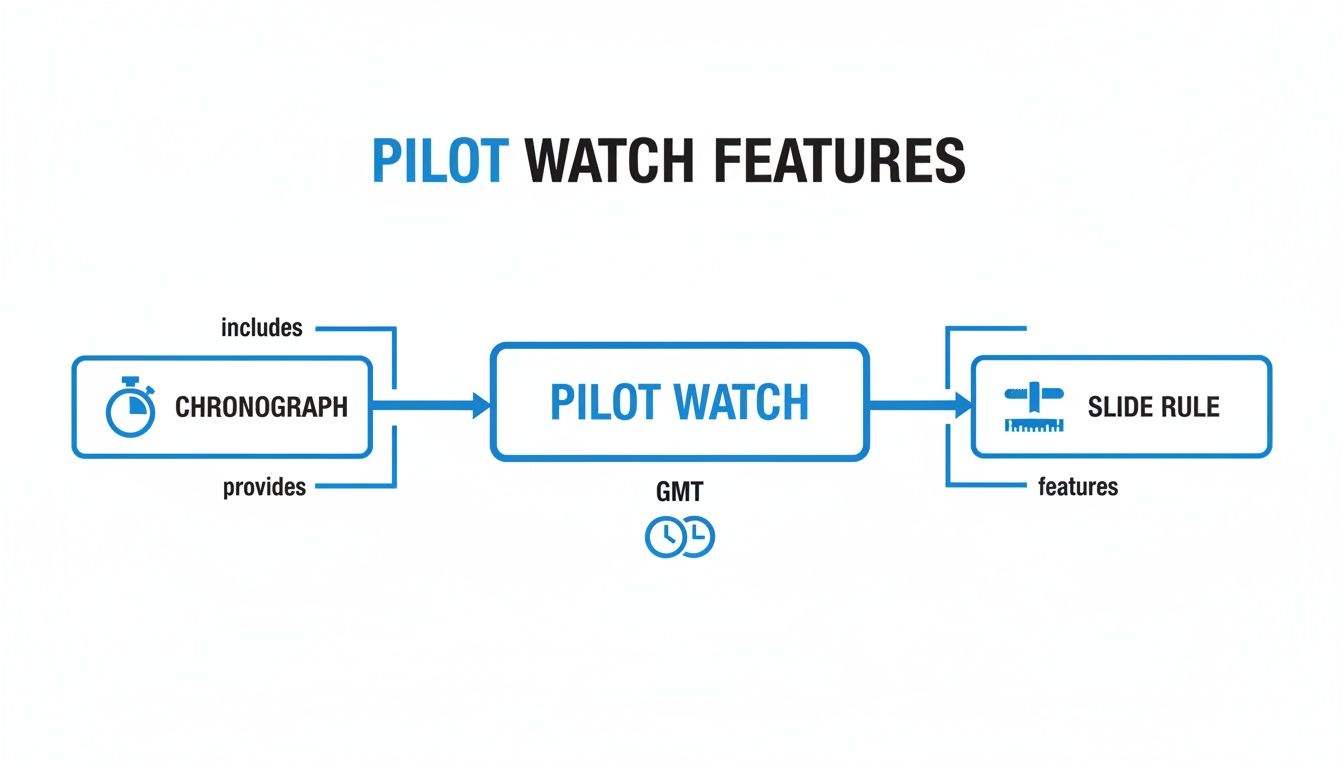
As you can see, tools like the chronograph, GMT, and slide rule were direct answers to the complex navigational and timing problems pilots were facing every day in the cockpit.
Entering the Jet Age
This legacy of military-driven design continued right into the post-war era. As propeller planes gave way to high-speed jets capable of crossing multiple time zones in a single flight, a completely new challenge emerged.
The dawn of transcontinental flight created a need for pilots to track multiple time zones simultaneously. This logistical problem spurred the development of one of the most iconic watch complications ever created.
Working directly with Pan Am pilots, Rolex developed the GMT-Master in 1954. Its clever fourth hand and rotating 24-hour bezel provided a simple, brilliant solution for tracking both local time and a reference time (like Greenwich Mean Time). It immediately became the new gold standard for international aviators.
This history of life-or-death engineering, from the B-Uhr to the GMT-Master, is what cemented the practical, purpose-built DNA that still defines a true pilot watch today.
Iconic Models Every Collector Should Know
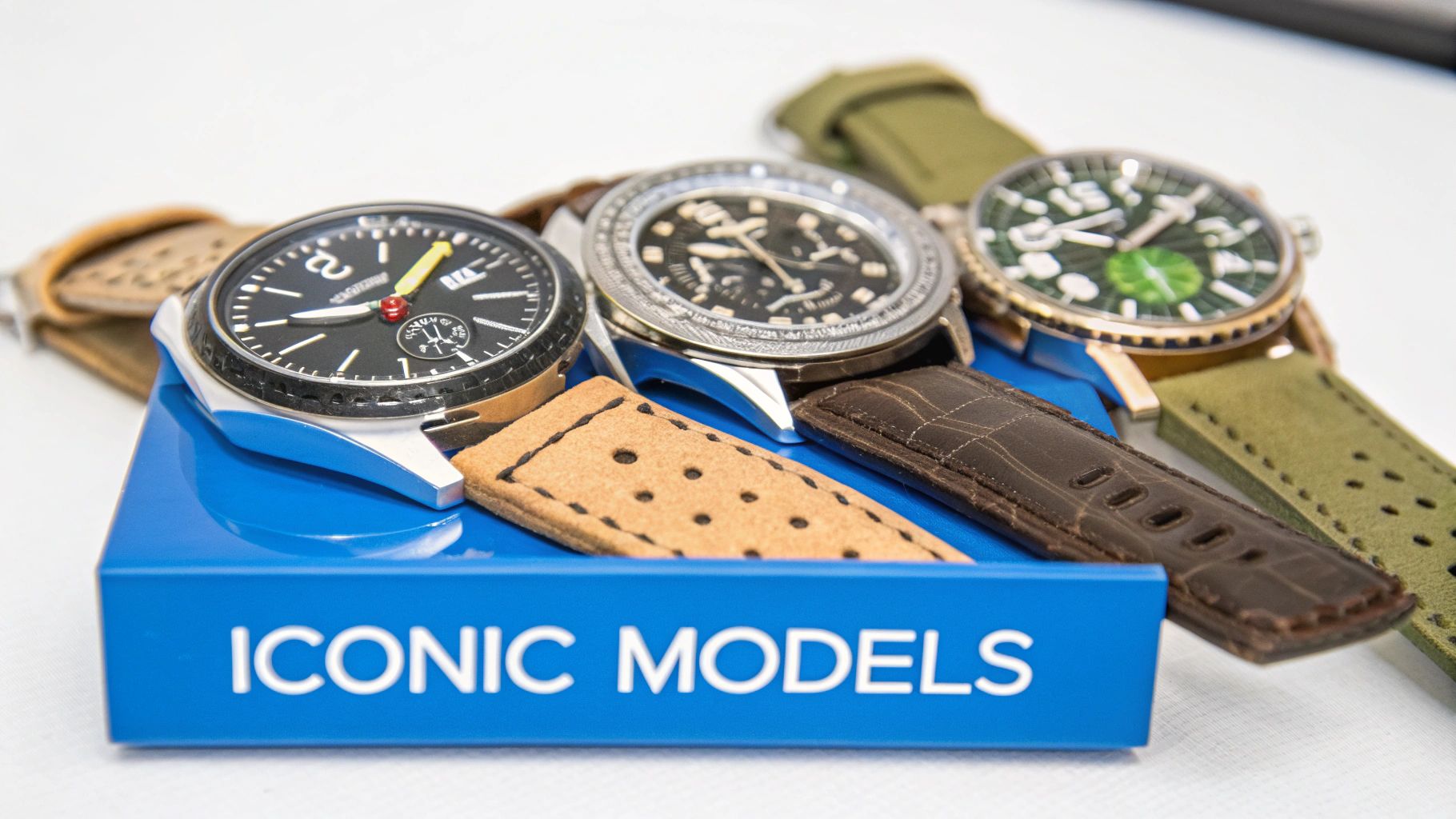
To really get a feel for the pilot watch, you have to look at the legends—the timepieces that didn't just tell time but defined the entire category. These aren't just watches; they're pieces of history, each one telling a story from the golden age of aviation. For any serious collector, knowing these cornerstones is non-negotiable.
It all started with the Cartier Santos. Back in 1904, aviator Alberto Santos-Dumont needed a way to check the time without fumbling for a pocket watch in the cockpit. The elegant, square-cased watch Cartier designed for him, with its distinctive exposed screws, wasn't just a solution—it was the very first purpose-built men's wristwatch. Every pilot watch that came after owes its existence to this one.
The Titans of the Cockpit
As aviation evolved, so did the watches. The models that followed became true instruments, each cementing its place in history by mastering a specific function. They represent the pillars of what a pilot watch could be, from a battlefield tool to a sophisticated flight computer strapped to the wrist.
- IWC Big Pilot: A direct descendant of the massive B-Uhr observation watches from WWII, the IWC Big Pilot is all about presence. Its huge case (often 43mm or bigger) and oversized onion crown were built for one thing: function. They ensured ultimate legibility at a glance and easy operation, even with thick flight gloves on.
- Breitling Navitimer: If one watch screams "aviation," it's the Navitimer. Its signature slide rule bezel was a brilliant analog computer, allowing pilots to calculate crucial metrics like fuel consumption, climb rates, and ground speed right on their wrist. If you're drawn to this icon, our guide to finding the perfect pre-owned Breitling watch is a must-read.
- Rolex GMT-Master II: Born in the 1950s from a collaboration with Pan Am, the GMT-Master was built for the jet age. It introduced the revolutionary dual-time zone function. That distinct fourth hand and rotating 24-hour bezel let pilots track local and home time simultaneously—an essential tool for transcontinental flights that's now a staple for world travelers.
These watches are far more than historical artifacts. They are the blueprints for the modern pilot watch. Their design DNA is so strong that it continues to shape the timepieces being made today.
Owning one of these is like owning a piece of the sky. They are the standard-bearers, each showcasing a different chapter in the pilot watch's journey from a necessary cockpit tool to a celebrated icon of engineering and style. For any collector looking to build a meaningful collection, these models are the absolute foundation.
How to Invest in a Pilot Watch with Confidence
Buying a pre-owned luxury pilot watch isn't just a purchase; it's an acquisition. When you know what to look for, you can navigate the market like a seasoned collector and make a smart investment.
The first—and most critical—step is always verifying authenticity. This is where you protect your investment from the very beginning.
You have to examine the small stuff. Are the serial numbers on the case and the warranty card a perfect match? Does the font on the dial look a little... off? Is the movement correct for that specific reference model? These are the red flags that an expert eye can spot instantly, confirming every single component is legitimate.
The Importance of Provenance
Beyond the physical watch itself, its history—what we in the business call provenance—is a massive factor in its value. For any serious collector, a complete set, often called "box and papers," is the absolute gold standard.
What does a full set include?
- The Original Box: Having the correct box for the watch's specific production year is a huge plus.
- Warranty Card/Papers: Think of these as the watch's birth certificate, stamped by the original dealer.
- Service Records: A paper trail of maintenance from respected watchmakers proves the watch has been properly cared for.
These items do more than just prove a watch is real. They tell its story, and that story significantly boosts its long-term value. On that note, proper storage is just as important. Learning about what is a watch winder can help you maintain the mechanical health of your automatic pilot watch for decades to come.
A pilot watch with its complete set is not just a timepiece; it's a verifiable artifact. The box and papers provide a direct link to its origins, making it a more desirable and valuable piece for any collection.
To fully protect your collection, it's also smart to look into specialized coverage. You can find excellent options through leading providers of specialized insurance. By focusing on these key areas, you can invest with total confidence.
Common Questions About Pilot Watches
Are Pilot Watches Just for Pilots?
Not at all. While their DNA is pure aviation, the very things that made them essential tools in the cockpit—their rugged build, crisp legibility, and classic looks—have made them a huge hit with collectors and watch lovers everywhere.
Today, people are drawn to them for their history and engineering. They work just as well as a reliable daily watch as they do a centerpiece for a serious collection.
What's the Difference Between a Pilot Watch and a Dive Watch?
It all comes down to their original purpose: the sky versus the sea.
A pilot watch is built for altitude, prioritizing instant readability, anti-magnetic properties, and flight-specific tools like chronographs or GMT hands. A dive watch, on the other hand, is engineered for depth, focusing on extreme water resistance, a unidirectional bezel for tracking underwater time, and bright lume that glows in the dark.
Why Are Pilot Watches Usually So Big?
That size is a direct throwback to their heritage as cockpit instruments. Early pilots in shaky, unpressurized cabins needed a large, clear dial they could read in a split second.
The famous oversized crowns had a simple, practical job: letting a pilot wind the watch or set the time without taking off their thick flight gloves. What was once pure function has now become one of the most iconic design features of the style.
Whether you're just starting your collection or searching for that one legendary timepiece, the experts at ECI Jewelers are here to help. We offer fully authenticated, investment-grade pilot watches backed by a personal concierge experience. Explore our curated collection of luxury timepieces today.


