


Let's be clear: the astronomical price of a Patek Philippe is no accident. It’s the result of a deliberate, near-200-year-old strategy built on two pillars: scarcity and perfection. When you buy a Patek, you aren't just acquiring a watch; you're becoming the custodian of a piece of horological history, engineered with an obsessive commitment to in-house craftsmanship.
The price is a direct reflection of this ethos—a formula where brand heritage, complex, hand-built movements, and intentionally limited production are the key variables.
The Real Price Of Unrivaled Prestige And Rarity
When you ask, "Why is Patek Philippe so expensive?" you're really asking about a philosophy that has always chosen legacy over volume. Unlike mass-market luxury brands that might produce hundreds of thousands of watches a year, Patek Philippe has always operated on a principle of deliberate scarcity. This isn't some slick, modern marketing tactic; it's a foundational belief that has guided the company since 1839.
This approach ensures every timepiece is built not as a product, but as a future heirloom destined to last for generations. The brand’s famous slogan nails it: “You never actually own a Patek Philippe. You merely look after it for the next generation.” That single line reframes the purchase from a simple transaction to a long-term stewardship of value, artistry, and family history.
The Core Elements of Value
The justification for the price tag becomes obvious once you break down what goes into every single Patek Philippe. Each factor below layers on top of the others, creating a cumulative value that is far greater than the sum of its parts.
- Generational Craftsmanship: Many of the skills required to build these watches are passed down through intense, multi-year apprenticeships. This is the kind of human touch that no machine can ever hope to replicate.
- Extreme Scarcity: With an estimated annual production of only around 60,000 to 70,000 watches for the entire world, demand will always overwhelm supply. This creates a level of desirability that is almost unmatched.
- In-House Mastery: From designing impossibly complex movements to hand-polishing the tiniest, hidden screws, nearly every component is conceived, created, and finished within Patek's own workshops.
- Investment-Grade Performance: It's no secret that many Patek Philippe references don't just hold their value—they appreciate significantly over time, performing more like blue-chip assets than simple accessories on the secondary market.
To put it all into perspective, the table below offers a quick summary of these core pillars. It gives you an at-a-glance breakdown of what truly drives the cost and sets the stage for a deeper dive into each element. Think of this as the framework for understanding the real value behind the world's most coveted timepieces.
Key Factors Driving Patek Philippe's Price
| Factor | Description | Impact on Price |
|---|---|---|
| Heritage & Cachet | Over 180 years of uninterrupted history, innovation, and association with royalty and icons. | Establishes a foundational brand value that commands a premium from the start. |
| In-House Manufacturing | Patek Philippe designs, develops, and produces nearly all its components and movements in-house. | Ensures total control over quality and exclusivity, adding significant cost. |
| Movement Complexity | From chronographs to perpetual calendars and minute repeaters, Patek's complications are legendary. | The more complex the movement (complication), the higher the price due to R&D and assembly time. |
| Materials & Finishing | Use of precious metals and obsessive, multi-stage hand-finishing on every visible and hidden part. | Hand-finishing requires hundreds of hours of skilled labor, dramatically increasing the cost. |
| Limited Production | An estimated 60,000–70,000 watches are produced annually, creating inherent scarcity. | Low supply plus high demand equals massive premiums, both at retail and on the secondary market. |
| Auction Performance | Consistently breaks world records at auction, reinforcing its status as a top-tier collectible asset. | Strong auction results create a "halo effect," lifting the perceived value of all Patek models. |
Understanding this framework is the first step. Now, let's explore how each of these factors contributes to the final price tag you see.
A Legacy Forged In Scarcity And Exclusivity
If you want to understand why a Patek Philippe costs what it does, you have to look past the gold and gears for a moment. More than anything else, the answer boils down to a simple economic principle they mastered over nearly two centuries: deliberate, unwavering scarcity.
While other brands chase volume, Patek Philippe has always cultivated exclusivity. They understand that true luxury isn't defined by how many you make, but by how few.
This isn't some modern marketing ploy; it’s a philosophy woven into the brand's DNA since its founding in 1839. They create timepieces not for the masses, but for a select group of custodians who will pass them down through generations. This creates a perpetual imbalance where global demand always, always outstrips the meticulously controlled supply.
The timeline below shows how this legacy of restraint has transformed the brand from a historic watchmaker into a global, blue-chip investment asset.
As you can see, a history built on limited production translates directly into enduring, appreciating value over time.
The Numbers Behind The Rarity
Let's put this strategy into perspective with some hard numbers. Patek Philippe has been meticulously tracking its serial numbers since day one, so we have a clear picture of just how modest their output is.
By 1920, they had produced only around 193,780 watches. By 1960, that number had grown to just 871,727. Do the math, and that's an average of only 11,947 pieces a year during those four decades.
Even today, the numbers are shockingly low. In 2018, the company capped production at 62,000 pieces, with CEO Thierry Stern enforcing a strict 1-3% annual increase to protect the brand's exclusive nature. You can explore more about this historical production data and see its impact firsthand.
This low-volume approach creates a massive contrast with a brand like Rolex.
In the 1990s, Rolex's output in a single year surpassed Patek Philippe's entire historical production up to that point. This single fact perfectly illustrates the foundational difference in business philosophy and is a core driver of Patek's pricing.
This isn’t a knock on other brands; it's a fundamental strategic choice. While one aims to be the undisputed king of accessible luxury, the other has chosen to remain the coveted prize for the world's most serious collectors.
When Scarcity Creates Legends
Nowhere is this philosophy more obvious than in the brand's iconic historical references—the "holy grails" of watch collecting. These aren't just timepieces; they are historical artifacts whose astronomical value is tied directly to their minuscule production numbers.
Consider these legendary examples:
- The Reference 1518: Introduced in 1941, this was the world's first perpetual calendar chronograph produced in a series. Yet "series" is a relative term—only 281 examples were ever made. The incredibly rare steel versions, with just four known to exist, have hammered for over $11 million at auction.
- The Reference 2499: The successor to the 1518, this reference was made for 35 years, yet only 349 examples were ever created. That's an average of fewer than 10 watches per year. Its rarity and perfect design make it one of the most desirable watches ever made.
These models prove a clear formula: groundbreaking innovation plus extreme rarity equals legendary status and record-breaking value. The high price of a new Patek Philippe is partly justified by the historical precedent set by these icons. You aren’t just buying a watch; you’re buying a potential future collectible, knowing the brand’s commitment to scarcity ensures that today's limited editions could become the legends of tomorrow.
The Art Of In-House Craftsmanship And Hand Finishing
While scarcity certainly builds desire, the real heart of a Patek Philippe’s value beats inside its workshops. The term "in-house manufacture" gets thrown around a lot in the watch world, but at Patek, it’s a deeply ingrained philosophy. It means they design, develop, and produce nearly every single component themselves—from the mainspring down to the tiniest, almost invisible screws.
This level of vertical integration gives Patek absolute control over quality and innovation. Think of it as the difference between a master chef who grows their own ingredients versus one who just buys them from a supplier. The result is a seamless harmony between every part, creating a mechanical symphony that’s more reliable, beautiful, and precise.
The Human Touch In A Mechanical World
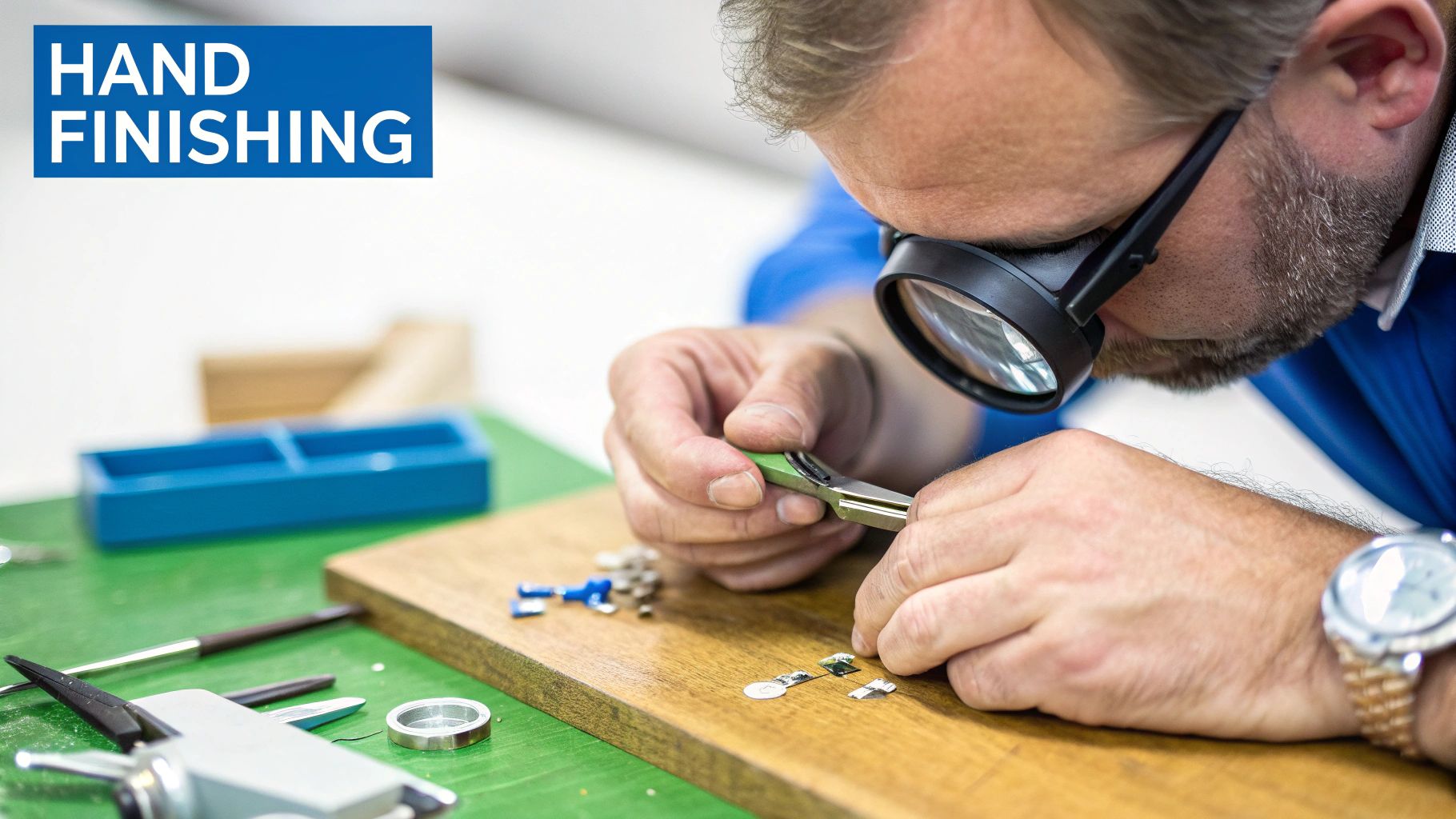
But the real magic happens with the hand-finishing. A machine can cut a component to near-perfect dimensions, but it can't give it a soul. Patek Philippe’s artisans spend hundreds of hours meticulously decorating and polishing parts that most owners will never even see, hidden deep inside the watch case.
This obsession with perfection is a core reason Patek Philippe is so expensive. A single timepiece can require 9-12 months of skilled labor, with hundreds of tiny parts finished by hand, jeweled, and tested with brutal rigor. This is horological artistry at its peak, and it’s what collectors worldwide are paying for.
"A Patek Philippe is finished twice. Once to make it technically perfect, and a second time to make it beautiful."
This unofficial motto floating around the company captures the essence of their craft perfectly. It's a commitment to aesthetic perfection that goes far beyond just making the watch work. These finishing techniques aren't just for show, either—they serve practical purposes like removing microscopic burrs, improving corrosion resistance, and ensuring the movement runs smoothly for generations.
The Signature Techniques Of A Master
Several key hand-finishing techniques elevate a Patek Philippe movement from a mere machine to a true work of art. These take years of apprenticeship to master and are simply impossible for an automated process to replicate.
- Anglage (Beveling): This is the art of hand-filing and polishing the edges of components like bridges and levers to a perfect 45-degree angle. The result is a brilliant, mirror-like finish that catches the light, but it also removes minuscule imperfections that could cause friction.
- Côtes de Genève (Geneva Stripes): These are the iconic, wave-like patterns you see across the broad surfaces of the movement's bridges. A specialized tool creates them, but achieving a perfectly uniform and aligned pattern requires immense skill and an incredibly steady hand.
- Perlage (Circular Graining): This technique involves creating a pattern of small, overlapping circles on surfaces like the mainplate. Each tiny circle is applied individually, creating a mesmerizing, textured finish that helps disperse light and adds incredible visual depth.
- Black Polishing (Poli Noir): Considered one of the most difficult finishing techniques, this involves polishing a steel component until its surface is so perfectly flat that it appears black from most angles. It only reflects light intensely at one specific angle, like a black mirror.
Each of these steps adds countless hours to the production time, which contributes directly to the watch’s final cost. You aren't just buying a watch; you're paying for a level of human artistry and patience that has become exceedingly rare. This meticulous assembly is what makes a mechanical watch tick, and you can learn more about how a mechanical watch works in our detailed guide.
Think of it like a bespoke suit versus one off the rack. Both do the same basic job, but the bespoke suit is crafted to your exact specifications, with every stitch and seam perfected by a master tailor. The difference in quality, feel, and longevity is immense—and so is the price. A Patek Philippe is a testament to thousands of hours of master craftsmanship, a piece of kinetic sculpture built to outlive its owner.
Mastering The World Of Horological Complications
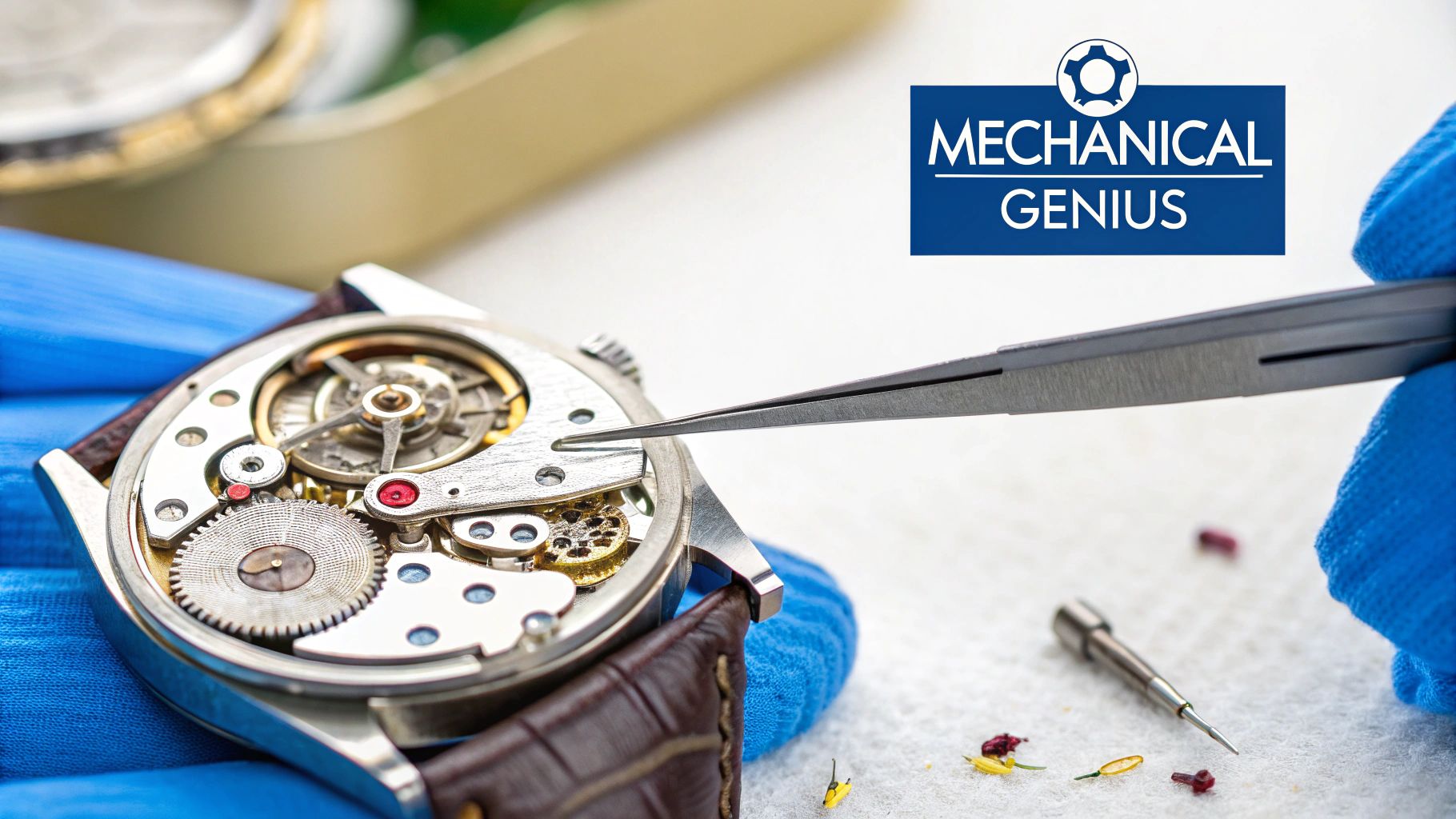
If the in-house movement is the soul of a Patek Philippe, its complications are the brilliant, complex mind. In the watch world, a complication is any function that goes beyond telling the simple hours, minutes, and seconds. Think of it as adding layers of mechanical genius to an already intricate machine, and it's one of the biggest reasons Patek Philippe watches cost what they do.
On a basic level, this could be something as practical as a date window or a chronograph for timing events. But Patek Philippe cemented its legend by mastering the highest echelons of this craft, creating miniature mechanical computers that can operate flawlessly for centuries. These aren't just features; they are feats of micro-engineering that demand hundreds of microscopic, interacting parts to work in perfect harmony inside a tiny watch case.
From The Practical To The Poetic
The world of Patek Philippe complications can be broken down into tiers of difficulty, with each level requiring an exponential leap in skill and development time. Every single complication adds significant cost, factoring in the R&D and the hundreds of hours of painstaking assembly required by a single master watchmaker.
- Useful Complications: These include chronographs (stopwatches) and annual calendars, which correctly display the date while accounting for months with 30 and 31 days.
- Grand Complications: This is where Patek Philippe truly reigns supreme. These are the most difficult and prestigious functions in all of watchmaking.
- Astronomical Functions: These track celestial cycles, like the ever-popular moon phase, which needs incredibly precise gear ratios to stay accurate for over a century.
The Holy Trinity Of Watchmaking Mastery
The term "Grand Complication" is reserved for timepieces that combine several of these high-level functions. For Patek Philippe, the mastery of three specific complications forms the bedrock of their reputation and justifies their top-tier prices.
-
The Perpetual Calendar: This is a mechanical marvel, essentially a tiny computer programmed to account for months of varying lengths and even leap years. A standard annual calendar needs a manual reset once a year, but a perpetual calendar—if kept running—won't need an adjustment until the year 2100. For a deeper dive, you can explore our guide on what is a perpetual calendar watch.
-
The Minute Repeater: Maybe the most romantic and challenging complication of all, a minute repeater chimes the exact time on demand using a series of tiny hammers and gongs. The watchmaker's job isn't just to assemble the mechanism, but to "tune" it by ear to create a clear, harmonious sound.
-
The Tourbillon: Originally developed to counteract the effects of gravity on a watch's accuracy, the tourbillon places the escapement and balance wheel inside a constantly rotating cage. It's a mesmerizing visual spectacle and a true testament to a watchmaker's ultimate skill.
A single grand complication watch can take a master watchmaker over a year to assemble. This isn't factory production; it is the slow, methodical creation of a functional work of art, and that is what you are paying for.
The Pinnacle Of Complexity: The Grandmaster Chime
To grasp the absolute peak of this mechanical wizardry, look no further than the Patek Philippe Grandmaster Chime Ref. 6300G. With a staggering 20 complications, two independent dials, and over 1,300 individual components, it is the most complicated wristwatch the brand has ever produced.
Its functions include a minute repeater, a perpetual calendar, and a patented alarm that strikes the time. Assembling just one Grandmaster Chime is an endeavor that requires thousands of hours of dedicated work from the most elite watchmakers at the company. This timepiece is the ultimate expression of Patek Philippe's entire philosophy—pushing the boundaries of what is mechanically possible, no matter the time or cost involved. This obsession with complexity is a defining factor in its price.
Why A Patek Philippe Is A Blue-Chip Investment
While the sheer artistry and mechanical genius inside a Patek Philippe more than justify its initial price, the real story of its value unfolds long after it leaves the boutique. These aren't just watches; they are premier, blue-chip assets that often behave more like tangible investments than simple accessories.
The brand’s unwavering commitment to quality and, crucially, scarcity creates an economic environment where demand consistently outstrips supply. This imbalance is the engine that drives incredible value retention and, in many cases, significant appreciation over time. It turns a high-cost purchase into a genuinely wise acquisition.
Performance On The Auction Block
Nothing tells the story of Patek Philippe's investment power better than its jaw-dropping performance at major auction houses like Christie's and Phillips. Time and again, rare references don't just sell—they shatter records, fetching many multiples of their original retail price and reinforcing the brand's top-tier status.
A legendary example is the stainless steel Patek Philippe Ref. 1518, one of only four known to exist. In 2016, it hammered down for over $11 million, becoming one of the most expensive wristwatches ever sold at auction. This wasn't a fluke; it was proof of the powerful formula of brand prestige, historical weight, and extreme rarity.
This consistent, record-breaking performance on the world stage creates a "halo effect" for the entire brand. It signals to the market that these watches are recognized stores of value, much like fine art or classic cars.
Understanding this dynamic is crucial for appreciating the total value proposition. For a wider view on high-value assets, insights from the European luxury property market trends and investment hotspots offer valuable context on global wealth allocation.
The staggering auction results seen with references like the Ref. 1518 aren't isolated events. They represent a well-established pattern of value appreciation for iconic Patek Philippe models, showcasing their potential as serious investment pieces.
Patek Philippe References Auction Performance
| Reference | Production Era | Notable Feature | Record Auction Price (Approx.) |
|---|---|---|---|
| Grandmaster Chime 6300A | 2019 | Most complicated Patek wristwatch ever made (one-of-one in steel) | $31.19 Million |
| Ref. 1518 in Steel | 1943 | First serially produced perpetual calendar chronograph | $11.1 Million |
| Ref. 2499 "Eric Clapton" | 1987 | Perpetual calendar chronograph in platinum (one of two) | $3.6 Million |
| Ref. 5002P Sky Moon Tourbillon | 2003 | Double-faced with celestial chart, tourbillon, perpetual calendar | $1.5 Million |
| Ref. 5711/1A-010 "Tiffany Blue" | 2021 | Final run of the iconic steel Nautilus with Tiffany & Co. co-branding | $6.5 Million |
This data clearly illustrates how a combination of rarity, complication, and provenance can drive a watch's value far beyond its original purchase price, cementing Patek Philippe's status as a blue-chip asset class.
The Key Drivers Of Appreciation
Of course, not every Patek Philippe appreciates at the same blistering pace. Several key factors are what turn a beautiful watch into a highly sought-after financial instrument. Discerning collectors know that these elements are what separate the good from the truly great.
- Brand Prestige: The foundational element. The Patek Philippe name is a symbol of uncompromising quality and exclusivity, built over nearly two centuries.
- Scarcity: As we've covered, the intentionally low production numbers ensure nearly every reference remains rare relative to global demand.
- Provenance: A watch’s history is huge. A timepiece previously owned by a notable figure or with a well-documented, interesting past can command a massive premium.
- Condition: Originality is everything. An unpolished watch in excellent condition with all its original parts will always be worth far more than one that has been heavily restored or altered.
When you combine the brand's sterling reputation with the rarity of a specific model, its value is almost certain to hold steady or climb. For those new to this space, a comprehensive guide on investing in luxury watches can provide a deeper understanding of these market dynamics.
Why A "Full Set" Is So Important
Finally, one of the most critical elements for realizing a Patek Philippe’s top investment value is having all its original accompaniments. In the collecting world, a “full set” or “complete set” means the watch comes with its original box and—most importantly—its Certificate of Origin, also known as "the papers."
Think of these documents as the watch’s birth certificate. They verify its reference number, movement and case serial numbers, and original date of sale. A watch with its complete set is far more desirable because its authenticity and provenance are easily confirmed. The absence of these papers can knock a watch's value down by 20-30% or even more, making them a non-negotiable for any serious investor.
How To Confidently Invest In A Patek Philippe
Knowing why a Patek Philippe is so expensive is one thing. But turning that knowledge into a confident purchase is a completely different ballgame. It means shifting from theory to hands-on inspection, focusing on the tiny details that protect and grow your investment over the long haul.
When you're looking at a pre-owned Patek, you're not just buying a watch—you're vetting a potential asset. The process has to be methodical, zeroing in on the core elements that serious collectors value most.
What To Inspect Before You Buy
To protect your investment, a deep evaluation is non-negotiable. You have to look past the initial "wow" factor and focus on what determines its real, long-term worth. A trained eye can spot the subtle tells that separate a good Patek from a great one.
Here are the four critical areas you need to examine:
- Case Condition: Look for sharp, well-defined lugs and edges. A history of over-polishing can round off these crisp lines, stripping the watch of its original character and taking a serious bite out of its value. You want to see the original factory finish as much as possible.
- Dial Originality: The dial is the face of the watch and a massive driver of its value. Check for any hint of restoration, like sloppy lume application or fuzzy, imperfect text. An original, untouched dial—even one showing a bit of age—is always worth more than a refinished one.
- Movement Health: A visual check is a good start, but the movement is the heart of the watch. Does it keep accurate time? Do all the complications snap into action correctly? A service history from Patek Philippe or a certified watchmaker is the gold standard and provides real peace of mind.
- The "Full Set": This is arguably the most crucial piece of the puzzle for an investment-grade watch. A "full set" means you have the original box and, most importantly, the Certificate of Origin. These papers are the watch’s birth certificate, proving its authenticity and story. A watch with its full set can easily command a 20-30% premium, sometimes even more.
A Patek Philippe without its original papers is like a masterpiece painting without its artist's signature. While still valuable, its provenance becomes a question mark, immediately impacting its investment ceiling and making it harder to sell later on.
This is exactly where a trusted, expert retailer makes all the difference. Trying to navigate the risks of a private sale—from spotting sophisticated fakes to verifying papers—is a minefield for even seasoned buyers. At ECI Jewelers, our deep expertise and rigorous authentication process take that danger off the table.
Of course, when you're treating a watch as a financial asset, it's smart to track its performance properly. Understanding the basics of calculating investment returns is a great way to monitor your watch's appreciation over time. With us, you get the assurance that you're buying a genuine timepiece with a verified history, giving you the confidence you need to make such a significant investment.
Answering Your Patek Philippe Questions
After diving into the world of Patek Philippe—its history, its incredible craftsmanship, and its performance as an investment—a few key questions always seem to pop up. Let's tackle them head-on to clear things up.
Is A Patek Philippe A Better Investment Than A Rolex?
This is a classic question. While both brands are champions at holding their value, Patek Philippe often pulls ahead in long-term appreciation, especially with its rare and complicated models. The biggest reason? Scarcity. Patek Philippe's intentionally low production numbers create a supply and demand gap that Rolex, with its much larger output, simply doesn't have.
Think of it this way: a Rolex is a blue-chip stock—a reliable, robust, and fantastic asset. A Patek Philippe, on the other hand, is more like a rare piece of fine art. Both are valuable, but they operate in different leagues with very different potential ceilings.
Why Is The Patek Philippe Nautilus So Expensive On The Secondary Market?
The Nautilus, and the steel Reference 5711 in particular, is a true icon. It captured a moment in design history and never let go. Its runaway popularity, smashed up against Patek's famously tight production, created a massive, unfillable void between the number of watches made and the number of people who desperately wanted one.
The result was a perfect storm: multi-year waitlists at dealers and secondary market prices that shot up to several times the original retail price. The Nautilus is the ultimate case study in iconic design meeting extreme scarcity.
This phenomenon shows how market forces can elevate a specific watch to legendary status, sending its value into the stratosphere.
How Important Are The Original Box And Papers For A Patek Philippe?
For a watch of this caliber, they are absolutely critical. The original box and the Certificate of Origin (what collectors call "the papers") are the watch's birth certificate. They are essential for proving its history, authenticity, and provenance.
Having a "full set"—the watch, its original box, and all accompanying papers—can boost a watch's value by 20-30%, sometimes even more, compared to the watch alone. We always advise clients to seek out complete sets. It's the best way to protect your investment for the long haul.
At ECI Jewelers, we know that buying a Patek Philippe is a major decision. Our experts authenticate every single timepiece, making sure you get a genuine watch with a verified history. Explore our curated collection of investment-grade watches at ECI Jewelers and let us help you add a masterpiece to your portfolio.


